Thursday, July 10, 2008

Bill Moody's "Swinging Detective" - John Dunton

John Dunton is a past, regular contributor to www.pennilesspress.co.uk which is edited by Alan Dent. I came across this piece while looking for information about Bill Moody’s Jazz mystery novels featuring Evan Horne, aka, Mr. Dutton’s “Swinging Detective” and thought it might be of interest to Jazzprofiles’ readers.

Since Mr. Dutton concluded his essay, Bill Moody has published two more Evan Horne novels – Looking for Chet Baker [London: Walker & Company, 2002] and Shades of Blue [Scottsdale, AZ: Poisoned Pen Press, 2008]. A brief synopsis of each of these works follows the conclusion of Mr. Dutton’s treatment which, as is the case with everything that appears on this blog, is 

[C] Copyright protected; all rights reserved.


THE SWINGING DETECTIVE
John Dunton
“Most crime novels follow a fairly conventional formula, especially when they use the stock device of building a series of stories around the activities of a specific investigator. The clues lead to more mysteries, the body count rises and a result is eventually achieved. The quality of the writing is often what distinguishes one novel from another. That and perhaps some sort of new or different background. Crime writing with a Jazz angle isn't new, though most of it has had a skewed vision of the music and its practitioners, and it's only with a writer like Bill Moody that the genre has come up with books that have a genuine feeling for jazz. Moody isn't an innovator in terms of the way he writes, and he sticks to the format described above, but he writes convincingly about the music.

He is, in fact, a jazz drummer, as well as a writer, and has had wide experience, including working with Earl Hines, Maynard Ferguson, Lou Rawls, and Annie Ross. He also works as a jazz critic and is the author of a factual book. The Jazz Exiles: American Musicians Abroad, which offers insights into the lives of musicians like Art Fanner, Phil Woods, and Red Mitchell. Moody has academic connections, too, and has taught at the University of Nevada and Sonoma State University in California.
His first novel, Solo Hand, introduced the character of Evan Horne, a jazz pianist who has injured his right hand and is unable to play. The book starts with an atmospheric description of him working at Howard Rumsey's Lighthouse club In Hermosa Beach, but it turns out to be a dream and ends: "The Lighthouse, I remind myself, no longer features jazz. I no longer play piano." This note of slight pessimism, and the feeling that not only has the individual career of the pianist been affected but that Jazz itself is increasingly being pushed aside, run throughout Moody's books generally. Chick Corea goes electronic and enters "the void of fusion," and "even Down Beat, once the jazz bible, now features more rock than Jazz in its pages."

Horne is pulled, reluctantly, into the role of private detective when a singer he once worked for is blackmailed. The singer has gone pop, which gives Moody the opportunity to put more comments about the decline of the music scene into Horne's mouth. He's particularly dry about country music, commenting that, "there is really only one country song. Most of them deal with prisons, ex-wives, trucks, dogs, and drinking. Variations on all these themes are sung by all singers who claim roots in Nashville or Mussel Shoals" I'm inclined to wonder what Horne would have thought had he met Charlie Parker, who was reputed to often play country records on the jukebox in Charlie's Tavern, a wall-known jazz hangout in New York. When taken to task about this by another musician, Parker replied: "the stories. Listen to the stories."


I don't intend to analyze the plots of Moody's novels As I said earlier, they follow an established pattern, with snappy dialogue, sharp confrontations, and twists and turns which sustain the suspense. And it all works efficiently and in a readable way. But the originality lies in the character of Even Horne and the detail provided about jazz. Bearing in mind that everything is seen from the point of view of Horne, with his jazz musician's tastes and prejudices, we are taken into a world of recording sessions, night-clubs, and so on. At one point Horne has to call at the Musicians' Union office in Los Angeles, and he notes the presence of "musicians dressed in designer jeans and golf shirts picking up recording cheques from television and film studios or session dates from any of the hundreds of record labels that have studios in Southern California. These are the best-paying gigs, but also the hardest to break into." Horne adds that a musician has to be highly adaptable to work in this kind of environment, and says: "The general rule is, the worse the music the better the pay."

Horne also meets individual musicians, some of them real people and some fictional characters, though often based on actual jazzmen. He seeks advice from a photographer who was, at one time, a wall-known drummer: "Carl Caye had always been one of my heroes. He was old enough to have played a supporting role in the bebop revolution and he'd recorded with some of the Fifty Second Street greats like Bird and Dizzy and Miles. He'd played on scores of record dates since then, and toured with just about everybody, including singers like Ella Fitzgerald and Sarah Vaughan." A basic knowledge of the history of modem jazz will tell you that this is Stan Levey, who was around New York in the 1940s, became a leading light on the West Coast in the 1950s, and did work with just about everybody. He was also a keen photographer, and when, In his words, "the music business changed," he turned to other things, such as running a successful photographic studio.
Real people mixed with fictional ones occur in the second Evan Horne mystery, Death of a Tenorman, the tenorman in question being Wardell Gray, who died in mysterious circumstances in Las Vegas In 1955. Horne, slowly getting back into shape again as a pianist, is offered a job playing in a shopping mall in Las Vegas. He's also asked by a friend who is a professor at the local university to do some research into Gray's death. Gray was one of the finest tenormen of the bop era and had recorded with Earl Hines, Charlie Parker, Dexter Gordon, Benny Goodman, and others. He was found dead in the desert outside Las Vegas while working there with Benny Carter's band.

A known drug-addict, Gray had been friendly with a dancer named Teddy Hale, also an addict, and it was said that Hale had panicked when Gray fell and broke his neck and had dumped the body. But rumours persisted that Gray had been murdered, though not by Hale, and the crime made to look like an accident. The Las Vegas police were not really all that interested in the death of a black, junkie jazzman, so no proper investigations seem to have taken place.
Looking into this mystery, Horne encounters people who don't want the events of the 1950s revived, not so much because they know how and why Gray died, but because there are other matters of a shady nature that they don't want brought to light. Horne's quest for information brings him into contact with local musicians and lets him observe what has happened to music in Las Vegas. Once known as a place where employment opportunities abounded because of the number of clubs, theatres, restaurants, and other establishments with live music, it has now. noticeably changed: "The music for the production shows at the major Strip hotels is now tape, replacing the live bands with music pre-recorded by musicians who are now out of work The majority of the other hotels that feature star policies - big-name singers and comedians - have reduced their house bands to skeletal combos or in some cases eliminated them altogether. The lounges for the most part hire self-contained groups with fewer and fewer musicians. Thanks to synthesizers, drum machines, and the awakening of the musician's union, Top Forty groups dominate the entertainment for audiences that are only killing time between gambling and eating." Needless to say, Horne keeps up his banter about country music and comments on the predictability of a singer's performance and how the audience laps it up.

Death of a Tenorman mentions a couple of jazz clubs in Las Vegas, which turn out to be real places. Moody's book about Jazzmen who worked in Europe has a chapter about baritone-saxist Jay Cameron who, when he returned to the USA, lived In Las Vegas for a time and played at a club called the Hobnob, "a haven where musicians could stop by and sit in after performing for Strip hotel shows." It closed as a jazz spot In 1992. There are also references to the Four Queens Hotel and Monday night jazz sessions run by a man called Alan Grant, who Is an actual person who tried to keep the jazz spirit alive In Las Vegas. The parallel investigation - of past and present - also plays a part in The Sound of the Trumpet, with Horne asked to authenticate some tapes which are supposedly by trumpeter Clifford Brown, who was killed in a road accident in 1956. The action again takes place in and around Las Vegas and Los Angeles, with the tapes much sought after by collectors and the competition leading to death. Real people are also present, with vibraphone player Dave Pike described at work in a club, and tenorman Jack Montrose, who recorded with Brown, asked to listen to the tapes and give his opinion about their authenticity. Other musicians and fans listen to them, and the book neatly highlights how even the most knowledgeable amongst them are uncertain about whether or not they feature Brown's playing or that of another similarly-styled musician from the 1950s.

There is a minor technical variation in the structure of The Sound of the Trumpet in that short chapters describing Brown's presumed activities on the night of his death are inserted into the narrative.. I say "presumed activities," because although the basic facts are well-known enough Moody invents conversations and minor situations to construct a plausible picture of what might have happened.

I've not referred to all the recordings by a variety of artists mentioned in Moody's books. Home listens to the radio when he's driving, and he plays cassettes, CDs, and LPs when at home. He has to listen to old records to try to obtain information which might be relevant. And people he visits often have music playing. Numerous names crop up, from Chet Baker to Miles Davis to Horace Parlan to Tadd Dameron. A lot of pianists are mentioned, which is natural enough In view of Horne's own involvement with the instrument, and his injury which makes him constantly aware of what he'd like to do and what, in fact, he can do.

Bird Lives! the most recent Moody novel, opens with Horne performing at a jazz club in Culver City as a substitute for a delayed (and real) Monty Alexander. He plays well, is approached by someone from a small record-company, and begins to think he's almost back on form. But there's a report on T.V. that a saxophonist named Ty Rodman has been stabbed to death. Horne doesn't think much of Rodman: "Ty Rodman and I don't travel in the same circles. He's one of a half-dozen sax players who’ve fused blues riffs with a rock beat and turned it into a fortune while breathing down Kenny G's neck." A friend In the police contacts Horne and asks for help with some clues. The slogan Bird Lives I has been scrawled in blood on a mirror and a record by Parker left playing at the scene of the crime. It also happens to be March 12th, the anniversary of Bird's death in 1955. And the police tell Horne that a couple of other fashionable musicians in the fusion style have died in similar circumstances.
Horne, despite his misgivings, is drawn into the investigation, and his activities give him plenty of opportunities to air his views about "lights-out jazz," or whatever name is given to these kind of repetitive and watered-down contemporary sounds. Horne describes it as music that's "known in the trade as fusion, smooth Jazz, almost pop music," and his uncompromising opinions lead to some amusing encounters with policemen who can't understand what's wrong with it. When asked why performers of smooth Jazz make more money than straightforward jazzmen, Horne replies: "The same reason writers like Stephen King and Danielle Steele make more money than John Updike or Saul Bellow. Mass market. They appeal to a lower common denominator."


He listens to Keith Jarrett and Bill Evans at home, hears Dexter Gordon on his car radio, and thinks about clubs like the Jazz Workshop and the Blackhawk in San Francisco. The Blackhawk had an eccentric owner and was hardly luxurious: "A leaky roof, wooden tables, and hard chairs, but acoustics so good the Modern Jazz Quartet could work there without microphones. And Guido left the musicians alone. The only important thing was the music, and now, like so many jazz meccas -Birdland, The Five Spot, Shelly's Manne Hole - the Blackhawk was gone." As a contrast, and as part of the investigation, Horne has to make an appearance with a semi-rock band at a large open-air event: "Buster stamps his foot for the tempo, and we're under way. I see my hands on the keyboard, but between the crowd noises and the roar of amps and speakers, I can't hear a note. The ear-splitting guitar screams, the drums pound, and the drone of Buster's bass resonates and slaps against the plastic canopy covering the stage. A three-chord vamp is all we have to play while the guitarist bends strings and sends his body into quasi-convulsions for nearly five minutes."


It's obvious that although Bill Moody is writing crime novels he uses them for some interesting comments on jazz and the general state of music today. In Bird Lives! a cynical and successful saxophonist questions Horne about his dedication to bebop: "Shit, let your hair grow a little more, get funky, and I could get you into some big bucks See, you don't get it, man. Bebop is dead. Smooth Is where it's at. It's on the radio. It's In Tower Records. Hell, I'm doing a TV commercial next week. Most of the people who buy CDs don't even know who Cannonball is, much less Bird." I suppose, too, that Moody, through Horne, is also reflecting on society in general and not just the music it listens to. The idea that it's money and success that counts and not any kind of dedication to something worthwhile is sadly all too prevalent in all walks of life. Evan Horne is not unlike Raymond Chandler's Philip Marlowe in attempting to preserve some sort of integrity in a corrupt and hostile world.


I've not made any claims for Bill Moody's novels as great or significant literature, but within their chosen framework they do their job efficiently and have the added attraction of ringing true about jazz. Even Horne is a believable character, possibly even to the point where someone not sharing his musical ideas might think him arrogant. But if, like me, you do share his ideas and tastes then you should find him immensely appealing. Out of curiosity as I wrote this piece I tuned into Jazz FM and heard a smooth saxophone riffing over a rippling and repetitive rhythm, and I could imagine Even Horne's response to the lack of imagination and spontaneity in the whole performance. And if you can think about how a fictional character might respond to a real situation then it seems to me that the writing has succeeded.”


NOTE:
Solo Hand was published by Slow Dancer Press, London, 1999. It was originally published in the USA in 1994 by Walker Publishing. Walker also published Death of a Tenorman in 1995, The Sound of the Trumpet in 1997, and Bird Lives! in 1999. Bill Moody's The Jazz Exiles: American Musicians Abroad was published by the University of Nevada Press, 1993.
From Publishers WeeklyLooking for Chet Baker 2002 – Walker & Company
"I'm a pushover for minor keys, minor chords, minor blues. Always have been," says jazz pianist and amateur detective Evan Horne. "I was drawn to those players and composers for whom minor keys and blues-drenched creations were a way of life." A blues-drenched creation aptly sums up Moody's sad and mellow Evan Horne mystery, his fifth (after 1999's Bird Lives!), in which his suffering hero, still recovering from the aftereffects of the violence of earlier cases, decides to get away and takes some gigs in Europe. In London, Horne meets an old friend, Ace Buffington. An English professor who needs to publish one more book to achieve tenure, Ace wants Horne to help him research real-life jazz great Chet Baker. In 1988, Baker fell (or was pushed) from his hotel window in Amsterdam, i.e., he died "under mysterious circumstances." Horne has no interest in more detective work, but when he gets to Amsterdam, he discovers that Ace has disappeared. Since the police express little interest in finding the missing professor, Horne is obliged to go looking for his buddy himself. Ace's trail parallels that of Chet Baker's last days, so Horne has to learn a lot more about Baker, his legendary talent, his tragic addiction to drugs. Moody does a wonderful job of re-creating the man and his times. For anyone interested in jazz, this is a must. For anyone just interested in a good mystery, this is just what the coroner ordered. Agent, Philip G. Spitzer. (Mar. 13)Forecast: As a jazz drummer and respected critic in the music world (Howard Mandel, president of the Jazz Journalists Association, and Dick Conte, of San Francisco's KCSM/KKSF, supply blurbs), the author is well positioned to push this latest jazz mystery to the obvious crossover audience.


From Library Journal


Series narrator/sleuth Evan Horne has success playing jazz piano in Europe after recovering from an injury to his hand. He winds up in Amsterdam, stays at the same hotel where some 11 years earlier jazz musician (and junkie) Chet Baker mysteriously fell to his death from an upper window, and becomes concerned about the disappearance of a friend researching Chet's life. Horne's own search involves a local jazz archive, a marijuana "restaurant," other American expatriate musicians, and frequent narrative diversions into the convolutions of jazz. Intricately described, carefully paced, and gently suspenseful, this is fitting for most collections. Copyright 2002 Reed Business Information, Inc.

Shades of Blue – Poisoned Pen Press – 2/15/2008 - From Library Journal After several months of successful work in London and Amsterdam with American expatriate Fletcher Paige, Evan Horne returns to the states and settles in the San Francisco Bay Area. There he reunites with his girlfriend, FBI agent, Andie Lawrence. And Evan quickly makes inroads into the Bay Area jazz scene. Life is good until a phone call from a Los Angeles attorney turns his life upside down. Evan’s old friend and former mentor, pianist Calvin Hughes, has died, and named Evan as his sole beneficiary. Evan is shocked to learn that Hughes has left him his small Hollywood house, money, and all his possessions. But when Evan begins to play through some hand-written sheet music, he recognizes one as a song from the landmark Miles Davis recording Birth of the Cool, and another from Kind of Blue, arguably one of the most important recordings in modern jazz. Was Calvin Hughes the un-credited composer of one or both of these tunes, or was it simply Hughes’s transcriptions from the recordings? In addition, Evans finds a cryptic note, and a photo taken almost 40 years earlier—a young Cal with his hand on a baby carriage. Both are taped to the bottom of a dresser drawer. A friend of Cal’s Lisa Gaines will continue to take care of Milton and rent from Evan. Evan is soon on a whirl-wind journey across the country to find answers from his family and to confront his mother. What was her relationship with Calvin Hughes? And just how did Jazz come into the equation?

Tuesday, July 8, 2008

The Improbability of the Clarke Boland Big Band - Part 2

Between 1967 and 1969 the CBBB recorded a series of fine albums, including Faces, Latin Kaleidoscope (with Phil Woods) Fellini 7 1/2 and Off Limits for the MPS label which were excellent showcases for the arranging and compositional talents of Francy Boland and for the band's exceptional 'togetherness'.

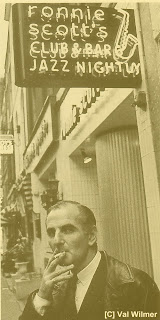
The vintage year of the Clarke‑Boland Band was 1969 and by common consent the peak performances of the band's career were heard ‑ and, happily, recorded ‑ during an unforgettable two‑week engagement at Ronnie Scott's Club in London from 17 February to 1 March. As I wrote at the time, if there has to be one set of recordings, from all of the band's repertoire on disc, selected to stand as a monument to the finest jazz ensemble to come out of Europe, then it has to be the thirteen tracks and two albums from that 1969 Ronnie Scott’s Club date.

The band broke attendance records at the club and, says Campi, only then did the musicians really feel the full extent of the power of which they were capable. To have the opportunity of playing together night after night for two weeks made it possible to achieve a rapport and a mutuality of feeling that even this intuitively integrated band had not equaled hitherto.

By this time the CBBB had an additional drummer. Recruiting a second drummer for a band that has Kenny Clarke in its rhythm section would seem to be setting a new standard in futility. But it worked. British drummer Kenny Clare, a noted session musician, with excellent technique and good reading ability, had first come into the band as a sub when Klook had other commitments. He handled the job so well that he was taken on the 'permanent staff.’ There are various explanations as to why this happened and, in all probability ‑ as is usually the case ‑ there is an element of truth in most of them.

Whenever it was suggested to Klook there was one drummer too many in the band, he vigorously disagreed. Two drum-heads, he argued, are better than one. He told Max Jones in a Melody Maker interview published on 15 March 1968:

It came about because of my teaching. From my experience with
students I thought that maybe drummers can play together without being noisy or confusing. So I tried it out at the Selmer school in Paris and found it worked well.

Between the two of us, I think that Kenny and I can play anything in the world ... He is someone who thinks exactly the same way I do about drumming. He's one of the most intelligent drummers I've ever met ... We're two soul brothers.

I would suggest that this may be another example of Kenny's tendency to retrospective rationalization. Ronnie Scott's recol­lection is that Kenny Clare's presence in the band was in­tended to take some of the pressure off Klook, 'who wasn't the greatest reader in the world. The arrangement allowed Kenny Clarke to coast from time to time ‑ and it worked because they were so compatible. It would have been disastrous otherwise.' And in best Ronnie Scott style he instanced the massive all‑star band organized by Charlie Watts in 1987 which had not two drummers but three. 'Someone asked the vibraphone player what he thought of the tempo of a piece the band was rehearsing. "Fine," he said, "I liked all three of them."'

Kenny Clare recalled his first gig with the band when he talked to Crescendo's Tony Brown in May 1968. He had made a good impression and was asked by Gigi Campi to play alongside Klook on the next date.

They gave me a couple of notes on vibraphone which I invariably played wrongly ‑ well, they figured that I'd always be available to do anything that Klock wouldn't be free to do. I could do sundry percussion. Then one number was a Turkish march thing and I played snare drum. When it was played back it sounded very much together, like one drummer. They talked it over. Next time I came, would I bring my drums as well? See if we could make it with both of us playing. It worked ‑ and it's been like that ever since.

There is no doubt that driving the CBBB took a lot of energy and endurance and the addition of Clare not only added to the rhythmic foundation but also spread the heavy percussion load.

Playing along with the greatest drummer in the world was a pretty intimidating experience for Clare. He once told me of the first gig with Klook in Ostend in 1967 when the dual drumming exercise became a nightmare. 'Try as I would at rehearsal, I just couldn't get it together. The drums were fighting each other.'

He left the theatre after the rehearsal full of gloom and depression and decided that the best thing to do for the sake of the band would be to slip silently away. He went to book a flight back to London ‑ but there wasn't one. He shrugged resignedly, walked around the town for a couple of hours, then finally made his way back to the theatre for the concert. 'I started the first number full of apprehension ‑ but from the very first beat, it all came together miraculously. I just couldn't believe it!'

And that was the beginning of a beautiful percussion friendship. From then on, Clare became an integral part of the rhythm section and missed only one gig with the band. Strangely enough, Clare said he was never able to play the same away from the band. 'There are many drummers who would love to get the same springy kind of beat that Klook gets. I'm one of them. When I'm with him, I can play that way without even thinking about it. As soon as I'm away from him, I can't do it any more.'

True to character, Klook gave every encouragement to Kenny Clare and undoubtedly one of the important reasons why they worked so well together was that they had such a warm relationship off the stage, as well as on.

British drummer Frank King, reviewing the two Polydor albums that resulted from the Scott engagement, wrote in Crescendo: 'The perception and telepathy between Kenny Clarke and Kenny Clare is magnificent. They have such a fantastic togetherness that in places it is miraculous.'
With Jimmy Woode unavailable, Ronnie Scott's bassist, Ron Mathewson, was brought in for the club engagement and with Clare, Scott, Tony Coe (on tenor and clarinet), Humble and Tony Fisher (trumpet, depping for Jimmy Deuchar), the British contingent in the band was as big as the American. Yugosla­via's Dusko Gojkovic was recruited into the trumpet section.

Gigi Campi had to miss the first week of the engagement, but when he walked into the club on the Monday of the second week, Johnny Griffin told him, 'Gigi, you're gonna hear some shit tonight!' Campi sat at a table with writer Bob Houston, my wife and myself and beamed as his 'family' took the stage. ('Italians, he'd explained to me once, 'always try to wrap everything up in a sense of family ‑ and that's how I regard the band.') Campi had heard practically every note the band had played since its debut. But when it hit, with a high‑voltage version of 'Box 703', Campi turned to us wide‑eyed and said, 'Wow!' Later he told me: 'I couldn't believe how good the band sounded. When they played the tutti in "Now Hear My Meanin' " I got goose pimples all over.'

For Ronnie Scott those two weeks were undoubtedly one of the major highlights in the history of the club, as well as being musically inspirational. 'It was marvellous. People used to applaud in the middle of the arrangements ‑ showing their appreciation of some of the tutti or soli passages. It was really one of the greatest musical experiences of my life.'
The year 1969 was certainly a banner one for the Clarke­ Boland Big Band. It played the Pori Festival in Finland that summer and Lars Lystedt, Down Beat's Scandinavian corres­pondent, described the condition of the audience as 'spell­bound'. In September the band shared the bill at Rotterdam's De Doelen concert hall with the mighty Thad Jones‑Mel Lewis Orchestra, and reporting for Britain's Melody Maker, Jan van Setten told of 1,780 people 'exploding into thunderous acclaim after the four‑and‑a‑half‑hour marathon concert'. It was a real battle of the bands, he said. 'Who won? Music.'

At the Prague Jazz Festival in October, the CBBB 'totally eclipsed' the Duke Ellington band, according to Melody Mak­er's Jack Hutton. 'This year's Prague Festival proved one thing conclusively to me ‑ the Kenny Clarke‑Francy Boland Big Band is the finest big band in existence,' he wrote.
And after a Paris concert in that same month, Jacques B. Hess of Le Monde wrote:

'The CBBB is a triumph, at the highest level of talent and professionalism.
The warmth, the commitment and the enthusiasm of the musicians is refreshing and a marked change from the lackluster and blasé perform­ances of the Ellington and Basie bands which we have become used to over the last few years.'
In October 1970 the CBBB was back in Britain for a three‑week engagement at Ronnie Scott's and at this time Carmen McRae came to London to record with the band in the Lansdowne Studios. With a minimum of rehearsal time, the superbly professional ex‑Mrs. Clarke managed astonishingly well with some difficult scores, especially considering that six of the eight tunes recorded were new to her. The whole session was completed in eight hours. It was named after a Boland-­Jimmy Woode song on the album, 'November Girl'.

There followed a three‑week European tour which had Dizzy Gillespie as special guest and which culminated in an appearance at the Berlin jazz Festival. But the tour was not a great success musically because the band had to submerge its own personality to play a programme that was more closely associated with Dizzy.

In fact there were now signs that the band was beginning to run out of steam and, no doubt, one of the factors which undermined its momentum was Campi's failure to conclude an agreement to take the band to the United States. It was a great disappointment for Kenny Clarke ‑ and for all concerned with the CBBB. But, for a variety of reasons ‑ predominantly financial ‑ plans to have the band appear at the Village Gate in New York, followed by concerts in Boston and Chicago, an appearance at the 1970 Newport Jazz Festival and a tour of Canada, did not come to fruition.

'I'd really love to take the band on the road in the States/ Kenny Clarke told me in 1967, 'just to prove the point about the high standard of European musicians.' But it was not to be.

What finally caused Kenny Clarke to acknowledge that the days of the CBBB were numbered, however, was the untimely death of Derek Humble on 2 February 1971 at the age of thirty‑nine. 'The band was never the same without Derek/ Kenny said, voicing a sentiment that was shared by the whole CBBB family.

In June 1971 the band made its last recording, Change of Scenes, with Stan Getz as guest soloist and, in March 1972 in Nuremberg, played its last concert date when, according to Gigi Campi, 'it was a sorry shadow of its former self'. He went on:

Johnny Griffin came to me after the concert, and virtually read the funeral service. The following morning I had a long discussion with Francy and Klook to see if we could keep the band going. I still thought there might be a possibility of pulling off an extensive tour of the USA which could have regenerated the spirit of the band. So some days later I went on a round trip of Europe to try to put the band together again. I called on Idrees, Nat Peck, Tony Coe and Johnny Griffin and finished up in Montreuil with Francy, Mook and Benny Bailey. And finally I realized that it wasn't going to happen ...

And that's when even Campi's apparently unquenchable enthusiasm gave out. It was April 1972 and the Clarke‑Boland Big Band had breathed its last.

But, as Bob Houston, who was closely associated with the band through most of its lifetime, wrote afterwards, though the demise was a matter for regret, that the band had existed at all was a matter for celebration ‑ 'as with all phenomena which survive on excellence against the tides of current fads and fashions ... The CBBB was one of the most enjoyable mani­festations of the last decade in jazz. Be grateful that it happened at all, and that we have it on record to enjoy.'

And Kenny Clarke said, 'It was a fantastic, unique experi­ence from which I learned a lot. It was not only a great band, it was a community, a congregation of friends ‑ and one of the happiest bands I've ever worked with.'

The Clarke‑Boland Big Band left a rich legacy of its reper­toire on record. In the eleven years of its existence it recorded thirty‑nine albums.

Kenny Clarke's role in the CBBB was not only the obvious one of being the rhythmic dynamo; he was important as a co‑leader in his own reserved and unobtrusive way. He led by example; he had the total respect of all the musicians who ever played in the band, and that respect, coupled with respect for one another, was what kept the band so tight and its musical standards so high.
Says Johnny Griffin,

The CBBB couldn't have lasted with a Benny Goodman or a Buddy Rich leading it ‑ because there were too many bandleaders in the band. It wouldn't have worked if the leaders had been dictators. I mean, the vibrations from the egos! My God, imagine ‑ three trumpet players all Leos: Idrees Sulieman, Benny Bailey and Art Farmer. It was like an armed truce. It was amazing with all those different characters and the strength in each one. And it would mesh! There was no one on the band that you could pick on! It was really like a zoo, with tigers, lions and gorillas in it!

'I never met anyone who stayed so calm/ Kenny Clare said of Klook in an interview with Crescendo's Tony Brown. 'You should come along to a recording session. All pandemonium let loose, everybody talking or blowing like a bunch of madmen. Kenny never raises his voice or gets excited. He is a wonder.'


Ronnie Scott confesses that he was always a little bit in awe of Kenny Clarke. 'But he was always so amiable and pleasant. He didn't come on like your typical extrovert bandleader. He just sat there, and played ‑ and that was enough.'

Gigi Campi remembers times when Kenny would arrive late for rehearsal or recording due to plane or train delays. 'We would all be waiting in the studio ‑ and as soon as Kenny walked in you were aware that there was suddenly more power in the room. His presence ‑ quiet, dignified and calm ‑was such a positive force.'

Jimmy Woode says that it was simply not Klook's way to get out in front of the band and pep‑talk the musicians. 'He might speak quietly. to you individually ‑ but his leadership was implicit in his solid integrity. Francy and Klook were not exactly charismatic leaders like Duke.'

Ron Mathewson remembers Klook as a man who comman­ded respect from all the members of the band without any attempt to pull rank: 'He was really helpful to me when I came into the band for the gig at Ronnie's. He said, to me, very nicely, "Keep a straight four. Let the guys feel you, because you're new. They want to trust the rhythm section. Just play it cool and let it happen."'

Francy Boland's co‑leadership consisted entirely of creating the band's inimitable book, writing not for the instruments but for the musicians, and providing support and solos from the keyboard that were consistently streets ahead of his own evaluation of them. Boland carries self‑effacement almost to the point of self‑erasure. He told me, 'Kenny didn't really have a lot to do with the music. And I wanted it that way because I was the arranger.'

And without any apparent awareness of the sublime irony of a Boland being struck by someone else's inclination to maintain a low profile, he added, 'Kenny was a very reserved person and he kept his thoughts to himself. He never express­ed enthusiasm when I came in with a new arrangement; though he might give me a compliment ‑ a small compliment ‑from time to time.'

Clarke and Boland, during their association together, were never in any danger of engulfing one another in explicit mutual admiration. But had it not been there in some abund­ance, the band simply would not have flourished. Whatever Boland may feel about the measure of respect and appreciation he received from Kenny, Gigi Campi remembers an incident which speaks eloquently of Klook's high regard for his partner.

The band was rehearsing and swinging like a demon ‑ without a drummer. Kenny was standing out in front, rolling a joint. Suddenly he looked up in mock disbelief and genuine joy, and said, 'This band doesn't need a drummer. That Belgian motherfucker swings it just with his writing, goddam it!

'For Kenny,' Campi adds, 'there were two great arrangers in Tadd Dameron and Francy Boland.'

Sunday, July 6, 2008

The Improbability of the Clarke Boland Big Band - Part 1

For a variety of reasons, I missed the Clarke Boland Big Band [CBBB] during most of its existence on the 1960s Jazz scene . Although I recall that many of my friends raved about the band, and I remember seeing their initial Atlantic LP – Jazz is Universal – on display in record stores, I never actually heard the band’s music until over 20 years after it had ceased to exist in 1972.

Thanks to the glorious era of re-issuance that followed the development of the compact disc, I now know what all the fuss was about. What a band! One of the all-time great bands in the history of Jazz.

Yet, judging by the opening paragraph from the chapter on the band in Mike Hennessey’s, Klook: The Story of Kenny Clarke [London: Quartet Books, 1990, pp. 160-177], it would appear that there were many reasons why this band should have been absented from that history in the first place.

And given Mr. Hennessey’s description of how the band came together and what it took to maintain it during the 12 or so years of existence, the fantasy world implication of the Disney art that adorns its More Jazz Japanese release may be more fitting than comical.

Of course, as a former drummer, how can you not love a big band that has two? But that’s another part of the improbable story as told by Mr. Hennessey, whose work is
[C] Copyright protected. All rights reserved.


“Almost everything about the Clarke‑Boland Big Band was improbable. It was invented, nurtured, nourished, fussed over, financed, promoted and absolutely adored by a German-­born Italian socialist whose qualifications for band management were that he was a trained architect and owner of a flourishing coffee bar in Cologne's Hohestrasse. Its leaders were two musicians who competed with each other in the art of staying in the background and maintaining a low profile. It roster of members over the years embraced more than a dozen nationalities, half a dozen religions and a daunting assortment of egos, most of them on the large side. To bring the band together for rehearsal, record dates and concerts involved formidable complexity of travel arrangements and much intricate juggling with the musicians' individual work schedules. Despite all of this, plus the inevitable, multiple frustrations, financial Everests, outbreaks of pique, petulance and pig-headedness, and that well‑known capacity of airlines to deliver a bass player to Cologne and his bass to Caracas, the band not only survived for eleven years but developed into a unit of surpassing excellence, becoming an important ‑ and genuinely significant ‑ part of jazz history. It was by far the finest jazz orchestra ever assembled outside the United States.

And Pier‑Luigi 'Gigi' Campi, the man who made it happen, is quite emphatic that the band simply could not have existed without Kenny Clarke. 'We needed his magic touch he told me.'

As a teenager in Italy during the Second World War, Campi used to listen under the blankets in a Jesuit college to jazz broadcasts from the American Forces Network. He listened to Louis Armstrong, Jimmie Lunceford, Roy Eldridge and Duke Ellington and among his circle of friends, jazz records were more highly prized than black‑market coffee.

But it was when Campi heard a Charlie Parker record in 1948 that he started to become a real jazz devotee. In 1949 he attended an international meeting of young socialists from all over Europe and, as he alighted from the train in Zurich, he saw a poster announcing a concert that evening by Django Reinhardt. A record by the Quintette du Hot Club de France was among those he had heard clandestinely in college and he couldn't resist the opportunity to see and hear Django in person. So he decided to skip the scheduled briefing for the
political meeting that evening and attend the concert instead. Gigi recalls:

There was another group mentioned on the poster but the names meant nothing to me. Django played the first half and I was really excited by the music. But in the second half, this group of black musicians played ‑ and the music sounded strange, but wonderful. I remember coming out of that concert feeling absolutely exhilarated. I was telling myself, 'Django was fine ‑ but those black musicians, they were really fantastic.' Three years later, James Moody and his group were touring Germany. My wife and I were passing through Munich on the way to a ski resort and we discovered that Moody's group was playing in town that evening. We went to the concert and as soon as the band took the stage, I said to my wife, 'I've seen that drummer before.'

The drummer, of course, was Kenny Clarke, who'd been a member of the band that had played the second half of the Django concert in 1949. And Gigi discovered that the men with Kenny at that time had been Miles Davis, Charlie Parker, Tommy Potter and Tadd Dameron, fresh from the historic first Jazz Festival.
‘I went backstage after the concert/ Gigi says, 'and had my first close‑up of what you later called "the thousand‑candle‑power-grin". Kenny impressed me enormously, not only as a drummer but as a person.'

The success of his coffee bar enabled Gigi Campi to indulge his love of jazz by
organizing concert tours and producing jazz records. He set up a tour for the Chet Baker Quartet and recorded Lars Gullin, Lee Konitz and Hans Koller for his Mod label. His enthusiasm, however, outstripped his entre­preneurial flair as a jazz promoter. He lost $10,000 on a 1956 Lee Konitz tour.

But I learned something from being on the road with Lee. My friends and I were big fans of cool jazz at that time, but Lee would always be singing Lester Young solos on the train. I think that tuned me in again to the swing‑band era. He also said that the next time he came on tour, I should make a point of hiring Kenny Clarke to play drums. But, after this tour had flopped, I decided to cut my losses and quit the jazz business. However, I remembered Kenny Clarke, of course, and I resolved that if I decided to get involved with jazz production and promotion again, the first thing I would make sure of was that I had a good rhythm section.

At the time that Campi was beating a retreat from jazz promotion, Francois 'Francy' Boland, a twenty‑ six‑year‑ old pianist, composer and arranger from Namur, Belgium, was in the United States writing arrangements for Benny Goodman and Count Basie, having been recommended by Mary Lou Williams. Boland, a largely self‑taught musician, had studied music for a few years at the local conservatory and had taken piano and harmony courses at the Liege Royal Conservatory. A great admirer of the swing bands, particularly those of Les Brown, Basie and Artie Shaw, he wrote his first big‑band arrangements in 1942 when he was thirteen years old.

Francy had also written arrangements for the German orchestras of Kurt Edelhagen and Werner Muller and it was through Edelhagen that Gigi Campi first became aware of his arranging skills. Kurt Edelhagen was the leader of one of Germany's most successful big jazz bands, a multi‑nation outfit which he assembled in 1957 and which, though a touch bombastic and lacking in subtlety, was one of the most impressive large jazz ensembles of its time in Europe and boasted some fine soloists ‑ including, at various times, Dusk Gojkovic, Jiggs Whigham, Carl Drevo, Peter Trunk, Jimmy Deuchar, Shake Keane, Ronnie Stephenson, Wilton Gaynair, Ferdinand Povel, Benny Bailey, Peter Herbolzheimer, Derek Humble and Ken Wray.
Edelhagen had a contract with the West Deutsche Rundfunk in Cologne, whose studios were opposite the office of Gigi Campi, and musicians from the band were always in the coffee shop. Campi used to go across the street to listen to the band rehearse, and on one of these occasions he heard a most arresting version of the Rodgers and Hart standard 'Johnny One Note'. He asked who'd done the arrangement and Chris Kellens, a Belgian who played trombone in the Edelhagen band said, 'That's one by the maestro, Francy Boland.' Campi toId Edelhagen that if he really wanted to develop the style and character of his band, he should give more arranging commis­sions to Boland.

Said Campi,

Francy was sending all the arrangements he was writing for Basie to Edelhagen as well, including 'Major's Groove', which later became 'Griff's Groove', a feature for Johnny Griffin. I had met Francy in 1955 when he was working with Chet Baker after the death of Chet's pianist, Dick Twardzik, and I remember enjoying his piano playing. Now, having listened to some of his arrangements, an idea was forming in my mind.

Later Francy, who had returned from the States after some disagreement over payment for the Basie arrangements, came to Cologne to look up some of his friends in the Edelhagen band, and Gigi told him that he was planning to put together a big band to play Boland's arrangements. They then spent an hour or so discussing the personnel for the band. At this time Gigi had returned to working as a jazz promoter, at least to the extent of featuring live jazz in his coffee house, so he had some musicians in mind. Campi made a point, in particular, of putting on jazz at the time of the annual fasching, the German mardi gras carnival, as a kind of antidote to what he called the 'traditional junk carnival music'. At carnival time in February 1960, Campi booked tenor saxophonist Don Byas and assem­bled in support Francy Boland, Kenny Clarke and a group of musicians from the Edelhagen band: Chris Kellens (trom­bone), Eddie Busnello (alto), Fats Sadi (vibes) and Jean War­land (bass). Recordings by this group were later issued by the German Electrola Company as Don Wails with Kenny.

The first real Clarke‑Boland recording, however, was made in Cologne a year later, in May 1961. It featured Kenny and Francy with Raymond Droz on alto horn, Chris Kellens on baritone horn, Britain's Derek Humble on alto, Austria's Carl Drevo on tenor and Jimmy Woode on bass. That was the firs manifestation of what was to become the regular rhythm section of the Clarke‑Boland band. Campi sent the tape to Alfred Lion of Blue Note who hailed it as 'fantastic' and released it under the title The Golden Eight.


Both the Electrola and the Blue Note albums had been recorded by a brilliant engineer, Wolfgang Hirschmann, who was to become the engineer of the CBBB over the next decade. Campi, Boland and Clarke all had the highest regard for Hirschmann. Kenny once said that the three sound engineers he really respected were Hirschmann, Rudy van Gelder and a German technician at the old Paris Barclay studios called Gerhard Lehner, because they all used just one mike above the drums to capture his sound. 'Sometimes they would use extra mikes for the hi‑hat and snare drum, but I preferred just one,' Kenny said ‑ which is another illustration of his belief in the efficacy of simplicity.

It was seven months later, in December 1961, that the Clarke‑Boland Big Band came into being in the Electrola Studios in Cologne ‑ and its recording debut was fortuitous. The session had originally been a date for Billie Poole, who was playing at the Storyville Club in Cologne at the time with Klook, Jimmy Gourley and Lou Bennett. Campi was arranging to record Billie for Riverside and had decided, with Kenny and Francy, to assemble 'a little big band' for the date. Francy wrote the arrangements and the line‑up was Benny Bailey, Roger Guerin, Jimmy Deuchar and Ahmed Muvaffak Falay (trumpets); Nat Peck, Ake Persson (trombones); Carl Drevo, Zoot Sims (tenors), Derek Humble (alto), Sahib Shihab (bari­tone), Francy Boland (piano), Jimmy Woode (bass) and Kenny Clarke (drums).

France's Roger Guerin had worked often with Klook since 1956. Shihab had come to Europe in 1959 with the Quincy Jones band and had stayed over, settling in Stockholm. Zoot was on tour, and Persson, another former Quincy Jones sideman, was now based in Berlin and freelancing. Falay ha come to Europe from Turkey, and although some people thought he had acquired his middle name after mortally offending a none‑too‑literate fellow musician, it seems that it really was genuine. Benny Bailey, yet another former Quincy Jones alumnus, was living in Berlin and working in the Sender Freies Berlin radio orchestra, and Nat Peck, a Paris‑based American, had chalked up a great deal of big‑band experience with Glenn Miller, Don Redman, Duke Ellington and ‑ need­less to add ‑ Quincy Jones.
All was set for the record date, when, one week before the musicians were due to assemble in Cologne, Billie Poole had to return to the States because of a bereavement in the family. Rather than cancel the date, Campi had Francy Boland write seven new arrangements at breakneck speed and the session became the first date for the Clarke‑Boland Big Band. It was released by Atlantic, and aptly titled Jazz is Universal.

Campi told me,

The opening track on that album, 'Box 703, Washington DC', was like an explosion. I remember Ake Persson coming into the control room to hear the playback and saying, 'Gigi, put this band on the road for six weeks and we'll scare the shit out of everybody!' The spirit among the musicians was tremendous ‑ everyone knew that we had a sensational band together. The feeling was electric. I remember Ake came into the office after we'd finished recording late one night and I told him I had some extra money to give him. He shook his head and said, 'No, we don't have to speak about money.'
I said, 'You mean you're not happy with the fee? You want more?
'No. I mean that I should be paying you for the privilege of playing in a motherfucking band like this after all these years.'
And that was the kind of spirit that developed ‑ the music and the feeling became more important than the money ‑ a really remarkable thing when you consider how hard musicians sometimes have to fight to get paid, or to get paid adequately.


What was especially important about Jazz is Universal was that it proved beyond a doubt that jazz was no longer the exclusive preserve of American musicians. 'The thoroughly integrated sound that emerged from this band,' wrote 'Voice of America' producer and presenter Willis Conover in the liner note for the album, 'is convincing evidence that international boundaries have no meaning at all to the practicing jazz musician.'

Seven of the thirteen musicians in the band were European and their ability to hold their own with their American colleagues did no damage at all to the cause of winning a just measure of appreciation and recognition for some of the excellent European jazz musicians who were emerging. An indication of how the band's enthusiasm for the music was as abundant as its musicianship is the fact that the album was recorded in just four hours!

It was always Campi's goal, with the CBBB, to create a band which had an immediately recognizable identity ‑ which was why he wanted Francy Boland to write all the band's arrange­ments. Boland's very special concept of arranging helped to achieve this aim, and the brilliant solo and section work of a band whose members loved to play together and who de­veloped such a great personal and musical rapport, did the rest.

The key elements, according to Campi, were first of all the rhythm section: 'I knew when I heard Kenny, Francy and Jimmy play together for the first time that I simply had to build a big band around them.' A second crucial element was the magnificent lead trumpet and solo work of Benny Bailey ‑ a musician for whom both Dizzy Gillespie and Thad Jones expressed admiration tinged with awe. The third was the immaculate lead alto saxophone and brilliant, serpentine solo work of Derek Humble. And a fourth was the massive loyalty and surging enthusiasm of the big Swede, Ake Persson, who was an indefatigable champion of the band. Ake was also a formidable trombonist. Nat Peck once said, 'Every time I sit down with him it's like I'm hearing him for the first time Thrilling! I've never worked with anyone who has stimulated me so much.'

Encouraged by the success of the Universal album, Gigi Campi decided to assemble an even bigger band for the next record date on 25, 26 and 27 January 1963. Two albums resulted from this session made with a twenty‑one‑piece orchestra ‑ six trumpets, five trombones, five saxophones and an augmented rhythm section with Joe Harris on percussion ‑ Now Hear Our ­Meanin' released on CBS, and Handle with Care, released on the Atlantic label. Britain's Ronnie Scott came into the band for the first time, as did Idrees Sulieman and Austrian trombonist Erich Kleinschuster. And, in the absence of Zoot Sims, Campi flew in Billy Mitchell from the United States as principal tenor‑saxophone soloist. Also in the line‑up ‑ through a misunderstanding more worthy of fiction than fact ‑ was trombonist Keg Johnson, direct from New York.
The band needed a bass trombonist ‑ and nobody seemed to be able to come up with a suitable candidate. Then Ake Persson came to see Nat Peck, clutching an album. 'I've got him,’ he said. 'Listen to this.' And he played a track from the Gil Evans album, Out of the Cool. Nat was impressed. Persson pointed out the name on the sleeve and they called Campi in Cologne. 'You must get Keg for this date,' they said. Campi, always responsive to enthusiasm, agreed to bring Johnson in from New York.

During the session Keg did a pretty good job, but somehow, Peck and Persson thought, he wasn't quite matching his playing on the Evans album. After the first day's recording was over, Persson and Peck had drinks with Johnson. They told him how they'd heard him on the Gil Evans album. 'Some of the best bass‑trombone playing I ever heard in my life,' said Nat Peck. 'Absolutely fantastic,' confirmed Persson.

'Well, thanks,' said Keg. 'But actually, that wasn't me. I didn't play bass trombone on that album. As a matter of fact, I'm not really a bass‑trombone player at all. I had to borrow the instrument for this date.'

The bass‑trombone player was actually Tony Studd. But Ake and Nat took a year to break the news to Campi.

Talking to me about the album in November 1966 when I was preparing an article on the band for Down Beat, Kenny Clarke said it was one of the most satisfying dates of his career. He said:

The record is proof positive that there are as good musicians in Europe as there are in the States. I have never felt that the standard in Europe was much lower than in America. In Germany, it is just as high, even higher.
I've worked around the studios in the States and I really think that music here in Europe is on a higher plane.

When I asked Klook how the Clarke‑Boland compared with big band of Dizzy Gillespie he smiled the inimitable Klook smile and said, 'There is no comparison. That was the greatest band I ever played with in my life. I have never played in a band that was so inspirational and dynamic. It will never happen again in my lifetime. But we can come pretty close.'

It was not until May 1966 that the Clarke‑Boland Band played its first live concert ‑ in Mainz, West Germany ‑ which was broadcast in the regular jazz programme of jazz producer and critic Joachim Ernst Berendt for the Sudwestfunk, Baden­-Baden. Reviewing the concert, the critic of the Mainzer Zeitung wrote:

The Clarke‑Boland Band showed that musically and technically they are masters of their craft. The compositions and arrangements were excellent and the solos displayed a combination of vitality, a beautiful smoothness and command of musical range ... What strikes one after close listening is the classic harmony of the brilliant soli and tutti passages, played with elegance and confidence and distinguishing the band from all other big jazz ensembles.


Boland's arranging style did indeed make excellent use of the soli [a section of the band playing in harmony] and tutti [literally, “all together; the entire band or a section in unison] devices, and they became something of a CBBB hallmark. He used them in 'Get Out of Town' on the Handle with Care album, and they were dramatically in evi­dence on the Clarke‑Boland Band's third album, recorded in Cologne on 18 June 1967 for the Saba (later MPS) label of Hans Georg Brunner‑Schwer. For this album, which featured Eddie 'Lockjaw' Davis as guest soloist, Boland wrote an arrangement based on 'Chinatown' and called 'Sax no End'. It was a masterpiece of saxophone scoring ‑ and it needed a saxophone team of the calibre of Derek Humble, Carl Drevo, Johnny Griffin, Ronnie Scott and Sahib Shihab to do it justice. After Eddie Davis solos over four choruses with just the rhythm section and Fats Sadi's bongos, the saxophone section, master­fully piloted by Humble, plays three complex and intricate soli choruses with fine precision, co‑ordination and compatibility. Two roaring tutti choruses follow. Saxophonist Kenny Graham, reviewing the Sax no End album in Crescendo in Mav 1968, said:

One particular bit did my old ears a power of good ‑ a saxophone chorus brilliantly led by Derek Humble. I just love hearing saxophones having a chance to play a well‑written chorus instead of riffs, figures and the boosting‑up‑the‑brass chores that they usually find themselves doing Maybe that's what Francy Boland is really all about. Nobody does saxophone choruses these days ‑ they're not on. F.B., oblivious of trends etc., bungs' em in. This and similar notions of his come off a treat because he believes in them.


Sax no End was a major landmark in the band's progress towards its ultimate corporate identity and it was followed by a number of other arrangements featuring saxophone soli, such as 'All the Things You Are', 'When Your Lover Has Gone', 'You Stepped out of a Dream', and many more. Ronnie Scott remembers those soli passages only too well. He says of 'Sax no End', characteristically self‑critical,

They were very difficult to play ‑ in fact, I never really got ‘Sax no End’ down. But they were beautifully written and sounded marvellous. Derek was the navigator in chief ‑ and, of course, Shihab was a great anchor man. After about the first four times, he never had to look at the part.

Certainly the arrangement made a big impression and was always a favourite at live performances. Oscar Peterson was so taken with the chart that he actually recorded a trio version for his MPS album Travellin' On. But perhaps the most remarkable thing about the Sax no End album was that all seven titles were recorded in seven hours.

'It was almost always a first‑take affair when the band recorded’ Gigi Campi says. 'We hardly ever played anything more than three times ‑ and then we usually found that the first take was the best.'

In between the big‑band dates Clarke and Boland made a number of sessions with smaller groups featuring different members of the band ‑ Johnny Griffin, Fats Sadi, Sahib Shihab ‑ and an octet album with singer Mark Murphy. The band also began to make more live appearances, playing festivals and concerts in Germany, Switzerland, Austria, Italy, Holland, Belgium, France, Hungary, Finland, Denmark, Sweden, Yugoslavia, Czechoslovakia and Britain.

Campi worked tirelessly to project and promote the band and, recognizing early on the importance of getting airplay for the CBBB's music, he concluded an agreement in 1967 to sell a monthly half‑hour programme by the band to radio stations in Helsinki, Stockholm, Copenhagen, Hilversum, Brussels, Vienna, Zurich, Baden-Baden, Munich, Stuttgart, Frankfurt, Saarbrucken, Hamburg, Berlin and Cologne.”

To be continued….

Thursday, July 3, 2008

Maynard My Way: Part 2

For me, A Message from Birdland is Maynard Ferguson and his ‘smaller’ [2 less trombones; one less saxophone] big band at its best. Bret Primack’s construct of a night at the club in which to frame a review of the album is a wonderful blending of both fiction and music criticism so rather than compete with it I thought perhaps it would be wiser to just serve up the best “as is.” Please keep in mind that Bret’s piece is [C] Copyright protected. All rights reserved.


“Descending the stairs to the jammed basement nitery, Ferguson acknowledges the greetings of the racially mixed throng, primed for an evening of high‑octane musical invigoration. At the first level down, patrons queue up before a tiny cage purchasing tickets for entry.

Down another flight and Maynard comes waist to face with Pee Wee Marquette, a uniformed midget who doubles as Maitre d' and MC.

"Maynard the Fox, Maynard the Fox," the manikin shrieks, his stentorian falsetto audible all the way to Brooklyn.

"Hello Pee Wee." Recoiling, Ferguson reaches for his wallet and scans the bar. Having played Birdland for six­teen weeks out of the last fifty‑two, Ferguson is no stranger to Pee Wee's shtick. In a pint‑sized act of extortion, Mr. Marquette, dubbed half a motherfucker by Lester Young, requires each performing musician to fork over a monetary taste. The penalty for disobedience is sobering: an elbow to the testicles if Pee Wee is working the door, and even worse, mispronunciation of one's name from the bandstand.

Everyone who plays Birdland knows there is nothing worse than a microphone in the hands of this mad dwarf juiced out of his nut. Accordingly, Pee Wee once announced Ferguson's former ensemble, called the Birdland Dream Band, as the Birdland Bird Band.

"Now baba, you know what Gene Krupa laid on me. Buddy Rich too."

From the bar, the sardonically elegant percussionist Philly Joe Jones, no stranger to scams, flashes Maynard his trademark toothy grin. As with most musicians who have graced Birdland's notorious stage, Philly Joe is a frequent guest at the dark, smoky boite de nuit. Earlier in the week, he sat in, taking the drum kit from Frankie Dunlop and swinging the Ferguson orchestra madly.

Remembering that Stan Kenton's orchestra works Birdland frequently, Ferguson asks Pee Wee, "How much did Stan give you?"

Entering the jazz consciousness as part of Kenton's Innovations Orchestra, Ferguson understands Stan's revul­sion for the small‑time chiselers and tawdry hustlers who inhabit the Jazz business, but Pee Wee's antics are chump change compared to the fiendish agents, callous club owners, tone deaf producers, egotistical critics, and mis­cellaneous leeches jazz musicians habitually encounter.

Pee Wee's parasitic supplications are stalled by the tumultuous arrival of an obese cannonball, bolting down the stairs as if the sky is falling. Producer Teddy Reig has arrived, to shepherd tonight's performance onto a long playing record. Ferguson glances at his watch and con­cludes that Ramsey Lewis has five minutes until break time. Is it possible for Reig, an insatiable gourmand, to consume his customary Birdland burger deluxe before Ferguson's first set begins? Soon Reig journeys backstage, a Titanic passenger in search of a lifeboat. Astonishingly, his hefty presence causes barely a ripple in this cabaret, where picturesque oddballs are the bill de faire.

Attentive to the music, the table crowd eats and drinks heartily, a mix of devotees, tourists, celebrities and assorted denizens of the wee small hours. Like Ava Gardner, Sammy Davis, Jr. and his blond Swedish wife, some ambassador, or perhaps Mr. and Mrs. Nine‑to‑Five, out for a night on the town that won't cost their first male born.

Riding the final crest of the bebop wave, Birdland is the hang, a musical oasis for accomplished improvisers where the finest jazz on planet Earth is presented with a mini­mum of pretense. The club's let‑it‑all‑hang‑out ambiance encourages musicians to stretch the boundaries with spirited audience encouragement. Live radio broadcasts from the club, hosted by Symphony Sid, compound the excitement. Who can forget the night eighteen‑year‑old Lee Morgan', crackling trumpet break with Dizzy's big band on A NIGHT IN TUNISIA left the audience thunderstruck. Or the final reunion of Bird, Dizzy and Bud Powell just a few months ­before Parker's untimely demise. Not surprisingly. the cats have been coming down to check out the band all week. To Maynard's left, at the bar, Tadd Dameron is hanging with Philly Joe, not far from Georgie Auld and Terry Gibbs. Miles came by last night and stayed for two sets, noting new pianist's Joe Zawinul's chops and Slide Hampton’s perspicacious arrangements.
In front of the bar, several rows of bleacher‑style benches house underage patrons and anyone wising to luxuriate Birdland's liberal admission policy. The inhabitants of the ­bullpen, or peanut gallery, pay only the admission fee, and then stay the night sans further disbursement.

As Maynard walks through the club, instant recognition – his career is ascending.
In this year's Down Beat reader's poll, he occupies the third trumpet position behind Dizzy and Miles. And in the big band category, the Maynard Ferguson Orchestra, only on the boards for two years, is right up there with Duke Ellington, Count Basie, Stan Kenton and Woody Herman. Maynard’s high wire upper register trumpet act, which he works without a net, never falls to wow an audience.

Respect for the musicians in this subterranean taberna­cle runs from high to hero worship, still some noisemakers ­produce a cacophonic murmur, thankfully overshadowed by the paid proceedings. One table of these regular, includes a group of Hebraic racketeers, fixated on horses and mathematical speculation. Their reputed financial interest in Birdland has spawned rumors that mob money governs owner Morris Levy. But Levy, a one‑man business cash machine who also owns Roulette Records, files his own marching orders.

Nevertheless, conjecture abounds regarding the murder ­of Birdland bouncer Irving Levy, Morris's brother. Last January, the younger Levy tried to hush an addled patron, who promptly pulled out a pistol and shot him. The thug thought his honor had been impugned when Irving seemed to cast a wary eye on his wife, a part time prostitute. Fortunately, the ill‑starred episode had little or no impact on Birdland itself.
To the right of the stage, through a pair of swinging doors, Maynard is greeted by Birdland manager Oscar Goodstein. Sitting at a cash register inspecting the night’s take, Goodstein smiles, but is obviously engrossed in matters of greater import. Reportedly a minority partner in the ­club, Goodstein is a former attorney who venerates celebrities. Each night, before the music begins, he dines with his wife and two young daughters at the club.


Along with Birdland kingpin Morris Levy, he genuinely enjoys jazz. But unlike Levy, whose persona is that of a Brooklyn street fighter, Goodstein conducts business with a pretense of nicety. Goodstein can also be generous, some­times lending money to musicians and letting them pay as they play, up to a certain dollar amount. But it takes a tight‑fisted taskmaster to run a successful Jazz carnival so to most musicians, Oscar Goodstein is but another in a long line of irksome club owners.

Meticulously eluding the tangle of microphone wires leading to a temporary engineering outpost set up to docu­ment the evening's festivities, Maynard greets a uniformed man working the service bar, and then stumbles upon his orchestra. Only numbering twelve, they are nevertheless too many for the dressing room so the group is scattered about the backstage area. Some use the time to woodshed. Ramsey Lewis is playing TICK TACK, his first set closer, but away from the stage, muted brass players disturb no one. Trumpeter Don Ellis uses every waking moment practicing scales. Clyde Reasinger, new to the lead trumpet book, is working on his upper register, although his previous attempts to mimic Maynard's supernatural reach have proved futile.

Willie Maiden, with earphone and portable radio, chain smokes while monitoring the progress of his beloved Yankees. Although in a pensive moment, he will admit to certain fascination with the first place standing of the newly relocated Los Angeles Dodgers. He is, after all, a baseball fan.

Hunched in a corner, Slide Hampton, trombone on lap, sketches out the lead trombone part for an arrangement based on the works of Chopin he's titled MY MAN CHOPIN. Bassist Jimmy Rowser sits nearby, bemused by Hampton's ability to work without a score.

Regal in red sport coats, band members receive Ferguson enthusiastically, their
relationship obviously not mired in the prototypical leader/sideman groove. Although most are in their twenties, the musicians have backgrounds as diverse as Vienna, Detroit and Houston, but are united by an enduring devotion to the music. The baleful working conditions ‑ ungodly hours, austere travel and sub‑average remuneration ‑ are quickly forgotten once the music begins; the experience of playing in a blazing big band akin to a prolonged orgasm with the hottest chick in town.

At the sound of sustained applause and Pee Wee's intro­duction of Lewis's trio, the orchestra wanders through the swinging doors and onto the bandstand. While juggling his alto and tenor saxophones, Carmine Leggio acknowledges to baritone saxophonist John Lanni that tonight is indeed, “my last gig with the band." The Westchester‑based sax‑man looks to go with Woody's band in a few weeks.

The Birdland gig is also trombonist/arranger Don Sebesky’s swan song. The Kenton band awaits although Sebesky will regularly contribute charts to the Ferguson’s book. It's not often that an up‑and‑coming arranger has the opportunity to ply his craft without creative limitations.

As the band takes the stage, Ferguson gingerly places his mammoth silver Conn Constellation trumpet onto the bar while drinking a glass of water. His valve trombone and baritone horn are already in place on the bandstand. The debonair, nattily attired thirty‑one‑year‑old has been blow­ing audiences away for the past seventeen years, yet he never falls to feel the anticipation just before he plays. Thanks to the band's bustling schedule, he has avoided the daily practice regimen the trumpet mandates. Clutching his horn, he blows some air through to push out the saliva.

With Willie Maiden's downbeat, the band breaks into BLUE BIRDLAND, the Jimmy Giuffre composition that serves as Maynard's theme. After the first few bars. Pee Wee grabs the microphone. "Ladies and gentlemen, we have a real ­treat in store for you tonight here at Birdland. a man who plays a lot of trumpet. That's right, the young man with the horn, the only and one, everybody put your hands together for Maynardddd Ferguson and his Birdland Dream Band. Maynard the Fox! Maynard the Fox!" As Ferguson walks on, his trumpet screams the out chorus of the chorus an octave above the trumpet section. The audience is mesmerized, Maynard's upper register, a dazzling gift from God.

Only trumpet players comprehend the monumental obstacles Ferguson conquers every time he soars into the stratosphere. The heart of the difficulty lies in the physical properties of the instrument itself. A musically sound upper register requires superhuman strength and coordination. Lips must vibrate expeditiously, a reservoir of air must be routed through the horn unremittingly, and the placement of the lips on the mouthpiece must be precise.

The theme ends to excited applause with the audience eager for the impending fireworks. Not missing a beat, Ferguson announces “This is OLEO,” and Joe Zawinul’s fleet piano initiates the Sonny Rollins composition. A version of the song performed at Birdland earlier in the year, when the Ferguson orchestra played opposite the Miles Davis Sextet, featuring Cannonball and Coltrane, inspired Slide Hampton to fashion this perfectly crafted, seamless tapes­try of harmony, texture and melody.

The visceral potency and brute strength of the orchestra are indelible. In front of the trumpets, saxophonist Carmen Leggio feels as if a vibrating power plant is ripping through him. Along with the orchestra itself, the audience is devoured by Frankie Dunlop's steamroller percussion. Dunlop not only swings the band hard, but adds enthusias­tic, richly‑shaded accents and flourishes. The brass plays so loud that Dunlop practically drives his foot into the bass drum, socking the rhythms out in perfect synchronization with the brass section, topped by Ferguson's penetrating trumpet. The effect is staggering.

Because of Birdland’s low ceiling, the sound is tighter, more compact, more intimate than any other club. With no echo, no real ambiance to the sound, the impact is immedi­ate. The band's power nails patrons to their seats.

Slide Hampton plays a trombone solo and quickly demonstrates that his improvisational prowess is on a par with his arranging facility. He's followed by twenty‑five­ year‑old Jerry Tyree, who played with Hampton back in Indianapolis along with the Montgomery Brothers, and his jazz solos seem to improve by the set.

A recent Jazz For Moderns tour included the Ferguson orchestra, Dave Brubeck's quartet and Sonny Rollins's trio. Rather than ride the band bus, Tyree chauffeured Rollins's newly acquired Cadillac so that the leviathan tenor man could practice while traveling. Obviously motivated from listening to Rollins's exercises, Tyree began wood-shedding exuberantly shortly thereafter.

In keeping with the orchestra's family ambiance, Hampton's Brooklyn brownstone houses not only his own kin and saxophonists Charles Davis and Eric Dolphy, but also band members Tyree and Josef Zawinul. The Maynard Ferguson Orchestra is Austrian Zawinul's first American gig and his comping and solos have made an immediate impression. Although he was a hero in his native Vienna, Zawinul was compelled nevertheless to assure Ferguson that he could "sving my ass off" when he auditioned for the band. Zawinul's roots, deep in Tatum and Powell, along with his rousing facility, mark him as a serious prospect.

Jimmy Ford takes the next solo, a passionate cry of existence. His searing alto saxophone rides above the band, a whirlwind of emotional intensity. Then Ferguson steps to bat and drives it all home, soaring to a lusty cli­max. With Dunlop’s propulsion, a truly thermonuclear dynamic, the band is wound tight, ready to explode.

On the heels Of OLEO'S balls‑to‑the‑wall climax, a wel­come bit of balladry appears with Benny Golson's STARFIRE. On display here, the orchestra's more soothing side, as delineated by Ferguson's middle register. The quest for provocative arrangements has led Ferguson to saxophon­ist/composer Benny Golson. The former Jazz Messenger has a distinctive touch, and his ballads never fail to glisten like jewels in the moonlight.

Just as the audience regains composure. Ferguson introduces THE MARK OF JAZZ, another Slide Hampton incendiary device. Named for the Philadelphia DJ Sid Mark, one of the band’s most vocal supporters, the tune is an unstop­pable juggernaut. Jimmy Ford's Incandescent alto swiftly builds the intensity. Composer/arranger Hampton’s trom­bone adds fuel to the fire, along with Ferguson's towering trumpet, Bowser's ambulating bass and Dunlop's kinetic percussion.

The emotional fervor surrounding performances by the Maynard Ferguson Orchestra is built on electrifying solos, Dunlop's propulsive percussion and sharply etched section work. The band's breakneck tempos and intricate arrange­ments mandate symbiotic instrumental blending in each ensemble passage. Accordingly, every instrumental grouping within the orchestra is a living, breathing, entity. When the brass section plays, they attack notes together with measured impact, ending notes in unison, precisely. This is the essence of the music, its fountainhead. What makes it more than just some musicians reading charts. They don't just play the notes, they play music, utilizing good sound, dynamics and intonation. The difference is immediately palatable.

TO cool things down, Ferguson calls for another Benny Golson original, NIGHT LIFE, a medium tempo minor blues which features Hampton, Tyree and Zawinul once again. This tune is actually FIVE SPOT AFTER DARK named after the ­great Greenwich Village club. On a live Birdland session for Roulette Records, that title would never fly. Philadelphian Golson is best known for his work with Art Blakey’s inde­structible quintet, and the composition has the feel that is one of the Ferguson orchestra's hallmark,.

For dramatic effect, the Victor Young standard STELLA BY STARLIGHT, is unrivaled. Inspired by the grand‑scale arrangements that Bill Holman and Bill Russo created for the the Kenton orchestra, Slide Hampton's chart is guaranteed to convert the most fervent big band skeptic. With shifting tempos and double‑barreled solos by Hampton, Ford, Ferguson and Dunlop, the chart climaxes in frenetic riffs followed by long pauses, the last six notes spanning five octaves. Lest patrons risk over‑ excitement, the management retains a tank of oxygen near the bandstand. A licensed physician is also on call.

The ensuing ballad, LONELY TIME, is a moving feature for the emotive tenor saxophone of Willie Maiden. West Coast arranger Marty Paich, who has contributed several charts to the band's book, has a way of using dynamics to bring out the more pastel shades of the band's personality. The backbone of the orchestra, Maiden's tenor echoes the liquid emotion of Lester Young, another effective contrast to the more demonstrative aspects of the Ferguson experience. This composition was known as VELVET in the Birdland Dream Band book.

But Maiden’s original BACK IN THE SATELLITE AGAIN quickly relaunches the band. At under three minutes, this breath-taking vehicle for the breakneck solos of Ford, Ferguson and Dunlop, mirrors the space race the dominates the headlines. With the cold war in a lock, public enemy number one, Nikita Khrushchev has challenged American technological superiority by launching the first man‑made satellite, much to the dismay of America's rocket scientists, but it is a matter of public record that there is no Russian equivalent of the Maynard Ferguson Orchestra.

Willie Maiden’s second original of the evening is THREE MORE FOXES, a trumpet joust for Jerry Tyree, Don Ellis and Maynard. Cutting contests have long been a staple of jazz performances, but this arrangement is more of a spring­-board for individual capabilities than instrumental rivalry. Although Ferguson is the principal soloist, leader and architect of the orchestra, he is intent on using the band as showcase for individual talent. Recognizing his particu­lar trumpet niche, he is not threatened when other trumpeters solo and impress the audience with their acumen, as is the case with the foxes Tyree and Ellis.

The closer, SEA ISLE STOMP, is a Don Sebesky original written for a favorite performance venue on the Jersey shore. Twenty‑year‑old Sebesky takes the first solo, fol­lowed by the impassioned tenor of Carmen Leggio. With tonight his concluding engagement, and in mourning over the recent death of best friend, Holmes Junebug Lindsay, Leggio's solos have an extra bite, catalyzed by the emotional turmoil that envelops him.

Finally. the band strikes up BLUE BIRDLAND and Pee Wee offers his concluding pronouncements, fueled by demon rum and a fat money clip. With the clock set to strike four, the few dozen remaining listeners contemplate climbing the stairs for a pre‑dawn rendezvous with reality.

In conclusion, Maynard picks up his horn and hangs over double high C, a source of bemusement for trumpeter Jerry Tyree, who tells section mate Don Ellis, "that mother­fucker is poppin' off those high notes like we're just getting started.”

After the final chord, the band packs up to more enthu­siastic applause. The Maynard Ferguson Orchestra goes back on the road this weekend, for a couple of college dance dates hundreds of miles apart, then more clubs, con­certs and other postal zones along their perpetual caravan.
A dazed but satiated audience slowly files out. Some even express the inclination
for another set, if Ferguson's chops can stand it. Back on the street, they linger in front of the club, basking in the afterglow of the performance. The sun will arrive soon, but most in attendance are too up to sleep. Maynard's music the antithesis of a lullaby. And so they scatter to coffee shops, after hours clubs and long rides home.

Yet Birdland is not long for Broadway. Within four years, audiences will dwindle to the point of invisibility. In fact, jazz will just about disappear from midtown Manhattan altogether. The coming invasion of youthful musical superfluity, spearheaded by Chubby Checker and a bundle of bands from Britain, will focus the music industry on other, more lucrative forms of expression. Outside the mass market ­area, jazz will be relegated to highbrow status, like its classical cousin. Birdland's next incarnation will be the short-lived Lloyd Price's Turntable. In a twist of fate, Slide Hampton will become Lloyd Price’s musical director and lead Price’s band at the club. Not long after the Turntable takes its final spin, the site will be occupied by a succession of discotheques and girly bars.

In 1977, the club will be gussied up for a farewell flutter in celebration of a newly-released live Birdland recording on the Columbia label involving Charlie Parker. The night survivors will reconvene to recall a time and place where the joy of creation and the ardor of camaraderie had not yet been pulverized by ego and the almighty dollar.

Today, jazz clubs in midtown Manhattan are as extant as bread in a Chinese restaurant. 52nd Street is skyscrapered, save the 21 Club. The buildings on Broadway remain, with new tenants. Ed Sullivan passed away long ago and his theater now houses David Letterman’s TV Show. Aping Steve Allen, Letterman likes to focus a street camera on Broadway’s most bizarre attractions, notably a strip joint called Flashdancers.

The [Birdland] striped canopy that once stood there is no more. In keeping with our present predicament, a walk down the hallowed stairway today leads only to pleasures of the flesh. However, the music played by the Maynard Ferguson Orchestra on that fateful June night in 1959 survives!”

- Bret Primack, June 1992

Maynard eventually issued 14 albums during his approximately six year stint with Roulette Records between 1958-1964, although the actual recording that was underwritten by the label would end in March, 1962.

During this period, a host of excellent players would replace or join with the original members of the 12-piece band including Chet Ferretti, Rick Keifer, and Rolf Ericsson, Bill Berry, Dusko Goykovich, and Don Rader [tp], Bill Byers, Ray Winslow, Kenny Rupp [tb], Lanny Morgan, Don Menza, Joe Farrell, Ronnie Cuber, Frank Hittner [saxes, Mike Abene, Jaki Byard [p], Gene Cherico, John Neeves, Linc Millman [b], Stu Martin, Rufus Jones [d].

The arrangers adding charts to the book was broadened to include Mike Abene, Jaki Byard, Benny Golson, Tom McIntosh, Don Menza, Bill Mathieu, and Don Rader.

With the help of DJ Sid Mark, Maynard recorded two tremendous LP’s for the Cameo-Parkway Label in 1964 which have been subsequently been collected an issued on Fresh Sound as The New Sounds of Maynard Ferguson and his Orchestra, 1964 [FSCD 2010], but these were to be a fitting swan song for this exciting period in Maynard’s career.


Soon thereafter, the “Dream" became for Maynard and the band a nightmare of financial issues with the IRS, problems booking the band, and a period of deep, personal despair the caused he and his family to seek refuge abroad.
Of course, many of us who have followed Maynard career over the years since this time know that the story ends well and that Maynard became a living example of the adversity adage: “if it doesn’t kill you, it makes you stronger.”

And while, I’m happy for Maynard and respectful of all of his musical achievements throughout the years, I can never forget the excitement that the music of the Birdland Dream Band generated in me “when the world was young.”

Tuesday, July 1, 2008

Maynard My Way - Part 1

Maynard Ferguson was active in the world of Jazz for over a half century. During most of this period, he could usually be found leading various big bands with whom he regularly explored the stratospheric regions of the trumpet’s range. This is a man who could play controlled, full tones [not just squeaks] on the instrument up to a double high C – often!

Concerning his early mastery of these high notes, Gene Lees, for many years Maynard’s neighbor in Ojai, CA, commented in Jazz Lives: 100 Portraits in Jazz: “… he equates it with the once unattainable four minute mile and says with a laugh, ‘Now I’ve got two or three kids in my band who can play that high.’” [p. 88]

I’m sure I’m not alone when I say that I have always had great respect for Maynard’s talents, both as a musician and as a businessman in the world of Jazz. Despite some rocky financial times in the mid-1960s, overall he was successful enough at the latter so that in his case being a Jazz businessman wasn’t a contradiction in terms.
Through listening to recordings and viewing films, I was able to review his career with the Stan Kenton Orchestra and with the Paramount Pictures studio orchestra which took place from about 1950 – 1955.

I am also somewhat familiar with the spiritual hiatus he took to India in the late 1960’s which would revitalize him to continue his career, first with a band based in England in the early 1970’s, and then at the end of that decade with what would ultimately become his Big Bop Nouveau band which he led until his death on August 23, 2006.

To my ears, however, one of the great highpoints in Maynard’s career and the period I enjoy the most was the eight years or so he fronted various versions of The Birdland Dream Band, beginning in 1956 and ending in 1964.

Strictly speaking, there were only three recordings issued under that rubric: Birdland Dream Band, Vol. 1 [RCA 74321581102], Birdland Dream Band Vol. 2 [RCA 74321580572] and Live at Peacock Lane [Fresh Sound FSCD 1016].

I’m taking a certain poetic license with these terms “Birdland Dream Band” to include in this period the Roulette albums – A Message from Newport [52012; on CD as Blue Note CDP 793 2722] and A Message from Birdland [52027; on CD as Blue Note CDP 97447], as well as, The New Sounds of Maynard Ferguson and His Orchestra 1964 [Fresh Sound FSCD 2010, a reissue of Cameo LP’s 1040 and 1066, The New Sound of Maynard Ferguson and Come Blow Your Horn].

Another primary reason for focusing on this particular period in Maynard’s career is that is affords the editors of Jazzprofiles with an opportunity to insert as the conclusion to this feature, Bret Primack’s excellently crafted "One Night at Birdland – A Reconstruction" which is excerpted from the insert notes of the now out-of-print Mosaic The Complete Roulette Recordings of the Maynard Ferguson Orchestra MD 10-156]. 


[c] Copyright protected. All rights reserved.
All of Bret’s insert notes for this Mosaic set are extremely informative and detailed, but this treatment for what was to be issued as the Roulette LP A Message from Birdland is particularly insightful and entertaining about both the recording and the setting in which it was made.

By way of background, with close friend tenor saxophonist Willie Maiden as his partner, Maynard used the steady studio gig at Paramount as a means of bankrolling a library of big band arrangements. Both were twenty-six years old in 1955 when they began building a library with arrangements that could be adapted to different set ups for the traditional big band. Funding some arrangements was one thing, but they lacked the necessary financing to put together a band to actually play them.

Until, that is, “Fate” in the form of Maynard’s friend, drummer Sid Bulkin, intervened. As Primack tells it in his Mosaic insert notes:

“… Sid Bulkin met with Birdland owner Morris Levy and Vik Records A&R man Jack Lewis. Levy and Lewis were looking for someone to briefly front a Birdland Dream Band, and Bulkin successfully served as Maynard’s intermediary.”
When Ferguson went to New York in 1956 to meet with Levy and Lewis, his big band book consisted of arrangements by Jazz’s best: Manny Albam, Jimmy Giuffre, Bill Holman, Willie Maiden, Johnny Mandel, Marty Paich and Ernie Wilkins. Once in New York, he would add charts by Al Cohn.

With a book like this, it’s no wonder that Levy and Lewis agreed to put up the money for a Birdland Dream Band that was to initially include:

Trumpets: Maynard [and valve trombone], Al DeRisi, Nick Travis and Joe Ferrante
Trombones: Jimmy Cleveland, Sonny Russo [or Eddie Bert]
Alto Sax: Herb Geller
Tenor Sax: Al Cohn and Budd Johnson
Baritone Sax: Ernie Wilkins
Piano: Hank Jones; Bass: Milt Hinton; Drums: Jimmy Campbell [or Don Lamond]
The band opened at Birdland on August 30, 1956 for an engagement that ran until September 25th. This Birdland “Dream Band” would produce Volumes 1 and 2 that were originally issued on Vik and later reissued on Bluebird/RCA as noted above.

From the opening refrains of Jimmy Giuffre’s Blue Birdland [which was to remain Maynard’s theme song throughout his career], to the closely harmonized lines of Bob Brookmeyer’s Still Water Stomp [with Maynard on valve trombone and a sound to pre-sage the Mulligan Concert Jazz Band and Johnny Mandel’s unison trumpets on Little Girl Kimbi [which Neal Hefti no doubt related to “girl talk”], the band plays in the spirited manner that was to become Maynard’s trademark for over 50 years.
With Mel Lewis on drums, Richie Kamuca on tenor and charts like Bill Holman’s Goodbye Mr. Chops, Johnny Mandel’s Groover Wailin’ and Marty Paich’s haunting Early Hours [featuring Richie], one could be excused if while listening to Maynard Ferguson and his Dreamband Orchestra ’56: Live at Peacock Lane the band sounds like a precursor to the Terry Gibbs Big band that came into existence three years later.


Jordi Pujol, owner and producer of Fresh Sound Records, explains the background to the gig and the recording date this way:

“Following the immediate and tremendous impact made by the new Ferguson [Birdland Dream] band, he was contracted to play over the Christmas holiday at Pete Vescio’s ‘Peacock’ Lane venue in Los Angeles, and for which job Maynard put together another all-star band. The very well-known recording engineer, the late Wally Heider, came to the club one night and recorded this superb concert performance. …. [Ferguson] once said: ‘my conception of an ensemble is that everybody must really be enjoying what they are doing and be happy on the band.”
The band Maynard put together for the Peacock Lane gig consisted of:

Trumpets – Maynard [and valve trombone], Tom Slaney [lead], Ed Leddy, Joe Burnett
Trombones - Bob Fitzpatrick, Bob Burgess
Alto Sax – Herb Geller
Tenor Sax – Richie Kamuca, Nino Tempo
Baritone Sax – Willie Maiden
Piano – Paul Moer; Bass – Red Kelly; Drums – Mel Lewis

With the promise of steady employment at Birdland, Maynard returned to New York in 1957 to put together a working band. He obviously couldn’t afford to keep the studio musicians who made up the original New York Birdland Dream Band on the payroll so he opted instead for young talent based around a three trumpet, two trombones, four saxes, and three rhythm configuration.

For this first working band – the Maynard Ferguson Orchestra – Maynard made two key additions that not only resulted in a exceptional trombone tandem, but also brought forth some sterling, new arrangements to go with the previously assembled charts. When Don Sebesky [lead trombone] and Slide Hampton [valve trombone] came on the band, they along with Willie Maiden wrote compositions that took the band in a fiery and vigorous new direction. Or as Duke Ellington always maintained, sooner or later, the tone and tenor of a band will begin to reflect the personality of it’s leader. The writing of Maiden, Sebesky, and Hampton insured that this would become a sooner rather than a later proposition as far as Maynard's band was concerned.

And although, I have written this piece chronologically to this point, in terms of my personal listening experience, I first encountered the band through its blistering and blazing 1958 Roulette LP – A Message from Newport – and then worked my way back to the earlier Vik/RCA recordings. After I heard this recording for the first time, it took a few hours to catch my breath and regain my composure from all of the excitement it generated in me.

The music on this LP is spine-tinglingly full of thrills and excitement. If you like upper register, unison trumpet section work with vibrato shakes, trills and squeals, then you need look no further than this album. Maynard’s high note playing, aided and abetted by the other trumpeters and arrangements that serve to launch him into the stratosphere, has never sounded more scintillating, let alone more musical.
Or as Down Beat [10/1/1959] reported:

“The band’s strengths included it’s raw, almost primitive power of ensemble when it roars; the always impressive use of dynamics; Maynard’s brilliant horn work; the writing by members of the band; and a feeling that Maynard can best describe only as ‘esprit de corps.’

“About the only adverse comment steadily made by the Ferguson band is that it opened like a jackhammer and belted, without letup, through the remainder of the set. Yet Maynard’s band is built on excitement, on the exhilarating sound of the trumpet, on the ability of the band to rocket through furious tempos, and on the ensemble’s ability to build to a crescendo like a juggernaut rolling downhill.”

The full roster for the electrifying band on this highly recommended LP included:

Trumpets: Maynard [and valve trombone], Bill Chase, Clyde Reasinger, Tom Slaney
Trombones: Don Sebesky, Slide Hampton
Alto Sax: Jimmy Ford
Tenor Saxes: Carmen Leggio, Willie Maiden
Baritone Saxes: Jay Cameron
Piano: John Bunch; Bass: Jimmy Rowser; Drums: Jake Hanna

With the exception of the opening track, And We Listened, which was composed and arranged by Bob Friedman, who was an instructor at the Berklee School of Music in Boston, the album is a showcase for the new arranging troika of Hampton, Maiden and Sebesky.

Dom Cerulli was the Associate Editor of Down Beat when he concluded his liner notes to the album with this assessment of Maynard at this point in his career:

“Somehow, through personnel changes and depression times for big bands, Maynard has managed to keep his band together and working [this would continue as a prophetic statement for almost 50 years from this writing!].

He is an enthusiastic, hard-working band leader on-stage and off. He has retained that technical mastery of his horn which made him famous ,but has added to it nearly a decade of experience, growth and ability as a jazz man. He can now move audiences by what he plays as well as how he plays.”

……. To be continued with a review of the Roulette LP A Message from Birdland, Bret Primack’s essay, "A Night at Birdland – A Reconstruction," and some closing comments centered around Maynard’s 1964 band and his temporary hiatus from the scene shortly thereafter.