 Bob Brookmeyer has always been a man of strongly-held opinions and, after reading this interview from 1980 with Wayne Enstice & Paul Rubin from their Jazz Spoken Here: Conversations with 22 Musicians [New York: Da Capo Press, 1994, pp. 59-75], I’m sure you will agree that not much has changed in this regard.
In addition to explaining how he got started in music, he shares many revealing anecdotes about and the musicians and groups he has worked with, especially those from the 1950’s and 60’s, and discusses the Jazz scene in and around 1980.
Never one to shy away from expressing his views, he also “holds court” on such far-ranging subjects as teaching improvisational skills to the ‘current’ generation of Jazz players, going back to the source as the proper place to begin one’s education in a particular style of the music, and his views about what he personally needs to do in order for Bob Brookmeyer to have a future in Jazz.
Obviously, in the intervening decades since this interview was conducted, Brookmeyer has been doing what needed to be done and has been able to add many more years to an already distinguished career. During the past 20 years, Bob would move to Europe and concentrate on composing and arranging large pieces for some of the state-supported, resident orchestras in The Netherlands [The Metropole Orchestra] and Germany [The WDR Big Band]. He now maintains dual residences in the USA and Europe and is currently the director of the New Arts Orchestra based in Lubeck, Germany.
The following interview is [C] copyright protected, all rights reserved.
Deep‑toned and incisive, the playing of valve trombonist Bob Brookmeyer is one of the most unmistakable sounds in jazz. The only important jazz musician other than Juan Tizol [played valve trombone in Duke Ellington's orchestra from 1929 to 1944 and again from 1951 to 1953] to concentrate on the valve trombone, Brookmeyer is also an accomplished pianist and composer‑arranger.
Born in 1929, the Kansas City, Kansas, native studied piano and composition at the Kansas City Conservatory. He began his professional career as a pianist in the early fifties, comping for various bandleaders, including Tex Beneke, Ray McKinley, Louis Prima, Claude Thornhill (with whom he played trombone and second piano), and Woody Herman. Brookmeyer started doubling on valve trombone in 1952, and in 1953 he did a year's stint with the Stan Getz Quartet that included the Paris Jazz Festival. It was not until the spring of 1954 when he replaced Chet Baker in Gerry Mulligan's West Coast‑style piano-less quartet, however, that Brookmeyer achieved national prominence.
 Brookmeyer worked steadily with Mulligan's sextet and quartet until 1957, then finished the decade by playing with the Jimmy Giuffre 3 and free‑lancing as a player and a writer in New York for a year. He toured with Gerry Mulligan's Concert Jazz Band in 1960, contributing charts and taking key solos on trombone and occasionally piano. In 1961 he found a kindred spirit in trumpet player Clark Terry, and the two began a five‑year association co‑leading a popular and critically well‑received quintet. The series of recordings they made for the Mainstream label persuasively captured the solid, straight-ahead blowing, the fresh arrangements, and the contagious joy that were consistent features of this congenial unit.
Brookmeyer was a charter member of the famed Thad Jones‑Mel Lewis Orchestra in 1965, dividing his chores between arranging and playing, and he found steady work as a band member on television's Merv Griffin Show. Beset by personal problems, Brookmeyer left New York in 1968 to resettle in southern California. For the next decade he did some studio work but was relatively inactive as a jazz musician.
Bob Brookmeyer came out of jazz retirement in 1978. He returned to New York and in 1979 began a long‑term relationship as composer-arranger and musical director of Mel Lewis' retooled big band. Although Brookmeyer has concentrated on writing over the last thirteen years (the American Jazz Orchestra premiered one of his works in 1986, making him the first composer to be so honored), he continues to tour and is particularly popular with European audiences. Since 1979 he has also released some memorable small‑group recordings on the Gryphon and Concord labels, which demonstrate that despite this versatile jazzman's devotion to composition, his gifts as an improviser and his abilities as a technically dazzling stylist have not diminished.
 WE: We enjoy the humor in your music. Do you hear humor in today's
BB: Well, I think there's been a slight change. To me, there's a broader way to look at it. In the times, say, from the late twenties through the thirties and the early forties, we had a period of great individualists. We had Lester Youngs, Charlie Parkers, Thelonious Monks, Duke Ellingtons, and Count Basies, and I guess the magic of the gift made them very innovative in what they did. I think probably if you're extremely different you become very secure in what you do. So I would think that a sense of humor would be implicit in a way to face and deal with life.
In the sixties we had some very outstanding musicians, but we didn't have quite the individuals that we had before. I've talked this over with some friends of mine who are writers and who are painters, and I think there is a general, if you want to call it, a cultural malaise. I'm not looking down my nose at it‑it's a comment‑that we have very fine musicians now‑great musicians‑but the character of the timber of the land doesn't seem to be suitable right now for producing the great individuals et twenty or thirty or forty years ago. And I'm not one who looks back to the good old days; to me, today is a good old day. I think that maybe that's one of the reasons that the humor might be‑if it is missing - might be missing.
PR: One reviewer once said that "of all the dropouts from the ranks of active jazz men in the sixties few left less conspicuously than Bob Brookmeyer or were more missed." How do you respond to that?
BB: Well, when I moved to California I was in the process of dropping out of life. I was fairly ill at the time, and I went to California a sick man. I spent ten years there, and I got my health back. So it wasn't "I'm fed up, I quit." It was a confused "I wonder what's going wrong" or "what's going worse," and everything seemed to go worse. When I got my health back, things began to dramatically improve, and I am glad that they missed me.
PR: What was it like when you returned to New York?
BB: When I went back to New York I hadn’t been active there really for about fifteen years as a functioning jazz musician. So it was a new world to me. There were a whole generation of people around town who were playing and working that I had to get to know again, and they didn't care what I'd done. They wanted to know what I could do.
PR: Could you give us an example?
 BB: I think the best example was Mel Lewis' band. They were all new to me. And I came down, and I was the old geezer who'd written some of the fifteen‑year‑old arrangements that they were playing. They could look at me and say, "Well, he did that," but that was no wedge for me in the door. I had to spend the first year and a half in New York getting to know them and saying, "Well, now look, here's what I do, what do you think of that?" So it was really reestablishing credentials, because not many people of the younger generation would say, "Gee, that's really great you played with Gerry Mulligan or Stan Getz." They couldn't care less, you know. If I'd played with maybe Herbie Hancock or Chick Corea or John Coltrane‑those were people who were important to them. So it was a different set of heroes and a different set of judgmental values.
WE: Did the response of those young band members strike you as narrow‑minded?
BB: No. When I first started playing my life was Count Basie and Bill Harris and Woody Herman. I didn't like Duke Ellington. I thought the man was sloppy and out of tune. That's how much I knew when I was m my late teens. And so I had firm opinions. I used what attracted me. I didn't say, "Well, I should like I heard Stravinsky, and I liked that first, then I learned to like Bach, and then I learned to love Bach, and I learned to like Mozart and like Haydn, you know. You can't say to somebody, "This is the right way, read this Bible and you will feel better tomorrow." They have to find for themselves what they want.
WE: What do you think of young players that you meet in clinics?
BB: The general rap that I heard before I began to do any clinic work – and I've not done a great deal‑ is great ensemble, no solo. That has been somewhat borne up by my experience. Once again, I'm speaking from a very small frame of reference.
What I think is most needed now are some traveling improvisational teachers who can teach people to begin to play a song on a C‑major scale or make up a melody with four notes and make up another melody on four notes. To learn to instruct your mind to become an improvisational organ. You know, it's a skill. And then, when you start writing songs, you would naturally, I think, go around Lester Young and graduate to Charlie Parker to hear how things get refined and broken up.
WE: Do you think that improvisation has become a lost art?
BB: Well, it isn't a lost art, really. I think people imitate what's before them, that they find attractive, and what is being imitated now is a refinement of a basic. I have some friends in New York in their early thirties I advised to stop listening to Cedar Walton and Bill Evans and to Richie Beirach and whoever, and go back and listen to Bud Powell. This person wanted to be a hot piano player, "hot bebop piano player," end quote. I said. "Well, go back to where it began." If you listen to all of these other people they are reflecting what they heard in Bud Powell. It's like listening to Phil Woods to try to find out how Charlie Parker played. Phil Woods is a fantastic saxophone player, but we all listened to Charlie Parker to learn that lesson. So go back to the source.
PR: Let's turn to your early years. Since you were born in Kansas City, did the jazz scene there have any influence on you?  BB: I was about eight or ten years old when I first heard Count Basie, so I wasn't gettin' around town too much then. My limit was about four or five blocks away from the house. The radio did [influence me], because we heard a lot of big bands. And I liked all the big bands. That was the closest thing to jazz music we could hear. I liked dixieland on the radio from Chicago.
When I got old enough to get around in the clubs, there was, I think at that time, a Kansas City sound from rhythm sections. It was a very smooth, fluid sound, much like Count Basie had. And I knew a few players that had been, say, with Lionel Hampton that played that way, and they were magical to play with. The younger, white players tried to play like Max Roach or Buddy Rich. But from the black musicians that I was around a lot, I got more of a good feeling about the music.
When Charlie Parker left, the soloists were all gone. Right before I left, I worked a bit with Ben Webster. He had come back to town when I was about twenty. He came back for a few months. But it was pretty quiet by that time, and it's been, I think, fairly quiet since then.
PR: We read that you began on clarinet and played some piano before picking up the trombone.
BB: Well, it's a little out of sequence. I went from clarinet to trombone. I was shanghaied into playing trombone by my parents and the band director that needed a trombone player. I wanted to be a trumpet player or a drummer, for which I'd saved money. So after being sold down the river, I didn't really care that much for playing slide trombone, and I learned quickly how to finger like a trumpet. That was my second choice of instrument, drums being first. I began to play the baritone horn all I could. And as soon as I could, I got a series of exotic valve trombones and finally, when I was eighteen, got an official one from Reynolds. So I wanted to be something else than a trombone player. I still do, but I would like to look like Robert Redford and sound like Walter Cronkite. So I'm a trombone player. That's my voice, I guess.
The piano came by accident, kind of. I wanted to write music also. When I was about thirteen I began to teach myself how to write. And by the time I was fifteen, I was selling arrangements to a territory band company in Omaha, Nebraska. I sent them a copied arrangement every other week for twenty bucks. And I then finally got a piano just before I was sixteen, so I began to learn officially how a piano went. And since valve trombone players didn't work too much in Kansas City, maybe one night a year, I began to learn how to play piano so I could support myself playing piano ‑ which I did. I supported myself in New York for my first year largely by playing piano.
WE: Your trombone playing abounds with vocal references. What's the source for that?
 BB: The biggest impact on me as a trombone player was Bill Harris. He was a very emotive vocalese‑type player. That's the way I tried to play on slide trombone, and that has hung over. I would tell anybody that if you want to play something through an instrument that you should be able to sing it with some conviction and authority and pleasant feelings in your heart as you do it before you can play it. I think it's still a melodic singing process. Beating on something and singing are the things that we start with before we approach an instrument or a chord.
PR: Early on, you played with the Claude Thornhill and Tex Beneke bands. In your estimation, were those dance bands or jazz bands?
BB: I would consider Claude Thornhill very close to being a jazz band. Gil Evans had written almost the entire library, and we had Gene Quill and Brew Moore in the band, Teddy Kotick was the bass player, so we had a very good band. Tex Beneke was obviously a Glenn Miller‑type dance band. I was playing piano, Mel Lewis played drums, and Buddy Clark played bass, so we had fun. We had a band within a band. I did a lot of other dance band work. My first road job was playing piano with Orrin Tucker for six months. I got to travel, and I was in Chicago for three months, and I met an awful lot of people there.
PR: How old were you at the time?
BB: Twenty. And in California I met some people, so my philosophy was then to take the first job you can get leaving town, and when you're on the road get out and play all you can. That's what we did.
 WE: Let's talk about J. J. Johnson. He is credited in the media as having been the translator of bop for the trombone. Is that true?
BB: I'm a friend and fan of J. J.'s. Yes, he was the man, as probably Dizzy Gillespie was, and Charlie Parker. The transition to playing bebop on trombone was very difficult, and J. J. solved it, I think, probably about as good as you could at that time.
Obviously, you don't have the upper range that is still desirable as you do in trumpet and alto. The timbre of trombone is dark and muddy and gets swallowed up by the overtone series of the drums and the bass. So it’s sometimes a fight for total survival ‑ acoustic survival ‑ down there. But he found really a good way to do it. J. still plays that way, and he plays better every year, so he found a true vein. He was an innovator. He’s the Charlie Parker of his instrument, I think.
PR: You played with Woody Herman.
BB: Briefly, yeah. All these big band stints were brief. In my first year in New York were stints with six or seven bands, I think. I went through a whole bunch of bands in a hurry. I didn’t like any of them. They were all bands past their prime, and I was looking for something, I guess. I'd had a chance to join Woody Herman a little earlier when I was in Kansas City, and that was the kind of band I wanted to be on ‑ the one with Doug Mettome. The bands I was on were not that good, so I quit. I figured I'd find something else. And I did.
WE: In the early fifties, didn't the melodic emphasis in your playing and Stan Getz's run counter to the bebop mainstream?
BB: The group in New York, of which Stanley became known as the leader, I guess ‑ he received the greatest notoriety ‑ would be Al Cohn, Zoot Sims, and Herbie Steward. They were the saxophone players I liked, because my instrument was very close to the tenor, so I heard as a tenor player. So I became, I guess, a Lester Young‑type player. Because that's what I liked. That's the way I liked to speak.
It's what we were attracted to. And I think most of the alto players that I was around liked to play like Charlie Parker. Very few Johnny Hodges alto players or Ben Webster tenor players in those days. We all, as now, we all rode the crest of what was popular. Those were the voices that we heard that we liked and understood. Much more than we'd have heard Chu Berry or Coleman Hawkins and said, "Oh, that really turns me on. That physically excites me." Lester Young physically excited us, and that process of making music was what physically excited us.
I was about ten years old when I first heard Count Basie live at the Tower Theatre in Kansas City. I heard six shows a day and saw a rotten movie five times [laughter]. It was the only time I ever cut school in my life: four or five times a year I spent seven days a week there. And in the morning for the first show the band would be behind the screen. And to hear the first note ‑ it was the severest physical thrill I think I've ever had. Drugs and sex and all that stuff ‑ it was just the most powerful thing. Playing still gets that way. It's still just viscerally the most thrilling thing that I can do, and most guys, I think, feel that way.
So this is to say that when you pick somebody to play like, it's not a selection process, like you sit down rationally and choose a car, it's what really moves you, and that man's playing really thrills you. And that's all there is to it ‑ it's like falling in love. That's the woman you must have at all costs. So it's the same process.
 WE: That seems to contradict something Lee Konitz told us. He said that he consciously avoided listening to Charlie Parker because at first the music was too hard and then later because Parker's influence would have been too strong.
BB: I'm speaking for most of us. Lee is an exceptional man. He's a great artist, and there is a big difference. Lee has been aware of the process most of his life, I think. Jim Hall is another one. Jim Hall is aware of what goes into his music, and he treats his musical life much as a classic artist would. He keeps going back, enriching and working on fundamentals.
PR: In the fifties, the term chamber jazz emerged in reference to, for instance, the piano-less groups of Gerry Mulligan and Chico Hamilton. Was that term just a media invention?
BB: Yeah. Bebop is a shorthand; chamber jazz is a meaningless phrase.
PR: We figured as much. We know that you worked with Jimmy Giuffre with no piano and ...
BB: No drums and no bass. Just Jim Hall and Giuffre and I. We liked it. We stuck with that for a long time. The first three months we almost didn't make it. We were really scuffling in New York, and finally the booking got better. What I look back now and find is that we didn't know it then, but we were a truly avant‑garde band. We played everything from folk‑sounding music, which Jimmy was writing then, to ‑ we used to improvise all the time. We had free improvisations every set.
And sometimes I played piano, and we'd sound like twelve‑tone musicians. Sometimes we sounded like, I guess, a lot of the free music today, ‑ [we'd] bash and clatter about. There were different ways we liked to play. And not different ways we contrived to play so we could sound like somebodv ‑ these were just ways that we would play if we were let alone to play. So that was it. It was nice. There was no word for it. They just said we were the guys with no bass player and no drummer [laughter]. But the words like chamber jazz don't mean much.
 PR: Are there any good recordings from that period?
BB: We made two records‑ one when we first started [The Jimmy Giuffre 3, Trav’lin Light, Atlantic, January 1958] and one just before we broke up [The Jimmy Giuffre 3, Western Suite, Atlantic, December, 1958]. If we'd have had tape recorders then like we do now, we would have had a lot of good tapes. But we don't.
PR: Was that a popular band?
BB: We did pretty well. My fondest memory is when we began to work in New York with the band we did eight straight weeks at the then Café Bohemia. And we started off, I think, against Wynton Kelly's Trio, and Wilbur Ware had a quartet, and somebody else ‑ the dynamite was getting hotter. And the last two weeks Miles [Davis] was there with a roaring band with John [Coltrane], and Bill Evans had just joined. And we thought, "We're really going to get killed because they're goin' to scream through us," because we at times were very soft, and "They're just gonna love Miles." Max Roach was down one night, and we were talking. He was saying that everybody talks through Miles and listens to you guys and it was the damnedest thing we ever heard.
I guess we were so soft and we were really serious about what we were doing that they'd stay quiet, I think, out of curiosity probably. But yes, I think people liked it, and they liked it not because we told them that we have a new way to play. They liked it because we sat down and played for them, and they appreciated what they heard. They weren't warned in front that it was going to be different. There weren't so many severe labels like they got to be later on. Like "this is really an eclectic experience" and "this is gonna blow your mind." Rock 'n' roll hadn't come into the merchandising yet. So we were still just a jug and country and string band gonna be in your town next week.
WE: About 1960 you joined Gerry Mulligan's Concert jazz Band. How did that come about?
…. To be contuned in PART 2
John Dunton is a past, regular contributor to www.pennilesspress.co.uk which is edited by Alan Dent. I came across this piece while looking for information about Bill Moody’s Jazz mystery novels featuring Evan Horne, aka, Mr. Dutton’s “Swinging Detective” and thought it might be of interest to Jazzprofiles’ readers.
Since Mr. Dutton concluded his essay, Bill Moody has published two more Evan Horne novels – Looking for Chet Baker [London: Walker & Company, 2002] and Shades of Blue [Scottsdale, AZ: Poisoned Pen Press, 2008]. A brief synopsis of each of these works follows the conclusion of Mr. Dutton’s treatment which, as is the case with everything that appears on this blog, is
[C] Copyright protected; all rights reserved.
THE SWINGING DETECTIVE
John Dunton
 “Most crime novels follow a fairly conventional formula, especially when they use the stock device of building a series of stories around the activities of a specific investigator. The clues lead to more mysteries, the body count rises and a result is eventually achieved. The quality of the writing is often what distinguishes one novel from another. That and perhaps some sort of new or different background. Crime writing with a Jazz angle isn't new, though most of it has had a skewed vision of the music and its practitioners, and it's only with a writer like Bill Moody that the genre has come up with books that have a genuine feeling for jazz. Moody isn't an innovator in terms of the way he writes, and he sticks to the format described above, but he writes convincingly about the music.
He is, in fact, a jazz drummer, as well as a writer, and has had wide experience, including working with Earl Hines, Maynard Ferguson, Lou Rawls, and Annie Ross. He also works as a jazz critic and is the author of a factual book. The Jazz Exiles: American Musicians Abroad, which offers insights into the lives of musicians like Art Fanner, Phil Woods, and Red Mitchell. Moody has academic connections, too, and has taught at the University of Nevada and Sonoma State University in California.
 His first novel, Solo Hand, introduced the character of Evan Horne, a jazz pianist who has injured his right hand and is unable to play. The book starts with an atmospheric description of him working at Howard Rumsey's Lighthouse club In Hermosa Beach, but it turns out to be a dream and ends: "The Lighthouse, I remind myself, no longer features jazz. I no longer play piano." This note of slight pessimism, and the feeling that not only has the individual career of the pianist been affected but that Jazz itself is increasingly being pushed aside, run throughout Moody's books generally. Chick Corea goes electronic and enters "the void of fusion," and "even Down Beat, once the jazz bible, now features more rock than Jazz in its pages."
Horne is pulled, reluctantly, into the role of private detective when a singer he once worked for is blackmailed. The singer has gone pop, which gives Moody the opportunity to put more comments about the decline of the music scene into Horne's mouth. He's particularly dry about country music, commenting that, "there is really only one country song. Most of them deal with prisons, ex-wives, trucks, dogs, and drinking. Variations on all these themes are sung by all singers who claim roots in Nashville or Mussel Shoals" I'm inclined to wonder what Horne would have thought had he met Charlie Parker, who was reputed to often play country records on the jukebox in Charlie's Tavern, a wall-known jazz hangout in New York. When taken to task about this by another musician, Parker replied: "the stories. Listen to the stories."
I don't intend to analyze the plots of Moody's novels As I said earlier, they follow an established pattern, with snappy dialogue, sharp confrontations, and twists and turns which sustain the suspense. And it all works efficiently and in a readable way. But the originality lies in the character of Even Horne and the detail provided about jazz. Bearing in mind that everything is seen from the point of view of Horne, with his jazz musician's tastes and prejudices, we are taken into a world of recording sessions, night-clubs, and so on. At one point Horne has to call at the Musicians' Union office in Los Angeles, and he notes the presence of "musicians dressed in designer jeans and golf shirts picking up recording cheques from television and film studios or session dates from any of the hundreds of record labels that have studios in Southern California. These are the best-paying gigs, but also the hardest to break into." Horne adds that a musician has to be highly adaptable to work in this kind of environment, and says: "The general rule is, the worse the music the better the pay."
Horne also meets individual musicians, some of them real people and some fictional characters, though often based on actual jazzmen. He seeks advice from a photographer who was, at one time, a wall-known drummer: "Carl Caye had always been one of my heroes. He was old enough to have played a supporting role in the bebop revolution and he'd recorded with some of the Fifty Second Street greats like Bird and Dizzy and Miles. He'd played on scores of record dates since then, and toured with just about everybody, including singers like Ella Fitzgerald and Sarah Vaughan." A basic knowledge of the history of modem jazz will tell you that this is Stan Levey, who was around New York in the 1940s, became a leading light on the West Coast in the 1950s, and did work with just about everybody. He was also a keen photographer, and when, In his words, "the music business changed," he turned to other things, such as running a successful photographic studio.
Real people mixed with fictional ones occur in the second Evan Horne mystery, Death of a Tenorman, the tenorman in question being Wardell Gray, who died in mysterious circumstances in Las Vegas In 1955. Horne, slowly getting back into shape again as a pianist, is offered a job playing in a shopping mall in Las Vegas. He's also asked by a friend who is a professor at the local university to do some research into Gray's death. Gray was one of the finest tenormen of the bop era and had recorded with Earl Hines, Charlie Parker, Dexter Gordon, Benny Goodman, and others. He was found dead in the desert outside Las Vegas while working there with Benny Carter's band.
His first novel, Solo Hand, introduced the character of Evan Horne, a jazz pianist who has injured his right hand and is unable to play. The book starts with an atmospheric description of him working at Howard Rumsey's Lighthouse club In Hermosa Beach, but it turns out to be a dream and ends: "The Lighthouse, I remind myself, no longer features jazz. I no longer play piano." This note of slight pessimism, and the feeling that not only has the individual career of the pianist been affected but that Jazz itself is increasingly being pushed aside, run throughout Moody's books generally. Chick Corea goes electronic and enters "the void of fusion," and "even Down Beat, once the jazz bible, now features more rock than Jazz in its pages."
Horne is pulled, reluctantly, into the role of private detective when a singer he once worked for is blackmailed. The singer has gone pop, which gives Moody the opportunity to put more comments about the decline of the music scene into Horne's mouth. He's particularly dry about country music, commenting that, "there is really only one country song. Most of them deal with prisons, ex-wives, trucks, dogs, and drinking. Variations on all these themes are sung by all singers who claim roots in Nashville or Mussel Shoals" I'm inclined to wonder what Horne would have thought had he met Charlie Parker, who was reputed to often play country records on the jukebox in Charlie's Tavern, a wall-known jazz hangout in New York. When taken to task about this by another musician, Parker replied: "the stories. Listen to the stories."
I don't intend to analyze the plots of Moody's novels As I said earlier, they follow an established pattern, with snappy dialogue, sharp confrontations, and twists and turns which sustain the suspense. And it all works efficiently and in a readable way. But the originality lies in the character of Even Horne and the detail provided about jazz. Bearing in mind that everything is seen from the point of view of Horne, with his jazz musician's tastes and prejudices, we are taken into a world of recording sessions, night-clubs, and so on. At one point Horne has to call at the Musicians' Union office in Los Angeles, and he notes the presence of "musicians dressed in designer jeans and golf shirts picking up recording cheques from television and film studios or session dates from any of the hundreds of record labels that have studios in Southern California. These are the best-paying gigs, but also the hardest to break into." Horne adds that a musician has to be highly adaptable to work in this kind of environment, and says: "The general rule is, the worse the music the better the pay."
Horne also meets individual musicians, some of them real people and some fictional characters, though often based on actual jazzmen. He seeks advice from a photographer who was, at one time, a wall-known drummer: "Carl Caye had always been one of my heroes. He was old enough to have played a supporting role in the bebop revolution and he'd recorded with some of the Fifty Second Street greats like Bird and Dizzy and Miles. He'd played on scores of record dates since then, and toured with just about everybody, including singers like Ella Fitzgerald and Sarah Vaughan." A basic knowledge of the history of modem jazz will tell you that this is Stan Levey, who was around New York in the 1940s, became a leading light on the West Coast in the 1950s, and did work with just about everybody. He was also a keen photographer, and when, In his words, "the music business changed," he turned to other things, such as running a successful photographic studio.
Real people mixed with fictional ones occur in the second Evan Horne mystery, Death of a Tenorman, the tenorman in question being Wardell Gray, who died in mysterious circumstances in Las Vegas In 1955. Horne, slowly getting back into shape again as a pianist, is offered a job playing in a shopping mall in Las Vegas. He's also asked by a friend who is a professor at the local university to do some research into Gray's death. Gray was one of the finest tenormen of the bop era and had recorded with Earl Hines, Charlie Parker, Dexter Gordon, Benny Goodman, and others. He was found dead in the desert outside Las Vegas while working there with Benny Carter's band.
 A known drug-addict, Gray had been friendly with a dancer named Teddy Hale, also an addict, and it was said that Hale had panicked when Gray fell and broke his neck and had dumped the body. But rumours persisted that Gray had been murdered, though not by Hale, and the crime made to look like an accident. The Las Vegas police were not really all that interested in the death of a black, junkie jazzman, so no proper investigations seem to have taken place.
Looking into this mystery, Horne encounters people who don't want the events of the 1950s revived, not so much because they know how and why Gray died, but because there are other matters of a shady nature that they don't want brought to light. Horne's quest for information brings him into contact with local musicians and lets him observe what has happened to music in Las Vegas. Once known as a place where employment opportunities abounded because of the number of clubs, theatres, restaurants, and other establishments with live music, it has now. noticeably changed: "The music for the production shows at the major Strip hotels is now tape, replacing the live bands with music pre-recorded by musicians who are now out of work The majority of the other hotels that feature star policies - big-name singers and comedians - have reduced their house bands to skeletal combos or in some cases eliminated them altogether. The lounges for the most part hire self-contained groups with fewer and fewer musicians. Thanks to synthesizers, drum machines, and the awakening of the musician's union, Top Forty groups dominate the entertainment for audiences that are only killing time between gambling and eating." Needless to say, Horne keeps up his banter about country music and comments on the predictability of a singer's performance and how the audience laps it up.
A known drug-addict, Gray had been friendly with a dancer named Teddy Hale, also an addict, and it was said that Hale had panicked when Gray fell and broke his neck and had dumped the body. But rumours persisted that Gray had been murdered, though not by Hale, and the crime made to look like an accident. The Las Vegas police were not really all that interested in the death of a black, junkie jazzman, so no proper investigations seem to have taken place.
Looking into this mystery, Horne encounters people who don't want the events of the 1950s revived, not so much because they know how and why Gray died, but because there are other matters of a shady nature that they don't want brought to light. Horne's quest for information brings him into contact with local musicians and lets him observe what has happened to music in Las Vegas. Once known as a place where employment opportunities abounded because of the number of clubs, theatres, restaurants, and other establishments with live music, it has now. noticeably changed: "The music for the production shows at the major Strip hotels is now tape, replacing the live bands with music pre-recorded by musicians who are now out of work The majority of the other hotels that feature star policies - big-name singers and comedians - have reduced their house bands to skeletal combos or in some cases eliminated them altogether. The lounges for the most part hire self-contained groups with fewer and fewer musicians. Thanks to synthesizers, drum machines, and the awakening of the musician's union, Top Forty groups dominate the entertainment for audiences that are only killing time between gambling and eating." Needless to say, Horne keeps up his banter about country music and comments on the predictability of a singer's performance and how the audience laps it up.
Death of a Tenorman mentions a couple of jazz clubs in Las Vegas, which turn out to be real places. Moody's book about Jazzmen who worked in Europe has a chapter about baritone-saxist Jay Cameron who, when he returned to the USA, lived In Las Vegas for a time and played at a club called the Hobnob, "a haven where musicians could stop by and sit in after performing for Strip hotel shows." It closed as a jazz spot In 1992. There are also references to the Four Queens Hotel and Monday night jazz sessions run by a man called Alan Grant, who Is an actual person who tried to keep the jazz spirit alive In Las Vegas. The parallel investigation - of past and present - also plays a part in The Sound of the Trumpet, with Horne asked to authenticate some tapes which are supposedly by trumpeter Clifford Brown, who was killed in a road accident in 1956. The action again takes place in and around Las Vegas and Los Angeles, with the tapes much sought after by collectors and the competition leading to death. Real people are also present, with vibraphone player Dave Pike described at work in a club, and tenorman Jack Montrose, who recorded with Brown, asked to listen to the tapes and give his opinion about their authenticity. Other musicians and fans listen to them, and the book neatly highlights how even the most knowledgeable amongst them are uncertain about whether or not they feature Brown's playing or that of another similarly-styled musician from the 1950s.
 There is a minor technical variation in the structure of The Sound of the Trumpet in that short chapters describing Brown's presumed activities on the night of his death are inserted into the narrative.. I say "presumed activities," because although the basic facts are well-known enough Moody invents conversations and minor situations to construct a plausible picture of what might have happened.
I've not referred to all the recordings by a variety of artists mentioned in Moody's books. Home listens to the radio when he's driving, and he plays cassettes, CDs, and LPs when at home. He has to listen to old records to try to obtain information which might be relevant. And people he visits often have music playing. Numerous names crop up, from Chet Baker to Miles Davis to Horace Parlan to Tadd Dameron. A lot of pianists are mentioned, which is natural enough In view of Horne's own involvement with the instrument, and his injury which makes him constantly aware of what he'd like to do and what, in fact, he can do.
Bird Lives! the most recent Moody novel, opens with Horne performing at a jazz club in Culver City as a substitute for a delayed (and real) Monty Alexander. He plays well, is approached by someone from a small record-company, and begins to think he's almost back on form. But there's a report on T.V. that a saxophonist named Ty Rodman has been stabbed to death. Horne doesn't think much of Rodman: "Ty Rodman and I don't travel in the same circles. He's one of a half-dozen sax players who’ve fused blues riffs with a rock beat and turned it into a fortune while breathing down Kenny G's neck." A friend In the police contacts Horne and asks for help with some clues. The slogan Bird Lives I has been scrawled in blood on a mirror and a record by Parker left playing at the scene of the crime. It also happens to be March 12th, the anniversary of Bird's death in 1955. And the police tell Horne that a couple of other fashionable musicians in the fusion style have died in similar circumstances.
There is a minor technical variation in the structure of The Sound of the Trumpet in that short chapters describing Brown's presumed activities on the night of his death are inserted into the narrative.. I say "presumed activities," because although the basic facts are well-known enough Moody invents conversations and minor situations to construct a plausible picture of what might have happened.
I've not referred to all the recordings by a variety of artists mentioned in Moody's books. Home listens to the radio when he's driving, and he plays cassettes, CDs, and LPs when at home. He has to listen to old records to try to obtain information which might be relevant. And people he visits often have music playing. Numerous names crop up, from Chet Baker to Miles Davis to Horace Parlan to Tadd Dameron. A lot of pianists are mentioned, which is natural enough In view of Horne's own involvement with the instrument, and his injury which makes him constantly aware of what he'd like to do and what, in fact, he can do.
Bird Lives! the most recent Moody novel, opens with Horne performing at a jazz club in Culver City as a substitute for a delayed (and real) Monty Alexander. He plays well, is approached by someone from a small record-company, and begins to think he's almost back on form. But there's a report on T.V. that a saxophonist named Ty Rodman has been stabbed to death. Horne doesn't think much of Rodman: "Ty Rodman and I don't travel in the same circles. He's one of a half-dozen sax players who’ve fused blues riffs with a rock beat and turned it into a fortune while breathing down Kenny G's neck." A friend In the police contacts Horne and asks for help with some clues. The slogan Bird Lives I has been scrawled in blood on a mirror and a record by Parker left playing at the scene of the crime. It also happens to be March 12th, the anniversary of Bird's death in 1955. And the police tell Horne that a couple of other fashionable musicians in the fusion style have died in similar circumstances.
 Horne, despite his misgivings, is drawn into the investigation, and his activities give him plenty of opportunities to air his views about "lights-out jazz," or whatever name is given to these kind of repetitive and watered-down contemporary sounds. Horne describes it as music that's "known in the trade as fusion, smooth Jazz, almost pop music," and his uncompromising opinions lead to some amusing encounters with policemen who can't understand what's wrong with it. When asked why performers of smooth Jazz make more money than straightforward jazzmen, Horne replies: "The same reason writers like Stephen King and Danielle Steele make more money than John Updike or Saul Bellow. Mass market. They appeal to a lower common denominator."
He listens to Keith Jarrett and Bill Evans at home, hears Dexter Gordon on his car radio, and thinks about clubs like the Jazz Workshop and the Blackhawk in San Francisco. The Blackhawk had an eccentric owner and was hardly luxurious: "A leaky roof, wooden tables, and hard chairs, but acoustics so good the Modern Jazz Quartet could work there without microphones. And Guido left the musicians alone. The only important thing was the music, and now, like so many jazz meccas -Birdland, The Five Spot, Shelly's Manne Hole - the Blackhawk was gone." As a contrast, and as part of the investigation, Horne has to make an appearance with a semi-rock band at a large open-air event: "Buster stamps his foot for the tempo, and we're under way. I see my hands on the keyboard, but between the crowd noises and the roar of amps and speakers, I can't hear a note. The ear-splitting guitar screams, the drums pound, and the drone of Buster's bass resonates and slaps against the plastic canopy covering the stage. A three-chord vamp is all we have to play while the guitarist bends strings and sends his body into quasi-convulsions for nearly five minutes."
It's obvious that although Bill Moody is writing crime novels he uses them for some interesting comments on jazz and the general state of music today. In Bird Lives! a cynical and successful saxophonist questions Horne about his dedication to bebop: "Shit, let your hair grow a little more, get funky, and I could get you into some big bucks See, you don't get it, man. Bebop is dead. Smooth Is where it's at. It's on the radio. It's In Tower Records. Hell, I'm doing a TV commercial next week. Most of the people who buy CDs don't even know who Cannonball is, much less Bird." I suppose, too, that Moody, through Horne, is also reflecting on society in general and not just the music it listens to. The idea that it's money and success that counts and not any kind of dedication to something worthwhile is sadly all too prevalent in all walks of life. Evan Horne is not unlike Raymond Chandler's Philip Marlowe in attempting to preserve some sort of integrity in a corrupt and hostile world.
I've not made any claims for Bill Moody's novels as great or significant literature, but within their chosen framework they do their job efficiently and have the added attraction of ringing true about jazz. Even Horne is a believable character, possibly even to the point where someone not sharing his musical ideas might think him arrogant. But if, like me, you do share his ideas and tastes then you should find him immensely appealing. Out of curiosity as I wrote this piece I tuned into Jazz FM and heard a smooth saxophone riffing over a rippling and repetitive rhythm, and I could imagine Even Horne's response to the lack of imagination and spontaneity in the whole performance. And if you can think about how a fictional character might respond to a real situation then it seems to me that the writing has succeeded.”
NOTE:
Horne, despite his misgivings, is drawn into the investigation, and his activities give him plenty of opportunities to air his views about "lights-out jazz," or whatever name is given to these kind of repetitive and watered-down contemporary sounds. Horne describes it as music that's "known in the trade as fusion, smooth Jazz, almost pop music," and his uncompromising opinions lead to some amusing encounters with policemen who can't understand what's wrong with it. When asked why performers of smooth Jazz make more money than straightforward jazzmen, Horne replies: "The same reason writers like Stephen King and Danielle Steele make more money than John Updike or Saul Bellow. Mass market. They appeal to a lower common denominator."
He listens to Keith Jarrett and Bill Evans at home, hears Dexter Gordon on his car radio, and thinks about clubs like the Jazz Workshop and the Blackhawk in San Francisco. The Blackhawk had an eccentric owner and was hardly luxurious: "A leaky roof, wooden tables, and hard chairs, but acoustics so good the Modern Jazz Quartet could work there without microphones. And Guido left the musicians alone. The only important thing was the music, and now, like so many jazz meccas -Birdland, The Five Spot, Shelly's Manne Hole - the Blackhawk was gone." As a contrast, and as part of the investigation, Horne has to make an appearance with a semi-rock band at a large open-air event: "Buster stamps his foot for the tempo, and we're under way. I see my hands on the keyboard, but between the crowd noises and the roar of amps and speakers, I can't hear a note. The ear-splitting guitar screams, the drums pound, and the drone of Buster's bass resonates and slaps against the plastic canopy covering the stage. A three-chord vamp is all we have to play while the guitarist bends strings and sends his body into quasi-convulsions for nearly five minutes."
It's obvious that although Bill Moody is writing crime novels he uses them for some interesting comments on jazz and the general state of music today. In Bird Lives! a cynical and successful saxophonist questions Horne about his dedication to bebop: "Shit, let your hair grow a little more, get funky, and I could get you into some big bucks See, you don't get it, man. Bebop is dead. Smooth Is where it's at. It's on the radio. It's In Tower Records. Hell, I'm doing a TV commercial next week. Most of the people who buy CDs don't even know who Cannonball is, much less Bird." I suppose, too, that Moody, through Horne, is also reflecting on society in general and not just the music it listens to. The idea that it's money and success that counts and not any kind of dedication to something worthwhile is sadly all too prevalent in all walks of life. Evan Horne is not unlike Raymond Chandler's Philip Marlowe in attempting to preserve some sort of integrity in a corrupt and hostile world.
I've not made any claims for Bill Moody's novels as great or significant literature, but within their chosen framework they do their job efficiently and have the added attraction of ringing true about jazz. Even Horne is a believable character, possibly even to the point where someone not sharing his musical ideas might think him arrogant. But if, like me, you do share his ideas and tastes then you should find him immensely appealing. Out of curiosity as I wrote this piece I tuned into Jazz FM and heard a smooth saxophone riffing over a rippling and repetitive rhythm, and I could imagine Even Horne's response to the lack of imagination and spontaneity in the whole performance. And if you can think about how a fictional character might respond to a real situation then it seems to me that the writing has succeeded.”
NOTE:
Solo Hand was published by Slow Dancer Press, London, 1999. It was originally published in the USA in 1994 by Walker Publishing. Walker also published Death of a Tenorman in 1995, The Sound of the Trumpet in 1997, and Bird Lives! in 1999. Bill Moody's The Jazz Exiles: American Musicians Abroad was published by the University of Nevada Press, 1993. From Publishers Weekly
 –
Looking for Chet Baker –
2002 – Walker & Company
"I'm a pushover for minor keys, minor chords, minor blues. Always have been," says jazz pianist and amateur detective Evan Horne. "I was drawn to those players and composers for whom minor keys and blues-drenched creations were a way of life." A blues-drenched creation aptly sums up Moody's sad and mellow Evan Horne mystery, his fifth (after 1999's Bird Lives!), in which his suffering hero, still recovering from the aftereffects of the violence of earlier cases, decides to get away and takes some gigs in Europe. In London, Horne meets an old friend, Ace Buffington. An English professor who needs to publish one more book to achieve tenure, Ace wants Horne to help him research real-life jazz great Chet Baker. In 1988, Baker fell (or was pushed) from his hotel window in Amsterdam, i.e., he died "under mysterious circumstances." Horne has no interest in more detective work, but when he gets to Amsterdam, he discovers that Ace has disappeared. Since the police express little interest in finding the missing professor, Horne is obliged to go looking for his buddy himself. Ace's trail parallels that of Chet Baker's last days, so Horne has to learn a lot more about Baker, his legendary talent, his tragic addiction to drugs. Moody does a wonderful job of re-creating the man and his times. For anyone interested in jazz, this is a must. For anyone just interested in a good mystery, this is just what the coroner ordered. Agent, Philip G. Spitzer. (Mar. 13)Forecast: As a jazz drummer and respected critic in the music world (Howard Mandel, president of the Jazz Journalists Association, and Dick Conte, of San Francisco's KCSM/KKSF, supply blurbs), the author is well positioned to push this latest jazz mystery to the obvious crossover audience.
From Library Journal
Series narrator/sleuth Evan Horne has success playing jazz piano in Europe after recovering from an injury to his hand. He winds up in Amsterdam, stays at the same hotel where some 11 years earlier jazz musician (and junkie) Chet Baker mysteriously fell to his death from an upper window, and becomes concerned about the disappearance of a friend researching Chet's life. Horne's own search involves a local jazz archive, a marijuana "restaurant," other American expatriate musicians, and frequent narrative diversions into the convolutions of jazz. Intricately described, carefully paced, and gently suspenseful, this is fitting for most collections. Copyright 2002 Reed Business Information, Inc.
 Shades of Blue – Poisoned Pen Press – 2/15/2008 - From Library Journal After several months of successful work in London and Amsterdam with American expatriate Fletcher Paige, Evan Horne returns to the states and settles in the San Francisco Bay Area. There he reunites with his girlfriend, FBI agent, Andie Lawrence. And Evan quickly makes inroads into the Bay Area jazz scene. Life is good until a phone call from a Los Angeles attorney turns his life upside down. Evan’s old friend and former mentor, pianist Calvin Hughes, has died, and named Evan as his sole beneficiary. Evan is shocked to learn that Hughes has left him his small Hollywood house, money, and all his possessions. But when Evan begins to play through some hand-written sheet music, he recognizes one as a song from the landmark Miles Davis recording Birth of the Cool, and another from Kind of Blue, arguably one of the most important recordings in modern jazz. Was Calvin Hughes the un-credited composer of one or both of these tunes, or was it simply Hughes’s transcriptions from the recordings? In addition, Evans finds a cryptic note, and a photo taken almost 40 years earlier—a young Cal with his hand on a baby carriage. Both are taped to the bottom of a dresser drawer. A friend of Cal’s Lisa Gaines will continue to take care of Milton and rent from Evan. Evan is soon on a whirl-wind journey across the country to find answers from his family and to confront his mother. What was her relationship with Calvin Hughes? And just how did Jazz come into the equation?
 Between 1967 and 1969 the CBBB recorded a series of fine albums, including Faces, Latin Kaleidoscope (with Phil Woods) Fellini 7 1/2 and Off Limits for the MPS label which were excellent showcases for the arranging and compositional talents of Francy Boland and for the band's exceptional 'togetherness'.
The vintage year of the Clarke‑Boland Band was 1969 and by common consent the peak performances of the band's career were heard ‑ and, happily, recorded ‑ during an unforgettable two‑week engagement at Ronnie Scott's Club in London from 17 February to 1 March. As I wrote at the time, if there has to be one set of recordings, from all of the band's repertoire on disc, selected to stand as a monument to the finest jazz ensemble to come out of Europe, then it has to be the thirteen tracks and two albums from that 1969 Ronnie Scott’s Club date.

The band broke attendance records at the club and, says Campi, only then did the musicians really feel the full extent of the power of which they were capable. To have the opportunity of playing together night after night for two weeks made it possible to achieve a rapport and a mutuality of feeling that even this intuitively integrated band had not equaled hitherto.
By this time the CBBB had an additional drummer. Recruiting a second drummer for a band that has Kenny Clarke in its rhythm section would seem to be setting a new standard in futility. But it worked. British drummer Kenny Clare, a noted session musician, with excellent technique and good reading ability, had first come into the band as a sub when Klook had other commitments. He handled the job so well that he was taken on the 'permanent staff.’ There are various explanations as to why this happened and, in all probability ‑ as is usually the case ‑ there is an element of truth in most of them.
Whenever it was suggested to Klook there was one drummer too many in the band, he vigorously disagreed. Two drum-heads, he argued, are better than one. He told Max Jones in a Melody Maker interview published on 15 March 1968:
It came about because of my teaching. From my experience with students I thought that maybe drummers can play together without being noisy or confusing. So I tried it out at the Selmer school in Paris and found it worked well. Between the two of us, I think that Kenny and I can play anything in the world ... He is someone who thinks exactly the same way I do about drumming. He's one of the most intelligent drummers I've ever met ... We're two soul brothers.
I would suggest that this may be another example of Kenny's tendency to retrospective rationalization. Ronnie Scott's recollection is that Kenny Clare's presence in the band was intended to take some of the pressure off Klook, 'who wasn't the greatest reader in the world. The arrangement allowed Kenny Clarke to coast from time to time ‑ and it worked because they were so compatible. It would have been disastrous otherwise.' And in best Ronnie Scott style he instanced the massive all‑star band organized by Charlie Watts in 1987 which had not two drummers but three. 'Someone asked the vibraphone player what he thought of the tempo of a piece the band was rehearsing. "Fine," he said, "I liked all three of them."'
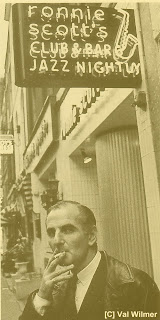 Kenny Clare recalled his first gig with the band when he talked to Crescendo's Tony Brown in May 1968. He had made a good impression and was asked by Gigi Campi to play alongside Klook on the next date.
They gave me a couple of notes on vibraphone which I invariably played wrongly ‑ well, they figured that I'd always be available to do anything that Klock wouldn't be free to do. I could do sundry percussion. Then one number was a Turkish march thing and I played snare drum. When it was played back it sounded very much together, like one drummer. They talked it over. Next time I came, would I bring my drums as well? See if we could make it with both of us playing. It worked ‑ and it's been like that ever since.
There is no doubt that driving the CBBB took a lot of energy and endurance and the addition of Clare not only added to the rhythmic foundation but also spread the heavy percussion load.
Playing along with the greatest drummer in the world was a pretty intimidating experience for Clare. He once told me of the first gig with Klook in Ostend in 1967 when the dual drumming exercise became a nightmare. 'Try as I would at rehearsal, I just couldn't get it together. The drums were fighting each other.'
He left the theatre after the rehearsal full of gloom and depression and decided that the best thing to do for the sake of the band would be to slip silently away. He went to book a flight back to London ‑ but there wasn't one. He shrugged resignedly, walked around the town for a couple of hours, then finally made his way back to the theatre for the concert. 'I started the first number full of apprehension ‑ but from the very first beat, it all came together miraculously. I just couldn't believe it!'
And that was the beginning of a beautiful percussion friendship. From then on, Clare became an integral part of the rhythm section and missed only one gig with the band. Strangely enough, Clare said he was never able to play the same away from the band. 'There are many drummers who would love to get the same springy kind of beat that Klook gets. I'm one of them. When I'm with him, I can play that way without even thinking about it. As soon as I'm away from him, I can't do it any more.'
True to character, Klook gave every encouragement to Kenny Clare and undoubtedly one of the important reasons why they worked so well together was that they had such a warm relationship off the stage, as well as on.
British drummer Frank King, reviewing the two Polydor albums that resulted from the Scott engagement, wrote in Crescendo: 'The perception and telepathy between Kenny Clarke and Kenny Clare is magnificent. They have such a fantastic togetherness that in places it is miraculous.'
 With Jimmy Woode unavailable, Ronnie Scott's bassist, Ron Mathewson, was brought in for the club engagement and with Clare, Scott, Tony Coe (on tenor and clarinet), Humble and Tony Fisher (trumpet, depping for Jimmy Deuchar), the British contingent in the band was as big as the American. Yugoslavia's Dusko Gojkovic was recruited into the trumpet section.
Gigi Campi had to miss the first week of the engagement, but when he walked into the club on the Monday of the second week, Johnny Griffin told him, 'Gigi, you're gonna hear some shit tonight!' Campi sat at a table with writer Bob Houston, my wife and myself and beamed as his 'family' took the stage. ('Italians, he'd explained to me once, 'always try to wrap everything up in a sense of family ‑ and that's how I regard the band.') Campi had heard practically every note the band had played since its debut. But when it hit, with a high‑voltage version of 'Box 703', Campi turned to us wide‑eyed and said, 'Wow!' Later he told me: 'I couldn't believe how good the band sounded. When they played the tutti in "Now Hear My Meanin' " I got goose pimples all over.'
For Ronnie Scott those two weeks were undoubtedly one of the major highlights in the history of the club, as well as being musically inspirational. 'It was marvellous. People used to applaud in the middle of the arrangements ‑ showing their appreciation of some of the tutti or soli passages. It was really one of the greatest musical experiences of my life.'
 The year 1969 was certainly a banner one for the Clarke Boland Big Band. It played the Pori Festival in Finland that summer and Lars Lystedt, Down Beat's Scandinavian correspondent, described the condition of the audience as 'spellbound'. In September the band shared the bill at Rotterdam's De Doelen concert hall with the mighty Thad Jones‑Mel Lewis Orchestra, and reporting for Britain's Melody Maker, Jan van Setten told of 1,780 people 'exploding into thunderous acclaim after the four‑and‑a‑half‑hour marathon concert'. It was a real battle of the bands, he said. 'Who won? Music.'
At the Prague Jazz Festival in October, the CBBB 'totally eclipsed' the Duke Ellington band, according to Melody Maker's Jack Hutton. 'This year's Prague Festival proved one thing conclusively to me ‑ the Kenny Clarke‑Francy Boland Big Band is the finest big band in existence,' he wrote.
 And after a Paris concert in that same month, Jacques B. Hess of Le Monde wrote:
'The CBBB is a triumph, at the highest level of talent and professionalism.
The warmth, the commitment and the enthusiasm of the musicians is refreshing and a marked change from the lackluster and blasé performances of the Ellington and Basie bands which we have become used to over the last few years.'
 In October 1970 the CBBB was back in Britain for a three‑week engagement at Ronnie Scott's and at this time Carmen McRae came to London to record with the band in the Lansdowne Studios. With a minimum of rehearsal time, the superbly professional ex‑Mrs. Clarke managed astonishingly well with some difficult scores, especially considering that six of the eight tunes recorded were new to her. The whole session was completed in eight hours. It was named after a Boland-Jimmy Woode song on the album, 'November Girl'.
There followed a three‑week European tour which had Dizzy Gillespie as special guest and which culminated in an appearance at the Berlin jazz Festival. But the tour was not a great success musically because the band had to submerge its own personality to play a programme that was more closely associated with Dizzy.
In fact there were now signs that the band was beginning to run out of steam and, no doubt, one of the factors which undermined its momentum was Campi's failure to conclude an agreement to take the band to the United States. It was a great disappointment for Kenny Clarke ‑ and for all concerned with the CBBB. But, for a variety of reasons ‑ predominantly financial ‑ plans to have the band appear at the Village Gate in New York, followed by concerts in Boston and Chicago, an appearance at the 1970 Newport Jazz Festival and a tour of Canada, did not come to fruition.
'I'd really love to take the band on the road in the States/ Kenny Clarke told me in 1967, 'just to prove the point about the high standard of European musicians.' But it was not to be.
What finally caused Kenny Clarke to acknowledge that the days of the CBBB were numbered, however, was the untimely death of Derek Humble on 2 February 1971 at the age of thirty‑nine. 'The band was never the same without Derek/ Kenny said, voicing a sentiment that was shared by the whole CBBB family.
In June 1971 the band made its last recording, Change of Scenes, with Stan Getz as guest soloist and, in March 1972 in Nuremberg, played its last concert date when, according to Gigi Campi, 'it was a sorry shadow of its former self'. He went on:

Johnny Griffin came to me after the concert, and virtually read the funeral service. The following morning I had a long discussion with Francy and Klook to see if we could keep the band going. I still thought there might be a possibility of pulling off an extensive tour of the USA which could have regenerated the spirit of the band. So some days later I went on a round trip of Europe to try to put the band together again. I called on Idrees, Nat Peck, Tony Coe and Johnny Griffin and finished up in Montreuil with Francy, Mook and Benny Bailey. And finally I realized that it wasn't going to happen ...
And that's when even Campi's apparently unquenchable enthusiasm gave out. It was April 1972 and the Clarke‑Boland Big Band had breathed its last.
But, as Bob Houston, who was closely associated with the band through most of its lifetime, wrote afterwards, though the demise was a matter for regret, that the band had existed at all was a matter for celebration ‑ 'as with all phenomena which survive on excellence against the tides of current fads and fashions ... The CBBB was one of the most enjoyable manifestations of the last decade in jazz. Be grateful that it happened at all, and that we have it on record to enjoy.'
And Kenny Clarke said, 'It was a fantastic, unique experience from which I learned a lot. It was not only a great band, it was a community, a congregation of friends ‑ and one of the happiest bands I've ever worked with.'
The Clarke‑Boland Big Band left a rich legacy of its repertoire on record. In the eleven years of its existence it recorded thirty‑nine albums.
Kenny Clarke's role in the CBBB was not only the obvious one of being the rhythmic dynamo; he was important as a co‑leader in his own reserved and unobtrusive way. He led by example; he had the total respect of all the musicians who ever played in the band, and that respect, coupled with respect for one another, was what kept the band so tight and its musical standards so high.
Says Johnny Griffin,
The CBBB couldn't have lasted with a Benny Goodman or a Buddy Rich leading it ‑ because there were too many bandleaders in the band. It wouldn't have worked if the leaders had been dictators. I mean, the vibrations from the egos! My God, imagine ‑ three trumpet players all Leos: Idrees Sulieman, Benny Bailey and Art Farmer. It was like an armed truce. It was amazing with all those different characters and the strength in each one. And it would mesh! There was no one on the band that you could pick on! It was really like a zoo, with tigers, lions and gorillas in it!
'I never met anyone who stayed so calm/ Kenny Clare said of Klook in an interview with Crescendo's Tony Brown. 'You should come along to a recording session. All pandemonium let loose, everybody talking or blowing like a bunch of madmen. Kenny never raises his voice or gets excited. He is a wonder.'

Ronnie Scott confesses that he was always a little bit in awe of Kenny Clarke. 'But he was always so amiable and pleasant. He didn't come on like your typical extrovert bandleader. He just sat there, and played ‑ and that was enough.'
Gigi Campi remembers times when Kenny would arrive late for rehearsal or recording due to plane or train delays. 'We would all be waiting in the studio ‑ and as soon as Kenny walked in you were aware that there was suddenly more power in the room. His presence ‑ quiet, dignified and calm ‑was such a positive force.'
Jimmy Woode says that it was simply not Klook's way to get out in front of the band and pep‑talk the musicians. 'He might speak quietly. to you individually ‑ but his leadership was implicit in his solid integrity. Francy and Klook were not exactly charismatic leaders like Duke.'
Ron Mathewson remembers Klook as a man who commanded respect from all the members of the band without any attempt to pull rank: 'He was really helpful to me when I came into the band for the gig at Ronnie's. He said, to me, very nicely, "Keep a straight four. Let the guys feel you, because you're new. They want to trust the rhythm section. Just play it cool and let it happen."'
Francy Boland's co‑leadership consisted entirely of creating the band's inimitable book, writing not for the instruments but for the musicians, and providing support and solos from the keyboard that were consistently streets ahead of his own evaluation of them. Boland carries self‑effacement almost to the point of self‑erasure. He told me, 'Kenny didn't really have a lot to do with the music. And I wanted it that way because I was the arranger.'
And without any apparent awareness of the sublime irony of a Boland being struck by someone else's inclination to maintain a low profile, he added, 'Kenny was a very reserved person and he kept his thoughts to himself. He never expressed enthusiasm when I came in with a new arrangement; though he might give me a compliment ‑ a small compliment ‑from time to time.'
Clarke and Boland, during their association together, were never in any danger of engulfing one another in explicit mutual admiration. But had it not been there in some abundance, the band simply would not have flourished. Whatever Boland may feel about the measure of respect and appreciation he received from Kenny, Gigi Campi remembers an incident which speaks eloquently of Klook's high regard for his partner.
The band was rehearsing and swinging like a demon ‑ without a drummer. Kenny was standing out in front, rolling a joint. Suddenly he looked up in mock disbelief and genuine joy, and said, 'This band doesn't need a drummer. That Belgian motherfucker swings it just with his writing, goddam it!
'For Kenny,' Campi adds, 'there were two great arrangers in Tadd Dameron and Francy Boland.'
 For a variety of reasons, I missed the Clarke Boland Big Band [CBBB] during most of its existence on the 1960s Jazz scene . Although I recall that many of my friends raved about the band, and I remember seeing their initial Atlantic LP – Jazz is Universal – on display in record stores, I never actually heard the band’s music until over 20 years after it had ceased to exist in 1972.
Thanks to the glorious era of re-issuance that followed the development of the compact disc, I now know what all the fuss was about. What a band! One of the all-time great bands in the history of Jazz.
Yet, judging by the opening paragraph from the chapter on the band in Mike Hennessey’s, Klook: The Story of Kenny Clarke [London: Quartet Books, 1990, pp. 160-177], it would appear that there were many reasons why this band should have been absented from that history in the first place.
 And given Mr. Hennessey’s description of how the band came together and what it took to maintain it during the 12 or so years of existence, the fantasy world implication of the Disney art that adorns its More Jazz Japanese release may be more fitting than comical.
 Of course, as a former drummer, how can you not love a big band that has two? But that’s another part of the improbable story as told by Mr. Hennessey, whose work is [C] Copyright protected. All rights reserved.
“Almost everything about the Clarke‑Boland Big Band was improbable. It was invented, nurtured, nourished, fussed over, financed, promoted and absolutely adored by a German-born Italian socialist whose qualifications for band management were that he was a trained architect and owner of a flourishing coffee bar in Cologne's Hohestrasse. Its leaders were two musicians who competed with each other in the art of staying in the background and maintaining a low profile. It roster of members over the years embraced more than a dozen nationalities, half a dozen religions and a daunting assortment of egos, most of them on the large side. To bring the band together for rehearsal, record dates and concerts involved formidable complexity of travel arrangements and much intricate juggling with the musicians' individual work schedules. Despite all of this, plus the inevitable, multiple frustrations, financial Everests, outbreaks of pique, petulance and pig-headedness, and that well‑known capacity of airlines to deliver a bass player to Cologne and his bass to Caracas, the band not only survived for eleven years but developed into a unit of surpassing excellence, becoming an important ‑ and genuinely significant ‑ part of jazz history. It was by far the finest jazz orchestra ever assembled outside the United States.
And Pier‑Luigi 'Gigi' Campi, the man who made it happen, is quite emphatic that the band simply could not have existed without Kenny Clarke. 'We needed his magic touch he told me.'
As a teenager in Italy during the Second World War, Campi used to listen under the blankets in a Jesuit college to jazz broadcasts from the American Forces Network. He listened to Louis Armstrong, Jimmie Lunceford, Roy Eldridge and Duke Ellington and among his circle of friends, jazz records were more highly prized than black‑market coffee.
But it was when Campi heard a Charlie Parker record in 1948 that he started to become a real jazz devotee. In 1949 he attended an international meeting of young socialists from all over Europe and, as he alighted from the train in Zurich, he saw a poster announcing a concert that evening by Django Reinhardt. A record by the Quintette du Hot Club de France was among those he had heard clandestinely in college and he couldn't resist the opportunity to see and hear Django in person. So he decided to skip the scheduled briefing for the
political meeting that evening and attend the concert instead. Gigi recalls:
There was another group mentioned on the poster but the names meant nothing to me. Django played the first half and I was really excited by the music. But in the second half, this group of black musicians played ‑ and the music sounded strange, but wonderful. I remember coming out of that concert feeling absolutely exhilarated. I was telling myself, 'Django was fine ‑ but those black musicians, they were really fantastic.' Three years later, James Moody and his group were touring Germany. My wife and I were passing through Munich on the way to a ski resort and we discovered that Moody's group was playing in town that evening. We went to the concert and as soon as the band took the stage, I said to my wife, 'I've seen that drummer before.'
The drummer, of course, was Kenny Clarke, who'd been a member of the band that had played the second half of the Django concert in 1949. And Gigi discovered that the men with Kenny at that time had been Miles Davis, Charlie Parker, Tommy Potter and Tadd Dameron, fresh from the historic first Jazz Festival.
 ‘I went backstage after the concert/ Gigi says, 'and had my first close‑up of what you later called "the thousand‑candle‑power-grin". Kenny impressed me enormously, not only as a drummer but as a person.'
The success of his coffee bar enabled Gigi Campi to indulge his love of jazz by
organizing concert tours and producing jazz records. He set up a tour for the Chet Baker Quartet and recorded Lars Gullin, Lee Konitz and Hans Koller for his Mod label. His enthusiasm, however, outstripped his entrepreneurial flair as a jazz promoter. He lost $10,000 on a 1956 Lee Konitz tour.
But I learned something from being on the road with Lee. My friends and I were big fans of cool jazz at that time, but Lee would always be singing Lester Young solos on the train. I think that tuned me in again to the swing‑band era. He also said that the next time he came on tour, I should make a point of hiring Kenny Clarke to play drums. But, after this tour had flopped, I decided to cut my losses and quit the jazz business. However, I remembered Kenny Clarke, of course, and I resolved that if I decided to get involved with jazz production and promotion again, the first thing I would make sure of was that I had a good rhythm section.
At the time that Campi was beating a retreat from jazz promotion, Francois 'Francy' Boland, a twenty‑ six‑year‑ old pianist, composer and arranger from Namur, Belgium, was in the United States writing arrangements for Benny Goodman and Count Basie, having been recommended by Mary Lou Williams. Boland, a largely self‑taught musician, had studied music for a few years at the local conservatory and had taken piano and harmony courses at the Liege Royal Conservatory. A great admirer of the swing bands, particularly those of Les Brown, Basie and Artie Shaw, he wrote his first big‑band arrangements in 1942 when he was thirteen years old.
Francy had also written arrangements for the German orchestras of Kurt Edelhagen and Werner Muller and it was through Edelhagen that Gigi Campi first became aware of his arranging skills. Kurt Edelhagen was the leader of one of Germany's most successful big jazz bands, a multi‑nation outfit which he assembled in 1957 and which, though a touch bombastic and lacking in subtlety, was one of the most impressive large jazz ensembles of its time in Europe and boasted some fine soloists ‑ including, at various times, Dusk Gojkovic, Jiggs Whigham, Carl Drevo, Peter Trunk, Jimmy Deuchar, Shake Keane, Ronnie Stephenson, Wilton Gaynair, Ferdinand Povel, Benny Bailey, Peter Herbolzheimer, Derek Humble and Ken Wray.
 Edelhagen had a contract with the West Deutsche Rundfunk in Cologne, whose studios were opposite the office of Gigi Campi, and musicians from the band were always in the coffee shop. Campi used to go across the street to listen to the band rehearse, and on one of these occasions he heard a most arresting version of the Rodgers and Hart standard 'Johnny One Note'. He asked who'd done the arrangement and Chris Kellens, a Belgian who played trombone in the Edelhagen band said, 'That's one by the maestro, Francy Boland.' Campi toId Edelhagen that if he really wanted to develop the style and character of his band, he should give more arranging commissions to Boland.
Said Campi,
Francy was sending all the arrangements he was writing for Basie to Edelhagen as well, including 'Major's Groove', which later became 'Griff's Groove', a feature for Johnny Griffin. I had met Francy in 1955 when he was working with Chet Baker after the death of Chet's pianist, Dick Twardzik, and I remember enjoying his piano playing. Now, having listened to some of his arrangements, an idea was forming in my mind.
Later Francy, who had returned from the States after some disagreement over payment for the Basie arrangements, came to Cologne to look up some of his friends in the Edelhagen band, and Gigi told him that he was planning to put together a big band to play Boland's arrangements. They then spent an hour or so discussing the personnel for the band. At this time Gigi had returned to working as a jazz promoter, at least to the extent of featuring live jazz in his coffee house, so he had some musicians in mind. Campi made a point, in particular, of putting on jazz at the time of the annual fasching, the German mardi gras carnival, as a kind of antidote to what he called the 'traditional junk carnival music'. At carnival time in February 1960, Campi booked tenor saxophonist Don Byas and assembled in support Francy Boland, Kenny Clarke and a group of musicians from the Edelhagen band: Chris Kellens (trombone), Eddie Busnello (alto), Fats Sadi (vibes) and Jean Warland (bass). Recordings by this group were later issued by the German Electrola Company as Don Wails with Kenny.
The first real Clarke‑Boland recording, however, was made in Cologne a year later, in May 1961. It featured Kenny and Francy with Raymond Droz on alto horn, Chris Kellens on baritone horn, Britain's Derek Humble on alto, Austria's Carl Drevo on tenor and Jimmy Woode on bass. That was the firs manifestation of what was to become the regular rhythm section of the Clarke‑Boland band. Campi sent the tape to Alfred Lion of Blue Note who hailed it as 'fantastic' and released it under the title The Golden Eight.

Both the Electrola and the Blue Note albums had been recorded by a brilliant engineer, Wolfgang Hirschmann, who was to become the engineer of the CBBB over the next decade. Campi, Boland and Clarke all had the highest regard for Hirschmann. Kenny once said that the three sound engineers he really respected were Hirschmann, Rudy van Gelder and a German technician at the old Paris Barclay studios called Gerhard Lehner, because they all used just one mike above the drums to capture his sound. 'Sometimes they would use extra mikes for the hi‑hat and snare drum, but I preferred just one,' Kenny said ‑ which is another illustration of his belief in the efficacy of simplicity.
It was seven months later, in December 1961, that the Clarke‑Boland Big Band came into being in the Electrola Studios in Cologne ‑ and its recording debut was fortuitous. The session had originally been a date for Billie Poole, who was playing at the Storyville Club in Cologne at the time with Klook, Jimmy Gourley and Lou Bennett. Campi was arranging to record Billie for Riverside and had decided, with Kenny and Francy, to assemble 'a little big band' for the date. Francy wrote the arrangements and the line‑up was Benny Bailey, Roger Guerin, Jimmy Deuchar and Ahmed Muvaffak Falay (trumpets); Nat Peck, Ake Persson (trombones); Carl Drevo, Zoot Sims (tenors), Derek Humble (alto), Sahib Shihab (baritone), Francy Boland (piano), Jimmy Woode (bass) and Kenny Clarke (drums).
France's Roger Guerin had worked often with Klook since 1956. Shihab had come to Europe in 1959 with the Quincy Jones band and had stayed over, settling in Stockholm. Zoot was on tour, and Persson, another former Quincy Jones sideman, was now based in Berlin and freelancing. Falay ha come to Europe from Turkey, and although some people thought he had acquired his middle name after mortally offending a none‑too‑literate fellow musician, it seems that it really was genuine. Benny Bailey, yet another former Quincy Jones alumnus, was living in Berlin and working in the Sender Freies Berlin radio orchestra, and Nat Peck, a Paris‑based American, had chalked up a great deal of big‑band experience with Glenn Miller, Don Redman, Duke Ellington and ‑ needless to add ‑ Quincy Jones.
 All was set for the record date, when, one week before the musicians were due to assemble in Cologne, Billie Poole had to return to the States because of a bereavement in the family. Rather than cancel the date, Campi had Francy Boland write seven new arrangements at breakneck speed and the session became the first date for the Clarke‑Boland Big Band. It was released by Atlantic, and aptly titled Jazz is Universal.
Campi told me,
The opening track on that album, 'Box 703, Washington DC', was like an explosion. I remember Ake Persson coming into the control room to hear the playback and saying, 'Gigi, put this band on the road for six weeks and we'll scare the shit out of everybody!' The spirit among the musicians was tremendous ‑ everyone knew that we had a sensational band together. The feeling was electric. I remember Ake came into the office after we'd finished recording late one night and I told him I had some extra money to give him. He shook his head and said, 'No, we don't have to speak about money.'
I said, 'You mean you're not happy with the fee? You want more?
'No. I mean that I should be paying you for the privilege of playing in a motherfucking band like this after all these years.'
And that was the kind of spirit that developed ‑ the music and the feeling became more important than the money ‑ a really remarkable thing when you consider how hard musicians sometimes have to fight to get paid, or to get paid adequately.
What was especially important about Jazz is Universal was that it proved beyond a doubt that jazz was no longer the exclusive preserve of American musicians. 'The thoroughly integrated sound that emerged from this band,' wrote 'Voice of America' producer and presenter Willis Conover in the liner note for the album, 'is convincing evidence that international boundaries have no meaning at all to the practicing jazz musician.'
Seven of the thirteen musicians in the band were European and their ability to hold their own with their American colleagues did no damage at all to the cause of winning a just measure of appreciation and recognition for some of the excellent European jazz musicians who were emerging. An indication of how the band's enthusiasm for the music was as abundant as its musicianship is the fact that the album was recorded in just four hours!
It was always Campi's goal, with the CBBB, to create a band which had an immediately recognizable identity ‑ which was why he wanted Francy Boland to write all the band's arrangements. Boland's very special concept of arranging helped to achieve this aim, and the brilliant solo and section work of a band whose members loved to play together and who developed such a great personal and musical rapport, did the rest.
The key elements, according to Campi, were first of all the rhythm section: 'I knew when I heard Kenny, Francy and Jimmy play together for the first time that I simply had to build a big band around them.' A second crucial element was the magnificent lead trumpet and solo work of Benny Bailey ‑ a musician for whom both Dizzy Gillespie and Thad Jones expressed admiration tinged with awe. The third was the immaculate lead alto saxophone and brilliant, serpentine solo work of Derek Humble. And a fourth was the massive loyalty and surging enthusiasm of the big Swede, Ake Persson, who was an indefatigable champion of the band. Ake was also a formidable trombonist. Nat Peck once said, 'Every time I sit down with him it's like I'm hearing him for the first time Thrilling! I've never worked with anyone who has stimulated me so much.'

Encouraged by the success of the Universal album, Gigi Campi decided to assemble an even bigger band for the next record date on 25, 26 and 27 January 1963. Two albums resulted from this session made with a twenty‑one‑piece orchestra ‑ six trumpets, five trombones, five saxophones and an augmented rhythm section with Joe Harris on percussion ‑ Now Hear Our Meanin' released on CBS, and Handle with Care, released on the Atlantic label. Britain's Ronnie Scott came into the band for the first time, as did Idrees Sulieman and Austrian trombonist Erich Kleinschuster. And, in the absence of Zoot Sims, Campi flew in Billy Mitchell from the United States as principal tenor‑saxophone soloist. Also in the line‑up ‑ through a misunderstanding more worthy of fiction than fact ‑ was trombonist Keg Johnson, direct from New York.
 The band needed a bass trombonist ‑ and nobody seemed to be able to come up with a suitable candidate. Then Ake Persson came to see Nat Peck, clutching an album. 'I've got him,’ he said. 'Listen to this.' And he played a track from the Gil Evans album, Out of the Cool. Nat was impressed. Persson pointed out the name on the sleeve and they called Campi in Cologne. 'You must get Keg for this date,' they said. Campi, always responsive to enthusiasm, agreed to bring Johnson in from New York.
During the session Keg did a pretty good job, but somehow, Peck and Persson thought, he wasn't quite matching his playing on the Evans album. After the first day's recording was over, Persson and Peck had drinks with Johnson. They told him how they'd heard him on the Gil Evans album. 'Some of the best bass‑trombone playing I ever heard in my life,' said Nat Peck. 'Absolutely fantastic,' confirmed Persson.
'Well, thanks,' said Keg. 'But actually, that wasn't me. I didn't play bass trombone on that album. As a matter of fact, I'm not really a bass‑trombone player at all. I had to borrow the instrument for this date.'
The bass‑trombone player was actually Tony Studd. But Ake and Nat took a year to break the news to Campi.
Talking to me about the album in November 1966 when I was preparing an article on the band for Down Beat, Kenny Clarke said it was one of the most satisfying dates of his career. He said:
The record is proof positive that there are as good musicians in Europe as there are in the States. I have never felt that the standard in Europe was much lower than in America. In Germany, it is just as high, even higher.
I've worked around the studios in the States and I really think that music here in Europe is on a higher plane.
When I asked Klook how the Clarke‑Boland compared with big band of Dizzy Gillespie he smiled the inimitable Klook smile and said, 'There is no comparison. That was the greatest band I ever played with in my life. I have never played in a band that was so inspirational and dynamic. It will never happen again in my lifetime. But we can come pretty close.'
It was not until May 1966 that the Clarke‑Boland Band played its first live concert ‑ in Mainz, West Germany ‑ which was broadcast in the regular jazz programme of jazz producer and critic Joachim Ernst Berendt for the Sudwestfunk, Baden-Baden. Reviewing the concert, the critic of the Mainzer Zeitung wrote:
The Clarke‑Boland Band showed that musically and technically they are masters of their craft. The compositions and arrangements were excellent and the solos displayed a combination of vitality, a beautiful smoothness and command of musical range ... What strikes one after close listening is the classic harmony of the brilliant soli and tutti passages, played with elegance and confidence and distinguishing the band from all other big jazz ensembles.
Boland's arranging style did indeed make excellent use of the soli [a section of the band playing in harmony] and tutti [literally, “all together; the entire band or a section in unison] devices, and they became something of a CBBB hallmark. He used them in 'Get Out of Town' on the Handle with Care album, and they were dramatically in evidence on the Clarke‑Boland Band's third album, recorded in Cologne on 18 June 1967 for the Saba (later MPS) label of Hans Georg Brunner‑Schwer. For this album, which featured Eddie 'Lockjaw' Davis as guest soloist, Boland wrote an arrangement based on 'Chinatown' and called 'Sax no End'. It was a masterpiece of saxophone scoring ‑ and it needed a saxophone team of the calibre of Derek Humble, Carl Drevo, Johnny Griffin, Ronnie Scott and Sahib Shihab to do it justice. After Eddie Davis solos over four choruses with just the rhythm section and Fats Sadi's bongos, the saxophone section, masterfully piloted by Humble, plays three complex and intricate soli choruses with fine precision, co‑ordination and compatibility. Two roaring tutti choruses follow. Saxophonist Kenny Graham, reviewing the Sax no End album in Crescendo in Mav 1968, said:
One particular bit did my old ears a power of good ‑ a saxophone chorus brilliantly led by Derek Humble. I just love hearing saxophones having a chance to play a well‑written chorus instead of riffs, figures and the boosting‑up‑the‑brass chores that they usually find themselves doing Maybe that's what Francy Boland is really all about. Nobody does saxophone choruses these days ‑ they're not on. F.B., oblivious of trends etc., bungs' em in. This and similar notions of his come off a treat because he believes in them.  Sax no End was a major landmark in the band's progress towards its ultimate corporate identity and it was followed by a number of other arrangements featuring saxophone soli, such as 'All the Things You Are', 'When Your Lover Has Gone', 'You Stepped out of a Dream', and many more. Ronnie Scott remembers those soli passages only too well. He says of 'Sax no End', characteristically self‑critical,
They were very difficult to play ‑ in fact, I never really got ‘Sax no End’ down. But they were beautifully written and sounded marvellous. Derek was the navigator in chief ‑ and, of course, Shihab was a great anchor man. After about the first four times, he never had to look at the part.
Certainly the arrangement made a big impression and was always a favourite at live performances. Oscar Peterson was so taken with the chart that he actually recorded a trio version for his MPS album Travellin' On. But perhaps the most remarkable thing about the Sax no End album was that all seven titles were recorded in seven hours.
'It was almost always a first‑take affair when the band recorded’ Gigi Campi says. 'We hardly ever played anything more than three times ‑ and then we usually found that the first take was the best.'
In between the big‑band dates Clarke and Boland made a number of sessions with smaller groups featuring different members of the band ‑ Johnny Griffin, Fats Sadi, Sahib Shihab ‑ and an octet album with singer Mark Murphy. The band also began to make more live appearances, playing festivals and concerts in Germany, Switzerland, Austria, Italy, Holland, Belgium, France, Hungary, Finland, Denmark, Sweden, Yugoslavia, Czechoslovakia and Britain.
Campi worked tirelessly to project and promote the band and, recognizing early on the importance of getting airplay for the CBBB's music, he concluded an agreement in 1967 to sell a monthly half‑hour programme by the band to radio stations in Helsinki, Stockholm, Copenhagen, Hilversum, Brussels, Vienna, Zurich, Baden-Baden, Munich, Stuttgart, Frankfurt, Saarbrucken, Hamburg, Berlin and Cologne.”
To be continued….
 Bob Brookmeyer has always been a man of strongly-held opinions and, after reading this interview from 1980 with Wayne Enstice & Paul Rubin from their Jazz Spoken Here: Conversations with 22 Musicians [New York: Da Capo Press, 1994, pp. 59-75], I’m sure you will agree that not much has changed in this regard.


