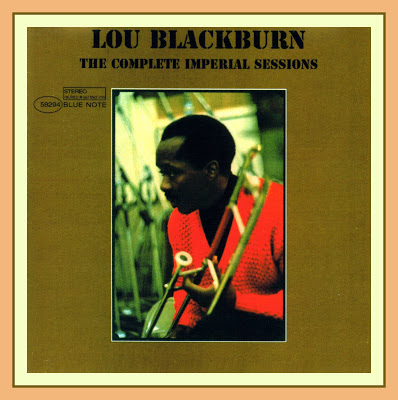
© -Steven Cerra, copyright protected; all rights reserved.
This is a wonderful story of what the world of modern Jazz world was like at the apex of its heyday in the late 1950s and early 1960s.
New groups kept coming into existence just at the point when many of the places to play were going out of existence.
Of course, this transition is observed with the luxury of 20/20 hindsight because no one could foresee the demise of the Jazz club scene at the outset of the 1960s. But the musicians looking for bookings during this era became more and more aware that this change was in the works.
Quintets led by a front line of trumpet and trombone have never been particularly common in Jazz which is one of the reasons for the interest in the quintet led by trombonist Lou Blackburn and trumpeter Freddy Hill.
In Dual Brass John Tynan details the formation of the Lou Blackburn-Freddy Hill Quintet for an article that appeared in down beat magazine, February 13, 1964
“IT TAKES MORE than conviction and courage these days to begin a new modern-jazz group; one has to have an inordinate helping of good luck too.
No one, of course, can predict how Lady Luck will turn. Many a promising new jazz group, bursting with talent and fresh ideas, has foundered on the Lady's scowl. Many another, with less to offer artistically, has prospered on her unpredictable smile.
In terms of luck alone, Lou Blackburn's burgeoning quintet is still in limbo. The former Lionel Hampton and Duke Ellington trombonist for almost two years has been deriving most of his income from Hollywood's motion-picture sound stages; jobs for the quintet are far from plentiful in an area where the jazz supply exceeds the demand, Greater Los Angeles.
But with the turn of the year, indications seemed to suggest a brighter tomorrow for this healthily swinging, unorthodox combination of jazz talent. First up in '64 came the quintet's initial out-of-town booking, at Basin Street in Denver, Colo. By February or March a German concert booker in Hamburg is expected to have completed plans for a European tour for the Blackburn group to last a minimum of 13 weeks, hopefully followed by a second 13 after a two-week vacation.
"After that," Blackburn said recently, "people will listen to us more."
Speaking in a rapid, precise manner, Blackburn recounted the group's fortunes since he organized it in November, 1962. For a while, he noted, it was heard in all the local Los Angeles clubs. Now, he added ruefully, it is difficult "to get a week in any club in town."
Still, by virtue of two albums released on the Imperial label (recently that company was acquired by Liberty records, but the Imperial brand remains on Blackburn's albums) the quintet is gaining some exposure. Of the first, New Frontier, the trombonist said candidly, "It would have been better if we had waited." This album was recorded on Jan. 25, 1963, a bare two months after the group's formation. The second LP, Two-Note Samba, speaks out eloquently for the group's distinctive personality, forged in the months following the making of the initial album.
Chief among its distinctive qualities was the playing of Freddy Hill, and Blackburn attributes to the 31-year-old trumpeter the original impetus for the group's formation.
"One night back in 1961," Blackburn recalled, "not long after I arrived in Los Angeles, I was playing with some fellows at the Rubaiyat Room in the Watkins Hotel. Freddy was one of them. Well, we seemed to get such a good blend with his trumpet and my trombone, he suggested we try to make it permanent. So we did."
Hill, a horn man little known outside Los Angeles' environs until now, began achieving some measure of professional recognition nearly five years ago. At 26 he was declared by a board of musician-judges to be the best trumpeter of the eighth annual Intercollegiate Jazz Festival held at the Lighthouse in Hermosa Beach, Calif. At that time the Floridian from Jacksonville had behind him four years on a music scholarship at Florida A&M College, two years in the 36th U.S. Army Division Band, and a further two years after discharge as music teacher in the Jacksonville public-school system. Hill participated in the week-long jazz festival as a member of the winning group from Los Angeles State College, where he then was engaged in graduate study.
(Other members of this quintet to gain recognition and a measure of jazz fame in the ensuing years were reed man Gabe Baltazar, now alto saxophone soloist with the Stan Kenton Orchestra, and Marvin Jenkins, the quintet's leader, pianist, and flutist. Both were also 26 at the time.)
Blackburn and Hill are unreservedly enthusiastic about the current quintet's trumpet-trombone front line. Following Hill's suggestion to combine their horns, Blackburn sketched the melody of an original composition, New Frontier. "We ran it down together," he recalled, "and it sounded good."
From that point the pattern for their group was set. To date, the quintet's book consists entirely of compositions and arrangements by Blackburn and Hill, although only Blackburn's works have been recorded.
While there is much concentration in the writing for the horns on harmonic relationships, Blackburn said, the tonal qualities of unison scoring are by no means ignored, and, he said, he also likes the flexibility possible in the combination.
"I dig it," said the tall, slim Hill enthusiastically. "I dig the sound. You can do a lot of things with the combination. And you have much more flexibility in some instances than, say, with trumpet and tenor. You can get more fire if you want; or you can get a woodwindy sound using mutes if you like. We use a wide variety of mutes."
Blackburn is quick to point out that the trumpet-trombone combination is not necessarily his or Hill's innovation. He cites the album Really Living, recorded some time ago by J. J. Johnson and Nat Adderley, though he noted that he doesn't feel "that the combination was exploited as well as it could be by J. J. and Nat."
Hill added, "Working as we do, we can have a brass section or a woodwind section effect. I think the combination is unlimited, really."
"At times," Blackburn continued, "it's actually difficult to distinguish just who is playing trumpet and who's on trombone, because we frequently voice the horns octaves apart, switching back and forth."
BLACKBURN SAID he feels that musicians in the Los Angeles area are "heavier" academically than those playing on the eastern seaboard.
Certainly his own background is academically impressive. Born 37 years ago in the Pittsburgh suburb of Rankin, Pa., he originally studied and gained considerable proficiency on piano. During his final two years at Roosevelt College in Chicago, however, he fell under the spell of the early work of J. J. Johnson and other modernists of the period, and he switched to trombone.
Inducted into the Army in 1945, he served until discharged in 1947. After a taste of civilian life, in which the musical going was unpredictable at best, he re-enlisted for an indefinite hitch. Promoted to master sergeant, he served his final two Army years with the Seventh Army Symphony Orchestra, along with such musicians as motion-picture composer and French hornist David Amram, concertmaster, Stanley Plummer, and string bassist Frederic Button, now with the Los Angeles Philharmonic Orchestra. Prior to that he was stationed in Japan, organized his first jazz group in Yokohama, and presented the first U.S. jazz concert ever held in Hibya Hall, Tokyo's opera house.
Service with the Army symphony orchestra in Stuttgart, Germany, did not prevent Blackburn from organizing a touring jazz variety show with the snappy billing Smart Affairs of '54 with which he played Army bases throughout the European command.
The troupe, consisting of five singers and a five-man instrumental group, included such jazzmen as vibist Walt Dickerson and pianist John Wright. One of the vocalists was Jesse Belvin, later in civilian life to attain considerable success in the commercial recording field before his death in a traffic accident.
But by 1956 M/Sgt. Blackburn had had it with the service. Some two years earlier, while on tour with the Smart Affairs troupe, he had met Lionel Hampton, who heard his playing and offered Blackburn a job as soon as his hitch was up. So, much to the envy of many a draftee, Blackburn exercised the prerogative of his rank and service and resigned from the Army.
Hampton was playing Atlantic City, N.J., when the freshly civilianized Blackburn showed up to claim his trombone chair. He was hired on the spot.
After 2 1/2 years with the Hampton juggernaut, during which he returned to Europe twice, Blackburn quit and worked with a small group for a while. Then came an offer from Duke Ellington. Blackburn didn't toy with the idea. He remained with Ellington for almost a year, before deciding to settle in Los Angeles in January, 1961.
THOUGH BLACKBURN has "worked at all the movie studios" and appears, well established in that well-paid and musically demanding milieu, he confesses he is "not really interested" in this work. "I'd rather work with five pieces," he said.
The remaining three of the five pieces now are Horace Tapscott, piano; John Duke, bass; and Vernar Barlow, drums. Barlow is a 20-year-old recent arrival from Florida of whom Blackburn predicts, "He'll be heard from."
Tapscott and Duke are doubling musicians. The former played trombone in the Hampton band before forsaking slide for keyboard; Duke is an ex-trumpet player who has, according to Blackburn, become "a very fine bassist." There has been some switching to and fro on drums with the group on occasion.
Next to be recorded in an album, Blackburn said, is a new work of his, The Afro-Eurasian Suite. This consists of three distinct sections, or movements — Newmto, an Ashanti word meaning chant; Yum Pihn, a Siamese expression meaning lovable; and Orient. The last section, Blackburn explained, is a straight jazz piece in 6/8 and 4/4 and then 6/8 played against 2/4. The suite is already in the active book, according to the leader, and the quintet regularly features it in clubs.
While Blackburn notes that "the Imperial albums helped us get our foot in the door," he emphasizes that they are but a beginning.
"I feel," he said confidently, "that we have found ourselves now. This is what we really want to do: play good jazz."”
If their luck stays bright, that is what Lou Blackburn and company will be doing from now on.
Lou Blackburn: The Complete Imperial Sessions were issued on CD by Blue Note [58294] and here are Michael Cuscuna’s insert notes to the CD reissue for which Michael served as the producer.
© -Michael Cuscuna, copyright protected; all rights reserved.
This disc contains the complete output of the Lou Blackburn-Freddie Hill Quintet. Like Curtis Amy, Teddy Edwards, Jack Wilson, and so many others in Los Angeles at the time, Hill and Blackburn were making their living in the recording studios and film soundstages. Their creative efforts were confined to low-paying club dates and the occasional album, which was usually met with nice reviews and poor sales.
Big bands were another creative salvation and the L.A. scene. Hill and Blackburn were, at various times, members of the Gerald Wilson, Onzy Matthews, and Oliver Nelson orchestras, which enjoyed some joyous live gigs and the hipper studio dates.
Together, they appeared on Wilson's Moment Of Truth, Matthews's Blues with a Touch Of Elegance, Lou Rawls's two Matthews-arranged albums Black and Blue and Tobacco Road, Oliver Nelson's Live From Los Angeles, and Nelson-arranged projects by Carmen McRae, The Three Sounds, and Thelonious Monk
Lou Blackburn was born in Rankin, Pennsylvania, a suburb of Pittsburgh, on November 22, 1922. His first instrument was piano, but during his final two years at Roosevelt University in Chicago, he switched to trombone, an instrument he felt to be mare natural for expressing himself.
He was drafted into the army in 1945 for two years. After discharge and a couple of years of civilian life as a musician, he rejoined the military and gained incredible experience while stationed in Japan and Germany, performing with David Amram, Don Ellis, Walt Dickerson, John Wright, and Jesse Belvin, and other artists who toured where he was stationed. In 1956, he left the service and gigged around Philadelphia and Atlantic City with Charlie Ventura, among others.
In 1958, he started a two-year stint with Lionel Hampton's big band, and then worked with Cat Anderson's group. An offer came from Duke Ellington in 1961 and Lou joined in time to participate in the Paris Blues and First Time/The Count Meets the Duke projects. It's easy to see why Ellington would be attracted to such an expressive and versatile trombonist, but the gig lasted only nine months.
Blackburn decided to settle in Los Angeles and, with his abilities, he had no problem breaking into the jazz, studio, and film scenes.
Freddie Hill was born in Jacksonville, Florida on April 18, 1932. He studied cello and piano as well as trumpet. After four years at Florida A & M on a music scholarship and two years in the army that brought him into contact with the Adderley brothers, among others, he moved to Los Angeles to pursue graduate studies at Los Angeles State College. Gigs with many artists, including Gerald Wilson and Earl Bostic, followed.
Hill eventually had the security Of steady studio work thanks to Wilson, Matthews, Nelson, and H. B. Barnum, but his opportunities to record as a jazz soloist were few. Besides Gerald Wilson's Pacific Jazz sessions on which he had to share space with a lot of outstanding soloists, he is heard to great advantage on Leroy Vinnegar's Leroy Walks Again!! and Buddy DeFranco's Blues Bag, which also included Curtis Fuller and Art Blakey.
Trumpeter Charles Tolliver remembers, "In 1966,I met Freddie Hill while he was working with Gerald Wilson. We discovered that we were both from Jacksonville and, it turned out, he knew my mother. He got me into Gerald's band and let me live in one of the houses he owned, which was around the corner from where Lou Blackburn lived and near where Andrew and Laverne Hill were staying at the time. Freddie and Lou were working studio dates around the clock. Earl Palmer was contracting a lot of sessions at that time."
Like Blackburn, Horace Tapscott, born in Houston, Texas on April 6, 1934 but raised in Los Angeles from the age of nine, started on piano and switched to trombone. He worked in the bands of Wilson, Hampton, and Matthews on that instrument; he had begun to shift his emphasis back to the piano by the time of these sessions. He remained one of L.A's best kept secrets although there were glimmers of hope when he wrote and arranged the music for Sonny Criss's Sonny's Dream (Birth Of The New Cool) in 1968 and made his debut as leader the following year with The Giant Is Awakened, an album that also introduced Arthur Blythe, on the newly formed Flying Dutchman label. From the early 1970’ss until his death in 1999, Tapscott would record a series of albums, either solo or trio or with his Pan-Afrikan Peoples Arkestra on Nimbus and a variety of independent labels, that revealed a distinctive pianist/composer with a conception all his own.
Bassist John Duke, who had already worked with Horace Henderson, gigged with Bobby Bryant and Louis Jordan among others after the dissolution of this quintet. He joined the Basie band in the 70s, frequently working side jobs with Al Grey when the band was off. Drummer Leroy Henderson is best known for his 1961-62 stint with Richard "Groove" Holmes's trio, which gave him the opportunity to record with Gene Ammons and Lou Rawls. Beyond gigs with Vi Redd and Charles Kynard, little is known about him after 1963.
In a feature article on the group in the February 13, 1964 issue of Down Beat, Blackburn told John Tynan that the idea for the group came shortly after he'd arrived in L.A.: "One night back in 1961, not long after I arrived in Los Angeles, I was playing with some fellows at the Rubaiyat Room in the Watkins Hotel. Freddie was one of them. Well, we seemed to get such a good blend with his trumpet and my trombone; he suggested we try to make it permanent. So we did."
The group was formed in November 1962 and quickly secured a contract with Imperial, a label not known for much jazz recording. The front-line instrumentation is rather rare. There was a 1957 Blue Note album by Curtis Fuller with Art Farmer, J. J. Johnson's 1958 quintet with Nat Adderley, the Clark Terry-Bob Brookmeyer Quintet of 1964-65, and, much later, Woody Show's 1980 quintet with Steve Turre. Rather surprising given that the combination has a lovely sonority all its own.
In Blackburn and Hill, one can hear all the qualities that made them in demand for studio work: their clarion tones, their accurate pitch and clean articulation, their breadth Of idioms, and their blend. But unlike many studio musicians, they were both expressive, first-rate soloists. Horace Tapscott, the other soloist here, had only recently returned to the piano; these were his first recordings on the instrument. He had yet to find his own personal voice on the piano, but elements of his style, like his percussive approach, were already in place.
The aforementioned Down Beat article, by which time Varney Barlow was the drummer, mentions plans for a third album that would include Blackburn's recently composed "Afro-Eurasian Suite," but it never materialized. There was also talk of a European tour, but, in all likelihood, aside from one gig in Denver, this quintet never played anywhere but in L.A. - and even then only infrequently. Blackburn's ten years in Los Angeles was not without its many rewarding moments (including performing "Meditations on Integration" with Charles Mingus at Monterey), but in 1971, he moved to Berlin and soon formed a unique band, Mombasa, that forged its own fusion of jazz, blues, and African music, which he led into the '80s. He died in Berlin on June 7, 1990.
Freddie Hill also left the L.A. scene in 1971. He had married the sister of skater Peggy Fleming and moved out to the desert. Studio work was dying up and Hill died a forgotten man before the end of the decade.
- Michael Cuscuna, 2006”