Saturday, October 15, 2016

Lorraine Desmarais Big Band - DANCES, DANZAS, DANCES

© -Steven Cerra, copyright protected; all rights reserved.


"I've heard so many wonderful Canadian (and especially Quebecois) artists at The Montreal International Jazz Festival. One of my favorites played the festival this year with her big band. Lorraine Desmarais at the piano can be romantic, melancholic, purely melodic, or down to earth and swinging. I love the most when she's so swept up in the music that she leaps to her feet as if catapulted by the groove...I especially remember her portrait of an Argentine who taught Lorraine how to tango…

This year's big band show at L'Astral was all about 'Danses, Danzas, Dances' (title of her newest album)...What's as great about her big band music is the big band playing her music, a Who's Who of the Montreal jazz scene...also spotlighted was carnivorous tenor saxist Andre Leroux, and, really, Lorraine spotlights them all. Lorraine's concerts always have been highlights for me at the festival, and especially this year, I enjoyed so much of Lorraine Desmarais' dancing!"

-Michael Bourne, On-Air Host/Producer/Blogger WBGO JAZZ 88.3 FM - New York City

"Colourful and contrasting dance styles. Compositions laced with humour. Surprising, unusual - and not always danceable - rhythms! Each one of these dances reflects the improvisational talents of the outstanding musicians who join me on Danses, Danzas, Dances.”
- Lorraine Desmarais, pianist, composer-arranger, band leader

At first glance [listen?], one would be tempted to consider Lorraine Desmarais as the Canadian, or should I say, Canadien, Maria Schneider.

But that would be all wrong because the texture of Lorraine’s writing is vastly different from that of Maria’s.

What is right about such a consideration is that “texture” is a point of emphasis that could form the basis of a comparison between Lorraine and Maria’s music.

This is because when writing about the music of Maria Schneider, the “texture” of her music is often stressed as that quality which makes it so unique and so appealing.

This is also the case with the music of Lorraine Desmarais as revealed in her recent, independent CD Danses, Danzas, Dances.

But what is a musical definition of “texture” which joins with melody, harmony and rhythm [meter] as a fourth building block used to create a musical composition?

Ironically, of the four basic musical atoms, the most indefinable yet the one we first notice is – “texture.”

“Texture” is the word that is used to refer to the actual sound of the music. This encompasses the instruments with which it is played; its tonal colors; its dynamics; its sparseness or its complexity.

Texture involves anything to do with the sound experience and it is the word that is used to describe the overall impression that a piece of music creates in our emotional imagination.

Often our first and most lasting impression of a composition is usually based on that work’s texture, even though we are not aware of it. Generally, we receive strong musical impressions from the physical sound of any music and these then determine our emotional reaction to the work.

Beyond the texture or sound of her music and the lasting physical and emotional impact it can create, Ms. Desmarais’s music is also heavily rhythmic – the most visceral and fundamental of all the musical elements. In  Danses, Danzas, Dances, her use of rhythm is especially compelling because it is structured around various dance forms.

Music takes place in time and like many great composers, Ms. Desmarais uses rhythms and the relationships between rhythms to express many moods and musical thoughts.

She uses rhythm to provide a primal, instinctive kind of foundation for the other musical thoughts [themes and motifs] to build upon.

This combination of powerful, repetitive rhythmic phrases and the manner in which she textures the sound of her music over them provides many of Ms. Desmarais’s compositions with a magisterial quality.

Another of Ms. Desmarais’s great skills as a composer is that she never seems to be at a loss for the new rhythms that she needs to create musical interest in her work.

She is a master at using the creative tension between unchanging meter and constantly changing rhythms and these rhythmic variations help to produce a vitality in her music.

In her use of melody,  Ms. Desmarais approach to composing, arranging and orchestrating appears to have much in common with the Classical composers of the late 18th and early 19th century [Mozart and Beethoven as examples] in that she relies on a series of measured and balanced musical phrases as the mainstay of much of her work.

And like these Classical composers, Ms. Desmarais is also careful not to let one musical element overwhelm the others: balance between elements is as important as balance within any one of them.

Ms. Desmarais obviously places a high value on melody in her writing as her themes have a way of finding themselves into one’s subconscious and staying there a la – “I can’t get this tune out of my head.”

This is in large part because Ms. Desmarais’s melodies are actually easily remembered short phrases, generally four or eight bars in length and these are often heard in combination with other similar phrases to fashion something akin to a musical mosaic with individual pieces joining together to create a musical whole.

Ms. Desmarais crafts little melodic devices that are wonderful examples of the composer’s art. And she has learned over the years to base her compositions out of the fewest possible melodic building blocks because if there are too many melodies, or for that matter, too many rhythms and too many different chords in a piece, the listener can get confused and eventually bored.

And on the subject of chords, the building blocks of harmony, here Ms. Desmarais’s approach is one involving multi-part harmony and is more akin to modern composers such as Debussy, Bartok and Stravinsky than to those of the Classical period.

Perhaps you can discern some of these qualities in her music by listening to the to the Soundcloud audio track entitled Reel which follows these excerpts from Lesley Mitchell-Clarke and Trevor Whittamore’s media release for the CD.
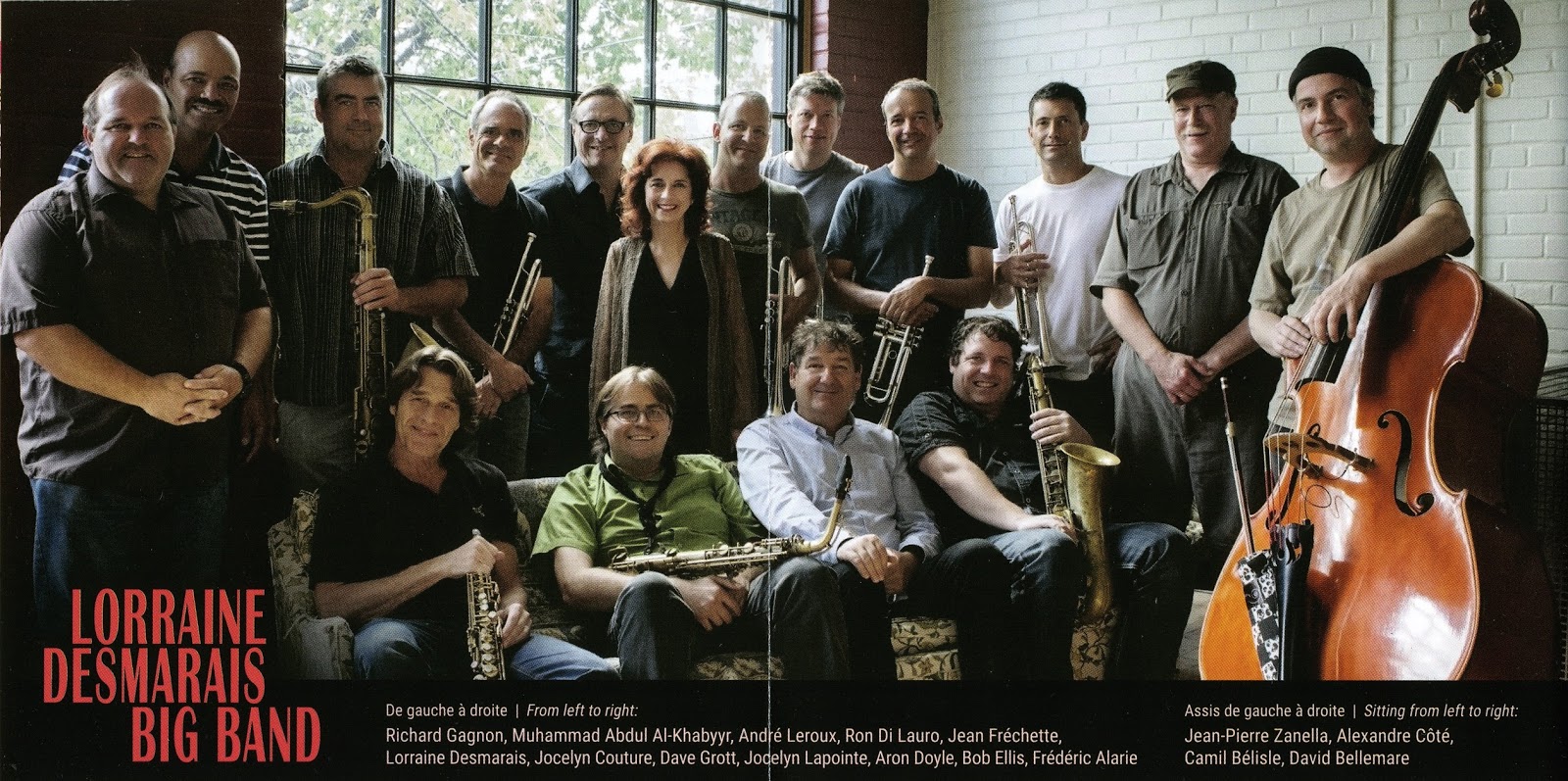

“With the release of her new, big band jazz CD, DANSES, DANZAS, DANCES, consummate, gifted and dynamic Montreal-based jazz pianist, composer and arranger LORRAINE DESMARAIS (www.lorrainedesmarais.com) has not only explored new territory as an artist, but in manifesting her vision, has surrounded herself with the creme de la creme of the Montreal and Canadian jazz cognoscenti-including brilliant musicians Richard Gagnon (trombone), Dave Grott (trombone), Mohammad Al-Khabyyr (trombone/voice), Bob Ellis (bass trombone), Andre Leroux (tenor sax/flute/clarinet), Jean-Pierre Zanella (saxophones/flute), David Bellemare (tenor sax/flute), Jean Frechette (baritone sax/clarinet), Alexandre Cote (alto sax/flute), Ron Di Lauro (trumpet/flugelhorn), Jocelyn Couture (trumpet/flugelhorn), Jocelyn Lapointe (trumpet/flugelhorn), Aron Doyle (trumpet/flugelhorn) and completing her fine rhythm section are Frederic Alarie (bass) and Camil Belisle (drums).

Desmarais wears several hats on this compelling, sensual, rhythmic and deeply evocative project, having not only composed, arranged and performed on all ten tracks, but also having acted as producer and artistic director. DANCES was launched with a hugely successful concert at this year's Montreal International Jazz Festival, where the joy was shared by audience members and critics alike - including Christophe Rodriguez of The Montreal Journal, who wrote that "Pianiste Lorraine Desmarais et ses complices ont injecte une forte dose d'octane" [Pianist Lorraine Desmarais and her accomplices have injected a strong dose of octane.]

Desmarais and her dynamic big band are currently planning international appearances in support of DANCES, DANZAS, DANCES which will include performances Toronto and New York City (where Lorraine lived during a significant part of her exceptional career.)

The beautifully recorded, masterfully performed and profound musical journey that encompasses DANSES, DANZAS, DANCES features ten original compositions and big band arrangements by Lorrraine Desmarais, including (in her own words!).


"Ultra Triple Swing" - a touch of madness, bursts of energy and bright tones, explosive rhythms, the big band boldly leaps between blues and jazz, sweeping me up to swinging heights!

"Olivier" - the sensual poetry of the Bossa Nova, infused with luscious Latin flavours and tasteful nuances. An intimate conversation between a piano and an orchestra. I feel the caress of a cool and gentle breeze.

"Reel" - a feast of fabulously funky solos and bold melodies blown by a boisterous orchestra. Like a long-forgotten Irish folk tune, this piece reminds me of the lively square dancing of my youth.

"Habanera" - like a captivating choreography, this music conjures up dizzying dance steps, set to a breathtaking soundtrack.

"Tango" - passionate, seductive, and sensuous. Delicate dance steps set the tone for an elegant improvisation.

"Milonga" - ardent Argentina, fiery footsteps pounding to a fast and uptempo beat. I am quite taken by the rustic charm and humour of this joyful celebration of life.

"Bolero Romantico" - I wrote this seductive, gracefully moving piece in a flash of inspiration, inviting the soprano saxophone to dance with the orchestra, as if gently gliding over turquoise waves.

"Reggae Do" - a jumble of joyful tones, thrilling rhythms and intoxicating ostinato, spiced up with solos that sizzle under the warm, Jamaican sun.

"Walzer" - as if set in the era of knights and nobleman this piece evokes all the poetry of an elegant ballet, where dancers exchange longing glances, and come together in a graceful embrace. Let yourself be charmed by the subtle nuances of this delicate waltz.

"Samba Para La Corrida" - a sunny Brazilian beach, alive with hip-swinging grooves and festive sounds that burst out like colourful confetti. Transport yourself to the carnival and samba your troubles away!”

Order information is available at www.lorrainedesmarais.com

Media contact: Lesley Mitchel Clarke - lmcmedia@sympatico.ca or via Trevor Whittamore - trevor@socialtalknoe.com


Friday, October 14, 2016

More Zoho: Albert Marques Trio - Live in the South Bronx

© -Steven Cerra, copyright protected; all rights reserved.


While we are the subject of the Latin Jazz featured on Zoho Records, the editorial staff at JazzProfiles, would also like to hip you to Albert Marques Trio Live in the South Bronx (Zoho ZM 201616) which has a Street Date of November 4, 2016 and features ALBERT MARQUES piano WALTER STINSON double bass ZACK O’FARRILL drums.


The  following insert notes are by pianist, composer and bandleader Arturo O’Farrill whose knowledge of all things Latin Jazz benefits from a legacy passed down by his father, the legendary Chico O’Farrill.


“Bronx is old school. Its terrain is gritty, real and demanding of your best. It rewards you though. Music history oozes from there. Many of our heroes were either born here or passed through. That mixture of tough, demanding but fierce passion is born out of love for community, for raza (people) and for art.


Pregones is a Spanish for street crier. Whether selling, proclaiming or announcing, the pueblo is filled with the sounds of Pregones. The theater where this performance was recorded is an example of proclaiming, self-realizing. When no one would invest in the South Bronx, the South Bronx invested in itself and a neighborhood theater was born. Tough meets passion, dedication meets hard work and the Bronx rewards the result. Pregones is a testament to neighborhood activism.


Albert Marques is tough but sweet, a Catalan transplant from Spain who created a life for himself in New York, and whose passion at the piano is only matched by his huge humanity and kindness. Walter Stinson is bass. He lives by his instrument and pours his soul into every note he plays. Zack O’Farrill, a gentleman I know quite well, has an encyclopedic knowledge of music, an intellect to match and the virtuosity/creativity at the drums-to realize those qualities musically.


The three of them are fierce, tough and passionate, but tempered by love and mad respect for each other. This is the secret to their Art. Music is a demanding discipline, not for the faint hearted one must be tough with a thick skin, yet flexible and passionate, willing to be vulnerable. All of thisis impossible without that greatest of all humilities, love. Put your heart out there, lay your ego aside,and let the greater good shape your art. This is the story of the Bronx, the story of Pregones and the story of the Albert Marques Trio.


Doble Sur (Double South) is not a Spanish style of jump rope. It is a seamless blend of Afro-Caribbean, Afro Mediterranean performance practice. It is montuno meets Phrygian in technical language, but for the layman it is rice and beans with manchego and chorizo. This piece is not solo-derived, but ratier built on bold strokes of color and rhythm.


This composition, IDN, first made its appearance on their self-released debut recording but makts its presence again here on their ZOHO debut, as if put through fire, the dross burned away and a leaner, meaner version emerges. Walter's introduction is unrestrained without being indulgent. The trio reponds telepathically to the piano solo and it morphs, as the tension builds to the bass and drum improvisation
.
These young masters give Iris, the Wayne Shorter composition, a loving treatment. You can hear the reverence and awe they have for Wayne. Again Walter wears his heart on his sleeve for his beautiful bass solo. Albert follows suit giving us a glimpse into a firmly Spanish take on jazz balladry.


Jazz Is Working Class takes on many who would argue that it is the sport of the elite. Before there were expensive buildings to maintain and seasons to program, jazz took place without soft drink sponsors, and was subversive. This composition captures the rebelliousness of an art form that belongs to the pueblo no matter how much plastic you cover it in. The provocation between Albert and Zack that leads to the drum solo is confrontational and illustrates the need for jazz to never abandon its hardscrabble roots.


Canco Pel Pare (Father Song) is beautifully appropriate to Albert who in this piece celebrates the center of his joy, being a young dad to a beautiful baby daughter, Aviva. If you know this about him, you've discovered his soul. Being young and a working musician with a new family can be a terrifying reality so this piece has both an edge and a reassurance to it.


Bill Withers is a big hero to a lot of us jazz musicians and one of his masterpieces is Ain't No Sunshine. It is piece about love that is so real that there is cost involved. Not the fluffy it's all about "me" love, but the kind that makes demands This is the love that playing instruments is about. It costs, and it involves some measure of sacrifice. Musicians understand this. To love is to give, to hurt, to miss, to fear but most of all to groove.


Walter Stinson's original, Allen Watts, is a portrait, a miniature. Like so much of Walter's writing it is definitive and unlike anyone else's work. There is an introspective quality to Albert's solo that feels integral to the composition. When you are a musical painter, like Walter, your solos have to reflect the quality of contemplative study.


I don't know what Zack has a Foggy Conscience about (and maybe I don't want to know) but I do know that this is exciting compositionally. It's new but doesn't feel like a belabored new. It feels like honest and rooted exploration. The dark, brooding quality in this piece has no relation to the nature of the Zack we know. But honesty as a composer is about vulnerability and wearing your explorer badge. I love the fluidity and ESP these three share, as they take the composition out for a walk.


Final Thoughts


This is not cartoon jazz, or stereotypical Latin Jazz trio. It is modern, fusing elements of Rock, Jazz , Flamenco, R&B with a healthy dose of introspection. Just because I know these guys, I can assure you there isn't a fake moment in the recording. Every note is played with grit, reality, and love. It seems easy to make records that fit a neat category, affirm one's identity and serve as musical wallpaper. It is a lot more difficult to go on journeys that demand honesty, a willingness to open up, the ability to withstand grit and funk, and to be real. But boy oh boy, do these young masters reflect the Bronx, Pregones and the pueblos they come from, boy do they reward!”


Arturo O'Farrill
July 2016, Rotterdam,
The Netherlands


Zoho Media contact: Jim Eigo Jazz Promo Services,
E-Mail: jim@jazzpromoservices.com


Thursday, October 13, 2016

Zoho Records, Greg Diamond and "Avenida Graham"

© -Steven Cerra, copyright protected; all rights reserved.


Almost since the inception of the music in New Orleans, Jazz has always had what Jelly Roll Morton labeled a “Spanish tinge.”


When Jazz evolved in New Orleans at the turn of the 20th Century, the city was a melting pot of Spanish, French, French-Canadien, English, and Negro slaves from various regions in Africa. Traders from many, other parts of the world also made port in New Orleans as did merchants from the Caribbean and South America. Many of these visitors were from Spanish-speaking colonies who brought their unique rhythms with them.


Very soon after Jazz evolved in New Orleans it arrived in New York and The Big Apple soon became the place to go to make it in the Jazz world.


It remains so today.


New York is “the place to be” if you want your music to be heard.


It also a setting where “the Spanish tinge” continues to make itself felt in the music.


The reason for this is partially due to the huge migration of Spanish-speaking immigrants that arrived in the city from Puerto Rico, the Caribbean islands, Cuba and parts of South America during the second half of the 20th century.


Independent record labels that focus on Jazz have always been an important means of broadcasting the New York Jazz scene to the rest of the world: think Blue Note, Prestige and Riverside, among many others.


Today’s New York Latin Jazz scene benefits immensely from the presence of the Zoho record label.


Here’s some background on Zoho and its founder, Joachim Becker, from the “About Us” segment on its website:


“Welcome to the colorful sounds of New York's freshest and sharpest latin / jazz and rock indie CD label! Founded in September, 2003 by New York producer and music industry veteran Joachim “Jochen” Becker, ZOHO has quickly distinguished itself as one of the most talked-about and creative voices on the U.S. indie label scene, with 1 GRAMMY and LATIN GRAMMY win each, and several additional GRAMMY and LATIN GRAMMY nominations as well.


ZOHO started with the vision of presenting a latin / jazz label with a distinctive “New York vibe” – listen to any group of ZOHO releases, and you’ll hear what’s presently new, fresh and happening in the New York clubs! The label has been fortunate in attracting a unique mix of major, internationally recognized, and mostly New York area based artists such as Ray Barretto, Dave Liebman, Arturo O’Farrill, and Carlos Barbosa-Lima to ZOHO. Additionally, the label is proud to present several young latin and jazz musicians from the dynamic downtown New York club scene, including 2006 Grammy nominees Edsel Gomez and Dafnis Prieto, plus releases by Pablo Aslan, the Stryker / Slagle Band, Rez Abbasi and many others.


In 2005, ZOHO saw an opportunity of expanding its artist roster and repertoire reach into the Blues, R & B and Classic / Southern Rock genres. The label has since been able to build a powerful catalog under the ZOHO ROOTS imprint, with American artists Bonnie Bramlett, Jimmy Hall, and the legendary Ike Turner. In 2006, ZOHO signed a multi-year cooperation agreement with Cote Basque Productions, a British production company specializing in British Blues, R & B and Classic Rock acts: the first three joint projects presenting Arthur Brown, the Malchicks and the Pretty Things are expected to be released in the summer of 2007.


ZOHO is mindful of the current, grim state of the recorded music industry and of the formidable challenges in running, let alone operating profitably, an indie music label. Where many fail, the most dynamic, savvy, persistent, fearless, and resourceful can and will be successful: ZOHO has been blessed with having some of the world’s finest artists, distributors, photographers, designers, publicists, consultants, attorneys, and others on its team.”


Jim Eigo of Jazz Promo Services sent along a preview copy of guitarist Greg Diamond’s forthcoming Zoho CD Avenida Graham (Zoho ZM 201615) which has a Street Date of November 4, 2016 and it is a classic example of what’s going on at the label and the type of artist it represents.


GREG DIAMOND Guitar, STACY DILLARD Tenor and Soprano Saxophone (1,4-6,8,9), SEAMUS BLAKE Tenor Saxophone (2,3), MIKE ECKROTH Piano, PETER SLAVOV Bass, HENRY COLE Drums , MAURICIO HERRERA Congas & Percussion (1,3,5,9)


Here’s the press release that Jim sent along which centers on Bill Milkowski’s insert notes to Greg excellent CD.


“Modern musicians living in New York City - those with their antennae up and with the open-mindedness to soak in their musical surroundings — are invariably the beneficiaries of what the city's former mayor David Dinkins once referred to as "a gorgeous mosaic."


Rather than depicting the city as a melting pot, in which myriad cultures blend into one homogenized mass of assimilation, Dinkins talked about the beauty of keeping rich cultures together, side by side, in his Inaugural Address of 1990. And so, it is possible, in walking through different neighborhoods in the boroughs of NYC, each with its own distinctive character, to experience Puerto Rican plena and bomba, Dominican merengue and bachata, Colombian cumbia, Peruvian festejo and lando and various other rhythms from the African diaspora in their pure form. And for eager musicians like Greg Diamond, those sounds and rhythms are bound to seep in.


A self-described 'hybrid musician/ guitarist-composer Diamond grew up in Queens, and later in a suburb of New York City, with a rich musical heritage in his own household, before he began experiencing the cornucopia of sounds the city had to offer. "I'm half Eastern European Jewish and half Colombian. My father's a New Yorker, born and raised. He was an opera singer who studied classical piano at Juilliard, so I was listening to that music growing up. And my mother is Colombian, so I definitely grew up with that component as well,"


Spending two years in Colombia after graduating from high school was a kind of roots journey that led him deeper into his appreciation of Latin music. "When I moved back to the city in '99, my main focus was jazz, learning the tradition," Diamond explains. "Yet at the same time my interest in Latin music in its various forms continued further."


From 2002-2013, when he lived near the intersection of Graham Avenue (aka Avenue of Puerto Rico) and Broadway in Brooklyn, Diamond would soak up the sounds of Hector Lavoe and Willie Colon blasting out of cars, apartment windows and porches in the neighborhood. "I got a good amount of inspiration living in that neighborhood, but more importantly, it represents a period of important growth," he says.


Today Diamond is a quintessential product of New York City's gorgeous mosaic, and Avenida Graham is a reflection of all his varied influences that have come together organically in his music. "I devote a lot of time studying the great masters but I also try to nourish another need to listen to other kinds of genres. I try not to limit myself to one part of the spectrum. Music is a universal language and we live in a rapidly globalizing and pluralistic society - I believe that a lot of music coming out today is a reflection of that."


Some of the pieces on Avenida Graham had their beginnings as far back as 2009. Others were written a few months before the May 2015 session at Sear Sound Recording Studio in Manhattan. All in all it's some of his most accomplished writing to date. Diamond, who exhibits a warm, unaffected tone in his cleanly picked lines throughout this spirited recording, is joined by a stellar crew. Drummer Henry Cole (who plays with Miguel Zenon) and pianist Mike Eckroth (formerly of John Scofield's band) are both returning from 2012's Conduit as are tenor saxophonist Seamus Blake (who appears on two searing tracks here) and percussionist Mauricio Herrera. Rounding out the lineup are saxophonist Stacy Dillard and bassist Peter Slavov.


The collection kicks off with the churning, odd-metered groover Synesthesia which is fueled by Cole's polyrhythmic pulse and Herrera's percolating percussion. Dillard, on soprano sax, engages in some tight unisons with Diamond on the head, and as the piece opens up each contributes free-flowing solos that uplift the proceedings. Cole is also turned loose over a long tag at the end, bringing this opener to an exhilarating conclusion.


Rastros ("Traces") opens on a tender note with Diamond's fingerpicked arpeggios against Blake's melancholy tenor tones. As the piece develops, it reveals a subtle tango flavor and gradually builds in intensity with Blake playing passionately over the top while Cole underscores with dramatic fills. Diamond's solo here is elegant and introspective. 'That's one of my favorite tunes on the record," says Diamond. 'The harmonic progression is based on an etude that I wrote for guitar. The melody is very simple but there's a flow to it that I like, and the mood of the piece is very somber and meditative." He explains this track's title: "Traces' is about posterity. It also signals the importance of endeavoring to create music that is transcendent and timeless, in the face of a rapidly changing world that is becoming increasingly chaotic and ephemeral."


El Coronel is a buoyant piece that incorporates an infectious son montuno jam in the middle section. Blake and Diamond have some lively exchanges and Cole erupts on his kit at the tag. "It's an homage to a character from Gabriel Garcia Marquez's One Hundred Years of Solitude," explains Diamond. "It was one of the more challenging pieces for me to write and record. But in essence, I think the song itself, and many of my compositions for that matter, is all about creating a singable melody that can be seamlessly interwoven into a framework that can be both rhythmically and harmonically complex."


Diamond plays fingerstyle archtop on the solo intro to the tender A Hint of Jasmin for more acoustic effect. This moving piece is also a brilliant showcase for Dillard's expressive tenor playing. Gentrix, a rhythmically deceptive piece in five, incorporates lots of tricky subdivisions as the tune progresses. The presence of Herrera's conga here also gives it a kind of Afro-Caribbean feel. Laia, on the other hand, is full of complexity as it opens with a rubato intro before leaping through different tempo changes and meter changes over the course of 8:26. Dillard soars on soprano here while Diamond contributes another remarkably fluid solo, spurred on by Cole's scintillating and interactive pulse.


Ultima Palabra is a contemplative, graceful number that incorporates an alluring Argentine milonga rhythm. Eckroth contributes a particularly moving piano solo on this thoughtful number. Cascade is a lively, affecting piece that shows Diamond's fondness for melody as a composer and also showcases Dillard's outstanding soprano sax work.


The collection closes with Diamond's most ambitious work, Motion Suite, a kind of sequel to his "Inertia" (from Conduit). "It took roughly two years to complete," he explains. "This one has more complexity than 'Inertia' in terms of tempo changes and changes in meter. I suppose that there's a lot going on here, I'm just really happy that we could make it all come to life in the studio."


Indeed, there's a lot going on throughout Avenida Graham, an auspicious and richly appointed outing from this promising talent on the New York scene.”


- Bill Milkowski


Artist Website: http://gregdiamondmusic.com


ZOHO ® is distributed by Music Video Distributors 203 Windsor Road Pottstown, PA 19464 www.mvdentertainment.com


Zoho Media contact: Jim Eigo Jazz Promo Services T: 845-986-1677 E-Mail: jim@iazzpromoservices.com


The following video features Greg’s El Coronel as set to the photographs of Anthony Hernandez whose work is currently on display at the San Francisco Museum of Modern Art.