© -Steven A. Cerra, copyright protected; all rights reserved.

Noal Cohen maintains a Jazz history website replete with a number of discographies of important Jazz artists and he is also the co-author along with Michael Fitzgerald of Rat Race Blues: The Musical Life of Gigi Gryce that is now available in a second edition.
You can locate more information about both via the following links:
The following blog posting, which is as an adaptation from another format, is presented with the author's permission.
Noal is one of the dedicated Jazz biographer - discographer's documenting the 1945-65 Jazz scene and it is a privilege to represent his work in these pages.
© -Noal Cohen, copyright protected; all rights reserved; used with the author's permission.
[Originally published in Coda Magazine, July/August, 2000 issue (No. 292), pp. 22-29]
Jazz has undergone substantial evolution in its first century, and a few true innovators have always been the required catalysts for change. By the early 1950s, with bebop in decline and big bands fading, many jazz musicians were in search of new approaches to revitalize their art form. While the somewhat earlier experiments of the Lennie Tristano and Miles Davis Birth of the Cool ensembles had attracted considerable attention, it was really the emergence of the West Coast school, the Modern Jazz Quartet, and the groups led by Gerry Mulligan and Dave Brubeck which strongly impacted the jazz scene during this period, resulting in commercial as well as artistic success in some cases. Because of its often restrained, carefully arranged and intellectual characteristics, this music was referred to (sometimes inaccurately) as “cool jazz” and would soon be overtaken and largely displaced by the genre known as “hard bop.”
“Along with Milt Jackson and Terry Gibbs, Teddy Charles had ushered the vibraphone into the modern era. He was also a significant contributor during this period through his innovative compositional approach to jazz performance. Issued between 1952 and 1956, Charles’s most important recordings were strikingly fresh, defying stylistic and geographic labels and were critically well-received. While his music has sometimes been portrayed as a precursor of both free jazz and the so-called “third stream,” it was his intent neither to jettison the conventional framework of jazz nor to create a fusion with classical music. For many years he was a mainstay in the New York clubs and studios and, gifted with organizational skills and the ability to recognize talent, would eventually move into the area of record production before leaving music for a long period to pursue his other passion in life, sailing.
Charles was born Theodore Charles Cohen in 1928, in the Springfield, Massachusetts area, to Jewish immigrant parents, and was the youngest of four siblings. Known as Teddy Cohen for the first five years of his professional career (he is so credited on many of his early recordings), he would change his name to Teddy Charles when he became a leader, at the urging of his manager who felt that the surname Cohen was too ethnic for widespread acceptance in the music business.
The family owned a piano and Teddy’s brother George was a self-taught pianist (and a fan of jazz giants including Benny Goodman, Duke Ellington, Artie Shaw, Jimmie Lunceford, Lionel Hampton, and Chick Webb) who passed on some of his knowledge and an appreciation of good music to his younger sibling. This, coupled with his own doodling on the chronically out-of-tune instrument, afforded Teddy a valuable familiarity with the piano keyboard, which would later facilitate his mastering the vibraphone.
Charles’s early years do not evoke pleasant memories for him because of the anti-Semitic harassment he endured and the lack of good music programs in the local school system. By high school, he had begun drum lessons but detested marching bands and the poor level of music instruction. Soon he was playing gigs around Springfield in place of local musicians still in wartime military service, and had decided that music was the profession he wished to pursue. After high school graduation, he entered a summer extension program at the Juilliard School of Music in New York, where it became apparent that he was in way over his head, competing with newly-discharged GIs who already had substantial musical training and professional experience. By working very hard on overcoming his deficiencies that summer, he survived an audition and was accepted at Juilliard as a full-time student and percussion major in the fall of 1946.
Although financial constraints forced him to abandon formal academic studies after two years, it was during this period that he forged a long-standing and highly productive relationship with the composer and pianist Hall Overton who was first a student and then an instructor at Juilliard. Fortunately, Charles was able to continue studies privately with Overton and others on the Juilliard faculty while sustaining himself with various professional opportunities as a drummer. Furthermore, having relocated to New York, he was now spending time on 52nd Street, listening to the new developments in music, even sitting in at times on drums and piano and interacting with other stars to be. There were also sessions at Nola Studios with people like pianists Joe Albany, Kenny Drew, and Billy Triglia, saxophonists Ray Turner, Brew Moore, and Zoot Sims, trumpeter Jerry Lloyd, and drummer Eddie Shaughnessy, among others. In Shaughnessy he would find another kindred spirit and frequent collaborator.
But Charles’s skills as a drummer were not overwhelming. His style, influenced by Gene Krupa, George Wettling, and Cozy Cole, was not suited to the bebop of the time. When he saw what great modern drummers like Shaughnessy and Max Roach were doing, he decided that perhaps the vibraphone, to which he had been re-exposed at Juilliard, was the instrument he should pursue. Given his facility as a drummer and a good working knowledge of the piano, the transition to vibes was an easy one and provided an opportunity for melodic and harmonic as well as rhythmic expression.
Besides gigs in New York City, Charles began to travel with some of the big bands including those of Bob Astor and Randy Brooks. Later, he would also work with Benny Goodman and Artie Shaw but never recorded with them. Since parts were generally not written for vibes, Charles would serve to provide background and to fill in for vocalists, experience which would later come in handy in commercial studio work. He toured with Roy Eldridge in a band that also included Zoot Sims and worked occasionally with Oscar Pettiford’s early small groups. He once appeared with Charlie Parker and Art Blakey in a concert at the Audubon Ballroom.
While influenced by the masters Lionel Hampton and Red Norvo, Charles had, by the late 1940s, assimilated the vocabulary of Parker and Gillespie and established himself as one of a handful of bebop vibraphonists. Chubby Jackson afforded Charles his first recording opportunity with the bassist’s short-lived but exciting big band of 1949, whose other members included saxophonists Frank Socolow, Ray Turner, and Marty Flax, trumpeters Al Porcino and Charlie Walp, pianist Gene DiNovi, bassist Curley Russell, and drummers Tiny Kahn and Joe Harris. Four tracks were recorded for Columbia and Charles plays a fluent two-chorus solo on the breakneck “Father Knickerbopper” and has a very brief outing on “Godchild.”
Another significant collaboration around the same time involved the sextet of clarinetist Buddy DeFranco which recorded five tracks for Capitol in August of 1949. This ensemble included guitarist Jimmy Raney, who would become another long-time associate of Charles, as well as the master drummer Max Roach. Charles contributed an original composition to this session, “Aishie,” named for one of his sisters, and based on the chord progressions of Cole Porter’s “Night and Day.” The music of this band, which has seen no reissue in the CD era, exhibits a smooth and liquid character because of the texture of the clarinet-vibes-guitar front line and offers an interesting contrast to the Benny Goodman and Artie Shaw sextets of similar instrumentation. The two standards, “Penthouse Serenade” and “Good for Nothin’ Joe,” are reminiscent of the George Shearing Quintet and suggest a commercial intent while other tracks are swinging bop with excellent but brief solos by DeFranco, Raney and Charles. The clarinetist and vibraphonist would interact again two years later, in DeFranco’s big band.
By 1950, Charles had become a fixture on the New York scene and worked frequently in a trio setting with guitarist/vocalist Jackie Paris. Charles’s first significant venture as a leader was known as the Teddy Cohen Trio, composed of vibes, guitar and bass, and obviously patterned after the Red Norvo Trio. Although Charles preferred working with a drummer, this format was successful and the group got consistent club work and even some TV spots. The guitarist was Don Roberts (later replaced by Jimmy Raney) and the bassist, Kenny O’Brien (later replaced by Bill Crow). In addition to their musical performances, the group was encouraged to do comedy routines in order to enhance their commercial appeal, but these usually fell flat with the musicians’ subtle, inside humor going over the heads of most audiences. The trio recorded in 1951 for Bob Weinstock’s Prestige label. Of the eight released tracks, seven are standards and one, “O’Brien’s Flyin’,” is an original blues. Charles’s arrangements make good use of the limited instrumentation and his solo on the up-tempo “Old Man River” is impressive, demonstrating great facility. But this was relatively bland stuff compared with what was to come.
A chance encounter in Toronto in which Charles’s trio was enlisted to back guitarist and vocalist Slim Gaillard resulted in a lasting change in his approach to the vibraphone. Astounded by the volume level at which Gaillard played his instrument, Charles found that in order to be heard, he had to respond by playing at levels and with an arm strength he had never previously attempted in most of the bebop settings he had participated in to that point. This valuable experience, coupled with his innate adaptability and musicianship, allowed him to become a versatile studio player. In the years following, he would be present on many New York rhythm and blues recording sessions led by major artists in that genre such as Sonny Terry, Earl Bostic, Chuck Willis, Bubber Johnson, Connelly King, and Little Jimmy Scott.
Between 1952 and 1955, Charles recorded a series of groundbreaking albums for the Prestige and New Jazz labels called New Directions, Vol. 1-5. With Hall Overton, he had developed a compositional approach to jazz performance that attempted to transcend the standard theme statement/solos/theme restatement format. Eschewing standards in favor of unfamiliar, original material, Charles’s concept was to fully integrate the written and improvised sections of a jazz performance so as to provide new contexts and challenges for the artist. Among the other musicians involved in these recordings were several who also had an interest in composition and broadening the boundaries of the art form including Jimmy Giuffre, Shorty Rogers, Bob Brookmeyer, and Jimmy Raney. The Charles/Overton philosophy was cogently summarized in Ira Gitler’s liner notes to one of the reissues, Collaboration West:
“It is not a radical departure from what has become conventional jazz playing but is rather an evolution to a jazz style more controlled with regard to form, unity of materials and development while generating through this medium a greater freedom for solo and group improvisation. The restricting of materials to circumscribed limits permits a freedom impossible where all players pull in completely independent directions. Teddy believes by using materials unfamiliar to conventional jazz playing, using conventional materials in unfamiliar ways and using compositional techniques in treating these materials, a cohesive jazz environment is produced which at once liberate the soloist.”
The first New Directions session was recorded in New York at the end of 1952 and involved a quartet with Jimmy Raney, Ed Shaughnessy, and bassist Dick Nivison. Like most of the sessions in this series, it was pianoless (Charles and Bob Brookmeyer do appear on piano on two of the later sessions). Charles felt that most pianists, with the exception of Overton and later, Mal Waldron, interfered with the vibraphone and limited the directions in which he wanted both the solos and instrumental interactions to develop.
In January of 1953, the most avant-garde of the New Directions series was recorded with a trio comprised of Charles, Overton, and Shaughnessy. No bass player is present nor would one have been appropriate as this music does not pulsate with anything resembling the usual jazz rhythmic sense. Four pieces were recorded, three by Overton and one, “Metalizing,” by Charles. It is very difficult to determine which portions of this music are written and which are improvised and the music has the character of a contemporary percussion ensemble. But this should not be confused with the “free jazz” of the 1960s. Again, Ira Gitler’s excellent liner notes are instructive:
“Each piece has a definite shape, based on a preconceived structure just as head arrangements are. Each structure is divided into sections, and specific thematic material is devised for each section, but the final working out of this material depends on the most sensitive kind of rapport between the performers.”
The next month, a combination of personal and professional factors led Charles to temporarily relocate to Los Angeles where he quickly became a part of the burgeoning West Coast jazz scene and began to supervise recording sessions for the Prestige label. His first project involved a sextet made up of tenor saxophone giant Wardell Gray, alto saxophonist Frank Morgan, pianist Sonny Clark, drummer Lawrence Marable, bassist Dick Nivison, and Charles, which recorded four swinging tracks including two Charles originals, “So Long Broadway” and “Paul’s Cause.” This was the recording debut of both Clark and Morgan. Charles appeared frequently with the Lighthouse All-Stars and worked in various contexts, including his own groups with many of the Southern California jazz luminaries such as Shorty Rogers, Jimmy Giuffre, and Bill Perkins, the performances usually being very well received.
In August of 1953, two recording sessions took place that represent the most successful examples of what Charles was striving for (New Directions Vols. 3 and 4). The participants were trumpeter Shorty Rogers, bassist Curtis Counce, and the incomparable Shelly Manne on drums. On the later session, Jimmy Giuffre was added on tenor and baritone saxophones and clarinet. Of the eight original compositions, five are by Charles, two by Rogers, and one by Giuffre. Hall Overton summarized the characteristics that distinguish this music from standard jazz formats: “1. longer forms than the usual 32 bar song form; 2. a much more varied type harmony (polytonality, 4th chords); 3. spontaneous counterpoint, whenever performers feel an extra melodic line fits; 4. fluctuating tonal centers.” Among many highlights, Charles’s “Variations on a Motive by Bud” is a fascinating, up-tempo reinvention of “Get Happy” based on a left-hand motif employed by the piano master Bud Powell, while the modal “Bobalob” clearly presages Miles Davis’s directions of a few years later. The rapport/interplay among the musicians is impressive and renders insignificant the East/West Coast and “cool” stereotypes that had become so entrenched. These sessions, like the Tentet recordings that followed, demonstrate that experimental and innovative jazz can also swing compellingly and need not abandon the fundamental characteristics of the idiom in order to achieve its goal.
Upon his return to New York, Charles began to tour the club and college circuit with a pianoless quartet which at various times included trumpeter Art Farmer, tenor saxophonist J.R. Monterose, trombonist Bob Brookmeyer, drummers Jerry Segal, Rudy Nichols, and Elvin Jones, and Charles Mingus on bass. Charles’s relationship with the immensely talented but difficult Mingus would be a long-lasting and productive one, resulting in some memorable collaborations ranging from gigs as a vibes/bass duo to a performance of Mingus’s extended orchestral work, “Revelations” at Brandeis University in 1957, and the Mingus Dynasty recording session for Columbia in 1959. In 1960, he participated in the “protest” festival at Newport organized by Mingus and Max Roach in response to economic exploitation and racial injustice, performing in a sextet with trumpeter Kenny Dorham, tenor saxophonist Allen Eager, pianist Kenny Drew, bassist Wilbur Ware and drummer Art Taylor. Charles had and continues to have the highest regard for Mingus’s music, describing its emotional impact as “raw power in action” while at the same time lamenting the bass player’s consistent and frustrating inability to notate his scores in a way that would produce the desired results.
In July of 1955, Charles played on, supervised, and wrote most of the arrangements for a Miles Davis session (Blue Moods) on Mingus’s Debut label. Charles had first met Davis when both were studying at Juilliard. This fascinating quintet (again forgoing piano) included Britt Woodman on trombone, drummer Elvin Jones, and Mingus, but personality conflicts and a copying error in Mingus’s arrangement of “Alone Together” led to tension and bickering which severely limited the session’s productivity. (Charles remembers this as one of the most difficult sessions in which he participated.) However, the resulting four tracks do show how genius can rise above adversity to yield memorable music. This low-key, sensitive, and emotional LP, dominated by Davis’s plaintiff trumpet, received a five-star rating in Down Beat magazine.
Charles was a participant in Mingus’s Jazz Composers Workshop which also included such major talents as George Russell, Gigi Gryce, Gil Evans, John LaPorta, Teo Macero, Mal Waldron, Wally Cirillo, Sam Most, Don Butterfield and many others with an interest in composition and experimentation. These associations facilitated the formation of the Teddy Charles Tentet, an unusual ensemble made up of three saxophones, trumpet, tuba, guitar, vibraphone and rhythm section. Recordings by this aggregation for the Atlantic label in 1956 have become classics and stand as the crowning achievement of Charles’s career and the culmination of the compositional approach which he and Hall Overton had formulated earlier. Blending breathtaking writing by Waldron, Russell, Gil Evans, Jimmy Giuffre, Bob Brookmeyer and Charles himself with outstanding solos by the leader, Art Farmer, J.R. Monterose, and Gigi Gryce, this music, fortunately reissued on CD, remains a delight, fresh and full of surprises some forty-three years after its release. Waldron’s “Vibrations” has been included in the Rutgers Institute of Jazz Studies archive collection, The Greatest Jazz Recordings of All Time. Charles’s tribute to Charlie Parker, “Word from Bird,” an extended work which added trombone and French horn to the instrumentation, was conducted by composer David Broekman at the Newport Jazz Festival. The Tentet was also a mainstay of Broekman’s “Music In the Making” series at Cooper Union. Unfortunately, this ensemble had little commercial potential and Charles, characteristically, rebuffed the urgings of his manager to compromise by adding material that would have broadened its appeal. By 1957, the Tentet was history, only being revived occasionally in the years to come.
In Mal Waldron, Charles had found a piano player with whom he felt comfortable and who shared his interest in composition. Both were thematic improvisers who constructed solos thoughtfully and within the context of a piece rather than relying on clichés and inappropriate technical flights of fancy. Many collaborations followed including the Prestige Jazz Quartet, a collective ensemble patterned on the Modern Jazz Quartet, with Addison Farmer on bass and Jerry Segal on drums. Two LPs were recorded for Prestige, one featuring tenor saxophonist Teo Macero as a guest artist. Both Waldron and Charles contributed adventurous original music including the vibraphonist’s “Take Three Parts Jazz Suite.” The quartet added trumpeter Idrees Sulieman for recordings on the Elektra and New Jazz labels that were very much in the now firmly entrenched “hard bop” tradition. An outstanding Prestige session (Olio) in which Charles and Waldron participated, and which has finally been made available on CD, involved trumpeter Thad Jones, flutist/saxophonist Frank Wess, bassist Doug Watkins, and the irrepressible Elvin Jones on drums. What would normally have been a jam session format common to Bob Weinstock’s label at the time was enriched by the writing of Waldron and especially Charles, whose dark and exotic compositions, “Dakar” (later recorded by John Coltrane) and “Hello Frisco” (a response to the earlier “So Long Broadway”) create a fresh and stimulating atmosphere for this immensely talented ensemble.
Having recently celebrated Duke Ellington’s centennial, it would be remiss to omit mention of the long-forgotten Three For Duke session of 1957 for the Jubilee label, in which Charles was reunited with his friend and mentor Hall Overton in a trio rounded out by the master bassist Oscar Pettiford. Six Ellington compositions were recorded including a nine-minute exploration of “Sophisticated Lady,” taken at very slow tempo, but notably avoiding the common ballad crutch of doubling the tempo. Charles had some trepidation about doing this album without a drummer, but Pettiford’s strength and taste rendered such concerns unnecessary. With sketches by both Overton and Charles, the music is faithful to Ellington’s legacy and thoughtful and moving solos are provided by all three participants. The concepts of group rapport and contextual appropriateness so important to all of Charles’s work are ever present. This is an album that definitely merits reissue.
By the late 1950s, Charles was deeply involved in record production and A&R work. He produced or supervised numerous sessions for the Prestige, Warwick and Bethlehem labels and often contributed compositions and arrangements. The list of featured artists, both instrumentalists and vocalists, reads like a who’s-who of the period. He even joined forces with pianist and concert promoter George Wein to form a record production company known as Joydine Productions. Creating new contexts for artists both upcoming and established, and combining personnel in ways that might generate novel results was an ongoing challenge that he enjoyed. One notable example of his work, long out of print, is The Amazing Mr. Sam Most, recorded for the Bethlehem label in late 1957, in which the multi-reed artist is backed by a string quartet in the performance of six standards. Charles’s arrangements, of which he remains very proud, create intriguing interactions between the strings and Most’s flute, clarinet and tenor saxophone that on certain tracks prefigure the Focus collaboration between Stan Getz and Eddie Sauter of four years later.
Through his close friend Teo Macero, who was performing A&R duties for Columbia Records, Charles became involved in two interesting recording sessions in 1959 for that label. (Neither has been reissued on CD in its entirety.) Something New, Something Blue was designed as a vehicle for four arrangers, Charles, Macero, Bill Russo, and Manny Albam, who each contributed an original composition and a new version of a blues standard for a medium-size ensemble which included Donald Byrd, Bob Brookmeyer, Mal Waldron, Ed Shaughnessy, and others. Charles provided his own “Swinging Goatsherd Blues,” originally written for the Australian Jazz Quintet, and an effective update of “Blues in the Night,” which features a beautifully voiced introduction, a 12/8 feel, and fine solos by the arranger, Byrd, and Brookmeyer. The second project was a jazz version of the Broadway show, Guys and Dolls with Charles and Macero dividing the arranging duties for varying ensembles aptly called “The Manhattan Jazz All Stars.”
The trumpeter Booker Little was a favorite of Charles as both a player and writer and, in 1960, was featured on a Warwick album called The Soul of Jazz Percussion. Charles, as producer, enlisted his old friends Mal Waldron and Ed Shaughnessy to participate in this project and they, along with Little, Tom McIntosh, and Alonzo Levister, provided some very unusual scores for stellar ensembles including Donald Byrd, Marcus Belgrave, Bill Evans, Paul Chambers, Addison Farmer, Philly Joe Jones, Don Ellis, Pepper Adams, and Curtis Fuller. Little also joined Charles’s quartet and tenor saxophonist Booker Ervin for a memorable concert at the Museum of Modern Art in New York which was first issued on the Warwick label, but later rather mysteriously reissued with the title Sounds of Inner City (TCB label) and most of Charles’s solos deleted.
An outstanding album of Charles Mingus’s music, performed by Pepper Adams, was produced by Charles in 1963 for the short-lived Workshop Jazz series of the Motown label with which he had become affiliated. He also adapted several themes of Russian classical composers for small jazz ensemble resulting in the United Artists LP, Russia Goes Jazz with an all-star cast of New York players (as always) and hilarious, satirical liner notes by Ira Gitler. But as the 1960s progressed and opportunities for jazz musicians began to dry up, Charles’s activities likewise diminished. His versatility and good sight-reading ability enabled him to secure lucrative commercial studio work (eg. Paul Simon, Dion and the Belmonts), but he abhorred and often could not even concentrate on music he found banal and uninteresting. His last recording for over twenty years was made in 1967.
Charles had a keen passion for and had been active in sailing and deep-sea diving all his life. (He even missed a performance at the Newport Jazz Festival in 1959 when he chose to make the trip from New York by boat and the winds died en route.) After finally making the difficult decision to abandon music, he relocated to the island of Martinique to begin a new life and successful career as a charter boat skipper, ferrying passengers and cargo around the Caribbean islands. This adventure in paradise lasted for several years until a chance encounter at a yacht club on Antigua rekindled his desire for music. While accompanying a local clarinetist on piano, Charles suddenly realized how much he really missed his earlier professional activities.
Shortly after his return to New York in 1980, Charles was introduced to the pianist Harold Danko with whom he found a musical kinship similar to those he had established with Hall Overton and Mal Waldron. The two worked together frequently over the next few years while Charles continued his sailing activities. The Soul Note label recorded Charles at the 1988 Verona Jazz Festival in a quartet setting with Danko, bassist Ray Drummond, and drummer Tony Reedus. Although this performance has its interesting moments, it lacks the group rapport and excitement that were so much a part of Charles’s earlier work. The next day, he and Max Roach appeared as a duo in the city of Rovigo, Italy, and tapes of this concert exist, according to Charles.
Charles currently resides in Greenport, New York, on the north fork of Long Island, where his boat, the Mary E, a 72-foot clipper schooner built in 1906, dominates the marina. His scenic cruises on Long Island Sound are quite popular during the summer and fall and a significant tourist attraction. At 71, “Captain Ted,” as he is known locally, is still vigorous, despite having undergone heart valve replacement surgery. He plays the vibraphone occasionally and is slated to perform some of the Tentet music September 18, 2000, in California, under the auspices of the American Jazz Institute.
The legacy of Teddy Charles is remarkably devoid of the mundane and defies easy classification. Nearly every project in which he participated, even those he only produced or supervised, provides some intriguing and novel aspect. While a technically gifted instrumentalist who could hold his own in any setting, his approach de-emphasized virtuosic solo excursions in favor of a collective musical goal. These factors, along with his relative inactivity during the last thirty years, have conspired to keep him in greater obscurity than he really deserves. Hopefully, the future will afford more opportunities for him, and perhaps some of the immensely talented young players of today, to re-explore his music.”
© 1999 Noal Cohen
This article is based, in part, on interviews with Teddy Charles in April and July of 1999. Many thanks to Bill Damm, Mike Fitzgerald, Dan Skea and The Institute of Jazz Studies at Rutgers University in Newark, NJ.
Author’s Addendum – November 2018:
Teddy Charles passed away on April 16, 2012 in Riverhead, NY where he had relocated from Greenport. He had just turned 84. The interviews that I did with him and the above article that resulted led us to become friends, quite a coup for me since his recordings were a great influence and source of pleasure when I was just getting into this music in the early 1950s.
In 2007, Teddy indicated to me that he wanted to return to actively performing in New York City and asked me if I knew any musicians who might be interested in collaborating with him. I immediately thought of saxophonist/composer/arranger Chris Byars who was delighted to assist such an innovative and historically important figure. A meeting at Teddy’s Riverhead home got the ball rolling and during the last years of Teddy’s life, Byars resurrected the famous Tentet and made several recordings and appearances with the vibraphonist. The performance venues included Smalls, The Village Vanguard, Iridium, The Players Theater and Kitano. In addition, Teddy traveled to The Netherlands in November of 2008, touring with local musicians and performing his extended composition “Word from Bird” in Leiden.
In 2010, Teddy and a Tentet including saxophonist Kim Richmond and drummer Ed Shaughnessyappeared at the East Coast Sounds Festival under the auspices of the Los Angeles Jazz Institute and in collaboration with Washington, DC-based saxophonist Brad Linde, there was also a Tentet appearance at The Atlas Performing Arts Center in 2011.
Teddy’s recordings during this period are the following:
Teddy Charles, Dances with Bulls, Smalls Records SRCD-0038 (2009)

Teddy Charles and Walter Wolff, Teddy Charles and the Walter Wolff Trio Live, O.A.P. (Du.) OAPR 904 (2009)

Chris Byars, Bop-ography, SteepleChase (Dan.) SCCD 31686 (2009)
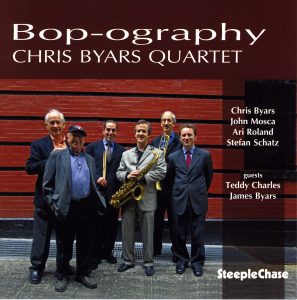
Although cut short by illness, Teddy’s late-career comeback was a significant and productive one and I am happy to have helped facilitate it.
Many of Teddy Charles’ papers and scores are archived at the Jazz Loft Museum in Stony Brook, NY.
Primary Sidebar
Teddy Charles Pages
Rat Race Blues
Buy the Book!

$24.95

Copyright © 2018 · Noal Cohen's Jazz History Website
website by Steve Albin


