Wednesday, March 11, 2020

Sonny Stitt and Gene Ammons: Cutting Sessions and Chases

© -Steven Cerra, copyright protected; all rights reserved.


“Today, fame can come swiftly on the heels of a Top Twenty record, but there was a time when a musician had to prove himself to other musicians in a cutting session. Whether a fellow hailed from New Orleans, San Francisco, Chicago, or wherever, he had to come to the center—New York— before he could get on the road to (relatively speaking) fame and fortune.


There, in the Apple, his skill was tested in competition with the established ones. If he couldn't cut the mustard, he became part of the anonymous mob; capable, perhaps, but not of star quality. However, if the critical, hard blowing jazzmen conceded him recognition, that acclaim would carry him on to bigger and better jobs.


This musical action on the New York battlefield was the cutting session, and the expression was an appropriate one. When a musician picked up his instrument, his intention was to outperform the other man. No quarter was given or expected, and the wound to a musician's ego and reputation could be as deep as a cut.


To a degree, all musicians, white or black, underwent the same test of strength. After arriving in the big town, a player first got squared away with a room. The next thing he'd do would be to ask where the musicians hung out. Downtown and in the evenings, this was usually a bar, say Charlie's Tavern. By day, it was much easier—most of the fellows could be found congregated on the street around the offices of the musicians union, Local 802. But uptown, night or day, Bert Hall's Rhythm Club at 132nd Street, just off Seventh Avenue in Harlem was the main testing ground, and there most of the jamming originated.”


As I recall, the process of elimination usually went this way. Whenever a stranger popped into the Rhythm Club, somebody would greet him with a hearty "Hi there, where are you from?" followed by "What do you blow?" If the newcomer was carrying his saxophone, trombone, or trumpet case, he would be invited to blow some, or, as they said in the argot of the time, "to show out."


Some piano man—and there were always a few of them in the place— would amble over to the keyboard and start comping a tune like "Sweet Georgia Brown" or "Dinah." This was the cue for the stranger to pull out his instrument and show what he could do. Meanwhile, the word had gone out all over the neighborhood—"stand by!"—because if this cat was really good, it was the duty of every tub to drop whatever he was doing and rush to the club. And nobody ever did fall into New York City and cut the entire field— some brother always came to the rescue of New York's prestige.


These sessions, as every other aspect of life, had a pecking order. The giants seldom deigned to compete with the peasantry. Instead, they sat around getting their kicks, listening with amusement as the neophyte struggled to justify his claim to entry into the charmed circle of the (for want of a better word) establishment.
The blowing would start, and the pilgrim's status was soon established— he was either in or out. If he was in, he would be toasted at Big John's bar, and friendships were formed that assured his being invited to sit in a session with the big shots, who did their serious blowing at the Hoofer's Club, downstairs in the basement of the same building.


There, in the Hoofer's Club, the cream of the crop in New York could be found—Jimmy and Tommy Dorsey, Benny Carter, Frankie Trumbauer, Buster Bailey, Sidney De Paris, Fats Waller, and just about every other great name in jazz. Almost every night, rain, snow, or what have you, there was a session—nothing prevented the cats from getting together.”
- Excerpted from Jazz trumpeter Rex Stewart’s chapter, The Cutting Sessions, in his book Jazz Masters of the Thirties as quoted in Robert Gottlieb, ed., Reading Jazz [pp. 387-388]


Cutting sessions and chases, duels and battles and even, for that matter, jam sessions are largely gone from today’s Jazz landscape.


But, as recounted in the opening quotation from Rex Stewart, there was a time when aspiring Jazz musicians had to prove themselves in one of these martial settings.


There are many famous combative pairings in Jazz history - trumpeters Roy Eldridge and Dizzy Gillespie, tenor saxophonists Dexter Gordon and Wardell Gray, drummers Buddy Rich and Gene Krupa - among many, many others.


This feature focuses on two of my enduring favorites, Sonny Stitt and Gene Ammons.


Here is some background on each and discography of their recordings together as drawn from Peter Mathieson’s Cookin’ Hard Bop and Soul Jazz, 1954-65.


© -Peter Mathieson, copyright protected; all rights reserved.


“Sonny Stitt made his initial impact as an alto saxophonist in a mould that was heavily influenced by Charlie Parker. In 1950, he added tenor and baritone to his armoury, and became equally well known on both alto and tenor. Stitt made a huge number of records across a long career (estimates are put at around 150 albums), most of which have long been unavailable, but his performance on disc was often inconsistent, and frequently fails to justify his high reputation for delivering exciting live performances. When he did find himself in a compatible setting in front of the microphones, or simply in the right mood, he laid down enough tangible evidence of his qualities to ensure that his posthumous reputation would reflect the best of his abilities.


He was born Edward Stitt on 2 February, 1924, in Boston, and emerged to notice playing alto in Tiny Bradshaw's band in the early 1940s. He joined Billy Eckstine's famous bebop-oriented big band in 1945, where he met another saxophonist who became his frequent collaborator over the decades, Gene Ammons. Captivated by Charlie Parker, Stitt developed an early style which owed a great deal to Bird in his phrasing, albeit with distinctive nuances of his own.


He worked with Dizzy Gillespie in both his sextet and big band, and formed a sextet with Gene Ammons in 1949, by which time he had adopted the tenor and, more occasionally, the baritone saxophone as an alternative to the alto. He quickly tired of carrying the baritone on gigs, but interchanged alto and tenor throughout the remainder of his career.


He recorded what are now regarded as classic bop sessions with both Bud Powell and J. J. Johnson for Prestige in 1949-50, and made his own recordings for the label in 1950-1, followed by sides for Savoy in 1952. They reveal a player in full command of the bop idiom, but with an equally sharp awareness of pre-bop styles (Lester Young is a palpable influence on his tenor voice, and he always seemed at home with players from the so-called Swing era).


By common consent, Stitt also possessed the requisite killer instinct when things grew combative on the bandstand. Johnny Griffin has identified him as a particularly formidable and even intimidating presence, while saxophonist Red Holloway has recounted the tale of how Stitt took time and trouble to teach him valuable lessons, then cut the younger saxophonist mercilessly after inviting him onto the stage on a club date.


Such stories locate Stitt firmly in the 'tough tenors' mould, and his partnership with Gene Ammons - as well as other blowing encounters with players like Sonny Rollins, Dexter Gordon and Eddie 'Lockjaw' Davis - reflects the ethos of the cutting contests and tenor battles which became part of jazz lore in the clubs and after hours joints. The Kansas City scene was one of its prime pre-war battlefields, later succeeded by the clubs of New York in the bop era, and institutionalised in the concert arena through Norman Granz's Jazz at The Philharmonic productions. When it came to sparring, Stitt was widely regarded by his fellow musicians as the toughest of the tough, but his music had a tender side as well, and he was a fine interpreter of ballads, and a genuine master of the blues idiom. …


“Gene Ammons (whose familiar nickname was Jug) was the son of the famous boogie-woogie pianist Albert Ammons. He was born in Chicago on 14 April, 1925, and was every bit as prolific a recording artist as Stitt. His early joust with Dexter Gordon on Billy Eckstine's 'Blowing The Blues Away' demonstrated his love of a challenge. He worked equally comfortably in both rhythm and blues bands and jazz outfits (including a brief stint with Woody Herman's Third Herd in 1949), and, like Stitt, spent most of his career working as a single. The two saxophonists played together in a twin tenor band in 1949-51, and are heard from that period on Ammons's All Star Sessions on Prestige, which includes three versions of one of their most famous features, 'Blues Up and Down', and its successor, 'New Blues Up and Down'.


Ammons best known records were cut for Prestige, who continued to release their accumulated stock of his recordings while the saxophonist was off the scene from 1962-69, serving a long jail sentence for possession of heroin (he had served a shorter sentence for a previous conviction in 1958-60). They include The Happy Blues (1956), Jammin With Gene (1956), Funky (1957), Jammin In Hi-Fi (1957), The Big Sound (1958), Groove Blues(l 958), Blue Gene (1958), Boss Tenor (1960), Jug (1961), Up Tight (1961), Boss Soul (1961), Angel Eyes (1961), Late Hour Special (1962), Preachin (1962), Bad! Bossa Nova (1962), The Boss Is Back! (1969), Brother Jug! (1969), The Chase (1970) and Big Bad Jug (1972), among others.


The titles say most of what needs to be said about the music -sometimes uneven but usually enjoyable, these are unassuming, hard swinging outings in which strong, emotionally direct blowing in a blues and funk vein is the standing order of the day, leavened by his soulful ballad interpretations (heard to advantage on Nice An' Cool (1961) and The Soulful Moods of Gene Ammons (1962), which were later combined as The Gene Ammons Story: Gentle Jug), and the odd foray into more tightly structured material like the four cuts arranged by Oliver Nelson for a ten-piece band on Late Night Special, or David Axelrod's more pop-oriented ensemble writing on Brasswind (1973).


He played with a number of organists at the height of the soul jazz wave (The Gene Ammons Story: Organ Combos) has a good representation, with Jack McDuffand Johnny 'Hammond' Smith as the featured Hammond men). His sound incorporated an inherent gospel tinge in any case, but he made it overt on Preaching a curiously uninspired collection of well-known hymns. He also cut a valuable session with the rarely recorded pianist Dodo Marmarosa in 1962, which was only released after his death, as Jug and Dodo.


His final disc for the label, returned to the jamming ambience of his classic 1950s sessions, with a fine acoustic septet. Ironically, the last tune of this final session in March, 1974, was an emotional version of the title track, which proved prophetic. The saxophonist died from cancer on 6 August, 1974, in his native Chicago.


The success of Ammons’ records made him one of the most popular saxophonists on the soul jazz scene,  … his overt emotionalism, big sound and truculent tone were tailor-made for the heat of the chase rather than more reflective avenues, and his partnership with Stitt, which they resumed in 1960, provided plenty of opportunity to exercise their considerable chops in that direction.


The pair recorded a number of albums together for Prestige, including Soul Summit (1961), Soul Summit Vol 2 (1962), and We'll Be Together Again (1961) in this initial phase of the reunion, and You Talk That Talk (1971) and Together Again for The Last Time (1973)....  The best of their collaborations, though, is Boss Tenors, recorded in Chicago on 27 August, 1961, for Verve, while the subsequent Boss Tenors in Orbit, recorded in February, 1962, repeated the dose, and is also very strong.


If you were looking for a template for the twin-tenor formula, you could do little better than Boss Tenors. Both men blow their hearts out on a set made up of two standards, including a fiery 'Autumn Leaves' (blown hard from the trees) and a version of 'No Greater Love' taken at a brisk tempo; a couple of original tunes, Ammons's quirky 'The One Before This' and Stitt's 'Counter Clockwise'; and their familiar co-composed blues vehicle, 'Blues Up And Down'. Stitt recorded a tribute to his partner in July, 1975, released as My Buddy: Stitt Plays for Gene Ammons, on the Muse label….”


You can check out the magic of Sonny and Jug blowing together on the following video which, not surprisingly, has as its soundtrack Red Sails in the Sunset from their We’ll Be Together Again recordings Prestige [OJCCD-708-2]. They are accompanied by John Houston, piano, Buster Williams, bass and George Brown on drums.


Gene takes the first solo, Sonny the second; the same order applies to the four bar chase sequence in the “tag” that takes the tune out beginning at 3:20 minutes. Just listen for the piano and bass drum accents to pick up the four bar breaks between the tenor saxes.


Tuesday, March 10, 2020

Max on Monk

Max on Monk

© -  Steven A. Cerra, copyright protected; all rights reserved.


The “Max” in the title of this piece does not refer to the more obvious connection to Thelonious Monk – drummer, Max Roach – but rather, to one of the more original, urbane and erudite perspectives in Jazz writing, that of, Max Harrison.

To attribute to Max his comments about Monk in the opening sentence of the following essay “… his singular originality was enough to ensure a hostile reception” – would be to put the matter lightly as Mr. Harrison’s musings always seemed to inflame passions wherever and however they were expressed.

Perhaps the strong reactions from some Jazz fans engendered by Max’s opinions had to do with the fact that he generally knew what he was talking about and wasn’t afraid to express his views very directly.

He’s not always easy to read, but if one is willing to make the effort, one usually comes away from Max’s essays well-rewarded with more knowledge and a totally different “take” on Jazz and its makers.

Here’s a sampling.

© -  Max Harrison/Jazz Journal, copyright protected; all rights reserved.

“If his singular originality was enough to ensure a hostile reception, it still is ironic that for many years comment on Monk centered around his supposed incompetence as a pianist. On his best days his public perfor­mances demonstrated, with a clarity which no recording ever could approach, that this musician was, in his highly individual command of the instrument and absolute control of his especial musical resources, as remarkable a virtuoso as, say, Earl Hines. The two transcendent techniques were, obviously, quite different, and in Hines's case the dazzling texture of his music, although shaped by an eminently characteristic melodic and rhythmic invention, was firmly rooted in the scale, arpeggio and chordal formations that have always provided the basis of tonal keyboard music.

In sharp contrast, Monk's pianism, strictly in accord with other aspects of his work, if it did not lead us to go quite so far as Andre Brassai, who wrote "awkwardness means greatness and lack of skill means talent and these things are signs of genuine creativity" (i), still had little connection with established conventions, and was of a purer, more directly musical order. His strength lay not in complex executive feats but in a deployment, at once sensitive and vividly incisive, of some of the basic elements of jazz: time, metre, accent, space. This is why, with minor exceptions like the Dutchman Stido Astrom, his influence was not on other pianists but on players of other instruments: the lessons he offered were purely musical, not arising of necessity out of the keyboard.

Certain of Monk's recorded solos, or sections of them, consist of rhythmic variations on the thematic line with shifting metres and evolving patterns of accentual displacement. When he first appeared, in the 19408, such a method seemed dangerously radical in comparison with the then usual system of basing improvised lines solely on the chordal harmonisation of the theme, not on the theme itself. That was because people who listened to Monk had never heard Jelly Roll Morton, and people who knew of Morton's use of motivic development wished to hear nothing of Monk. To both, of course, thematic varia­tion was an essential process.

Much was made of Monk's harmonic innovations, and his pungent, hard-biting sonorities were the aspect of his language which aroused nearly as much adverse criticism as his playing. Yet this shows how right Stanley Dance, a tireless advocate of progress in jazz, always a friend of the latest development, was to complain of the jazz audience's frequent "inability to appreciate the joy of the musician in expression through harmonies rich and strange", of listeners' "narrowed sen­sibility which does not permit them to perceive, through its subtlety and complexity, the inner integrity of much of the later jazz" (2). Certainly in Monk's harmony, and perhaps more immediately than in his exceptionally subtle rhythm, we apprehend a needle-sharp in­telligence which rigorously avoids the commonplace.

Yet however striking this music may be on rhythmic and harmonic planes, it is always informed and directed by the requirements of melody. If the melodic construction is often severe in its economy this is because Monk knew precisely what he wanted to say and how to say it, because he had full command both of his ideas and their means of communication. Thus is explained much of the immense temperamental drive and magnetic cogency of his finest work—again, not fully conveyed on any recording. In his most representative moments all effort was devoted to the true expressive aim, none wasted on mere decoration. Such control is an authentic sign of mastery, but naturally Monk could not bring it off every time; indeed, he was in the same situation as a sculptor for whom one false stroke could ruin the whole statue.

In fact it is misleading to discuss the separate aspects of Monk's work too much in isolation. All elements of rhythm, melody and harmony interact so closely that it is unrealistic to consider one without the others. Monk did not offer an assemblage of easily identifiable trade marks in the manner of a popular soloist: his improvisations are new wholes, not just accumulations of pleasing objects. He was, in short, a composer, not simply because he wrote many 'tunes', or even themes, but because the compositional mode of thinking is evident in everything he did. One instance is his accompanying of other improvisers, for, instead of providing the normal type of chordal support, he often set modified fragments of the theme beside—not behind—the soloist's line in such a way as to give extended performances a closer-knit feeling of thematic reference. A different illustration is his treat­ment of popular songs like Smoke gets in your eyes, where he abstracts and rearranges the components to a quite drastic extent.

Just as Monk's pianism was unusually direct in its musicality, so his recordings, for all their self-consistent idiosyncrasies, have a curious air of objectivity. Even when the choruses follow the conventional AABA pattern of four eight-bar phrases, they are in the tradition of 'com­positions for band', like Morton's Cannonball blues or Bix Beiderbecke's Humpty Dumpty, rather than jazz versions of mere songs. As such, pieces like Epistrophy or Criss cross are altogether foreign to the world of pop­ular music in a way that, for example, even masterpieces of transmuta­tion such as Coleman Hawkins's Talk of the town or Charlie Parker's Embraceableyou can never quite be. And, with a few exceptions like the train piece Little roo tie-too tie, his works never attempt to establish a particular atmosphere, as does Mood indigo by Duke Ellington, or to suggest a specific place, like Tadd Dameron's Fontainebleau.

They are, rather, investigations of perfectly specific musical ideas, such as the minor seconds idea of Mysterioso or the diminished fifth ideas of Skippy, which arise out of his unusually acute awareness of the expressive weight of a given melodic interval or rhythmic or harmonic pattern (3). If, however, there remains, even in the most violent

passages, a kind of detachment, a feeling of objective exploration, it should not be imagined that all Monk offers is a series of abstractions. It is his achievement that in following such a path he created jazz which balances the rival claims of surprise and inevitability. Such music, to quote Brassai again, is "a rebellion against the misdeeds of a mechanised civilisation" (i), but also shows the artist, at an extreme pitch of technical and psychic tension, coming to terms with violence and disorder in the self and in the public world; indeed, that presumably is what its reconciliation of opposites is really about.

Monk's best jazz has, then, a more substantial intellectual content than most, and, while it would be naive to imagine that lessens its power to move us, this world is not the easiest to enter. The private, self-contained nature of his music, its strange, mineral toughness, make it hard to grasp, and help explain the disproportionate popularity of a relatively untypical piece like Round about midnight. It may also account for undue emphasis on the humour in his work. A sharp wit, as ever manifesting itself in directly musical terms, is clear in such things as his caricature of Tea for two, with sophisticated bitonal harmony countered with deliberately stiff rhythms. But whenever we saw Monk at the piano he presented that admirable and, in the jazz world, rare spectacle of a serious artist wholly possessed by the urgency of the matter in hand, the creation of music. Humour was evident in his eccentric platform demeanour—away from the instrument—which, however offhand, clearly aimed if not to amuse then at least to dis­concert. This may be regarded as a characteristically oblique com­ment on the social isolationism and outright rejection of the audience practised by other musicians of his generation, such as Charlie Parker. With typical parochialism, the jazz community believed the boppers' attitude to be unique, and uniquely reprehensible, while, as Monk's very dryness implies, it was a mild gesture compared, say, with the cubist painters' hermeticisation of content several decades earlier in protest against a commercialised academic tradition.

It is a deceptive simplification to say that we get the art we need and deserve, yet it may be that Monk was a little like the court jesters of old, who clothed their home-truths in just sufficient foolery. Whenever we saw him, the stiff-limbed, ungainly movements and bland smile appeared to be those of a buffoon, yet the harsh rhythms and acidulated dissonance of the music he played us said something altogether different (4).”

Jazz Journal, June 1961, as quoted on pages 28-31 of Max Harrison, A Jazz Retrospect, New York: Crescendo Publishing, 1976.

Footnotes:

1   Andre Brassai: Graffiti (Stuttgart, 1960).
Stanley Dance:  'Towards Criteria' in Jazzbook 1947 edited by Albert McCarthy (London, 1947).
3  Certain of these "specific ideas" are helpfully illuminated by some of Andre Hodeir's treatments of Monk themes, which are in effect musical   instead   of  verbal   commentaries.   Instances   are   his variations on Mysterioso titled Osymetrios /and // (American Philips PHM2OO-O73)   and   his   atomisation   of Round  about   midnight (American Epic LN3376).
4  Further reading: Lucien Malson: Les Maitres du Jazz (Paris, 1952; rev. ed. 1972); Gunther Schuller: 'Thelonious Monk', Jazz Review, November 1958; Max Harrison: 'Thelonious Monk' in Just Jazz 3 edited by Sinclair Traill (London, 1959); Grover Sales: 'Monk at the Black Hawk', Jazz, Winter  1960; Nat Hentoff:  Thelonious Monka List of Compositions Licenced by B.M.I. (New York, 1961); Nat Hentoff:  The Jazz Life (New York,  1961); Andre Hodeir: Toward Jazz (New York, 1962); Wilfrid Mellers: Music in a New Found Land (London, 1964); Max Harrison: entry on Monk in Jazz on Record edited by Albert McCarthy (London, 1968); Jack Cooke: entry on Monk in Modern Jazz: the Essential Records 7945-70 edited by Max Harrison (London, 1975).


Monday, March 9, 2020

How Art Tatum Got His Style

© Copyright ® Steven Cerra, copyright protected; all rights reserved.


Stay with this; it’s short but you’ll like where it’s going and the premise it’s based on.


It's not often that you hear comparisons between Brubeck and Tatum, or for that matter, between Brubeck and Teddy Wilson, Billy Kyle, Milt Buckner and Thomas “Fats” Waller, but those comparisons are for another time [see the blog feature “Dave Brubeck: Solo Piano Player”].


But while Art Tatum’s condition of blindness was known about from an early age, Dave Brubeck’s eye problems stemming from an affliction known as strabismus - a condition in which the visual axes of the eyes are not parallel and the eyes appear to be looking in different directions - was rarely noted.


What has been recognized is that Tatum’s blindness caused him to rely on his ears as the platform from which he derived his phenomenal technique, but what hasn’t been credited is that Dave’s abnormal alignment of the eyes and the related squinting also caused him to develop his style aurally.


Both Tatum and Brubeck heard the music because each, for different reasons, couldn’t see it. 


Here’s how Philip Clark describes the similarities in the development of Brubeck and Tatum’s pianism in his Dave Brubeck A Life in Time [pp. 311-312] 


“The picture that emerges of the young Dave, holed up on the ranch in lone, anxiously cupping his ears to the radio in the hope of catching a morsel of Benny Goodman or Count Basie on the radio, is of a dreamer—a teenager lost in music. To that extent he was his mother's son, and Bessie tried to instill in him a well-read, rigorous musicality that she could recognize and respect. For the first time, though, Brubeck's determination to do things his own way came to the fore. Despite Bessie's best efforts to teach Dave written notation, he much preferred to eavesdrop as Bessie taught her other students, then regurgitate what he had heard by ear. 


Dave's reluctance to engage with notation began with a childhood diagnosis of strabismus, which left him wearing glasses at an early age and made reading music a near impossibility. It took Bessie a while to cotton on to the fact that she was being hoodwinked—a situation that she came to accept.


Could Dave's aural development and perception—his acute, bat-sharp ears—have been heightened by his visual impairment? Not that Brubeck knew it, but there was an intriguing precedent for a pianist with sight problems but all-hearing ears. 


Art Tatum, 90 percent blind from birth, was born in Toledo, Ohio, ten years before Brubeck. Making his formative steps as a pianist, he replicated the 78 rpm records that littered the Tatum home to the best of his ability, his aural imagination and burgeoning technique finding workable solutions to the problem of how to copy what he was hearing. 


Only subsequently did he realize he had been listening to four-hand boogie-woogie performances by Pete Johnson and Albert Ammons and had negotiated a way of rendering their performances with two hands. As Tatum continued to practice, broadcasts of master pianists like Fats Waller, James P. Johnson, and Earl Hines mulched with the classical music he heard — Horowitz and Godowsky playing Liszt, Chopin, Schumann, and American light classical music by Victor Herbert and Edward MacDowell. 


Through the imagination of his inner ear, Tatum instinctively blended the figurations and gestures of early jazz and stride piano into the elaborate ornamentation he'd heard—but not read—in classical music.”


Sunday, March 8, 2020

Rosario Giuliani - Love in Translation

© Copyright ® Steven Cerra, copyright protected; all rights reserved.


“The musicianship of Rosario Giuliani is exhilarating.  His total package of performance, composition and improvisation is not so much a breath of fresh air as it is a gale force wind blowing across a landscape littered with Charlie Parker and John Coltrane disciples.  He has a confident, masculine tone that is at once assertive and tender, betraying a bit of Julian Adderley and Eric Dolphy.”
- C. Michael Bailey, All About Jazz, Review of Mr. Dodo, Dreyfus Jazz CD [FDM 36636-2]

“The overwhelming immediateness, passion and extraordinary swing is enriched by the surprising maturity with which Rosario handles the most difficult and compelling repertoire.”
- Paolo Piangiarelli, owner-operator, Philology records

“The discovery of Rosario Giuliani by a large audience is a blessing. At 34, this sax player is one of Italy's hidden treasures and his reputation keeps growing there. Swift, lyrical and inspired, endowed with an alto and soprano sound of blazing intensity, that owes as much to Cannonball Adderley or Jackie McLean as it does to Puccini, Giuliani presently shows a bold maturity. As both a sideman and a leader, he has, until now, mostly graced the stages and studios of his native peninsula, astonishing both European and American musicians who crossed his path. For six years now, the Rosario Giuliani quartet has been the laboratory for a personal, genuine, and invigorating vision of the Parker and Coltrane legacy - a crucible of creative and generous musicianship. Following a couple of recordings on small labels, this is his first album on the international scene. With it, the Rome-based reedman is likely to set the record straight, ruffle some feathers in the process, and provide many listeners with the whiff of fresh air they've been waiting for. At last!”
- Thierry Quenum, Rosario Giuliani Quartet: LUGGAGE [Dreyfus Jazz FDM 36618-2]

“I met Rosario Giuliani some years ago (he happened to be part of an orchestra in one of my recording sessions); after hearing him playing I nicknamed him "thousand-notes boy". I realised I had met a young sax virtuoso, perfectly mastering a refined and unexceptionable technique: an authentic improvisator. 

And you know, improvisation is the real essence of jazz. Capable of such personal interpretations (he seems to "live" each theme note by note, interval after interval) whose rigour and coherence I'm pleased to define almost classical, in this CD Rosario succeeds in giving the impression of a live stage, thus shortening distances between players and listeners and, therefore, heating the cold atmosphere usually pervading recording rooms. He has got sufficient charisma to become the catalyst agent of the group, gathering four extraordinary players: Pietro Lussu on piano and keyboards, Fabrizio Bosso on trumpet, Joseph Lepore on double-bass, and Lorenzo Tucci on drums.

Everything is plunged in a magic perception of time, non technical, where notes fly around the executed themes while different signals and sensations follow one another as if they were waving. Giuliani performs such long solos neither schematic nor repetitive. He has got a boundless fantasy and expresses himself playing notes which amplify the basic chords. His music is direct, harsh, delicate, introspective; his phrasing produces somewhere "note storms" His style is an exhausting outline of Parker's, Coltrane's and sometimes Ornette Coleman's musical experiences, filtered by his personal "search for freedom". The result is harmonically rich music, absolutely charming with its evolved melodies and swing.”
- Gianni Ferrio, [16 November 1924 – 21 October 2013) was an Italian composer, conductor and music arranger.

Italy is the home of clothes that people around the world love to wear, cars they love to drive and an appetizing cuisine that is universally popular.

It is also the home of a number of first rate Jazz alto saxophonists
dating back to the late Massimo Urbani [1957-1993], after whom Italy’s most prestigious Jazz award is named, including Gianluigi Trovesi, Paolo Recchia, Francisco Cafiso, Stefano Di Battista and Rosario Giuliani.

Indeed, if you like your alto playing searing, sensual and sonorous, welcome to the world of Rosario Giuliani. His is an alto tone that is big, biting and burning – all at the same time; it is a sound that totally envelopes the listener.

In addition to Adderley and Dolphy [and perhaps even some ‘early years’ Art Pepper], Giuliani also incorporates a style that is reminiscent of Chris Potter before he moved on to “the big horn,” especially the Potter of Presenting Chris Potter on Criss Cross [CD 1067].

Other alto saxophone contemporaries such as Jesse Davis, Kenny Garrett, Jon Gordon, Vincent Herring, and Jim Snidero, and are also reflected in Giuliani’s style, and yet, despite these acknowledgements, he is very much his own man.

Whether it’s running the changes on finger-poppin’ bop tunes, improvising on modal scales and odd time signatures or finding his way movingly and expressively through ballads, Giuliani enveloping sound is a force and a presence. He has a technical command of the instrument that lets him go wherever he wants to on the horn including employing the dash difficult Paul Desmond device of improvising duets with himself.

Giuliani’s recordings will also provide an opportunity to hear some wonderful rhythm section players frequenting today’s Italian Jazz scene such as pianists Dado Moroni, Pietro Lussu, and Franco D’Andrea; bassists Gianluca Renzi, Jospeh Lepore, Pietro Ciancaglini, Dario Deidda, and Rimi Vignolo; drummers, Lorenzo Tucci, Benjamin Henocq [Swiss/Italian], Massimo Manzi and Marcello Di Leonardo.  All of these guys are virtuoso players who can really bring it.

Rosario’s music is a reflection of a contemporary player finding his way through the modern Jazz tradition and establishing his own “voice.”


On his latest CD - Love in Translation from Via Veneto Jazz [VV 133] and Jando Music, Giuliani teams up with another distinctive stylist on today’s Jazz scene - vibraphonist Joe Locke. Joe has such an affinity for Jazz in Italy and seems to spend so much time in that beautiful country that fans might begin sounding out the “e” vowel the ends his last name rather than keeping it silent.

By way of background, Joe Locke was on the New York scene by 1980, leading bands of his own and playing with such leaders as Eddie Henderson, Ronnie Cuber and (as an arranger) Grover Washington Jr. His own projects have offered a very broad range of sympathies: straight-ahead vibes and rhythm, quasi-fusion projects, albums of pop covers and impressionist, chamberish music. 

But he stands very tall in a line of virtuoso vibes players, and there's little in any of them which sounds like compromise or music made just to sell records. He considers himself 'a two-mallet player who holds four mallets' because he uses the 'second' mallets to play chords rather than single lines. As with so many American players, much of his work has been done for European labels like Steeplechase and Sirocco.” [Source: Richard Cook’s Jazz Encyclopedia].

On Love in Translation, Giuliani and Locke are joined by bassist Dario Deidda and drummer Roberto Gatto who is himself a bandleader and recording artist of considerable repute.

The CD is available through Forced Exposure and offer information can be located by going here.  

The annotation for the recording on this marketing and distribution site reads as follows:

“With this intense and sophisticated album, Rosario and Joe celebrate the twentieth anniversary of their alchemical partnership and friendship. As the album's title itself suggests, Love in Translation is centered around the theme of love, the most powerful and enigmatic emotion. Among the famous standards contained are "Duke Ellington's Sound of Love" by Charles Mingus, "Love Letters" by Victor Young and Edward Heyman, and "Can't Help Falling in Love" of Elvis Presley's repertoire. It includes creative and warm original songs as well as tributes to two remarkable musicians: "Raise Heaven" which Joe Locke dedicates to Roy Hargrove and "Tamburo" by Rosario Giuliani to Marco Tamburini [a trumpet player who died in a motorcycle accident]. An entrancing, lavish album embodying overwhelming emotions yet with freshness, and which is sure to be a 2020 highlight. Also features compositions by Charles Trenet and Léo Chauliac, Weiss/Peretti/Creatore, and Cole Porter.””


Saturday, March 7, 2020

Duke Ellington - The Blanton-Webster Band - John Edward Hasse

© Copyright ® Steven Cerra, copyright protected; all rights reserved.


“All through the 1930s, Duke’s creativity seemed limitless: scores of compositions exploited the unique gifts of his players and the confines of the three-minute record. Harry Carney's baritone sax gave the reed section an unrivaled sonority, and the various trumpet sections made light of the fundamental differences between each performer when they all played together. Juan Tizol's valve-trombone, often blended with the reeds rather than the brass, added another individual touch. Although the death of his mother was a very black moment for Ellington (he wrote 'Reminiscing In Tempo', 1934, as a requiem), most of the decade found him enjoying a scintillating success, which two European tours in 1933 and 1939 added to. 
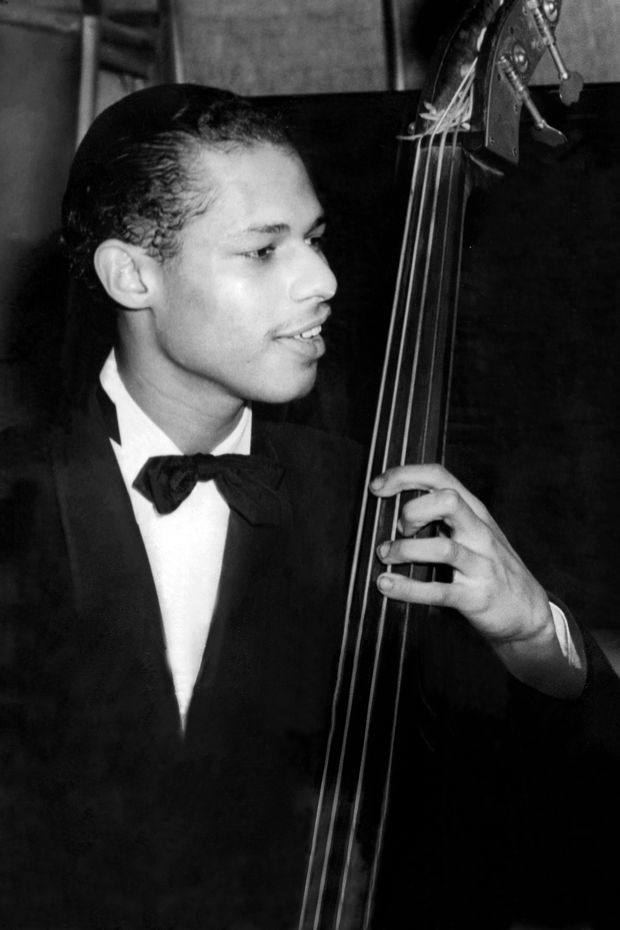
When he hired Jimmy Blanton on bass in 1939, it was another turning point: Blanton seemed to modernize the band's rhythms at a stroke. With the further arrival of saxophonist Ben Webster and, as Duke's new compositional right-hand man, Billy Strayhorn, the period 1939-44 glittered with genius, from Strayhorn's tune Take The "A" Train' (which became the Ellington theme tune ever after) to such miniature masterpieces as 'Harlem Air Shaft', 'Ko Ko', Jack The Bear' and countless others: every new record date for Victor seemed to offer fresh riches, and more than any other period of Ellington's music, this is the one scholars agree on as his most consistently inspirational.”
- Richard Cook’s Jazz Encyclopedia
The following appeared in the February 11, 2020 issue of the Wall Street Journal.
“Duke Ellington, I like to argue, ranks as America’s greatest all-around musician—composer, arranger, bandleader, accompanist, soloist and musical thinker. Who else did it all with such sit-up-and-notice style, originality and longevity?
He and his band reached a new peak of musical expression when a refreshed roster first headed into the studio 80 years ago this week. Their recordings from 1940 to 1942, dubbed their “Blanton-Webster” iteration, created one of the high points of American music.
In 1940, Ellington began what some regard as his premier period. He had recently hired Jimmie Blanton, a 21-year-old who would revolutionize jazz bass playing, and Ben Webster, who brought the tenor saxophone to new prominence in the ensemble. They both sparked the Ellington Orchestra. “Every time there was an addition to the band,” baritone saxophonist Harry Carney told jazz writer Stanley Dance, “the new instrumentalist seemed to give Duke new ideas and something to draw from and add in his writing.”
Another recent hire, arranger and composer Billy Strayhorn, began his ascent to becoming Ellington’s indispensable musical partner and an invaluable composer in his own right.
The Ellington band with Blanton and Webster made its first recording on Feb. 14, 1940, but it took a few weeks to hit its stride. In March, Ellington began recording for RCA Victor, whose engineers captured the Ellington sound with resounding richness, fidelity and balance. Remarkably, the label allowed Ellington to choose most of his repertory.
At its first recording session for Victor, the band laid down “Jack the Bear,” a showcase for Blanton, who gave his instrument an expanded role and an outsize tone. A well-disguised 12-bar minor-key blues with an exotic, almost unearthly quality, “Ko-Ko” fascinates with its drama, from its opening tom-toms to its final crescendo, each chorus building in intensity.
In “Concerto for Cootie,” Ellington, a master of contrast, provides bravura trumpeter Cootie Williams with three unlike themes for muted, open and growling trumpet, alternately poignant, sweet, bluesy, sorrowful and exultant.
Alto saxophonist Johnny Hodges, unmatched as a player of warm, lyric, romantic melody, renders “Warm Valley” ravishingly. Webster’s inspired solo on “Cotton Tail” became one of his most famous and enduring. In that recording, Ellington opened a window to the future, laying the foundation for what would soon become known as bebop.
First recorded in 1941, “Take the ‘A’ Train,” a feature for trumpeter Ray Nance, marked Strayhorn’s breakthrough as a composer. After this compelling dance number became a big hit, Ellington adopted it as his orchestra’s signature tune.
What accounted for the luminosity of this period?
Ellington was seasoned, and so were nearly all of his players—some of the best in the world—with an average tenure of 10 years with him. Blanton and Webster brought increased rhythmic drive and instrumental virtuosity. Strayhorn introduced new harmonic choices. Ellington was energized by signing new management and booking, and by moving in with a beautiful new woman. And the band was invigorated by a recent concert tour of Europe. Cornetist Rex Stewart recalled in his autobiography, “Boy Meets Horn,” that “the band started hitting on all cylinders like a wonderful musical juggernaut.”
During this time and throughout his career, Ellington, unlike most of his contemporaries, wrote most of the music played by his orchestra and composed exclusively for it. He was the supreme creator of music for that essential American institution, the jazz orchestra or big band. Developing his own harmonic language and tone colors, he was a wizard of experiment.
“A musician’s sound is his soul, his total personality,” Ellington told Nat Hentoff. “I hear that sound as I prepare to write.” Ellington composed not for the instrument, but for the man and soul behind the instrument. Not for first or second trumpet, but for Cootie Williams or Ray Nance, to tap the gifts of each. When Ellington hired a new musician, he’d quickly learn his strengths and weaknesses, and write to bring out his very best. He alchemized his players’ musical and emotional personalities into a unique new sound, which Strayhorn called “the Ellington Effect.” Rarely if ever had anyone assembled 15 musicians with such singular soundprints and transformed them into a distinguished e pluribus unum.

Jimmy Blanton in 1941 PHOTO: JP JAZZ ARCHIVE/GETTY IMAGES

Webster and colleagues deeply admired Ellington, who led an ingenious instance of what the business writer Warren Bennis termed a “great group”—one in which the leader helps the members find greatness in themselves. In Ellington’s case, the inspiration worked both ways—he inspired his players, and they inspired him. It’s a lesson for leaders in all fields.
The best way to hear this momentous material is through “Never No Lament” (2003), a superbly remastered three-disc set from Japan that collates 75 selections from 1940 to 1942. These magnificent works reward repeated, close listening. And they will continue to, I predict, for centuries to come.”
—Mr. Hasse is curator emeritus of American music at the Smithsonian Institution. His books include “Beyond Category: The Life and Genius of Duke Ellington” (Da Capo) and “Discover Jazz” (Pearson).