© Copyright ® Steven Cerra, copyright protected; all rights reserved.
“Twenty years after his death, Frank Sinatra continues to generate controversy. Whether it concerns his tempestuous love life or ongoing allegations of organised crime connections, both the press and public alike still can't get enough of his larger than life character. Alongside these extra-musical fascinations, at the very heart of Sinatra's unrivalled vocal art there lays another, equally engrossing controversy, a was he or wasn't he? argument that underscored the vocalist's career almost from day one and which now, nearly eighty years since his voice was first heard on record, still has no definitive answer. The question remains - was Sinatra a jazz singer? DownBeat poll wins, a headlining appearance at the prestigious Newport Jazz Festival, high-profile recorded collaborations with two of the music's regal megastars - Duke Ellington and Count Basie - and arguably the finest ever big band and crooner album ever - 1956's Songs For Swingin' Lovers - argue yes, he was. And yet the jury is still out.”
As a regular visitor to these pages, by now you’ve come to know that It's always a treat when Simon Spillett reaches out with one of his well conceived and well written essays and allows the editorial staff at JazzProfiles to post it to these pages.
In this feature, “the jury is not out” as far as Sinatra the Jazz Singer is concerned as Simon makes the case that Frank’s “tone, well-paced delivery, control and above all his phrasing” securely ensconced Old Blue Eyes in this category. He also brings forth a host of broader arguments to legitimize Sinatra as a Jazz Singer..
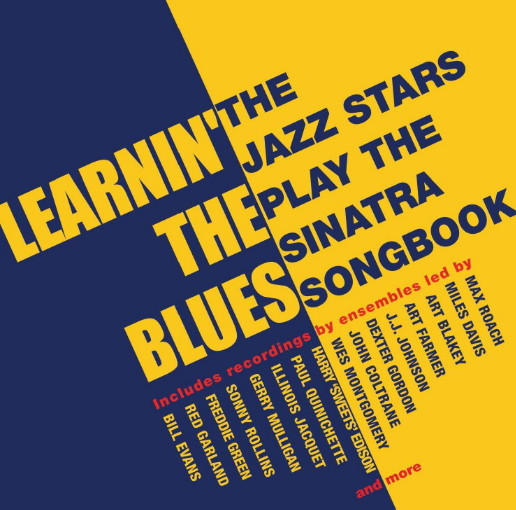
The piece that follows is from the notes he prepared for LEARNIN' THE BLUES - The Jazz Stars Play The Sinatra Songbook Acrobat.ADDCD 3270. They will be presented in two, sequential parts to make for more comfortable reading in this format.
Simon Spillett is a Jazz tenor saxophonist and an authority on the music of many of the great players of the instrument who blossomed during the second half of the 20th century, both in Great Britain and in the USA.
He is the author of The Long Shadow of the Little Giant: The Life, Work and Legacy of Tubby Hayes which Equinox has recently published in a second edition. You can locate my review of it by going here.
In addition to fronting his own quartet and big band, Simon has won several awards for his music, including the tenor saxophone category of the British Jazz Awards (2011), Jazz Journal magazine, Critic's Choice CD of the Year (2009) and Rising Star in the BBC Jazz Awards (2007).
Simon has previously shared essays on Hank Mobley, Hank with Miles Davis, Booker Erwin, Stan Getz, Jim Hall, Paul Jeffrey and Al Cohn and Zoot Sims. on this page, and he has his own website which you can visit via this link.
© - Simon Spillett, copyright protected; all rights reserved, used with the author’s permission.
“If I could put together exactly the kind of band I wanted, Frank Sinatra would be the singer. Really, my main man is Frank Sinatra.”
- Lester Young
Was he or wasn't he?
Twenty years after his passing, aged 82, in 1998, Frank Sinatra continues to generate as much controversy as he does admiration. During a career lasting over half a century he proved time and again to be larger than life. Posthumously, he's proved to be nothing less than larger than death. Just look at the thousands of pages of biography written about him since 1998, not to mention the endless reams of debate, analysis and discussion out there on the worldwide web. Rarely, if ever, does any disagreement centre on his musical gift; for close to eighty years it's been widely accepted that Sinatra elevated popular singing to the level of high art, no questions asked. If anyone anywhere remains sceptical of this fact, witness the virtually ceaseless round of “tribute” albums or celebratory projects that continue to venerate his name. Indeed, if imitation truly is the sincerest form of flattery then Sinatra must surely be the most complimented of all vocal artists anywhere, at any time, his legacy positively groaning under the weight of obeisance it's received. And it's not just the pretty-boy new-school crooners – the Buble's and Cullum's – who reference him. Even those as idiomatically removed from Sinatra as can be imagined sometimes feel the pull of The Voice.
Always keeping a weather eye on popular music, Sinatra recorded compositions by Lennon and McCartney in the 1960s and Neil Diamond and Stevie Wonder in the 1970s, ever alert to material that might just bend his way. He even put out a whole album of the folksy themes of poet Rod McKuen, A Man Alone. But he never covered Dylan.
Dylan recorded Sinatra though. When the former Sixties folk/protest icon released the unprecedented album Shadows In The Night in 2015 – a collection of ten songs all recorded at one point or another by Sinatra – he tried to play down the connection and was perhaps a shade too quick to dismiss the idea as a straight down the line homage. “I don't see myself as covering these songs in any way,” he said. “What me and my band are basically doing is uncovering them. Lifting them out of the grave and bringing them into the light of day.” Although nobody could mistake Dylan's drawling readings from the Great American Songbook for those of a wanna-be Ol' Blue Eyes, the very wording of his denial contained a subtle wink to those who know their Frank from their Bob. In rescuing some of the contemporary material Sinatra had made famous during his (Dylan's) youth, Dylan was actually following the pattern Sinatra himself had set during the 1950s, when his Capitol recordings made popular the notion that old songs – in Sinatra's case those of Tin Pan Alley of the 1920s and 30s - never really die they just need updating. It wasn't so much Sinatra's songbook Dylan was echoing – it was his modus operandi; find the good songs, wherever they may lurk and dress them up as yours. Or, in other words, treat them like a jazz musician would.
Dylan doing Sinatra might sound like an edgy prospect, but as anyone with even the slightest knowledge of the latter's life and times can attest, where Sinatra is concerned there's controversy and there's controversy. For the most part, that surrounding the vocalist still concentrates on his off-stage antics – his tempestuous love life, the raffish indulgences of the Rat Pack, the supposed political wrangling, the undying allegations of organised crime associations. And yet there endures at the heart of his art one burning, unanswered question, a quandary that has detained and distracted many of his listeners almost since the dawn of his career.
The question remains; was Frank Sinatra a jazz singer?
The quick and easy answer is, yes, of course he was. One needn't dig too deep for affirmative evidence, his partisans maintain. Look at his repeated wins in the annual polls conducted by jazz bible DownBeat, for instance, or his headlining 1965 appearance (with Count Basie no less) at the prestigious Newport Jazz Festival, arguably the flagship event for the music during the 1950s and '60s. Then there's the album he cut with Duke Ellington, a never to be repeated summit that found him juxtaposed with America's finest jazz composer. That's not all. Hadn't he once recorded with an all-star line-up organised by Metronome magazine, which pitched him in with the likes of Coleman Hawkins and Charlie Shavers? Didn't he do a more than convincing turn as a jazz drummer in The Man With The Golden Arm? And how about that litany of classic crooner and big band long players from the 1950s – Songs For Swingin' Lovers (arguably the finest ever boy singer/swing band album ever made), A Swingin' Affair, Come Dance With Me and so on? If that weren't confirmation enough of his bonafide jazz authenticity, remember his valedictory solo outing, 1984's L.A. Is My Lady, orchestrated by Quincy Jones, and taped in the company of a veritable who's who of jazz from Lionel Hampton to Ray Brown. Sinatra surrounded by jazz musicians? Hadn't this always been the case, going right back to his days with Tommy Dorsey through his classic Capitol recordings and beyond? At the very least he'd always been a great champion of the music – didn't his Reprise label sign musicians like saxophonist Ben Webster and pianist Bud Powell? Sinatra a jazz singer? Absolutely!
The trouble with this analysis is that it makes the potentially damaging assumption that Sinatra needs to be judged by association only. The “and he recorded with jazz icon X” argument is always a flimsy one on which to base any qualification of equal billing. Other popular singers of Sinatra's generation also recorded with Duke Ellington and Count Basie – Rosemary Clooney, Teresa Brewer, the Mills Brothers even – but we find no real case has been made for elevating them to the pantheon of “jazz” singers. This isn't to imply that Sinatra was ever in the same ballpark as these increasingly overlooked or half-forgotten names, merely to clarify how hopeless it is to make a trial by association summary of his claim on jazz.
Nor has Sinatra ever been given the easy ride that Nat 'King' Cole is afforded by jazz aficionados, who'll very often remind you that Cole was at heart a jazz pianist and therefore even the occasional artistic excrescence (Those Lazy-Hazy-Crazy Days Of Summer, anyone?) are merely a forgivable blip on an otherwise unimpeachable career. Even Mel Torme, a singer whose “jazz” collaborations frequently sounded more mannered than sincere gets a better time from the purists than Sinatra. Quite why remains something of a mystery. Perhaps it's that Sinatra's gifts are more subtle, less easily defined than those who've readily nailed their colours to the jazz mast. Maybe he's just too well-known and commercially successful enough to be seen as a genuine jazz figure (the music being especially good at equating obscurity with true musical worth). Or perhaps he's simply not “hip” enough – a paunchy, anachronistic Las Vegas-style crooner who fought the march of time by marrying a wife half his age and kitting himself out with a toupee.
Whatever the reason, Sinatra has always come in for something of a hard time from jazz critics, even at the hands of those ostensibly supporting his cause. The handy pocketbook Jazz On CD (Mitchell Beazley, 1995) includes an entry for the vocalist that begins unpromisingly “Sinatra is not a pure jazz singer. Ask him to scat and the result is laughable. Given a blues, he has more limitations than many.” Nobody could argue these points in Sinatra's favour without slipping over into unadulterated sycophancy, and yet the very idea that he fails to qualify due to not adhering to the narrowest of criteria – that a jazz figure either has to display a deep affinity with the blues or virtuoso improvising chops – borders on lunacy.
If these qualifications are the only ones with which to ascertain whether an artist is of the jazz kind or not then where do we place, say, an instrumentalist like pianist Lennie Tristano, who hardly registers as a player steeped in the blues, or a baritonist Harry Carney, whose strongest musical suit was his melodic delivery and not his soloing. Tristano founded his own school of jazz; Carney spent over forty years anchoring the saxophone section of indisputably the finest orchestra within the idiom, Duke Ellington's, achievements that speak loud and clear about what matters most.
Very often, these assumptions are based in what jazz writers believe to be the prerequisites vital to be called a jazz musician, rather than what the musicians themselves see as truly valuable musical characteristics, the very reason why a saxophonist such as the unflashy Hank Mobley may well have had a wider practical impact among his peers than, to pick a name at random, the more overtly attention-grabbing Johnny Griffin. Critic-dictated stipulations and fashion have very little to do with things where musicians are concerned. If you've ever wondered why Lester Young named Frankie Trumbauer as an influence, or why Miles Davis spoke admiringly of Harry James, this is why: it wasn't that these earlier players were particularly inspiring jazzmen – it was that they were superb craftsmen first and foremost, as was Frank Sinatra. Innovation is very often arrived at by haphazard means – craftsmanship takes patience and time and, as any working musician will tell you, it's craftsmanship that ultimately impresses most.
Sadly, it's not just retrospective critics who've questioned Sinatra's handle on the jazz idiom.
Go back to the days of his peak – the 1950s and '60s – and you'll find that even then, there was more than a little caution at appending him with the j-word. “He is not basically a jazz performer,” wrote Leonard Feather in his entry of the singer in the 1960 edition of The Encyclopedia of Jazz, “[though] his quality of phrasing and best have a tremendous appeal to jazz musicians.”
There was something rather disingenuous to Feather's pat encomium; the same entry listed Sinatra's numerous wins in jazz polls conducted by magazines including DownBeat, Metronome and Playboy and, even earlier, when Feather has asked 120 leading jazz musicians who they'd chose as their top singer for his 1956 Encyclopedia Yearbook of Jazz, over half had nominated Sinatra, including such iconic players such as Duke Ellington, Lester Young, Miles Davis, Stan Getz, Gerry Mulligan, Bud Powell and Horace Silver.
Yet again, the issues with definition were clearly not with the musicians but with the critic concerned, a situation that has sadly never really altered where Sinatra is concerned, and which, in this instance, reveals yet another instance in which Feather seemed to value his own observations over those with perhaps greater insight. Very often, what jazz musicians want in a singer is not what they always want in themselves; jazzmen have the technical know-how, the notes and the licks – singers have the one thing they'll never possess – the lyrics, the ability to recount a story that isn't ambiguous or skewed only for the cognoscenti. And, in general, jazz musicians like a singer who treats a voice as what it is – an instrument for producing words. Most blanch at the merest suggestion of “scat”. But since Sinatra didn't scat-sing (outside the occasional and utterly embarrassing doobey-doobey-do) and as jazz critics seem to see this as a vital requirement of a jazz vocalist it left him a sitting duck.
In an interesting if time-locked article published in the English magazine Jazz News in 1960 – titled Are There Any Real Jazz Singers – Is Sinatra One? - an unidentified writer speculates that despite the vocalist possessing “good timing, perfect diction, good pitch and a natural 'feel' for a song...improvisation which is this basis of all jazz is strangely absent in the singer's interpretation.”
“The two paramount qualities which possibly attract jazz [poll] votes is [sic.] his phrasing and his choice of material, but these alone hardly put him in the jazz category.”
Even noted Sinatra's sycophants were notably reticent when expressing an opinion on whether their hero was fundamentally a jazz artist. Benny Green, an ardent admirer, who had met Sinatra and attended one of his recording sessions, was remarkably circumspect in the entry he penned on the singer for Encyclopedia Britannica in 1972 (an entry which the Encyclopedia actually chose not to include), stating “he has an instinct for phrasing which is part inborn, part picked up from the jazz musicians of his early professional years.” Others were just as careful. Back in the days when his albums had little more than a bit of advertising puff on their back sleeve (“Sinatra style, with its faultless phrasing, its bright lilt, its captivating poise” reads the note on 1954's Swing Easy) rare were the passages in which a writer explicitly bracketed the vocalist with jazz, and even then it was usually with overt use of the word swing rather than anything suggestive of something more modern. Ralph J. Gleason was an exception. In his note to the 1959 Capitol album No-One Cares he ventured “to me, it is as certain a truth that Frank Sinatra is the greatest ballad singer of his generation as that Charlie Parker was a musical genius.”
Strange as it may sound to 21st century observers, living in an age when mid-20th century culture is rapidly becoming a well-spun, homogenised mash-up, mentions of Sinatra and Charlie Parker in the same breath were by no means a common occurrence back in the 1950s.
If there is any common ground to be recognised in how many of Sinatra's admirers regard his relationship to jazz it can be found in the one word that occurs time and again in various summaries – phrasing. Benny Green's observation that Sinatra's mastery of this complex and yet undeniable musical tool was “part picked up from the jazz musicians of his early professional years” is spot-on.
Sinatra was, after all, a product of a heady epoch which hadn't become known as the Swing Era for nothing. There was also no denying that, especially on material that came packaged in the familiar big band and crooner wrapping, the lessons he'd learned from standing in front of a drummer like Buddy Rich (working with Tommy Dorsey) remained the backbone of his approach. And it was with the generation of musicians that came up as he and Rich did, with the great big bands of the late 1930s and early 1940s, that he felt the closest affinity. In fact, one of the most revealing aspects of carefully examining his solo discography from the mid-1940s to the late-1950s, is seeing how it was this wave of players and not the subsequent phalanx of studio-based young lions who most often surrounded him on his recordings – men like trumpeters Zeke Zarchy (ex-Glenn Miller), Bobby Hackett (ditto), Ziggy Elman (ex-Dorsey), Billy Butterfield (ex-Bob Crosby) and Yank Lawson (ditto), saxophonists Johnny Mince (ex-Dorsey), Hymie Schertzer (ex-Benny Goodman), Ernie Caceres, Al Klink, Jerry Jerome, Wilbur Schwartz, Chuck Gentry (all ex-Miller) and Sam Donahue (ex-Gene Krupa) and rhythm section men such as Johnny Guarnieri (ex-Artie Shaw), Jack Lesberg (ex-Goodman), Carmen Mastren (ex-Miller) and Trigger Alpert (ditto).
Unlike Billy Eckstine, who circled himself with a clutch of nascent modern jazz stars in the 1940s, Sinatra didn't go much for bop. Also, the idea of his Fifties sessions employing the cream of young Hollywood-based jazzmen – the Shelly Manne's and Shorty Rogers' of West Coast jazz fame – is largely a fallacy (although both worked with the singer on the 1955 film The Man With The Golden Arm, adding more than a hint of jazz authenticity) Indeed, players of this school, such as ex-Stan Kenton trombonist Milt Bernhart, who began to crop up on Sinatra sessions in the early Capitol days, were something of a exception rather than a rule and it was only with the sessions for Ring-A-Ding-Ding!, Sinatra's first LP for his own Reprise imprint, taped in 1960, that this closed shop was truly broken into, arranger Johnny Mandel – himself a prominent West Coaster – bringing in soloists such as trumpeter Don Fagerquist, trombonist Frank Rosolino and flutist Bud Shank.
Sinatra's choice of arrangers too – from Axel Stordahl and George Siravo in the 1940s, through to Billy May and Nelson Riddle in the 1950s – was by and large informed by old-school connections made early on in his career. The recruitment of younger faces during the 1960s like Quincy Jones and Neil Hefti, neither of which was a particularly left-field choice, was nevertheless a major departure for the singer. In fact, at a time when jazz and big band arranging was evolving rapidly, he largely chose to ignore its innovations (Sinatra and Gil Evans might well have been an oil and water mix). Moderniser of popular singing though he was, Sinatra himself was no modernist, and it's only in the 1960s, with his collaborations with the likes of newer arrangers like Don Costa and Claus Ogerman that we began to hear him finally break free of the legacy of the big band sound.
However, even given his apparent comfort in Swing Era-styled big band surroundings, Sinatra's relationship to the jazz music of that period remains somewhat opaque. We know that he adored tenor saxophonist Lester Young, star of the late 1930s Count Basie band, and that the feeling was mutual. In response to Young declaring that “if I could put together exactly the kind of band I wanted, Frank Sinatra would be the singer,” he added “we had a mutual admiration society. I took from what he did, and he took from what I did.” What both men already possessed in spades was a gift for melody; what they may have taken from each other could well have been rhythmic. Listen to Young's playful way with the beat during his Basie heyday, in particular the weight he was able to place on repeated notes (via “false-fingering”, a technique enabling a saxophonist to play the same note with different finger positions), and then dig out Sinatra's hipper sides from his later Columbia period (around 1949-50). Both represent the very essence of what it means to swing.
He also developed an intimate friendship with Young's soulmate Billie Holiday, attending her deathbed and (according to some sources) footing the bill for her medical care close to the end. The two shared a birth year and in earlier, happier times, had formed a tight circle of influence. There exists a touching photo from the early 1940s of Sinatra signing an autograph for Holiday (who says heroes don't have heroes?) and in one 1944 interview Lady Day confessed to giving her pal some advice “I told him certain notes at the end [of a phrase] he could bend. Bending those notes – that's all I ever helped Frankie with.”
Sinatra thought otherwise, stating in 1958 that “it is Billie Holiday... who was, and still remains, the greatest single musical influence on me.” According to the singer's valet, the news of Holiday's death hit him like a locomotive, leading to his spending days alone, tearfully listening to her records. What Sinatra saw in Holiday is obvious: both were storytellers supreme, able to turn a simple song copy into a candid expression of their innermost feelings. Listen to Holiday's reading of I'm A Fool To Want You, one of the few songs for which Sinatra penned lyrics, from her penultimate album Lady in Satin, recorded in 1958, and then hear Sinatra's own account, taped the previous year for the album Where Are You? Despite the differences in orchestration (Ray Ellis' for Holiday lushly melancholic, Gordon Jenkins' for Sinatra by comparison spare) and delivery (Billie's a broken down plea, Frank's a Bel Canto declaration), they are like conjoined expressions of the same basic, futile longing.
Later still, Sinatra would record a piece written as a memorial to Holiday, simply titled Lady Day.
It was in this, the gift to tell a story, at its most affecting on ballad-tempo material, that Sinatra gave his greatest contribution to the jazz idiom. Indeed, this is the very juncture at which Sinatra – Swing Era boy vocalist – meets Sinatra – ballad touchstone among younger jazz instrumentalists. He'd had to work to reach this point though. During his early 1940s stint with Tommy Dorsey, he had been required to handle both slow love songs and what were then rather euphemistically called “rhythm numbers” (even as late as 1950, when Columbia issued the 10” LP Swing and Dance with Frank Sinatra, his producer, Mitch Miller, was still thinking of anything medium or up-tempo in such outdated terms; in one radio interview promoting the album Sinatra himself called described the material as comprising “a lot of jazz things”). Listening back to his recordings with Dorsey nearly eight decades later, it's the ballads that stand out, and for good reason. The man at whose side the young singer was learning his craft was a ballad master, in more ways than one, and he was taking a hands on interest in his new charge.
The influence of Dorsey's superhuman breath control on Sinatra has long been the stuff of legend – particularly noticeable on slower songs (if there's any lingering doubt about the legacy the trombonist left with his former vocalist, listen to 1963's bravura account of Ol' Man River, from the album The Concert Sinatra. You'll know the note when you hear it!) but it's generally less well acknowledged that in serving his musical apprenticeship in a band like Dorsey's rather than, say, Benny Goodman or Artie Shaw's, Sinatra was almost preordained to be a master of the ballad form. With a leader whose metier was ultra-smooth virtuoso expositions of melody – and who was, by his own admission, a less than convincing improviser – Sinatra had something of a practical blueprint on which to pattern his art. Dorsey's rhythm numbers undoubtedly swung (and perhaps did so even more in the years immediately after Sinatra's departure) but they often did so with a sense of hard deliberation rather than the relaxed joy heard in a Basie or a Barnet. Tone, well-paced delivery and control were Dorsey's preoccupations and his best records are those which display all three, making them somewhat anomalous to the rest of what was going on under the banner of big band swing. Exposure to these lessons – rammed home by a leader who was every bit a martinet – formed the very bedrock of Sinatra's mature style. In fact, it's not at all fanciful to suggest that had he joined another leading band of the era (he once approached Glenn Miller, whose “sound first, stars second” attitude would have swallowed him whole; he also tried to get Artie Shaw to hire him only to be told Shaw preferred Tony Pastor as he made him laugh) key parts of what ultimately made Sinatra Sinatra may never have been realised – acting career and all.
There's little doubt that it was this – Sinatra's masterful way with a ballad – that most affected the generation of young would-be jazzmen who heard him during their youth in the 1940s. His swinging things, they were still beautiful, but to these new ears that was music that somehow belonged to World War Two, to the big bands, to a musical establishment that they, as young men fueled with the possibilities of post-atomic, post-war America, saw as close to its demise. Sinatra as a balladeer said something much more: his success promised a musical world in which a voice, an identity made clear in barely a few syllables (or notes) could sing a song as if it were a great drama. Sinatra's solo career had also shown the wider world that a single voice – a solo act – set like a jewel by just the right kind of setting – could replace the idea that contemporary music needs to be an ensemble dominated enterprise. Sinatra's very tone would influence the arrangers with whom he worked – soloist and accompanists acting as mutual inspirations, freed from the draconian demands of the big band leader. Both instrumentalists and singers were to benefit from the realisation in the years ahead. And it is these musicians that are the subject of this collection of jazz-oriented, Sinatra-related material.
Among those listening closely to this side of Sinatra during the late war years was a shy, teenaged trumpeter from St. Louis, who'd arrived in New York in 1945, ears wide open to new sounds and new approaches. Miles Davis may have alighted on the city to play the rollercoasting, overdriven “modern” jazz of Charlie Parker and Dizzy Gillespie but it was to be the careful, take-your-time pacing of Frank Sinatra that was to leave a more indelible mark.
“I learned how to phrase by listening to Frank,” he later confessed, “his concept of phrasing.” It wasn't just phrasing though; when Davis finally freed himself from the deep mire of hard drug addiction and his career really got going in the mid-1950s, his recordings frequently used the same material as Sinatra's. Sometimes it was as if they were engaged in a non-verbal conversation from coast-to-coast. Sinatra's landmark concept album In The Wee Small Hours was issued in April 1955, one of its songs being the Schwartz-Dietz ballad I See You Face Before Me; Davis taped his version two months later, its muted, close to the mic mood of introspection seemingly an echo of Sinatra's.
But this was only the beginning; indeed, the trumpeters albums during his first golden period – 1955-1963 – unashamedly pilfered songs which Sinatra has made his own – S'posin', I Thought About You, There's No You, Baby Won't You Please Come Home, I Could Write A Book, It Never Entered My Mind, Spring Is Here, How Am I To Know and so on. In an age of a burgeoning rock and roll-led attack on musical standards (in every sense) it was possible to view Davis and Sinatra's albums as the 'adult' alternative: quality contemporary music, swinging yet still full of dance-friendly romance; emotional yet not sappy; serious yet not solemn.
Later on, Sinatra and Davis would meet – sometimes drinking together at New York's legendary Jilly's bar – and there was even some talk of a possible recorded collaboration, but even before this happened the two seemed to have a spiritual brotherhood. Both were lean, sharp-thinking, and didn't mind speaking their mind. Both would stand up for causes they thought worthy of a hard fight – race issues in the main – and both were snappy dressers. Both adored women and were inveterate ladies men. Both looked like icons if captured by a photographer's lens. Both knew that how their “product” was sold was key, steering those who designed the covers of their albums in an age when few artists ever got a say. Both worked closely with the producers at their respective labels – Capitol and Columbia – creating albums as chapters in an ongoing career storybook rather than as collections of unrelated performances. Both were dedicated to pursuing their musical goals but were realistic if a direction wasn't for them.
Both knew the value of change and evolution. Both were pathologically distrustful of the press. Both had tough guy exteriors hiding vast, sentimental natures. Both surrounded themselves with musical peers who could extend and amplify their artistic desires. Both were unafraid of the future. Both had learned the lessons of the past. Both prized loyalty and were unforgiving if their trust was abused. Both went out of their way to help those they admired or thought would benefit from their largesse without ever expecting recompense. Both were storytellers par excellence. And both knew how to say something with next to nothing, the merest gesture, the subtlest of inflections, as revealed in a remark Sinatra once made to Bono of the band U2; “Miles Davis never wasted a note, kid – or a word on a fool.”
They even shared something else – an indefinable yet intrinsic brand of melancholy, for all their commercial success. Writing in These Jazzmen of Our Time (Victor Gollancz, 1959), Alun Morgan creates a vivid vignette of an encounter with Davis in a Parisian side street in the small hours of the morning. “We met Miles strolling along with Sinatra-like nonchalance.” The trumpeter couldn't find where he was staying. “Don't you know the name of your hotel?” Morgan asked. “Miles considered. 'No' he said slowly. 'But wherever it is I'm in room 215,' and he continued his nocturnal perambulation.” It's the same kind of romantic imagery captured on the cover of Sinatra's Point Of No Return, and heard in his saloon-song anthem One For My Baby. Heartbreak with a hint of hubris. Loneliness with a certain elegance. Pity with self-pride.
Davis was by no means the only modern jazz star touched by Sinatra's example. Another equal contender for the title of ultimate cool jazz icon, Stan Getz was known to be a fan. During 1955, the saxophonist had gone spectacularly off-the-rails and one of the aids to his recovery was a batch of Sinatra albums bought as a gift by his wife Monica. Resting up, Getz listened endlessly to Sinatra's version of Violets For Your Furs, intoxicated by the singer's tone and delivery (curiously Getz never recorded the piece himself). “He just loved all these songs [on the albums],” Monica later remembered. “Romantic songs.”
Years later, interviewed by journalist Stan Britt, Getz revealed that he hoped Sinatra might one day invite him to record the saxophonist “like a bride waiting for the groom.”
Sinatra's albums were also having a restorative effect on the man from whom Getz had taken much of his initial inspiration, Lester Young, who, by the late 1950s was in real danger of being eclipsed by his disciples. Visiting Young's house in Queens, writer Ira Gitler saw a stack of the singers LPs on the floor. “He [told] me he never played a ballad without first learning the lyrics”, says Gitler. “I asked him the source for the lyrics...he said 'Frank Sinatra.'”
It wasn't just Sinatra's vocal ability that was impressing jazzmen. To those who'd grown up in the racial/cultural melting pot of 1940s New York, the vocalist was even something of a sociological hero. In 1945, Sinatra the actor had appeared in an Academy Award-winning short film titled The House I Live In, produced by RKO Pictures, the premise of which was to preach inter-community understanding (in the film Sinatra breaks up an outburst of anti-Semitic bullying and, after giving a brief lecture on the merits of America's racial diaspora to the victim and his tormentors, sings the Earl Robinson-penned title song). Soon after the film's release life began to mirror art. The new Benjamin Franklin High School, constructed on New York's 116th Street and Pleasant Avenue – a largely Italian neighbourhood – boosted its intake by admitting black students from Harlem, including a teenaged Sonny Rollins, then a fledgling alto saxophonist. Straight away, there was conflict.
“People in the neighbourhood used to throw stuff out the windows at us and swear, “ Rollins remembers of his daily trip to school. “It was like walking through Beirut...there were a lot of bad feelings.”
In order to calm things down, the school enlisted the services of several popular artists – black and white - in order to demonstrate racial understanding. “One of them was Nat King Cole and the other was Frank Sinatra,” recalls Rollins. “Nat Cole played, I don’t think he talked too much, but Sinatra sang and lectured the kids about not fighting and being brotherly. Things actually got better after that.”
The song Sinatra sang? The House I Live In, prompting Rollins, always a man with a nose for a good tune, to include it on an album released in 1961, Sonny Boy (ironically it had been taped five years earlier but went unreleased possibly due to the controversy surrounding Rollins' album length statement on America's racial dilemma, The Freedom Suite, issued in 1958).
To be continued in Part 2.


