Tuesday, November 3, 2020

Scott LaFaro - "Young Mr. LaFaro" - Part 2

© -  Steven A. Cerra - copyright protected; all rights reserved.


“Extending a concept begun by Red Mitchell and Charles Mingus, Scott LaFaro developed a rapid fingering and plucking system, and found the perfect place to use it when he joined the Bill Evans Trio in 1959, with Paul Motian on drums. Together, the three musicians invented a style of jazz in which no one was required to spell out the tempo with an explicit beat. This gave LaFaro the freedom to invent a new kind of "conversational" bass accompaniment, made up of short melodic figures and phrases rather than of a steady pulsing line.”
- Bassist Bill Crow, The Bass in Jazz, in Bill Kirchner, ed., The Oxford Companion to Jazz


“His recordings with Bill Evans and Ornette Coleman [1960-61] set the standard for a new generation of Jazz bass players who varied their accompaniments by mixing traditional time-keeping bass lines with far-ranging countermelodies in free rhythm.”
- Barry Kernfeld, The New Grove Dictionary of Jazz


The following piece about Scotty first appeared in the July and August 2005 editions of Gene Lees’ Jazzletter.


“Though he is known primarily through the albums with Evans, LaFaro played with a great range of jazz musicians during his short career, including Chet Baker, Paul Bley, Ornette Coleman, Eric Dolphy, Stan Getz, Hampton Hawes, Freddie Hubbard, Cal Tjader, Booker Little, Bobby Timmons, Victor Feldman, and Herb Geller. Feldman and Geller loomed large in his life.


Scott LaFaro was born on April 3, 1936, the eldest of five children. Next in line was his sister Helene, who later married a Cuban-born engineer and artist (and a very good one) named Manny Fernandez. Helene was followed by Linda, Lisa, and Leslie. She and Scott were particularly close.


A few months ago, she and Manny paid me a visit, bringing along Herb Geller, with whom I had struck up a friendship in the previous few months.


Manny has a vivid memory of the kind of ear Scott had. He said, "I had an old 1955 Jaguar. I was in the garage trying to tune the car. I was messing around with a timing light to get the spark right. And Scotty had his hand on the fender. He said, 'It's tuned now.' I looked at him. He said, 'There's no vibration now. You've got it right on.' I was shocked. Just by touching the car he could tell."


Helene says: "Scotty and I were born in Irvington, New Jersey, which is a suburb of Newark, but my mother and father were born in Geneva." Geneva is in a verdant agricultural area of Upstate New York, in the Finger Lakes region.


Scott was named Rocco Scott LaFaro, Scott from his mother's maiden name. Helen Lucille Scott was twelve years Joe LaFaro's junior. They married, with the approval of both families, eleven days after she turned eighteen.


Helene continued: "My dad went to the Ithaca Conservatory of Music when he was twelve. He studied under Fritz Kreisler's professor. It later became a credentialed college. It's still one of the major schools in the east to study music, like Eastman in Rochester."


It was founded in 1892, added a drama course within five years, and continued expanding.


"My dad," Helene said, "was eighteen when he had finished six years of the Ithaca Conservatory.


"It was the middle of the roaring twenties. My dad played with Paul Whiteman, Rudy Vallee, and both the Dorsey Brothers. He was pals with George Van Eps. He was with CBS studio orchestras in New York. In World War II, work was just non-existent. My dad was too old for military service, and he had flat feet. It would have been better for his career if he had gone into one of the service bands, like many of the guys he worked with. They kept their networks of connections, and all ended up better than my dad did, but finally he went back to his hometown. He had a society band there at a private club all the rest of his life."


His father in turn was an immigrant: the family's origins lay in Calabria, which is in the toe of the Italian boot. Calabrese have a reputation among Italians for being stubborn, and Scott LaFaro was all of that.


"My dad told us we had to appreciate everybody's music. He wouldn't allow us to make fun of hillbilly music or anything like that. He said it has a value, because it's an expression of the people. He also had this other side. He said, 'If you can't do something really well, do the world a favor and don't do it.' Both of those things came through to Scotty and myself. I think that some of that intoleration that Scott had came out from my dad. My sons have the same thing, so maybe it's a familial thing: an impatience with people who don't see things immediately. Just aren't as sharp as they should be.


"Geneva High School was a really terrific school. It still has a pretty good music program. In junior high you had to take music. You had a choice. You could take general music or you could take an instrument to prepare for the high school orchestra. I took general music. That was real basic theory, sitting there and singing to show you could read the notes. But Scotty thought, I'll take an instrument.


"There wasn't really any choice. It was whatever instrument the band director was going to need. He would tell the kids, 'Once you get into high school, you can switch over to what you want.' Scott ended up playing bass clarinet. He was very very good at that too right away, and by the time he was in eighth grade he was invited to be in the high school band. They had theory and advanced theory. Scott was in, I think, three different choruses as a tenor. He was in Varsity Chorus, Boys' Chorus. We both had to join the Presbyterian church because the organist was so fantastic. My father said, 'You have to go there, you have to sing.' When it came to religion, our family always went wherever the music was best. Sometimes we'd be at the cantor's Friday night for the Shabbat dinner because he would sing the service. At the Presbyterian church, there was this fabulous organist that my father just couldn't stop talking about. Scotty sang tenor and I was a second soprano.


"At the high school, they had a concert band, and marching band, and orchestra and jazz orchestra. Godfrey Brown was Scotty's mentor. He kind of gave Scotty the discipline that my father was loath to do. He was never going to force music on him, but Godfrey was very exacting and stern and he and Scotty had a great relationship and admiration. He really made Scotty get concentrated on things.


"Scott had four serious girlfriends, and I've got the things he wrote to them. He told each of them, 'You're very important but you're not music.' That kind of ended some relationships." Helene laughed. She continued:


"In the early years, he really was only interested in being a sax player. He wanted to be the next Zoot Sims and Parker and everybody rolled into one. And he was going to be better than them all. And that's how he left high school, thinking that that's what he was going to do. He started on bass clarinet in junior high and then went to tenor saxophone and the only reason he took clarinet was that when he was going to go to Ithaca College, you couldn't major in sax.


"Because he was a music major, Scott had to take a string instrument and percussion and piano. The girl who was a bass player in the orchestra showed him a few things, and when he talked to my dad about string instruments, he told Scott, 'Well with the bass, when you're at home, you can gig with me at the club.' That's how he decided that for strings, it would be the bass.


"He used to play basketball at the Y, and he cut his lip. He had a few stitches, and his lip hung. He thought it was going to affect his embouchure for saxophone. He was going to overcome all that. But the minute he touched the bass, that was it. My dad had him take a few lessons with a bass player named Nick D'Angelo. He was from Pennsylvania, but when he was in the Air Force up there, he liked the town, and after he went to Eastman, he got a job teaching music, and he's still doing it today. When Scotty was just a month or so into the bass, it was, 'My God! What have I been doing all this other time?' I was talking to his teacher only a few weeks ago, and he said, 'Teaching Scotty was like a Hollywood script because it was from A to Z in only three months.'


"Scotty was there all that year, and he went back for the beginning of the sophomore year. And Nick D'Angelo had a buddy who was playing with Buddy Morrow. His buddy called and said he was leaving the job, and asked Nick if he wanted it. He said, 'No, I enjoy teaching. But I'm giving lessons to a kid who's really pretty good.' Nick told me he covered the phone and said to Scotty, 'Hey, do you want a job?' And Scotty said, 'Well, do you think I can do it?' Nick said, 'It's a dance band. It's not going to be very hard for you.'


"And so he set it up for Scotty to have an audition with Buddy Morrow. It was only about three weeks into the fall term of the sophomore year.'

"How old was he then?" Herb asked.


"He was nineteen. So he auditioned for Buddy Morrow and he called home and said, 'I got the job.' And he was off. He'd been playing bass for about a year and three months. That's the first time he traveled across to California, the first time he saw the West Coast."


In New York City, in the fall of 1956, LaFaro auditioned for Chet Baker, and joined Baker's group.


Early in 1957, Scott met Victor Feldman, who would become one of his closest friends. In May of that year, the Chet Baker group went to Los Angeles, and played a gig there. The pianist on that job was Don Friedman, the drummer Larance Marable, and Richie Kamuca the saxophonist. Friedman said:
"Scotty and I worked [that] gig at Peacock Alley…. [It]
was for a week. As I recall, Chet didn't finish the week. The cops were looking for him and he literally escaped from the club and never came back. I don't remember whether we finished the week without him."


Scott was stranded, which experience may have contributed to his wariness about heroin addicts. And Baker was one of the worst. His habit destroyed his career and eventually his life. He was found in May 1988 close to a hotel in Amsterdam.

Whether he fell or was pushed or thrown no one knows, but the underworld of Holland is notoriously among the most vicious in the world, and it is widely believed that he was murdered over a narcotics debt.


During the Chet Baker engagement in Philadelphia, Scotty expressed his dismay at Baker's heroin use. He told Helene that of all the musicians he had met thus far, the one who puzzled him the most was Gerry Mulligan. He couldn't understand how anyone of Gerry's intellect could get caught up in heroin addiction. But intellect has nothing to do with it. As it happens, Gerry was a very close friend of mine and his drug habit, which he successfully broke, is something I discussed with him. Indeed, I discussed it with a lot of addicts and former addicts, including Zoot Sims, Al Cohn, Arnold Ross, Bill Evans (on many occasions), Howard McGhee, and J. J. Johnson, who told me he found it easier to give up heroin than cigarettes, a not uncommon experience.


I became interested in the question of heroin use, because it had been epidemic in the jazz world, when I became editor of Down Beat in 1959. The magazine's owner, John Maher, wouldn't admit there even was such a problem, but there was. And then Art Pepper got a third-time conviction in California and was sent to prison for life; and Bill Rubinstein and J. J. Johnson were denied "cabaret cards" permitting them to play in places in New York City where liquor was sold. I raised so much editorial hell about this that, I have been told, I was partially responsible for the abolition of the cabaret cards. But it was the Art Pepper case that really bothered me, and I read every possible book on heroin use, including DeRopp's Drugs and the Mind, which I can no longer find. And I devoted an entire issue of the magazine to the drug problem.


I came to a tentative conclusion. All men (and women) who are operating at the highest levels of their own intelligence crave to expand beyond its limitations, and some take to psychotropic substances to help them achieve this. All such persons sense that there is more out there. Within a few years, I am certain, we will have means to lift the level of human intelligence to new and very high levels. But we are not there yet, and the substances we use in our aspirations to it are not efficient, and some of them, such as crystal meth, are devastating in their physical ravages.


I have never known a jazz musician who had quit drugs who didn't assert that they don't help your playing. I am not sure they are right. Alcohol is one of the finest intellectual lubricants known to our species, which is why so many of our greatest writers have been very heavy drinkers, from Shakespeare (by all the evidence) on through to Faulkner, Steinbeck, Dorothy Parker, and many more. And since improvising music is an extraordinarily dangerous thing to do, I'm not surprised that some musicians have resorted to drugs to lower the inhibitions, get the self out of the way, and let the conceptions flow from somewhere within.


And Scott worked for three heroin users: Stan Getz, Chet Baker, and Bill Evans. No wonder he was leery of them.”

To be continued in Part 3.

Monday, November 2, 2020

Tubby Hayes/Paul Gonsalves - Pedro's Walk

           Jimmy Deuchar (tp,mell),
Les Condon (tp), Keith Christie (tb), Tubby Hayes (ts,vib,as), Paul Gonsalves (ts), Jackie Sharpe (bs), Stan Tracey (p), Lennie Bush (b), Ronnie Stephenson (d)

Composition by Ian Hamer.

Johnny Scott Orchestra - Limehouse Blues (1960's audio) EXOTICA

Scott LaFaro - "Young Mr. LaFaro" - Part 1

© -  Steven A. Cerra - copyright protected; all rights reserved.


The editorial staff at JazzProfiles is currently preparing a synopsis of Jade Visions: The Life and Music of Scott LaFaro (University of North Texas Lives of Musician Series). The biography was written by Helene (LaFaro) Hernandez, Scotty’s older sister.

While the synopsis is being developed, I thought you might enjoy reading a piece about Scotty that appeared in the July and August 2005 editions of Gene Lees’ Jazzletter.

Given the length of the Jazzletter feature on Scotty, it will appear in multiple segments on these pages.

“Scott LaFaro was something of a mystery to me. I never knew him well, and not for long. There was too little time. He played the bass for only seven years, from the summer of his eighteenth year until just after his twenty-fifth birthday, when he was killed in an automobile accident, but in that short period he became the most influential bassist of the last half of the twentieth century, and his echo continues in the work of Dave Holland, Neal Swainson, Eddie Gomez, Christian McBride, and many more. In this he was like Jimmy Blanton, who influenced the bass in terms of its harmonic role was dead at twenty-four, in his case of tuberculosis. One thinks too of Charlie Christian, who died at twenty-six but influenced probably every guitarist who came after him. He too succumbed to tuberculosis.

It was not only LaFaro's extraordinary technique that set him apart. He had a lyrical sensibility which reached its pinnacle in his work in the Bill Evans Trio of the early 1960s, a distinguished melodic gift that made his solos and contrapuntal conversations with Evans unique.

Bill's drummer during that period was Paul Motian. Later, Jack DeJohnette played drums with Bill. Jack told me:

"I guess the concept of the bass the way Scott played it was not so much unusual — people like Mingus were playing with the fingers before Scotty. You had Blanton. I think had Danny Richmond been a different kind of drummer, he might have had the kind of interplay with Mingus that you got with Scott LaFaro and Paul Motian. That combination of Bill, Paul, and Scotty shifted the emphasis of time from two and four. The way Paul played sort of colored time rather than stated time. As opposed to what Miles would do. So that they made it in such a way that when they did go into four-four, it was kind of a welcome change. Then they'd go back into broken time.

"I remember the effect it had on rhythm sections in Chicago, because I was at the time a pianist, playing with a bassist who also played cello. We would sit up nights late, listening to the trio records. I noticed the rhythm sections in Chicago started playing that way.

"I had a drummer with me named Art McKinney, who was doing things like Paul Motian and Tony Williams were doing. This whole concept of broken time freed up the rhythm sections. It created a dialogue in rhythm sections as opposed to just the solid rhythm section like Wynton Kelly and Paul Chambers and Jimmy Cobb.

"After that everybody followed that concept."

Bill Crow, himself one of the finest bassists, said:
"The big influences were Blanton, Oscar Pettiford, Ray Brown, Red Mitchell, and LaFaro, for my money. Charles Mingus was impressive, but I don't think too many bassists tried to emulate his playing. Israel Crosby knocked me out when I heard his first records, and later with Ahmad Jamal he was impressive. But the five I listed probably changed the way people played more than any others.

"I was at the Village Vanguard when the Bill Evans trio with Scotty first played there, and I remember how delighted Ray Brown was, sitting at the table next to mine. He kept saying, 'This kid has his own thing! Man, he really has his own thing!'"

Ray's widow, Cecilia, told pianist Mike Wofford that when Ray was teaching clinics, he put Scott LaFaro in his list of the top five bassists and innovators on the instrument, with Jimmy Blanton, Oscar Pettiford, Milt Hinton, and Paul Chambers.

Bill Crow continued: "The Bill Evans Trio found a new game to play: all three musicians agreed on the time center so completely that no one of them felt the need to be explicit about it. They could all dance around it, play with it, decorate it, ignore it, and the time was still solid among them. Scott opened up a whole new way of thinking about the role of the bass in the rhythm section."

A magnificent illustration of Bill's — and Jack DeJohnette's — point is found in the trio's recording of Johnny Carisi's Israel, in the 1961 Riverside album Explorations. After a chorus of the melody, they play a chorus of collective improvisation. No one is playing the time, not Motian (who plays brushes), not LaFaro, and not Bill. Yet you can feel the pulse at all times, so perfectly are they agreed on where it is. In the third chorus, Paul starts playing with sticks, and LaFaro goes into straight four. It is more than relief. Such is the swing that it will lift you off your chair. It is one of the most thrilling recordings in all of jazz. A footnote to this thought: after you have listened to this track, start it again immediately. You will find that the tempo has not changed by even a micro-beat. That was characteristic of Bill's playing, but obviously of Scott's and Paul's as well. A friend from Scott's high-school band days in Geneva, New York, said, "Scotty was a stickler with perfect pitch. He was also a stickler on rhythm — I accused him of having a metronome in his head. Whenever I listen to Scott's recordings, I'm certain of it."

LaFaro's use of a two-fingered right-hand technique to pluck the strings came not from Charles Mingus but from Red Mitchell. Earlier bass players plucked the strings with just the forefinger or, sometimes, the forefinger and middle finger held together for strength, and often just a four-fingered grip in the left hand. Modern jazz bassists all use the classical left-hand configuration, with the index and pinky fingers outstretched and the middle fingers close together, but Red Mitchell was the primary influence in establishing the use of two fingers in the right hand, which tremendously increases facility.

Scott, according to his sister, always gave Red Mitchell credit for this development in his playing. Red told me a few years ago:

"It is the left brain that controls articulation. The right hand. That's what the right hand does — articulate. The right brain controls spacial visualization, fantasy, forms, abstraction. That's what the left hand has to do.

"Gary Peacock and Scott LaFaro were both proteges of mine. I remember one session in east L.A. when I showed them both this two-finger technique, which I had worked out in 1948 in Milwaukee, on a job there with Jackie Paris

"It's a little harder than patting your head and rubbing your stomach. But it's the same kind of problem. You have a tendency, if you go one-two one-two one-two with your fingers, and you want to go two-one two-one on the other hand, to hang up. You have to develop the independence. So that you can go one-two one-two one-two, or, even better rhythmically sometimes, two-one two-one two-one with the right hand and then random — you have to practice — fingering with your left hand so you can keep the right hand consistent and the left hand can go anywhere and not be hung up. When you get it down, the one hand doesn't know what the other hand is doing.

"And then you use your weaknesses. As Miles and Dizzy both used their pauses between phrases. You use the unevenness of it later so that the accents are where you want them. The loud notes are where you want the accents."

Bill Crow told me: "The funny thing is, Red developed that two-fingered system of plucking the bass before there was good amplification for the instrument. As a result, in the early years of his using it, you often couldn't hear him very well in night clubs. On records and in concert halls you could hear the wonderful music he was playing. But he played very softly. You can't pull the string as hard when you're just plucking with the fingers. Most players up until then got strength from pressing the right thumb against the side of the fingerboard and pulling against that leverage with the forefinger. The two-finger system raises the hand above the fingerboard where, even with the thumb as a fulcrum, the pull isn't as strong. But as soon as good amplification systems were invented for the bass, it became possible to change the setup putting the strings closer to the fingerboard, and to pluck without pulling the strings so hard.

That opened up a new technique that now has bass players playing with a velocity that was impossible in Blanton's day. You win some and you lose some. Not pulling the string hard changes the tone of the instrument, and amplification won't completely replace the tone quality of a richly vibrating instrument. I think George Mraz strikes the best balance I've heard: rich tone, wonderful technique."

Charlie Haden, another brilliant bassist who was one of Scott's friends, said: "Scotty never liked pickups — he wanted a real wood sound. Sometimes he would use a microphone wrapped in a towel wedged between the tailpiece and belly of the instrument, not in the bridge."

Don Thompson, who is not only a fine pianist and vibes player but a superb bassist, said:
"Because they've got the amplifier, guys lower the strings, lower the action, and then they can play real fast. And they get all that stuff going for them. But, unfortunately, what you lose in a lot of cases is that actual sound. Because when you hear guys play live now, you're not hearing the bass, you're hearing the amplifier. A bass doesn't sound like a bass any more. You're hearing pre-amps and speakers and effects and every other darn thing.

"Scott LaFaro had a beautiful sound. It was a real bass sound. Charlie Haden's sound on those old Ornette Coleman records, that's a real bass sound. Ray Brown on the Oscar Peterson records, you were hearing the bass. Now you hardly ever do. It's turned into something different. I don't like it as much.

"A lot of bass players are missing the message of Scott LaFaro. Scotty had some chops. He figured out the top end of the bass. He could play fast arpeggios. He could play amazingly fast. Too many bass players, I think, just play fast. But they don't hear the beauty of his melodies. They also don't hear how supportive he was when he played behind Bill Evans. He played pretty busy sometimes, but I don't think he ever seemed to get in the way or take the music away from Bill. Some other people, when you listen, you wonder: Who's playing here, is it bass or piano or what? With some guys the bass is actually distracting from the music. You can't really tell what's going on in the music because the bass is either too loud or too busy or playing too hard. The guy's not playing what the music needs, he's just playing what he wants to play. The music needs something from the bass, and if you don't play that, it doesn't matter what else you play, you've screwed it all up.

"Scotty managed to play the foundation and play a bunch of other stuff too and he never got in Bill Evans' way at all."

Chuck Israels, who replaced LaFaro with Bill Evans and was yet another friend of Scotty's, is in complete accord: "People have misused Scotty by saying 'Oh my God, it's possible to play fast.' And then they play fast but the content is missing."

One magazine writer called Scott the most influential bassist of the last fifty years, and I think that's true. Incredibly, his reputation rests almost completely on only four albums. Although he recorded with other groups, his importance emanates from the three sessions with Bill for Riverside Records and the four albums that came out of them, all produced by the company's president, Orrin Keepnews.

Bill recalled the beginning of that trio:
"When I left Miles Davis to form a trio in the fall of '58, Miles tried to help me get off the ground. He called some agents, and I asked (bassist) Jimmy Garrison and (drummer) Kenny Dennis. They said they'd like to try, so we had a few rehearsals and I got a booking at Basin Street East, which was a pretty heavy club.

"We were opposite Benny Goodman, who was returning to the scene after a long absence. It was a triumphant return — the place was jammed the whole time and they were paying him a tremendous price, chauffeured limousine, the whole thing. But they treated us as the intermission group, really rotten — a big dressing room and steak dinners for Benny's band, but we couldn't even get a Coke without paying a buck and a quarter.

"Kenny and Jimmy couldn't put up with this scene. It really got bad. In a two-week engagement, I think I went through six bass players and four drummers. Philly Joe Jones was on the job a few nights and began to get pretty heavy applause. So the boss said, 'Don't let your drummer take solos any more' and turned the mikes off on us."

Goodman was notorious for this. Whereas Woody Herman reveled in the applause his sidemen got, Goodman would not tolerate it, and would remove those solos by others that generated excitement. This is recounted in the extended article about the Goodman band's Russian tour, written by Bill Crow, who was on that tour, and published in the Jazzletter in 1985.

Bill Evans continued: "Well, I was quite friendly with Paul Motian. We had been making sessions together. And Scott LaFaro was working around the corner with a singer — I forget who — and dropped into Basin Street a couple of times. Anyway, it ended up where Scott and Paul were the final guys.

"All I had to offer was some kind of reputation and prestige that enabled me to have a record contract, which didn't pay much, but we could make records — not enough to live on, but enough to get a trio experienced and moving. I found these two musicians were not only compatible, but would be willing to dedicate themselves to a musical goal, a trio goal. To make an agreement to put down other work for anything that might come up for the trio."

The first engagement he obtained for this trio was at the Village Vanguard, owned by Max Gordon who, I always sensed, adored Bill. The club itself, on lower Seventh Avenue, was in a basement reached by a steep flight of stairs. It was shaped like a slice of pie, with the bandstand by the south wall. My memory is that it was mostly in red. It had very good acoustics, and I can think of no club in jazz history that, over the years, presented so distinguished a roster of great musicians. It was Bill's New York home, and I spent numberless evenings there with him, sitting back at the bar when I was alone, or at a front table when I was with his manager (and later, record producer) Helen Keane, to whom I introduced him. Soon after that Orrin Keepnews produced the first of the albums with that group, Portrait In Jazz, which reached the market in March 1960.

Orrin told me, "There were two studio sessions that produced Portrait in Jazz and Explorations, and an all-day session at the Village Vanguard that produced two albums, Waltz for Debby and Sunday at the Village Vanguard'.'

I asked Orrin, "During the sessions, did you have any feeling of their historical importance?"

"Of course not," he answered. "I do remember what went on during the Explorations session. Bill and Scott were fighting constantly. Scott was asking for more money, because he didn't want to run the risk of going on the road with a junky and getting stranded somewhere." Orrin laughed. "So you could say there was a lot of creative tension on that session. Years later, Bill surprised me by telling me how happy he was with that album."

Scott was always angry with Bill over his heroin addiction. So was I.

Explorations was released in March, 1961. Four months later Scott LaFaro was dead. Bill refused to play in public for nearly a year. He was shattered by the death, and guilty over the thought of all they might have accomplished during their brief time together had he not been strung out. He told me so. He worked with some superb bassists in the ensuing years, among them Eddie Gomez and Marc Johnson, but there was something he had with Scott LaFaro for which he yearned ever after.”

To be continued in Part 2.


Sunday, November 1, 2020

Pure Jazz Incarnate: A New Look at Al and Zoot in London by Simon Spillett

© Copyright ® Steven Cerra, copyright protected; all rights reserved.


For Simon Spillett I would imagine that the next best thing after playing his tenor saxophone is talking and writing about other Jazz tenor sax players, in this instance, two of the greatest to ever play the instrument - Al Cohn and Zoot Sims.


On the sidebar of the blog you’ll see a listing of “writerly attributes according to Gary Giddins” and in his essays on Jazz, Simon always manages to tick off a number of them.


Based in the UK, he leads his own quartet and big band and - speaking of great tenor saxophonists - he  is Tubby Hayes’s biographer. You can locate more information about him by visiting his webpage.


It’s always a pleasure and a privilege to host his thoughts on Jazz and its makers on these pages.


© -  Simon Spillett, copyright protected; all rights reserved, used with the author’s permission.

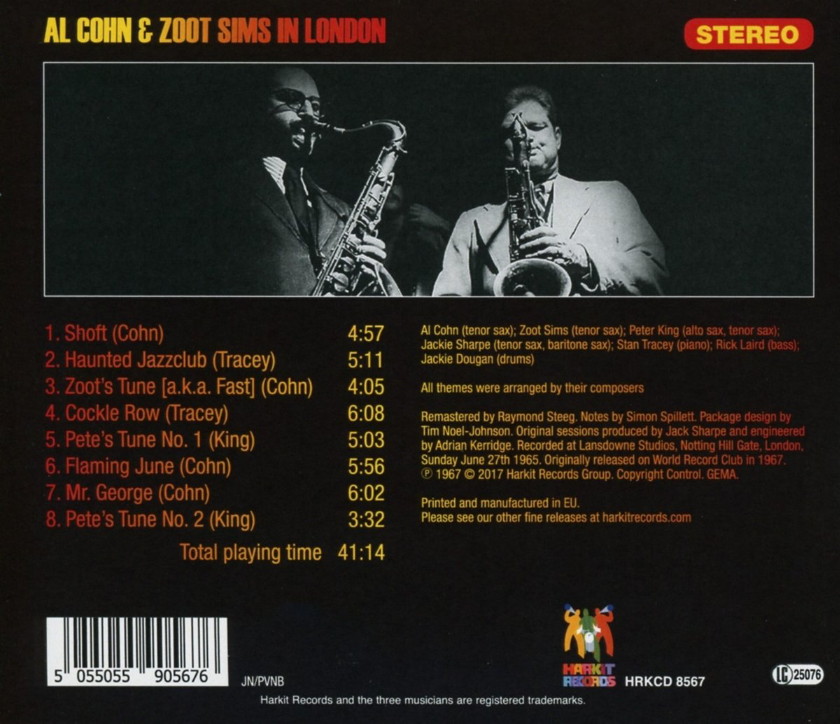
Al and Zoot in London: Harkit HRKCD 8567

“For some, the arrival of American tenor saxophonists Al Cohn and Zoot Sims at Ronnie Scott's club in early June 1965 couldn't have come soon enough. By the middle-1960s, the envelope of “modern” jazz was being pushed to breaking point, both in the US and the UK, and to Scott his two visitors that summer represented the perfect antidote to all the Coltrane and Ornette-inspired “freedom”. Writing in Melody Maker, he described Al and Zoot as “their own men, concerned with a brand of jazz music that is to do with swing, melodic invention, good sounds.”

Scott had long been an admirer. Indeed, he had chosen Sims as the first soloist to inaugurate his club's policy of importing US guest artists four years earlier. When he returned again in late 1962, Sims brought his long-term confederate Cohn with him, upping the musical ante and delighting all those who'd admired the two-tenor team on record.

“Zoot and Al were pure jazz incarnate,” remembers saxophonist Peter King, one of many London musicians drawn to the Americans' feel-good orbit. “They loved to play, respected Stan [Tracey]'s trio and positively relished working with it. They swung their asses off night after night and had a ball, falling in love with England, the admiring audiences and the excellent musicians they met here.”

Putting the visitors on record together with their UK counterparts was a logical next step, an exercise in mutual admiration masterminded by British saxophonist Jack Sharpe, a player who did a great deal to make life comfortable for touring American jazzmen. Indeed, he'd already produced three London-made recording sessions featuring a visiting US soloist, Duke Ellington star Paul Gonsalves (one of which Change of Setting, co-led by Tubby Hayes can be heard on Harkit HRKCD 8561). His fourth such effort, again taped at Lansdowne Studios in Notting Hill Gate, this time on the afternoon of Sunday June 27th 1965,  was designed to showcase Cohn and Sims alongside their regular Scott club accompanists, Stan Tracey, bassist Rick Laird and drummer Jackie Dougan and two further guests, Peter King and Sharpe himself.

Once again, Sharpe leased the resulting master to the mail-order only World Record Club, who issued the finalised LP as Al and Zoot in London in late 1967. Despite receiving some enthusiastic press reviews, including a glowing appraisal in Melody Maker, which noted the albums “highly professional jazz...concerned with form and coherence...and a belief that jazz should communicate with the paying customer”, the LP quickly went out of print. Having also never received a US release, it soon became one of Cohn and Sims most sought-after recordings.

Although Albert McCarthy's sleeve notes to the original record provided a useful précis of Cohn and Sims careers to date, they were less transparent on the specific aspects of the session itself. Fifty years on since its initial release, this new Harkit reissue (the albums début on CD and in glorious stereo to boot) provides a welcome opportunity not only to appreciate this music afresh, but also to reveal some more of its background.

As with his previous recordings centred upon Paul Gonsalves, Jack Sharpe had made the artistically healthy decision of utilizing a shuffling pack of players and arrangers. Indeed, despite McCarthy's sleeve note claim that “most of these tracks feature a four piece sax section, with the scoring presumably done by Cohn,” there is actually far greater variety, both instrumentally and compositionally. For example, Zoot's Tune (a retitling of a piece by Cohn named Fast when first recorded in the company of Sims and Stan Getz in the late 1940s) and Mr. George (another Cohn original dedicated to a verbally enthusiastic fan present at many Cohn/Sims performances at New York's Half Note club) are by a quintet line-up featuring the two American tenorists and the Tracey trio. Peter King makes up a three-tenor frontline on Shoft, while the remainder of the tracks swap instrumentation from a standard alto, two tenors, baritone sax section to a “Four Brothers” three tenors, one baritone set-up.

Fortunately, the music remains focused regardless of these shifts. Nor is there a palpable change of pace as the baton changes hands between the various composers and arrangers. Stan Tracey contributes two themes – a lilting waltz, Haunted Jazzclub, first recorded by Ronnie Scott in 1961, and Cockle Row, excerpted from his recently taped (but not then released) classic Under Milk Wood, a performance made all the more remarkable for hearing Cohn and Sims essaying material hitherto thought of as the sole property of the late Bobby Wellins, a close friend of both men. The spirit of Under Milk Wood is also strongly felt in one of Peter King's two contributions. As King remembered it in his autobiography (Flying High: A Jazz Life and Beyond, Northway Publications, 2011), he had been asked to write something for the album but “as usual, I left it to the last minute and ended up writing non-stop for a whole day and a night. I was still copying parts in the studio, on the session. I never even got around to giving the tunes titles. When the record was finally released, Jack Sharpe had named them.”

One suspects that King may have had a helping hand from Tracey too; Pete's Tune No. 2 moves from a gorgeous sax section introduction to a stark modal vamp that sounds eerily close to Tracey's Starless and Bible Black. Hearing Sims and Cohn – who is especially inspired here – improvising on such “modern”-sounding turf is intriguing, although sadly the performance is faded to a close rather than carried through to a proper climax.

The day of the session had proved especially eventful for King. Then deep in the throes of heroin addiction, he had also used what he called “masses of cocaine” to keep awake. Later that day, following a gig of his own, he was due to celebrate the success of the recording at a party in Jack Sharpe's flat, also attended by Cohn and Sims, but on the way there was involved in a car crash. “I arrived at the party with my head still bleeding, and feeling like a total idiot. Al and Zoot were there, wondering what the hell happened.”

Regardless of the personal dramas surrounding the session, Al and Zoot in London remains a classic – a rare on-record meeting between a perfectly matched Anglo-American musical alliance. All of its headliners virtues are on display: Sims' ability to levitate a band with his unwaveringly joyous sense of time; Cohn's marriage of rhythmic brinkmanship and harmonic daring, and their partnerships conjoined dedication to making music that, as Melody Maker put it in a review of a gig at Ronnie Scott's earlier in June 1965, required nothing more of an audience than “a pair of ears educated enough to appreciate simple swinging jazz.”

As for their English counterparts, there is no suggestion whatsoever of an uneven playing field. Whether on alto or tenor, Peter King sounds as authoritative and commanding an instrumentalist aged 25 as he now does as a septuagenarian veteran, while Stan Tracey, in the triple-role of accompanist, soloist and composer, gives yet another masterful display of his world-class talent. Hindsight also provides moments of revelation in the cases of both King and Tracey; the former comes across as far more rounded, less bop-centric player than many of his contemporary critiques allowed, and Tracey, especially in his careful, playful improvisation on Flaming June, shows a musical restraint that at times sounds more Basie- than Ellington-like.

Although the session and its backstory are very much part and parcel of the Golden Era of British jazz, and of the whole Zeitgeist of the early years of Ronnie Scott's club, the music on Al and Zoot In London itself stands very much on its own timeless merits. But then Cohn and Sims had never chased fashion. Interviewed by Max Jones in Melody Maker in summer 1967, a few months before this album was released, Zoot Sims observed how his and his partners preferred style had begun to sound “kind of mainstream” when compared to the pioneers of the avant-garde. At the time, fierce debate was raging in the pages of the jazz press about whether the idiom itself was dying, a victim of the scorched earth explorations of the new wave. Jones asked Sims if he thought the music was on its way out. His answer was as characteristically unpretentious as his playing; “I always say one thing: jazz has been dying for 70 years and it's going to last a lot longer than the record we're making now.”

Fifty-years on, that record is back, alive and kicking and sounding as good as ever.”

 Simon Spillett

Simon Spillett is the author of The Long Shadow of The Little Giant: The Life, Work and Legacy of Tubby Hayes (Equinox Publishing Ltd. 2015)

 1. Shoft (Cohn)

2. Haunted Jazzclub (Tracey)

3. Zoot's Tune [a.k.a. Fast] (Cohn)

4. Cockle Row (Tracey)

5. Pete's Tune No. 1 (King)

6. Flaming June (Cohn)

7. Mr. George (Cohn)

8. Pete's Tune No. 2 (King)


Al Cohn (tenor sax); Zoot Sims (tenor sax); Peter King (alto sax, tenor sax); Jackie Sharpe (tenor sax, baritone sax); Stan Tracey (piano); Rick Laird (bass); Jackie Dougan (drums)

All themes were arranged by their composers

Original sessions produced by Jack Sharpe and engineered by Adrian Kerridge

Recorded at Lansdowne Studios, Notting Hill Gate, London, Sunday June 27th 1965


Zoot Sims - Al Cohn - Haunted Jazzclub