Sunday, December 20, 2020

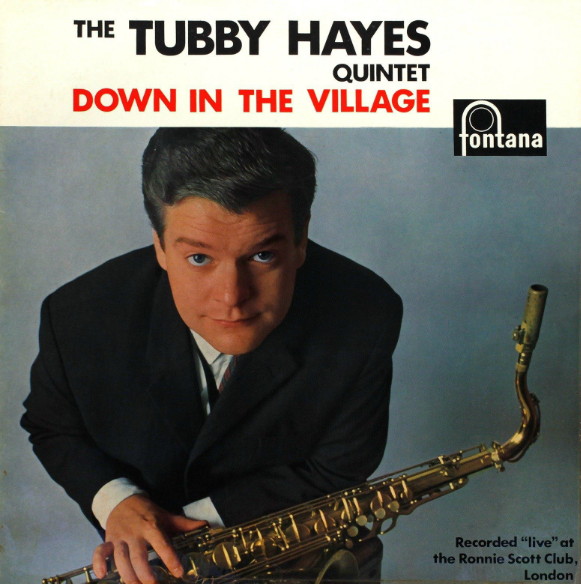
The Tubby Hayes Quartet - Down in the Village
© Copyright ® Steven Cerra, copyright protected; all rights reserved.
I suppose I shouldn’t be surprised.
With the possible exception of the likes of Louis Armstrong, Duke Ellington and Dave Brubeck, many other Jazz musicians were hardly household names even in the halcyon days of the music in 20th century America.
But it still takes me aback when someone who has known the music for a long time is “just discovering him,” or “didn’t know about him until I read your blog postings about him,” or “how do I find out more about him - just seeing his name for the first time.”
The “him” in question is Tubby Hayes [Edward Brian Hayes 1935 - 1973], the brilliant tenor saxophonist [and later vibraphonist and flutist] who reigned supreme on the British Jazz scene from the late 1950’s until his premature and tragic death in 1973 from an unsuccessful heart surgery.
And it still amazes me that anyone in the Jazz world is unfamiliar with Tubby’s brilliance as a multi-instrumentalist soloist, composer-arranger and leader of bands big and small.
For those who knew his work, the magnitude of the admiration for Tubby’s achievements was such that Simon Spillett, posits the question of “What would the British Jazz scene [... have been] like without him?”[The Long Shadow of the Little Giant: The Life Work and Legacy of Tubby Hayes [Equinox, 2nd Ed., 2017]
Fortunately, many of the recordings noted in the Select Discography of Simon’s bio are still available as individual CDs and Fontana recently put together a boxed set in both vinyl and CD formats of all the recordings that Tubbs made for that label from 1961 - 1969.
Among these, my favorite is The Tubby Hayes Quintet - Down in The Village [Fontana TL 5195] and reissued on CD by Redial/PolyGram [CD 558 184-2]
There’s so much to like about this 1962 recording made in performance at Ronnie Scott's in London, not the least of which is it’s blistering version of Rodgers and Hart's "Johnny One Note" as arranged by trumpeter Jimmy Deuchar, Tubby's front line mate on the date. The only way I've been able to stay with this blistering tempo is to count it in one.
Besides Tubby's accustomed brilliance on tenor [and now soprano and also vibes], you can't go wrong with a rhythm section made up of Gordon Beck on piano, Freddie Logan on bass and Alan Ganley, kicking everybody in the backside, on drums.
Each time this disc turns up on my player, it confirms that the prevailing stateside view of the time that "European rhythm sections" can't swing was nothing more than bull puckey.
To better familiarize you with Tubby Hayes and all aspects of this recording, I’ve posted excerpts from Simon Spillett’s biography of Tubbs, Ronnie Scott’s liner notes to the original vinyl LP and Richard Cook’s comments on the CD reissue.
In my opinion, if you are looking for a starting place to appreciate Tubby Hayes, The Tubby Hayes Quintet - Down in The Village is second to none.
Let’s begin with Simon Spillett, The Long Shadow of the Little Giant: The Life Work and Legacy of Tubby Hayes, pp. 160-161:
“Eager to capitalize on the success of the quintet, in early May Fontana announced that the band were to record live at Ronnie Scott's club. Two evenings were set aside for the project, Thursday 17th and Friday 18th, a decision that yielded rich dividends. Live jazz recording was growing ever more commonplace in the early 1960s, and the previous year had seen the landmark albums recorded by Miles Davis (In Person: Friday and Saturday Night at The Blackhawk), John Coltrane (Live at The Village Vanguard) and Bill Evans (Sunday At The Village Vanguard), each an acknowledged classic of its kind. The addition of something similar to Hayes's canon made sense to everyone concerned, doubly so as several jazz critics had already noted that the clout of hearing the saxophonist live had never really conveyed itself on his studio sets. Released as Down In The Village and Late Spot At Scott's, the two albums taped at Gerrard Street that spring have since become two of the best known, and best loved, of all of Hayes's output and, five decades after they were first released, their impact is still immediate. Those lucky enough to have been in on the action as it happened were even more fortunate. Jazz writer Brian Davis remembered that there were high spirits both on and off the bandstand….
Both albums abound in great jazz, and, as with Miles Davis's Blackhawk sets, hearing one without the other is unimaginable. Down In The Village is the more varied in content, and therefore more indicative of Hayes at his diverse multi-instrumental best. Among the highlights is Jimmy Deuchar's opening tear-arse arrangement of Johnny One Note with the leader's tenor successfully contriving to marry mobility with a lustrous tone, something he again achieves on the fiendishly complex Deuchar original First Eleven which concludes the album. Between these two performances, there is a subtle vibraphone reading of But Beautiful, the waltzing The Most Beautiful Girl In The World with another sing-song lyrical improvisation from the leader, a reprise of the soprano saxophone vehicle In The Night, this time sounding more overtly Coltrane-like than the previous BBC recording, and the modal title track, containing, in its hard-hitting vibes solo and Allan Ganley's snapping rim shots, the dance-friendly elements that have ensured its continued popularity as one of Hayes's best-known recordings.”
Ronnie Scott’s text reproduced from original LP:
MY FIRST ENCOUNTER WITH TUBBY occurred some twelve years ago in a now defunct jazz club somewhere in South London - I forget the exact location. I was booked as a guest soloist and during the course of the evening, a chubby young man who appeared to be about twelve years old (he was, in fact 15) came on to the stand with a tenor saxophone only a couple of sizes smaller than himself and asked if he could "sit-in". With rather patronising amusement, I agreed.
He then proceeded to scare the daylights out of me.
The conception, the spirit and fire, the confidence in one so young and inexperienced was absolutely astounding. In the years that have elapsed since then I have been closely associated with Tubby both musically and socially. We have played together on countless jam sessions and for a period of about two years, we worked together as co-leaders of a two tenors and rhythm group - The Jazz Couriers. I have watched his youthful promise develop inexorably so that today, he is, at the age of 27, one of the finest jazz musicians this country has ever produced, and one of the very select band of British jazzmen who can be compared with the best in the world.
Tubby's musical capacity is almost without parallel - when he decided he'd like to play the vibraphone, it took him just about a year to become not only an accomplished soloist, but to my mind the best performer on this instrument in this country. Virtually the same applies to the flute, one of the most difficult instruments to play at all, let alone with the artistry that Tubby displays.
He has topped more polls than I can remember and of late has delved into the fields of arranging and composition, once again with the success one has come to expect of this phenomenal musician. But primarily he is a tenor saxophonist-possessed of a breathtaking ever improving technique and a forthright, no-nonsense conception that reflects the man's own personality and bubbling self-confidence. A measure of his skill as a jazz musician may be taken from his recent appearance at the "Half Note" club in New York, when he played with and for some of America's greatest musicians and was received with tremendous enthusiasm by all who heard him. Tubby would be fantastic even had he been born and bred in America, with all the opportunities that country can offer to the jazz musician. The fact is he is British and has been restricted to learning his art in the main from records and the occasional visit of an American artiste, makes his achievements almost unbelievable. Truly a musician of whom we can feel very proud.
He is, at present, leading a Quintet which is one of the most impressive groups I have ever heard, nationality notwithstanding. Its personnel includes some of the best jazz talent in the country including first and foremost, Jimmie Deuchar. Thirty-one years of age and Scottish born, Jimmie is unquestionably the nation's foremost jazz trumpet player. I have known him ever since he first came to London in 1950, to join the Johnny Dankworth Seven, and we have worked together in several groups including Jack Parnell's excellent band of some ten years ago, as well as in various combinations that I have led. Apart from being a wonderful arranger he is one of the truly natural musicians who plays jazz as easily as breathing, possessed of a warm full tone, and a beautiful sense of timing. When Jimmie's lip is "in", he is one of the most thrilling soloists in jazz.
Allan Ganley is another perennial poll-winner, and I doubt if there is another drummer in the country who could take Allan's place in the group. A rarity in a land notoriously short of good drummers, Allan has a meticulous technique and excellent timing, as well as the great virtue, lacking in so many drummers, of producing musical sounds from the drums. With Tubby's own definite feel for time, and his penchant for ultra-fast tempos, the importance of the drummer in this group cannot be overestimated. Allan fills the bill admirably.
There are two or three talented young pianists around at the moment, and Gordon Beck is surely one of the most promising. At 26, his professional experience apart from some jazz club appearances with pick-up groups, has been limited to a spell with Tony Crombie and more recently the now disbanded Vic Ash-Harry Klein Jazz Five. Gordon is a sensitive pianist, possessed of considerable originality, who has also contributed to the group's library of original compositions. The Quintet is completed by Freddy Logan on bass. Freddy was born in Amsterdam, and first came to England in 1956 after working extensively in jazz groups in Holland and Germany, and has since spent some time in Australia, leading his own trio. His big sound is commensurate with his size (he is 6 ft. 3 ins.) And with Allan Ganley and Gordon Beck, he completes one of the few rhythm sections in the country capable of generating good time at any tempo.
The Quintet spends much of its working time at my Club, and this album was recorded over a period of two nights when the group was appearing at the usual evening sessions. I'm not going to write at length about the music itself - to me jazz must always be largely a matter of personal taste, and I'm a little sick of sleeve notes that would have one believe that every release is a jazz classic. Listen for yourself-there is a great deal worth hearing.
For my own part, the best moments occur in the title track, Down in the Village - one of Tubby's most intriguing compositions, on which he plays two swinging choruses on vibes, and which also features Jimmie Deuchar in his best work on the record. Then there is Jimmie's own First Eleven, a harmonically intricate composition on which Tubby excels - not in the least fazed by the complicated changes. The two waltzes on the record include In the Night, a strangely pastoral-sounding work by Tubby, on which he displays his talents on the soprano saxophone and The Most Beautiful Girl in the World with Tubby at his big-toned roaring best.
There is a great deal more Gordon Beck on In the Night, the rhythm section, especially Allan, on Johnny One-Note, and Tubby's feelingful vibraphone ballad work on But Beautiful.
This album is representative of the very high standard of jazz music that this group is producing, and proves overwhelmingly that British jazz at its best is second only to the best from the U.S.A. and whilst the gap certainly exists, musicians like Tubby are demonstrating very definitely just how rapidly it is being closed.”
TUBBY HAYES 1935-1973 by Richard Cook [1998]
“Edward Brian Hayes has passed into British jazz legend, and 25 years after his untimely death, he seems to exist as a large, shadowy figure standing over a particular era of music-making - long gone, yet almost with us. His physical presence and boyish demeanour endure through photographs and memories, and the sound of his saxophone, spilling over with exuberance, makes him vivid and alive across the years. British jazz has never been short of characters, but it has managed to nurture very few strikingly individual performers. Tubby was preeminent among them.
Not that he was much nurtured by his surroundings. Precociously brilliant as a teenager, as Ronnie Scott's affectionate original note for Down In The Village recalls, he matured into an authoritative voice as a saxophonist and vibes player, composer and group-leader. His early records for Tempo, under his own name and with The Jazz Couriers, document an already formidable voice, but it is his Fontana albums that suggest how important a figure he could have been. The Sixties should have been his decade, but it was not the most successful period for jazz in Britain, and his later discography consists of a mere handful of records that have until now never made it to CD release. Like Joe Harriott or Harold McNair, his music has been more talked about than heard in recent times. To some degree he symbolizes a lost promise which jazz in Britain has sought to fulfill.
Down In The Village and Late Spot At Scott's document some of the music of a great man in full flow, as well as affording a valuable glimpse of some other fine individual voices: Jimmy Deuchar, Gordon Beck, Logan, Allan Ganley.
Tubby's tenor is a marvel of sheer virtuosity at fast tempos, but listen also for his soprano sax - still a comparatively rare instrument in 1962 - and vibes, especially on the title track to Down In The Village. The music follows exactly the order of the original LPs which have since become among the most sought-after records of their kind. Their reissue is long overdue, and we are proud that we can start our Redial series of classic British jazz albums with these beautiful sessions. Luckily, there is still more Tubby to come.”
Saturday, December 19, 2020
Friday, December 18, 2020
The most famous music from “A Charlie Brown Christmas” was originally written for a different project
The most famous music from “A Charlie Brown Christmas” was originally written for a different project

Snoopy in the birdbath
By Liz Fields, December 3, 2020, American Masters, PBS
Even if you’ve never watched the 1965 animated television special, “A Charlie Brown Christmas,” based on Charles Schulz’s beloved comic strip, “Peanuts,” chances are you’ve heard songs from the film’s soundtrack of the same name — likely in a department store, some Hollywood holiday rom-com or around a family dinner table — without even knowing it.
The album, which includes jazzy renditions of classic Christmas songs such as “Greensleeves,” “O’Tannenbaum,” and “What Child is This,” also features original songs written and performed by pianist Vince Guaraldi, including, “Christmas Time is Here,” and “Skating.” But one song, “Linus and Lucy,” which stands out in particular as an instant modern classic, was actually originally written for another project.
In 1963, Lee Mendelson, executive producer of “A Charlie Brown Christmas,” had just finished filming a documentary on Schulz and his “Peanuts” strip, and knew he needed to add music.
“I had always been a great fan of jazz,” Mendelson muses in his book, “A Charlie Brown Christmas: The Making of a Tradition.” “And while driving back from [Schulz’s] over the Golden Gate Bridge I heard a song called, ‘Cast Your Fate to the Wind.'” Mendelson said it was like nothing he’d ever heard before. “It was jazz, but it was melodic and open and came like a breeze off the bay.”
That song turned out to be the Grammy-winning tune written by Guaraldi for the album, “Jazz Impressions of Black Orpheus.” Mendelson immediately reached out to the fellow San Franciscan to help score parts of the documentary. After working on the score for a few weeks, Guaraldi phoned him up, “very excited,” said Mendelson.
“He said he wanted to play something he had just written,” Mendelson recalled. “I told him that I would prefer to come hear it at his studio rather than over the telephone, but he said he couldn’t wait, ‘I’ve got to play this for someone right now or I’ll explode!’ he said. I told him to go ahead, and what I heard over the next two minutes stunned me. It was perfect for the Peanuts characters! When he returned to the phone, I asked him what he was going to call it. He said, ‘Linus and Lucy.’ Little did we know that years later this piece would become a jazz standard throughout the world.”
As fate would have it, the documentary did not sell to a major network at the time, but it did catch the attention of an advertising agency, whose client, Coca-Cola, were looking to make a Christmas special. The agency asked Schulz and Mendelson to come up with something pronto. After pairing up with animator Bill Melendez, whom they’d worked with before, the trio got to planning. It was Schulz who decided that the score to “A Charlie Brown Special” should “mix some of that jazz music with traditional music,” recalled Mendelson, who immediately commissioned Guaraldi once more to re-work some of the tracks from the documentary as well as score new songs for the Christmas special.
Guaraldi, who used to call himself a “reformed boogie-woogie piano player,” was a “high-energy guy with a great sense of humor,” Melendez remembered of the jazz legend. “He was very contemporary and very improvisational, which gave ‘A Charlie Brown Christmas’ and the other shows a hip sound.”
Mendelson described Guaraldi’s music as “bright” and “childlike.”
“The same way Bill kept the animation simple, Vince kept the music simple. This was jazz that appealed to both kids and adults, that captured the spirit of the characters. The music helped make the shows, and the shows helped make the music,” he said.
Mendelson also recalled that Schulz wanted to create a scene especially to showcase Guaraldi’s “Linus and Lucy” theme, which would eventually become the famous dance segment in the Christmas special.
As production was wrapping up on the film, Guaraldi presented the team a beautiful instrumental song he had recorded with his trio (consisting of bassist Fred Marshall and drummer Jerry Granelli) to open the show with. But Mendelson remembers that everyone felt the song needed lyrics, so he stepped in. “Because we were running out of time, I wrote some lyrics in about fifteen minutes on the back of an envelope,” he said. “The song became ‘Christmas Time Is Here,’ which has become a holiday standard covered by dozens of recording artists. Who knew?”
When “A Charlie Brown Christmas” aired in December 1965, it subverted expectations in many ways, including by omitting the standard “laugh track” which was popular in television at the time, and also by featuring voices of real children to play Charlie Brown, Linus, Lucy and the rest of the gang. The children’s chorus who sang on the tracks, “Christmas Time is Here” and “Hark the Herald Angels Sings,” were also volunteers from a church choir in the Bay Area.
Because of these unique features and the show’s understated tone, CBS executives watched the 30-minute film and immediately assumed it would be a flop. Everyone, including the creators, were surprised when the special received a record 36 million viewers when it aired December 5, 1965, and then went on to win an Emmy and a Peabody. Today, the special is still broadcast every year to millions — and many believe the music was a huge part of the show’s popularity and lasting impact.
The soundtrack has since hit Quadruple Platinum (over four million copies sold) and has been added to the American National Recording Registry’s list of “culturally, historically, or aesthetically important” sound recordings. Over time, Guaraldi’s songs from the album have also been recorded by many artists including Dave Brubeck, Wynton Marsalis, George Winston and David Benoit, who credited “A Charlie Brown Christmas” for sparking his love of playing jazz piano.
“That was the first time that jazz piano has been used in animation, which helped make it a really groundbreaking show,” Benoit recalled in Mendelson’s book. “I agree with a lot of people who believe that a big part of the success of ‘A Charlie Brown Christmas’ was Vince’s music.”
Thursday, December 17, 2020
Hank Jones - The Elite


