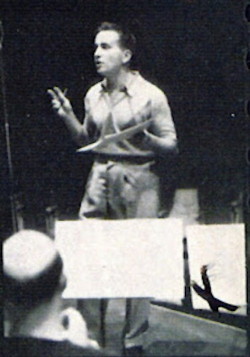
© Copyright ® Steven Cerra, copyright protected; all rights reserved.

The following is excerpted from the JOHNNY MANDEL [1925-2020] NEA Jazz Master (2011) interview that was conducted by Bill Kirchner on April 20-21, 1995 in New York City. The 179 page transcript is in the Archives Center, National Museum of American History of the Smithsonian which can be reached at www.archivescenter@si.edu.
This portion of the interview deals with the period in Johnny’s life from the early 1960s onward and focuses on his continuing development as an orchestrator and composer in a variety of musical contexts, as well as, some of the films he scored, recordings he worked on and particular musicians he favored.
This part of the interview gets a bit technical in places but it will serve to give you an indication of how much thought, planning and technical skill goes into making a large scale instrumental or vocal arrangement.
“Kirchner: Now the Sinatra record. Ring-a-Ding-Ding!
Mandel: Yeah.
Kirchner: Which was the very first record that Sinatra did for Reprise.
Mandel: Yeah, which was his company at the time.
Kirchner: Was that the very first Reprise record?
Mandel: The very first Reprise record.
Kirchner: So you were following...
Mandel: No one.
Kirchner: Well in terms of the people...
Mandel: [laughs]
Kirchner: Yeah right, true.
Mandel: For once.
Kirchner: [laughs] Although in a sense you were because, say Nelson Riddle and Billy May and Gordon Jenkins had been doing his writing.
Mandel: Oh, I'd followed all those great arrangers...
Kirchner: Yeah.
Mandel: Axel Stordahl
Kirchner: Yeah.
Mandel: Oh, with Sinatra sure.
Kirchner: Yeah, I've referred to that, to Ring-a-Ding-Ding! half facetiously as Sinatra's bebop record and I'm exaggerating for effect but my point in that is...
Mandel: I didn't write any bebop in it.
Kirchner: Not overtly.
Mandel: By then, it was like ten years after I was writing those bebop arrangements for Artie Shaw and people like that, I didn't really write like that anymore if you'd noticed.
Kirchner: Right, but what I...
Mandel: I don't mind the way I wrote then, it's just that my head changed somewhat during those ten years. I got much more basic in terms of swing.
Kirchner: Although it's very subtle but I get it, like for example Nelson Riddle came out of the swing era.
Mandel: Much more so than I did.
Kirchner: Yeah.
Mandel: Although we were both in bands at the same time.
Kirchner: Um-hm, and Billy May was...
Mandel: Much more, much more.
Kirchner: There's a very subtle but different flavor in what you wrote for Sinatra but at the same time I mean it's totally appropriate and he's totally comfortable with it.
Mandel: Yeah.
Kirchner: But there's just a different flavor just because of your orientation and the fact that you came on the scene a little bit later.
Mandel: Well I was much more of a jazz arranger than Nelson was too, whereas you can't say that of Billy, Billy was always this free loose swinging wonderful arranger who started with Charlie Barnet. You know which was one of the great white swing bands, truly and very undervalued from a historical perspective.
Kirchner: Like for example on Ring-a-Ding-Ding!, just some of the soloists you use and the way you use them, like say with Don Fagerquist...
Mandel: Yeah.
Kirchner: Or Frank Rosolino.
Mandel: Yeah or Joe Maini or some... yeah.
Kirchner: Yeah, who was the lead alto player on that?
Mandel: Joe Maini.
Kirchner: It was Joe? I was wondering whether it...
Mandel: The best and I've never been able to replace him. [Joe Maini died a tragic early death due to a self-inflicted gunshot wound.]
Kirchner: I can imagine.
Mandel: The best,
Kirchner: There is one, I don't know how much in detail you remember those charts but I was just listening to "A Foggy Day," the other night and there's a sax section background you write behind Sinatra's vocal that sounds to my ears it sounds like a five way voicing with a drop two. Do you remember? It's an unfair question to ask any writer what he did with specific voicing on a specific record but I can't help but ask.
Mandel: I generally favor five way voicing, I'm not really one of those four-part harmony with a double-lead writers. I don't do that a lot, unless I want that particular effect, but that's not I'd say a general working tool for me. I like writing five ways very much, I like writing six ways, I love having six saxophones better than anything else but I found out if I make my records with six saxophones they sound wonderful on the record but the minute the singer wants to go out on the road with them, I have to re-voice them for five and that's a pain in the you-know-what.
Kirchner: Absolutely.
Mandel: I have to totally re-voice them then, and it's double work plus it just doesn't sound as good for five, so you know I'm sort of pushed into going with five but I sort of feel like five way writing has all been pretty well exploited to its maximum. I'd like to have six or seven saxophones even because there's all kinds of ways to use them that I can think of.
Kirchner: Yeah, the five way voicing I was talking about on "Foggy Day," reminded me... like the end of the 60s Thad Jones started using a lot of soprano lead.
Mandel: Yep.
Kirchner: And I mean the voicing's you wrote for Sinatra were pretty high which is the reason I thought they were dropped twos.
Mandel: Dropped twos? What are dropped twos, that's what T was starting to wonder?
Kirchner: When you take the second highest voice and drop it an octave, if you have a close voicing.
Mandel: Oh, I know what you're talking about, you mean when you got six way... I know what you mean.
Kirchner: When you have a close voicing.
Mandel: You drop, yeah, you take the second highest and drop it...
Kirchner: An octave.
Mandel: So that you got - it's almost like... yeah I know what you're talking about. So you have a space between the first and third voice.
Kirchner: Exactly.
Mandel: Sometimes I'll do that.
Kirchner: That was one of Thad Jones' favorite saxophone voicings.
Mandel: I do that quite often, yeah.
Kirchner: Only...
Mandel: Whereas if you have six or seven brass you can just plain do it without leaving anything out.
Kirchner: Um-hm.
Mandel: So you can do it with six or seven saxophones too.
Kirchner: Exactly. I think it works particularly well when the lead alto line is pretty high on the horn.
Mandel: Pretty high on the horn yeah.
Kirchner: So, I mean it was interesting for me to hear that segment just because it was something Thad did a few years later with soprano lead, but you were doing it earlier with the alto lead.
Mandel: Um-hm, it's another reason why I like at least two altos, I don't like having that top tenor up there too much, I mean it's okay up there but it's a different sound.
Kirchner: And it's hard for a lot of players to play in tune up there consistently.
Mandel: I'd say so, and also the one alto sticks out. There's not something to blend it with, in fact if I have six saxophones, I'll use three altos, three [tenors], two [baritone], and one is a wonderful sound.
Kirchner: Have you heard the things Clare Fischer did for six saxes with two altos, two tenors, baritone and a bass on the bottom?
Mandel: Bass saxophone on the bottom?
Kirchner: Um-hm.
Mandel: No. I haven't butt I don't think that's a very good combination because the baritone will have a dumb part.
Kirchner: Interesting, yeah.
Mandel: He's sitting up on the upper part of his horn and it's not a real good sound, in the section because the good notes are going to the bass saxophone, which is a relatively clumsy instrument.
Kirchner: Um-hm.
Mandel: It's a good instrument it's just, I used to use it a lot more than I do now, I like bass saxophone. But I'd use it in place of baritone if I just wanted to extend the range rather than having a baritone up above it. I never liked the Kenton two baritone set up either.
Kirchner: No.
Mandel: 'Cause the top baritone's got the part nobody wants.
[They both laugh]
Mandel: The bottom baritone has the best part in the band.
Kirchner: One of your characteristic woodwind voicing that to my ears is characteristic anyway is, having six reeds and having what sounds like two flutes, two alto flutes, bass clarinet and contrabass clarinet, like you used when I went down to see you do that Kevin Kline end title a couple weeks ago.
Mandel: Oh, yeah?
Kirchner: That sound is something that I've heard you use before with Shirley Horn. Say on the Shirley Horn album I think you use something similar right?
Mandel: Yeah, I'll talk about that to you a little bit later.
Kirchner: Okay.
Mandel: Great.
Kirchner: So, Johnny when we broke we were talking about just - we were into a little technical discussion about your woodwind voicings and when I went to that film that you did in town about two or three weeks ago with Kevin Kline, I noticed with looking at the score you had six woodwinds and you had two flutes, two alto flutes, bass clarinet and contrabass clarinet and it reminded me of some things I'd heard you do earlier, for among other people, Shirley Horn.
Mandel: The reason I used that kind of a voicing was basically to give the greatest amount of flexibility. For instance, if I wanted to get a clarinet trio down on the bottom I could break the clarinet loose and have him playing with the bass clarinet, and the contrabass clarinet. And by the same token I had four flutes apart - three flutes apart from that and... well no, wait seven woodwinds,
Kirchner: No you had six right? Two flutes...
Mandel: I had six.
Kirchner: Two flutes, two alto flutes, bass clarinet, contrabass clarinet.
Mandel: Oh, oh, okay, yeah, in an instrumentation like that the bottom alto flute would swing to the clarinet if necessary. The top alto flute would swing to flute if necessary, depending on how high or low everything was written and if I wanted to I could move the bass clarinet up to clarinet or if I wanted to get a five flute thing you could do that too. I'd get somebody on - that's the swing chair, that bass clarinet chair, the contrabass clarinet just stayed with what he had. That was really the bottom, unless I got into something where I wanted six-way-stuff you know, then I'd break all six loose from the clarinets.
Kirchner: Now, you and Billy Byers to my knowledge use contrabass clarinet more than anyone else.
Mandel: I use it all the time, I don't do anything without it unless it's a big band.
Kirchner: What's the appeal of it as a voice for you?
Mandel: Oh God, it speaks very - first of all it speaks beautifully, it can bark, it's got a total dynamic range of quadruple P to quadruple F. It's got a range down to F just above bass-E which puts it way down in the bottom octave of the piano. Those are good notes, they don't rattle around like a double bass clarinet, a double B-flat and...
Kirchner: So you use the E-flat?
Mandel: I always use the E-flat.
Kirchner: Otherwise known as the contra alto clarinet.
Mandel: No, just contrabass clarinet.
Kirchner: Okay.
Mandel: I mean it's almost never used except in symphonies that double B-flat.
Kirchner: Um-hm, yeah.
Mandel: 'Cause it's kind of useless, that sound unless you double it an octave above when you're doing a line that you want to bring out, which you can probably do better with a contrabassoon anyway. You know you're looking for real low voices in the orchestra. See that's one of my problems with jazz bands is that not only are you lacking soprano voices, they're lacking real good bass voices. So, you're limited really... from just about cello C to about G above high C which isn't... or F above high C which isn't a tremendous range. But it's okay and that's pushing it a bit, certainly for an ordinary dance band that's pushing it a great deal. But now that they have baritones with low A on it you've got the cello C.
Kirchner: And bass trombone.
Mandel: Yeah, that kind of stuff. But I always like to spread out and there weren't instruments that could do it which is why I started adding a lot of instruments in the case of, you know an E-flat clarinet up top, which is really not an instrument for general use 'cause it's a real interesting color but it's like a very cutting kind of color.
Kirchner: You used it really effectively in I Want to Live!
Mandel: I wanted a chilling sound and it's a chilling sound. It's not a warm sound, but it's perfect for what it is.
Kirchner: That comes to mind, there was that segment, the gas chamber scene where you use the low register piccolo playing.
Mandel: Right, how do you know that?
Kirchner: Almost inaudibly.
Mandel: Did I write about it in the notes or something?
Kirchner: No.
Mandel: I might have.
Kirchner: Or maybe, there's a little bit of it in there about Harry Klee playing it I think.
Mandel: Yeah... the low register piccolo is interesting 'cause like low register flutes there are no, absolutely no, overtones to the bottom octave of those instruments. So it makes them sound an octave lower than they are, but also a low register piccolo sounds like a dying man gasping for breath, it's a very strange sound and it's not something you'd associate with a piccolo. In fact, for I Want to Live!, I wrote all the instruments a great deal of the time way out of their registers either the high ones are playing very low or the low ones are playing very high. That was another effect I was trying to get, to try and submerge the identity of the instrument.
Kirchner: How did the players react to all these unconventional uses of their instruments?
Mandel: They said, "Jesus, are you crazy," no, they didn't say that, [laughs] They were all for it, they liked it, they felt like they were doing something at the time.
Kirchner: It was definitely not a run in the mill film date.
Mandel: I guess not. You know I don't have the perspective of a player ever because I don't have to sit day after day and play lots of different kinds of music. I'm in my own head and I know what I'm going to do, or if I don't know what I'm going to do, I'll know what I've done by the time I get into the date. And I have no idea what they've looked at that day from other people or what they've had to look at all week and so I figure if they don't throw me out of there I am doing pretty good.
Kirchner: Now one of the key players on, I Want to Live! and you mentioned he played lead alto on the Sinatra record was Joe Maini.
Mandel: Oh yeah.
Kirchner: Let's talk a bit about him.
Mandel: He was one the most amazing alto players I've ever known and do I miss him, we lost him in the early 60s and he's the best lead alto player I know. All you have to do is listen to all the Terry Gibbs, Dream Band records. He was a wonderful soloist and he had great emotional appeal. He was not of the cool school and I'm not one who liked the cool school, particularly.
Kirchner: He was a very Charlie Parker influenced alto player.
Mandel: And he was one of the funniest people I've ever known and unknown to most people he was very literate. He was a professional ignoramus who pretended to be, it was an act with him, he was extremely intelligent.
Kirchner: I'm told by a reliable source that Lenny Bruce got a great deal of his shtick from Joe Maini.
Mandel: He got a lot of it but Lenny Bruce didn't need to get his shticks from anybody, he was the most creative comic I've ever heard, bar-none, and to this day nobody's come close to him and I'm sorry that they've missed him. It would be wonderful if there was a revival and some people started doing comedy on the level of his comedy, 'cause I think comedy these days is just stupid. It's as bad as comedy was in the 20s as far as the level it plays to, forgetting the scatological pails of it, they tell jokes and do old-time stand up comedy is what they do and it's just not the kind of sophisticated comedy we had in the 50s and 60s.
Kirchner: There's no place for a Mort Sahl.
Mandel: No, no, doesn't seem to be.
Kirchner: How well did you know Lenny Bruce?
Mandel: Pretty well, just thought he was wonderful. He was a wonderful self-destructive man.
Kirchner: He used to work at a lot of jazz clubs right?
Mandel: Oh yeah, well he used to work a lot of burlesque houses too, don't forget his mom Sally Marr, Sally was the dirtiest comic I've ever heard. They thought Lenny was dirty, Sally Man- was a burlesque comic that's where, you know he came by it honestly, his mother was a burlesque comic and they are as raunchy as they come and she dated from the 20s. So, I mean she used to embarrass Joe Maini and Jack Sheldon, that took some doing.
Kirchner: I'll bet.
Mandel: Oh yeah.
Kirchner: So you used to hear - did you used to see Lenny work quite a bit?
Mandel: Yeah, whenever I could. Oh, he had us on the floor at all times.
Kirchner: How did it compare with the records for example? Do you know the records?
Mandel: Oh they're wonderful, they're classics.
Kirchner: But how close are the records to the way he really was?
Mandel: Oh, he never kept a show the same, ever. So who knows, he didn't do pat things, he was so wonderfully inventive that it was always changing.
He didn't have a routine like so many comics do, where he froze it...
[Begin CD 6]
Mandel: And did it like it was a show. It wasn't like that with him at all, he was very off the cuff.
Kirchner: And very in tune with musicians.
Mandel: Oh extremely, sure.
Kirchner: What do you think would have happened had he lived?
Mandel: Who knows? I mean who does know? He, if he hadn't self-destructed... see Lenny got so involved in defending himself in the courts that he stopped being funny, so it's hard to say, his life went in just totally different directions for the last few years of his life. And he was like Mort Sahl, that happened to Mort Sahl too, he got hung up on the Kennedy assassination and he became serious and, you know about trying to... disprove the prevailing theory you know and prove it was a conspiracy and all the rest of it. Lenny was just trying to save himself in the courts as far as his arrests on narcotics, his arrests on obscenity. He was not an obscene comic at all, not really, even by those standards back then. These guys today are obscene.
Kirchner: Well it's the theory of shock for shock's sake, I think. That there's no substance below it.
Mandel: Yeah, he never used it for shock value and he was very much against it, he used to talk, he said, he'd never use scatological references for shock value at all and he thought it was dumb, the people who did it were pretty dumb. 'Cause there's no point in it, it's not funny unto itself, it's only when it's juxtaposed with something else that it becomes funny.
Kirchner: Now, we were talking about Joe Maini, I'm told he was a great strip joint tenor player.
Mandel: The best, it was when I first heard him playing in strip joints that kind of alto, real rye balled alto that I decided right then and there that was the perfect thing for, I Want to Live! For all those scenes, like when she was arrested and screaming over crowds and all that stuff, that was the sound. And I heard him first do it in strip joints, exactly.
Kirchner: A lot of players used to play in strip joints in L.A. in the 50s right?
Mandel: Sure.
Kirchner: That was...
Mandel: That was, a lot of that work was there.
Kirchner: It was like another form of casuals.
Mandel: Yeah, but you had to outplay the drummer in strip joints 'cause they were busy catching the kicks with the girls and all and tit wags and what else, whatever else, fanny wags.
Kirchner: [laughs]
Mandel: So you had to really be able to speak on the instrument, that was definitely not for West Coast jazz players.
Kirchner: So what else did you use Joe on besides, Ring-a-Ding-Ding!
Mandel: Everything, once I discovered him, I wouldn't let him out of my sight.
Kirchner: He was kind of for you what Ait Pepper was for Marty Paich.
Mandel: I guess so, but I loved Art Pepper too but Art Pepper wasn't around a lot of the time.
Kirchner: Right.
Mandel: Art Pepper was a marvelous player, I used him on the Hoagy Carmichael album. I used to play with him in the Spanish bands, you know when I was playing in the Latin bands. We called them Spanish bands, they weren't Spanish, they were Puerto Rican or Cuban, that was in the late 40s.
Kirchner: How well did you get to know him?
Mandel: Very well.
Kirchner: Would you like to talk about him a bit?
Mandel: He was like a brother, he was like a beautiful pure soul, who unfortunately got loused up on drugs like so many. Chet was that way too, you know they were drug casualties, what else can I say. One of those unfortunate people who crossed paths with drugs, had they been born twenty years later or twenty years earlier, it would never have happened. Even ten years earlier or later.
Kirchner: Yeah, well like you were talking yesterday it seemed to have all happened in, the most intense drug period seemed to be say 1945 to '55 was when most of the people who were getting hooked got hooked.
Mandel: Yeah, '45 to '60, I'd say. Yeah and it really dwindled off in the 60s. Thank God, I mean it was just a terrible period, but it was a great musical period, I gotta say that.
To be continued in Part 5.