© -Steven Cerra, copyright protected; all rights reserved.

"Well, listening to [Al and Zoot’s] music takes me back ... which is OK because — let's face it — the past is home to me. It's home to me and other surviving musicians from Zoot and Al's generation, and I speculate on how quaint we must seem now to the younger people who have never been interested in the music we play. We're the guys with the half-diminished chords and tritone substitutions who know 'all the tunes' and like to talk about swinging. We're today's 'old-time musicians', like the polka-band musicians of my childhood. And just like Whoopee John or the Six Fat Dutchmen or Frankie Yankovic, we're keeping alive the music of the 'old country', except that unlike those polka guys, we come from various racial and national backgrounds and the term 'old country' no longer applies to someplace overseas."
- Dave Frishberg, Jazz Pianist
Has there ever been a more engaging tenor sax duo than Al Cohn and Zoot Sims?
Thank goodness they had such a long association and that much of it was recorded.
The Jazz world would have been a much poorer place without Al and Zoot’s “... elegant interplay, silk-smooth textures, cheerful swinging, bodacious unisons and thumping good individual solos. It may not dig all that deep, but when you are listening to [them] you tend to wonder why more Jazz records don’t have this feel-good factor. ….” [paraphrased from Richard Cook and Brian Morton, The Penguin Guide to Jazz on CD, 6th Ed.].
The editorial staff at JazzProfiles found this essay on Al and Zoot in the February 2005 edition of late Gene Lees’ Jazzletter and we thought we shared it with you
Bright Nights at The Half-Note: Legend of Zoot and Al
“The year 1962-63 was a dark one for me. I had dumped my job in Chicago as editor of Down Beat and moved to New York, pretty much flat broke, and that year was a crazy quilt of contradictions, of deep depressions and unexpected soaring of the spirit, of successes and discoveries and new friendships, some of which I treasure to this day, whether that friend is alive, like Phil Woods and Dave Frishberg and Bill Crow and Roger Kellaway, or gone, like Zoot Sims and Al Cohn and Art Farmer and Gerry Mulligan and Bill Evans and Jack Whittemore and Jimmy Koulouvaris.
Among my best memories of that time were two or three weekends spent at Phil Woods' home in Bucks County, Pennsylvania, and nights at the Half Note listening to Zoot Sims and Al Cohn, who could have inspired Zasu Pitts, Mischa Auer, Ned Sparks, Virginia O'Brien, and even Buster Keaton to smiles and even laughter.
Jack Whittemore was an agent and Jimmy Koulouvaris owned and operated a New York bar called Jim and Andy's on 48th Street just west of Sixth Avenue. Almost no one patronized the place except musicians, and any jazz fan who inadvertently wandered in could look the length of the bar and see a lot of the most famous names he had ever admired. Jimmy Koulouvaris was a Greek-American former Seabee, a veteran of the Pacific, who liked musicians, and who extended them credit on food and drink that kept many a soul alive through lean times. Jack Whittemore had been the head of the Shaw Agency, but quit to book jazz groups on his own. Agents are often detested, Jack was loved. He set a lot of careers in motion, in effect starting the Horace Silver group, and doing much for the career of Stan Getz.
Stan uttered one of the most cogent bits of jazz criticism I have ever heard. Asked for his idea of what would make the perfect tenor saxophone player, he said (in the presence of Lou Levy, who passed it on to me): "My technique, Zoot's time, and Al's ideas." Zoot 'n' Al were two of the most faithful denizens of Jim and Andy's. Both were famous among the regulars for humor, and Al had a new joke — no, three or four of them! — every afternoon, when he'd come in from one studio gig or another. We all used to wonder where he got them.
Al was an adept of unpremeditated wisecracks. Two of the most famous:
A derelict approached him on the street, saying, "Sir, I'm an alcoholic, and I need a drink." Impressed, presumably, by such candor, Al — a pretty stalwart drinker himself, as we all were in those days — peeled off a little loot and said, as he handed the man the cash, "Wait a minute, how do I know you won't spend this on food?"
Al played a gig in Copenhagen, where they have a brand of beer called Elephant. He was asked when he checked in at the club, "Would you like an Elephant beer?"
"No," Al said. "I drink to forget."

I just remembered another one, which has assumed the proportions of myth; I presume it's true because it sounds like him. Someone asked if he played Coltrane's Giant Steps. Al said, "Yes, but I use my own changes."
Man, that's fast.
Zoot was just as funny, but in a different style. More incidents in the legend of Zoot and Al:
Zoot, who was not renowned for sartorial splendor — one could say he usually looked rumpled — came into Jim and Andy's (known as J&A's or The Gymnasium) about eleven o'clock one morning dressed neatly in suit and tie. Somebody said,
"You're looking pretty dapper this morning. What happened?
"I don't know," Zoot said. "I woke up this way."
One day, after playing late the night before, Zoot turned up in Jim and Andy's, said he had a record date ahead of him and asked if anybody had any kind of upper pill to keep him going. The wife of another musician said that she did, got the pill out and handed it to him. Zoot said, "Is this pretty strong stuff?"
She said, "Well, you could break it in half and throw the rest away.
Zoot said, "What? Throw that good stuff away? Do you realize there are people in Europe sleeping!"
Andre Previn, another of Zoot's great admirers, told me the next story. Years ago Andre played a Hollywood record date for John Graas, a classical French horn prayer who had a certain (and by now faded) vogue as a "jazz composer" and recorded some LPs I found impenetrable. One of his compositions had space for a solo over some difficult and pretentious chord changes. When one musician after another had a cut at it and crashed, the solo was assigned to Zoot, who sailed through it with characteristic insouciance. At the end of the tune, someone asked,
"Hey Zoot, how did you do that?" to which he replied, "I don't know what you guys were doing, but I just played “I Got Rhythm. "
Al Cohn, as a consequence of an infection, had lost an eye. The record producer Jack Lewis also had one eye. One night Jack, Al, and Zoot were driving back in the rain from some place or other. Zoot was zonked out in the back seat. He stirred, leaned over the back of the front seat, and said, "I hope you guys are keeping both eyes on the road."
Zoot-n-Al were inseparable names, like Pratt and Whitney, Vic and Sade, Lum and Abner, Chase and Sanborn, Laurel and Hardy, and Gilbert and Sullivan, not to mention Ipana and Sal Hepatica. There have been several of these relationships in jazz, Duke Ellington and Billy Strayhorn, Bix Beiderbecke and Frank Trumbauer, Dizzy Gillespie and Charlie Parker among them.
If Jim and Andy's was the diurnal habitat of Zoot and Al, in the evenings, much of the year, it was the Half Note, an Italian restaurant in the South Village, at Hudson and Spring Streets, a district of old warehouses and factories abandoned at night, their windows all dark. I still can see the old brick cobblestones given texture by the light of the lamp at the corner and the neon sign, a half note, above the restaurant.
It was a family operation…..
Two groups operated almost as house bands, one led by Bob Brookmeyer and Clark Terry, with Phil Woods a frequent member, the other by Zoot and Al.
Phil recalled, "Brookmeyer used to bring a football to work and insisted on playing catch across the traffic."
Bill Crow wrote:
"The Half Note moved to 54th Street in 1972. It lost much of its ambience in the transplant and went out of business before long. The Canterinos went their various ways, as did the groups that had made so much music for them. But for those of us who were part of the family, the memories are poignant. It takes no effort at all to re-imagine the old club and fill it with all the good musicians who played there and all the friends who used to crowd the bars and tables. In those empty streets cobbled with red brick, it seemed, with its warm lights and the smell of its food and sound of its music, a haven in the night."
Phil Woods said, "God, I miss Frank Canterino and the meatball sandwiches. When they moved uptown and they all wore tuxes, I knew the writing (or pizza sauce) was on the wall. You can't serve bebop pizza in a tux!"
For myself, I miss the eggplant parmigiana, although I must admit those meatball sandwiches were pretty groovy. Try saying "groovy" to some young people; you're likely to get a bemused expression, as you will if you say phonograph or record player or LP.
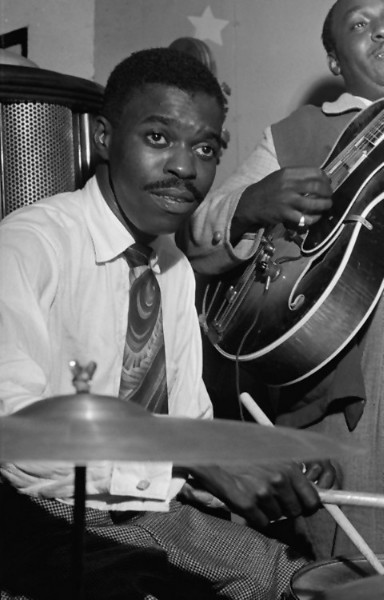
Roger Kellaway was the pianist, much of the time, with the two groups. Sometimes Dave Frishberg was the pianist with Zoot and Al. Various bass players worked with them, but the drummer was usually Mousey Alexander.
In a liner note for a 2002 Verve CD reissue from a 1960 LP by Zoot and Al, titled You 'n' Me, Dave wrote, "Together and separately they were probably the most widely admired musicians I ever came across. I used to watch other musicians listen to them, and I remember how their faces would light up, and how they would burst into spontaneous cheering and howling. I think it might have been the drummer Jake Hanna who said, 'Everybody wants to either play like Zoot and talk like Al or play like Al and talk like Zoot….'
"If you were a piano player doing jazz work in New York in those years you couldn't ask for a more nourishing, more rewarding, experience than to play with Al and Zoot and their colleagues and friends and fans at the Half Note every night. You got to play with Jimmy Rushing on the weekends. And ninety dollars a week wasn't bad, especially if you supplemented it with rehearsing a singer or two. The point was that you could be involved, you could be included, you could be on the scene each night making music with two immortals in their prime. This was Zoot 'n' Al, man! This was jazz playing of the highest order and purity, the most serious and sublime joy. This is why you came to New York.

"During the bass solo, Al Cohn would drain the contents of a shot glass in one gulp, then, staring straight ahead, he would hold the glass with thumb and index finger at arm's length, shoulder level, and let it drop. Sonny or Mike would whirl and pluck the glass cleanly out of the air with barely a glance upward. Mousey Alexander would 'catch' the action with a cymbal crash. I never saw anybody miss.
"The shtick with the shot glass seemed to express the unflappable comic worldliness that was Al Cohn's personal magic. But it went deeper than that. When Al and Zoot played, they spoke straight to the music in each of us, player and listener alike. Somebody once remarked that when Zoot Sims starts to play, everything starts to sound better. I agreed and reminded him that Al Cohn need only enter the room to make it happen. What a thrill, what a privilege, to be on the stand with them."
There is an old jazz musician's story according to which when Bunny Berrigan was asked how he could play so well drunk, he replied, "Because I practice drunk." The remark is also attributed to Zoot. The story may be apocryphal. Yet it may be true.
Well, Zoot not only played well when he was drunk, he seemed to play better and better the more so he got. I can remember seeing him with a Woody Herman reunion band at the Monterey Festival. He was so loaded that he kept tilting in his chair, at one point leaning on Richie Kamuca (another of the missing) and then, tilting the other way, on Al Cohn. Woody tried to stand in front of him, to hide him from the audience, but wherever Woody would stand, Zoot tilted the other way. Finally came time for him to solo. He got up, made his way unsteadily downstage to the microphone, and played one of he most magnificent ballad solos one can imagine.
Roger Kellaway tells me that when Zoot got down to a low A-flat on the horn, you knew he was really drunk.
When Zoot and Al were at the Half Note, I'd sometimes go there with Gerry Mulligan or Paul Desmond or both. Zoot of course had played in Gerry's Concert Jazz Band, and Desmond was simply enthralled by Zoot's playing. Paul said once, "It has the sweet innocence of a baby's first steps. You can't care if he stumbles. The recovery is so charming."
Not to detract from anybody else's work, but oh did Zoot swing. His records are the best antidote for a dark day I know, along with those of Count Basic and Dizzy Gillespie.
Al Cohn was also a superb arranger, turning out countless charts back in the pre-synthesizer days when the New York (and Los Angeles and Chicago) recording studios were beehive busy with real live musicians recording real live arrangements by the likes of Johnny Mandel and Marion Evans and Sy Oliver and Claus Ogerman and Billy May and Marion Evans and Nelson Riddle and Gary McFarland and Peter Matz and God knows how many more. Those days are gone, and don't call me a pessimist for saying so. They are, factually, gone, and I cannot see in the future anything like the conditions, economic or esthetic, in which that music flourished. Al wrote for everything, including singers' record dates, Broadway musicals, and TV specials.
I guess I first became aware of Al and Zoot when they were with the Woody Herman Four Brothers band. If you lived through that era you can probably shut your eyes and hear that saxophone sound, three tenors and a baritone. If Woody wanted alto lead on something, he'd play it himself.
Zoot was born John Haley Sims, the son of vaudevillians, on October 29, 1925, in Inglewood, California. He had two brothers, Gene Sims, who played guitar, and Ray Sims, born in 1921, a really fine trombonist. The extended family included Roger Kellaway, who was at one time married to their cousin Patti, a singer. The family always considered Roger one of them. Zoot's family and, later, his friends, called him Jack. He got into some band or other whose leader though it would be cute to put "hip" nicknames on the music stands, and the stand Jack inherited had "Zoot" inscribed on it. It stuck forever as his professional name. I knew Ray before I knew Zoot. Ray was at the time with the Les Brown band, and I became friends with him and Wes Hensel, who played lead trumpet (and later headed the brass department at Berklee in Boston). Ray doubled as a vocalist, and he was very good at it. Whenever the band would come into Hamilton or Toronto, I'd be there. Contrary to legend, the first thing musicians seem to ask of local people is not where they can find a chick but where they can find a good restaurant. "The conversations on the band bus," Roger Kellaway confirmed, "were always about food." I was their guide to the eateries, which weren't much in those days before fancy foreign restaurants colonized even the smallest cities.
Zoot became a professional musician at fifteen, eventually playing with Bobby Sherwood, Sonny Dunham, and, after two years in the army, Benny Goodman. He was with the Herman band 1947-'49, which tenure brought him to fame as a soloist, using elements of Charlie Parker's playing in a style that derived largely from Lester Young. The Four Brothers band brought fame also to Stan Getz, of whom Zoot said in later years, "Stan is a whole bunch of interesting guys."
There is a deft description of Zoot's playing in the Leonard Feather-Ira Gitler Biographical Dictionary of Jazz: "Always a natural swinger, he brought a shimmering, mellow warmth to his ballad playing." Although he worked with various bands over the years, including the Mulligan Concert Jazz Band and Stan Kenton and he went on the legendary Benny Goodman tour of the Soviet Union, always there was that centripetal friendship with Al Cohn, a partnership that seemed to bring out the best in both of them.
Alvin Gilbert Cohn was born in New York City on November 24, 1925. I am often intrigued at the way friendships in jazz (and incidentally in theater too) go back to school years (Benny Golson and John Coltrane, for example) or even childhood.
Johnny Mandel said: "I was born in New York at 85th and West End Avenue at Queen of the Angels Hospital, or something like that, on November 23, 1925." Thus John had one day's seniority on this earth.
Mandel said, "I looked up to Al. I first met him when I was going to boarding school, New York Military Academy, up in Tarrytown. I was very much into music already and started writing. Al was playing with Paul Allen's band. There was a bunch of musicians in there that were very good. Nat Peck was in the band, and Lee Pockriss, who ended up writing Broadway musicals. The lead trumpet player, Jack Eagle, was telling me about this great arranger they had, Al Cohn. He said, 'Why don't you come over to a rehearsal?'
"They were playing Basie stocks and those things, and some arrangements by Al. I met Al and listened to what he was doing on songs like Where or When. He was playing different changes on the song. I had a band back at the school, and I went back, and I'd copy those changes. I remembered them. I played them with my band. Al never knew that.

"Later on, when I was out of school and a working musician, we'd sort of cross paths. When I'd play in a band, he'd been there ahead of me. I wrote for Woody Herman and Artie Shaw and he was in both those bands. I think we may have played together in some Georgie Auld bands. We worked in one band together, Henry Jerome. Leonard Garment and Alan Greenspan were in that band too at one time, and Al took Alan Greenspan's place.
"I admired everything Al did as an arranger. He was a great player too. I really wanted him to like what I did. He was sort of the guy in the back of my brain. I'd say, God, would he like this? I didn't have the arrogance to think, He should like me! I was listening to everyone and wondering if anything I did was good enough. We used to show each other things during the Nola rehearsal hall period, when everybody would jam forever.
"I think I used to resent him a lot because he was having such a great time, and I was so serious about music that I was struggling.
"I missed a lot in New York because I left the city in 1953 when I went with Count Basie, and then settled on the West Coast. I heard Zoot and Al down at the Half Note, but it would only be when I came into New York on something. Yeah!'"
Al Cohn worked for Joe Marsala when he was eighteen — and it is interesting to note how many of the best jazz musicians of his generation were full professionals by that age — then for Georgie Auld. Rejoined the Boyd Raeburn band in 1946, and went with Woody Herman in 1948.
Lou Levy, pianist with that band, recalled in a conversation with me in 1990:
"When I joined, Herbie Steward had been replaced by Al Cohn. So they had Al, Stan Getz, Zoot, and Serge Chaloff. The brass was Ernie Royal, Bernie Glow, Shorty Rogers, Irv Markowitz, and Stan Fishelson. The trombones were Bill Harris, Ollie Wilson, Bob Swift, and Earl Swope. Don Lamond was playing drums. Chubby Jackson was on bass. Terry Gibbs was playing vibes. Oh God, what a wonderful experience! I'd love to go through it again now that I know a few things. When you're in the midst of such greatness at such a young age, I don't know if you realize what you're involved in. I was nineteen. The magnitude! I don't know if I appreciated it. I didn't know how good these guys were yet.
"One thing was made evident to me right away. Everybody in the band was crazy for Al Cohn. When he played, there was sheer reverence as everybody turned their eyes and their ears toward him. When somebody else played, they just looked straight ahead. When Al Cohn played, it was always something special. You can ask anyone who's left from that band.
"Yesterday, for instance, I was out at Stan Getz's house at Malibu. He played a tape that Al Cohn did in Germany not very long before he died. The tune was Some Other Spring with a large orchestra. It's like it came from heaven, you can't believe how gorgeous it is. Stan still has that same reverence for Al. I remember in 1948 and '49, Stan would look up at Al with those blue eyes of his and just stare at him when he was playing. This is Stan Getz, and he's pretty snappy himself.
" I miss Al Cohn. And I remember how all the guys in Woody's band looked at him."
"That band was pretty strung out when you joined it," I said. "Woody told me some stories about it. Some of them funny, some of them not so funny. And both Zoot and Al told me about it too. That's how Al lost his eye, he told me. It was from an infection from a bad needle. He said, 'Losing your eye, that's a pretty good reason to quit.' And Zoot told me he got into a car with a girl he was going with and drove to California. He said he withdrew in the motel rooms along the way. And they both stayed straight."
"Well," Lou said. "Heroin was the drug of the period. Pot was already old hat. Cab Calloway was singing songs about it and making jokes about pot. And Harry the Hipster. Heroin was a serious habit, but that was the drug that everybody was using at the time. I got into it."
"The guys who got into it either got out of it or they aren't here."
"Pretty much. There are a few who are still around who are into it. We don't have to name names, we all know who they are. I was not serious about it, not serious like some of the guys who aren't here any more. I got out. It took me a while. I finally just got disgusted with myself and gave it up."
"Woody told me once that he was so naive he couldn't figure out why his band kept falling asleep."

Lou laughed. "Oh Woody! I remember Woody's expression. He'd just look at us! He didn't even shake his head. He'd just look. He never said anything to anybody that I can recall."
"I know he tangled with Serge Chaloff about it once," I said. "Serge being the band druggist. And yet it never affected the quality of the music."
"Oh! The quality of the music was very important to them. They were very conscious of their image. What they were doing in their hotel rooms or on the bus or at intermissions was one thing, but on the bandstand they were real music-conscious. We'd all look for the opportunities to play. Sometimes Woody would get off the bandstand for the last set and go home. We'd drag out all the arrangements we really loved to play, Johnny Mandel's Not Really the Blues, and play them. There was so much we loved to play in the band anyway, Neal Hefti and Al Cohn stuff. The soloists were always at their best. In a theater, we'd find a piano in some room down in the bowels of the theater and jam between shows. Al, Zoot, Stan, everybody. Always looking to play. Whatever else suffered, the music never did. The band sounded healthy.We may have had some unhealthy habits, but the music sounded healthy. Great vitality, great oneness."
The quintet Al and Zoot formed in 1957 went on into the 1980s.
It is little noticed that many jazz musicians have been good singers, among them Buddy Rich (who would have preferred a career as a singer and like Zoot came from a vaudeville family), Ray Sims, of course, Cannonball Adderley, Jack Sheldon, Chet Baker, Dizzy Gillespie, Richard Boone, Jack Teagarden, Blossom Dearie, Gerry
Mulligan, Dave Frishberg, and four pianists I think of instantly whose abilities as singers overshadowed their talent as pianists, Jeri Southern, Sarah Vaughan, Carmen McRae, and Nat Cole. And trumpet players beginning with Louis Armstrong and continuing through Roy Eldrige, Ray Nance, Hot Lips Page, and Doc Cheatham, have done a certain amount of singing, including Clark Terry, in part to rest their chops and let the blood flow back into their lips, as Clark once pointed out to me. But I think they do it because they like it: it adds that extra dimension of words. And most songwriters sing, and sometimes, as in the cases of Alan Bergman, Alan Jay Lerner, and Harold Aden, have been very good at it. An interesting phenomenon: so many jazz players, though they have had all the equipment in the world for vocal improvisation, have sung straightforwardly, staying close to the melody and letting the words breathe through, as in the cases of Chet Baker, Gerry Mulligan, and Nat Cole. Well Zoot was one of these people.
In late 1984, Roger Kellaway and I had a one-week gig at the Chateau Laurier in Ottawa. We noticed that Zoot was closing the night before we opened, so we flew up a day early to hang with him and listen. He was very weak by now, and played sitting down. I was particularly partial to his soprano saxophone, and he played a lot of it that evening. And he sang. Beautifully. At the end of his first set he joined us, and he said, "Hey, Gene, I didn't know you could sing."
I said, "Well, Jack, I didn't know you could either."
I never saw him after that night.
I last talked to Al Cohn on the telephone. He was in the hospital. Al was married to Flo Handy, who had been married to George Handy. She had put out the word somehow that Al wanted to hear from friends. I called him, somewhat hesitantly, and we talked for a little while.
Zoot died in New York City on March 25, 1985; Al in East Stroudsburg, Pennsylvania, on February 15,1988, both of cancer. So many jazz musicians have succumbed to this scourge that I have wondered if this is a consequence of playing in smoky nightclubs. Even those (few) who didn't smoke were subject to enough second-hand smoke to stagger an elephant. Later, Flo told me that my call to Al meant a lot to him, which surprised me, but I have learned never to hesitate to call friends in that condition.
And when my dear friend Sahib Shihab was dying, I went to the hospital several days running, and sat by the bed, just holding his hand. Dying is a lonely business.
Zoot would have turned eighty on October 29, 2005, Al would have turned eighty on November 24. On a compromise date, November 5, a celebration was held at East Stroudsburg University of Pennsylvania, where the Al Cohn Memorial Jazz Collection resides, gathering pertinent material on their careers and other important musical documentation. I couldn't be there, but toward the end of the afternoon event they played a CD of an interview I did with Johnny Mandel about Al; it lasted nine minutes. The panelists and audience told Al and Zoot stories, including those I have just recounted, which are common currency of those of us who knew those two guys.

Phil Woods wrote me:
"What a party! Louise Sims [Zoot's widow], Maddie Gibson [widow of Dick Gibson, who used to hold the Colorado jazz party at which Zoot and Al often played], Dave Frishberg, Bill Crow, Ira and Mary Jo Gitler — she did a great poster for the event — Joe Temperley, Dan Morgenstern, Stanley Kaye, Marvin Stamm, Eddie Bert, Dick Meldonian, damn fine alto man who was with Elliot Lawrence when Al was writing for the band, John Coates with Joe Cohn [Al's son], Bob Dorough, Bill Goodwin, Steve Gilmore, Wolgang Knittle — my neighbor — Lew Del Gotto, Bob Lark, a tenor conclave of a bunch of B-flat cats including Nelson Hill and Tom Hamilton, Sherry Maricle and Five Play, the Festival Orchestra with me — I'd just flown in from Salzburg, Austria — and much more, plus an enthusiastic audience of about 400 guests.
"All and Zoot would have been proud."
Bill Crow added: "It was a lovely day. Bob Bush, who is supervisor of the Al Cohn Memorial Jazz Collection, and his wife Narda pulled the whole thing together. It was nicely organized and everyone seemed happy to be there. The first event was the noontime seminar remembering Al and Zoot, with a panel of myself, Ira Gitler, Dan Morgenstern, Stanley Kaye, and Steve Gilmore. There were many of Al and Zoot's old friends and colleagues in the audience, so the storytelling flowed from the stage to the audience and back again. It was like Jim and Andy's without the booze. (There were lots of stories about booze, too).
"The afternoon concert went on at two. Bob Dorough sang a couple of his songs and then was joined by Dave Frishberg for their collaboration on I'm Hip. Next a band of old friends of Al and Zoot played: me, Ross Tompkins, Eddie Bert, Dick Meldonian, and Marvin Stamm, and the young drummer Marko Marcinko. I hadn't played with Ross for quite a few years, and enjoyed him a lot. We were followed by Katchie Cartwright who, accompanied at the piano by Eric Doney, sang a lovely selection of Flo Cohen's songs. They're remarkable and difficult songs, and Katchie rendered them perfectly. Dave Liebman did a set with Jack Reilly, Steve Gilmore, and Bill Goodwin, and Sherrie Maricle's Five Play went on as a quartet. Sherrie's musicians, all women: Tomoko Ohno on piano and Noriko Ueda on bass, and a marvelous Israeli tenor player, Anat Cohen.
"The evening concert began at eight, with Dave Frishberg doing a wonderful set of his tunes, a set by Joe Cohen and John Coats Jr (Joe is one of my favorite guitar players), and Phil Woods playing beautifully with the Festival Orchestra with Wolfgang Knittel and Rick Chamberlain plus guests from the afternoon concert. For the finale, there was a conclave of all the tenor players in the house.
"It was a good hang, and some good music got played. I hope they do it again next year."
I suddenly had another memory of Al. Some time in the late 1960s, my father was visiting me in New York. He was a violinist who had studied in England with a student of Joachim's. My dad's professional playing career pretty much ended with the advent of talking pictures, when musicians by the thousands lost their jobs in the pit orchestras that had accompanied silent movies throughout North America. He affected not to like jazz, but in the later years I noticed that it was sneaking up on him.
Tony Bennett was appearing at the Copacabana, and I took my father to hear him. As always, Tony had a first-class orchestra behind him. There were some tenor solos. At the end the first set, my father said with awed enthusiasm, "Who was that B-flat tenor player?"
I said, "Al Cohn."
"He's marvelous!" my father said.
He knew musicianship when he heard it. I introduced him to Al that evening. He was almost reverent.
Dave Frishberg wrote of the Zoot 'n' Al recordings:
"Well, listening to this music takes me back ... which is OK because — let's face it — the past is home to me. It's home to me and other surviving musicians from Zoot and Al's generation, and I speculate on how quaint we must seem now to the younger people who have never been interested in the music we play. We're the guys with the half-diminished chords and tritone substitutions who know 'all the tunes' and like to talk about swinging. We're today's 'old-time musicians', like the polka-band musicians of my childhood. And just like Whoopee John or the Six Fat Dutchmen or Frankie Yankovic, we're keeping alive the music of the 'old country', except that unlike those polka guys, we come from various racial and national backgrounds and the term 'old country' no longer applies to someplace overseas."
Amen.
Dave was having lunch with my wife and me in California some years ago. We talked about those old polka bands in the Midwest, which I too remember and seemingly nobody else does. Dave said, "Gene, we're dinosaurs. We're Whoopee John." He talked about baseball players of old and 1930s radio shows and how much he missed these things. And he said, "Oh man, I miss everything."
So do I. Especially Al and Zoot.”
The following video tribute features Al and Zoot together on Al’s original Doodle Oodle with Jaki Byard on piano, George Duvivier on bass and Mel Lewis on drums.