Monday, November 15, 2021

"Monk" - Whitney Balliett

 © Copyright ® Steven Cerra, copyright protected; all rights reserved.


The Boston Globe stated: “Balliett’s genius for pictorial description (which helps make him a gifted writer of profiles) extends to the music itself. No one writes about what they listen to anywhere near as well.”


Although he played drums during his college days and was a member of a band, Whitney was not a studied musician. He had no formal training in theory and harmony so during the 40+ years he wrote Jazz profiles for The New Yorker magazine he had to fall back on his other gifts when describing the music - his gift for “pictorial description.”


In many ways, this made Whitney’s Jazz writings more accessible to the majority of Jazz fans since they, too, for the most part, lacked procedural training in melody, harmony and rhythm - the building blocks of music.


As a result, "Balliett comes as close as any writer on jazz—perhaps on any musical style — to George Bernard Shaw's intention to write so that a deaf person could understand and appreciate his comments. This volume approaches indispensability." Choice reviewing Balliett’s American Musicians.


The editorial staff at JazzProfiles thought it might be fun to share some briefer pieces from the pen of our ideal - Whitney Balliet - to give you an appreciation of his “ … genius for pictorial description.” This is the first in a series of six continuously running featuring Whitney’s sui generis pictorially descriptive approach to writing about Jazz which is marked by what Gary Giddins has labeled “writerly attributes: insight, candor, observation, discernment, delineation, style, diligence and purpose.”


These are all drawn from Goodbyes and Other Messages: A Journal of Jazz 1981-1990 [1991].


Monk [Thelonious]


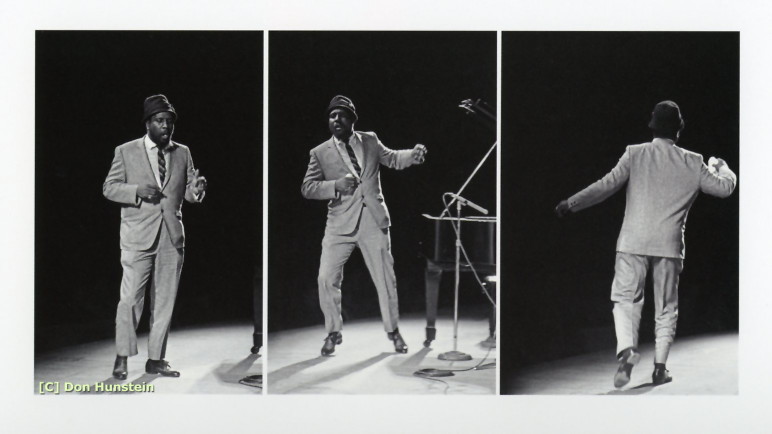
“The pianist and composer Thelonious Monk, who died last week [February 17, 1982], at the age of sixty-four, was an utterly original man who liked to pretend he was an eccentric. Indeed, he used eccentricity as a shield to fend off a world that he frequently found alien, and even hostile. A tall, dark, bearish, inward-shining man, he wore odd hats and dark glasses with bamboo frames when he played. His body moved continuously. At the keyboard, he swayed back and forth and from side to side, his feet flapping like flounders on the floor. While his sidemen soloed, he stood by the piano and danced, turning in slow, genial circles, his elbows out like wings, his knees slightly bent, his fingers snapping on the after-beat. His motions celebrated what he and his musicians played: Watch, these are the shapes of my music. His compositions and his playing were of a piece. His improvisations were molten Monk compositions, and his compositions were frozen Monk improvisations. His medium- and up-tempo tunes are stop-and-go rhythmic structures. Their melodic lines, which often hinge on flatted notes, tend to be spare and direct, but they are written with strangely placed rests and unexpected accents. They move irregularly through sudden intervals and ritards and broken rhythms. His balladlike tunes are altogether different. They are art songs, which move slowly and three-dimensionally. They are carved sound. (Monk's song titles— "Crepuscule with Nellie," "Epistrophy," "Ruby, My Dear," "Well You Needn't," "Rhythm-a-ning," "Hackensack"—are as striking as the songs themselves. But none beat his extraordinary name, Thelonious Sphere Monk, which surpasses such euphonies as Stringfellow Barr and Twyla Tharp.) His improvisations were attempts to disguise his love of melody. He clothed whatever he played with spindly runs, flatted notes, flatted chords, repeated single notes, yawning silences, and zigzag rhythms. Sometimes he pounded the keyboard with his right elbow. His style protected him not only from his love of melody but from his love of the older pianists he grew out of—Duke Ellington and the stride pianists. All peered out from inside his solos, but he let them escape only as parody.


Monk hid behind his music so well that we know little of him. He was brought from North Carolina when he was little, he eventually settled in the West Sixties, and he lived there until his building was torn down. He married the Nellie of his song title, and he had two children, one of whom became a drummer. He began appearing in New York nightclubs around 1940, but he achieved little recognition until the late fifties. (He was often lumped with Charlie Parker and Dizzy Gillespie; however, he did not have much in common with them outside of certain harmonic inventions.) Part of the reason for Monk's slow blooming was his iconoclastic music, and part was the fact that he was unable to perform in New York night clubs from 1951 to 1957 — the time when Charles Mingus and the Modern Jazz Quartet and Gerry Mulligan were becoming famous. (The police had lifted his cabaret card, because he had been found sitting in a car in which narcotics were concealed.) But when he returned to the scene, he suddenly seemed to be everywhere — on record after exceptional record, at concerts and festivals, at the old Five Spot and the Vanguard and the Jazz Gallery. He filled us with his noble, funny, generous music.


Then, in 1973, he vanished again. There were rumors that he was ill and had been taken in by his old friend and mentor the Baroness Nica de Koenigswarter, who lives in a big house in Weehawken, New Jersey. The rumors turned out to be true, and this is what the Baroness had to say about Monk before he died: "No doctor has put his finger on what is wrong with him, and he has had every medical test under the sun. He's not unhappy, and his mind works very well. He knows what is going on in the world, and I don't know how, because he doesn't read the newspapers and he only watches a little telly. He's withdrawn, that's all. It's as though he had gone into retreat. He takes walks several times a week, and Nellie comes over from New York almost every day to cook for him. He began to withdraw in 1973, and he hasn't touched the piano since 1976. He has one twenty or thirty feet from his bed, so to speak, but he never goes near it. When Barry Harris visits, he practices on it, and he'll ask Monk what the correct changes to 'Ruby, My Dear' are, and Monk will tell him. Charlie Rouse, his old tenor saxophonist, came to see him on his birthday the other day, but Monk isn't really interested in seeing anyone. The strange thing is he looks beautiful. He has never said that he won't play the piano again. He suddenly went into this, so maybe he'll suddenly come out." 


But Monk must have known he wouldn't. His last public appearance, at the Newport Jazz Festival of 1976, was painful. His playing was mechanical and uncertain, and, astonishingly, his great Gothic style had fallen away.”


Friday, November 12, 2021

Nat Adderley and Alto Saxophones Players [From the Archives]

 © -  Steven A. Cerra, copyright protected; all rights reserved.


“Julian ‘Cannonball’ Adderley’s enormous personality and untimely death, together with his participation in such legendary dates as Miles’s Kind of Blues, have sanctified his memory …. But brother Nat was a big part of the band they had together from 1959 until Cannonball’s passing in 1975 at the age of 45.

One of the few modern players to have specialized on the cornet, … Nat was always the more incisive soloist, with a bright ringing tone that most obviously drew on the example of Dizzy Gillespie  but in which could be heard a whole raft of influences from Clark Terry to Henry ‘Red’ Allen to the pre-post-modern Miles Davis of the 1950s.”
Richard Cook and Brian Morton, The Penguin Guide to Jazz on CD, 6th Ed.

“Nat Adderley received top billing in the Cannonball Adderley Quintet from 1959 to 1975. Although overshadowed by his brother Julian "Cannonball" Adderley, Nat's own contribution to the band's success was substantial….

Nat contributed to the quintet as both player and composer. He wrote several hits that became jazz standards, including "Work Song," "Sermonette," and "Jive Samba." His instrumental style bears the influence of Clark Terry, Miles Davis, and, in brassier moments, Dizzy Gillespie.

How­ever, Nat's solos are often highly personal in their use of half-valve (slurred) effects, unusual tone color, and a wry sense of humor.

Without him, the quintet would have been an altogether different, and perhaps more somber, band.”
Len Lyons and Don Perlo, Jazz Portraits

Nat Adderley became a bandleader in 1975 without really wanting to ….”
- Orrin Keepnews

As I have mentioned before on these pages, business travel was a constant part of my life, especially during the last two decades of my career.

Most of it was national, some of it was international. Occasionally, and much to my relief, it was local.

One such local trip that I made on a quarterly basis involved visiting a client who owned a business based in Stockton, CA, which is about 80 miles due east of my office in San Francisco.

Since the purpose of these visits involved an early morning meeting with the company’s Board of Trustees, I would usually drive out for dinner with my client the previous evening to discuss the agenda, and then stay the night in a nearby hotel. It was easier than battling the morning traffic and the especially-dangerous morning fog.

A big box bookstore was located in the same complex with the hotel, and as I was restless following dinner, I wandered over to it to kill some time before turning in.

The store carried an extensive display of CD’s [remember those?] and while browsing its collection, I came across some music by Nat Adderley’s group featuring “Vincent Herring,” an alto saxophonist whose name was new to me.

I’d always dug Nat’s playing, the discs were being offered at half price and the “kicker” was that Jimmy Cobb was the drummer on two of the three that I purchased.

Boy, was I in for a treat.

When I returned to the room, I popped one of the CDs into my portable player, put on my ear phones and there went my early night as I stayed up half of it being blown away by Vincent Herring.


Poor Nat; here he was with another fantastic alto sax player.

As was the case with brother Julian, Nat more than held his own, but, man, Vincent Herring was somethin’ else [no pun intended].

As Nat described to Alwyn and Laurie Lewis in his March 1992 interview with them for Cadence Magazine: “Vincent plays Vincent; he has the style of Cannonball’s, but he does not play Cannonball’s licks. And that’s why I like him.” [paraphrased]

Elevating, exciting, electrifying - whatever the best words are to describe Vincent Herring - one thing is certain, you can’t expect to listen to his playing and easily go to sleep, afterwards.

Although a little groggy from lack of sleep, I showed up to the Trustees’ meeting the following morning with a big smile on my face. That and saving the client a good deal of money on their reinsurance placement must have won the day as I was able to renew the contract for one more year.

I owe it all to Nat Adderley, at least, the smile on my face, as if it hadn’t been for him, I most probably wouldn’t have discovered Vincent Herring.

Judge for yourself whether it was a worthwhile finding as Vincent is featured on the audio track to the following video tribute to Nat. Work Song is one of Nat's more famous tunes. David Williams on bass and Jimmy Cobb on drums and Larry Willis does the honors on piano.


Thursday, November 11, 2021

Art Pepper - 1925-1982 And His "Second Career"

 © Copyright ® Steven Cerra, copyright protected; all rights reserved.


"The Second Career" by John Lithweiler originally appeared in the January/February 1998 issue of Coda magazine, and can also be found in Todd Selbert’s The Art Pepper Companion: Writings on a Jazz Original [200] in a slightly revised and expanded version. Its publisher, the Cooper Square Press, still makes Todd’s compilation available.


I’m a big fan of collective writing approaches to an artist’s work as it offers the Jazz listener many different perspectives on a Jazz musician’s rather than the one provided by a biographer, per se.


This is in no way meant to minimize the monumental effort and skill involved in researching and writing a professional biography, but rather, as a way of saying a word or two in defense of the multi author compilation of which, in my opinion, there are two few that focus on Jazz and its makers.


Art Pepper’s career is often viewed as a First Career, which took place from about 1945-1960 and, as John notes, a Second Career that occurred from “ ...the mid-'70s to his death in 1982,” the interregnum between them caused by Pepper’s stints in federal prison due to drug abuse and criminal activity related to it.


Todd’s The Art Pepper Companion offers articles that seem to favor one or the other of these two stages, but rarely both, so, in this regard, it is particularly helpful to someone like me who favors Art’s First Career but has a difficult time coming to terms with his music during the Second Career.


John takes on an attempt to explain the distinctions and relative merits between these two phases in Art Pepper's career - especially the second - through a review of the following later-in-Art’s career recordings:


ART PEPPER

With Duke Jordan in Copenhagen 1981 * Galaxy 2GCD-

8201-2(2-CDset)

ART PEPPER-ZOOT SIMS

Art N' Zoot * Pablo 2310-957-2

ART PEPPER

Tokyo Debut * Galaxy 4201-2


“Was Art Pepper a greater artist during his second career (the mid-'70s to his death in 1982) than during his first career as a mature artist (the 1950s to I960)? Gary Giddins and Laurie Pepper certainly seem to think so, in the expanded 1994 Da Capo edition of the book Straight Life, and moreover, Laurie maintains that Art recorded with more major jazz names during his second career — quite an assertion, considering all those 1950s dates with singers and the likes of Chet Baker, Jimmy Giuffre, Warne Marsh, Hampton Hawes, Red Norvo, the Red Garland Trio, and on and on, including the Kenton band and crowds of ex-Kentonites.


There's no question that Pepper was a different artist in his second career. The wonderful Galaxy recordings have been, up to recently, the best available evidence of that. And now during the 1990s Laurie Pepper has begun leasing, to the Fantasy combine, broadcast recordings of Pepper's second career, material that originally appeared on Japanese and European releases according to Todd Selbert's Pepper discography. The prospect of future issues is a real matter of intrigue, for Art Pepper was billed as a sideman on a number of sessions ostensibly led by Sonny Stitt, Lee Konitz, Jack Sheldon, Milcho Leviev, and others. The purported sidemen on those tend to be Pepper's regular quartet, as in Sheldon's Angel Wings LP (Atlas LA27-1001), which includes 3 originals, 2 by Pepper and one Sheldon-Pepper collaboration. As a matter of fact, Sheldon plays fine lyric trumpet throughout the date, but Pepper, in beautiful form, takes the lion's share of solo space, and the cover photo tells the story: A glum Sheldon, on the right, points to Pepper, center, gloating over all his loot.


What happened to Pepper between his first and second careers? Prison and the Synanon cult, of course, and a much-reported period of obsession with Coltrane that you'd hardly have anticipated from the earlier, distinctively original Pepper, a bop era artist with swing era origins. Terry Martin's 1964 Jazz Monthly essays indicated the opposing pulls of black and white jazz on Pepper's early development, the models of Benny Carter and Lee Konitz (Pepper liked to cite the Lester Young tradition as his principal inspiration), the growth of Pepper's mastery of improvised form and linear flow. Joined by Martin, I heard Pepper for the first time in 1974 at a college jazz band conference, Pepper was teaching clinics for Buffet saxophones in those days; prior to his set, chaperoned by an obviously worried Ken Yohe of Buffet, Pepper showed all the symptoms of stark, paralyzing terror. Yet, joined by trombonist Bill Watrous and accompanied by an uncoordinated student rhythm section, he played excellently and at length.


The differences between the first and second Art Pepper, including the influence of Coltrane, became evident later, when he began touring in clubs and concerts. Pepper liked to draw attention to the differences, by performing, along with his new songs, new versions of his early triumphs. As Martin wrote, one of Pepper's early breakthroughs was his lovely 1951 solo feature on Shorty Rogers' "Over the Rainbow." Of course Sun Ra's satiric solo versions point up for all time the song's inherent emotional dishonesty, with the yearning octave leap that begins and the comforting major thirds and soothing cadences that follow. But Pepper, who played it again and again in his second career, seemed to wish the "Rainbow" fantasy would come true.


In his 1970s and 1980s versions, Pepper liked to open "Over the Rainbow" with an unaccompanied alto intro, beginning with a cascading phrase that had no direct reference to the theme. The version in Art N’ Zoot has his intro in something of a pure form, with variations on that opening phrase notable for fourths and flatted intervals that evade the theme or at best dwell on its yearning qualities. He then interpolates minor notes into his theme variations and this opening solo includes a high, harsh, anguished tone to indicate that Harold Arlen's world is in fact far from his. That high note predicts the harshness (sheets of sound) that begins his second solo and the strained, climactic octave leap. He finds no comfort in the concluding cadence, either, for he creates sheets of sound yet again in the rubato coda. His Copenhagen version develops rather similarly, though after the cascading opening phrase his intro is quite diffuse; this version has the advantage of Duke Jordan's solo, for in contrast to the tormented yearning in Pepper's broken phrases, the pianist creates long lines of flowing bop melody.


On the other hand, there's "Winter Moon," a near-masterpiece in the 1956 Hoagy Carmichael recording: Pepper's opening solo is the plaintive, long-tone, minor-key theme with spare decorations, and the sorrow that emerges from his simple 24 bars is unforgettable. The long Galaxy solo (1980), over a string arrangement intended to dramatize the song's starkness, is itself admirable but sounds melodramatic by contrast One of his very best blues solos is "Las Cuevas De Mario" in the 1960 Smack Up, a marvelous trip through strange melodies and dislocated accents in 5/4 meter; Pepper's 1977 Village Vanguard version by contrast struggles to be coherent. There are the fast, biting, brittle, staccato Pepper solo in the 1960 "Rhythm-A-Ning," ending in an ecstatic chorus of pure accents—surely this is rhythmic virtuosity to rival Charlie Parker—and his Copenhagen "Rhythm-A-Ning" solo, slower but with a similar tension of varied phrase shapes and silences, with sheets of sound erupting in the third chorus and recurring thereafter; Pepper may be preferable in the earlier version, but Duke Jordan's 1981 piano solo, in delightful long lines, all the brightness of Bud Powell without the mania, is quite superior to Wynton Kelly in the earlier.


One more comparison: "Besame Mucho," in which Pepper, in a great 1956 Tampa recording, concentrated a lifetime's tragedy into two wrenching choruses. In his second career he played the minor-key piece often, including a comparatively subdued ballad version in that 1979 Tokyo Galaxy disc. There's a 1978 version not to be missed in Art Pepper Live In Japan Vol. I (Storyville 4128). with squalls of Coltrane like fury in the intro and coda vamps. The Copenhagen version has less dramatic dynamic contrasts but does include strained tones and sheets of sound. These later versions are in considerably more broken phrases than the Tampa "Besame Mucho," and these solos' very length determines that they're more diffuse solos. Admirable though these solos are, they're coarser works that deliberately attempt to evoke the tragedy that grew naturally from the lyric tensions in the early version.


What are the differences between early and late Art Pepper? Like his first master, Benny Carter, his alto sound, always beautiful, acquired a firmer quality over time, and it probably never sounded so brilliant as when Rudy Van Gelder recorded him in that 1979 Elvin Jones Quartet session, originally on a Japanese 45 r.p.m. LP (Evidence CD 22053). His vibrato, always so slow that it was more like a little quaver, widened. The later Pepper played longer solos, of course; now that he was a full-time bandleader, he structured performances on a large scale, and he especially liked routines such as the vamps that often opened and closed his pieces. Necessarily, the forms of his solos, ever a crucial concern with Pepper, also changed. While he was recurrently capable of creating beautiful melodic phrases, the more crucial element of his soloing was tension sustained and developed through fine sensitivity to phrase lengths, accenting, and rests. Slightly off-pitch tones, emphatically bent tones, low register passages became more frequent. High, strained tones, or overtones; multiphonics tones; momentary flurries of 16th notes to end phrases, all appeared, adding further stresses to his lines. All these expressive elements added to the tension of his solos, but then his sheets of sound that became climactic developments of vamps recalled an aspect of Coltrane's cyclic forms, too. Interestingly, Pepper's sheets of sound were not rising chromatic scales, like Coltrane often used, but arpeggios — even at his most extreme his harmonic vocabulary was founded on pro-bop practices.


Altogether, the body of his solos offered the early Art Pepper kinds of tension and phrasing, with more elaborate details and settings. The newest formal element was the one-chord intros and codas, which by their absence of mobile harmony demanded a different approach to shaping solos. That these changes did not, to him, devalue his earlier kind of lyricism was shown by his many clarinet solos and many of his last duets with pianist George Cables. As a generalization, joy, tragedy, pure beauty, and the emotions between them arose from Pepper's lines themselves in the 1950s. The later Pepper often consciously sought to evoke these emotions in his late career, especially in his extended routines. But throughout his career, early as well as late, he was an uncommonly self-aware artist, and his fine care for solo creation led to intimate revelations in both periods.


Tokyo Debut comes from his first tour of Japan (4/5/77), upon which he was accompanied by members of Cal Tjader's rhythm section. Unlike Charlie Parker and most other jazz players of his generation, Pepper had a real affinity for Latin phrasing, fitting accents and phrase lengths to mambo and samba patterns. So the Latin specialties, "Manteca” and two standards from Black Orpheus, in which he joins Tjader's full, quite extroverted band, are thoroughly sparkling. As usual, he played "Straight Life" very fast, at a "KoKo'- like tempo, like a diatonic Parker. Considering that Pepper always denied any direct Parker influence, let's say that his great freedom of accenting surely had affinities with Parker's discoveries. There's a medium-up blues, "The Spirit Is Here," that brilliantly shows Pepper's sense of structure, It begins with a little rift' theme that he varies for a few successive choruses; variations of that riff then pop up in every second chorus that he improvises, resulting in an unusually unified solo.


Art N’ Zoot (9/27/81) has a changing cast of characters including Victor Feldman, Ray Brown, Charlie Haden, Billy Higgins, and Barney Kessel; there's Pepper's solo feature, "Over the Rainbow," and three solo features for Sims plus "Wee" ("I Got Rhythm") and the blues for the saxes together. It's revealing that Sims, with his uplifting swing, meant more to Pepper than Getz, with all his virtuosity, and it's interesting that on this concert Zoot plays a cheerful, rifting "Girl From Ipanema" at a faster tempo than Getz did, with no hint of Getz's melancholy. Alto and tenor open and close the slow blues as duo improvisations, but the remarkable empathy of Pepper, Warne Marsh, and Ted Brown in two 1956 albums is impossible here. Instead, Pepper and Sims provide a more conventional battle-of-the-saxes show; they make interesting contrasts, with the altoist (the bluesier of the pair anyway) interjecting funky phrases and the tenorist swinging with a rude swagger and a sometime broad, dramatic sound that recalls Coleman Hawkins and Ben Webster.


None of these three concert albums is with Pepper's standard rhythm section. Despite all his work with forceful bop pianists, for his own sessions he preferred less aggressive, less distinctive accompanists who supported with simple but hip harmonies and who soloed in pretty melodies, on something less that Pepper's own high creative level; think of the likes of Ronnie Ball, Pete Jolly, Marty Paich, Dolo Coker in earlier years, and later the many tours and recordings with the ingenious Cables. All of which makes the two-disc Copenhagen (7/3/81) especially attractive, for Duke Jordan is truly the costar throughout the program, complementing Pepper's complex self-examinations with their emotional opposite: long lines of melodies that flow inevitably, yet with surprise and delight. Moreover, Jordan's intensity is of Pepper's own quality, so the concert is uncommonly well-sustained — was the altoist, at any other time in his career, matched with another pianist this inspired? Too bad there wasn't more rehearsal time, because I for one would have loved to hear Pepper take on the challenge of excellent, and once-familiar, Jordan themes like "Flight to Jordan" and "Jor-du."


The album has a flying start in the terrific "Blues Montmartre"— Pepper was at his best in up-tempo blues — with the theme generating his developments in early choruses, then riff choruses alternating with melodic choruses, new material alternating with developments of earlier ideas, and exultant sheets of sound by the 18th chorus, an ingeniously structured solo followed by particularly witty Jordan playing. The vocalized elements in "What Is This thing Called Love?" rise to the climax of another especially well-formed alto solo. He generates tension in the vamp intro to the fast "Caravan" by alternating bars of brittle sound with bar-long rests, playing broken phrases that become unsnarled with the accompanying rhythm, all confined in a half-octave in the lower middle register. Not until the theme bridge does he break free, but only briefly, for the punchy, low, minor piano chords call him back to brittle, eventually convoluted phrasing throughout his solo on the chords. There is a driving piano solo, and the vamp alto coda is the finishing development of an extended, harrowing performance.


The ultra-last tempo of "Cherokee" segues into the ultra-slow "Radio Blues"; the tempo extremes finally defeat the musicians. After all the complexities of the preceding selections, the relative respite of "Good Bait" is welcome. It's a lyrical clarinet solo, intense but without strained passages, with early low-register choruses over only bass and drums, then by the fourth chorus higher tones that suggest something of the sound of Lester Young's metal clarinet. The final piece, at the same tempo, is "All the Things You Are," with a perfectly appropriate conclusion: Pepper and Jordan alternating eights and fours, playing off and fulfilling each other's lines and finally pointing up the good musical feelings between the pair. As you'd expect, throughout the 11 songs bassist David Williams and drummer Carl Burnett provide very alive accompaniment.


Pepper obviously believed in Lester Young's dictum that a solo should tell a story. Even without the book Straight Life, you can hear themes of his life in his playing — the affinity for darkness in his minor-key pieces; his quest for ecstasy especially in his ultra-fast-tempo pieces; the broken phrasing that suggests a disrupted consciousness; above all else, the great tension that sustains all of his solos. The quest for beauty is in all of his music and the vocalized techniques of his second career are an almost visceral reflection of the pain involved in his quest. You may hear his phrasing now and then in improvisers like Frank Morgan and Bud Shank, but unlike some songs of, say, Jordan, none of his themes became standards, and by and large Pepper had no more direct influence on his fellow saxophonists than Jelly Roll Morton had on other pianists of his era. The music, the beauty, the intensity were Pepper's story and his alone.”


Wednesday, November 10, 2021

"What Is Jazz" - From Jazz Americana by Woody Woodward [From the Archives]

 © -Steven Cerra, copyright protected; all rights reserved.


“Frenchmen call it Le Jazz Hot. If you want a hot argument, just ask two
or more jazz enthusiasts to define it for you.”


“The jazz musician begins as such. He does not simply graduate to it as his taste dictates. Jazz is there from the beginning of his musical awareness.”          
- Woody Woodward


The record label that was the California equivalent of Blue Note Records during the post world War II years was Pacific Jazz. It was established by Richard Bock in the early 1950s, initially to record the new Gerry Mulligan - Chet Baker Quartet


In the case of Pacific Jazz, Richard Bock was blessed at the outset to have the brilliant photographic work of William Claxton form the basis for most of his album cover art.  Ray Avery, a contemporary, once said of Claxton work: “Some of us take photographs of Jazz musicians, but Bill does much more than that: he is an artist with a camera.”


In fairness, Dick Bock’s Pacific Jazz label gave Bill Claxton a place to learn and practice his art as a photographer so the creative purposes of each were well-served through their business relationship.


Acknowledgement should also be made of the skills of Woody Woodward, who designed many of the Pacific Jazz covers, and without whose logistical and technical contributions, Dick Bock’s Pacific Jazz would have been even more disorganized, and of Dotty Woodward, the firm’s accountant and the person who managed the royalties for the musicians and composers.


Thanks to a close friend who is pretty much the unofficial historian of all things Pacific Jazz [and all things West Coast Jazz, too], I recently learned that Woody Woodward was also somewhat of a Jazz historian and the author of Jazz Americana: The Story of Jazz and All Time Jazz Greats from Basin Street to Carnegie Hall.


Jazz Americana was published in 1956 in a 6.5” x 9” magazine format by Trend Books and sold for 75 cents. Fortunately, I was able to track down a fairly serviceable copy at a reasonable price and I thought it would be fun to share some excerpts with you.


Let’s begin at the with Chapter 1 - What Is Jazz - which Woody subtitles: “Here It Is! The First Good Definition of Jazz”


Despite this imposing assertion, Woody put a great deal of thought into his definition of what Jazz is including, what it isn’t.


In many ways, it is one of the more coherent and cogent definitions of Jazz that I’ve ever come across, one that is especially helped by the clear and direct writing style in which it is presented.


In retrospect, given when it was written, Woody’s definition of Jazz stands the test of time and holds up very well.


See what you think.


“ I find myself confronted with the task of writing an entire book on a subject that hasn't even the advantage of an adequate definition. In 50 years, all the articulate and learned men whose opinions and observations have been placed before the public have failed collectively to produce a generally accepted definition for the common everyday word jazz. A more compatible relationship between jazz and its public might have been achieved sooner if it had been possible to offer the inquirer a useful definition. So little agreement has existed on informed levels that the question, "What is jazz?", too often remains unanswered. In its place comes a thin, superior smile and a condescending shrug — inferring, "... if you don't know what it is I can't tell you." Small wonder that the public has been so often confused, especially when one considers that there have been as many personal concepts as there are experts. As might be expected this leads to a great many misconceptions about jazz, made worse by the cliquish groups "in the know" who seemed quite satisfied to keep the whole business about jazz a mystery.


Time has shown us that the public has been a great deal more willing to accept jazz than they've been given credit for and jazz musicians considerably more interested in being accepted then they’ve been given credit for. The jazz musician wants very much to have his music understood and be respected as a professional. In the main, he believes this can be done without subverting his integrity. This has been made difficult for him since most of the media of mass communications - radio, television, motion pictures, and the written word  -have consistently caricatured him as an inarticulate ne'er-do-well. A typical motion picture approach shows the jazzman, after years of struggling, at the heights of achievement when his jazz concerto is presented in Carnegie Hall. This is usually showcased by a hundred-piece symphony orchestra with the composer conducting, especially sobered for the occasion. Being allowed on the stage of a concert hall is symbolic of his emancipation from so coarse and useless an existence as being a jazz musician. The inference is, "See, jazz musicians aren't so bad after all. They even read music and wear formal clothes."


This is rather a negative approach and reveals almost nothing of the nature of jazz; however the movies are not alone in promoting the Big Fable. On highly dramatic New York television plays or Hollywood films, it is currently very fashionable to play jazz records behind any act of violence. The slick magazines' preoccupation with anthropology, antiquated jazz slang, and endless intellectual dissertations, while less damaging, add to the confusion. It is something of a testimony to the taste and good sense of the public that people are presently supporting jazz in the manner to which it is unaccustomed. Despite the difficulty of getting much in the way of intelligent information on jazz from the usual sources, the public and jazz are getting together. This is something of a testimony to the strength of the music and the men who make it. Not so long ago sentiments were so strong in camps of the cultists that none could condone the existence of the others. Each group imposed confining limitations on the jazz of its choice. Each maintained his jazz was the true jazz. Dixieland People scorned Swing People, Swing People fought verbal battles with Bebop People, and Beboppers depreciated both. In the past few years, jazz has begun to emerge from this fog of music prejudice. Visibility could be improved but the haze is lifting; today Louis Armstrong, Count Basie and Dave Brubeck can stand side by side, offering their art to all whom will listen.


Be it Dixieland, Swing, or the embracing horns of the .Mulligan Quartet, to a steadily increasing hundreds of thousands, jazz is a new found source of pleasure, a multifaceted, infectious music as calm and organized as a Bach fugue, as extroverted and exciting as the Mardi Gras.


I mentioned the absence of an adequate definition of jazz. This is not to say that none has been attempted. A few have found their way into print, some of them rendered by knowledgeable men. However, nearly all that have come to my attention have been more in the way of a description. One of the best of these was written by Wilder Hobson for the 1956 ENCYCLOPEDIA   BRITANNICA.  As it contains several thousand words, Hobson's offering is not useful in the normal dictionary limitation of perhaps 50 or 60 words. Be that as it may, I recommend it to all concerned with the subject.


A better example of what's available might be a typical dictionary definition. Webster's New School and Office Dictionary, ordinarily a source of accurate definitions, says: "JAZZ (jaz) noun—Negro term for syncopated music or ragtime played discordantly on various instruments: a boisterous dance to such." This definition is very misleading. It infers that jazz is played unharmoniously, and implies that it is the product of a number of instruments presumably played simultaneously. It further suggests that jazz is attended by dancing. While any or all of these conditions may be present in jazz, none are required.


Jazz is not exclusive to the Negro. Many other races have produced and supported it. Jazz does not have to be discordant . . . and rarely is. The playing of jazz need involve no more than one musician. He may be the soloist in a large orchestra which features no other jazz musicians, or a lone musician playing in an empty ballroom.


Barry Ulanov, former editor of Metronome, an excellent magazine with a strong dedication to jazz, has referred to "freshness, profundity and skill", as important requisites for good jazz. These are qualities that may separate the mediocre performance from the outstanding, but this phrase is not helpful in defining jazz, as all three qualities may be absent from a performance and yet be jazz.


One problem Is that jazz does not fall within the confines of definite form like the symphony which is traditionally presented in four movements, or the fugue which utilizes its moving melodic lines in a predetermined manner. Jazz is without movements and is not constructed like a fugue. Jazz. musicians may use these devices but they are not peculiar to the medium. The closest we come to this in jazz is in the case of the blues, where a 12 bar tune is involved, using a specific set of chord progressions. However this is not form in the strict sense. It is rather a framework on which to drape a series of improvisations. The elements of form, so far as classical music is concerned, involve the traditionally-accepted manner of presenting music in a particular way. While a jazz composer may avail himself of these forms, the use of them actually has nothing to do with jazz itself. It's simply another way of presenting and expanding jazz.


Another element that further complicates matters is the fact that the jazz musician is not required to produce what might be termed a standardized tone or sound from his instrument. In classical music, each instrumentalist strives to produce a standard or uniform sound; a trumpeter from Paris, France, will produce a quality of sound almost the same as a trumpeter from Indianapolis, Indiana, assuming that each has had the advantage of similar training. With slight exception, there is only one way to play the instrument correctly, by classical standards. The very nature of jazz encourages the individual to express himself differently, though the musician may have the technical background to play in the classically accepted manner.


If jazz is not dependent on definite form and uniform sound, as with classical music, in what manner are we able to detect its existence? How are we able to separate jazz from all other types of non-classical music? I should preface this by mentioning that very few qualified sources have ever agreed completely on the important elements of jazz. However there are several components arrived at more frequently than any others. These are: (1) improvisation, (2) a rhythmic conception exclusive to jazz, and (3) a range of sounds distinguished by individuality. The disagreement between the experts is not whether or not the above elements are important, but to what degree each should exist in relation to the others. Some feel that improvisation is the most important and that rhythm and sound are lesser things. Others believe that rhythm plays the dominant role, and so forth. At any rate, it's the balance of all three elements that constitutes the individual style of a jazzman. It is the existence of these three elements and the way in which they are combined that separates jazz from other music.


IMPROVISATION


Improvisation is the ability of a musician to "make up" a tune in a spontaneous fashion, or to play a series of variations on a melody without consulting written music, and without prearrangement. Generally a specific set of chord changes are agreed upon in advance by the participating musicians. This establishes a format and a sequence, but allows the freedom necessary for improvisation. Often several musicians improvise simultaneously, producing counterpoint, a second melody line sympathetic to the first.


This has been a common practice since the very beginning of jazz. Early New Orleans bands frequently utilized three improvisational lines at the same time; the trumpet played the melody, the clarinet played an obbligato or second line, and the trombone punctuated rhythmically or produced a series of tones very close to the chords. The results were similar to the melodic styles of the barbershop quartets so far as the harmonics were concerned.


Because of this collective improvisation, a performance was produced that could never be completely duplicated even though a group of jazzmen might play the same tune many times during their association. This is also true today. Even at a recording session, where a piece of material is played six or eight times in a row in an effort to get the best performance, the collective improvisation produces a wide variety of renditions to choose from.


Improvisation is not limited to jazz. Almost any skilled musician is capable of making up a tune as he goes along. A knowledge of the chord progressions of a tune and familiarity with the melody is sufficient to enable a musician to embellish the composition. Improvisation to some degree exists in most popular music. It is also employed in classical music occasionally, particularly when showcasing a soloist with an orchestra; certain parts of the orchestrated composition provide for this.


In the Seventeenth Century, improvisation was more common than in today's classical music. In Bach's and Mozart's time, it was quite frequently used in chamber music. The elements of improvisation can be taught but, for the most part, it is instinctive rather than learned. Since improvisation plays a major role in his music, the spontaneous improvisation of the jazz musician is quite unique and manifests itself differently; when two or more jazz musicians improvise together, a rapport can be established that finds a parallel nowhere else in the world of music.


THE RHYTHMIC CONCEPTION


The rhythmic conception in jazz is perhaps its most unusual feature. Generally, a syncopated beat is used in 4/4 time. Like improvisation, 4/4 time and syncopation are not limited to jazz; 4/4 time is common to most American and European music and syncopation is found in almost all music to some extent. However, its occurrences outside jazz are in a more formal manner, occurring in a regular pattern and on the same beats of every bar. In jazz, the musician plays unexpected accents with great freedom, syncopating in an irregular manner. He often plays with no strict adherence to time value at all, other than tempo; some play right on the beat, some behind the beat, and some anticipate or play a little ahead of the beat. It's not uncommon to hear a soloist demonstrate all these rhythmic variations within the course of a single chorus. He may enter the chorus anticipating, then fall behind the beat or produce any other combination of time values. This particular ability seems to be the one element that can't be taught. It can be developed if the latent ability is present, but in its accepted usage it is a native talent. The musician either possesses the ability to generate this rhythmic force or he fails completely to play with a jazz pulse.


THE JAZZ SOUNDS


The sounds of jazz are the most difficult to describe and are perhaps the easiest of the three basic jazz elements for non-jazz musicians to affect. Jazz sound is distinguished by the absence of regulation. It is a broad unconfined sound that can be likened to the human voice; each voice possessing a timber not entirely like any other. Jazz sound is a personal utterance, carrying with it the peculiarities of the individual. Almost any sound an instrument is capable of producing, within the realm of good taste, is acceptable in jazz.


Despite this, a characteristic does exist; the general absence of a "legitimate" attack. The jazz musician tends not to hit a note right on pitch. He is inclined more to slur or slide up to a note then slide on to the next without much more than passing through the pitch. Of course, when the need to hold a note occurs, the jazz musician, like all other, holds to proper pitch.


As was mentioned before, a classical musician must produce a sound traditionally associated with his instrument. Most of the music he plays is written and orchestrated in such a way as to take advantage of the sound his instrument customarily produces. Any marked deviation from this is very undesirable. In jazz the same instrument seldom sounds the same. One musician might play with a light vibrato-less tone, another dynamically, with a robust strident tone. The myriad of sounds that lies between these two extremes are as numerous as the musicians playing jazz. Even with a large jazz orchestra of i5 or 20 men, where group compatibility is essential, it's the combined styles of the men involved that give each orchestra its characteristic sound. The same arrangements, under the direction of the same leader, will never sound quite the same if different musicians are involved.


A  DEFINITION


Any attempt to define jazz must be arbitrary; the absolute is not found in this medium. It must be further realized that any useful definition of jazz must encompass all styles and concepts within that medium from the very beginning to the present, with the additional capacity to include and anticipate all that jazz may produce in the future. With this in mind, and the further knowledge that the definition I offer here, may fail to meet universal acceptance (as the many attempts that preceded it) I submit the following definition for jazz:


JAZZ (jaz) n. a native American music, a popular art form, begun by the negro, originally influenced by African and Caribbean rhythms and popular music available to the negro around the turn of the twentieth century. A product of the instantaneous rather than the premeditated, characterized from the beginning to the present by three basic elements: Improvisation, a unique time conception, and a range of sounds distinguished by their individuality.


The 1956 jazz picture encompasses such a wide range of styles and means of presentation that it is far more difficult for the layman to recognize jazz than it was 20 or 30 years ago. In 1926, jazz meant pretty much the same thing to everyone; there were fewer styles then and these were closely related. Ten years later the Swing Era was well underway and big dance bands were gaining prominence. Still, the situation remained uncomplicated. Whatever jazz acceptance went with the dance bands was mostly for the soloists. To most people, jazz still meant Dixieland.


By the end of World War II the big bands had received recognition. They took their place alongside earlier jazz developments. At the same time, a number of brilliant young jazz musicians were busy shaping a whole new approach which came to be known as Bebop, Progressive, and several other confusing names. From the standpoint of jazz activity, this movement was to overshadow all but three or four of the most firmly entrenched big bands. The Swing Era had come to a close and in it's place there was a return to small groups and a re-emphasis on improvisation.


In 1956 we have access to the accumulation of more than 50 years of individuality. Today, it's possible for us to hear in concert, club, or on record, all the styles in the Dixieland Tradition from the turn of the century through the Twenties; the products of the Swing Era; and the multitude of jazz concepts that developed following the second World War.


It scarcely seems possible that these many jazz styles are more than slightly related —  yet, they are. All result from steady and continual evolution. None could have developed without that which preceded it. Jazz draws always from its heritage. Honest and spirited mainstream jazz never loses its luster and appeal. Because jazz is so much a product of the moments during which it is played, it undergoes constant change as the moments pass into days and the days into years. This is why jazz of different decades seems so unrelated. Today's jazz is minutely different from last week's jazz. It is a reflection of the life and times contemporary with its performance. The past can never be completely recaptured, even by those who were among the molders of jazz past. Even men whose concepts have matured, whose styles have crystallized, arc subject to the changing times.


But how do we distinguish between that which is jazz and that which is not? At what point does a musician cross the threshold into jazz? The answer lies in this basic premise: if the musicians involved are jazz musicians and the material being performed does not require the participants to subvert their musical identity, then the product is jazz. This is in direct proportion to the number of jazz musicians participating. If five members of a 15-piece band are not jazz musicians, then the performance suffers to that degree.


The composition being played can be a waltz, mambo, foxtrot or anything else that allows the jazzmen to apply their art. Structurally, it can be a 12 bar blues, a popular tune or a fugue. In short, a jazz composition can be anything that does not require the jazzmen to sacrifice their individuality.


Because of the need to preserve the basic jazz elements, certain approaches to composing and arranging are more conducive to the medium than others. The material must be compatible with the musicians involved to be successful. This has led to a whole new field within jazz — that of composing and arranging material especially for jazz.


This began during the late Twenties when musicians realized a need for more challenging material and a larger framework for their improvisation. Then, too, the emergence of larger bands required more organization than the five- and six-piece groups that preceded them. The use of arrangements was the answer to these problems and grew from the same needs for individual expression that brought jazz forth. Composition and jazz could not be better suited. All jazz musicians are endowed with the ability to compose, though not all possess the technical knowledge to write their compositions. They compose whenever they improvise. The difference between those who actually write and those who are unable, is the ability to organize music on a more extensive scale — not the lack of compositional talent.


The one thing that remains unchanged is the fact that jazz musicians are required to play jazz. It cannot be produced by others.


This seems to be a rather obvious factor; however, a widespread misconception is that virtually any young musician associated witli a dance band is a jazz musician. Since jazz has become so much an integral part of American popular music, most popular musicians and singers display some jazz influence. Obviously, mere influence does not make a jazz musician. The jazz musician begins as such. He does not simply graduate to it as his taste dictates. Jazz is there from the beginning of his musical awareness.”