Jessica Williams Died on March 12, 2022. I am reposting this piece in her memory.
I first “met” Jessica around 1980. This was back in the days when one could kill a few minutes waiting for a business appointment or a luncheon while perusing the local record store.
Usually privately-owned and operated, every community in southern California seem to have one and some of these Mom-and-Pop stores even had a Jazz section.
It was during one such diversions that I noticed an LP in the cut-out bin by Jessica Jennifer Williams entitled Orgonomic Music [Clean Cuts CC703]. On the back of the album sleeve was the following quotation by Wilhelm Reich:
"Love, work and knowledge are the well-springs of our life. They should also govern it.”
I didn’t know who Reich was, nor did I know anything about “Jessica Jennifer Williams” and the only musician in the sextet featured on the album that I was [barely] familiar with was trumpet player Eddie Henderson.
But what the heck, Philip Elwood of The San Francisco Examiner said of Jessica that she was a devotee of Reich’s whose sentiments I agreed with, the LP was only a buck, so I gave it a shot.
Boy, am I glad I did. I’ve been listening to everything I can get my hands on by Jessica ever since.
However, it wasn’t until 1992, thanks to a fortuitous business trip to San Francisco, that I had the opportunity to hear Jessica in person as a part of pianist Dick Whittington’s on-going Maybeck Recital Hall series.
I “stayed close” to Jessica’s music in the 1990’s thanks to my association with Philip Barker, the owner of Jazz Focus Records for whom Jessica made a number of recordings including her Arrival CD which has the distinction of being the very first disc issued by Philip’s label [JFCD001].
Thanks to a tip from Gene Lees in one of his JazzLetters, I was also able to score one of the limited edition [1,000] Joyful Sorrow compact discs that Blackhawk Records issued as her solo piano tribute to the late, Bill Evans.
It was recorded at The Jazz Station, Carmel, CA on September 15, 1996 on the 16th anniversary of Bill’s death.
Sadly, too, The Jazz Station in Carmel is no more, but Joyful Sorrow endures as just about my all-time favorite Jessica recording.
Thankfully, Jessica has subsequently released quite a number of solo piano and trio Jazz recordings, many of which are available as audio CD’s and Mp3 downloads.
Jessica is a powerful and pulsating pianist. Her music literally “pops” out at the listener it’s so full of energy and enthusiasm.
She records many solo piano albums, a format which can sometimes be a recipe for self-indulgence and excessive displays of technique. But Jessica’s music is always tasteful and informed. You can hear the influences from the Jazz tradition in her playing, but you also hear innovative probing and forays into her unique conception of what she is trying to say about herself and how she hears the music.
Her touch on the instrument is such that she makes the piano SOUND! It rings clear and resonates as it only can in the hands of a masterful pianist.
As Grover Sales, the distinguish author and lecturer on Jazz has commented:
“Jessica Williams belongs to that exclusive group Count Basie dubbed "the poets of the piano" that includes Roger Kellaway, Sir Roland Hanna, Ellis Larkins, Jaki Byard, Bill Mays, Alan Broadbent, Cedar Walton, the late Jimmy Rowles and of course, Bill Evans. All share in common a thorough working knowledge of classic piano literature from pre-Bach to contemporary avant garde as well as the classic jazz tradition from Scott Joplin to the present.
All developed an astonishing and seemingly effortless technique that enabled them to venture anywhere their fertile imaginations wished to take them. All take to heart the dictum of Jelly Roll Morton in his epic 1938 interview for the Library of Congress: ‘No pianist can play jazz unless they try to give the imitation of a band.’
And for all of their varied influences from Earl Hines to Bill Evans and beyond, all are instantly identifiable—unique in the literal sense of this often misused word.”
Writing in the insert booklet to Jessica’s Maybeck Hall CD [Concord CCD-4525], Jeff Kaliss notes:
“It's all there in the first track. Within a few choruses, Jessica Williams shows her hand, or hands: the harmonies in seconds (hit way off to the side of the piano), the punchy attack, the dust-devils in the upper octaves, the nutty quotes. It's familiar Jessica, but she's got plenty up her sleeve for the rest of this remarkable entry in the Maybeck menagerie. …
She came to my awareness as a word-of-mouth legend, a Baltimore-bred genius whose history and personality were said to be as mysterious and unpredictable as her keyboard inventions. As soon as I got to hear her, I was into the reality of her spontaneous magic and not much concerned with the legend. …
[She] has remained a best-kept secret … commanding awe and quiet in the clubs she visited … [her playing] filled with energy and imagination.”
One gets more about her sense of “energy and imagination” when one reads the following notes that Jessica wrote about herself and her music for her Intuition CD [Jazz Focus JFCD 010]:
“I'm occasionally asked where I studied to learn to do what I do; who taught me, what "tricks" are involved, what secrets enable me, how does the process occur... how does one "distill magic out of the air?" The truth is that there are no practice techniques, no miracle drugs, no mantras, no short-cuts to creativity. I tell them that I've played piano since I was four, that I've played jazz since I was twelve, that I've never taken another job doing anything except what I've always known I should be doing in this life: playing music. And maybe that's a part of the answer, if indeed there is one. It's about Castenada's PATH, Campbell's BLISS; you follow it no matter where it leads, and over many years you learn to control it, channel it, allow it to happen.
You become the bow; the arrow is the gift. You never fully own it, just as you can never explore all of its depths, because it springs from the infinite possibilities within you. In this realm, your only ally, your only guide, is intuition. It is seeing instead of looking, knowing instead of believing, being instead of doing. It is Coltrane on the saxophone, Magic Johnson on the court, Alice Walker on the printed page; it is the primary intuition of "right-brained" activity, the birthing of idea into existence.
Perhaps it cannot be taught, but it certainly can be shared...and it is in the sharing that we all experience the best parts of ourselves. We instinctively intuit our organic truth; when we learn to live it, our planet could be paradise.
Your dreams are your sacred truth. …”
You can listen to Jessica’s quite stunning pianism on the following video from the Joyful Sorrow Bill Evans tribute CD.
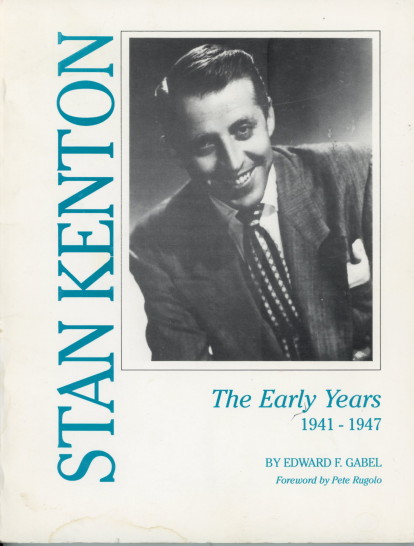
Ed Gabel’s Stan Kenton: The Early Years, 1941-1947 is filled with a tone of wide-eyed innocence and naivete.
From the vantage point of life in the United States today, it’s difficult to imagine an American culture that produced such wholesome, natural and unrefined sentiments.
After reading the story of how Stan reached out to Ed’s mom to allow the young man to travel with his orchestra as the “band boy.” one could almost imagine an Andy Hardy movie coming to life with Mickey Rooney and Judy Garland shouting: “Hey kids, let’s put on a show” and the next thing you know, through the magic of Hollywood, an old farm house is converted to a concert hall replete with theatrical sets being pulled up and a 100 piece orchestra rehearsing in the pit.
There’s a certain amount of hero-worship involved in Ed Gabel’s view of Stan Kenton; a status that some may find difficult to ascribe to a mere bandleader.
But why not? Sometimes circumstances chose our heroes for us and judging from the environment Ed was placed in as a young man, learning the virtues of hard work, being a supportive member of a team and developing new Life skills while a member of the Stan Kenton Orchestra during its nascent years probably helped him mature into a responsible adult, willing to take on obligations and to do one’s fare share. Sometimes, I wish there were more of these “grown ups” around.
Here’s Ed’s Chapter One - Artistry in Rhythm to his fascinating book of remembrances.
"This is the Mutual Broadcasting System. Please stand by... We now switch to the west coast and the music of Stan Kenton and His Orchestra, coming to you live from the Rendezvous Ballroom in Balboa, California, located on the shores of the beautiful blue Pacific Ocean. We start the program with Stan's theme Artistry In Rhythm, followed by Eager Beaver and Red Dorris singing Do Nothin' 'Til You Hear From Me."
Stan Kenton's name was new to me and the sound coming from the speaker in my Atwater Kent radio made my whole body shake with excitement. It was a late afternoon in July, 1941 when I first heard his orchestra. The sound of the three different sections — the throbbing beat of the rhythm, the melodic rapture of the reeds and the crescendo of the brass led me to believe I had discovered a rising new star in the music business.
Stan Kenton's orchestra and "Artistry In Rhythm” would soon enter my life, but I had no idea at the time of what was to follow.
First Trip East
In September, 1941, the Stan Kenton Orchestra completed their four month engagement at the Rendezvous Ballroom in Balboa, California. The band was an overwhelming popular success with their new musical sound. Music fans from Southern California turned out in droves to hear the exciting new style of music.
Kenton's booking manager, Carlos Gastel, suggested to Stan that it was time to take the band on the road to other parts of the country. The band swung eastward for a series of one-nighters, working their way to the east coast. The tour was successful until they arrived in New York City. Promotional advertising for a Kenton appearance at the Summit Ballroom in Baltimore had proclaimed "Glenn Miller, move over - Kenton is gaining on you!" But, in New York, all bets were off!
Gastel had signed a contract for a three week engagement at the Roseland Ballroom in New York. Carlos thought this would establish name recognition with the east coast audience. To be successful in the music business you had to be where the action was and that was New York City.
However, the Roseland date did not work out as planned. The conservative dancers could not dance to the staccato, throbbing beat of the Kenton music. The Roseland was a ten-cents-a-dance hall, where you paid to dance and choose your partner and thus it was hardly a place to showcase Stan's style of music.
Carlos had made a mistake with this booking but he achieved his objective; he got the band to New York, where record companies, song writers and booking agents were centered in a place off Broadway known as Tin-Pan-Alley. Kenton later "made it" in New York at such places as the Café Rouge of the Hotel Pennsylvania and the Paramount Theater
Kenton in Chicago
On the first Sunday in December, 1941 Bill Murphy, a friend and classmate of mine, and I decided to go downtown to the Hotel Sherman to hear Jack Teagarden and his all star Dixieland band in an afternoon concert. After the concert we left the hotel at 5:00 p.m. and were greeted by the news that the Japanese had bombed Pearl Harbor. People gathered around their radios, waiting for the latest news bulletins. The radio networks stayed on the air past their usual sign off times, filling the time between news reports with big band remotes. The Stan Kenton Orchestra was appearing at the Hollywood Palladium when the war broke out and, with the three hour time differential between the coasts, they were the last to sign off for the night. It was a cold, dark and scary ride home on the Illinois Central train that evening. I wondered what would happen to me with the country now at war.
In January 1942, the Kenton orchestra was booked into the Panther Room of the Hotel Sherman in downtown Chicago. Their three week appearance created a huge demand for reservations in the supper club. Listening to the weekend radio broadcasts on NBC encouraged me to go downtown and see the band in person. The long, narrow room had standing room so underage people could watch and listen to the band. The emotional lift of the music left me spellbound. I wanted to meet Mr. Kenton but was too nervous to introduce myself so I just stood by as he greeted other fans.
I read a story in the Chicago Tribune that the three-week stand at the hotel was a long sought break for the band after playing one-nighters for a month. The story mentioned that it was a chance for the band to wash their clothes and sleep in the same bed for a change. It also told about their opportunity to gain valuable coast to coast air time which would help the band become better known and stimulate sales of newly issued recordings. Hotels paid musicians union wages and big name bands like Tommy Dorsey, Charlie Barnett, Gene Krupa and Glenn Miller used the radio broadcasts from the hotel to stimulate record sales. The earnings from record sales helped to meet their payroll and traveling expenses.
After the hotel date, the band played one night dance and theater dates in the Chicago area. Unbeknownst to me, they had been booked into the State Theater, which was close to where I lived.
The State Theater featured name bands every Sunday, along with the regular motion pictures. I saw the Claude Thornhill Orchestra there on the last Sunday in January. At the conclusion of their stage show, they announced that the Stan Kenton Orchestra would be the following week's attraction. I was thrilled to learn they'd be coming the following week. There was no way I was going to miss hearing this exciting new band again!
Hello Mr. Kenton
It was two blocks from my house to 11th street where the street cars went east to Michigan Avenue, the location of the State Theater. Snow drifts blocked the road that cold, snowy February morning. Street cars were unable to operate but I didn't care. I decided to walk the mile to the theater. I figured that way I could save the seven cents I would have spent on the street car fare and spend it on a cup of hot chocolate at the White Castle on my way home.
I arrived early, planning to see the first stage show and the movie "It Started With Eve," a comedy with Deanna Durbin and Charles Laughton.
Although I wore a heavy coat, galoshes, scarf and hat, I was freezing while I waited by the stage door, hoping to get a glimpse of the band. After a few minutes a bus pulled into the parking lot and Stan, along with the band members, unloaded the equipment and transferred everything into the theater.
A short time later I ducked into the café next to the theater to get warm and noticed Stan and some of the band members seated in a booth, eating breakfast. He was wearing a long black overcoat. I approached him and said “Hello, Mr. Kenton," hoping my voice didn't betray my nervousness, "my name is Ed Gabel."
"Please call me Stan. What did you say your name was? Mind if I call you, Gabe?" he said, moving over in the booth and motioning me to take a seat.
"Meet Bob Gioga, my road manager, and this is his wife, Dorothy. Dorothy's our band secretary. She keeps track of my appointments and handles the band's payroll. How about something to eat?"
I wasn't really hungry but I ordered a hot chocolate and some wheat toast, then sat back and listened while Stan told me about their recent trip to the east coast. I mentioned that I'd gone downtown to the Hotel Sherman to hear the band a month before and had listened to their radio broadcasts on the NBC and CBS networks.
"Well," he said, "what do you think of the band? Do you like our music?”
I assured him that I did and went on to tell him that the first time I'd heard the band was when they broadcast from the Rendezvous Ballroom in Balboa, California, on the Mutual Network.
I said, "Wow! What a sound, what a great band! I remember hoping you'd play in Chicago someday, and here you are!"
Invitation
After breakfast Stan invited me backstage to watch the band warm up and rehearse the tunes they would play for the stage show. It was my first opportunity to be backstage and I thoroughly enjoyed being so close to the music. It was fascinating watching the stage hands controlling the lighting and working the spotlights.
During the breaks while the movie was showing, I talked with Red Dorris and Bob Gioga, who played saxophones in the band. Bob introduced me to trombone players Harry Forbes and Bart Varsalona. They told me about their home towns and why they joined the Stan Kenton Orchestra. I told them about Chicago, my school, my interest in music and my trip to the Orange Bowl in Miami. During the next stage break, someone brought dinner in for everyone. As we ate, I realized it was getting late and thought about the long walk home through the snow and cold. It had gotten dark and it was time for me to thank the band members for the time they had spent with me.
I was saying good-bye when Stan approached me and asked, "Gabe, have you ever thought about going on the road with a band?"
I gave him the “who me" look and said, "No, I never have. What would I do? And where are you going?"
"Well," Stan said. “I need someone to help with the equipment and setting up the bandstand as we travel across the country. You could assist me and Bob Gioga in making travel plans, I hadn't thought about hiring anyone until today."
"You really like the band, and with so many men going into the service it would be a great opportunity for you. I'll pay you $30.00 a week, plus a dollar from each band member, so your total pay would be $48.00 a week. You'd have to pay your hotel and meals out of that, but you'll have extra money for other things you want to do."
I started to mull over his offer when he said. "Look, we have another week of one-nighters, then two weeks at the Tune Town Ballroom in St. Louis before we come back to Chicago where we'll be at the Oriental Theater for a week. Why don't you think about the job and see me there? Ask the stage door man to phone me and you can come up to my dressing room."
"Mr. Kenton," I replied. I'm only seventeen, and in my last year of high school. I need to graduate. My mother would have a fit if I don't graduate."
"Gabe, check with your mom, I'd like to meet her. Bring her down to the theater when we get back." Stan said.
I was thrilled over this chance to see the U.S. and have some direction in my life. My mind flashed back to the trip to Miami I'd taken not long before. My dream of traveling was about to come true.
"OK, Mr. Kenton, I'll give you my answer when you come back to the Oriental Theater."
After the last stage show, I watched as the band packed up and left on tour. Now I was left with a dilemma. Should I accept the job offer or tell Mr. Kenton, "No way, my mother needs me at home."
Mom was living in our big old southside house with my sister Marilyn and me. Marilyn, who was three years younger than I, was in her first year of high school so I assumed the responsibility of man of the house.
My two older brothers, Harry and Norman, were grown up and away from home, out on their own. How could I tell my mother? What would she say?
Her response was just what I expected. "Edward, you are so close to graduating. You must finish high school," she said.
"Mom, I promise you, if I go with the band, someday I will graduate."
She gave her approval reluctantly, on my promise to eventually finish school, and also made the condition that she first talk with Mr. Kenton personally. I later kept my promise to finish school after I took up permanent residence in southern California.
My mother had no idea what a big band looked or sounded like so I took her downtown to the Oriental Theater the week before the Stan Kenton appearance to acquaint her with the world of big bands. The Count Basie Orchestra was the stage attraction. After hearing the band she was impressed enough to again insist on meeting Mr. Kenton before she would grant me permission to travel with the orchestra.
The following week the Kenton band appeared at the Oriental so I took the train downtown to the theater. The stage doorman phoned Stan in his dressing room. "Would it be OK to send Gabe up to your dressing room?"
"Sure, send him on up, I'm expecting him." Stan replied.
“Gabe, how are you? Have a chair. Did you talk to your mother?"
"She gave her approval for me to join the band, but only after she talks to you," I said. "I'm her only son at home and she needs to feel that going with the band is the right thing for me to do."
"Gabe, I want to meet you mother. In fact, I insist on meeting her. I want to get her approval for you to join us and travel on the road with the band. Bring her down to the theater before you accept the job."
We went downtown the next day. Mr. Kenton cordially welcomed my mom in his dressing room. He asked about how she liked living in Chicago. He asked her about my brothers and sister and mentioned that I had told him about my family and my oldest brother Harry, who was away studying at Northwestern University and planned on becoming a teacher, and about Norman, my middle brother, who was also in college studying to be a teacher. He assured her there was no reason to worry about me and promised to look after me. He grinned and said, "I've got eighteen musicians who would do the same."
Mom felt he was really interested in my welfare and appreciated the fact that he took the time to explain who he was and how he grew up in California. He told her how his mother raised him and his sisters and that his father was a vagabond and was rarely around to offer any family support. He smiled when he remarked that he must have his father's genes because he had formed a traveling orchestra. He went on to explain his plans for the orchestra and how it was necessary to travel in order to spread his ideas about music to the public across the country.
My mother thought he was a real gentleman, which he was. In my five years with the orchestra he regularly asked how she was doing.
My mother, a serene, tranquil lady with a retiring quietness about her, surprised me when she started telling Stan about her life. She told him that she had been an office secretary when she met my father, who was an assistant state's attorney in Chicago. After they married and were raising their children, my father decided to run for Cook County State's Attorney on the Republican ticket in 1932. After that, her life was never the same.
After all the political parades and picnics, the marching bands and speeches, he lost the election along with others on the Republican ticket. President Hoover and the entire Republican ticket were swept out of office in the landslide election of Franklin Roosevelt.
I accepted the job offer and Stan and I shook hands.
"Welcome aboard," he said.
"Where are we going?” I asked.
"Dorothy, show Gabe our itinerary." She handed me a copy. I could hardly wait to get started on our journey around the country.
I was convinced that I had made the right decision. I was now a member of the Stan Kenton Orchestra! Stan told me about their future plans to play dance and theater dates in Iowa, Indiana, Missouri and Michigan and about returning to Chicago before leaving for Hollywood.
“This is the story of the personal relationship between Stan Kenton and his friend Ed Gabel during the first years of the first Kenton orchestra -1941 through 1947.
It is an adventure story about a young man who shared the great bandleader's professional and personal life. It depicts the hectic world of life on the road with a traveling orchestra.
Ed Gabel shares an intimate behind the scenes view of Stan Kenton the man, as well as Stan Kenton the bandleader. He also reveals how Anita O'Day came to join the band and how June Christy acquired her stage name.
We also get a feel for the effects World War II had on the day to day life of the average American.
Gabel's work chronicles those early years. Gabe was there; he knows whereof he speaks and he places those early years in their proper place — the embryonic years! This is a significant personal work and adds greatly to the written history of the prodigious Stanley Newcomb Kenton.”
- Anthony J. Agostinelli, Editor, THE (Kenton) NETWORK Newsletter
Here’s Ed’s Prologue to his fascinating book of remembrances.
AN ARTIST OF RHYTHM
“Stanley Newcomb Kenton was such a gigantic figure in the world of modern American music that, to attempt to write something that will capture his stature is, at best, to write a less than adequate essay. What does one satisfactorily say about a person who was at once an international public figure, a bandleader, a composer, an arranger, an educator, a father figure to his bandsmen and women, an innovator, a cultivator of creative talent and a mentor to so many young men and women? These were only some of the roles that Stanley played in his musical and professional career.
Wichita, Kansas has the legal right to claim Stanley Newcomb Kenton as a native son. He was born there on the cold morning of December 15, 1911 (not February 19, 1912 as has been widely believed).
The early days of his childhood were not unlike those of any average boy, except that his family moved frequently. By the age of five he'd moved from Kansas to Colorado and then to California.
What time wasn't spent in going to school or helping his father repair automobiles was spent debating with his mother who, inasmuch as she was a piano teacher, tried to convince her son that he should study music. She eventually convinced him that he was meant for music and, after experimenting with various horns and reeds, he finally decided the piano would be his chosen instrument.
By the time Stanley was fourteen the piano had become an integral part of his life. Fourteen is an age that finds most boys worrying about whether or not they'll make the high school baseball team, or if they've enough nerve to ask the girl next door to the dance Saturday night. These things didn't concern Stanley, but something else did. He wondered whether he'd become as talented a pianist as his idol, Earl "Father" Hines.
Music was beginning to dominate his life and he was coming to believe that no matter what happened, music would always be the most important part of his life. He didn't realize it at the time but he was destined to become the foremost leader in the field of modern music.
Stanley graduated from Bell High School in Los Angeles in 1930, during the dark days of the depression. He was an awkward eighteen year old, standing six feet, four inches tall, with long arms, large hands and a rich baritone voice. He would have liked to have gone to a university to study the piano but his family's finances precluded that option.
Instead of going to school, Stanley spent his time working in small neighborhood bands, which were a good proving ground for his music and modern style. During 1933 and '34 he played in beer joints from San Diego to Bakersfield, earning the price of dinner one day and never knowing whether he'd go hungry the next. His financial situation gradually improved in the mid-thirties when motion picture and radio studios provided work. In 1940 he was appointed assistant musical director at Earl Carroll's Theater in Hollywood.
Stan was now becoming more and more aware of the stagnant state of the music business. In 1940 he began to ask himself what he could do about it. He was frustrated by the lack of progress in the development of new musical concepts. The nation had entered a new period of growth and was recovering from the effects of the depression. It seemed to Stan that the time was ripe for experimenting with new musical sounds and theories. Day and night, every spare moment was spent at the piano writing musical arrangements. It was then that he conceived the idea of having his own dance band.
Stan found that hiring musicians was no easy job. In order to portray his musical ideas to the public he needed musicians who understood music in the same way he did. It took weeks of auditioning and of weeding out misfits before he felt he had the nucleus of the band he wanted. But now that he had a band and a book of new arrangements he had no place to play. With an instinctive belief in himself and his band he was able to talk the owner of the Rendezvous Ballroom at Balboa, California into giving the band a job on a trial basis.
The Stan Kenton Orchestra opened on Memorial Day weekend, 1941, and played at Balboa for four months. During that time word spread like wildfire all over southern California about this drastically different style of music. His popularity spread to the east coast through weekend radio broadcasts over the Mutual Network.
There were plenty of disappointments ahead. Not everyone was ready to accept the new Kenton style of music. Some music trade papers and magazine reporters wrote raving reviews; others did not. What really mattered was that music fans enthusiastically began to support the band. A new dance step - the Balboa Shuffle - a tribute to the new band, was born in southern California.
With west coast acceptance assured it was time to venture to the east coast and the Midwest to try and establish a national following. Stan wondered if the rest of the country would accept the band, with its staccato beat of the rhythm section, melodic blend of the saxophones and the soaring brass ensemble sounds.
Struggling with payroll and transportation obstacles made it virtually impossible to continue on, but sheer determination and an iron will kept him from giving up. He continued to fight for his beliefs and gained the respect of the entire music business - even those who disagreed with his musical ideas. This respect filtered down to the general public and gradually more and more people became familiar with the Artistry In Rhythm sound.
As a tribute to Stan and his years of hard work, Lookmagazine, in January of 1946, predicted that the Kenton organization would be the band of the year, then sat back and watched their prediction come true. The previous year the band had won every popularity poll and had run up high grosses wherever they appeared.
Kenton was a living legend in the music business before the age of forty. Music was his whole life and band members were his family. He had a total commitment to music and had twelve separate orchestras in his lifetime. He created the musical concepts that resulted in the Artistry In Rhythm, Innovations In Modern Music and Progressive Jazz Orchestras.
The fame of the Stan Kenton Orchestra spread throughout the western world in the 1960's and ‘70’s. Stan had now taken his orchestra to the concert stage in the United States and Europe. The band made several trips to Europe where the fans clamored for tickets to sold out concerts. During this phase of modern music, Stan developed his idea of teaching his musical concepts to young college and university music students. Under his direction the orchestra appeared in schools throughout the country and the program became known as the "Stan Kenton Orchestra in Residence." Music lessons were for one and two week periods and were very popular with the students.
Even in the 1970’s Stan still found it hard to lead the band without stumbling over his feet now and then. Over a period of many years he'd fallen off the bandstand too many times to mention; once even breaking a rib and a toe due to his exuberant conducting.
Stan had the greatest personality of anyone in the music business and a sense of showmanship that had no equal. He had a way of making a perfect stranger feel immediately comfortable while talking to him. And after talking to him, whether one agreed or disagreed, there's one point everyone did agree on -that the originator of "Artistry In Rhythm" was truly an artist.
Superlatives abound and the list could go on and on. Stanley was at home on the road, playing the musical venues of the world, performing his special brand of music. That music captured the minds, hearts and bodies of his followers and blew away his detractors with its sound and fury. The blare of the trumpets, the majesty of the trombones, the middle-horned sweetness of the mellophoniums, the husky, reedy sound of the saxes, the drive of the rhythm section, enhanced by "latinesque" pulsations, all blended into a whole that, within each of us, struck chords, feelings and emotions that were often difficult to fathom or sort out.
We could only experience Stanley and his music alone, within ourselves. We might have attended a concert or dance with someone else; he or she might have sat right next to us, but it was only in our "aloneness" that we sensed what was happening with the music.
Stanley established forever the sound and direction of the music of television, films and the characteristic sound of American jazz orchestras. His bands remained alive and active while other orchestras went into hiatus or out of existence. In the face of the receding trend in the big band business, Stanley added strings (the Innovations period), or French horns (the late fifties) or mellophoniums (early sixties). He was not about to give up his mission and his quest for inventiveness.
The early years, when the nature of his music was being formulated, were ones marked by overwhelming popular acclaim. All the popular mass market magazines selected Stanley's orchestras as style setters, the most popular and its performers as stars of quality and competence. As evidence, consider that the alumni of these orchestras went on to achieve individual fame and acclaim. Their names and accomplishments are legion and are well known to the world as jazz pacesetters.
The Kenton music was exciting, interesting and new, as his music was throughout his career. The greats and near greats gravitated to his orchestras -"I've got to play or arrange for that Stan Kenton band!" The recordings made during that period and beyond were, in great part, responsible for the success of Capitol Records.
In all, Stanley achieved a lasting greatness, leaving a legacy to American music that few others have managed. He provoked controversy amongst some traditionalists and some others resistant to innovation. Undaunted, he pursued his goals, influenced others to do the same, and became the standard bearer of all that is and was great in modern big band music.”
Recently, I’ve been spending a lot of time with the music of the late guitarist Pat Martino who died on November 1, 2021.
Pat and I have been “together” for over fifty years: he as a preeminent Jazz guitarist and me as his admiring fan.
In searching for the beginning of our long “association,” I traced it back to the 1967 Prestige recording entitled Strings! [P-7547; OJCCD 223-2]. I’d heard a track on the local FM Jazz station and Pat’s playing completely blew me away.
On Strings!,he is backed by Joe Farrell on tenor sax and flute with Cedar Walton on piano, Ben Tucker on bass and Walter Perkins on drums. I knew the rhythm section quite well but Joe was new to me and his playing on this album - like Pat's - was a revelation.
Also revealing were Mark Gardner liner notes which met the standards of the time by providing a historical context for Pat’s place in the development of the Jazz guitar, details about Pat’s background [he was only 23 years old when this album was recorded and yet had already accomplished a great deal] and an a description of each of the tunes on the LP, the solo order and some personal observations about the qualities of each performance.
Sometimes, I feel that Mark gets a little carried away searching for adjectives to describe the playing of the musicians on each track, but overall, I think his comments and observations are spot on and greatly enhance the listener’s experience.
Fifty plus years later, in an age when information about a musician or a recording can be obtained almost instantaneously with the click of a mouse, I can’t emphasize too strongly how invaluable these liner notes were at the time as an illuminating source about Jazz and its makers.
“Since Charlie Christian first plugged in his amplifier and revolutionized jazz guitar in the late 1930s, each subsequent decade has witnessed the emergence of a handful of new string stylists. Barney Kessel. Jimmy Raney, Billy Bauer, Chuck Wayne and Oscar Moore were the dominant voices of the 'forties. And in the 'fifties Tal Farlow really came into his own to be followed by Jim Hall, Kenny Burrell, Johnny Smith and Wes Montgomery. The 'sixties in turn have produced Grant Green, Bola Sete, Gabor Szabo, George Benson and now Pat Martino. To bracket Martino with the foregoing list of great jazz plectrists warrants some weighty evidence in his favour. After all he is only twenty-three years old and the enclosed sides are the first real jazz sides to be released under his leadership. Which is precisely where the proof of my assertion lies — within this album. It is quite plainly demonstrated on all five tracks that Pat Martino has already conceived a style of his own.
To arrive at a personal mode of expression so young requires more than heavy chops and good taste, it calls for imagination, the sifting of one's emotional and intellectual resources into an abstract form with discipline. The guitarist has passed through this inner process of self-realization which is essential for every artist before he can begin to create works of lasting importance. Pat is not a 'natural talent' because no such thing exists. He has had to work and work hard to get where he is. As alto saxophonist Sonny Criss remarked recently, 'A lot of people say that Bird was a born genius. That's wrong. He wasn't born with anything except the ability to breathe. Unless you really apply yourself nothing's ever going to happen.' What has happened to Martino, a young man with an exciting future ahead, is the result of the sort of application Sonny spoke of.
But the drive to seek originality did not always grip Pat. 'When I first went on the road at the age of fifteen with guys like Willis Jackson, Red Holloway and Sleepy Henderson I wasn't concerned about being creative. It was just a job to me and I was infatuated with the traveling. What really made me realize this attitude would not fulfill me was a four-month period I spent working with Sonny Stitt. Sonny is such an inspiration and every night on the stand was a challenge. Suddenly I knew I had to meet that challenge.'
Pat was born in Philadelphia on August 25, 1944. Philly has cradled several important guitarists including Thornel Schwartz, Perry Lopez, Billy Bean and Dennis Sandole. The latter two were influences on Martino, 'I used to listen to Billy a lot and loved what he played. Dennis Sandole, who is a wonderful composer, helped me to see the road I wanted to take.' But the first jazz guitarist he heard was Johnny Smith who made some records with Stan Getz which found their way into the Martino household. Pat's father, a singer, encouraged his son to get a guitar. 'I was kind of pushed into it really but once I had the instrument it fascinated me. A cousin of mine who is a guitarist gave me some tips.'
While teaching himself the rudiments of music, Pat was frequently taken along by his father to the Red Hill Inn to hear people like Red Rodney, Johnny Smith, Art Blakey, local boy Lee Morgan, Johnny Collins and John Coltrane. Later he jammed with many of these men and others such as James Moody, Benny Golson, Art Farmer and Jim Hall. 'Philly sure is a beautiful town to study in,' says Pat.
After the stints with Holloway, Henderson and Stitt, Martino had a spell in the Lloyd Price band. 'That was interesting because Jimmy Heath was on tenor and did some of the arrangements and Melba Liston also contributed charts for the band. Jimmy is a very underestimated writer and I'm grateful to him for his encouragement. He urged me to write at that time.’
Pat also played in the Willis Jackson group and his earliest recordings with Jackson are on Prestige. Then I was using my family name which is Azzara. My father always worked under the name Martino and I eventually adopted it too. My dad is Arabian in descent and my mother is Italian, incidentally.'
For the next couple of years Pat toured with 'all the organists-Jimmy Smith, Jack McDuff. Jimmy McGriff. Don Patterson. Groove Holmes, Trudy Pitts and others. ‘Much as I dig the combination of guitar and organ it gets to be rather confining after a while. It's more or less one groove all the time.'
In 1966, Martino, weary of constant travel, returned to Philly to take stock of his progress and resume his studies with the Sandole brothers. A comfortable living was there for him in local record, radio and television studios. But the sojourn didn't last long. Over on the West Coast alto saxophonist John Handy had just lost his guitarist Jerry Hahn. Howard Johnson, the tuba player, recommended Martino to Handy as a replacement. A call came through to the studio where Pat was working and Handy on the other end and he asked: “Can you get on the next plane to L.A.?” Ten hours later, Martino walked onto the platform at the University of California as a member of the John Handy Quintet. ‘John had never heard me play. There were no charts so it was a bit of an ordeal. Pat survived. And he values the eight months experience with Handy, Bobby Hutcherson, Albert Stinson and Doug Sides. 'I respect John and what he is trying to do but as the group developed I found that our musical aims were different so we went our own separate ways.'
Martino recorded with Handy for Columbia but as with all his previous disc experience (except for a date with alto saxophonist Eric Kloss on Prestige) he disliked his own contributions. ‘I've never been happy with any of my solos on record until the session with Eric.' Like this album, the Kloss date was taped in the snug atmosphere of Richard Alderson's mid Manhattan studio and Don Schlitten was the producer. ‘Don and Dick are an ideal team to work for because they make everyone feel relaxed’ notes Pat. ‘I’ve been on many recordings that I would rather forget. They were mismanaged efforts.’
Thus far Martino has not enjoyed many good breaks. Some of his original compositions were waxed by Red Holloway for Motown in 1963. They were never released. Strictly speaking his first album should have been issued several years ago. He cut sides for Vanguard with two different rhythm sections - Tommy Flanagan with Ron Carter and Tony Williams; George Tucker and Oliver Jackson. They were not released either. Pat remembers the date with Tucker for a particular reason: it was the bassist's last recorded work. He died from a cerebral hemorrhage the following day. 'George and I had been friends for a long time and I really wanted to make music with him. We only ever did get that one chance. When I heard of his death I couldn’t believe it. I wandered into a church somewhere that night and spent eight hours thinking about the tragedy of it.'
Pat was beginning to wonder if he ever would receive another chance when Don Schlitten stepped into the picture. As an indication of Schlitten's awareness of young and neglected talent it is worth noting that only a couple of weeks before recording Pat he recorded Tal Farlow who had not made an LP for eight years. Listen to him on Sonny Criss' Up, Up And Away (PR 7530). 'I don't want to be limited to the role of guitarist. I do want to compose and grow artistically and have my music accepted without making concessions,' states Pat. With Prestige he is getting the opportunity to achieve these goals. Certainly the Martino Quintet makes no concessions - except to good music - and four of the compositions here are by Pat.
When we met a couple of days before the session Pat said: I’m very excited about it. Joe Farrell is always a gas and it will be nice working with Cedar Walton, a pianist I have a great admiration for. I’ve recorded with Ben Tucker before and he is beautiful. At that stage the drummer hadn’t been fixed. Don suggested Walter Perkins and everybody was happy with the choice. The five got together to make Strings! on a warm day in late September, 1967.
The proceedings went off without a hitch or hassle and the Alderson microphones (which the engineer picks so carefully to suit the character of each instrument) captured a bumper harvest of vibrant sounds, shot through with strength and sincerity.
Martino's four colleagues have all appeared on Prestige previously. Joe Farrell, whose flute work is contrastingly delicate as his tenor solos are robust, comes from Chicago where he was born 30 years ago. His early tenor influences were Johnny Griffin and Stan Getz. Later he listened profitably to Bird, Dexter Gordon, Sonny Stitt, Sonny Rollins and John Coltrane. Which is not to suggest that his playing is a mélange of other styles. If you've heard him once Joe's easy to recognize. He took up flute in 1955 and continues to make progress on this 'horn,’ not to mention soprano sax. Farrell worked with Maynard Ferguson, Tito Rodriguez, Jaki Byard and Charlie Mingus in the Sixties and for the last couple of years has been a spark plug of the Thad Jones-Mel Lewis Band. And there is fine Farrell on The Jaki Byard Quartet/Live! Volumes 1 & 2 (PR 7419, PR 7477) and Dizzy Recce's Asia Minor (Prestige/ New Jazz 8274).
Cedar Walton is deservedly 'house pianist' for Prestige. His own album Cedar! (PR 7519) was one of the real ear-openers of 1967 and his flexibility is such that he can easily adapt to most contexts and the needs of a great variety of soloists. On Prestige he has backed Sonny Criss, Teddy Edwards, Eric Kloss, Houston Person and many others. A tasty ‘comper,’ Cedar is a consistently interesting soloist and he was at the top of his game on this one.
The ubiquitous bassist Ben Tucker, from Nashville, Tennessee, is one of the unsung masters of the big fiddle. But fellow musicians know his true worth which is why he is always in demand for session work. I could fill this sleeve with the names of leaders who have employed him. Warne Marsh, Art Pepper, the late Carl Perkins, Billy Taylor and Herbie Mann were among them. Ben’s large tone and nimble walking has enhanced Prestige dates by Eric Kloss and Teddy Edwards.
Walter Perkins, like Joe Farrell, is a native of the Windy City. At one time, he fronted an excellent group the MJT+3 and he has propelled lots of combos - Ahmad Jamal, Art Farmer & Jim Hall, Lucky Thompson, Errol Garner, Sonny Rollins, Teddy Wilson etc.— during a productive career. He played a vital part in Booker Ervin's Prestige debut album Exultation! (PR 7293) and was present on one of Lucky Thompson’s releases, Happy Days Are Here Again (PR 7394). Walter is a steady and unobtrusive percussionist.
A forty eight-bar Martino structure, Strings! opens the set on a lifting note Cedar states the little pattern in the bass that runs right through the piece. The rhythm (helped by two guests handling Latin percussion for such was the spontaneous party feel of the session) is an insinuating, hypnotic one - and very danceable. Joe (on flute) weaves in and out of the theme statement artfully. Pat has the floor to himself and he shapes a wonderful solo that has every element - suspense, surprise, logic continuity and depth. You will detect his respect for Wes Montgomery. But the name written on the music is unmistakably Martino.
Minority, a durable Gigi Gryce composition first recorded by the saxophonist with the late Clifford Brown in 1953, signals an acceleration of mood and tempo. Pat and Joe (tenor) burn up the thirty bar melody. And Farrell is off at the starting flag and into a boiling solo of seven dynamic choruses. With the rhythm section up tight behind him, Joe gives one of his best performances on record to date. If his wailing fails to get your adrenalin working — call a doctor. Pat takes the next five and does he ever go! Dig the way he latches onto one phrase to raise the tension. Cedar follows with six flowing choruses and to conclude a Minority that earns a majority of points Joe and Pat ‘peck’ the final measures in simultaneous improvisation - and harmony.
Lean Years, the second Martino chart, refers to tough times in the past. But don’t look for self-pity or sentimentality in this performance but rather the determined fight and victory over adversity. There is a menacing atmosphere laid down by Pat in the tune’s opening thirty-two bar section but on the sixteen-bar modal bridge Joe and Pat bring a surging release indicating the hope ahead. The last twelve measures telescope the original theme. Joe again leads the solo order with more virile blowing . Cedar follows and Pat has the final potent say. The suspended rhythm is superbly carried by Ben Tucker while Walter Perkins is ever alert and tasteful.
The very beautiful Mom paints a placid picture that is an eloquent tribute to the lady concerned. This particularly melodic example of Pat’s writing shows how well he has learned from Dennis Sandole. Martino and Farrell (flute) treat the delicate tune with great sensitivity and Pat has a deliciously serene solo.
As we started, so we close - in a Latin bag. Pat on this occasion pulls out a swinging, swaying jazz rhumba — Querido. The beat is irresistible, as conceived by Walter Perkins. The tune is simple and this whole south of the border sortie turns out to be a happy gas. Pat, Cedar and Joe (flute) all dance some and catch that carefree fiesta spirit.
Pat Martino knows where his music is heading. ‘I want my music to be accepted, naturally. But rather than sell out, I would rather quit. I don't want any part of the so-called new thing. If economics dictated that I had to play that stuff or nothing I would sooner become a butcher or a baker. I have ideas for writing for sixteen or seventeen guitars. The possibilities of that sound have never been fully explored and I've already experimented by multi-tracking by myself. You know the guitar is possibly the most abused instrument in music which is sad when you think it is probably the most beautiful. I would like to help restore its dignity.'
With this LP that task of loving restoration is handsomely begun. And jazz lovers in this instance will be glad there are strings attached to the singing guitar of Mr. Martino.”