Wednesday, June 22, 2022

Dexter Gordon - The Blue Note Years - Part 1

 © Copyright ® Steven Cerra, copyright protected; all rights reserved.


In his prime, his music had a kind of jovial gravitas at its heart, building on Lester Young's example without succumbing to Lester's waywardness, and he was a great influence on the likes of Coltrane and Rollins. 

- Richard Cook’s Jazz Encyclopedia


“When Bob Leonard, agent for The Three Sounds among others, contacted Blue Note in 1960 about recording Dexter Gordon, Alfred Lion was not only willing but also able to say yes. Although he'd recorded Monk, Bud Powell and Miles Davis in the early stages of their careers, this was the first opportunity for Blue Note to sign an already established major artist.

For Dexter Gordon, who'd hardly recorded in the fifties, this was a chance to jump-start his career on an international level with a company that was as classy as he was. This mutually-beneficial, well-suited five-year relationship between Dexter and Blue Note yielded a gorgeous body of work, all of which is gathered in this boxed set.”

- Michael Cuscuna, Producer


Chuck Berg closes the introduction to his 1977 Downbeat interview with Dexter by stating:


“Dexter Gordon was one of the greatest tenor saxophonists in the history of modern Jazz and I was delighted that he finally received the acclaim and the accolades he deserved during the last decade of his life.”


While I’m no expert on the greatest anything in the history of Jazz, my reaction to Chuck’s statement was a sad “what took so long” as I felt that way after I heard Dexter’s early 1960s Blue Note recordings which have, thankfully, been loving collected and annotated in a  boxed set Dexter Gordon: The Complete Blue Note Sessions [6 CDs-7243 8 34200 2 5]


Even while these Blue Note sessions were in progress, a variety of factors came together in the early 1960s which influenced Dexter to leave the USA for Europe where he ultimately took up residence in Copenhagen.


And like Jazz, Dexter quietly passed from the scene for the remainder of the 1960s and for much of the 1970s.


But Dexter Gordon’s return in 1976 was a triumphant one – and deservedly so!


Dexter Gordon was one of the greatest tenor saxophonists in the history of modern Jazz and I was delighted that he finally received the acclaim and the accolades he deserved during the last years of his life [He died in 1990].


This being said, for my money, Dex never played better than his work on these early 1960s Blue Note recordings; especially impressive on these recordings is his ballad work which becomes essentially a clinic in what has largely become a forgotten skill.


Dexter’s balladic interpretation of I Guess I’ll Hang My Tears Out To Dry, Where Are You, You’ve Changed, Don’t Explain, Until The Real Thing Comes Along, Darn That Dream, Willow Weep For Me, Stairway To The Stars, Who Can I Turn To, Everybody’s Somebody’s Fool and I’m A Fool To Want You collectively could be formed into an instrumental Jazz textbook for how to play such songs and interpret their lyrics.


In addition to all the majestic music that Dexter and his colleagues created on these Blue Notes another distinguishing feature of these albums is that each of them was annotated by liner notes written by some of the best writers that Jazz had to offer in the 1960s among them Ira Gitler, Leonard Feather, Nat Hentoff, Robert Palmer, as well as, a relative newcomer at the time - Barbara Long. 


Their insights, observations and commentaries serve to enrich the listening experience and our understanding of Dexter and his music.


Given the many later-in-his-career accolades, accords and kudos, we thought it might be fun to run a multi-part series highlighting the individual recordings that Dex made for Blue Note from 1961 to 1965 and which were released during that time span, along with the 6 disc boxed set that was issued in 1996 which contains these tracks as well as alternate tracks from these sessions plus the tracks from this period that were released on three, later albums: 1967, Gettin’ Around [BST-84204]; 1979, Clubhouse [LT 989]; 1980 Landslide [LT-1051]. All three of the latter have been reissued on CD as Japanese imports and each of these will also be the focus of individual features on the blog.


Let’s start with the boxed set, copies of which can be found both used and new from various online resellers and which contain The Complete Blue Note Sessions, both those that were released on Blue Note albums from 1961-1965 and those that came later.


The boxed set annotations are by Michael Cuscuna, who has had a long association with Blue Note and produced many of its reissues, both on vinyl and CD. These include music that was issued subsequent to Blue Note's existence from 1939 until its acquisition by Liberty Records in 1965.


Michael has also continued to be involved with Blue Note reissues in his current role as one of the executives at Mosaic Records.


Bruce Lundvall who signed Dexter to a recording contract with Columbia when Gordon triumphant return to the USA in 1977 contributed some reminiscences to the boxed set’s notes, Dexter’s widow Maxine shared some of the ongoing correspondence that Dex has with Alfred Lion and Francis Wolff, the owners of Blue Note and the esteemed Jazz author and scholar Dan Morgenstern contributed a track-by-track analysis of each of the sessions to the boxed set booklet.


So as to keep this initial feature from becoming unwieldy, excerpts from Bruce’s memories, Maxine’s correspondence file and Dan’s track descriptions will be used as lead-in quotations to other blog segments focused on Dexter’s Blue Note Years.


To kick-off things, here’s Michael Cuscuna’s overview of the history of Blue Note and how Dexter’s music became a part of its offerings.


“BLUE NOTE was recognized as a distinctive and uncompromising jazz label of quality from its inception in 1939. It teetered on the brink of insolvency for most of its first 17 years. Founder Alfred Lion and his partner Francis Wolff would rather record people they loved like Thelonious Monk and Herbie Nichols than chase hits that compromised their taste.


Success came anyway in 1956 with the music of Horace Silver and Art Blakey. They and a few others had formulated an audience-friendly offshoot of be-bop that came to be known as hard bop. The tempo was slowed, the melodies more memorable and earthier elements of blues and gospel were intermingled with the achievements of modern jazz. And when it swung and had a creative edge, it was called The Blue Note Sound. The public responded.


The combination of Lion's meticulous preparations and production, Rudy Van Gelder's sparkling sound, Reid Miles's cover designs and Wolff's photography made Blue Note THE hip label. It didn't hurt that discoveries like Jimmy Smith and The Three Sounds were beginning to sell in healthy numbers.


When Bob Leonard, agent for The Three Sounds among others, contacted Blue Note in 1960 about recording Dexter Gordon, Alfred Lion was not only willing but also able to say yes. Although he'd recorded Monk, Bud Powell and Miles Davis in the early stages of their careers, this was the first opportunity For Blue Note to sign an already established major artist.


For Dexter Gordon, who'd hardly recorded in the fifties, this was a chance to jump-start his career on an international level with a company that was as classy as he was. This mutually-beneficial, well-suited five-year relationship between Dexter and Blue Note yielded a gorgeous body of work, all of which is gathered in this boxed set.


From a gene pool that spanned Africa to Northern Europe with a healthy infusion of elements from 19th century migration to Canada and the United States came Dexter Keith Gordon on February 27, 1923. He was the only son of Frank, a native of Fargo, North Dakota who became a prominent doctor in Los Angeles and Gwendolyn, whose Father was born in Wyoming. And he was doted upon.


Lionel Hampton and Duke Ellington were among Dr. Frank Gordon's patients. Dexter was treated to his father's records and to concerts that he attended with his father that often included backstage visits. He often used to say, "I don't care how old "Sweets" [Harry Edison] says he is, the first time I saw him, I was in short pants and he was on stage."


Doctor Frank bought his son a clarinet at age seven and encouraged his musical inclinations. Seven years later, Dexter experienced a profound and lifelong emptiness when his father succumbed to a heart attack without warning.


Dexter switched to alto saxophone and then tenor. His favorites were the giants of the day, most especially Lester Young, who deeply shaped his musical intellect, and Dick Wilson, featured soloist with Andy Kirk.


At the tender age of seventeen, Dexter was invited to audition for the Lionel Hampton band by Marshall Royal, a patient of his father and older brother of Dexter's friend Ernie. He got the job and, with his mother's blessing, stepped on the band bus before graduating high school. It's a day that lived vividly in Dexter's memory.


Dexter's tenor mate in that band was Illinois Jacquet, only a year older but a great deal more experienced. "I was always leaning on Dexter to get his stuff together. He was so young and wanted to copy everything Lester Young said, wore and played. In the band, we'd all tap our feet in time while we played the chart. But Dexter was so big and those size-fourteen feet would come up in their own time and then come down again with no relation to the tempo. I told him that that had to stop. It was messing me up….  Dexter and I used to do a Lester Young-Herschel Evans two-tenor number called "Pork Chops." It went over big with the audiences. I remember, one night at the Savoy Ballroom, Dexter and I were out front playing it. People at the foot of the stage were blowing pot smoke up at us. By the thirtieth chorus, we had no idea what the changes were, (laughs) I wanted Hamp to record it, but he never did. He regretted not doing it and used to bring that up to me for years."


In 1944, Dexter played with Fletcher Henderson and then got a job with the Louis Armstrong Orchestra. And although he was basically a section man, he adored that time, studying with the master innovator and showman. Around this time, Dexter cut four quartet sides for Norman Granz with Nat Cole on piano. His own sound was emerging.


By the end of '44, Dexter was a member of the Billy Eckstine Orchestra that became an incubator for the bebop revolution. It was Art Blakey that dragged him into the fold. Suddenly, Dexter was surrounded nightly by Sarah Vaughan, Dizzy Gillespie, Fats Navarro, Sonny Stitt, Lucky Thompson, Gene Ammons, Leo Parker, John Malachi and other architects of the new music.


From Lester Young, Dexter learned the art of improvisation: develop ideas of substance, finish a thought, never waste a note and, above all, know the lyrics of any ballad you dare to play. Once he found a mouthpiece and instrument to his liking, Dexter developed a robust sound and brought to the tenor saxophone the first totally realized bebop style on the instrument. He would become a model for both Sonny Rollins and John Coltrane, who would in the fifties spearhead the two major streams of tenor saxophone playing for the next twenty years.


Through his 52nd Street appearances with Dizzy Gillespie and his LA recording of "The Chase" with tenor saxophonist Wardell Gray, Dexter became something of a bi-coastal celebrity in the late forties. Gray was a saxophonist with fluent articulation and a smoother sound. But he and Dexter developed a musical connection that transcended the arena of the tenor battle. Listening to a reissue of live tapes, Dexter once told me that, despite the differences in their styles, it was sometimes hard for him to tell where one left off and the other began. Their symbiosis ran that deep.


In late 1952, Dexter was busted for possession of heroin and sentenced to two years at the state prison in China. It gave him an opportunity to make his film debut in "Unchained," although Georgie Auld's tenor is dubbed in when Dexter is playing on screen. But more importantly, as Dexter with a steely stare was always quick to point out of this and a subsequent internment, "It saved my life." But it also derailed his career.


By 1955, the rage in LA was the west coast sound of Shorty Rogers, Shelly Manne, Chet Baker and the other disciples of the cool school. The successful hard-bop school of Silver, Blakey et al., which was then developing, was far more suited to Dexter's style. In fact, his big sound, his soulful behind-the-beat phrasing and his lyricism foreshadowed this movement. But he was in LA, and the hard boppers were in New York. He was all but forgotten and they were rising young stars. So too were Sonny Rollins and John Coltrane.


Upon his parole in 1960, Dexter was approached by Cannonball Adderley to record an album for Riverside. The result was 'The Resurgence Of Dexter Gordon," an album which was not entirely successful but served the purpose. The next year, Dexter was asked to compose the music and lead the band on stage for the LA production of "The Connection," which had originated in New York two years before with Freddie Redd's music.


Dex was back. He accepted the offer from Blue Note Records. And the jazz world finally remembered. For five years, Dexter made one masterful session

after another for Blue Note. The music coupled with the fascinating correspondence between Dexter and Blue Note's Alfred Lion and Frank Wolff during those years, found elsewhere in this booklet, complete the picture of a very important period in this artist's career.


Dexter liked working with Alfred Lion who leaned heavily on planning and rehearsals in hopes that such preparations would provide a spontaneous, but beautifully executed date. Beyond his own sessions, Dexter participated in two sideman appearances, Herbie Hancock's first album Takin' Off (not included here) and an aborted Sonny Stitt session, from which the one releasable tune, "Lady Be Good," appears here for the first time. Listening to the tapes of this session some 18 years ago, Dexter told me, 'This was Stitt and his working band. Alfred asked me to join in on a few numbers. Sonny didn't want to rehearse or talk about tunes. Alfred was already frustrated when the date began. Stitt was charging through things. Alfred was getting more and more nervous. And when Sonny started playing "Bye Bye Blackbird," Alfred just lost it. He started screaming, 'what are you doing to me?...You've recorded that a hundred times' and called off the date. It was a funny scene." (The music for the albums Landslide and Clubhouse and the bonus tracks which later appeared on CD were also auditioned at that time and approved by Dexter.)


During this time, Dexter was spreading his wings. A gig at Ronnie Scott's began a love affair with London, then Paris, then Copenhagen. And Dexter became, like Kenny Clarke, Don Byas, Johnny Griffin and so many others, an expatriate.


These Blue Note sessions afforded him the opportunity to record for the first time with musicians like Freddie Hubbard, Bobby Hutcherson, Barry Harris, Kenny Drew, Horace Parian and Billy Higgins with whom he would have a professional connection for years to come. Ironically, Hutcherson and Higgins reach back to Dexter's childhood. One of Dexter's best friends in high school was Bobby's older brother Teddy (Dexter even refers to Bobby as Teddy in a letter to Alfred.) And Billy Higgins remembers, as a youngster, seeing Dexter come up the walk to sit on the front porch with his older sister. Years later Billy Higgins and Bobby Hutcherson joined Dexter in the film "'Round Midnight."


Dexter's fondest memory of his years with Blue Note was the album Go. It's rare that an artist, the critics and the fans are all in accord. But everyone agrees that this was Dexter's greatest album. The empathy among Dexter, Sonny Clark, Butch Warren and Billy Higgins is extraordinary. Within a beautifully balanced selection of material, Dexter fashions gorgeous solos with complete abandon and trust. The rhythm section rises to the occasion with everything they've got. The result is perfection. The session that produced A Swingin' Affair two days later runs a close second. Both of these rarefied musical experiences are on Disc Three of this set.


Dexter's musical accomplishments and achievements went on for more than twenty years beyond his association with Blue Note, culminating with a nomination for Best Actor at the 1987 Academy Awards for his starring role in Bertrand Tavernier's film "'Round Midnight."


Dexter Gordon, his musical genius aside, is one of the most unique people I've ever met. A voracious reader, Dexter's taste ranged from 19th century French writer Emile Zola to J. P. Donleavy's "The Ginger Man." (He remembered an especially dour high school teacher who hated musicians and was confounded and annoyed by the fact that her only A students were Dexter and Chico Hamilton).


When Maxine met Dexter in Europe in 1975, they began to plan for his spectacular return to the US. (He holds the world's record for homecomings and resurgences.) In 1976, Bruce Lundvall signed him to Columbia Records. Woody Shaw asked me to produce the recordings and put together a band and material for Dexter. At six o'clock on a Friday night, we were all sitting in the office of a Columbia business affairs executive, negotiating Dexter's buy-out from a Danish jazz label. He was to hit that night at nine-thirty at the Village Vanguard. I had an engineer (Malcolm Addey) and equipment standing by. Finally, at seven-thirty, we got the green light. Dexter and I grabbed a cab to the club. We were alone for the first time. I asked him a question at about Fiftieth Street. There was total silence for fourteen blocks. I thought, 'oh my God, this guy hates me!' Finally, just below Madison Square Garden, the answer slowly emerged.


It took some time to get used to Dexter's internal clock, but we became very close over the years. And his friendship is one that I will always cherish. Dexter loved language and linguistics. He learned a healthy chunk of every language to which he was exposed. He devoured local customs and cuisine with vigor and panache and had friends in every corner of the globe. Yet there was that part of him that was purely American. He would not take a gig during the World Series, loved meatloaf, mashed potatoes and peas and actually thought that 'too much garlic' was a physical impossibility.


Outwardly, Dexter was exceedingly charming and friendly to all. Inwardly, he was a very private man who showed himself to few. It took a great deal to shake his veneer. I remember once flippantly referring to a musician as sounding too white. Uncharacteristically, Dexter shot me a hard glance and said, "We went through a lot for the right to play with whomever we want to, white or black."


Then there was the time Dexter called me at eleven o'clock one night and strongly suggested that I come down to the Village Vanguard. After I resisted on the grounds that I had work to do, he politely insisted. Finally, I said, "do you want me to come down to fire the piano player?" There was a long pause on the phone and then he said, "ahhh...that would be nice."


To paraphrase two remarks by Dizzy Gillespie, "He did everything wrong and it all turned out right. He should have left his karma to science."

-MICHAEL CUSCUNA July 1996


Monday, June 20, 2022

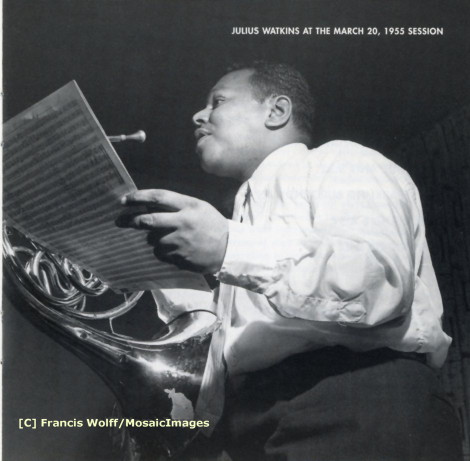
JULIUS WATKINS by Gordon Jack

 © Copyright ® Steven Cerra, copyright protected; all rights reserved.


Original liner notes Julius Watkins: Volumes 1 & 2 [Blue Note 7243 4 95749 2 2]

PRIOR TO THESE Blue Note sessions, Julius Watkins's first jazz exposure came from a Thelonious Monk quintet session for Prestige that included Sonny Rollins and introduced "Friday The 13th," "Think Of One" and "Let's Call This" to the world and an Oscar Pettiford sextet date for Debut.
As these sessions prove, Watkins had extraordinary facility and the imaginative mind of a jazz improvise!*. This music is pure hop with no concessions to the technical difficulty in adapting French horn to the form.
These recordings came at the end of the 10-inch era and, if they had any chance of selling, the new 12-inch format took care of that. Julius Watkins persevered and formed The Jazz Modes in 1957 with tenor saxophonist Charlie Rouse (they'd worked together in Pettiford's sextet.) The group lasted for three years and five albums (on Dawn and Atlantic) with some success. "Linda Delia" and "Garden Delights" from these sessions found their way into the Jazz Modes repertoire.
But Watkins was becoming more and more in demand in studios, Broadway pits and the big bands of Pettiford, Pete Rugolo, Johnny Richards, George Shearing and later Charles Mingus. His technique and jazz ability made him doubly valuable on large-scale jazz recordings like Miles Davis's Porgy And Bess, Randy Weston's Uhuru Africa, John Coltrane's Africa Brass and countless sessions by Gil Evans, Oliver Nelson, Art Farmer, Curtis Fuller, Milt Jackson and so many others.
Watkins never realized his goal to bring his instrument into the jazz mainstream. But his efforts have been carried on by the likes of John Clark, Tom Varner, Alex Brofsky and Vincent Chauncey. And the music he made under his own leadership and with so many giants is a testament to his varied and ubiquitous career.
—MICHAEL CUSCUNA, 1998

Gordon Jack is a frequent contributor to the Jazz Journal and a very generous friend in allowing JazzProfiles to re-publish his perceptive and well-researched writings on various topics about Jazz and its makers.


Gordon is the author of Fifties Jazz Talk An Oral Retrospective and he also developed the Gerry Mulligan discography in Raymond Horricks’ book Gerry Mulligan’s Ark.


The following article was published in the October, 2016 edition of Jazz Journal. 


For more information and subscriptions please visit www.jazzjournal.co.uk


© -Gordon Jack/JazzJournal, copyright protected; all rights reserved; used with the author’s permission.


The french horn which has more than eleven feet of tubing is the most demanding member of the brass family. Because of its size swiftly articulated bebop choruses are particularly difficult. The mouthpiece which is smaller than a trumpet’s has been described by my good friend Ken Collins as “Unforgiving”. (Ken played french horn with the New Jazz Orchestra for a while back in the sixties). Julius Watkins brilliantly overcame these problems to become a virtuoso and the first-call horn player for NYC studio dates throughout his career. The instrument has a normal range of three and a half octaves but just like the legendary Dennis Brain, Julius could manage four quite effortlessly. He did not have a symphonic background unlike his contemporary John Graas who was the first horn with the Indianapolis Symphony in the early forties. Graas made a number of well-received recordings in Los Angeles during the fifties with people like Conte Candoli, Herb Geller, Art Pepper and Shorty Rogers.  His writing was always interesting but he never solved the instrument’s intrinsic problems as a soloist. 


Julius Burton Watkins was born in Detroit on the 10th. October 1921 and began lessons on the french horn at the age of nine. In 1939 he joined the Ernie Fields band on trumpet as there was no opening for a french horn. The band was based in Tulsa, Oklahoma and for the next three years he endured constant one-nighters throughout Texas and Oklahoma on his secondary instrument. He returned home to Detroit in 1942 where he enrolled in the U.S. Naval Reserve. After the war he played in local dance bands before accepting an offer from Milt Buckner. He stayed with Buckner until 1949, recording a memorable french horn solo on Yesterdays for the MGM label in a band that included Booty Wood, Billy Mitchell and Charlie Fowlkes 


Tiring of life on the road he enrolled at the Manhattan School of Music in 1950, remaining there until 1953. That year he was selected for a notable Prestige session with Thelonious Monk, Sonny Rollins, Percy Heath and Willie Jones where Let’s Call This, Think Of One and Friday The 13th. were recorded. Brian Priestley In Jazz The Rough Guide says, “To say that the french horn solos are not anti-climactic alongside Monk and Rollins is sufficient”.  In August 1954 he made his first recording as a leader for Blue Note performing four titles in a sextet that included Frank Foster, Oscar Pettiford and Kenny Clarke. 


In 1956 Stan Kenton added two French horns (Fred Fox and Irving Rosenthal) to the band and in May that year Julius took Fox’s place for three days of recording that produced Cuban Fire. The band had been expanded to 27 pieces to interpret Johnny Richards’ challenging music which resulted in one of Kenton’s most popular and successful albums. Watkins does not solo but he certainly impressed Billy Root who played baritone on the date. Years later when I met him in Las Vegas he told me, “Julius was something else. He could sound like J.J. Johnson on that thing”. 


That year Oscar Pettiford organised a big band including Julius and fellow french horn-man David Amram who was a cousin of Otto Klemperer the conductor. It survived for about eighteen months with occasional appearances at Birdland, the Café Bohemia and other local New York clubs but luckily two albums were recorded for posterity.  Gigi Gryce wrote a feature for Watkins and Amram titled Two French Fries - an up-tempo Rhythm piece allowing them to demonstrate just how nimble a french horn could be in the right hands. Amram was quoted saying, “I think this could have been one of the major bands of our time if only Oscar could have secured enough work for it.” In an interview for Cadence, Jimmy Cleveland said playing with the band, “Was one of the highlights of my life”. Another notable 1956 Watkins recording occurred when he was a guest on a Gil Melle’ Prestige date with Art Farmer and Hal McKusick. He is featured prominently on Soudan, a Melle’ original based on Bartok’s Walachian Melody.


Early in 1956 Leonard Feather asked a number of leading musicians to list their favourite instrumentalists.   Clifford Brown, Osie Johnson, Quincy Jones, Red Mitchell, Max Roach and Randy Weston all voted for Watkins in the Miscellaneous Category section. In 1957 Nat Hentoff described him as, “The most satisfying hot french horn improviser yet to be heard in jazz”. In November that year he and David Amram were heavily featured on an intriguing Curtis Fuller date with Sahib Shihab and Hampton Hawes produced for Prestige by Teddy Charles.


It was while he was working with Oscar Pettiford that he became friendly with Charlie Rouse. They decided to form a quintet together which they called Les Jazz Modes with Gildo Mahones, Martin Rivera and Ron Jefferson. It was actually their manager Princess Orelia Benskina who came up with the name and they stayed together until 1959 recording no less than five albums. The group appeared on Steve Allen’s TV show and worked at Birdland, Café Bohemia, Chicago’s Blue Note and the Modern Jazz Room in Cleveland. They made an effort to achieve a highly personal ensemble sound, occasionally adding vocalist Eileen Gilbert, harpist Janet Puttman and Sahib Shihab on baritone to some recordings. Ms Gilbert had been one of Julius’ fellow students at the Manhattan School of Music but it has to be said that her classically trained soprano adds little of value. Rouse occasionally played bass clarinet on club bookings with the quintet and he had this to say about his co-leader, “His horn has all the virility and hard masculine quality of the trumpet and trombone. There is so much more to the french horn than the symphony orchestra players ever realised and Julius is the person who has made everybody aware of this.”  Reviewing one of their albums for the Gramophone, Alun Morgan said, “Julius Watkins is quite simply the finest French horn soloist in the idiom”.


Early in 1958 Gil Evans used Julius on his New Bottle, Old Wine album and later that year he was again in the ensemble for the classic Miles Davis-Gil Evans collaboration that created Porgy & Bess. One of many highlights is Gil’s arrangement of Summertime where the three-man horn section (Watkins, Gunther Schuller and Willie Ruff) together with the woodwinds perform a haunting almost ethereal accompaniment to the trumpet solo. Studio time was expensive of course. That probably accounts for the slightly tardy ensemble playing on Gone which has some explosive drum fills from Philly Joe Jones and was the only non-Gershwin composition on the album. The following year Art Farmer recorded The Brass Shout with a ten-man group featuring some of the finest NYC brass players like Lee Morgan Jimmy Cleveland, and Curtis Fuller. Julius demonstrates his amazing upper register control on Autumn Leaves, Five Spot After Dark and Minor Vamp. 


1959 was the year he began a long association with Quincy Jones. Their first collaboration in March introduced Quincy’s new big band with features for Sam ‘The Man’ Taylor on tenor that were released as singles. Two months later a more jazz-oriented repertoire was recorded with some charts by Benny Golson including I Remember Clifford, Along Came Betty and Whisper Not. Later that year Quincy was asked to take an all-star band to Europe for the Harold Arlen-Johnny Mercer show “Free and Easy” starring Harold Nicholas of the tap-dancing Nicholas Brothers. It was intended that Sammy Davis Junior would take his place when the show reached London. Some of the band members had speaking parts and they all performed on-stage having memorised the music. The show was successful in Brussels but when it moved to Paris attendances were very poor. After a few weeks, the producer told Jones that “Free & Easy” was to close. Clark Terry who had just left the Ellington band was the straw-boss and as he points out in his autobiography, “Nobody wanted to see that band break up. Instead of taking a plane back home…Quincy lined up some dates and we stayed (in Europe)”.


The leader said at the time, “It was the best band I ever had” and their 1960 European performances over the next few months have been well documented with no less than ten CDs released including two concerts (Paris and Zurich) with Nat King Cole. One of Watkins’ regular features was an Ernie Wilkins chart titled Everybody’s Blues aka The Phantom Blues (The Phantom was Julius’ nickname).  Rather than sitting in the brass section, the sleeve-note for their Lausanne concert recording has a photo showing Watkins sitting with the saxes next to Sahib Shihab.  


It proved increasingly difficult to find club bookings and having lost some $50,000, Quincy decided to call it a day in October when he and the band returned to the States. He summed up his European experiences in a Downbeat interview with Leonard Feather titled, “How to lose a big band without really trying”. Early in 1961 Watkins was featured on Phil Woods’ Rights Of Swing holding his own in the heady company of Benny Bailey, Curtis Fuller and Sahib Shihab. A few months later the Jones band appeared at Newport and Julius can be heard on G’Wan Train, a cute, foot-tapping original by pianist Patti Bown.  He does not solo on the 1961 Quintessence album but on some tracks he plays lead in a four-man horn section with Ray Alonge, Jimmy Buffington and Earl Chapin. They are particularly effective on Quincy’s lush treatment of Bronislaw Kaper’s lovely Invitation.  The leader started to move into the popular music field and in 1963 he produced It’s My Party for Leslie Gore which was his first hit single.


In May 1961, Watkins was in the ensemble for two notable recordings – Miles Davis and Gil Evans at Carnegie Hall and John Coltrane’s Africa Brass. In the following years he continued to be in demand with leaders like Milt Jackson, Manny Albam, Charles Mingus, Tadd Dameron, Dizzy Gillespie, Michel Legrand, Art Blakey and Horace Silver. He also worked with the New York Municipal Orchestra as well as the New World Symphony which performed music by black composers at Avery Fisher Hall. Around 1968 he developed dental problems which were compounded by the onslaught of diabetes. He still managed to combine performing and teaching students like Tom Varner and Vincent Chancey at his home in New Jersey. In 1973 he joined the pit orchestra for the musical “Raisin’” and remained with the show for the next three years. His last recording was with the Thad Jones-Mel Lewis band on the 10th. January 1976. He died after a massive heart attack on the 4th. April 1977


Julius Watkins was the first-call french horn player for studio dates in New York despite the presence there of highly regarded performers like Jim Buffington, Ray Alonge, David Amran, Gunther Schuller, Willie Ruff and Bob Northern. Tom Lord lists him on no less than 198 jazz recordings and he was also in demand for Broadway musicals, orchestral and pop recordings.


SELECTED DISCOGRAPHY


As Leader


Julius Watkins Sextet Volumes 1 & 2: (Blue Note 7243-4-95749-2 CD) 

Charlie Rouse & Julius Watkins: The Complete Jazz Modes Sessions (Solar Records 4569911)


As Sideman


Thelonious Monk & Sonny Rollins: (Prestige PRCD 30010-2)

Oscar Pettiford: Oscar Rides Again (Properbox 5002)

Gil Melle’; Gil’s Guests (Prestige OJCCD-1754-2)

Curtis Fuller & Hampton Hawes With French Horns (New Jazz OJCCD-1942-2)

Phil Woods: Rights Of Swing (Fresh Sound FSRCD 746)

Quincy Jones Orchestra Live At Newport (Avid EAMSC 1107)

Quincy Jones Big Band: Swiss Radio Days Volume 1 ((TCB Records SWI 02012)


Saturday, June 18, 2022

ELLA AT THE HOLLYWOOD BOWL 1956: THE IRVING BERLIN SONGBOOK

 © Copyright ® Steven Cerra, copyright protected; all rights reserved.


Some readers of the blog may recall that back in the early days of radio and television, occasional statements and information would be passed along to listeners as “public service announcements.” 


The following notice is intended as such.


You can find a video of Ella singing Puttin’ on the Ritz from this 1956 Hollywood Bowl concert at the close of this feature.


UNRELEASED LIVE CONCERT OF ELLA FITZGERALD PERFORMING

SONGS FROM HER BELOVED IRVING BERLIN SONGBOOK WITH A FULL ORCHESTRA AT THE HOLLYWOOD BOWL RECENTLY DISCOVERED IN NORMAN GRANZ’S PRIVATE COLLECTION


FULL PERFORMANCE MIXED FROM ORIGINAL ANALOG TAPES

BY GRAMMY AWARD-WINNING PRODUCER GREGG FIELD FOR RELEASE AS

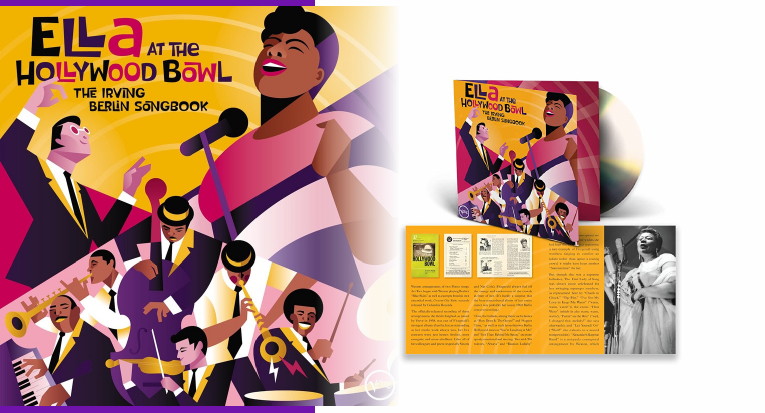
ELLA AT THE HOLLYWOOD BOWL: THE IRVING BERLIN SONGBOOK


AVAILABLE JUNE 24 VIA VERVE RECORDS/UMe


“Cheek To Cheek” is from the forthcoming release, Ella At The Hollywood Bowl: The Irving Berlin Songbook, which will be released June 24 via Verve/UMe.


 The album, which will be available on CD, vinyl, limited edition yellow splatter vinyl, and digitally, includes 15 never-before-released songs of Ella performing selections of her now-classic album, Ella Fitzgerald Sings The Irving Berlin Songbook, to an adoring sold-out crowd at the Hollywood Bowl in August of ’58. Conducted and arranged by Paul Weston, who also arranged and conducted the studio sessions, this concert marked the only time that Ella performed these iconic arrangements live with a full orchestra.


Discovered in the private collection of producer and Verve Records founder Norman Granz, this landmark record marks the first time a live Songbook has been released from Ella. It is also significant in that it captures the only time Ella worked in concert with arranger-conductor Paul Weston. And, although she performed regularly at the Hollywood Bowl, this is the first full-length concert by Ella from this iconic venue to be released (notably, Ella was featured prominently on Verve’s Jazz At The Hollywood Bowl album, recorded and released in 1956, the year Granz formed the label).


The live tracks were mixed from the original ¼” tapes by Grammy Award-winning producer and musician Gregg Field who played drums for Ella in her later years. The album is rounded out with insightful liner notes about the concert and Ella’s Songbook series by noted author and music critic, Will Friedwald.


Widely considered her greatest achievement, Ella’s Songbook records, with peerless renditions of the best songs by America’s greatest composers, are the cornerstone of the Verve catalog and the undisputed standard for jazz vocal recordings. At the inaugural Grammy Awards, her Irving Berlin album won Ella her first Grammy for “Best Vocal Performance, Female,” and was also nominated for “Album Of The Year.”


Aside from the lucky audience at the Hollywood Bowl that night, it wasn’t generally known, until the discovery of these tapes, that Ella had ever performed any of the Songbook arrangements in concert, let alone that such a pristine and sonically sumptuous recording existed.


While Ella’s live appearances had evolved over the years from her early big band years where she primarily sang in ballrooms with the Chick Webb Orchestra to supper clubs, theaters and concert halls, she mostly stuck to a nightclub format of performing a selection of songs accompanied by a trio. This performance at the Hollywood Bowl was incredibly unique for her. As Friedwald reveals in the liner notes, “But to come on stage – with a full orchestra – and essentially sing the contents of a studio album, well, nobody did that. Not Sinatra, not Tony Bennett, not Miles Davis, nor any of the other key innovators who contributed to the development of what came to be known as ‘the concept album.” Friedwald continues, “so exactly why did Fitzgerald and Granz choose to face this particular music and dance in this singular fashion? We may never know, but the logical answer is that the song books were proving to be such a major component to her burgeoning career that… Fitzgerald and Granz were determined to do something special in honor of the ongoing series.”


And special it was. Across 15 songs, Ella and the orchestra performed dazzling arrangements of some of Irving Berlin’s best-known songs including the classic ballads “How Deep Is The Ocean” and “Supper Time,” Hollywood tunes “You’re Laughing At Me” and “Get Thee Behind Me Satan,” and swinging up-tempo numbers “Cheek To Cheek,” “Top Hat,” “I’ve Got My Love To Keep Me Warm,” “Heat Wave,” and “Puttin’ On The Ritz.” The concert pops with an electricity not found on the studio recording as Ella feeds off the energy and enthusiasm of the crowd, whose applause and adulation bookend each song.


The Hollywood Bowl, which is celebrating its centennial this year, loomed large in Ella’s life. She made her Bowl debut alongside Louis Armstrong in 1956 at a star-studded program, which was released as the double LP, Jazz At The Hollywood Bowl. Ella holds the rare distinction of having sold out the Hollywood Bowl in each of five decades, from the 1950s through the 1990s. Aside from headlining numerous times, Ella, who lived in LA for much of her career, also performed as part of the annual Playboy Jazz Festival; her last appearance was a couple years before her passing in 1996. Read more about Ella and her history with the Hollywood Bowl here: https://www.hollywoodbowl.com/about/watch-and-listen/bowl-history-spotlight-ella-fitzgerald


The voice of Ella Fitzgerald, the songs of Irving Berlin, the timeless arrangements of Paul Weston with an orchestra at the Hollywood Bowl, Ella At The Hollywood Bowl: The Irving Berlin Songbook is the pinnacle of American song – live and like never before.


ABOUT ELLA FITZGERALD

Dubbed "The First Lady of Song," Ella Fitzgerald (1917-1996) was the most popular female jazz singer in the United States for more than half a century. In her lifetime, she sold more than 40 million albums and received most every honor a performer could dream of winning, including the Kennedy Center Honor (1979), the National Medal of Arts (1987), France's Commander of Arts and Letters (1990), the Presidential Medal of Freedom (1992) and 13 Grammy Awards. In 2007, the United States Postal Service honored Fitzgerald with a postage stamp.


In her six-decade long career, the Queen of Jazz recorded more than 200 albums and roughly 2,000 songs, making her the most recorded female – and the second most recorded – performer in history. Among those recordings are works with some of history's greatest musicians and legendary songwriters.


Fitzgerald's distinct style has influenced multiple generations of singers and her work transcends generations and musical genres. She had an extraordinary vocal range and flexibility and possessed a preternatural gift for pitch, rhythmic sense and flawless diction. Immensely versatile, she could sing it all from jazz and bebop to ballads, swing, pop and rock. With an unparalleled ability for mimicry and “scat” singing, Fitzgerald also produced melodic lines that put her in the category of great instrumental improvisers. Her voice was flexible, wide-ranging, accurate and ageless.


She passed away due to complications from diabetes, dying in her Beverly Hills home on June 15, 1996.


The Ella Fitzgerald Charitable Foundation was created and funded in 1993 by Ella Fitzgerald in order to fulfill her desires to use the fruits of her success to help people of all races, cultures and beliefs. Fitzgerald hoped to make their lives more rewarding, and she wanted to foster a love of reading, as well as a love of music. In addition, she hoped to provide assistance to the at-risk and disadvantaged members of our communities - assistance that would enable them to achieve a better quality of life. The Board of Directors of the Ella Fitzgerald Charitable Foundation seeks to continue Ella Fitzgerald's goals by making charitable grants serving four major areas of interest: Creating educational and other opportunities for children; fostering a love and knowledge of music; including assistance to students of music the provision of health care; food, shelter and counseling to those in need and specific areas of medical care and research with an emphasis on Diabetes, vision problems and heart disease.


ELLA AT THE HOLLYWOOD BOWL: THE IRVING BERLIN SONGBOOK

TRACKLISTING

1. The Song Is Ended

2. You’re Laughing at Me

3. How Deep Is the Ocean

4. Heat Wave

5. Suppertime

6. Cheek to Cheek

7. Russian Lullaby

8. Top Hat White Tie and Tails

9. I’ve Got My Love to Keep Me Warm

10. Get Thee Behind Me Satan

11. Let’s Face the Music And Dance

12. Always

13. Puttin’ on the Ritz

14. Let Yourself Go

15. Alexander’s Ragtime Band