© Copyright ® Steven Cerra, copyright protected; all rights reserved.
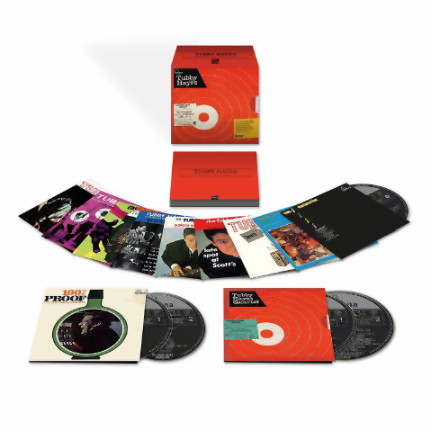
Here is part two of Simon Spillett’s sleeve notes for the now out-of-print 'Tubby Hayes: The Complete Fontana Albums 1961-69'
More about Simon can be found via his website including contact information and of course you're always welcome to leave your thoughts in the “comments” field of this blog.
© -Simon Spillett, copyright protected; all rights reserved; used with the author’s permission.

TUBBY HAYES
THE COMPLETE FONTANA RECORDINGS 1961-1969
'They say you can’t sell British jazz in Britain - not the modern stuff. That’s not quite true. With someone like Tubby, who now has an international reputation, sales are healthy enough. He is, in fact, the modern star name among European jazzmen.'
Jack Baverstock, Crescendo, June 1963
OK, let's have a go
It was exactly this sort of thinking that had made Hayes' relationship with the UK record industry hitherto an inconsistent one. The briefest of précis' of his talents and career-achievements up to the late-1950s gives more than enough detail to realise why his was a talent already straining at the leash of localism; precociously gifted, Hayes the boy-wonder tenor saxophonist had turned professional at just fifteen years of age, shoehorning his appetites for the latest in modern jazz (his favourites ranged from bop fountain head Charlie Parker to cool-school prince Stan Getz) into a series of prominent local dance bands – Kenny Baker, Roy Fox, Tito Burns, Bert Ambrose, Vic Lewis, Jack Parnell. It was remarkably short apprenticeship as, by early 1955, he had formed a group all his own, a rabelaisian octet of largely unknown young colleagues who had somehow bagged a contract with Decca Records, signed in February that year.
Hayes was just twenty years of age.
In an effort to capture how important he was now becoming, the press had by this point given him a further nickname,The Little Giant, a sobriquet that summed up the disparity between his short stature and his imposing musical abilities. Privately, he detested it. Publicly, it made for another good sales ploy. As a British jazz recording artist, he'd need every trick in the book to sell his records.
From 1955 to 1960, he recorded almost exclusively for Decca's Tempo subsidiary, a run-for-kicks operation overseen by the almost equally youthful Tony Hall, the man-about-town of London jazz who combined several roles – club compère, promoter, disc-jockey – with a day job as Decca's Exploitation Manager.
Frustratingly, the one thing Hall really wanted to exploit – British modern jazz – remained low on the companies list of priorities, Tempo's discography yielding more EP's than LP's as both sales-demands and up-front finance were limited. While it made a useful grab-bag of the disparate ambitions of a small coterie of UK modernists (everything from the quirky post-bop of trumpeter Dizzy Reece to the almost West-Coastish music of tenorist Don Rendell), Tempo rarely created classic albums, with even Tubby Hayes – arguably the labels star signing – taking an age to come up with a characteristic, signature LP.
Then, in 1957, Hayes and fellow tenor Ronnie Scott – a man the younger saxophonist considered his greatest first-hand influence – teamed up to form The Jazz Couriers, an undisguised answer to the tidal wave of American Hard Bop that had been launched by The Jazz Messengers in New York City. Unusually in British jazz circles of the time, this was a band that made no play at coming over as a semi-commercial dance outfit; its title was as much a declaration of intent as a catchy moniker.
Over the ensuing two years the Couriers made history, quite literally, deeply impressing visiting American jazzmen who either heard them at their regular gig at London's newly opened Flamingo premises in Wardour Street (Sonny Stitt, Donald Byrd, Zoot Sims) or who found the English band acting as 'support' on their own UK tours (Sarah Vaughan, Dave Brubeck – the latter famously quipping 'they sound more like an American band than we do').
They also created Tempo's first great albums – a triptych of releases of which one, The Jazz Couriers in Concert, became that rarest of rarities; a best-selling British modern jazz LP. The quality of the Couriers' music – and that of Hayes' contributions in particular – even piqued the interest of the US-record industry, with whom Tony Hall had always maintained strong ties. In 1958, the band taped a release exclusively for the American market (The Couriers of Jazz, Carlton) and that same year Hayes participated in a covert London-made session for the prestigious Blue Note label, resulting in trumpeter Dizzy Reece's US début album Blues In Trinity. Upon its release, stories abounded about how drum icon and Jazz Messengers-leader Art Blakey had talked of hiring Hayes.
When the Jazz Couriers split in the autumn of 1959, ground out of existence by the limited opportunities of the UK jazz circuit, Hayes went it alone with just a rhythm section for company. Still signed to Tempo, late that year he taped two sessions for the label which proved hands down that his was now an international-level jazz talent. Issued in spring 1960, Tubby's Groove found Hayes channelling all his contemporary influences – from Stan Getz, Hank Mobley and Johnny Griffin to early Coltrane – into a six-theme recital that was to tip the balance of British jazz. Not only did the album become the first ever by a UK artist to be placed as a Melody Maker album of the month in July 1960, it also became a best-seller, in part due to a modest but key marketing campaign launched at producer Tony Hall's own personal expense. The record even received rare praise in the pages of US jazz bible DownBeat,
British jazz was to throw up very few authentic-sounding Hard Bop albums during the late 1950s and early 1960s – in part due to many local players favouring something altogether more cool sounding – but Tubby's Groove was without doubt the best of them.
Its counterpart, however, didn't hit the target it had been intended to. Sent to Alfred Lion of Blue Note records, the session was shelved – Lion vetoing its release owing to the poor sales figures for its thus-far only exclusive non-US signing Dizzy Reece (eventually these tapes were issued by the Candid label in 2011, appropriately titled Tubby's New Groove).
Elsewhere, Tony Hall was having a shade more luck, negotiating a US release of the Jazz Couriers final recording on the Jazzland subsidiary of New York's Riverside Records, home of Cannonball Adderley, Johnny Griffin and other leading Hard Bop lights.
Keen to tape a follow-up UK release for Tempo, despite Hayes' saleability (helped enormously by the saxophonist's weekly appearance on the BBC-TV show Tempo 60 during the summer of 1960), Hall got the block from Decca, leading to the peculiar circumstance of he, as one of the companies employees, actually railing against those for whom he worked on the front page of Melody Maker. 'The chief troubles are lack of money and initiative from record companies in general,' he lamented, supporting the former claim with a confession that he was unable to secure the £19.00 needed to finance another Tempo release.
This small figure said it all, especially when compared to the kind of money being thrown at current US-jazz stars; the year before John Coltrane had signed a contract to Atlantic Records for $7000 per year, with an option to extend if both parties were happy. When Miles Davis' had signed to Columbia four years earlier, his advance was such that it enabled him to purchase a Mercedes sports car and still have something left over to blow on his other passions. Coltrane had been given a Lincoln Continental with his Atlantic contract. British musicians were lucky to get the bus fare home.
By 1960, Hayes had risen to become a sort of anomaly – the one British modern jazz musician who truly sounded like an American, particularly in his grasp of the most elusive of all jazz qualities – time - and one whose virtuoso technical command was second to none anywhere on the globe. He also had more talent than one instrument could contain. By the end of the 1950s, he had added both vibraphone and flute to his arsenal (both these new doubles self-taught) and was already showing signs of being as gifted and skilled at composition and arrangement as he was at performing. That he was world-class was undeniable.
Conceivably, given the right breaks, he might actually be able to hold his own within the most demanding jazz arena of them all, i.e. in New York.
This much was true. However, just as his vibrant bursts of musical endeavour found themselves seeming all the more exotic for being set against the rather bland, dull gray ennui of the Macmillan era, then his ambitions likewise found themselves tempered by environment, choked half-to-death by the red tape restrictions that had, ever since the late 1930s, prevented a free and fair exchange between UK and US musicians.
Even at the dawn of the 1960s, four years into what had proved to be an almost laughable reciprocal band-for-band agreement between the American Federation of Musicians and the British Musicians' Union (try Lonnie Donegan and his Skiffle Group for Bill Haley and The Comets), it still seemed to be the Yanks calling the shots, food for thought for anyone suspecting that the much-talked up 'special relationship' was in danger of leaving the UK as culturally indentured as it had geopolitically.
Hayes' ambitions weren't solely transatlantic though. Interviewed in Jazz News in the late summer of 1960, America was just one of his concerns; there was talk of a new group, of his new found passion for big band writing, of his interest in several younger musicians who were then just beginning to prise open the long-closed shop of local modernism. 'I'm not bored,' he stated, although, as the article maintained, 'just about everything that can be achieved in the relatively small field of British jazz has been achieved by Tubby Hayes.'
There was one thing bugging him though; fêted as a true international contender, a player whose sheer ability more than matched (and in several cases superseded) that of any number of American jazzmen, he still couldn't strike the right kind of relationship with the UK record industry.
The patronage of Tony Hall was one thing ('[he] gave us loads of LP's to do of different jazz things, myself and Ronnie [Scott] and Jimmy Deuchar and people like that', he said admiringly in one magazine interview) but everyone knew he was ultimately only a conduit to upper-management, who were noticeably reluctant to throw anything but the slightest investment in local modern jazz.
It was too easy to blame the 'system' though – sometimes it was the musicians who fouled things up. Hall later recalled how some of Tempo's sessions were sabotaged by less-than-prepared players or, worse still, by those who treated the entire undertaking as little more than an excuse for an in-studio rave up (Hayes himself recalled a Tempo session so unruly that Hall thought it 'a drunken orgy', forcing the saxophonist to make an in-person shamed-faced apology to Decca's head – the soon to be Sir - Edward Lewis).
In general though, the Tubby Hayes of the early 1960s was still a man with his off-stage predilections well-hidden, something of a paragon of professionalism. In fact, so clear-eyed were his ambitions at this point that, sometime around early 1961, he made what amounted to a five-point plan as to where he wanted to head next. America was at the top of the list, but among the other goals were increased television presence, movie roles, more exposure for his ever-burgeoning composing and arranging skills - with strong emphasis on his own multi-instrumental abilities - and, the thing he presciently saw as the key to whole operation, a regular, fully cooperative relationship with a major record label.
If the idea of Tubby Hayes arch-impulsive sitting down and making such a list seems a little off-kilter with his folk-image, there is very strong eye-witness evidence to suggest he did indeed do so.
Pete King – one half of the team who'd opened Ronnie Scott's new Gerrard Street club in the autumn of 1959 and, since 1958, Tubby Hayes' manager – recalled an evening in which he and Hayes got together to finalise these goals.
'I remember vividly that we went out to dinner, with his wife and my wife, and [afterwards] we sat down on the floor of his flat over in Notting Hill and we worked out a schedule for the way forward for Tubby.'
The saxophonist was especially keen to bag a record contract with a major label, with a view to making an album showcasing his big band writing, a talent he'd been polishing within the informal Downbeat Big Band, which he'd been leading for close to two years.
But who to ask? Between them, he and King settled on Jack Baverstock, then head of the UK division of Fontana, and a figure already regarded as something of an industry giant.
Like Hayes, Baverstock was a man on a mission. And, like Hayes he'd worked his way up from budget-lined productions to something far more grand.
Tall, bespectacled and with a swathe of swept-back, graying hair, there was something of the schoolmaster to his appearance, although in his bluff no-nonsense manner, he often came on more Trades' Union spokesman than favourite teacher (one magazine profile of Baverstock in the 1960s records just how outspoken he could be if the occasion called for it, recounting a session in which he upbraided the John Dankworth band for sounding like something from a pre-war Palais). He was no musical dilettante though, having worked as a dance band pianist before moving into journalism and the record business.
Appointed to Fontana upon the formation of its English operation in 1958, he'd already worked magic at smaller labels like Oriole and Embassy, producing countless cheaply-priced 45's of cover versions of current pop songs, aimed at the customers of Woolworths. There'd been hits along the way – most notably Nancy Whiskey's skiffle-anthem Freight Train – but in the main Baverstock's emphasis had been on catalogue. 'Every shilling counted,' he told Record Mirror in 1966. 'I had to make sure nothing was wasted. It was great training.'
His task at Fontana was simple; 'First I concentrated on building a strong LP catalogue,' he remembered, 'to give the label a firm grounding. I recorded Irish folk music and it sold like a bomb. Johnny Mathis did well for us too.'
Having the British license for US labels like Columbia certainly helped, but very quickly Baverstock looked to making signings of his own. 'I began looking for talent in all directions,' he recalled in 1966.
All directions were right; within a few years he'd signed a bewilderingly eclectic bunch of names – from folk favourites Robin Hall and Jimmy Macgregor to Greek songstress Nana Mouskouri. Some artists came and went before they could find their chart-scoring potential – Matt Monro for one – but by and large Baverstock achieved his stated aims; to have a rich, stylistically varied LP catalogue and a phalanx of consistent hit-single-making artists.
But British jazz? How would he take that? After all, by the time that Tubby Hayes was getting ready to approach Fontana, the only kind of local jazz that was shifting in truly significant quantities was that played by the booming Trad bands, the likes of Chris Barber, Kenny Ball and Acker Bilk, musicians whose commercial outlook was anathema to the modernists purist ethos.
Hayes may well have had all the right artistic credentials to do well – as the slew of glowing reviews for Tubby's Groove made clear – but sales were sales and those for Tempo were anything but healthy.
The only approach that could conceivably work was a direct one – Hayes had to go into any negotiations stating his aim as clearly as possible. This was as much practical as self-preservative; with Tempo drifting out of existence (it issued its final British modern jazz LP around the time Hayes taped his first for Fontana) what could he lose? He was already making no albums. Anything above that had to be a plus!
It's hard to say if Hayes underestimated Baverstock. For one thing, as a highly experienced A&R man the latter had a keen eye for an artist in whom lay hidden riches; for another, he had high standards himself (in 1961, during the height of the Trad Boom, a time in which every record label in London was busy snapping up any band with a banjo and a gimmicky uniform, Baverstock stood his ground, famously telling Jazz News that he'd 'listened to tapes for over a year' before finding a single new band worth signing).
And then there was the question of catalogue: variety was the key. Fontana already had plenty of American jazz artists – Miles Davis, Dave Brubeck, Duke Ellington among them. A British jazzman might make a nice makeweight, if nothing else.
According to Hayes, whatever negotiations there were were short and sweet. 'I thought of doing this big band album, and so forth,' he told Crescendo's Les Tomkins in 1963, 'I went to see Jack Baverstock and he said: “OK, let's have a go” - so we did it.'
Was it really as simple as that? Amazingly it appears to have been, with Hayes signing his contract with Fontana on the afternoon of Monday March 6th 1961. Immediately after it was business as usual, the saxophonist playing a gig in Harrow later that evening.
A good sign: Tubbs
Although details of what precisely comprised the deal have been lost to the sands of time – and may well survive in a filing-cabinet black hole somewhere – we know from several eye-witnesses that Hayes' agreement was nowhere near as lavish as those of his transatlantic opposite numbers.
That same year, the resurgent Sonny Rollins – then ready to emerge from his legendary 'Bridge' self-exile – had been signed to RCA-Victor for a truly astronomical $90,000, the label wanting five albums from him in two and a half years.
As Pete King remembered it, 'England's Answer To...' received something far more modest – a single two-year contract, nothing more, nothing less.
'It wasn't like record deals are today,' he recalled in a 2001 interview, 'just union scale'. Nevertheless, while the basis of the contract remained the same as that of his previous tie-up with Tempo – payment for each individual session and royalty on compositions and records sold – Fontana also promised something far more useful; a full, higher-level advertising campaign and, crucially, a harder-driven distribution pitch.
One of Hayes' gripes (not entirely justified) had been that 'you could only buy [Tempo albums] in Dobells', the fondly remembered London jazz specialist shop. While not strictly true, the story did have a hint of reality to it. Tempo had at times seemed more like an cottage-industry operation than a bona-fide subsidiary to a major record company and it had never really mastered the promotion game. Just ask Tony Hall.
Under Philips' proactive aegis, however, Hayes's Fontana albums were to be pushed as never before, with the ultimate carrot dangled before him being the reciprocal deal between the Dutch giant and the US Columbia label, meaning that, technically at least, he could release his albums both in America and England.
There was irony here too. Hall had bust a gut sending tapes to this American label and that, tirelessly attempting to get those British jazzmen he thought deserving an album release in the United States; Hayes' might now be able to record for a US major through little more than the flick of a pen nib on a page.
The sensible thing might have been to keep his powder dry, but this was as big a story as had ever happened in British modernism and Pete King quickly alerted the jazz press, Melody Maker breaking the story on the cover of its March 25th issue, complete with a photo of a smiling Hayes and Baverstock at the saxophonist's first session, taped earlier that week. Elsewhere, Jazz News doorstepped Tony Hall for a reaction to the news.'Tubby never told me', came his rueful reply, like that of a jilted bride.
'He is the first British modern jazzman to be signed by a major label for some years,' Melody Maker's coverage ran, as if anyone needed to be told the obvious. The article also revealed that for his first Fontana album, Hayes would feature three distinct groups – the quartet he had led since late 1959, then the solidest modern draw in London's clubland; a woodwind-centred group and an all-star brass ensemble, which had been the line-up chosen to commence the project. Clearly things had moved on considerably from Hayes' idea of 'this big band album'.
In part, this rethinking had been Hayes' own but it had been Jack Baverstock who'd seen the bigger picture; his new signing was now a triple-threat – multi-instrumentalist, composer/arranger and bandleader – omitting one of these skills on what was to be this début album for a new label would be like going mountain climbing and packing everything but your boots. Crucially, Baverstock was putting Fontana's money where Hayes' mouth was.
This was a big budget exercise, so big in fact, that when it came to penning a sleeve note, even the normally phlegmatic Benny Green was at a loss for a wholly satisfying explanation as to how it had occurred. Nor was there anything to really compare it with.
'This album...represents the first occasion I can remember when one of our major instrumentalists was let loose, so to speak, in a recording studio, told he could play what he liked how he liked, with as many musicians as he liked, on as protracted a session as he liked.'
'I am by no means resorting to sleeve-note euphemism,' Green confessed, 'when I describe this album as unique.'
Green's notes also faced full-on the only real niggle that anyone – fans, Baverstock, Fontana's accounts department, even Hayes himself - could have felt concerning the project; its commercial potential.
'It's only conceivable handicap from a sales point of view that I can think of,' he wrote, 'is the fact that it was recorded within hailing distance of Marble Arch'.
Released in June 1961, the first Hayes' Fontana album – titled simply Tubbs – both broke the mould and set a precedent. For starters, there was its cover: a bold, full colour photo of the saxophonist in a tricolour shirt, shot from underneath, eyes shut, his powerful jaw muscles clamped so tightly around his instrument's mouthpiece that his chin puckered and dimpled. Placed side-by-side with the sleeve of his Tempo predecessor Tubby's Groove one sees almost a mirror image – the protagonist shot from both left and right – one in grainy, austere and old-fashioned black and white, the other in sharp, up-to-the-moment colour. It was hard not to think in these terms with the music. Indeed, what the album captured was so much more defining that anything Hayes had done for Tempo, a tapestry of musical images made all the more vibrant for the pin-sharp sound-mix favoured by Fontana's mastering process. On the signature unaccompanied closing of Cherokee, to pick just one example from many, there was an almost tangible quality to his playing, Hayes sounding so up-close that a listener might be forgiven for thinking he could reach through the fourth wall of the LP format and actually see him. Benny Green was right on two levels: this really did sound unlike any other British jazz album.
Long gifted with the knack of synthesising the latest jazz trends, Hayes had also ensured that the album contained several nods to his contemporary US heroes, as if he realised that this was the record that he would use to finally break America, once and for all, the great manifesto statement that said how he saw his future panning out – a potent mix of playing, composing and arranging at the very highest, international level.
Musically, Tubbs touched many bases – the Great American Songbook, the soul-jazz boom, even the easy-listening market (The Folks Who Live On The Hill). Instrumentally, its three shifting line-ups of big band and tenor, woodwind and vibes and sax-piano-bass-drums quartet also took something of their cues from recent American examples: Sonny Rollins' and The Big Brass; Milt Jackson's Bags and Flutes; a whole host of top-flight American sax-led quartet albums from Saxophone Colossus through to Giant Steps. What united it all was Hayes' sheer conviction, and it was this characteristic, long talked of on the British jazz scene, but somewhat dissipated on his previous studio albums, that became the talking point for critics appraising his new Fontana album that summer.
To a man, they lined up and heaped praise upon the saxophonist, almost tripping over themselves in a rush to say that they'd long thought Hayes had the makings of a true jazz giant. In some it was a bum's rush, but for the most part the reviews were almost nakedly sincere. Jazz Journal's Michael Shera thought the album a signal success, 'infinitely better listening than many present records by highly rated American saxophone players. The recording, too, surpasses anything I have heard previously on a British issue.'
Jazz News' Kitty Grime called it 'a record of which everyone can be proud – and one which you can stack in any modern jazz library'. Melody Maker went one better, titling its review 'Tubby achieves world status', Bob Dawbarn believing the album 'deserves the highest praise'. It was, he maintained, 'a record that not only does Hayes proud, but Fontana and British jazz as well.'
Two weeks later, the paper voted Tubbs its Jazz Disc of The Month (following its June choice of John Coltrane's Blue Train) Dawbarn reprising his earlier opinions, congratulating Fontana on the 'rare abandon' in giving its signing his head, and declaring that the album was 'excellent jazz – by any standards.'
'Let's hope that [Hayes] gets the support - from record buyers, clubgoers and critics – that he deserves,' he concluded.
Crucially, the saxophonist had already got the support of something arguably more important than all three – Fontana's publicity department, whose efforts that summer were unprecedented for a UK jazz product; half page adverts in Jazz Journal and Jazz News, box ads that ran over several weeks in Melody Maker, a full page in the brochure for the Beaulieu Jazz Festival. Hayes was even afforded the opportunity to run through virtually the entire album's contents live on a special edition of the BBC's popular 'Jazz Club' radio slot. Not quite product placement but pretty damn close.
The net results justified all the investment. Interviewed in August of 1961, Hayes was asked how his new album was selling. 'It's out of print at the moment, which I take as a good sign,' he replied, adding modestly, 'there is a chance it may be released in the States.'
A good sign? This was an understatement of the nth degree. Hayes had long operated in an atmosphere both cultural and commercial that was downright apathetic to local jazz endeavour (broadcaster Peter Clayton once colourfully described it as 'like selling balloons in a cemetery'). Now, some two months after its initial release, demand for his new LP was so vociferous that his new label affiliates were already demanding its follow-up. 'Fontana want another album,' Hayes told Melody Maker that summer, confessing that, despite the pressure, he wouldn't be rushed. 'I am taking my time thinking about it. The last one is difficult to follow.'
Somebody did something about it
What he didn't reveal is that Fontana was already trying to do exactly that. Indeed, even before the release of Tubbs the company had caught Hayes on-tape again, appearing live at the London Palladium on a Jazz News' magazine Poll Winners concert also featuring fellow-Fontana signing Cleo Laine, which had taken place on March 31st, barely a few days after he'd completed his first LP for the label (strictly speaking Fontana hadn't actually done the taping at all, the entire afternoon being documented by a remote team from the Portland Place-based IBC Studios). And in August, he'd collaborated with ex-Stan Kenton and Nat 'King' Cole percussionist Jack Costanzo on two self-penned big band tracks that would be the highlights of a collaborative LP, issued the following year as Equation In Rhythm.
Recording dates very often mean little to anyone but the most minutiae-obsessed discographer, but in Hayes' case they're hugely important. With the addition of the Palladium session, the Costanzo date and a clutch of tracks taped for a forthcoming film soundtrack album, Fontana had recorded the saxophonist a staggering seven times in six months. With Tempo, he'd been lucky to cut a set of his own once a year.
It was a heady time for both artist and label. That summer the saxophonist was taking part (both as an actor and musician) in the Rank pictures feature film All Night Long, shot at Pinewood, netting himself no less than £100 a week over the seven weeks of filming, a job which also found him appearing alongside UK jazz icons Charles Mingus and Dave Brubeck, both of whose Columbia discs were distributed in the British Isles by Fontana (a tie-in LP appeared on the label the following year, almost as much an unfocused mash-up of jazz clichés as the film itself).
In the meantime, Jack Baverstock was head-hunting further local talent. He'd already secured Cleo Laine and Hayes, and now signed up 21-year old tenor saxophonist Dick Morrissey, a hugely promising player then carving a reputation for himself in London's clubland similar to that hewed by Hayes a decade earlier.
By the following year, and with still more signings in the pipeline, Baverstock's initiative was beginning to make a genuine impact on the British jazz psyche, as Benny Green observed in Scene magazine;
'The executives of most recording companies would never be seen dead in a jazz club,' he began wearily. 'They are used to more genteel environments, so they go to press parties and conferences instead, where instead of listening to good jazz, they study the discords of their own conversation.'
Tubby Hayes, however, had shaken apart this routine by deeply impressing Fontana's head.
'This, of course, was not the first time somebody had perked his ears up after hearing Hayes. But this time somebody did something about it. Fontana started to exploit Hayes with surprising success.'
As both Green and Fontana knew, this exploitation ran both ways. Through the summer of 1961, Pete King, Hayes' manager, had been negotiating a deal enabling the saxophonist to appear in New York. With a no-nonsense line in rhetoric and a poker-faced impassivity so immovable that it might have shamed a card shark, King actually had little trouble navigating his way through the seemingly intimidating cast-list that comprised the American Federation of Musicians' New York chapter. Convincing them that an American musician visiting England would benefit from any reciprocal exchange was easy – he could promise a months' worth of work at London's leading jazz venue and, with the knowing cooperation of Fontana, the additional possibility of paid recording work while there.
But sending an English jazz musician into the heart of New York's jazz jungle? How would that work? Wasn't this as much lamb to the slaughter as Coals to Newcastle?
Actually, as King already knew, this was more like sending a Trojan Horse. To clinch the deal, he simply played Tubbs to both the AFM officials and the owners of the club in which Hayes looked likely to appear, Manhattan's Half Note, soon to be the spiritual home of Hayes' idol, John Coltrane and his quartet. Instantly any reservations melted away.
'I was amazed how many people knew of Tubby [already],' he told Disc magazine. 'I guess the word got around. Everyone wanted to hear Tubbs' latest on Fontana. They were knocked out when they heard it.'
As well as flooring the musical cognoscenti, Tubbs was bulldozing its way through the entrenched misconceptions of the US record industry. 'It's practically certain that Tubby will record in New York,' Disc revealed. 'For Columbia's subsidiary Epic, with trombonist Jay Jay Johnson, for one. There may be other dates.'
'At first, the American Federation turned down the disc deal,' admitted King. 'Then I reminded them that it would mean extra work for American musicians and American technicians in American studios – and they said O.K.'
The coup that was Tubby Hayes' opening at the Half Note in late September of 1961 is central to his legend, its impact well conveyed in a series of newspaper and magazine headlines that appeared in the weeks following, both in the UK and the US; 'Tubby A Triumph in USA' shouted Melody Maker; 'A Great Day For British Jazz' trumpeted Disc; 'Tubby Hayes Startles American Jazz Scene'; 'All-Star Welcome'; 'New York Is The Only Place For Jazz'; 'That U.S. Trip was simply tremendous, says Tubby Hayes'; 'I'll Go Back Again';. On it went.
The line of the good and the great on American jazz who came to either check-out or sit-in with the English visitor was even more impressive - Miles Davis, Zoot Sims, Paul Desmond, Donald Byrd - their endorsement making flesh of Hayes' own belief (expressed in a letter to his wife, written on the eve of this trip) that 'I feel I have a huge responsibility going with me for the whole cause of Jazz Music in this country...I will do my utmost to create a favourable impression musically and socially.'
Among the telegrams sent to the Half Note on opening night was one from Tony Hall, wishing his ex-Tempo signing all the very best. In the still small world of UK modernism there was little room for tightly held grudges. Ahead of the trip, Hall had written in Record Mirror 'I hope [Hayes] will be allowed to record there. Because the way he is playing just now, there can't be many better anywhere.'
The reception Hayes was given appeared to bear this out. 'The musicians I met just couldn't do enough for me,' he told Jazz News. And, rather to his surprise, some of those he'd only previously known as distant idols transpired to be fans. 'I met Sonny Rollins,' he remembered in one interview. 'He had heard my Fontana album and 'The Folks Who Live On The Hill' track impressed him. As a result, he plans to include the tune in the repertoire of his new group.'
News of this kind and the sheer novelty of such a welcome has tended to overshadow perhaps the greatest achievement made by Hayes on this, his first pioneering sortie to New York – the making of his Stateside recording début. In turn, the achievement of this additional goal has also obscured the rather less than clear organisation that lay behind the whole enterprise.
Hayes himself was well prepared though, according to Stanley Dance, the English jazz writer domiciled in America, who wrote the sleeve notes for the US release of the album (Tubby The Tenor, Epic), 'on several days before the session, Tubby had gone to [a studio] for three or four hours and shut himself up in a room, alone with a piano. There he had done his homework, familiarising himself with the changes and numbers he was to record.'
What Hayes couldn't get a handle on, it appears, were the logistics and choice of personnel. He knew that there'd be two dates, each beginning at midnight, scheduled for early October, the last the night before he flew home to the UK, both slated to take place at the legendary Columbia Studios 'A' at 799th 7th Avenue (the space in which such hits as Tony Bennett's I Left My Heart In San Francisco, The Byrds' Turn, Turn, Turn and virtually all of Bob Dylan's early catalogue would soon be created).
He knew that his producers would be Mike Berniker and Nat Shapiro of the Columbia off-shoot Epic Records. But other than that? His trio from the Half Note engagement (Walter Bishop Jr, Julian Euells and G.T. Hogan) weren't invited and he was none the wiser as to who might be his front-line partner. The messages coming through to London the week before the sessions were due to take place were very far from clear. ''I'm not sure whether it'll be Don[ald] Byrd or Clark Terry,' Hayes told Melody Maker. 'As for the rhythm section, Mike Berniker, my A&R man, mentioned both the Miles Davis [quintet] and Cannonball Adderley [quintet] rhythm trios.'
In the end, Berniker's choices were far more expedient and practical: Byrd couldn't get the go-ahead from his label, Blue Note, and so Terry stepped in, the last minute nature of his engagement apparent in the fact that the two themes he contributed to the sessions fed directly on the old idea of fresh lines over old changes. Vibraphonist Eddie Costa's last-minute contributions were even more casual, Stanley Dance remembering that he arrived during the intermission of his own local club gig to play his parts, staying just long enough to take off his raincoat. Hayes's rhythm team was a similarly casual affair: pianist Horace Parlan – famed for his work with Charles Mingus: bassist George Duvivier, a musician whose stylistic breadth encompassed all kinds of jazz and one of the most-recorded musicians in New York, and drummer Dave Bailey, a player Hayes already knew from the American's 1957 UK tour as part of the Gerry Mulligan Quartet. The three had never before recorded as a unit.
Over two nights – and in circumstances that sometimes resembled a party, visited by well-wishing musicians, journalists and friends – Hayes and his team came up with more music than could be contained within one album. As with so many things in the saxophonists career, this was an achievement almost as impressive as the performances themselves. 'We did a whole LP in 2 ½ hours!' he revealed to Disc. 'On the next night, trumpeter Clark Terry was added and we cut another whole LP.'
If Hayes was slightly exaggerating (it was more like an LP and a-half over two nights) then his enthusiasm was forgiveable; not only had he played the States, he'd recorded there too, the sometimes forbidding environs of the studio – very often the most inhibiting of all performance arenas for an improvising musician – proving no obstacle whatsoever to his creativity. And if anyone had been expecting the Englishman to be cut to ribbons by his American counterparts, they were to be sorely disappointed. Stanley Dance even recalled an unusual role-reversal taking place on one of the performances, drummer Dave Bailey turning to Hayes after one especially fast tempo to tell the saxophonist 'you're cruel'.
Clearly this was going to be an album that would elevate Hayes' reputation further still, and even before he'd stepped on-board the plane that was to fly him back home, tapes of his US sessions were being prepared for dispatch to London.
'Material for two LP's has since been sent to Fontana a-and-r manager Jack Baverstock,' reported New Musical Express, 'who will handle the British release of the session.'
To be continued in Part 3.