© Copyright ® Steven Cerra, copyright protected; all rights reserved.
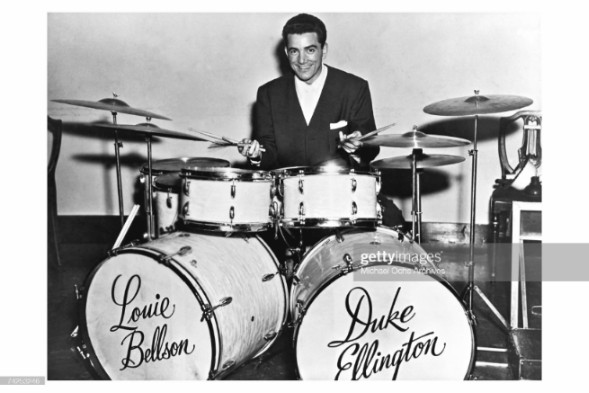
Brown: Today is October 21st [2005]. We’re continuing with day two of our Smithsonian Jazz Oral History interview with Louie Bellson in his home in San Jose, California. Good morning, Louie. Once again, here we are. Bellson: Good morning.
Brown: Sorry to invade your household, but yesterday was such a great experience. We hope that we can continue documenting your life in music and all the contributions you’ve made to American musical culture. I’d like to begin, before we continue with the chronology, to talk about some of the things that you discussed yesterday that perhaps you can help expound on. For example, obviously your stint with Duke Ellington was a very, very important part of your career. As arranger-composer, you had personal access to Strays and Duke. You did talk yesterday about the influence they had on you, but I was thinking, if we could look at it now in retrospect, how that experience, being around Duke and Strays, had an impact on your compositional and arranging sensibilities?
Bellson: Having worked with Duke – I think I mentioned also, Clark Terry, said that Duke had such an impact on his life that whatever he decided to do, it was based on what he did with Duke. He learned from Duke: conducting the band, writing, everything. Thad Jones is another one. He loved Duke so much that whenever he would write something, he’d think about Duke. It’s so powerful.
Brown: So is that the same with you as well? That influence with Duke was very, very dominant?
Bellson: Yeah. The same with me. I was doing certain things with sketches before I joined Duke’s band. Then, when I got to know him well, I started doing the right things that he does. It’s so powerful.
Brown: Can you describe in detail what were some of those things? Like, how you prepared a sketch?
Bellson: I used to make a sketch and then make a complete score, which takes a long, long, long time – not a concert sketch, but a transposed sketch, which takes a lot of time. But I can see why Duke avoided all that. He wanted to get to the sketch, and then he wanted to hear it right away. When he wrote something, he wanted to hear it right away. When you have to make a sketch and then make a score, that takes a lot of time. It’s hard on the eyes. Too tough. So I learned to do that: make a sketch – clean sketch. That way the copyist can transpose it and have it ready. .
Brown: Did you actually see Duke go through that process with this copyist? And who were the copyists at that time?
Bellson: Tom Whaley.
Brown: So Duke would have a C, or concert, sketch all laid out, and he would give that to Tom Whaley. Then Tom Whaley would do what?
Bellson: Juan Tizol also was a copyist. Brown: The two of them. They were – because normally, if you give that sketch to somebody out of the band, they wouldn’t know what Duke’s little tricks were, because he used to put “Rab” [Rabbit was Johnny Hodges’ nickname] – that’s Johnny Hodges – and put “Mex” for Paul Gonsalves.
Brown: He called him Mex?
Bellson: Yeah. He had a name for everybody. He wrote for individual players. That way they kept a good span for – never wrote anything too high for Ray Nance. All the high notes are done by Cat Anderson. So it is personalized. I learned to do that. It saves a lot. I still do that today. In fact I’m getting a score sent in from L.A., a thing called Opus No.6. I’ll be rehearsing with a band on Monday. That’s a full band. I gave the copyist a full sketch. He learned from that. I did that a couple weeks ago. If I didn’t have a full sketch and had a major score, it would take me a long time.
Brown: Use that shorthand that Duke Ellington – now, what about Strayhorn? How did he prepare his? Did he use the same method?
Bellson: Same way. It’s amazing. Billy Strayhorn said that he was doing this even before he met Duke. That shows you how close they were. He writes the sketch. It’s amazing, the two of them.
Brown: We’re going to talk about your career developing in the ’60s, but one of the things at this point, since we’re talking about arranging, even during this period and forward, we know that you were working with Benny Carter and Don Redman. Were there any particular arrangers that you worked with that you felt really captured the essence of your musical vision?
Bellson: Oh yeah. I was very lucky to have arrangers like Benny Carter, number one; Don Redman, number two; Tommy Newsome, who led “The Tonight Show” band. He wrote a lot of scores for me. He had that swing down. I wanted to hear that. Then I had Bill Holman write some things for me. Bill Holman was a great writer. He was influenced by Fletcher Henderson. Fletcher Henderson influenced everybody, really. Benny Goodman always notates and says that Fletcher Henderson was the reason for his success, because when they played the old Fletcher Henderson arrangement – Stealin’ Apples, Down South Camp Meeting – they swung like mad. Then I had Bob Florence writing for my band for a while, and – I mentioned Tommy Newsome. Oliver Nelson was a big man in my band. My band manager was saying to me one day – when I was looking for a tenor saxophone player, he came back and said, “I just went to New Jersey and heard a guy named Oliver Nelson play. He was playing with Bill Davis, the organ player.” I said, “Let’s bring him in. Let’s hire him.” So we hired him. Not only was he a great saxophone player, but he wrote some great arrangements for me. He wrote all the charts on that James Brown CD. Ernie Wilkins was big with the Basie band. Ernie Wilkins wrote – those were the main guys that I had. In fact, I had all of them writing something during Pearl’s 15 television shows. I made sure that that was listed on every show, too. They didn’t used to do that. So Pearl and I said, we want their names mentioned. They wrote the charts.
Brown: Who was the producer? Who was instrumental for arranging to have Pearl have her own television show? Do you remember who that was?
Bellson: Who was the manager of that?
Brown: Either manager – who arranged for Pearl to actually have a television show?
Bellson: That came about after she had such a big success in Hello Dolly in New York.
Brown: When was that? What was the year for her?
Bellson: That was 1969. They started off in Washington, D.C., before it went on Broadway. Then in ’72, I think, they opened up in New York. That was quite an opening. Carol Channing was there. She sat next to me in the front row. Carol was the first one to do Hello Dolly. Then Louis Armstrong made a hit record out of it. But I sat next to Carol Channing. There were certain standing ovations throughout – the most that’s ever been done in the history of Broadway. Walter Winchell was covering it. He was sitting in the front row about five seats away from me. After the show was over, he came to me and said, “I don’t want to go backstage, because there’s too much going on, but tell Pearl that that opening is the biggest opening I’ve ever witnessed in my whole life.” He said, “Up until that point” – what’s the guy’s name? The old timer. He used to do a minstrel deal. Al . . .?
Brown: Al Jolson?
Bellson: Al Jolson. He said he went to his opening. It was big. He said Pearl’s was bigger. It was fantastic. All the reviews were fabulous. So after Pearl did that, television was next in line. It was just natural for her to do television. So she did all the mediums. She could do all the mediums. Some big stars could only do one, like a television show, or a Broadway show, and that’s it. But she could do all of them. She was a great performer.
Brown: It sounds like that household was filled with two great performers. How did you guys work that out, the balancing act of two very, very, very strong, very, very prominent, very successful performers? How did that work?
Bellson: That’s a good question, because during interviews during that time, people used to say, aren’t you jealous, because Pearl gets more limelight than you do? I said no, I feel great about it, because we’re all a family, and I’m doing a gig. I said gigs are far between. As long as I get a gig, I’m all right. Playing drums, that’s my life. But I felt good about that, because here I was, musical director for Pearl. It was so great to be doing shows with her. You never got bored. She didn’t keep the same format. She changed. In the space of a week – in one week, we were looking at five different shows that she was doing. That was wonderful.
Brown: So the ’60s, really into the ’70s, your major musical focus was as musical director for Pearl Bailey?
Bellson: Right.
Brown: But at the same time you started your own big band, in 1967.
Bellson: Yes, I did.
Brown: How did that come about?
Bellson: Pearl told me. She said, “Lou” – that was the advantage of having somebody that understands music. She said, “You’ve got your own career going, and I feel sometimes that you’re doing something with your own band.” I said, “I’ve got the band. I rehearse the band.” “You should be doing some dates.” I remember a couple of times I got a phone call to do something. Pearl said, “Go ahead and take the date.” I said, “Yeah, but what’s happening to this date that we’ve got with you? It’s paying an awful lot of money.” “Your end is just as important to me as the gigs.” So she said no on her gig. It was something – a lot of money for that date. She said, “No. I’ll give Lou a chance to do his thing too.” So that was wonderful to have that kind of – a wife that understands. Otherwise if I would have been with her 100% with the writing, it would have stifled me a little bit.
Brown: So you started the band – was it in North Hollywood, where you were based at that point?
Bellson: Yeah, North Hollywood. Right.
Brown: It sounded like you had quite a lineup. You had some of the top players. You had Cat Anderson, Conte Candoli, Bobby Shew, Don Menza, Pete Christlieb, Ted Nash, Joe Romano, John Heard, George Duvivier – I guess they traded off on bass – Frank Strazzeri. Anybody they left out here in the dictionary?
Bellson: And Blue Mitchell.
Brown: Oh yeah, Blue Mitchell. Great.
Bellson: Bobby Shew would not play any jazz as long as Blue was in the band. He loved Blue Mitchell. Then when Blue Mitchell passed away, then Bobby started playing jazz too. But he loved Blue so much. He said, “As long as Blue’s here, he’s the boss.” Blue Mitchell was great, a great performer, a great guy.
Brown: What else can you say about Blue, since he’s overshadowed in the history of jazz, and here you had a really . . .?
Bellson: An underrated player. He was not marketed. We tried to give him as much publicity as possible. But he’s one of the unsung heroes as far as trumpet players are concerned.
Brown: So why was it? Was it a personality situation? Or . . .?
Bellson: I don’t know. Some of those things I don’t understand. Here’s some trumpet players that couldn’t even shine his shoes, and they get all the glory. I guess it’s up to who they have to market them. Half of those guys didn’t have a personal manager or a – what do you call them? Pearl had it. Pearl had a spokesman for her. What do they call it?
Brown: Publicist.
Bellson: Publicist, yeah. I’m a little slow this morning.
Brown: Who was Pearl’s publicist and manager? Probably several different managers and publicists?
Bellson: Yeah, she had several. Stan Irwin was her manager for a long time.
Stan was responsible for getting Louis Prima and Keely Smith to the Sahara and negotiating that. That became big. Stan, he does things for me today. The publicist – she had several of them. They did a good job of keeping her in the foreground all the time, in front of the public eye, which is very important. People like Blue never had that. He was content with just blowing his horn. But thank God his name is emerging more.
Brown: Was he a quiet guy? Was he flamboyant? What was his personality like, Blue Mitchell?
Bellson: He was a very happy guy, but he never pushed himself. He was low-key when it came to that. You said, “Blue, that was great.” He said, “Naw, that was nothing. I wasn’t on that day.” We made a record with Blue and Shew. You know about that record? It’s a part of an album. That was the one where Bobby got the chance to play jazz along with Blue Mitchell. Bill Holman did the chart. It’s called Blue and Shew.
Brown: Later on in the interview, I’m going to ask you what were some of the more memorable recordings that you made, but – unless you want to talk about that now? Because your discography is how many pages [Ken Kimmery comments Probably about 40, 50 pages.] So maybe at the end we’ll review it and ask about some particular highlights.
Bellson: I didn’t realize that I wrote so much and recorded so much, because that’s all I did. Then when somebody suggested it, I said, “Oh, I forgot about that one. . . . how is it you made a CD with Meade “Lux” Lewis. I said, “I didn’t hardly know Meade ‘Lux’ Lewis.” “You did an album with him.” “I did?” “Yeah. I got it right here.” Norman Granz called me and said, “I want you to do an album with Meade ‘Lux’ Lewis, just the two of you, piano and drums. That’s all.” When I got to the record date, I – he was a wonderful guy, very, very upbeat, and all music. It was fun doing that. Boogie-woogie style. Yeah, great. He was a wonderful man. Did you know about that one?
Brown: No, I didn’t know about that one. I’m sure it’s in the discography. One that’s a particular fascination for me, coming into your house and seeing that little corner in the next room where you’ve got the James Brown figure and the album cover – can you talk about that date, how that came about, you working with James Brown?
Bellson: I had known about James Brown for years. I knew about him. Suddenly I got a phone call. It was James Brown. James Brown said, “Louie, this is James Brown.” I said, “You mean the James Brown?” He says, “Yeah. Yeah, yeah, yeah, yeah. I want to make a record with you.” I said, “You sure you got the right guy?” He said, “Yeah.” I said, “What do you have in mind?” He said, “I want Oliver Nelson. Oliver Nelson. I heard Oliver Nelson in your band, and I want to get him to write the arrangements.” I said, “Fine. Wonderful.” “We’ll do it in L.A. with your band, and I’m going to do . . .” Oliver said, “Yeah, I’d like to do that, write the arrangements.” So we got together, and James Brown said, “You write too. Why don’t we do one of your compositions?” So I said, “Okay. I’ve got the right tune for you. It’s called I need your ki to turn me on.” It’s on the album. The ki is the k-i, which in Japanese, that’s a martial art form. So I wrote that, and wrote a little patter in between for James Brown. We did that. Everything jelled just perfectly. Also on the record was Maceo . . .
Brown: Maceo Parker?
Bellson: Maceo Parker. It was fun because James was in this little booth, and the band was swinging so hard, he would say, “The band, the band, the band, swing it.” We had him yelling and screaming on that. Did you hear that?
Brown: No. I’ve got to hear it. I’ve got to hear that. That’s great. He was easy to work with?
Bellson: Oh yeah.
Brown: I don’t suspect he read music, so . . .
Bellson: Right.
Brown: . . . how did it work? You just played the music down for him? How did the session go?
Bellson: Yeah. We played it down once for him. He had it. He was so wrapped up with the band. The sound of the band knocked him out completely, because that band was hot. That band was – they were ready. They ate up those things. We had one short rehearsal with just Oliver, to check it, to see if there were any bad notes. He cleared that off. It was amazing to me that James Brown was able to get into the swing things and also into his own bag, his bag of singing. The same thing with the band. Everything just jelled. No problems at all. One sad thing that happened was afterwards the recording was – their record man died. Bud Hobgood. He was the one that arranged the recording session. Bud Hobgood died right after that album was done. It made James feel down. That’s why they didn’t publicize it too much. Even today I don’t think they’ve publicized it enough. But it’s a great album. It really is.
Brown: What did Maceo do? What was his role in that? Because he usually served as musical director for the James Brown band. So what was his role in this project?
Bellson: Oliver wrote some tunes for him to play in between on some tunes.
Brown: Did he work with James to go over any of the music? Or was he just a soloist for this date?
Bellson: Yeah, just a soloist. He was there to help James on any arrangements, but he didn’t need it. James was – he behaved like a kid with toys. He would scream and whoop, “Yeah, yeah, yeah. The band, the band, the band, the band.”
Brown: That must have been a highlight for you.
Bellson: It was. I spoke to him after that. Then one time he called me, after he had gotten the record a couple of years. He said, “I’d like to do something with Pearl.” I said, “Let me talk to her about it.” She said, “Yeah. It would be nice to do that.” And of course Pearl passed away. That solved that.
Brown: What year was that?
Bellson: 1990. August 18th.
Brown: August 18th, 1990. From what? What was her ailment?
Bellson: She had an anginic condition – her heart condition.
Brown: Was it something that had been a problem earlier, or was it unexpected?
Bellson: It had been a problem earlier.
Brown: You said Pearl – when we were talking off mike – was originally from Philadelphia?
Bellson: She was born in Newport News, Virginia, but spent a lot of time in Philadelphia and Washington, D.C. – those two places.
Brown: Were you with her when she passed?
Bellson: Yeah. I was with her. We were talking. She was in good health. Everything was going good. It was in the afternoon, about 1:30 or 2 o’clock in the afternoon. I had just given her a backrub. She sat down, and all of a sudden, she says, “Something’s happening to me. Something’s happening.” She was sitting like where you are, and I was sitting there. She said, “There’s something happening to me.” I said, “What’s the matter?” All of a sudden she just – her eyes went up to the ceiling and she lost control of her body. She leaned forward and said, “I don’t know what’s going on.” I got her so she wouldn’t fall down on the floor. I got her up on the bed. That’s the time when she just blacked out. I got on the phone. Luckily there was a fire station right across the street from the Holiday Inn. It was the Holiday Inn in Philadelphia where this happened. They tried to revive her. I got in the ambulance when it came. I noticed that she wasn’t moving at all. I think she passed away in the ambulance, that quick. By the time we got her to the hospital, the doctors came out and said, “She’s gone.” I stayed in there in the room with her and held her hand, and she’s giving me signals about what to do. That sounds far fetched, but it was. She was telling me how to handle the kids, take care of the kids, do this and do that, but she was gone. I felt the vibrations. That was quite an emotional thing. She was a beautiful person. She was a giver. She gave people, not only of herself, but anything else that she had that somebody else would benefit by, she’d do it. Like, for instance, every year she would go down to the fire station with $300 worth of chickens to allocate to the poor people. She was always for the underdog, always thinking about that. That’s the way she treated her people in the show. At one point in our career we had a big show on the road. We had a choir – a big choir. That choir was [?].
Brown: Band of gold.
Bellson: We had the big band. It was a big troupe. We traveled all over with it. That’s what she liked to do – liked to make people happy.
Brown: Is she buried in Philadelphia or in California?
Bellson: Back in Philadelphia. Westchester.
Brown: Did she come from a big family?
Bellson: Not a big family. There were three girls and one boy. Virgie was the oldest. She just passed away not too long ago. Then Ura was also a good singer. Pearl was the youngest. Bill Bailey was in between. That was a great tap dancer. He was in a class with Baby Laurence, Teddy Hale, Bojangles, Bill Robinson. He did a takeoff on Bill Robinson that was absolutely fabulous. One of the greatest dancers ever. Duke Ellington quoted himself by saying that Bill Bailey was the greatest tap dancer he’d ever heard. And Duke heard quite a few of them.
Brown: So you knew Bill? Bill Bailey?
Bellson: Yeah. Bill was something else.
Brown: Did you play with him? Did you work together?
Bellson: Oh yeah. We worked in the show with him. On that tour he was also with us. He was a natural comedian too.
Brown: We talked yesterday about how you were a pioneer yourself, a trailblazer as far as race relations. We talked about how you felt that you were nurtured that way, coming up. How was Pearl’s family in receiving you? Was there any tension or any animosity? Or were you also welcomed with open arms?
Bellson: Oh yes. I was welcomed with open arms. They were beautiful. Ella Mae Robinson was Pearl’s mother. She was a real comedian. She was a beautiful lady. Her father was a reverend. He had a shock of white hair – gray hair, like white hair. He was very stern, very religious. But he and I got good vibes. We talked a lot about life. We had a lot of fun. And Ura and Virgie – they were all very close as a family there.
Brown: And on the other side, was your family accepting and embracing of Pearl as well?
Bellson: Oh yeah. They were very happy. They felt that Pearl had found somebody that liked her – loved her, because she was married four times you know.
Brown: No, I didn’t know.
Bellson: Yeah. It didn’t work out. One was an alcoholic. Another was into drugs. So when we finally got together, the family was happy that somebody was taking care of Pearl. Because they wanted another boy, before she was born. That’s why they called her Aunt Dick. They didn’t call her Pearlie. The immediate family, the cousins. Aunt Dick, Aunt Dick, Aunt Dick. It was really Pearlie Mae. She was responsible for a lot of great things. There’s people, since she died, that are interested in doing something for Pearl. I think they should, because when you look at her career, not only as a dancer first and as a singer, then doing a television show and a hit on Broadway, then also a U.N. delegate for the United States, then earning a degree at Georgetown University. They gave her a doctorate there. She went back and earned it. Took her seven years to do it. That’s something. That never happened before. The people at Georgetown called me up after she said she was going to earn it. They said, “Is she kidding?” I said, “No, she never [?]. She wants to go back and earn that doctorate.” I used to go and pick her up. I’d go, and oftentimes I’d see Pearl conducting the class and the teacher sitting in the audience. That was funny. But she earned it. She got the Dean’s award. She was – her schoolmate was Pat Ewing, the basketball player. “See, he’s making all the money, and I’m making all the knowledge.” She used to say, “It’s easier for me to know the Lord than to learn French.” But she did it. She was an A student. All those things are fabulous. President Nixon at that time made her ambassador of love. She was very prominent with President Ford. In fact we slept in Lincoln’s bed, Pearl and I did. A great big bed at the White House. [?] bed.
Brown: The bed of the Great Emancipator.
Bellson: Right. She was second to Bob Hope in many times at the White House. I used to be in line to meet all the Presidents with her. When I’d come to Ronald Reagan, he’d look at me and say, “What? You again?” I sat next to – I had lunch with Cheney.
Brown: Dick Cheney?
Bellson: Before he was Vice President, years ago. I got to know all of the people at the White House, not only the dignitaries, but the people that worked at the White House. The waiters were all very special people.
Brown: Duke’s father used to be a butler at the White House.
Bellson: That’s right. So I got to be – I could have had a gig at the White House very easy. Been there many times.
Brown: Did you like the people at the White House? Maybe not the workers, but the temporary residents, i.e., the elected people?
Bellson: Yeah. They loved Pearl. I don’t know one of them that didn’t – dislike her. But she could tell the President to do something, and it would be done in a way that they listened. For instance, when Reagan was President, there was a certain time when 250 Marines went somewhere in the Gulf, or somewhere overseas. Pearl told, “Don’t send those boys over there, because they’re going to be killed.” Sure enough, they did. All 250 Remember that? It was in the news.
Brown: Um-hmm. 250 were killed.
Bellson: She had – I don’t know whether you would call it a psychic memory or what, but she had an intuition.
Brown: That was a great take. Take a break here. [recording interrupted] We were talking about your achievements in the ’60s. The James Brown recording was in November of ’69. If you could talk about some other achievements during this period of the ’60s, when you were leading your band – if you could talk about that, then I want to ask you about what it’s like to be a bandleader, what motivated you to assume that role.
Bellson: I feel, myself, I was ready to be a bandleader because I had experience with other bandleaders. I watched and listened to what they did, how they conducted themselves with their men, with their players. So I was ready to take my own band out. Also, I had respect from my guys, because knowing that I could rehearse the band on one of my charts, I didn’t need somebody else to come in and clear up all the bad notes or whatever. They knew that I was a musician – not only a drummer, but a musician. That made me feel good, that I was able to accomplish that. Then I had people working in my band that – they didn’t need a bandleader. They were so good. But I started the tempos myself. I learned from working with Duke and Basie that when they played the piano for 32 bars or 64 bars to establish the groove, the band was ready. So what I did, I gave the guys eight bars, up to tempo – four bars, another time. Ballads, give them one bar. All these things came in handy for me. It was important for me to tell my guys that I liked them and I want to do a lot of things for them. I don’t want to fight with them, because they’re seasoned players. How am I going to fight with somebody like Blue Mitchell or Conte Candoli or Pete Christlieb or Ernie Wilkins? They all know what to do. I learned that from Duke and Basie. Let them breathe. Being a bandleader, my door was always open for problems off the bandstand and around the bandstand too. I used to talk about this with Buddy Rich all the time. Buddy would yell and scream at his guys. I said, “You’re not going to get anywhere doing that.” He said, “Yes, but what do you do?” I said, “I don’t yell and scream at them, because they’re grown up. They’re players. They know how to do it.” “You’re different than I am.” I said, “That’s true.”
Brown: How did you deal with any disciplinary problems? If you had a member of the orchestra or the band who was chronically late, either for rehearsal or for the performances, how would you handle those situations?
Bellson: I was very fortunate not to have those problems. But I remember one case where we were recording for Norman Granz with a big band. Two of my players were at a concert and coming in late. So Norman called me in the booth and said, “Look. We’re doing three day’s work. We’ve got one more session. What goes with these two guys that are always coming in late. They’re costing me money and costing you money.” So I went to the two guys and explained to them what was happening. They said, “We can’t help it.” You can’t help it by being on time. What happened was, they came late – an hour late for the first session. By the time they got there, I had replaced them with two other players. So they had no comeback. I saw these two guys later, in Chicago. They said, “We learned a lesson, being with you. We make time now.” Because whoever said this phrase: to be on time is to be late. Johnny Lee Jones said that, a bandleader from Northern Illinois. To be on time is to be late. Because if you’ve got a 1 o’clock record date, and you show up at 1 o’clock, you’re late, because you have to take your horn out of the case and warm up. That’s going to take a half hour. So to be on time is to be late. I learned that. But I was very fortunate to have all those heavyweights with me. They came – they made time, because they wanted to play. They knew they were playing great music, and they responded. By having artists like that in the band, 95% of the battle is won. You don’t have to worry about what they do offstage. Onstage, they’re doing their thing. They’re doing 100%. With me they gave over 100%.
I had an experience once when Buddy Rich got sick. He was in the hospital for back problems or something. He was gone for a month. The promoter said, “We’ll have to cancel the tour unless you get Louie to come in and play with the band.” So I did. I said, “Okay. I’ll cancel my couple of gigs and take over Buddy’s band for him until he comes back.” I was in contact with Buddy every night. I called him in the hospital. He says, “How did the guys do? Don’t forget to work them hard now. Work them hard.” I said, “I want to talk to you about that. You play two sets with the band – 45 minute sets, right?” He said, “Yeah, that’s right.” I said, “I’m playing two one-hour sets, and the guys want to play another set. They want to play a third set.” So I said, “Let me ask Buddy.” I told Buddy, “The guys want to play three sets.” Silence. I said, “Are you there?” He said, “Yeah.” He said, “Okay. All right” So we played three sets a night. I had some of my charts there, and I played all of his charts – West Side Story. All of them. The band was popping – good band. When the month was over, Pat LaBarbera called me. He said, “I’ve got to tell you. Buddy had a big meeting after you left. The first thing he said was, ‘Bellson’s not here, so wipe the smiles off your face – number 1. Number 2: who gave you guys permission to play three sets?” Pat LaBarbera says, “Louie says you did.” So Buddy didn’t say a word after that. I called him. I called Buddy after that, because we were close friends. We were like brothers. I said, “So you had a meeting with the band, huh? Why didn’t you tell them that you okayed the three sets?” “I was just having fun with them?” I said, “Anyway, I got your band all right. They’re in shape. They’ll play three sets.” So he was happy about it.
Brown: What year was that?
Bellson: That had to be in the ’60s.
Brown: A month with the Buddy Rich big band. Whipped them into shape.
Bellson: He had a great band. We played Lennie’s-on-the-Turnpike [Boston] – quite a few dates back East.
Brown: We were talking about you as a bandleader. You never seemed to feel it was necessary to get a straw boss, somebody who would handle those kinds of issues. Or did you have a straw boss?
Bellson: Yeah. I had – my trombone player Nick DiMaio was the guy that handled the checks for the band. He was good at that. He took care of the business end of it, and I took care of the music part of it. Nick was very good. He was not only a good player, but he was good with the band too. I told him – I said, “We’ve got 17 or 18 good musicians here, so I want to give them a good opportunity.” I learned that from Norman Granz. Norman Granz said, “You join my outfit, you’re going to go first class all the way.” Whenever we flew on an airplane, everybody went first class, for a lot of money. One time, they didn’t have no seats for everybody. One was missing. So I said, “Norman, why don’t you take that seat? I’ll go back in coach.” He said, “This is my tour. You mind your own business. Get your butt up there in first class, and I don’t want to hear nothing . . .” But he – that man did so much for me during that period we talked about.
Brown: Jazz at the Philharmonic?
Bellson: I had my band. We played Donte’s nightclub in North Hollywood. We had people like Wayne Newton, Bill Cosby, and Red Foxx. All the dignitaries came in to hear the band on Thursday nights, to hear that great band. Buddy came in one night. He said, “That band is superb.” Everybody was impressed. Also, Norman Granz, besides having me on tours in Europe, in Japan, and in the States, he called me up one day and said, “Ella Fitzgerald is getting a big award at Radio City hall in New York. I want your New York band there. I want you to play four numbers, and I want you to escort Ella out on the stage.” I didn’t talk money with him. I said, “Pay the band.” Later on I got a check for playing four numbers and escorting Ella out on the stage. I got a check for $10,000. That gave you an idea of what he did for people. He loved Roy Eldridge, Dizzy, Lester Young, Ella, Ray Brown, Oscar Peterson. You went first class all the way, stayed in the finest hotels. That was Norman Granz. He’d say, “I want the music to be right.”
I remember a couple of times that somebody was creating some noise while somebody was playing on stage. He walked out on stage, stopped, and said, “There’s some people making noise, and that’s not fair to everybody. So those of you that are making noise, meet me at the box office. I’ll give you your money back. But this is a music concert, and I want – these are artists that have to be dealt with.” He did it. Recordings – one time he came to Basie and I, and he said, “Why is it that you two guys want a big band to record?” He loved the blues. Small group, and loved the blues. So Basie says, “The reason I got a big band is because I’ve got dates, I’ve got money in the bank, and I’m making a good living.” “Okay. What about you, Lou?” I said, “Ditto, what Basie said.” So he gave us a chance to express ourselves. I don’t know if you know about this album or not. I mentioned Buddy Baker, my composition teacher. Norman came to me after that and said, “You’ve been with me a long time. I’ve never given you a bonus. What do you want to do for a recording. I don’t care if you want to hire a symphony orchestra. I don’t care what you want to do. What do you want to do?” I said, “My teacher Buddy Baker and I wrote 26 arrangements. Twelve of them are all woodwinds. 26 written arrangements. The other 12 are all strings. Mood music. All love. Journey into love.” He said, “That’s what you want to do? Okay.” There’s a record out now called Journey into Love. Beautiful. All compositions, original. I helped Buddy do the scoring. A lot of people can’t believe that’s me, because all my other albums are swing, bebop, straight-ahead.
Brown: Is this going back to your early influences with Ravel, Daphnis and Chloé?
Bellson: Yeah.
Brown: That’s what I think of when I think of love music.
Bellson: Right. That’s right.
Brown: That’s a soundtrack for love if I’ve ever heard it.
Bellson: Exactly.
Brown: Can you talk about your process, your craft of writing a piece of music? How does that start? Does it come from internal inspiration? External? How does a piece of music start with you? How do you compose?
Bellson: I learned from my dad to think it in my mind first, because if I go to the piano right away, the piano’s going to take me on another excursion. What I want to do is think about the music in my head, the whole composition, the melody. Then I’ll go to the piano to search for chords. But I want to stick with the melody, because that’s important. I learned that from Duke. I had an experience once with Duke, when Duke – we were on an airplane. Most of the time with Duke’s band we traveled by train, because they didn’t like to fly. But we had to fly a couple of times. He was sitting about six chairs in front of me on the plane. He turned around to me and said, “Have any manuscript paper?” I said, “No. I’ve got it in the storage room.” He got up, unbuckled. He had a white shirt on. He wrote the staff, five lines. He had bars of music on his sleeve. Later on he told me, “You’ve got to – when you think about something, you’ve got to put it down right away. Otherwise you’re going to – you forget it.” He was right. That was another lesson I learned from him. Get the overall thing. Then, also, what I learned – after I had the melody planned in my mind, I went to the piano and searched for chords and harmonization, because, as you know, you can write four bars of music and you can have 50 ways of voicing those four bars of melody. You have to pick the one that you want. That’s what Duke did too.
Also, when he wrote something, he wanted to hear it right away. He didn’t want to wait. So on the bandstand we’d see 8 bars of music and the melody. Then the next gig we’d see 16 bars of that. Then the next day we’d see a full score on the whole thing. But sometimes we’d see 8 bars. We wouldn’t see the 8 bars any more. I said, “Why’d you do that, Duke?” He says, “Because I couldn’t think of the rest of it. That 8 bars wasn’t enough. It didn’t strike me too much, so I let it go.” The next night there were 32 bars for a melody. Johnny Hodges played it. He wanted to hear it and [?]. So that’s what I [?], because I know a lot of arrangers that go to the piano right from the beginning – good piano players excluded, because that’s their instrument they know. But most arrangers say that they go to the piano first. The piano takes you on a different level. What you were thinking of was not that. It was – the keyboard trap made you travel away from the original thought. That’s not good. So I learned, doing the whole thing – like this last arrangement. In fact, I’m waiting for the Federal Express man to come today. I hope it comes while you’re still here. It will give you an idea. I’ll show you what I did. I had [?], my copyist, my sketch. He wrote all the parts for it, but I wrote the whole thing. When I did it, I sat right there where you are at the [?]. I was thinking the whole 32-bar chorus. I went to the piano, played the melody, and the chords came out what I wanted. When I fool around with the piano alone, I do that just to keep my fingers tuned to the piano, not as a player, just as knowing the keyboards. So that’s what I do. It’s been working good for me. If it worked good for Duke, it would work for me too.
Brown: When you choose to do an arrangement of a tune, is that something that also comes into your head, and then you try to capture that arrangement rather than an original composition? Let’s say if you hear How High the Moon or something – the arrangement comes into your head? Or how do arrangements – how do you create arrangements? Bellson: To create an arrangement – I’m going back to my early days with my dad in the music store. He made me take lessons on the trumpet, the trombone, and the saxophone, just to know the key fundamentals of the instrument. That helped me. I rebelled against that at first, because, “Dad. I play drums.” He said, “I know. But you’ll be a composer too. You have to know the compass of the instruments.” You can’t just write any note for a trumpet player. You can’t give him a triple-high C. You’ll have to pump him up with a pump to get a triple-high C. Cat Anderson wouldn’t even be able to do it. So you have to know something about the instrument. So I did that. So when I would write an arrangement, I would know the compass of the saxophones, the compass of the brass, and what to do with the rhythm section. I keep that in mind and give the band a rest now and then. I asked Harry James once why he liked Ernie Wilkins’s arrangements, his Basie arrangements. He said, “Because he writes the greatest rests in the world.”
In other words, you can be on “The Tonight Show.” Several guys come in with arrangements that the players couldn’t play. They had to circle certain notes. It was too busy. They had trumpet players way up in the upper octaves, and no rests. All they need is to call 9-1-1. They’re trying to play this arrangement. So Doc had to circle certain portions of the arrangement. I know what to do with giving guys rests now and then. Also, if it’s a big band arrangement, I don’t start off with a ff [double forte in volume]. Sometimes, but most of the time, [?] playing, there’s no place for [?], I just go after that. If they keep that up, that ff, the chops are gone. I had an experience. Remember direct-to-disc music? You had to play four tunes in a row without making a mistake. If you played three of them and made a mistake, you had to start all over again. My trumpet section had blisters in their lips after that. The recordings came out great, but we worked the guys to death – too much. So I know, writing arrangements. I keep all those things in my mind. Also, if I’m writing an alto solo, I’ve got to make sure that my lead alto player is a guy that ad libs too. You have to know all those things. I know all those things ahead of time before I write an arrangement.
Kimery: We have to change tapes.

