Thursday, January 30, 2025
Dave Tough: 1908 -1948 [From the Archives]
[The following piece on drummer Davy Tough was one of the earliest posted to the blog and I am re-posting it in order to correct a number of technical errors and in the hopes that those of you who may have missed it the first time can enjoy it now.]

“One of the two or three greatest drummers of all time. A sad guy, such a sad little guy.”

I have played in big bands as a drummer and, for a variety of reasons, I think it may be an experience that is somewhat like piloting a jet fighter plane [okay, humor me here].
To begin with, very few arrangers know how to write drum charts, so looking at the music is like piloting the fighter, but now you are doing it blindfolded.
Once the downbeat is given, an audio G-force is unleashed and the music starts coming at you fast and furious all of which you are supposed to catch and do something with: accent, fill, kick, employ a short solo, crescendo, decrescendo, stop, lay out, start, fill and kick again, employ another short solo, play stop time, double the time: all the while moving the music along, keeping it in balance and not allowing it to slow down or speed up.
And the anxiety associated with this dynamic is heightened by the fact that in most cases, you have no visual road map to help guide you toward where the big band is supposedly going. And of course, once played, rightly or wrongly, you can’t take anything back.
When it all comes together and you successfully navigate the band through the arrangements, it’s an immensely satisfying experience. But when it fails, you are responsible for taking 15 or so fellow musicians and driving them into the musical equivalent of a train wreck. [I know I'm mixing metaphors, but it's fun].
One learns to survive, avoid the crack-ups [after the loss of a few engines and their tenders] and – more often than not - actually steer the band “safely” to its final destination.
Ultimately, I learned to navigate myself through these challenging and treacherous big band charts by looking at the first trumpet and the first alto parts because therein lies the key/s to anything that’s happening in an arrangement. I would then take these notations and pencil-them-in at the appropriate places in the drum part.
Larry Bunker [drummer in the original Gerry Mulligan Quartet, Shorty Rogers Quintet, Bill Evans Trio and Clare Fischer's Big Band] was the person who taught me this “science” of super-imposing lead sheet parts. He also urged me to listen to how drummers like Jo Jones with Count Basie’s band and Davy Tough with the Woody Herman First Herd Big Band artfully propelled their bands as though they were pushed by the wind. I also attended the Mel Lewis Big Band drumming “clinic” [in the informal sense of the word] which he conducted every Monday night while performing with the Terry Gibbs Big Band at various Hollywood venues during the late 1950s.
Both Jo and Mel became very well-publicized figures in my lifetime and deservedly so as they were each masterful big band drummers. But who was this Davy Tough?
Thanks to my father’s extensive collection of Tommy Dorsey, Benny Goodman and Artie Shaw and Woody Herman 78 rpm records, I did have the opportunity to listen to Davy’s fluid style of big band drumming. He was a wonderful drummer and gave all of these bands a “personality” filled with excitement and energy and he did all of this without ever seeming to put himself first. The drums were never overpowering. They were more like a pulse that you just felt: what Burt Korall calls “The Heartbeat of Jazz.”
But I never knew much about Davy Tough the person and the tragedy that became his life until I read this insightful piece by the dean of Jazz writers, Whitney Balliett.

Mezz Mezzrow, the clarinetist, hustler, and embroiderer of tales, recalls lin his "Really the Blues" how Tough talked:
Dave Tough, who tipped delicately over his words like they were thin ice, always used to lecture me on how important it was to keep your speech pure, pointing out that the French and people like that formed their vowels lovingly, shaping their lips just right when they spoke, while Americans spoke tough out of the corners of their mouths ... I thought Dave's careful way of talking was too precise and effeminate. He thought I was kind of illiterate, even though he admired my musical taste and knowledge. He was always making me conscious of the way I talked because he kept on parodying the slurs and colloquial kicks in my speech, saying that I was just trying to ape the colored man.
Tough's profession and drinking had already estranged him from his family. In 1927, barely twenty, he married and went to Europe with his wife and the clarinetist Danny Polo. He worked with various bands in Paris, Ostend, Berlin, and Nice. The Prince of Wales, who seemed to do little else at this period, sat in on his drums, and Tough drank a great deal. Bud Freeman says that Tough wrote limericks with Scott Fitzgerald, and that Tough was shocked when he discovered that Freeman, over on a short visit, hadn't read "The Sun Also Rises." Tough returned to America in 1929, worked for a time with Red Nichols, and went back to Chicago, where he entered what his biographer, Harold S. Kaye, calls his "dark period." He seems, for the next four or five years, to have been a derelict.
 Jess Stacy was in Chicago in the early thirties, and he remembers Tough. "He'd always had trouble with drinking," he said recently. "I used to see him all the time before I joined Benny Goodman, in 1935, and he was in terrible shape. He looked like a bum and he hung out with bums. He'd go along Randolph Street and panhandle, then he'd buy canned heat and strain off the alcohol and drink it-this being during Prohibition. I played with him in Goodman's band in 1938, right after Krupa left and Goodman was running through drummers a mile a minute. Goodman said to Tough one day just before show time, 'Hey, Davy, I want you to send me,' and Tough replied, 'Where do you want to be sent?' He was a brilliant little guy, and I always wondered if he wasn't torn between being a writer and being a drummer."
Tough moved on to New York in 1935, but he still wasn't well enough to work regularly. Joe Bushkin has said, "I was with Bunny Berigan at the old Famous Door, on Fifty-second Street, in 1935, and Davy'd come by with his drums and set up and sit in. It was the fashion then to take the Benzedrine strip out of an inhaler and put it in a Coke, and he'd do that for courage. When he drank too much, he was gone. He was totally out of body. Sometimes, when I was still batching it, I'd take him home with me. He weighed less than I did. I've always been around a hundred and twenty-eight, but he must have been close to a hundred pounds. He was so much of an artist that having a bank account would have been appalling to him. He was a natural musician who did things effortlessly, and that always made you comfortable."
 Half of Tough's career was over, and he didn't seem to have much to show for it. But this was deceptive. He certainly had helped inspire the great rhythmic drive of the Chicago players, and he must have helped shape whatever subtlety they had. He had worked his way through the styles of the New Orleans drummers Baby Dodds and Zutty Singleton, and, by ceaselessly experimenting, had become a first-rate, original drummer.
 He knew books and art, and this added stature and class to the popular image of the jazz musician as an uncouth primitive. His great gifts were far more visible during the last half of his career. Tommy Dorsey, starting his own band, hired Tough in 1936, and appears to have helped him back to some sort of normality. (Tough and his wife were divorced the same year.) He stayed with Dorsey for more than two years, lifting his soloists and giving what was basically a big Dixieland band a fresh and buoyant feeling. He also took on an advice-to-drummers column for the monthly music magazine Metronome. Much of what he wrote tends to be facetious, but it knocked out his peers and gave him the reputation of being a writer. He considers drummers and chewing gum:
After considerable spade work on my research into the effects of chewing gum on swing-drumming, I have turned up a few hitherto unpublished secrets of world-shattering importance: George Wettling and Maurice Purtill chew nothing but Juicy Fruit. James Crawford, the gent who beats out all that gyve [jive] with Lunceford -solid man! - prefers Spearmint. The two Rays, McKinley and Bauduc, are Black Jack men down to the ground.
 Once in a while he would get down to business:
This discussion reminds me of Ed Straight, the old Chicago drum teacher, to whom stick grips were a phobia. He was a kind, likable old chap who was usually very calm and patient in his methods. That is, was calm and courteous until you tightened the first two fingers of your left hand around the stick in an attempt to close up your roll. Then he'd raise hell. You'd be rolling along trying to smooth it out nice and even, and suddenly he'd knock the stick out of your left hand. If it flicked out easily, he'd smile; if it didn't, you were in the dog-house. His rule was: at all times during the roll, the left stick should be held so loosely-with the wrist, the thumb and third finger doing all the work-that it can be easily dislodged with just a light flick.
Or even do a one-sentence Hemingway parody:
But I can say this, sir, that Chick Webb is much better than whom and who and he's good and he's very, very good and he does everything there is to be done to a drum and he does it beautifully and sometimes he plays with such stupefying technique that he leaves you in a punch drunk stupor and ecstatically bewildered as this sentence has wound up to be.
Tough left Dorsey early in 1938, and during the rest of the year moved erratically from Bunny Berigan back to Dorsey to Benny Goodman to Bud Freeman, establishing behavior patterns that would become more and more unpredictable. He passed through Jack Teagarden's big band in 1939 and was with Joe Marsala's jumping small band on Fifty-second Street in 1940. He rejoined Goodman in 1941, was with Marsala again, had a good stint with Artie Shaw, and was briefly with Woody Herman. He was in Charlie Spivak's band in 1942, and then he became part of Artie Shaw's Navy band.
 Shaw has said, “I first knew Davy in the thirties when he was with Tommy Dorsey, and we'd go up to Harlem to listen to music. He was a sweet man, a gentle man, and not easy to get to. He was shy and reclusive. He had great respect for the English language. He read a lot and I read a lot, so we had that in common. During the Second World War, he was in my Navy band, and we'd manage to get together once in a while with 124 American Musicians and talk. He was an alcoholic, and, like all alcoholics, he always found things to drink. I'd assign a man to him if we had an important concert coming up-say, for the crew of an aircraft carrier-and that man would keep an eye on him all day. This was so he wouldn't get drunk and fall off the bandstand, which he had done a couple of times. I think he was the most underrated big-band drummer in jazz, and he got a beautiful sound out of his instrument. He tuned his drums, he tried to achieve on them what he heard in his head, as we all do, and I think he came as close as you can get. He refused to take solos. Whenever I pointed to him for twelve or eight or four bars, he'd smile and shake his head and go on playing rhythm drums."
The Shaw band spent the year of 1943 in the South Pacific, and Tough, worn out, was discharged in 1944. When he recovered, he married Casey Majors, a black woman he had met in Philadelphia, and he rejoined Woody Herman, who had a wild new, young band. Tough, showing verve and brilliance, became the foundation of the First Herman Herd, which lasted until 1946 and was one of the hardest-swinging of all big jazz bands. He suddenly began winning music-magazine polls, and became a star.
Tough's style had evolved steadily. By the time he rejoined Tommy Dorsey, it had pretty well set, although there were still traces in it of New Orleans drumming-press rolls, ricky-tick on the drum rims. His cymbal playing as well as his bass-drum work grew increasingly dominant. Bob Wilber has said, "His cymbal playing was completely legato - that is, each cymbal ring melted into the next one. He fashioned a kind of cymbal shimmer behind whatever band he played with. It was a lateral flow. He kept his bass-drum heads very loose, so that he got a dull thud instead of a boom-boom-boom. And he used a great many bass-drum off beats, in the manner of the early bebop drummers. He also developed a habit on slow tempos of implying double time, thus giving the tempo a lift and a double edge. It's a device every modern drummer uses."
 The drummer Ed Shaughnessy, long in the "Tonight Show" band, hung around Tough when he was fifteen or sixteen and Tough was with Woody Herman. He once said of him, "No drummer could match his intensity. He used a heavy stick with a round tip, He had the widest tempo, the broadest time sense, and in that way he was like Elvin Jones. He was always at the center of the beat, even though he gave the impression he was laid back. He played loosely, with not much tension on the stick, and he tuned his drums loosely. He kept a glass of water and a cloth on the bandstand, and before each set he would dampen the cloth and wipe the foot-pedal head of his bass drum with a circular motion. That drumhead was so loose it almost had wrinkles in it. He told me he did this because he didn't want the bass drum to be in the same range as the bass fiddle. He didn't want the two to compete. And he tuned his snare and tom toms the same way, so that they were almost flabby. He was a master cymbal player-maybe the greatest of all time. He had a couple of fifteen-inchers on his bass drum, plus a Chinese cymbal and what we call a fast cymbal - a small cymbal you use for short, quick strokes. And he had thirteen-inch high-hat cymbals. He'd use his high hat, either half open or open-and-shut behind ensembles, and when things roared he would shift to the big, furry sound of the Chinese cymbal.
 He had a very loose high-hat technique, and he was always dropping in off beats on it with his left hand. He often used cymbals for punctuation where other drummers used rim shots or tom tom beats. He told me he didn't want to interrupt the rhythmic wave. When he played, he looked sort of like a bird, his arms moving in birdlike arcs. But they moved as if he were playing under the water - not very heavy water. He was a surprisingly strong brush player, and he could easily carry a big-band number with brushes. He hated soloing. I remember in 1946, when he'd won the down beat poll and he was with Joe Marsala at Loew's State Theatre, and Marsala announced, 'We will now have a drum solo from Dave Tough, winner of the down beat Poll,' Davy looked like he was having his wisdom teeth pulled. He was always putting himself down, by saying things like 'I can't even roll on the goddam snare,' or, talking about bebop drumming, 'I can't change gears now and play the way you guys do.' He always liked everything that was new, though. He listened to all the young drummers, and he thought Max Roach was terrific."
 The bassist Chubby Jackson worked beside Tough in the Herman band, and he spoke of him: "He was a champion of my life. We'd sit together on the bus between gigs and endlessly talk rhythm. In those days, there was great motivation between the drummer and the bass player, and the relationship could be like a happy marriage. He taught me to play non-metronomic time-that is, to play organized time. He said that human beings weren't metronomes, and drummers shouldn't be, either. Sometimes he would slow the beat down slightly so that the band would have a bigger sound, and sometimes he would speed up half a peg if things were getting sluggish. Or he'd hit five quarter notes in a row as a signal to the boys to pep up. He was the little general of that First Herman Herd. He did strange things to his cymbals. He'd remove all the sizzles except one or two from his Chinese cymbal, and he'd cut a wedge out of a ride cymbal to get a broader sound. He played differently behind each soloist. He'd say Bill Harris plays on the top of the beat, and Flip Phillips plays in the center of the beat-and he'd do specific things for each of them.
But during the final ensembles he and I went our way, and some of those ensembles lifted off the roof. I don't think there has ever been a big band with more feeling and excitement. It was Woody's idea to hire Davy, and we all thought he was nuts. We were in our twenties and here was this old guy who had been around forever. Because he was the oldest guy in the band, he lived in fear of being thought old. So he thought young, and he was always doing things in his drumming to make it sound modern. And he was always looking for approval. We'd finish a set, and he'd say, 'Hey, Snuggy' which is what he called me-'how was that? How'd you like that?' He never talked like a musician-no lingo or cutie-pie -Hey-man-what's-happenin' sort of thing. He talked more like a writer or lecturer."
 The sound of Tough's cymbals changed constantly in the background. The splashing opening high hat gave way to the shining ride cymbal (behind a clarinet), which gave way to a roaring Chinese cymbal (behind a trombone), which gave way to a tightfisted closed high hat, with clicking afterbeats struck on the high-hat post with one stick (behind a piano), which gave way to pouring half-open high-hat figures (behind a trumpet), and, finally, to the open high hat or Chinese cymbal (behind the closing ensemble). He used occasional, often indistinct accents on his snare drum and a steady panoply of jarring bass-drum accents. He created a ringing jubilance with his cymbals. They were also the canvas for the soloists to paint on. It was never clear whether his dislike of drum soloing-in a time when drum solos were the height of jazz fashion-was because he wasn't good at it (his solos, always short, generally consisted of rolling, with accents on the rims, and concluding cymbal splashes) or because he simply disapproved of the custom. Jimmy McPartland has said that Tough's beat was "relentless," and it was. There was no place for laggards or fakes in his musical world, and he would either change them or demolish them.
Tough's drinking, quite controlled with Herman, finally drove him out of the band in September of 1945. He went back to Joe Marsala, and in 1946 he helped Eddie Condon open his new night club in Greenwich Village. (This was when William Gottlieb took his famous gamin-like photograph of Tough in Condon's cellar-his eyes sad and bleared, a cigarette in his mouth, his sticks poised over a rubber practice pad.) He worked on Fifty Second Street with Charlie Ventura and Bill Harris, the former Woody Herman trombonist. In 1947, he went to Chicago with his old friend Muggsy Spanier. He was deteriorating physically, and he was worried by bebop, whose rhythmic intricacies he was certain (wrongly) he could never absorb. He was losing his saturnine good looks. He had a long, wandering, bony face, a high, domed forehead, and black hair with a widow's peak-it was a face, perched on his tiny shoulders, of a bigger man. He spent most of his last four months of his life in the Veterans Administration Hospital in Lyons, New Jersey. Late in the afternoon of December 8, 1948, when he was apparently on his way to the apartment he and his wife had in Newark, he slipped on the street, hit his head on a curb, and fractured his skull. It was dark and he was drunk. He died in a hospital the next morning. He had no identification, and his wife did not find him for three days.
 Tributes and Reflections about Davy from Burt Korall’s Drummin’ Men:The Heartbeat of Jazz – The Swing Years.
 “I think Dave Tough played more than any white drummer I ever heard. I admired him very much. He was one of my favorites. … Yeah! Dave Tough. He could play!- Arthur Taylor
“Dave’s time was so perfect that your fingers flowed over the horn. He did it for you.”- Max Kaminsky
“He never made an irritating sound.”- Johnny Mince
“He was the most imaginative drummer we ever had in the business. Everything the man hit was musical. If he tapped the floor, it was musical.”- Lionel Hampton
“Dave would lay down such a beat you’d go out of your mind. … And man, did Louis [Armstrong] love Davy.”- Jimmy McPartland
“He was a natural musician who did things effortlessly, and that always made you comfortable.”- Joe Bushkin
“Some of the most revered players in history could hardly execute at all in the scholastic, rudimental sense. What they did to an extraordinary degree was relate to the musical situation at hand, and to comment with their instruments in a unique and individual manner. This is a far more effective means of becoming indispensable than striving to be a drum athlete.”- Jim Chapin
“A giant rhythm player! With the least amount of ‘chops,’ Dave inspired a whole big screamin’ band with his subtleties and strong feeling for time. And he was probably the most gentle, the kindest, one of the grooviest cats you’d ever want to know."– Woody Herman
“Dave Tough was probably the most underestimated drummer of all and … so musical.” - Artie Shaw
“Dave never got in the way; he didn’t overplay. What we need today are a few more Dave Tough’s”
-Dizzy Gillespie
Wednesday, January 29, 2025
Jazz West Coast, 1945-1965
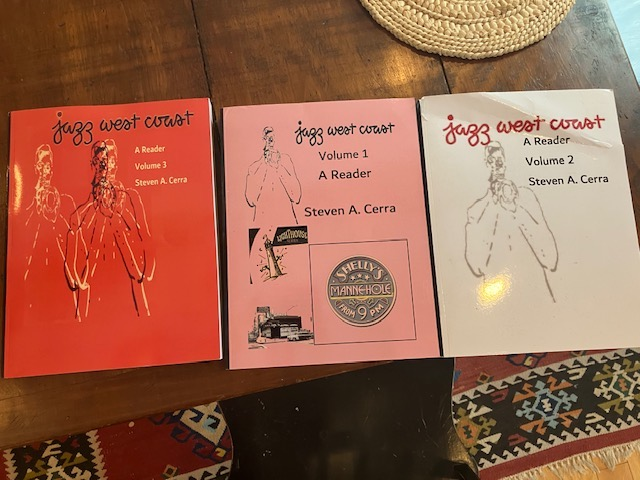
Get your copies while they're hot! The three volumes combine over 100 articles and 1,000 pages about Jazz on the West Coast from 1945-1965. All three are available as paperbacks and eBooks exclusively through Amazon. 50% of royalties go toward the purchase of musical instruments for students.

Monday, January 27, 2025
Friday, January 24, 2025
"Ira Gershwin A Life in Words" by Michael Owen: A JazzProfiles Feature
© Copyright ® Steven Cerra, copyright protected; all rights reserved.
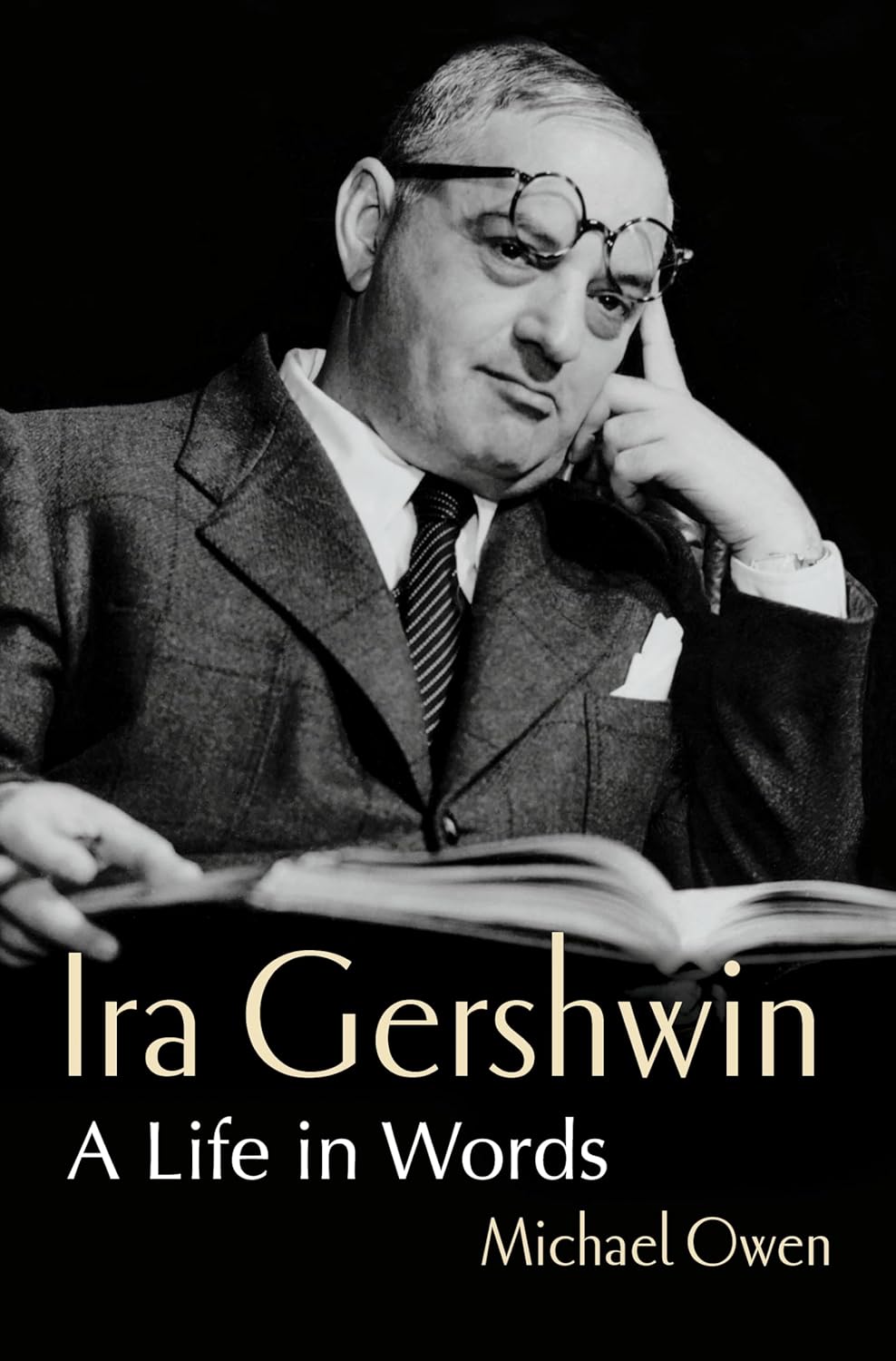
"This book is a marvel and a model of how to write resonantly and engagingly about a charming subject who was unintentionally elusive. Having personally known and adored Ira for years, I am overwhelmed by the information and detail Owen captures. I love the way he spins the tale of a greatly talented lyricist who, thanks to this book, might permanently find his proper place in the pantheon of great songwriters."
—MICHAEL FEINSTEIN, singer, pianist, founder of the Great American Songbook Foundation, and author of The Gershwins and Me: A Personal History in Twelve Songs
This is a story about a world gone by.
About a time when rhapsodic musical melodies were graced with poetic lyrics.
A time when songs were artistically composed and the words that made them memorable were created by writers with a sensitivity to language who used it to help create an enjoyable musical experience.
Not all of these songs were serious: some were whimsical; some expressed light-hearted sentiment; some were downright comedic.
But the music and the lyrics were crafted in such a way that they created feelings that reached a variety of emotions: love, happiness, longing, grief and many more.
How did these lyricized songs happen? Who did it and why?
Ira Gershwin A Life in Words by Michael Owen tells the story of one of these magical wordsmiths, a story too often overshadowed by a more renowned brother - George Gershwin.
In many ways the story that Michael tells here is one of death and resurrection.
Following George Gershwin’s death at the age of 38, Ira Gershwin is forced to begin anew. The composer is no more but the lyricist is challenged by circumstances to carry on.
The six chapters of Michael’s biography are essentially structured around the death of George in 1937: the first three with George and the last three in which Ira draws out from under the shadow of his more famous brother and becomes his own man.
By way of background, Michael Owen is a historian, researcher and served for many years as the manager of Ira’s archive. He is also the author of one of my favorite books about Jazz and popular singing - Go Slow: The Life of Julie London [2017]. He also served as the editor for The Gershwins Abroad [2024].
Obviously, with that background, who better to write Ira’s biography?
The significance of Michael’s work and its contribution to the genre of what is now generally referred to as the literature of The Great American Songbook is ably summed up in this assessment by —ANNA HARWELL CELENZA, author of Jazz Italian Style and general editor of The Cambridge Companion to George Gershwin:
"In Ira Gershwin: A Life in Words” Michael Owen offers an insightful exploration of his subject's lifelong quest for an artistic voice. Using a rich variety of archival resources — personal letters, diaries, production notes, and business correspondence — Owen documents Gershwin's tireless commitment to song-writing, from the linguistic play of his teenage years and his prizewinning successes (and failures) as an adult, to his commitment to preserving the Great American Songbook and the Gershwin family legacy in his final years. The book is indispensable for fans and scholars alike. It shines a revelatory light on the complex life of the great lyricist who lived forever in the shadow of his younger brother George."
The “artistic voice” that Ms. Celenza references comes to life with examples, description and analyses on what made Ira so special - his lyrics.
These are portrayed throughout the book in the context in which they were created. Thus we read:
“Shall We Dance [1937 Astaire/Rogers film] proved that George and Ira could still write hit songs, and the score contained at least three that rank among the greatest of their storied careers.
The idea for the lyric of "They All Laughed" came from the 19205 boom in the business of self-improvement, with an extremely popular correspondence school advertisement for the US School of Music: "They laughed when I sat down to play the piano but when I started to play!" One of the lines—"They laughed at Fulton and his steamboat"—may have been borrowed from Ira's friend Groucho Marx, who reportedly made that quip to George S. Kaufman.
They all laughed at Christopher Columbus
When he said the world was round;
They all laughed when Edison recorded sound.
They all laughed at Wilbur and his brother When they said that man could fly; They told Marconi Wireless was a phony—-It's the same old cry!
They laughed at me wanting you,
Said I was reaching for the moon; But oh, you came through—
Now they'll have to change their tune.
They all said we never could be happy, They laughed at us—and how!
But ho, ho, ho— Who's got the last laugh now?
One of the cleverer ideas in "Let's Call the Whole Thing Off" was inspired by Lee Gershwin's youthful — and retained in adulthood — pronunciation:
You say eether and I say eyether, You say neether and I say nyther; Eether, eyether, neether, nyther— Let's call the whole thing off!
You like potato and I like po-tah-to, You like tomato and I like to-mah-to; Potato, po-tah-to, tomato, to-mah-to— Let's call the whole thing off!
For Ira, the key ingredient in "They Can't Take That Away from Me" was the lovely, raised note that his brother gave him to accompany the buildup to the emotion of the word "life" at the end of the song:
The way you wear your hat, The way you sip your tea, The mem'ry of all that— No, no! They can't take that away from me!
The way your smile just beams,
The way you sing off key, The way you haunt my dreams— No, no! They can't take that away from me!
We may never, never meet again
On the bumpy road to love, Still I'll always, always keep
The mem'ry of—
The way you hold your knife, The way we danced till three,
The way you've changed my life-No, no! They can't take that away from me! No! They can't take that away from me!”
Rarely are masterfully wrought lyrics such as these read. They are usually heard while listening to the song in which they are placed. In offering them to us in this manner, Michael helps us appreciate them even more.
Or as the esteemed essayist, writer and novelist Joseph Epstein explains in his Wall Street Journal review:
“Lyricology,” as Michael Owen notes in his biography, is not an established subject, which is to say that not all that much is known about the lyricist and his work. Many popular composers — Irving Berlin, Cole Porter, Stephen Sondheim — were able to do without lyricists, writing both music and lyrics themselves. Others — Jerome Kern, Richard Rodgers, George Gershwin — found lyricists indispensable. The construction of lyrics is fraught with complications. Some composers could not write their music until they had the lyrics before them; others—George Gershwin again—wrote the music and let lyricists find words to fit the music.
The lyrics of the songs of what came to be known as musical comedy — featuring romance, colloquial speech, street slang—may indeed be the true American poetry. They were written by, among others, Yip Harburg, P.G. Wodehouse, Cole Porter, Irving Berlin and Ira Gershwin. As for the job of lyricist, it is perhaps best described by Ira Gershwin himself: “Given a fondness for music, a feeling for rhyme, a sense of whimsy and humor, an eye for the balanced sentence, an ear for the current phrase and the ability to imagine oneself as a performer trying to put over the number in progress — given all this, I would still say it takes four or five years collaborating with knowledgeable composers to become a well-rounded lyricist.”
On the precariousness of the lyricist’s job, Ira wrote that it requires “a certain dexterity with words and a feeling for music. . . the infinite patience of the gemsetter, compatibility with the composer and an understanding of the various personalities in a cast.” Difficulties invariably arise. Songs one loves are canceled from shows, some performers insist on alterations in what one has written, others perform them poorly, the whims of producers are weighed, disputes over royalties emerge, entire shows are closed down for want of public taste.”
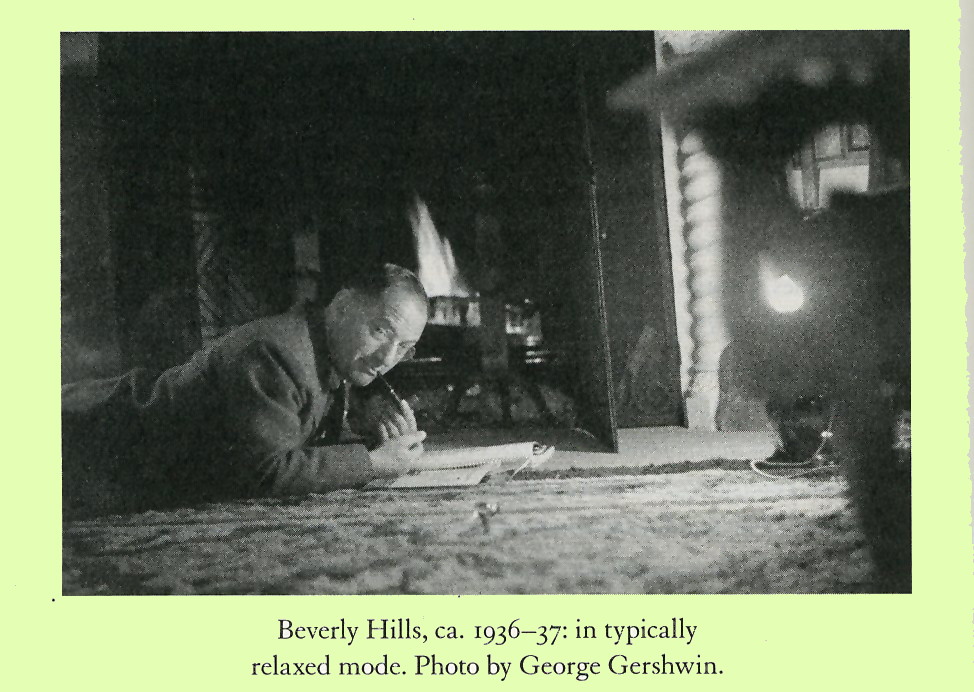
The slow and deliberate process of lyricology is reflected in this photograph of Ira laying before a fire in his Beverly Hills home, pipe in mouth, pen in hand and, assumedly, blank notebook before him.
As you read through Michael's richly detailed biography replete with anecdotes, jokes, and example lyrics, the reader comes to understand what Alexandra Jacobs meant when she wrote the following in her New York Times review of his work:
"Owen gives this perpetual supporting player an infusion of main-character energy. He succeeds. Ira Gershwin: A Life in Words is dignified but not starchy, efficient but not shallow, and honest about grief's unrelenting toll. . . . Owen captures elegantly his survivor guilt, flying home for the grand funeral of his brother . . . . George Gershwin's presence in this book is not only spectral; it's almost holy . . . .
Life's plodders can be as interesting and amusing, in their way, as the sprinters. . . . You feel deeply for the oldest Gershwin brother, who tended George's legacy like a faithful gardener."
Returning to Joseph Epstein who beautifully summarizes the reading experience of Michael’s Ira Gershwin biography:
"The reader comes away from Mr. Owen's Ira Gershwin: A Life in Words with a strong appreciation for all that the craft of the lyricist entails. . . .More important, at the close of Mr. Owen's biography one feels that one knows Ira Gershwin — knows him and likes him. In these pages we learn what the world thought of Ira Gershwin, what his co-workers and family thought of him, and, through Mr. Owen's careful mining of his subject's letters and diaries and pronouncements, what he thought of himself."
This concluding statement is drawn from the publisher WW Norton’s press release:
“The Pulitzer Prize-winning American lyricist Ira Gershwin (1896-1983) has been hailed as one of the masters of the Great American Songbook—songs written largely for Broadway and Hollywood from the 1920s to the 1950s. Now, in the first full-length biography devoted to his life, Ira Gershwin steps out at last from the long shadow cast by his younger and more famous brother George.
It's a life with a sharp dividing line; we witness Ira's transformation by George's death at thirty-eight. From carefree dreamer and successful lyricist, he becomes guardian of his brother's legacy and manager of complex family dynamics, even while continuing to practice his craft with composers like Harold Arlen and Jerome Kern.
Drawing on extensive archival sources and often using Ira's own words, Michael Owen offers a rich portrait of the modest man who penned the words to many of America's best-loved songs.” For order information, go here.