Monday, March 3, 2025

Part 2 -Duke Ellington - "The Hot Bach" by Richard O. Boyer

 © Copyright ® Steven Cerra, copyright protected; all rights reserved.

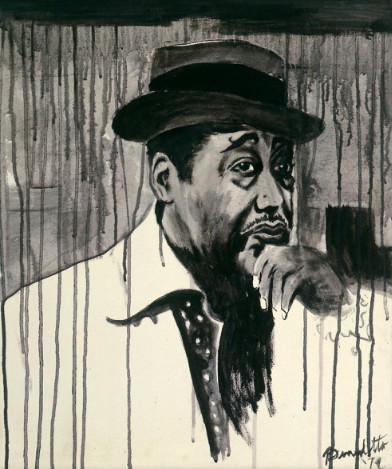
Few writers have depicted Ellington and his world as vividly as Richard 0. Boyer in "The Hot Bach," a three-part profile published in The New Yorker during the summer of 1944. ]Source: Richard O Boyer, "The Hot Bach-1," The New Yorker (24 June 1944), 30-34, 37-36,40,42, 44; "The Hot Bach-2," The New Yorker (1 July 1944), 26-32. 34; "The Hot Bach-3," The New Yorker (8 July 1944), 26-31]. [The painting of Duke is by the vocalist Tony Bennett.]


Boyer not only interviewed Ellington extensively but traveled with the orchestra, observed rehearsals and performances, spoke with musicians, and jotted down overheard conversations. (In the text Boyer refers to himself as the "Boswellian friend of Duke's" and "friend with a historical turn of mind.") The result is a richly textured, candid portrait of Ellington offstage, out of the public eye.


Boyer deftly captures the group spirit of Ellington's musicians on the road, showing their extraordinary resilience in the face of monotony, physical discomfort, and racial discrimination. He highlights the important supporting roles played by Ellington's road manager Jack Boyd, his valet Richard Bowden Jones ("Jonesy"), and especially his writing partner Billy Strayhorn. Boyer's expert touch with description and dialogue brings to life scenes rarely observed by outsiders, such as activities before and after a typical dance job, and the collective working-out of a new piece in the middle of the night,


In this "jumpy atmosphere," as Boyer calls it, Ellington forms the calm center-patiently enduring a myriad of distractions, steadily making art out of chaos.


An abridged version of the article was included in Peter Gammond's Duke Ellington: His Life and Music (1958). Following is the complete text.


Remember, as you read this that it was written from the perspective of a racial context in 1944 America and does not reflect any of today’s sensibilities on the subject of race.


“There are times when Duke Ellington exudes such calm contentment that a colleague, under the influence of the benign radiation, once murmured drowsily, "Duke makes me sleepy, like rain on the roof." His nerves and laughter are so loose and easy that members of his jazz band believe that they got that way because of his physical makeup rather than because of the quality of his spirit. "His pulse is so low he can't get excited," they explain. "His heart beat slower than an ordinary man's." Only something in the flow of the blood, they are sure, could explain a calm that has survived twenty-three years in the band business — years in which Duke and his seventeen-piece band have again and again clattered on tour from one end of the country to the other. Duke believes that his calm is an acquired characteristic, attained through practice, but whether acquired or inborn, it is his monumental placidity, which is only occasionally shattered, that enables Duke to compose much of his music in an atmosphere of strident confusion. 


Most composers, alone with their souls and their grand pianos, regard composition as a private activity. Often, when Duke is working out the details of a composition or an arrangement, the sixteen other members of his band not only are present but may even participate, and the occasion sometimes sounds like a political convention, sometimes like a zoo at feeding time. Ordinarily, Duke completes the melody and the basic arrangement of a composition before he tries it out on the band at a rehearsal; then, as he polishes, or "sets," the arrangement, he is likely to let the men in the band make suggestions in a creative free-for-all that has no counterpart anywhere in the world of jazz or classical music. Perhaps a musician will get up and say, "No, Duke! It just can't be that way!," and demonstrate on his instrument his conception of the phrase or bar under consideration. Often, too, this idea may outrage a colleague, who replies on his instrument with his conception, and the two players argue back and forth not with words but with blasts from trumpet or trombone. Duke, whom European music critics have called the American Bach, will resolve the debate by sitting down at his piano, perhaps taking something from each suggestion, perhaps modifying and reconciling the ideas of the two men, but always putting the Ellington stamp on the music before passing on to the next part of the work in progress. Duke sometimes quotes Bach. "As Bach says," he may remark, speaking about piano playing, "if you ain't got a left hand, you ain't worth a hoot in hell."


The band rarely works out an entire arrangement collectively, but when it does, the phenomenon is something that makes other musicians marvel. This collective arranging may take place anywhere — in a dance hall in Gary, Indiana, in an empty theatre in Mobile, or in a Broadway night club. It will usually be after a performance, at about three in the morning. Duke, sitting at his piano and facing his band, will play a new melody, perhaps, or possibly just an idea consisting of only eight bars. After playing the eight bars, he may say, "Now this is sad. It's about one guy sitting alone in his room in Harlem. He's waiting for his chick, but she doesn't show. He's got everything fixed for her." Duke sounds intent and absorbed. His tired band begins to sympathize with the waiting man in Harlem. "Two glasses of whiskey are on his little dresser before his bed," Duke says, and again plays the eight bars, which will be full of weird and mournful chords. Then he goes on to eight new bars. "He has one of those blue lights turned on in the gloom of his room," Duke says softly, "and he has a little pot of incense so it will smell nice for the chick." Again he plays the mournful chords, developing his melody. "But she doesn't show," he says, "she doesn't show. The guy just sits there, maybe an hour, hunched over on his bed, all alone." 


The melody is finished and it is time to work out an arrangement for it. Lawrence Brown rises with his trombone and gives out a compact, warm phrase. Duke shakes his head. "Lawrence, I want something like the treatment you gave in Awful Sad," he says. [Awful Sad, first recorded in 1928 featuring trumpeter Arthur Whetsol, had also been recorded for Victor in 1933 —when Brown was in the orchestra —but not issued.


Brown amends his suggestion and in turn is amended by Tricky Sam Nanton, also a trombone who puts a smear and a wa-wa lament on the phrase suggested by Brown, Juan Tizol, a third trombone, says, "I'd like to see a little ritard on it," Duke may incorporate some variation of one of the suggestions. Then he'll say, "Come on, you guys. Get sincere. Come on down here, Floor Show" - he is addressing Ray Nance — "and talk to me with your trumpet." In a moment or so the air is hideous as trombone and clarinet, saxophone and trumpet clash, their players simultaneously trying variations on the theme, Johnny Hodges suggests a bar on his alto saxophone, serpentine, firm, and ingratiating, and tied closely to Duke's theme. Harry Carney, baritone sax, may say it is too virtuoso for the whole sax section and clean it up a little, making it simpler. "Come on, you guys. Let's play so far," Duke says. As the band plays in unison, the players stimulate one another and new qualities appear; an experienced ear can hear Rex Stewart, trumpet, take an idea from Brown and embellish it a bit and give it his own twist. Duke raises his hand and the band stops playing. 


"On that last part —" he says, "trumpets, put a little more top on it, will ya?" He turns to Junior Raglin, the scowling bass player, and says, "Tie it way down, Junior, tie it way down." Again the play, and now the bray of the trumpets becomes bolder and more sure, the trombones more liquid and clearer, the saxophones mellower, and at the bottom there is the steady beat, beat, beat, beat, four to a bar, of the drums, bass and guitar, and the precise, silvery notes of Ellington on the piano, all of it growing, developing, fitting closer together, until Duke suddenly halts them by shouting, "Too much trombone!" Juan Tizol, a glum white man and the only player in the band who likes to play sweet, complains, "I think it's too gutbucket for this kind of piece. I'd like it more legit." He plays a smooth, clear curlicue on his valve trombone. "Well, maybe you're right," Duke says, "but I still think that when Sam gets into that plunger part, he should give it some smear." 


Again the band begins at the beginning, and as the boys play, Duke calls out directions. "Like old Dusty," he may say (Dusty is a long-dead jazz musician), and even as he says it the emphasis and shaping will change. Or he may lean forward and say to one man, "Like you did in The Mooche," or he may shout over to Carney, who doubles on the clarinet, "The clarinet is under Tricky too much!" As the music begins to move along, he shouts, "Get sincere! Give your heart! Let go your soul!" His hands flicker over the keyboard, sometimes coming in close together while he hunches his broad, quivering shoulders, one shoulder twisted higher than the other, an absorbed half-smile upon his face. At a signal from Duke, various players, with the theme now solidly in mind, will get up and take solos. He points at the soloist he wants and raises his right index ringer, and as long as the player doesn't get too far away from the theme, Duke lets him have his way. 


Perhaps two hours have gone by. The sky is getting gray, but the boys have the feel of the piece and can't let it alone. They play on and on, their coats off, their hats on the backs of their heads, some with their shoes off, their stocking feet slapping up and down on the floor, their eyes closed, their feet wide apart and braced when they stand for a solo, rearing back as if they could blast farther and better that way. Now Juan Tizol grabs a piece of paper and a pencil and begins to write down the orchestration, while the band is still playing it. Whenever the band stops for a breather, Duke experiments with rich new chords, perhaps adopts them, perhaps rejects, perhaps works out a piano solo that fits, clear and rippling, into little slots of silence, while the brass and reeds talk back and forth. By the time Tizol has finished getting the orchestration down on paper, it is already out of date. The men begin to play again, and then someone may shout "How about that train?" and there is a rush for a train that will carry the band to another engagement.


Duke enjoys the rhythm of a train as it rolls across the country and on one occasion he even scored it, putting notes on paper as he bounced and swayed along, listening to all the metallic variations of sound. He called the piece that resulted, Daybreak Express. The continental nature of Duke's profession is indicated by his itinerary for 1942. He began on January 1st in Kansas City, Missouri, and then, playing one-night stands and engagements that lasted as long as six weeks, rattled along to Junction City, Kansas; Omaha, Nebraska; Madison, Wisconsin; Waukegan, Illinois; Elkhart, Indiana; Chicago; Detroit; Canton, Ohio; Pittsburgh; Uniontown, Pennsylvania; Boston; Lawrence, Massachusetts; Portland, Maine; Worcester, Massachusetts; Boston, Toronto, Buffalo, Washington, Baltimore, Philadelphia, Pittsburgh; Moline, Illinois; South Gate, San Diego, San Francisco, Stockton, and Sacramento, all in California; Portland, Oregon; Vancouver; Seattle and Tacoma; Salem in Oregon; and then back to King City, Vallejo, San Jose, Los Angeles, and Ocean Park, in California; Salt Lake City, Denver, Chicago, Milwaukee, Chicago, Cleveland, Dayton, Fort Wayne, Chicago, St. Louis; Moberly and Kansas City, in Missouri; Topeka, Kansas; back once more to California to play at Long Beach, Los Angeles, Hollywood, Sacramento, Oakland, and San Jose; then to Salt Lake City, St. Louis, Omaha; Storm Lake and Fort Dodge, in Iowa; St. Paul, Madison, Chicago, Toledo, Cincinnati, Youngstown; Toronto and Kitchener, in Canada; down to Buffalo, Fort Dix, Philadelphia, Baltimore, Washington, Hartford, Bridgeport, Harnsburg, Columbus, and, on the last day of 1942, to Detroit.


Duke likes trains because, as he says, "Folks can't rush you until you get off." He likes them, too, because dining-car waiters know about his love for food and he is apt to get very special attention. His journeys are punctuated by people who shove bits of paper at him for his autograph. Not long ago, traveling between Cleveland and Pittsburgh on a day coach, a German refugee with sad, weak blue eyes who had once played chamber music in Stuttgart sat down next to Duke and asked him for his autograph, and the two men got into conversation. A friend of Duke's with a historical turn of mind happened to be along on the trip and took notes on what the two men said. The refugee knew little about jazz, but he did know that Stokowski, Stravinsky, and Milhaud had described Ellington as one of the greatest modern composers.


"You can't write music right," Duke said, explaining his methods of composition, "unless you know how the man that'll play it plays poker."


"Absolut phantastisch!" the German murmured. Duke seemed startled, then laughed.


"Vot a varm, simple laugh you haf," the refugee said enviously.


Duke laughed again. "No, what I mean is," he said, "you've got to write with certain men in mind. You write just for their abilities and natural tendencies and give them places where they do their best — certain entrances and exits and background stuff. You got to know each man to know what he'll react well to. One guy likes very simple ornamentation; another guy likes ornamentation better than the theme because it gives him a feeling of being a second mind. Every musician has his favorite licks and you gotta write to them."


"His own licks? Licks?" asked the refugee.


"His own favorite figures," Duke said. He looked out the window. "I sure hated to leave that chick," he said affably. "I'd just met her. She was all wrapped up for me. All wrapped up in cellophane."


"Please?" asked the German.


"I know what sounds well on a trombone and I know what sounds well on a trumpet and they are not the same," Duke said. "I know what Tricky Sam can play on a trombone and I know what Lawrence Brown can play on trombone and they are not the same, either."


"Don't you ever write just for inspiration?"


"I write for my band," Duke said. "For instance, I might think of a wonderful thing for an oboe, but I ain't got no oboe and it doesn't interest me. My band is my instrument. My band is my instrument even more than the piano. Tell you about me and music — I'm something like a farmer."


"A farmer that grows things?"


"A farmer that grows things. He plants his seed and I plant mine. He has to wait until spring to see his come up, but I can see mine right after I plant it, That night. I don't have to wait. That's the payoff for me."


"Mr, Ellington, how do you get those lovely melodic passages?"


"If you want to do a mellow cluster with a mixture of trombones and saxes, it will work very well," Duke said. "A real derby, not an aluminum one, will give you a big, round, hollow effect."


"A real derby?"


"A real derby."


"Not an aluminum derby?"


"Not an aluminum derby."


"phantastisch,” the exile said.


Duke laughed. He called to Sonny Greer, his drummer, sitting up ahead, "I sure hated to miss that chick," he said. "She was all wrapped up in cellophane."


The refugee's pale blue eyes stared steadily at Duke. "When inspiration comes, Mr. Ellington," he said finally, "you write, naturlich?"

"It's mostly all written down, because it saves time," Duke said. He seemed eager to get away, but the coach was crowded and there wasn't another place to sit. "It's written down if it's only a basis for a change. There's no set system. Most times I write it and arrange it. Sometimes I write it and the band and I collaborate on the arrangement. Sometimes Billy Strayhorn, my staff arranger, does the arrangement. When we're all working together, a guy may have an idea and he plays it on his horn. Another guy may add to it and make something out of it. Someone may play a riff and ask, 'How do you like this?' The trumpets may try something together and say, 'Listen to this.' There may be a difference of opinion on what kind of mute to use. Someone may advocate extending a note or cutting it off. The sax section may want to put an additional smear on it."


"Schmear?"


"Smear," Duke said.


Duke tried a few times to end the discussion, but the exile's questioning kept bringing him back to his exposition, and he was still explaining when the train pulled into Pittsburgh, where he and his band were to give a concert at Carnegie Hall. The hall is a resplendent place. It has tall, gray marble columns with gilt Corinthian capitals, and on its walls are inscribed the names of Schubert, Brahms, Bach, Beethoven, Mozart, and Chopin. As the band trooped through the building to the dressing rooms, Duke glanced at the list of his predecessors and remarked, "Boys, we're in fast company."


When the band is doing five shows a day in a movie house, Duke can take a hot, stuffy dressing room, often windowless and small, and give it the pleasant atmosphere of a neighborhood saloon. As soon as a show is over, Jonesy, his valet, who always wears a hat on the back of his head and a leather windbreaker, helps him undress and holds his red bathrobe up while he slips into it. Then Duke will lie down on a cot, a towel over his eyes to shield them from the light. Jonesy goes out to get him beer and sandwiches, and by the time he returns Duke is usually up playing a game of cassino with someone in his band. Other members of the band will keep walking in and out. "My honor is here. My honor is here,” Duke mumbles, as he examines his cards, in a voice that has the lulling drone of an electric fan. Sometimes he varies this refrain with the more firmly voiced observation, "I will now do something to straighten this out." 


He keeps the door of his dressing room closed, but even so there is always the presence of the mechanical voice in the movie, faint yet powerful, and, now and then, the brash canned music of the newsreel. Sometimes, too, down the corridor, the deep voice of Estrelita, the South American Bombshell, who is part of an act that occasionally travels with Duke, may be heard as she sings, "Doan be so hasty. Yo' kisses so tasty!" Jimmy Hamilton's clarinet is often heard as he walks up and down outside the room like a bagpiper, practicing Grieg or some other classical composer. Someone in Duke's dressing room will open the door and say, "Jimmy, can't you get those squeaky mice outta that reed? They musta built a nest in it." Jimmy, a solemn youth, will not reply. Duke, his big face relaxed, will say sleepily,"I think I'll rest my spine awhile," and lie down again on his cot. 


Billy Strayhorn will be working quietly over the score of some new tune in a corner. After a time a masseur will come in, and perhaps a newspaper reporter. Duke, his voice shaking as the masseur kneads him, will be interviewed as he lies naked on his cot. Recently a young reporter asked him what he had in mind when he wrote "Mood Indigo." "It's just a little story about a little girl and a little boy," Duke said. "They're about eight and the little girl loves the little boy. They never speak of it, of course, but she just likes the way he wears his hat. Every day he comes by her house at a certain time and she sits in her window and waits." Duke's voice dropped solemnly. The masseur, sensing the climax, eased up, and Duke said evenly, "Then one day he doesn't come." There was silence until Duke added, " 'Mood Indigo' just tells how she feels."


When the reporter left, Duke said, "Jesus, did you see the tears come into his eyes when I spoke about 'Mood Indigo'? That's what I like. Great big ole tears. That's why I liked Whetsol." Whetsol is a trumpet player now dead. "When he played the funeral march in 'Black and Tan Fantasy,' I used to see great, big ole tears running down people's faces." Duke chuckled. In such moods as this, Duke and the older members of his band are almost sure to talk about the musicians who played with them when the band began. Their conversation has something of the nostalgic, elegiac atmosphere that surrounds a group of old Yale grads talking about football players of other years. "Bubber Miley!" Duke exclaimed on one of these occasions. (Bubber, too, is dead.) "Bubber used to say, 'If it ain't got swing, it ain't worth playin'; if it ain't got gutbucket, it ain't worth doin.'' Freddie Guy, guitarist, was present and, as Duke went on to speak of great trombone players and great trumpet players, with never a word for the rhythm section, Freddie at last mumbled regretfully, "Duke sure love his brass! Duke sure love his brass!"


The world of jazz is sentimental. When Cootie Williams, another great trumpet player, left the Ellington band three and a half years ago to go with another band [Benny Goodman sextet], a composer who had nothing to do with either band [Raymond Scott] wrote a sad piece called "When Cootie Left the Duke." Duke still finds it hard to talk of Cootie's departure. Both Bubber and Cootie were known for their "growl" effect. Duke occasionally says, "Cootie gave the growl more beauty than anyone, more melodic magnificence. He had a sort of majestic folk quality. His open horn was wonderful — wonderful loud and wonderful soft. He had a hell of a style." Such adoring reminiscence sometimes bothers the newer members of the band. Juan Tizol once asked gloomily, at one of the dressing-room sessions, "What do you see in my playing anyway, Duke? I don't call myself a hot man anyway." There was a hurt tone in his voice. "Not for me. I take all my solos straight. Sweet style."


"Well, Juan," Duke said gently, "there are times when a writer wants to hear something exactly as it's written. You want to hear it clean, not with smears and slides on it. Besides, your style is a good contrast to the more physical style of Johnny Hodges."


"I play with a legit tone," Juan said, as though accusing himself of something rather unforgivable. "Duke, what is there about my trombone tone?"

"You get an entirely different quality," Duke said. "It's real accurate. So many look on the valve trombone as an auxiliary instrument, and it's your main instrument. That's a hell of an obligation. You got to live up to those valves and you do, Juan, you do. You know how many slide trombonists use the slide so they can fake, and when you object they say, 'Whatta ya think this has got on it —valves?'"


"If there was any room in legit, I'd still go back to legit," Tizol said. He seemed inconsolable. "I like legit because I could feature myself better in legit than in a jazz band. I don't feel the pop tunes, but I feel 'La Gioconda' and 'La Boheme.' I like pure romantic flavor. I can feel that better."


Duke said to the room at large, "Juan's got inhibitions. He won't ad-lib. Once, on the 'Twelfth Street Rag,' he did some ad-libbing. Only time he ever did."


Jack Boyd, Ellington's road manager, a small, brisk white man from Texas, knocked on the door and said, "Five is in, folks" — five minutes before the band was due onstage for another performance. Jonesy came in to dress Duke, and Tizol rose to go. "You're a hell of a good man, Tizol," Duke said, making a final effort to comfort his trombone. "We need a man who plays according to Hoyle. A guy who does only one thing but does it for sure, that's it."


"I'm only legit," Tizol said.


There are times when Duke's cheery calm is shaken and when his dressing room is more like a prison cell than a friendly saloon. A few months ago the

band arrived in St. Louis to play at the Fox Theatre. As the train pulled into the Union Station, Ellington's two white employees — Tizol and Boyd — immediately got a taxi and went to one of the town's good hotels. Duke and the band members got taxis only after an hour and considerable begging, since most of the drivers didn't want Negroes as passengers, and then they were taken to a rickety hotel in the Negro section. The next day, when the colored members of the band went out for lunch after the first performance, they couldn't find a restaurant in the neighborhood that would serve them. They didn't have time to get over to the segregated district before they were due on stage again. They returned to the theatre and arranged for a white man to go out to buy sandwiches at a drugstore. When the proprietor of the store. making inquiry, found that the sandwiches were for a Negro band, he refused to fill the order. A few minutes later the men went back to work, hungry, the curtain rose, and from the white audience out front there came a burst of applause. The crowd cheered, whistled, and stamped its feet. As the curtain. was going up, the dejection on the faces of the players vanished, and, as swiftly as an electric light is switched on, it was replaced by a look of joy. The music blared, Duke smiled, threw back his head, and shouted "Ah-h-h!," Rex Stewart took off on a solo that was greeted with fervor, and as he bowed, the musician next to him muttered out of the side of his mouth, "Bend, you hungry fathead! Bend!" Everything was flash and brightness until the curtain came down. Then the joy was switched off and there was just a group of angry, hungry Negroes arguing their right to food,


"Can't we eat in our own country?" Rex Stewart said.


"And my son is in the Army!" another man said.


"Are we prisoners or something?" Harry Carney asked.


The band milled around in the gloom backstage. "Gee," said Stewart, "I'd like to go to a valley hemmed in by mountains, just me myself. That would be Utopia." The manager of the theatre was called, and admitted that if the band was to work it should be allowed to eat. He arranged for food to be sent in. A few minutes later, Boyd was in a saloon overlooking the stage door when a man in the band came out and got into a taxi.


"Did you see that?" asked a woman on a stool at the bar.


"See what?" Boyd said.


"See that nigra get in that cab?"


"Well, he's a pretty nice fellow. He's a member of the Ellington band. Some people think he's a very great artist."


"A very great artist? Well, I don't know what you think, but I always say that the worst white man is better than the best nigra."


Duke tries to forget things like that, and if he doesn't quite succeed, he pretends he does. An hour after the show, Duke was introduced to a policeman who said enthusiastically, "If you'd been a white man, Duke, you'd have been a great musician." Duke's smile was wide and steady as he answered quietly, "I guess things would have been different if I'd been a white man."


Once Duke is aboard a train, soothed by the ministrations of admiring porters and dining-car waiters, he likes to relax and talk about his music. He is somewhat given to making set speeches and often, when he is asked if he can recall an incident, he remembers what he is in the habit of saying about it rather than the event itself. He enjoys telling how he happened to write any of his compositions. "In my writing," he said not long ago on a train, in the presence of his historian friend, "there's always a mental picture. That's the way I was raised up in music. In the old days, when a guy made a lick, he'd say what it reminded him of. He'd make the lick and say, 'It sounds like my old man falling downstairs' or 'It sounds like a crazy guy doing this or that.' I remember ole Bubber Miley taking a lick and saying, That reminds me of Miss Jones singin' in church.' That's the way I was raised up in music. I always have a mental picture."


He looked out the window at a drab village through which the train was speeding. A woman stood on a porch, holding a tablecloth which she seemed about to flourish. Before she completed her motion, she was out of sight. "I'd like to write something about that," Duke said. "You know, people moving in a train, other people standing still, and you see them for just an instant and then you rush on forever. Sometimes you look right into their goddam eyes. Seems for a minute like you know them. Then they're gone." He kept staring out the window. After a while he pointed at a tree and said, "Looks like a band leader." Again he was moodily silent. Then he suddenly said, Take 'Eerie Moan [recorded 1933], I wrote that in 1930, when I was at the Cotton Club. It's the voice of New York City. You're lying in bed all by yourself. The window is open. It's summer. If there was someone in bed with you, you'd be contented. But you're alone and it's very late and you listen and listen and you hear something out there that comes from millions of people sleeping, from manhole covers that give a double click as a taxi shoots over them, from tugboats far away when they whistle hoarse. You really don't hear anything single, just a kind of general breathing. You feel very alone. You moan and it seems like that's the sound you're hearing from all the city outside in the night. Only place you can hear it is New York City."


Boyd lurched down the aisle. Duke caught him by the arm. "What time have we got to catch the train tomorrow?" Duke asked. "Seven in the morning," Boyd said cheerfully. "God damn!" said Duke. "You can't sleep after the birds wake up, so you don't want anyone else to! You're not normal. You can't sleep after sunrise." Duke's voice was bitter. "You change that train or we won't get any sleep!" Boyd continued down the aisle, muttering to himself, and Duke mumbled, "He can't sleep after sunrise and he doesn't want anyone else to,"


Two young soldiers came up to ask for his autograph. After Duke had given it to them, they hung around to talk. "My favorite piece," one of the soldiers said, "is 'In a Sentimental Mood.'"


"It was one of those spontaneous things," Duke said. "It was after a dance at Durham, North Carolina, and they gave me a private party. Something was wrong with it. Two girls weren't speaking to each other. One girl had cut in on the other girl's guy and the other girl kept saying, 'Of all the people in the world! That she should take my man!' I was sitting at the piano, one girl on each side, and I'm trying to patch 'em up, see? And I said, 'Let's do a song' and that was the outcome, and when I finished they kissed and made up." Other passengers had become aware that Duke was talking about his music and a little group crowded around, its members occasionally clutching at each other and at the seats to steady themselves.


"How about 'Clarinet Lament'?" someone asked.


"It was just something for Barney to play," Duke said. Barney is Barney Bigard, a famous clarinettist who used to be with the band. "We sort of worked it out together. You sit down and try this and that and finally you run upon something and write it out."


"How about 'Awful Sad'?"


"It's a beautiful thing," Duke said. "Very little to be said beyond the title. After I wrote it I said, 'What'll I call it?,' and someone said, 'It's awful sad. I fingered it out on the piano. It was late at night. It had a beautiful part for Whetsol, a beautiful, tender part. It gives me a chill when I hear it."


Someone asked him about "Solitude" and he said, "I wrote it in Chicago in twenty minutes while waiting for a recording date. The other band, the one ahead of us, was late coming out and I wrote it while holding a sheet of music paper against a glass wall. When we went in, it was the first thing we made. The sound engineer was half crying. It filled everybody up. To make people cry, that's music at its highest. My songs had a tendency in those days to be laments. There was always that melancholy in them. You look at the same melancholy again and again from a different perspective."


Duke seemed to feel that the conversation had taken too somber a turn and he began speaking of his appetite, documenting his claim that it is national, even international, in scope. "I have special places marked for special dishes," he said. "In Taunton, Massachusetts, you can get the best chicken stew in the United States. For chow mein with pigeon's blood, I go to Johnny Cann's Cathay House in San Francisco. I get my crab cakes at Bolton's — that's in San Francisco, too. I know a place in Chicago where you get the best barbecued ribs west of Cleveland and the best shrimp Creole outside New Orleans. There's a wonderful place in Memphis, too, for barbecued ribs. I get my Chinook salmon in Portland, Oregon. In Toronto I get duck orange, and the best fried chicken in the world is in Louisville, Kentucky. I get myself a half-dozen chickens and a gallon jar of potato salad, so I can feed the seagulls. You know, the guys who reach over your shoulder. There's a place in Chicago, the Southway Hotel, that's got the best cinnamon rolls and the best filet mignon in the world. Then there's Ivy Anderson's chicken shack in Los Angeles, where they have hot biscuits with honey and very fine chicken-liver omelets. In New Orleans there's gumbo file. I like it so well that I always take a pail of it out with me when I leave. In New York I send over to the Turf Restaurant at Forty-ninth and Broadway a couple of times a week to get their broiled lamb chops. I guess I'm a little freakish with lamb chops. I prefer to eat them in the dressing room, where I have plenty of room and can really let myself go. In Washington, at Harrison's, they have devilled crab and Virginia ham. They're terrific things. On the Ile-de-France, when we went to Europe, they had the best crepes Suzette in the world and it took a dozen at a time to satisfy me. The Cafe Royal, in the Hague, has the best hors d'oeuvres in the world — eighty-five different kinds, and it takes a long time to eat some of each. There's a place on West Forty-ninth Street in New York that has wonderful curried food and wonderful chutney. There's a place in Paris that has the best octopus soup. And oh, my, the smorgasbord in Sweden! At Old Orchard Beach, Maine, I got the reputation of eating more hot dogs than any man in America. A Mrs. Wagner there makes a toasted bun that's the best of its kind in America. She has a toasted bun, then a slice of onion, then a hamburger, then a tomato, then melted cheese, then another hamburger, then a slice of onion, more cheese, more tomato, and then the other side of the bun. Her hot dogs have two dogs to a bun. I ate thirty-two one night. She has very fine baked beans. When I eat with Mrs. Wagner, I begin with ham and eggs for an appetizer, then the baked beans, then fried chicken, then a steak - her steaks are two inches thick — and then a dessert of applesauce, ice cream, chocolate cake, and custard, mixed with rich, yellow country cream. I like veal with an egg on it. Monseigneur's, in London, has very fine mutton. Durgin-Park's, in Boston, has very fine roast beef. I get the best baked ham, cabbage, and cornbread at a little place near Biloxi. St. Petersburg, Florida, has the best fried fish. It's just a little shack, but they can sure fry fish. I really hurt myself when I go there."


Duke's audience seemed awed at his recital, and he looked rather impressed

himself. "Gee," he said admiringly, "I really sent myself on that, didn't I?" Some of the passengers wanted to ask more questions, but Duke had worked himself up to the point of having to go to the diner. There, between bites, he resumed the discussion of his music with one of his new acquaintances, who had gone along with him. "Take 'Harlem Air Shaft,"' Duke said. "So much goes on in a Harlem air shaft. You get the full essence of Harlem in an air shaft. You hear fights, you smell dinner, you hear people making love. You hear intimate gossip floating down. You hear the radio. An air shaft is one great big loudspeaker. You see your neighbors' laundry. You hear the janitor's dogs. The man upstairs' aerial falls down and breaks your window. You smell coffee. A wonderful thing, that smell. An air shaft has got every contrast. One guy is cooking dried fish and rice and another guy's got a great big turkey. Guy-with-fish's wife is a terrific cooker but the guy's wife with the turkey is doing a sad job." Duke laughed. "You hear people praying, fighting, snoring. Jitterbugs are jumping up and down always over you, never below you. That's a funny thing about jitterbugs. They're always above you. I tried to put all that in 'Harlem Air Shaft.'"


It was dark outside now, and Duke looked out at the night. When he saw that the moon was up, he said, "Bomber's moon. I'm going to write a song about that." Duke's companion asked him about "Saturday Night Function." "That's from the old rent-party days," he said. "When I was young, I traveled around with a character named Lippy and with James P. Johnson, one of the world's great piano players. He really can play plenty of piano. I can still hear Lippy coming into a tenement at four in the morning and shouting, 'It's Lippy, and James P. is with me!' We'd be in bed and hear that ole click, clack, click of those triple locks and when they'd open up, Lippy would shout, 'Wake up everybody and dust off that piano so James P. can play!' Everybody would crowd around and James P. would milk 'em around, kind of teasing 'em when they asked for a piece, saying 'Is this what you mean?' and 'Or is this the number?' and then finally bang into it. That's real dramatic timing."


Duke lit a cigarette. "That's the way the whole world should be," he said.


"James P. was an artist and the people wanted to hear him at any hour. Now everybody wants to know your pedigree. I think I'll build a city like that. A guy has a new painting or a poem that he wants people to enjoy at four in the morning, and it's all right. I’ll have nothing but bungalows, so we can always knock on windows and walk in and sit down and start playing on a man's piano without offending anybody." He was silent for a moment and then said, "I like that city idea." He thought for a while. "I really like that city idea. I think I'll call it Peaceful Haven."


To be continued and concluded in Part 3.


Sunday, March 2, 2025

Yusef Lateef - Atlantis Lullaby - The Concert From Avignon (Full Album)

"Yusef's Mood," which begins at 20:51, offers an incredible series of Blues choruses by Kenny Barron. Yusef on tenor and Kenny on piano with Bob Cunningham on bass and Albert "Tootie" Heath on drums.

Contemporary Records "Studios" [!]


"Almost immediately after Roy DuNann went to work for Les Koenig in 1956, two things changed. Koenig decided to begin recording modern jazz at Contemporary, and he decided to set up his own studio. Roy knew little about the former and a lot about the latter, but his experience at Capitol had not prepared him to set up a studio in the absence of money and space. Once again, he had to figure it out.

Koenig had an office in a little building on Melrose Place, a short street off Melrose Boulevard, and in the back was a little shipping room where "a couple guys worked shipping out Good Time Jazz records." Right off the shipping room, across a narrow hall from one another, were two tiny offices, one vacant, one occupied by a publicist who wrote a monthly newsletter. In a corner of the shipping room was an Address-O-Graph machine, for the newsletter.


"Lester decided he wanted to try recording jazz groups in the shipping room," Roy remembers. "There were records stacked all over the place on shelves. We needed a little control room so we could listen on loudspeakers without feedback into the studio. So we set it up in the office across from the publicist's. Lester had a German friend who had worked at Telefunken with an engineer named Neumann. This friend had brought a Telefunken condenser microphone with him from Germany. It was named after the most famous German World War II U-boat, the U-47. Later there was a Neumann U-47, of course. It may have been the same microphone.


"The recording studios at the time were using broadcast microphones — RCAs, Western Electrics — ribbon-type dynamic mikes. This Telefunken really sounded different. Lester liked it so much he bought a few condenser mikes out of Germany and Austria, including a couple of Austrian AKGs, C-12s, that were really expensive. Lester had these AKGs and Telefunkens when I got there. They were about all he had. He was using them when he was still recording in other studios. He would bring them with him to the sessions."


Roy explains that "Lester wanted to set up the studio as cheap as possible, and make it sound as good as possible." Lester's expensive condenser mikes had high output because of the tube preamps built into their heads. When Lester took them into a recording studio (like, for example, Capitol's, which was set up for a variety of microphones, primarily dynamic), the signal coming off Lester's mikes had to be attenuated so that they did not overload the equipment.


"So," Roy continues, "it was my idea — why attenuate the microphones and then amplify the signal again? Why don't we just take the signal out of the microphones and run it through variable attenuators, and we wouldn't need any amplifiers? So that was the original console. Nothing to it. I probably had eight attenuators. That was before they had sliders, even. Couldn't find any decent sliders. Didn't even want one. We did all our mixing by turning knobs. We went from the attenuators right into the tape machine — no other equipment."


Forty-five years later, Bernie Grundman reflected that "Roy was making the best sound in the business by cutting corners. It was such a clean signal path. All the gain that was needed for the mixing function came right off the microphone preamps. Roy could mix like that, on the fly."


The 45-year-old picture begins to clarify: In a tiny shipping room, whose acoustics are a miraculous accident, often in the middle of the night after the musicians have finished their regular gigs, Roy DuNann goes to work. The drums are in one corner. There are no baffles, but a piece of acoustical material is draped on wires about 4' over the drummer's head. The musicians are as far apart as they can get, which is not far, and those superb microphones are up close on each instrument in order to minimize leakage. Forty-five years later, Joe Harley says, "Simple is better." You cannot get any simpler than this.


Saturday, March 1, 2025

Pete Jolly Trio - Variations

I always thought of Pete Jolly [1932-2004] and Lou Levy [1928-2001] as the West Coast equivalents of Hank Jones and Tommy Flanagan - out of Bud Powell but with a gift for making Bop more lyrical in terms of the melodies they improvised in their solos.


The sound of Jazz that came out of their style of playing somehow seemed lighter, prettier, and happier and helped to create a mood of satisfaction and contentment when listening to it.


It also helped to provide a nice contrast to the aggressive and energetic horn solos often associated with Bop, especially the Hard Bop form of the music.


But none of this is intended to belittle Pete’s magnificent pianism as the speed and power of his technique were virtuosic. Pete was a bona fide two-handed piano player whose ability to express himself on the instrument was seemingly unlimited.


Shelly Manne: His Life and Music

This Shelly bio is now available as both a paperback and an eBook exclusively on Amazon. Just type my name in the search box. I am donating most of my royalties toward building a scholarship drum kit for a needy student. Hope you'll consider acquiring a copy. Thank you.


Friday, February 28, 2025

Part 1 -Duke Ellington - "The Hot Bach" by Richard O. Boyer

 © Copyright ® Steven Cerra, copyright protected; all rights reserved.


Few writers have depicted Ellington and his world as vividly as Richard 0. Boyer in "The Hot Bach," a three-part profile published in The New Yorker during the summer of 1944. [Source: Richard O Boyer, "The Hot Bach-1," The New Yorker (24 June 1944), 30-34, 37-36,40,42, 44; "The Hot Bach-2," The New Yorker (1 July 1944), 26-32. 34; "The Hot Bach-3," The New Yorker (8 July 1944), 26-31]. [The drawing of Duke is by the vocalist Tony Bennett.]


Boyer not only interviewed Ellington extensively but traveled with the orchestra, observed rehearsals and performances, spoke with musicians, and jotted down overheard conversations. (In the text Boyer refers to himself as the "Boswellian friend of Duke's" and "friend with a historical turn of mind.") The result is a richly textured, candid portrait of Ellington offstage, out of the public eye.


Boyer deftly captures the group spirit of Ellington's musicians on the road, showing their extraordinary resilience in the face of monotony, physical discomfort, and racial discrimination. He highlights the important supporting roles played by Ellington's road manager Jack Boyd, his valet Richard Bowden Jones ("Jonesy"), and especially his writing partner Billy Strayhorn. Boyer's expert touch with description and dialogue brings to life scenes rarely observed by outsiders, such as activities before and after a typical dance job, and the collective working-out of a new piece in the middle of the night,


In this "jumpy atmosphere," as Boyer calls it, Ellington forms the calm center-patiently enduring a myriad of distractions, steadily making art out of chaos.


An abridged version of the article was included in Peter Gammond's Duke Ellington: His Life and Music (1958). Following is the complete text.


Remember, as you read this that it was written from the perspective of a racial context in 1944 America and does not reflect any of today’s sensibilities on the subject of race.


“Duke Ellington, whose contours have something of the swell and sweep of a large, erect bear and whose color is that of coffee with a strong dash of cream, has been described by European music critics as one of the world's immortals, More explicitly, he is a composer of jazz music and the leader of a jazz band. For over twenty-three years, Duke, christened Edward Kennedy Ellington, has spent his days and nights on trains rattling across the continent with his band on an endless sequence of one-night stands at dances, and playing in movie theaters, where he does up to five shows a day; in the nightclubs of Broadway and Harlem and in hotels around the country; in radio stations and Hollywood movie studios; in rehearsal halls and in recording studios, where his band has made some eleven hundred records, which have sold twenty million copies; and even, in recent years, in concert halls such as Carnegie and the Boston Symphony. His music has the virtue of pleasing both the jitterbugs, whose cadenced bouncing often makes an entire building shudder, and the intellectuals, who read into it profound comments on transcendental matters. 


In 1939, two consecutive engagements Ellington played were a dance in a tobacco warehouse in North Carolina, where his product was greeted with shouts of "Yeah man!," and a concert in Paris, where it was greeted as revealing "the very secret of the cosmos" and as being related to "the rhythm of the atom." On the second occasion, Jacques-Henri Levesque, a Paris critic, professed to hear all this in the golden bray of trombones and trumpets and in the steady beat of drums, bass, and piano, and Blaise Cendrars, a surrealist poet, said, "Such music is not only a new art form but a new reason for living." A French reporter asked Tricky Sam Nanton, one of Ellington's trombonists, if his boss was a genius. "He's a genius, all right," Sam said, and then he happened to remember that Ellington once ate thirty-two sandwiches during an intermission at a dance in Old Orchard Beach, Maine. "He's a genius, all right," he said, "but Jesus, how he eats!"


Ellington is a calm man of forty-five who laughs easily and hates to hurry. His movements are so deliberate that his steps are usually dogged by his road manager, Jack Boyd, a hard, brisk, red-faced little white man from Texas, whose right index finger was shortened by a planing machine twenty years ago. Boyd, who has been an Ellington employee for some years, yaps and yips at his heels in an effort, for example, to hurry him to a train which in fifteen minutes is leaving a station five miles away. Boyd also lives in fear that Ellington may fall asleep at the wrong time, and since it usually takes an hour of the most ingenious torture to put the slumbering band leader on his feet, the manager's apprehension is not unreasonable. In general, Boyd's life is not a happy one. It is his job to herd about the country a score of highly spirited, highly individual artists, whose colors range from light beige to a deep, blue black, whose tastes range from quiet study to explosive conviviality, and whose one common denominator is a complete disregard of train schedules. Often Duke finishes his breakfast in a taxi. Frequently, driven from the table in his hotel room by the jittery, henlike cluckings of Boyd, he wraps a half-finished chop in a florid handkerchief and tucks it in the pocket of his jacket, from which it protrudes, its nattiness not at all impaired by the fact that it conceals a greasy piece of meat. Not long ago this habit astonished an Icelandic music student who happened to be on a train that Duke had barely caught. The Icelander, after asking for Ellington's autograph, had said, "Mr. Ellington, aren't there marked similarities between you and Bach?" Duke moved his right hand to the handkerchief frothing out of his jacket. "Well, Bach and myself," he said, unwrapping the handkerchief and revealing the chop, "Bach and myself both" —he took a bite from the chop —"write with individual I performers in mind."


It is in this jumpy atmosphere that Ellington composes, and some of his  best pieces have been written against the glass partitions of offices in recording studios, on darkened overnight buses, with illumination supplied by a companion holding an interminable chain of matches, and in sweltering, clattering day coaches. Sometimes writing a song in no more than fifteen minutes and sometimes finishing concert pieces only a few hours before their performance, he has composed around twelve hundred pieces, many of them of such worth that Stokowski, Grainger, Stravinsky, and Milhaud have called him one of the greatest modern composers. There are many musicians who have even gone as far as to argue that he is the only great living American composer. His career almost spans the life of jazz and has figured prominently in the surge which has brought jazz from the bawdy houses of New Orleans to the Metropolitan Opera House and even to Buckingham Palace. King George. who has one of the world's largest collections of Ellington records, is often found bending over a revolving disc so that he can hear more clearly the characteristically dry, dull thud of the band's bass fiddle pulsing under an Ellington theme or the intricate sinuosity of a tenor saxophone as it curls in and out of the ensemble. 


To Ellington devotees in Europe, which he toured in 1933 and in 1939, identifying him as a mere writer and player of jazz (his instrument is the piano) is like identifying Einstein as a nice old man. Some notion of their fervor is apparent in the words of a London critic reporting an Ellington concert at the Palladium. "His music has a truly Shakespearean universality," he wrote, "and as he sounded the gamut, girls wept and young chaps sank to their knees." The American counterparts of these European devotees prefer to emphasize the air of gaudy sin that surrounded the birth of jazz instead of likening it to the music of the spheres. They like to dwell on Madam White's Mahogany Hall in New Orleans, a resort which offered its patrons jazz music, and on Buddy Bolden's extravagant love life (Bolden was an early jazz cornettist), and they find pleasure in the belief that most jazz musicians smoke marijuana and die spectacularly in a madhouse. They try to ignore the ugly fact that several of Ellington's musicians learned how to play in Boy Scout bands. In endowing the late Bubber Miley, originator of the growl style on the trumpet and one of the early members of Ellington's band, with an almost legendary aura, although he has been dead less than ten years, they are grateful for the fact that he at least was a very heavy drinker. 


Anyone who is now forty-five has lived through the entire history of jazz, but this does not prevent the followers of the art from speaking, for example, of the trumpet player King Oliver, who died in 1938, as if he were a Pilgrim Father. In the jazz world, 1910 is the Stone Age and 1923 is medieval. The men in Ellington's band, which was playing when Benny Goodman was in short trousers and when the word "swing" was unknown, have aroused such admiration individually that there are many collectors who spend their time searching for old Ellington records not because they want to listen to the band as a whole but to savor the thirty seconds in which their particular hero takes a solo. As he plays, they mew and whimper in a painful ecstasy or, as they themselves put it, they are sent.


Ellington has, like most entertainers, a stage self and a real self. On the stage, at least when he supplies the "flesh" —the trade term for personal appearances in movie houses —he presents himself as a smiling, carefree African, tingling to his fingertips with a gay, syncopated throb that he can scarcely control, As the spotlight picks him out of the gloom, the audience sees a wide, irrepressible grin, but when the light moves away, Ellington's face instantly sags into immobility. He has given a lot of thought to achieving serenity and equipoise in a life that gives him neither repose nor privacy. He craves peace. He will not argue with anyone in his band, and his road manager, on whom most of the burdens fall, repeatedly sums up his problem in the phrase "Trouble with this band is it has no boss." The arguments which Duke refuses to have, and which, to Boyd's acute distress, he concedes beforehand, usually involve overtime pay or a request for an advance on next week's salary. When Boyd tries to persuade Duke to take a militant attitude, Ellington usually says, in a tone of wheezy complaint, "I won't let these goddam musicians upset me! Why should I knock myself out in an argument about fifteen dollars when in the same time I can probably write a fifteen-hundred-dollar song?" Besides, Ellington contends that an argument may mean the difference between a musician's giving a remarkable performance and just a performance. Furthermore, doctors will tell you that there is a definite relation between anger and ulcers. "Anyway," he will add, in a final desperate defense of his pacific nature, "why should I pit my puny strength against the great Power that runs the universe?" Ellington wears a gold cross beneath his flamboyant plaids and bold checks, reads the Bible every day, along with Winchell and the comics, and has been known to say, "I'd be afraid to sit in a house with people who don't believe. Afraid the house would fall down." He broods about man's final dissolution, and in an effort to stave his own off he has a complete physical examination every three months.


Part of Duke's character goes well enough with the onstage Ellington who periodically throws back his head and emits a long-drawn-out "Ah-h-h!" as if the spirit of hot had forced wordless exultation from his lips. He likes to eat to excess and to drink in moderation. He is also fond of what he calls "the chicks," and when they follow him to the station, as they often do, he stands on the back platform of his train and, as it pulls out, throws them big, gusty, smacking kisses. (He is married, but he has been separated from his wife for fifteen years.) He has a passion for color and clothes. He has forty-five suits and more than a thousand ties, the latter collected in forty-seven states of the Union and seven European countries, and his shoes, hats, shirts, and even his toilet water are all custom-made. His usual manner is one of ambassadorial urbanity, but it is occasionally punctuated by deep despair. In explaining his moods, he says, "A Negro can be too low to speak one minute and laughing fit to kill the next, and mean both." Few people know that he is a student of Negro history. He is a member of one of the first families of Virginia, for his ancestors arrived at Jamestown in 1619, a year before the pilgrims landed on Plymouth Rock. He has written music commemorating Negro heroes such as Crispus Attucks, the first American killed in the American Revolution; Barzillai Lew, one of the men depicted in the painting called "The Spirit of '76"; and Harriet Tubman, Nat Turner, Denmark Vesey, Frederick Douglass, and other Negro fighters for freedom. [Beyond Barzallai Lou (as Ellington spelled the name) and the historically panoramic Black, Brotvn and Beige (both 1943), it is not clear which other pieces Boyer had in mind that commemorated various "Negro fighters for freedom."]


He has also written an unproduced opera, "Boola," which tells the story of the American Negro, and a long symphonic work entitled "Black, Brown and Beige," which he says is "a tone parallel to the history of the Negro." His concern for his race is not entirely impersonal, since he and his band are constantly faced, even in the North, by the institution of Jim Crow. "You have to try not to think about it," Duke says, "or you'll knock yourself out."


Because Duke likes peace and repose, he tries to avoid the endless controversies that go on in the world of jazz. The followers of jazz cannot even agree on the fundamental point of what it is. To keep out of this dispute in particular, Duke frequently says, when people try to pin him down, "I don't write jazz. I write Negro folk music." There are those who insist that the only "righteous jazz," as they call it, is performed by bands of no more than six or seven men whose music is as spontaneous, unpremeditated, and unrehearsed as that of Shelley's skylark. Yet the very aficionados who insist that all real jazz is improvised and that all the solos must be impromptu often claim that Duke's artistry is the genuine, blown-in-the-bottle stuff, brushing aside his own statement that almost all the music his seventeen-piece band plays has been scored. Partly because of this bickering, Ellington always feels that he has found sanctuary when he boards a train. He says that then peace descends upon him and that the train's metallic rhythm soothes him. He likes to hear the whistle up ahead, particularly at night, when it screeches through the blackness as the train gathers speed. "Specially in the South," he says. "There the firemen play blues on the engine whistle —big, smeary things like a goddam woman singing in the night." 


He likes, too, to sit next to the window, his chin in his hand, and, in a trancelike state, to stare for hours at the telephone poles flashing by and at the pattern of the curving wires as they alternately drop and ascend. Even at night, particularly if his train is passing through certain sections of Ohio or Indiana, he will remain at the window (shifting to the smoker if the berths are made up), for he likes the flames of the steel furnaces. "I think of music sometimes in terms of color," he says, "and I like to see the flames licking yellow in the dark and then pulsing down to a kind of red glow." Duke has a theory that such sights stimulate composition. "The memory of things gone is important to a jazz musician," he says. "Things like the old folks singing in the moonlight in the backyard on a hot night, or something someone said long ago. I remember I once wrote a sixty-four-bar piece about a memory of when I was a little boy in bed and heard a man whistling on the street outside, his footsteps echoing away. Things like these may be more important to a musician than technique."


Perhaps Duke will still be awake at three in the morning, when his train stops for fifteen minutes at a junction. If there is an all-night lunchroom, he will get off the train, straddle a stool, his Burberry topcoat sagging like a surplice, a pearl-gray fedora on the back of his head, and direct the waitress in the creation of an Ellington dessert. The composition of an Ellington dessert depends upon the materials available. If, as is often the case, there is a stale mess of sliced oranges and grapefruit floating in juice at the bottom of a pan, he will accept it as a base. To this he will have the girl add some applesauce, a whole package of Fig Newtons, a dab of ice cream, and a cup of custard. When Duke is back on the train, Boyd, who has stayed up for the purpose, will beg him to go to bed, if they are on a sleeper, or to take a nap, if the band is traveling by day coach, as is often necessary in wartime. Ellington not infrequently takes out a pad of music-manuscript paper, fishes in his pockets for the stub of a lead pencil, and begins composing, and Boyd departs, complaining to the world that "Ellington is a hard man to get to bed and a harder man to get out of it." Frowning, his hat on the back of his head, swaying from side to side with the motion of the car, occasionally sucking his pencil and trying to write firmly despite the bouncing of the train, humming experimentally, America's latter-day Bach will work the night through.


It was on a day coach, rolling through the Ohio and Pennsylvania night, that Ellington wrote most of "New World A-Coming," a symphonic work which had its premiere at Carnegie Hall last December. A Boswellian friend of Duke's who was traveling with him at the time took notes on the scene. Across the aisle from Duke as he worked, four men in the band were playing tonk, a form of gin rummy, at a dollar a hand. In front of him a harassed mother was trying to soothe a crying baby and behind him two little boys, in the great day-coach tradition, were eating oranges. 


Nearby, Lawrence Brown, an Ellington trombonist, a husky, dignified man who looks like a doctor and says he would like to be one, was reading the Atlantic Monthly, while Junior Raglin, a chunky youth who plays the bass fiddle, was scowling over a comic magazine. Sonny Greer, Ellington's jaunty, jouncy drummer, looked up from the card game and said to Duke, "What you doing, Dumpy?" Duke grunted, then said, "Oh, just fooling around on a new piece." The other card players looked over and in succession asked, "How's it going, Pops?," "Getting anywhere, Sandhead?," and "You sending 'em, Fatso?" The band members, who sometimes speak of Duke as The Duke, also address him as Phony, which is short for the Phony Duke, and Ze Grand, a contraction of Ze Grand Duke. Duke didn't reply to any of the questions; he just kept on working, swearing whenever the rocking of the train made him blur his notations. Not far away, a group of soldiers were swarming around Estrelita, whom publicity men know as the Sepia Gypsy Rose Lee or the South American Bombshell and whom the band calls Skookums. She is a part of a vaudeville act that occasionally tours with Ellington. Down the aisle a way, Albert Hibbler, a blind singer in the band, was balancing himself on the arm of a seat occupied by Berry Roche, Ellington's blues singer, whose customary white dress highlights the deep black of her skin, and at one end of the car Wallace Jones, Harold Baker, and Rex Stewart, trumpets, and Juan Tizol, trombone (a musician, of course, takes the name of his instrument), were discussing the occupational hazards of their trade.


"When we don't sleep," said Tizol, who is a Puerto Rican and the only white man in the band, "seems like our lips get even stronger. Get a lot of sleep and damn if they don't crumple."


"I got a salve I like," Jones said. "Prevents muscles of the lip going dead. But the muscles of my lip just wouldn't vibrate last night, just wouldn't vibrate. That damn hall was too cold."


Baker began talking about the difficulty he had had in learning the trumpet. "I breathed all wrong," he said, "and it strained the whole side of my face. It used to hurt so. I blew from too low and I couldn't learn to keep my stomach tight. I used to blow with my jaw as hard as a wall and my teacher would walk up and bang the trumpet right out of my mouth. I pressed so hard against my teeth that they were sore all the time. To cure myself, I hang my trumpet on a string from the ceiling. Just walk up to it and blow it without touching it with my hands.


"Music is bad for the nerves," he went on. "My nerves are bad now. You gotta do so many things at once. You gotta think about how to fill your horn, about harmony. You gotta look pretty and keep the guy next to you satisfied. You sneak each other that ole go-to-hell look, then flash the public that ole full-of-joy look. I dunno. It's just rush and then rush some more. Never no sleep. Feel like I want to quit sometime." No one spoke for a moment and there was no sound except the rattling of the train. Then Baker said musingly, "Always wanted to play like Joe Smith, but seemed like my notes would crack on me. Joe's notes were so clear and clean." Rex Stewart, a ball of a man with a mustache and a slow, pleasant smile, said comfortingly, "Well, Harold, I'm always missing something, too. Never get exactly the right thing out, Never sounds exactly like I imagine before I play."


The train rounded a long curve and Duke stopped writing. He began again and then evidently decided he wanted to try the music out on someone. "Swee-pea? Sweepea!" he called. Sweepea is William Strayhorn, the staff arranger and a talented composer in his own right. Strayhorn, who, incidentally, does not play in the band, is a small, scholarly, tweedy young man with gold-rimmed spectacles. He got his nickname from a character in a comic strip, Strayhorn, who had been trying to sleep, staggered uncertainly down the aisle in answer to his boss's summons.


"I got a wonderful part here," Duke said to him. "Listen to this." In a functional, squeaky voice that tried for exposition and not for beauty, Duke chanted, "Dah dee dah dah dah, deedle dee deedle dee boom, bah bah bah, boom, boom!" He laughed, frankly pleased by what he had produced, and said, "Boy, that son of a bitch has got a million twists."


Strayhorn, still swaying sleepily in the aisle, pulled himself together in an attempt to offer an intelligent observation. Finally he said drowsily, "It's so simple, that's why."


Duke laughed again and said, "I really sent myself on that. Would you like to see the first eight bars?"


"Ah yes! Ah yes!" Strayhorn said resignedly, and took the manuscript. He looked at it blankly. Duke misinterpreted Sweepea's expression as one of severity.


"Don't look at it that way, Sweepea," he said. "It's not like that."


"Why don't you reverse this figure?" asked Strayhorn sleepily. "Like this." He sang shakily, "Dah dee dah dah dah, dah dee dah dah dah, boomty boomty boomty, boom!"


"Why not dah dee dah dah dah, deedle dee deedle dee dee, boom bah bah bah, boom?" Duke said.


"Dah dee dah dah dah!" sang Strayhorn stubbornly.


"Deedle dee deedle dee dee!" Duke answered.


"Dah dee dah dah dah!" Strayhorn insisted.


Duke did not reply; he just leaned eagerly forward and, pointing to a spot on the manuscript with his pencil, said, "Here's where the long piano part comes in. Here's where I pick up the first theme and restate it and then begin the major theme. Dah dee dah, deedle dee deedle dee, boom!"


The train lurched suddenly. Sweepea collapsed into a seat and closed his eyes. "Ah yes!" he said weakly. "Ah yes!"


Duke retrieved his manuscript from him and went back to work. The blackness outside was changing to gray, and presently the music slipped from his hand and his head dropped forward as if his neck was broken. Some time later Boyd bustled through the coach, shouting to the band that the train would be in New York in half an hour. He was brought to a halt by the sight of Ellington's sleeping form. He began to shake Duke. "Damn if I don't let him stay here!" Boyd said to Duke's friend after a moment. "Damn if I don't do what I did in Tacoma! Let him stay there that time until the train was switched to a siding five miles away. He had to walk back. Damn if you wouldn't think that'd cure him!" He loosened his clutch on Duke's collar and the big man sagged forward. Boyd glared at him. "Once in San Francisco," he said, "Ellington slept that way and when he got off the train he was so sleepy he got in a line of men that were being herded into a van. They were prisoners for San Quentin. When Ellington tried to get out, the guard wouldn't let him. Damn if I should of rescued him! Should of let him go to prison. It would of taught him."


Boyd tries to arrange things so that the band will arrive at its destination at about six or seven in the evening, making it possible for Duke to sleep an hour or two before the night's engagement. If the town is in the North, Ellington can occasionally get into a hotel, since his name is well and favorably known, but the other members of the band have to scurry around the Negro section of the town, if there is one, and make their own arrangements for lodgings. Usually they can get rooms in the households of amiable colored citizens, and if they can't do that they often pass the time in some public place like a railway station or a city hall. Most dances begin at nine and run until two in the morning. On dance nights, Boyd has an assignment that almost tears him in two. He is supposed to "stand on the door" and check the number of admissions to the dance, but he is also supposed to have Duke awake and at the dance hall. At about eight-thirty, after a half hour's futile effort to rouse his boss, he is in a frenzy. Then, with the strength of desperation — Boyd is a small man and Duke is six feet tall and weighs two hundred and ten pounds - he props the unconscious band leader in a sitting position on the edge of his bed and, grabbing his arms, pulls him out of bed and onto his feet and walks him across the floor. This usually restores a degree of consciousness, which slowly spreads through the rest of Ellington's system. At this point, Boyd tears off to the dance hall, leaving some hanger-on behind to see that Ellington does not go to sleep again.


Duke thereupon pads sleepily about the room, groping for his red bathrobe and red slippers. His bare shanks show from beneath what appears to be a short, old-fashioned nightshirt, but if anyone calls it a nightshirt Duke is insulted. He says sulkily, "It's an Oriental sleeping coat. Not a nightshirt. Have 'em specially made for me." When he gathers himself together, he reaches for a phone and orders what for him is breakfast — fruit, cornflakes, and black tea with cream. While he is on the phone, he may pick up a pencil and scribble a few bars of music on the pad before him. After humming a bit of what he has just written down, he may say, "Always like to use the voice instead of the piano when writing. Piano holds you too much to what falls naturally under the fingers." With an almost imperceptible increase in tempo, he will eat his breakfast, and then, at a faster pace, he will shave and take a shower. He usually trots out of the bathroom, flings himself on his bed, and douses himself with talcum powder. He also sprays himself with toilet water, Then he may say, "Tell you about me and toilet water. It must have two properties. It must have a nice, clean fragrance, and it must be pleasant to the taste. Have mine blended for me. Call it Warm Valley. After one of my pieces." When he has dressed, he grabs a hat, flings it away, takes another one, and says, "Tell you what goes with me and hats. I pay twenty-five or thirty dollars for a specially tailored hat and then throw it away and buy one of these dollar-ninety-five corduroy porkies. I love these little porkies."


Duke usually arrives at a dance a trifle late, a common practice among band leaders and one they justify by arguing that they can make a more dramatic entrance after the band has been playing awhile. Most of the dances Ellington plays for are held in auditoriums, dance halls, or armories that accommodate anything from two to ten thousand people. When Duke arrives, someone tells the men in the band, and after a minute or two they call a halt and explode into the band's dressing room. They are very intense. 


As Sonny Greer explains, "To give anything, you gotta give everything." Their intensity is expressed by a weird cacophony in which some of the musicians shriek like steam whistles, some of them imitate the pantings of locomotives, some sing like saxophones or trombones, and some make sounds so complicated and unearthly that it seems impossible that they come from a human throat. There is a good deal of horsing around and pushing, and occasionally a bottle is passed. While all this is going on, Albert Hibbler may still be dressing and complaining, "I can't see my uniform." Somebody may say with rough affection, "Shut up, you squarehead. You don't need no uniform," and hunt it up for him. If someone tells Duke that there is a big crowd on the floor, he starts to yell, "Hurry up! Hurry up! I want to make my entrance!" No one pays much attention to him. Lawrence Brown, who is one of the best trombones in the profession, usually stands apart from the rumpus, as if he disapproved. "I don't care anything about the band business," he says. "I sometimes think I may still study medicine." Brown, who is thirty-six, a college graduate, and the son of a minister, used to play trombone for Aimee Semple McPherson in the Angelus Temple in Los Angeles, a fact which disturbs some of his admirers, who, with the reverse morality of jazz fanciers, would prefer that he had begun his career in a sporting house. While his mates riot in the dressing room, Brown may say with quiet pride, "I do not curse, drink, or smoke." Not long ago he said that if he couldn't become a doctor, he would be a dentist or an undertaker.


In general, or so its members like to think, the more exhausted the Ellington band is, the better it plays. Ordinarily, the tempo at the beginning of a dance is rather slow; both players and dancers have to warm up to their interdependent climax. By midnight both are in their stride. Then the trumpets screech upward in waves, sometimes providing a background for a solo, soft and sensuous, by tough little Johnny Hodges, alto saxophonist, who advances toward the front of the stage threateningly and who holds his instrument as if it were a machine gun with which he was about to spray the crowd. Johnny is fond of addressing his fans as "Bub" or "Bubber" when they come up to talk to him at a dance. Junior Raglin's bass fiddle beats dully, like a giant pulse. Junior's eyes are closed and his face is screwed up as if he were in pain. Duke's face is dominated by an absorbed, sensual scowl as he plays his piano. Sonny Greer, a cigarette waggling before an impassive face, jounces up and down on his stool so hard that he seems to be on a galloping horse, and Rex Stewart, as the night advances, becomes progressively more cocky and springy as he takes his solos. Sometimes the excitement among the dancers reaches a pitch that threatens literally to bring down the house. Two years ago, a dance in a hall in Arkansas was stopped when the floor began to collapse under the feet of the jitterbugs, and five years ago, in Bluefield, West Virginia, so many people crowded about Duke on the stage that it caved in, fortunately without casualties. 


Almost always a group of serious thinkers who attend these affairs just for the music and not for the dancing gather before the bandstand in front of Duke and make profound comments. "The guy is really deep here," one will say, over the howling of the jitterbugs. Another will murmur, "Terrific mood, terrific content, terrific musicianship." Prim little colored girls sitting along the wall with their mammas — many of Duke's dances in the North are attended by both Negroes and white people — will get up and really throw it around when they are asked to dance, and then will return demurely to their mammas. The serious thinkers disapprove of the jitterbug and his activities, but Duke says, "If they'd been told it was a Balkan folk dance, they'd think it was wonderful." Every now and then there is a wail from Tricky Sam Nanton's trombone, a sad wa-wa melody which sometimes sounds like an infant crying, sometimes like the bubbly, inane laugh of an idiot, and sometimes like someone calling for help. Sam says, "It's a sad tale with a little mirth. When I play it, I think of a man in a dungeon calling out a cell window." 


Usually a dance ends peacefully, but more than once, in the Southwest, cowboys have brought the festivities to an abrupt ending by firing their guns at the ceiling. On such occasions, the band gets off the stage in a hurry, which is probably a good idea. Once in a while, in the South, a gentleman draws a gun and insists that the band play only his favorite tunes. Unpleasantness, however, is not confined to regions below the Mason-Dixon line. During prohibition, a group of gangsters tried to shake Duke down when he was in Chicago. They presented their demand to Sam Fleischnick, who was then Duke's road manager. Fleischnick refused. "All our boys carry guns," he told the gangsters. "If you want to shoot it out, we'll shoot it out." Ellington considered getting out of town when he heard of Fleischnick's declaration of war against the gang, but he finally solved the problem in a more sensible fashion. He telephoned the influential owner of a New York night club where Duke and his band once had played and the owner arranged for Ellington to have the freedom of Chicago without cost.


When a dance is over, Boyd and his Negro assistant, Richard Jones, or Jonesy, who doubles as Duke's valet, begin packing the instruments, uniforms, scores, stands, and the like so that they can be transported to the next town the band is playing. "If the band gets four hours' sleep," Boyd often says, "me and Jonesy don't get any. When the band walks out, they're through, but me and Jonesy have to get the baggage on the train and often we don't get to bed at all." After work, Ellington and Strayhorn are likely to go to some Negro all-night spot, if they are in Buffalo, Cleveland, Chicago, New Orleans, Pittsburgh, San Francisco, or some other big town which affords such a luxury. Duke, who is always worrying about keeping his weight down, may announce that he intends to have nothing but Shredded Wheat and black tea. When his order arrives, he looks at it glumly, then bows his head and says grace. After he has finished his snack, his expression of virtuous determination slowly dissolves into wistfulness as he watches Strayhorn eat a steak. Duke's resolution about not overeating frequently collapses at this point. When it does, he orders a steak, and after finishing it he engages in another moral struggle for about five minutes. Then he really begins to eat. He has another steak, smothered in onions, a double portion of fried potatoes, a salad, a bowl of sliced tomatoes, a giant lobster and melted butter, coffee, and an Ellington dessert —perhaps a combination of pie, cake, ice cream, custard, pastry, jello, fruit, and cheese. His appetite really whetted, he may order ham and eggs, a half-dozen pancakes, waffles and syrup, and some hot biscuits. Then, determined to get back on his diet, he will finish, as he began, with Shredded Wheat and black tea. 


Long before this, he is usually surrounded by an admiring crowd, which watches him with friendly awe. He chats with the chicks in the group and may turn from his steak or lobster to say pleasantly to one of them, "You make that dress look so beautiful." He is not a bit embarrassed by the fact that he said the same thing the night before to another chick in another town. Sometimes he will pause before eating a dessert awash in rich yellow cream and say to a girl, "I never knew an angel could be so luscious." At the end of his supper, he may lean back, satisfied at last, and sing out to Strayhorn, "Dah dah dee dee dee, tah tahdle tah boom, deedle dee, deedle dee, boom!"


''Why not deedle dee deedle dee dee, deedle dee deedle dee dee, dumtah dumtah dumtah, boom?" Billy asked recently on such an occasion.


"I don't think that's right for a trio," Duke said. "This is a trio."


"I don't think your strain is melodic enough," Billy said.


"I think it's a nice strain. Then it goes backward." Duke said, and sang, 


"Boom, dee deedle, dee deedle, boom tah tahdle tah, dee dee dee dan dah!"


"I still think it has too many notes for a trio," Billy said. "I'm looking for something small that goes up a half tone."


Sometimes Duke and Strayhorn have adjoining rooms at a hotel. It will be bright daylight when they climb into their beds, Duke first having said his prayers. Ellington may stare up at the ceiling a moment before he falls asleep and then call ro Billy, in the next room, "Sweepea! How about dah dee dah dah, dah dee dah dah dah as an opening fanfare?"


"Why not deedle dee deedle dee deedle dee, deedle dee dee?" sings Sweepea sleepily. 


Then there is silence.”


To be continued in Part 2.


Thursday, February 27, 2025

Blueport (Live At The Village Vanguard / 1960) - Gerry Mulligan Concert Jazz band

Stick around for the trades between Gerry Mulligan at Clark Terry which begin at 6:13. I guarantee they'll have you smiling throughout.