Wednesday, June 11, 2025

Part 3- "Quincy Jones - A Morning Light" by Raymond Horricks

 © Copyright ® Steven Cerra, copyright protected; all rights reserved.


3


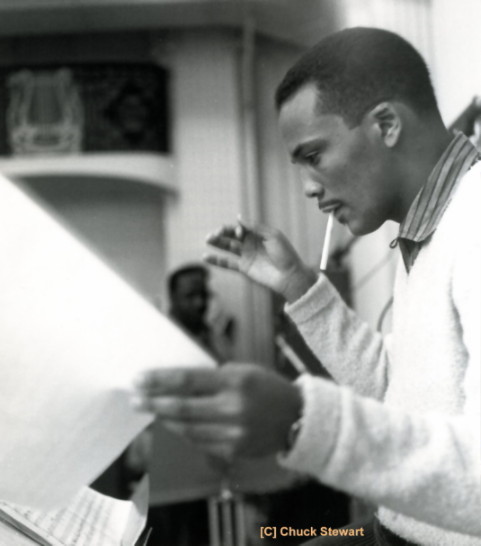
“I examined Quincy's leather travelling grip when we met in London in 1957. As if in defiance of the grey July day, it was bright with colour: stuck over with labels of all sizes and shapes from the different countries where music had taken him. There were so many of them that at first I thought the grip had served several musicians. However, this wasn't so. They all tied in with Quincy's movements, and little by little, pausing over first one and then another, I followed the pattern of his working life.


The American cities he'd passed through with Hampton as a musical apprentice of seventeen. Canada and Mexico, Paris and Western Europe, the Scandinavian countries, and then North Africa: the extent of his 1953 touring with Hampton. Athens, the Middle East and on to Pakistan with Dizzy Gillespie's band; then back to New York before setting off on a South American tour with Gillespie. Each told of something achieved, of some new experience befallen the musician. The last batch of labels proclaimed his return to Paris, as staff arranger for Nicole Barclay, and with the intention of studying composition privately under the aged Nadia Boulanger, intimate associate of Igor Stravinsky and musical and spiritual leader for several of the world's finest composers.


It was while I was examining the grip, and inwardly reflecting that at twenty-four Quincy was already one of the most-travelled musicians in jazz, that he said I didn't look like a writer.


"You know," and his smile was disarming, "I've always imagined a writer as someone — well, someone kinda fat, who peers out at you from behind thick-lensed glasses, and has a lot of awkward questions for you."


I straightened up at that, fast. Any second now, I thought, and he's going to say how spare I look. I'd better change the subject. So I pointed at the grip, and said — if a little obviously — that he'd collected more travel labels in the few months he was with Dizzy's band than he had in the rest of his life.


He said "yes" to this, and then, almost without realizing it, I had a load of questions for him about this band. Not awkward questions, as it happened, because Quincy has a retentive memory — and he is an easy conversationalist, with an alert way of speaking and an almost Max Beerbohm-ish sense of humour. Questions, though, that let him lead me 'backstage' where this unique band was concerned; to learn, if posthumously, of the part he had played as its musical director.


In recalling the conversation we had then, I find there are a few facts with which I need to preface it. In the first place, the 1956 tour of the Middle East by the Dizzy Gillespie big band was sponsored by the United States Government.


The State Department, recognizing that jazz music was an important cultural export — perhaps a means of improving international relations—authorized The American National Theatre Academy to send a sizeable jazz unit overseas as part of its $2,500,000 propaganda programme.


It was Professor Marshall Stearns, founder of The Institute of Jazz Studies in New York, who suggested building a big band about Dizzy Gillespie, the greatest modern trumpeter, and at that time without a band of his own. This was ultimately approved, and Stearns himself was retained as a lecturer to go with the band. Plans went ahead for the band to leave New York in the late spring of 1956.


Because the State Department had agreed to underwrite the difference between the tour's cost and its receipts the band had a sure start. It missed meeting those characters, straight out of the pages of Scott Fitzgerald, who usually get their hands on a big band venture. The money was there to pay for arrangements, uniforms, travel tickets, everything. Salaries for sidemen were to be generous, and this too was important, for it meant that the band would have noted soloists which the normal big band (Ellington and Basie apart) cannot afford. But there was one problem: the non-availability of Gillespie himself at the time the band was to go into rehearsal.


Though overjoyed at the prospect of fronting a big band (and at a salary rumoured to be near that of the U.S. President) the trumpeter was contracted to tour Europe in the spring of 1956 with Norman Granz's "Jazz At The Philharmonic" unit. After much debate it was finally agreed that Dizzy should make the tour with Granz — and in his absence the actual organization of the new band be entrusted to a deputy, Quincy Jones. Though already arranging for the band, and busily practising trumpet after hardly touching the instrument in two years, he had to find time to hire the musicians and then go down and rehearse them.


RH. Those must have been the busiest few weeks of your life, even more than when you were in Europe with Hampton.

QJ. So right. I was kept as busy as a one-armed wallpaper hanger with lice. I scored Jessica's Day, Rocking Chair, The Champ, School Days, I Can't Get Started, Night In Tunisia and Hey, Pete (which we used to play with the stage lights off during the Middle East tour).

RH. Ernie Wilkins also scored for the band. Dizzy's Business adapted

from a movement of The Drum Suite was one of his, I remember. And Doodlin’ the Horace Silver blues. Was he able to take charge of any rehearsals for you ?

QJ. No. Ernie was busy making The Drum Suite and the Andy Kirk albums for RCA Victor. I was even lucky to get him to rehearsals. Up until a week before leaving, deep inside I was not sure about Ernie going — but he didn't let me down. I had the rehearsal headache alone for two weeks, planning two concert programmes, getting the music written and getting it rehearsed. Lorraine, Dizzy's wife, was of great assistance. She was behind me all the way too, in every decision I made.

RH. Where in New York did the band do its rehearsing?

QJ. At Ames' Studios on 52nd and 7th Avenue.

RH. Were the musicians paid by the State Department at this stage, or did they have to fit in the rehearsals between their other paid work ?

QJ. The rehearsals were paid for, fortunately — and this helped to get the full respect of all the musicians involved. But the payments were almost cut the last week—a misunderstanding on some official's part. Four days to go before the tour started and the money stopped! We made it though!

RH. Then there was the problem of several musicians you wanted for the band not being available at the time of the tour.

QJ. Well, the original band Dizzy and I decided on in New York had Idrees Sulieman and Ermet Perry as the other two trumpets; Melba Liston, Jimmy Cleveland and Frank Rosolino, trombones; Gigi Gryce, Ernie Wilkins, Lucky Thompson, Jerome Richardson and Sahib Shihab, saxophones; Walter Bishop, piano; Nelson Boyd, bass; Charlie Persip, drums; and a Cuban conga drummer called 'Potato'.

Anyway, it was a good idea — too damn good. Money, previous commitments, and a thousand and one other reasons prevented me moulding the band with these men. All kinds of guys were hitting on me to get places in the band, of course, and half of them were probably great but I had to be sure — there was no room for any chances. Lucky Thompson couldn't get back from Paris in time. Gigi Gryce changed his mind about going after he'd already called one replacement, who'd called another replacement. Finally, in desperation, I called Phil Woods long distance on the Birdland tour, and he accepted the alto solo book.

When the band was finally settled I had Ermet Perry, Joe Gordon, Carl Warwick and myself as the trumpets; Melba Listen, Frank Rehak and Rod Levitt, trombones; Phil Woods, Jimmy Powell, Ernie Wilkins, Billy Mitchell and Marty Flax, saxophones; and the same rhythm section as planned.

I happened on several of the men quite accidentally. Rod Levitt had played in my band in Seattle. I hadn't seen him in five or six years, and then one day I was walking home and met him in the street in New York. There and then I asked him if he'd go to the Middle East with Dizzy Gillespie. At first he thought I was crazy. But I knew he was a good bass trombonist and a wonderful musician too. So I asked him again. When he realized I was serious he agreed.

For tenor I first tried to get Budd Johnson. Then he became the contractor for Benny Goodman's band, so that was that. I tried to find Benny Golson, on tour in Florida with Earl Bostic—no luck. Jerome Richardson had accepted, but between times he was called by the Roxy house band, one of the first Negroes ever to be in the house band there. I couldn't halt that kind of progress, could I ? Finally, I thought of a guy I'd heard on records and at sessions at The Bluebird in Detroit. It was a long shot, but worth a try. Billy Mitchell, he was called. I sat down at the 'phone to call Thad Jones who'd played in Detroit with him and who I thought might have his number. Suddenly the 'phone rang on me, and who should it be but Billy! Cannonball Adderley had passed through Detroit with his band and told Billy about my problem. So he was hired.

Frank Rehak was working with his father as a plumber but wanted to play trombone again, so he was hired. Joe Gordon was with Herb Pomeroy's big band in Boston, and I stole him! Dizzy had set Melba Listen and the rhythm section before he left for Europe. And Carl Warwick too, who was an old childhood buddy of his. 

RH. Did you have to turn away anyone you'd have liked to have in

the band? 

Q.J. After it was too late, as you'd expect, I had offers from all kinds

of guys! Milt Hinton was one. Wow!

RH. That must have been a real disappointment, both for them and for you.

Another point, Quincy. With the kind of shouting brass figures

that Wilkins and Melba Liston as well as yourself were writing for the band, how exactly did you distribute the demanding lead trumpet parts?

QJ. Ermet Perry played most of the lead trumpet parts. He's like a rock. Joe Gordon played lead on Cool Breeze. I played lead on I Can't Get Started, My Reverie, Flamingo and Yesterdays — all the ballads, in fact, because my chops were tired. Rehak played all the trombone leads (great too!)

RH. I noted that Dizzy had all the trumpet section change to the 45-degree angle instrument he'd developed. With all its bells pointing upwards and outwards like that the section must have disseminated its sounds better.

QJ. I found the 45-degree angle horn better for reading too. And it added a 3rd to the top register. I got pretty used to it after a while.

RH. After hiring the right musicians — the men you knew would make it musically — you had to find out at the rehearsals if they got on together. What I mean is, a collection of great performers don't of necessity make a great band — not if they can't get on together as human beings. And yet you can't apply too much discipline, simply because they are human beings; if you try to hold down strong personalities you take the edge off their natural enthusiasms. And this starts to show when they play then. Did you have any conflicting temperaments to reconcile?

QJ. There were no tempers. The guys were on guard, and were the best disciplined band I ever fronted at rehearsals. I even remember most of the guys showing up for rehearsals at the height of the blizzard with arms full of injections. (No, not dope; we had no narcotics problems with the band, but shots for typhoid, etc.) We got an almost impossible job done, thanks to their enthusiasm.

RH. What route did you take when the band left New York?

Well, let's see now. We left New York, by air, and picked up Dizzy in Rome. He was there waiting at the airport with his 45-degree angle horn out—and playing Sweet Lorraine for his wife, who'd come with us. He had no idea who was in the band unt we got out of the plane. It was funny when he saw cats like Joe Gordon and Billy Mitchell — he was quite surprised. Once the tour began Dizzy solidified the band's morale. It was as if a flock of sheep had at last found its shepherd. And Dizzy's sense of humour knows no limits. 

RH.  And then it was on to work in the more intense heat of the Middle East.

QJ. Yes. So right. We balled all the way down to Abadan, Persia-Dacca, Pakistan—Karachi, Pakistan—Beirut, Lebanon—Damascus, Syria—one other city in or near Syria, I forget the name of it—Ankara, Turkey—Istanbul, Turkey—Belgrade, Yugoslavia— Zagreb, Yugoslavia—and finally, Athens. Flying all the way, of course.

RH. Was there anyone to look after the band while it was there? You know, the luggage, and that sort of thing.

QJ. Yes. Dizzy's cousin, Boo Fraizer (Boo's Blues). He was a disc-jockey in North Carolina and he took a leave of absence to be our band boy. He's a groovy little cat too. There wasn't a lot of work for him to do though. We hung out together a lot.

RH. Once in the Middle East the concerts brought you in contact with so many different peoples, each with its own traditions and way of life. On account of these, the audience reception must have varied perceptibly between the cities you visited. Often you were representing the culture of the newest civilization in the world in cities with cultural traditions of their own going back more than 2,000 years. And political attitudes too. When you played in Athens the anti-Western feeling over the Cyprus situation was at its worst.

Q.J. Well, thinking back, I'd say Athens was the most unmusical of the cities we went to. And our stay there wasn't too pleasant because of a cultural attache (an American) who didn't appreciate jazz—and who let us know it as often as he could.

On the other hand, Belgrade was a bitch. There was a wonderful radio orchestra there which we loved to listen to. The musicians were very warm and friendly. They reminded us very much of musicians in New York, which was surprising, because the Yugoslavs have only been allowed to dig jazz for the last eight years.

RH. Which reminds me of Marshall Stearns' story of the communist party member in Yugoslavia who, after meeting the band, exclaimed in wonderment, "But you're all so unorganized—until you begin to play." The band's team spirit and coordinated swing, without its keeping a tight rein on outstanding individuals, represented a new kind of freedom for him.

QJ.  Yes. In Yugoslavia we had some of our most enthusiastic audiences. Perhaps they spoiled us for Athens which came after them.

RH. And Persia ? How did you find it there ?

QJ. Persia was very, very crude. It was still like five hundred years ago there. The audiences were very warm though, once they caught on to what we were doing. When we arrived, we found they hadn't even heard of Louis Armstrong! We felt very close to them, and to the people of Pakistan, mainly because of a link we found between the rhythms in their native music and the rhythms in ours.

RH. U.S.I.S. had made all the arrangements for the tour, of course,

QJ. The lay-out of the tour made everything look good. We always had good hotels. But we all got 'Karachi tummy' when we were in Pakistan, and Charlie Persip went down so bad with it that we had to use a Pakistani drummer part of the time.

RH. Marshall Stearns, reporting on the poverty that was everywhere the band played, mentioned you giving away a suit of clothes.

QJJ. That was in Persia. Billy Mitchell and I bought a suit of clothes for a sailor — also shoes. The poor guy earned only $ 1.80 a month in the navy. When we told him how much an American sailor earned he wouldn't believe us.

Everyone was poor in Persia it seemed. The living conditions were quite nasty there. I remember, Ernie Wilkins' saxophone had been misplaced in New York, so when he reached Abadan he went out to borrow one. Wow! He found saxophone players there who had used one reed for more than a year!

RH. Were you able to do any arranging work while actually on the tour?

QJ. Ernie Wilkins was my room-mate after Syria, and we spent a lot of time together trying to force each other into writing. Phil Woods too. He was very interested in learning to arrange. He's a very talented little cat.

RH. Dizzy arranged his Tour De Force for the band in Athens, which surprised me because he must have been kept continually busy as diplomat-extraordinary, meeting people and so on. Still, I can't think of a better choice for this than Dizzy, with his brilliant, natural showmanship, and persistent sense of humour.

QJ. Dizzy was always with cobras or camels or something for personal reasons and publicity purposes, but really I think he enjoyed every minute of it. I expect you saw the famous photograph of Diz blowing the snake-charmer's pipe, and the snake draped around his neck. Well, I bought that pipe afterwards. I have it at home in New York. All kinds of native drums I bought too. My apartment in New York has all sorts of souvenirs from all over the world. It looks like a modern museum. My favourite is the 45-degree trumpet which Dizzy gave me. It was his personal, gold-plated one.

RH. Dizzy can clown, and yet, underneath it all, he manages to remain an idealist. As a man, as well as a musician. That incident in Ankara, when he refused to let the band play at a diplomatic garden party unless the poor children crowding outside the walls were let in. That's typical Dizzy. The band itself, of course, non-segregated, with eight coloured musicians and four white musicians, was designed to break through any colour barriers.

QJ. We certainly couldn't understand why the people in the street in Pakistan were segregated — because they all looked the same colour to us!

RH. That would be the caste system. Something perhaps even more difficult to break through than the colour bar.

QJ. I got slapped by a performing monkey in a Pakistan street. Had a scar on my forehead for a week. I couldn't get a reputable antiseptic so I had to put shaving lotion on it — and didn't it sting!

RH. After the tour, and after the band had returned to New York, it went into Norman Granz' studios, and recorded almost its entire concert programme at one free-wheeling session. Most of the time with first 'takes'. I know that these recordings have been criticized on account of imperfect balances, some internal ones too, but I feel that by letting the session run as freely as a concert the engineers caught something of the band's real life spontaneity, something of the spirit of its public playing. The men knew the scores well, and to have insisted on continual 're-takes' might have taken the edge off their spirit. Might have made the performances seem mechanical. Did you feel this way at the time of the session?

QJ. No. I was disappointed with the session, and having to record seventeen numbers in two hours, all 'first takes' and with no one there in the control room to supervise the session. I think 're-takes' would have improved these particular recordings without spoiling the band's spirit.

RH. I remember your own Jessica's Day, always an interesting score for me, with the small-group ensemble set within the larger ensemble, was one of these performances. Immediately after these sessions didn't Benny Golson at last come into the band?

O.J Yes, Benny joined the band prior to its leaving for South America. As soon as he joined he wrote Stablemates, Whisper Not and several other wonderful things for Dizzy — and he played the end!

Benny was the only change for the South American tour, after Ernie Wilkins had dropped out. I was out of the band for a while when we got back from the Middle East. I had some writing to do, and as the band was playing theatres, playing only two or three tunes at each show, the library wasn't really marred by a change of personnel. Ronald Jones Jnr. (son of Basie's former lead man) deputized for me then. I knew the South American tour was coming off though, and while I was out of the band I'd play a little trumpet at home each day just to keep my chops in order.

RH. Where did the South American tour take you ?

QJ. Quito, Ecuador—Guayaquil, Ecuador—Buenos Aires, Argentina —Montevideo, Uruguay—Rio de Janeiro, Brazil—Sao Paulo—and Bella Horizonte, Brazil, Again flying all the way. I met Villa-Lobos in Rio. Benny Golson, Father Crowley and myself all went to his house one afternoon. A profound individual.

RH. That meant you passed through several zones of climate. Did these affect your playing, or were they with you all the way ?

QJ. No, to the last. Exactly the opposite. The climate was all against us. In the Middle East it had been as hot as hell, but hadn't interfered with our playing. In the South Americas it was winter — and as cold as a whore's heart. In Quito we caught hell at an altitude of 5,000 feet. Bad intonation and bad breathing on account of the rarefied atmosphere. Dizzy was smart and let Joe Gordon show off on all the trumpet solos. Joe almost killed himself — he was really ill after the concert, and had to drop out of the band. In Buenos Aires we used a trumpet player called Franco Corvini, but after that we made do with the four trumpets.

RH. One last point, Quincy. Did you, on either one of the tours, come up against any difficulties on account of language?

QJ. No. No language problems at all. Our music acted like an international language, and people everywhere accepted us on account of it. I picked up about twenty words of each language, though, and was really confused at the end of the two tours!”




Monday, June 9, 2025

Part 2- "Quincy Jones - A Morning Light" by Raymond Horricks

 © Copyright ® Steven Cerra, copyright protected; all rights reserved.


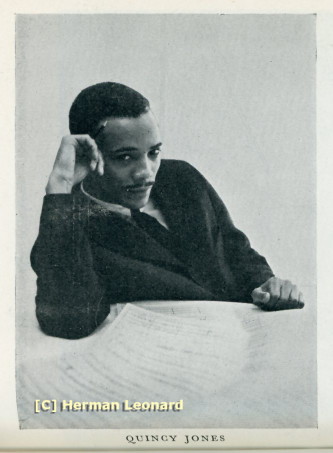
He was born Quincy Delight Jones on March 14, 1933, in Chicago.

"As one of a family of ten (seven sisters, two brothers) music didn't seem too important to most of them," he remembers. "My older brother played military drums, started in jazz the same time that I did, and then quit. My father wasn't a musician, but he was the greatest inspiration I've ever had. He encouraged me from the beginning, and I feel him behind me with every note I play."


When he was eleven the family moved north-west to Bremerton, Washington, near Seattle, and in 1948 they moved into Seattle itself.


"This was a hell of a change for me," he insists. "It's interesting because I went through exactly what all the fuss in the States right now is about — integration in schools. I've seen both sides.


"I experienced it first as a child in Chicago, where I was exposed to all kinds of gangs. 'The Vagabonds', 'The Giles A.C. Gang', 'The Dukes and Duchesses', and so on. Colour meant a lot in their constant rebellion against society, and believe me Chicago gangs were rough. I'll never forget when I was seven years old and saw 'Two-Gun Pete', a famous tough Chicago cop, shoot down a cat [bop lingo for a person] from one of the gangs and he crumpled up in front of Walgreen's Drug Store. My mind was not mature enough really to feel sympathy. I'd seen too many movies and I just accepted it as a part of Chicago life. And I accepted colour hatred as a part of it.


"Then, presto! A change. Out to near Seattle. I entered school — the only coloured kid in the class — and the other kids were wonderful to me. Positively no problems. Completely integrated. A hell of a contrast from Chicago where in the gangs they dared white kids in the coloured districts and vice versa. It was all a lack of understanding there. Just put a white kid in a coloured school and he acts like the majority of coloured kids act. The same with a coloured kid in a white school. There are some traits that are more heavily instilled from childhood, but basically kids all act alike. In Seattle we used to fight together, play together, everything — and it made me realize how each side was afraid of a non-existing element. Fear of the unknown.


"Now this isn't true everywhere in the States. In the South there is a different scene. There it's pure, unadulterated ignorance. Seattle though is like a model city and the only time the colour pattern gets distorted is when an outside influence starts interfering with it. These influences can set back progress twenty years with just one scene.


"I feel I've experienced the integration problem. And I'm sure things would be cooler if more people had. I'll even go further and say that if people would make an effort to meet more people, inside and outside their own country, then things would be cooler. The enemy always looks stronger when he's far away from you. People need to get closer.


"Even in Seattle, though, I used to shine shoes, paper routes, run errands for bootleggers, pimps, prostitutes and so on. You get this everywhere. It opens your eyes to life."


It was in Seattle that he began to show a real interest in music. "The only music I was ever exposed to in Chicago was from the house-rent piano players — long-fingered, elderly cats who just played and got juiced and ate neck-bones and red beans and rice. They all had fantastic left-hands when they played. I was very aware of this even though I was only ten."


His interest started with his helping to organize a small choir at the local church. His family was Catholic but as he puts it: "I got more of a message from the Baptist and Sanctified churches, because they used to project their feelings more. Also, I started singing spirituals under Joseph Powe, who at one time had been with 'Wings Over Jordan'. He was at the same time leader of a Navy dance band, and he taught me a lot about pulsation and phrasing.


After singing with him I started on piano. Then I was student manager for the Robert E. Coontz High School band and in that I experimented with clarinet, trombone, tuba, French horn, baritone, E-flat  alto horn, percussion, and then I bought a second-hand trumpet. From then on I was in every musical organization in school until I had graduated: chorus, orchestra, dance band, etc,


"I wrote a suite called From The Four Winds when I was sixteen, I still don't know how I knew how to do it. I'd never studied writing music. Yet I think the form, orchestration and imagination were even more mature than in some of my later works. I still can't figure it out. Hampton played it later. It was long — nearly twenty minutes. Anyway, I got a scholarship because of it to Seattle University."


Quincy remembers becoming increasingly interested in jazz from the age of fourteen onwards.


"It began when Cab Calloway came to play in Seattle and I was part of a band that played opposite him. Jonah Jones was on trumpet with Cab then, and Milt Hinton on bass.


"After Cab left, Billie Holiday came and the band I was with had to accompany her. Bobby Tucker was Lady's pianist then. I've loved him ever since. He was so patient when he rehearsed with us. We didn't read music too fast at the time.


"And then Count Basie came with his Sextet. Buddy De Franco on clarinet. Charlie Rouse on tenor. Gus Johnson on drums. And the great Clark Terry on trumpet. Clark told me how wrong I was playing and that I had a very bad lip position (I played under the lip). And he showed me how to get past these problems. He inspired me. His trumpet playing was so different — it had skill and soul."


Another who inspired him was the blues singer, Ray Charles.


"Ray Charles was seventeen when I was fifteen. In Seattle he had a trio he called The Maxim Trio. It was a gas! Very modern. Played all the hip things then. And Ray used to write for a vocal group (five voices) I was with. Ernestine Anderson was our lead singer. She was very modern too and had plenty, plenty of soul. One of my very first arrangements was the result of Ray showing me how to voice brass, using Billy Eckstine's Blowin’ The Blues Away as an example. And at every jam session in Seattle there was Ray's influence as strong as a radio-active wave—it always came into them. He played alto, clarinet, piano and he sang the end. Afterwards he went to California and recorded Confessin’ The Blues. To me, though his blues singing has always told the truth. My idea of a perfect marriage in jazz would be his feeling with a very full technique to project and develop it.


"Later, I was influenced by Lester Young, Dizzy Gillespie, and of course, by Parker. Remember, though, this was not particularly new music to me, because in 1948 the new jazz had been in for some time and was the only jazz music I'd grown used to hearing on records. Consequently, I had to go back and find out what had happened before in jazz. This same situation applied to Clifford Brown, Gigi and many other young musicians who were not raised in the swing era. It would account for the unbiased outlook this generation should have, being at an age where progress is yet to be seen."


Actually, after graduating, Quincy had received two scholarships. The first was to Seattle University, where he found the modern music department disappointing; the second was to the Schillinger House in Boston, which in his own words 'was a gas' and where he studied for nearly a year. In Boston he met Gigi Gryce for the first time. Also, the local school of jazz musicians: Herb Pomeroy, Charlie Mariano, Nat Pierce and so on. Then, when he'd turned fifteen, he went on tour for several weeks with the Jay McShann band.


"It was a very uncertain band with Jay never showing up at the rehearsals," he remembers. "The drummer was Brady from California (he's been with Oscar Moore since then). The trumpet player was Eric Von Slitz from Texas and he reminded me personality-wise of Benny Bailey. The tenor player was Carruthers and he's in Los Angeles now. I don't remember the other guys. While with McShann I gained valuable experience in writing and playing, but most of all I discovered the financial insecurity in the music business.


"After finishing school I ventured out with Lionel Hampton," he recalls. Gladys, Hampton's wife, was doing most of the hiring and firing for the band at this time, and a lot of younger modernists had sneaked into what was essentially a relic of the swing era (although an indestructible relic, still emotionally stimulating). In the trumpet section, apart from the veteran lead Walter Williams, Quincy found Benny Bailey and the still-developing Art Farmer. And then, a few months before the band's European tour in 1953, Clifford Brown joined the section, Clifford was already a solo voice to be reckoned with, and his attitude in playing jazz entirely agreed with Quincy's attitude in writing it. Quincy decided that the trumpeter was the one man he most wanted to write for. And he continued to do so until the time of Brownie's death in the car crash in 1956.


In a letter to me just before this tragic event, Quincy wrote: "About Clifford Brown, I'll put it like this. If any musician of the present day can be compared with Parker, it's Clifford. I can honestly say that he is the most unblossomed talent of this generation. He should not only be judged by his present talent (which is still of superior quality) but by his potentialities. Charlie Parker and Dizzy and all the other influences were not judged until they reached maturity. It takes a young musician many years to rid the mind of cliches, and to unscramble the millions of young ideas into what it takes to make a mature and original musical influence. By knowing Clifford very well, I'm very aware of his sensitivity and superior taste; he will never lower his standards and play without sincerely feeling, whatever the mood. He is a young musician in age but comparatively mature in ideas. When he matures in his own standards I do believe he will be a major jazz influence. He is the kind of person that would excel at anything attempted. (He plays as much piano as he does trumpet.) You can rest assured that all the Dizzy and Navarro influences will not be present in the mature Brownie. Remember, Dizzy began by imitating Roy Eldridge."


About Lionel Hampton he is still undecided. "The guy's a natural, and is a very unpredictable man and musician." When I met Quincy in London I suggested he write a short memoir of the time he was with the band, including a section about the leader. He shook his head, "I'm sorry. It would take three or four chapters of a book even to start recording all the weird things Hamp used to do. And I couldn't give you reasons for them. He is definitely more than a character."


With Hampton's band Quincy had moved to the front of the music scene and he discovered that he had to look after his music. Today, he has a share in a large music publishing house, and his compositions are well protected. (Incidentally, Kingfish, the first composition of his which Hampton recorded, contains a rare instance of Quincy playing a trumpet solo.)


On September 2, 1953, the Hampton band left New York for Oslo and the beginning of a long European tour. Only a week before Clifford Brown had recorded an LP for Blue Note under his own name; included in it were Quincy's Wailbait and a new ballad he'd written and called Brownie Eyes. However, it was after the band reached Europe that the arranger kept the recording companies as busy as a disturbed ants' nest. He was playing a concert each day with Hampton, sometimes two; and often travelling a considerable distance between concerts. Even so, Gigi Gryce and he wrote and recorded prolifically — in Paris and in Stockholm.


When I visited Paris some nine months later with Alun Morgan the French Vogue office had still not recovered from the impact of Quincy. Al Ferrerri of Vogue, a former saxophone player, said, "Last year we had a remarkable young man here, by the name of Quincy Jones. He wrote all the time." Apparently, after the concert with Hampton was over, he would regularly stay up the whole night writing. And nothing perturbed him. If he arrived in the recording studios to find more musicians there than his score had anticipated he simply sat down and wrote out the additional parts on the spot. He would write any time, anywhere. He went with Gigi Gryce to one of the Swedish sessions, and their scores were still unfinished. The studio contained only one piano. Gigi immediately sat down at this to finish his score. Quincy sat down in the far corner of the studio, and despite the crash of experimental piano chords going on, and the talking and the tuning up of the other musicians, he finished his off on a few scraps of manuscript.


"And he writes the kind of arrangements that musicians like to play," Borje Ekberg, the chief of Swedish Metronome, told Alun Morgan. "Most of our sessions with the Hampton boys had to be held very late at night or early in the morning after the public concerts and naturally the musicians were tired. But when they saw Quincy's scores they all said, 'Hell! This is great. Come on, let's make it!' "


In Paris, Quincy composed for octets, septets and sextets, and for a seventeen-piece band with Americans and Frenchmen mixed. In Stockholm, he composed for the brass soloists of the Hampton band, Clifford Brown especially, and for a band built around pianist George Wallington. But these recording sessions took place in an atmosphere of intrigue, for Lionel Hampton had ruled that no member of the band could record in Europe. Anyone caught recording, he announced, would be immediately fired and would lose his passage money back to the States. It was necessary, therefore, that the musicians make their way to the recording sessions without his knowing.


At the outset this was easy. When the band arrived in Stockholm from Oslo the first session was set for the morning of September 14. The several Hampton men called for left their hotel singly and at irregular intervals, and later reassembled in the Metronome studios. At this session Quincy played piano on the background parts to the Annie Ross vocalese version of Jackie, originally a tenor-saxophone solo by Wardell Gray, and also on Gigi's score of the Jerome Kern ballad, The Song Is You, for Miss Ross. Then he worked on two longer scores featuring George Wallington with a Swedish band. 'Round About Midnight, the Thelonious Monk classic, was first — and Quincy's dangerously brooding orchestration here is a model of mood evocation with a small jazz group. A Wallington original, Blue Bird, came after it, and into this Quincy introduced a more conventional swing. Outstanding in the band with Wallington was trombonist Ake Persson.


It was then time for the Hampton men to leave for a rehearsal and the band's evening concert. Quincy promised though that he'd be back at midnight with three scores to feature Clifford Brown and Art Farmer with the Swedish band.


This time it wasn't so easy. Hampton by now suspected that someone was recording. He wasn't staying with the musicians, but when the men went back to their hotel after the concert he posted George Hart, the band manager, in the foyer there, with orders to stop anyone leaving with their instruments. Quincy and Clifford and Art complained of tiredness and went to their rooms. There they sat and fumed until nearly midnight, and still the band manager hadn't moved. The let-out came though when someone discovered the fire-escape ran by a window at the end of the corridor. Delighted, the three felt their way down it and were off into the night.


At this session Quincy introduced his melodic and intriguing Stockholm Sweetnin', a jazz classic. Both trumpeters made outstanding use of it, Farmer playing in the near-Miles Davis style which he has since left behind, and Brownie already himself. Quincy later commented, "I consider this one of Brownie's most well constructed solos on record, and in itself serves as a stimulating, inspired composition." Also, Quincy introduced 'Scuse These Blues, revealing his clear understanding of the old and the new in jazz, and a score of the standard Falling In Love With Love. The session ended with the trumpeters jamming on Lover Come Back To Me.


After Stockholm the band went to Brussels, and then on to Paris, It was here that Annie Ross was reportedly told to leave the band by Hampton. Stories converge to the effect that the agents for the tour and a certain critic had been advising the leader that a white singer with a coloured band wouldn't please the French audiences. So Annie went, and out of sympathy George Wellington walked off the stand with her. At subsequent concerts Quincy and Lionel Hampton shared the piano parts.


Of course, the recording began again, and with it the subterfuge, Hamp's manager was still shadowing several suspected musicians, and particularly Clifford Brown. The musicians in turn enlisted the aid of the French recording staff, in whom the efficiency of a wartime underground movement still lingered. These men, by an elaborate system of decoys, ensured that the musicians made the sessions.


At the first session on September 26, two Jones' scores were recorded. Purple Shades featured Anthony Ortega, the Hampton lead alto. La Rose Noire, based on the harmonies of George Gershwin's Summertime, featured trumpet, trombone, alto, tenor, baritone, flute, rhythm and the composer on piano; it is an instance of the way Quincy can write a gentle and beautiful score and still cause it to swing.


Two days later Lionel Hampton was invited by the Hot Club de France to a party at L'Ecole Normale de la Musique Superior. It was a unique affair at which the champagne never ceased to flow. Before a selected audience of friends and musicians Lionel organized a jam session which included such different musicians as Mezz Mezzrow, Alix Combelle and Billy Mackell. And as the party progressed Lionel himself improvised brilliantly at the vibraphone. Previously, French Vogue had asked if they might record the proceedings and had been told "Go ahead." This was pure strategy on their part. For it meant that at the same time the coast would be clear for Gigi Gryce and Quincy to organize their big band session (and including ten Hampton men) in a studio the other side of Paris.


Even then the session almost fell apart. Hampton, quite innocently, invited lead trumpet Walter Williams and trombonist Jimmy Cleveland along to the Hot Club party; two men who were essential to the big band. To refuse the invitation would have aroused his suspicions, so they told Gryce to rehearse the band and wait for them. They went to the party, jammed a little with Lionel, and waited for the champagne to take over. Then, in the mounting excitement, they slipped away, jumped into a taxi, and raced to join the big band.


Quincy's Keepin' Up With Jonesy, recorded that day, is perhaps the most outstanding performance by a Franco-American band in existence. The composition has a double theme. The first theme, of 32 bars, is played by pianist Henri Renaud and the rhythm section. The second, a supple variation on the first, is then taken up by the whole band. A muted trumpet chase follows between Brownie and Farmer, and then solos by Gryce, Cleveland and tenorman Clifford Solomon before Quincy draws out a magnificent climax in brass. The whole, lasting some seven minutes, is characterized by a very Basie-like swing.


Hampton took the band on tour through France after this and it wasn't until October 9 that the big band reassembled to record Quincy's Bums Rush and another Gryce score. On the following day Gryce with a small group recorded Quincy's lovely Evening In Paris.


The last European session he had to write for was on November 10, after the band had returned to Stockholm. He asked four Hampton men to these sessions: Clifford Brown, Art Farmer, Jimmy Cleveland and drummer Alan Dawson. These, with five Swedish musicians, again including Ake Persson. Then Clifford Brown received a telegram from the American Federation of Musicians expressly forbidding him to record in Sweden without Hampton's permission. Quincy had written a feature for him, Pogo Stick, but decided it was wiser to let him stand down. As he says, "You can't go against the Union. They fight for you, so you have to respect and obey them." The others made the session, Art Farmer pretending to the band manager he was ill and confined to his room. They recorded Pogo Stick, Jones Bones, Liza and jammed Sometimes I'm Happy, Farmer in particular contributing a series of finely conceived solos.


The tour ended and the rest of the band flew back to the States in advance of Hampton. Eleven members of the band resigned immediately, leaving Hampton, for the first time in his career as a leader, completely without a band. "I wanted to settle down in New York and arrange," Quincy explains. "My little girl was born at this time. I was so broke, mind you, that if a trip around the world cost a nickel, I couldn't have paid the fare to get across the street."


He did settle down to arrange. In the next couple of years the only trumpet he played was on a couple of recording sessions with Dizzy Gillespie; also, on a CBS-TV series with Ray Anthony through the summer of 1954.


He arranged for everyone that mattered, it seemed. A letter he sent me in 1955 read: "New York has about as much work as an arranger could ask for, believe it or not. I'm freelancing a lot, doing jazz and commercial recordings. Fortunately, the A & R man, Marv Holtzman, that I work for at Columbia is very jazz conscious and is more than considerate in letting me have as much freedom in jazz as possible, so I have to cooperate with a smile when he does a commercial date. He's letting me do a big band record under my own name, the first.


"And yet ... in a year's time maybe nobody will be working. I guess by now you've heard about Parker. [He had died the month before.—R. H.] What are all the cats going to play now since he can't make any more records ? There was a big benefit for his kids at Carnegie Hall last week. It raised $13,000. It's too bad they didn't give that kind of money to him when he was alive. Financial insecurity was one of the causes of his death."


Quincy arranged albums for a series of musicians he completely admired: Clark Terry, Sonny Stitt, George Wallington, Oscar Pettiford, Cannonball Adderley. Then he had a disappointment. The big band album of his own he'd been promised by Columbia fell apart. He made the first session, with nineteen men, and then the interested A & R man left the company. No one offered to carry it on. To my knowledge the tapes of the first session are still gathering dust in the Columbia vaults.


And then one day he walked home from a recording session and his wife said: "Dizzy Gillespie's been on the 'phone. He kept talking about the desert.”


Sunday, June 8, 2025

Snide Remarks - Bill Stewart Quintet


“Words can’t express how much I admire his drumming,” Scofield wrote in his liner notes to EnRoute, a live trio record issued on Verve in 2004. Metheny, speaking to the Austin Chronicle in advance of a similar release, Trio Live, was just as kind: “This guy’s a bottomless pit of ideas. He’s thrilling to be on the bandstand with. He’s not just one of the best drummers, but one of the best musicians I’ve ever been around.”

Friday, June 6, 2025

Part 1 - "Quincy Jones - A Morning Light" by Raymond Horricks

 © Copyright ® Steven Cerra, copyright protected; all rights reserved.


“I have to consider the individual personalities of the guys I'm writing for; but I still like to have the feeling of an improvisation in the writing. Form alone is not enough in jazz writing. Ellington has always impressed me with the improvised feeling he writes into his work.


"The only way to write this feeling into a score is to let the head and the heart work together. If the head works alone then the score usually sounds contrived, even with the best craftsmanship. If the heart works with the head, though, the score becomes more of a living thing. All your feelings are able to flow freely. All your thoughts too. In effect, you tell the truth about yourself, and the truth doesn't need to hurt. Jazz has always been a man telling the truth about himself."

- Quincy Jones


“Usually, the ideas for a melody come to him suddenly, at the precise moment when he least expects them. He prefers this: a free and not a forced imagination. "Ideas are unusual in that they never come when you sit down and try to have them," he says. "They come when you're walking down the street, or drinking a cup of coffee, and then you have to reach for a newspaper or a menu card to note them down." But with the selection from these ideas, and the shaping of them, he prefers to take his time. Often he will spend six months thinking about a melody before he is satisfied with it.” 

- Quincy Jones


"Quincy Jones - A Morning Light" is one of 15 essays which can be found in Raymond Horricks, These Jazzmen of Our Times, which was published in 1960 by the London Jazz Book Club by arrangement with Victor Gollancz. Joining Mr. Horricks as guest authors are Alun Morgan, Max Harrison, Charles Fox, Nat Hentoff, Benny Green and Martin Williams.


From this compilation, we’ve previously posted Gil Evans’ approach to compositional texture and orchestral sonority by Charles Fox which you can locate by going here.


Written in 1959, Quincy affectionately called “Q” by those who knew him, passed away on November 3, 2024 and I am reposting it in four parts as a tribute to his memory beginning today.


As is the case with all of the writings in this compendium, Mr. Horricks' is literary criticism in which he puts forth what he thinks is worthwhile in Quincy’s work while also taking him to task by what he perceives as “Q’s” shortcomings.


Given it’s vantage point in the late 1950s, this “take” on Quincy’s abilities is largely unaware of how he would go forward to make his mark in commercial music primarily outside the Jazz World and develop into one of the most successful music producers in the history of the business. But that's obviously a story for another time. 


Based in the UK, Mr. Horricks used English spelling.


“QUINCY JONES is a compact, finely featured young man, almost an eagle, with bright eyes, a determined mouth, and quick, animated gestures. His talk about music, once started, is a fast flow, touching on many shores, and all the time carrying with it the remarkable flotsam and jetsam of his experience. However, as with other odysseys, there is a single determining idea behind this and Quincy always returns to it.


"I'm sure," he says, "that jazz will not be furthered by long analytical speeches of accomplishment. It will always be sparked by emotion, warmth, heart and a certain intellectual content that is not overdone. Without emotional and rhythmic feeling, jazz is not jazz. Borrowing classical techniques to further this feeling is progressing jazz, but trying to put it on the same level as these techniques is retarding it. There has been a tendency in America of late to stress classical airs in many of the jazz works. 


In doing this, a lot of musicians have missed the message altogether. In short, when we stop swinging, we're competing with Ravel, Bartok, Stravinsky and a lot of other brilliant musicians on their own ground . . . musicians who easily outdo us there. Jazz must develop its own language."


In Quincy Jones' own jazz works, this is not only an ideal but a reality. He is an arranger and composer. He is also a pianist, and at one time or another has played all the brass instruments, but he doesn't let this divert him from what he single-mindedly considers his raison d'etre. Although, for instance, he has played in several of the greatest trumpet sections in jazz, he doesn't look back on this experience as a trumpeter usually does (that is, thinking of the extra command and confidence it gave to his personal playing); instead, he looks back on it for the extra insight it gave him into the ways of brass players — how they think, how they feel, how they are best utilized in written passages.


As a result, of course, he writes particularly well for brass, Wendell Culley, a trumpeter who has worked with many big bands, and recently Count Basie's, singles out Quincy from all the arrangers he has known for this. "Quincy is a young man," he says, "but he has such a vivid imagination that he can scare you with his brass writing at times. And yet, when you get down to playing it, you find he's written things which appeal to the trumpeter. It's because he plays the instrument himself and fully understands the physical problems of it. Some writers, who only know the theory side of the trumpet, will demand that you play vicious shock notes all the time and that can soon wear your lip out. Quincy doesn't do it that way. He actually notates a passage as the trumpets would naturally feel it."


Always, then, Quincy's understanding of instruments is the servant of his arranging and composing. "The orchestra is the most fascinating instrument I've played," he says. "It has more dimensions than a solo instrument."

On the other hand, he has approached the orchestra with something of the head-and-heart wisdom of the great users of solo instruments in jazz: of Armstrong, of Hawkins, of Parker.


"I like to look on the orchestra as my personal instrument, the same as the soloist looks on his, and I like to improvise with it," he explains. "I like it to describe my feelings, my moods and my thoughts, so that writing becomes the same as improvising a solo for me. Of course, I have to consider form too, even more than the soloist does; also, I have to consider the individual personalities of the guys I'm writing for; but I still like to have the feeling of an improvisation in the writing. Form alone is not enough in jazz writing. Ellington has always impressed me with the improvised feeling he writes into his work.


"The only way to write this feeling into a score is to let the head and the heart work together. If the head works alone then the score usually sounds contrived, even with the best craftsmanship. If the heart works with the head, though, the score becomes more of a living thing. All your feelings are able to flow freely. All your thoughts too. In effect, you tell the truth about yourself, and the truth doesn't need to hurt. Jazz has always been a man telling the truth about himself."


In Quincy's writing, where intelligence and passion mingle and delight each other, there is a thoroughly emotional verve; a verve which erupts into existence as soon as the musicians play over their parts and which recalls the spontaneous combustion of a big band 'head' arrangement at its best (and, after all, what is a 'head' arrangement if it isn't a suddenly desired and conceived ensemble improvising?). It is, of course, the attacking attitude in his scores which most clearly expresses this verve. The attacking attitude in the ensemble passages, which are designed to speak in a very definite way, and in the underlying pulsation, which is always forceful and freely flowing without ever careering along like some clumsy coach out of control. "He writes with such a natural swing," the Swedish altoist Arne Domnerus has said, "that it seems like his compositions more or less play themselves."


However, the actual content in his scores also expresses this verve. As an orchestrator he is invariably direct. He notates his passages with an orderliness and a sense of proportion that is diametrically opposed to the trundling masses of Bill Russo's writings. Of this he is aware; it is an affair of the head, and, as John Steinbeck says, "It is good to know what you are doing." At the same time, though, he notates his passages with an instinctive strength, enough to encourage the ensemble to shout out energetically, and with an instinctive timing, enough to encourage it to swing without inhibition. Of this he is again aware; but it is an affair of the heart, and he knows only of its existence and of its effect. "I prefer not to ask too many questions when it's an affair of the heart," he replies to questions about this instinctive strength and swing. "It's there, and I'm grateful it's there. I prefer not to ask why or when it came to be there."


Of the head's exclusive affairs he is more consciously aware. This is because he has to select from his thoughts, and then shape and stabilize them on paper. "There are the parts of jazz writing that are only arrived at as a result of knowledge," he says. "The construction and the continuity of a work. Then the orchestrating of it. In orchestrating a work, if I use a voicing that hasn't been used before, or a texture, it's a result of musical knowledge. And composing the work itself is a result of musical knowledge used with imagination."


Quincy is richly endowed with the knowledge and imagination he mentions. Remarkably so for a young man, although as the English arranger Eddie Harvey points out, "It is inevitable that at some point after Ellington there should come along another young man who, in writing jazz, has intense passion and at the same time facility and originality in the right amounts to further the cause of the orchestra in jazz, and Quincy seems to be that man."


He is a fine orchestrator, after Gil Evans perhaps the finest in modern jazz. His knowledge of the orchestra, and of its possible subdivisions, is full and far-reaching and allows him to write with an easy exactness (even when he is clearing an area of 'new ground' for cultivation). It is important, this exactness, in two essential ways: first, in telling the truth, about his thoughts, and about his attitudes; second, in taking advantage of the many possibilities in big band writing (the textures, the techniques, and so on). Also, as in Gil Evans' orchestrations, it is easily accommodated in his writing's attack. He can write a brilliantly detailed score that appears to the casual listener to have a simple spontaneity because it is easily accommodated in an excitingly emotional attack. As illustrations of this, I have only to mention the passages, so lightly but firmly ensembled, that attend Dizzy's I Can't Get Started solo; or the small, trumpet-led ensemble, set against the larger ensemble, that exposes the theme of Jessica's Day; or the few fearless outbursts of brass at the close of Night In Tunisia — all parts of Dizzy Gillespie's "World Statesman" LP recorded for Verve.


His orchestrating complements his composing. For, unlike Ellington, he doesn't consider orchestration as a part of the composition, although he considers composition vital to orchestration. He prefers to compose, and then to orchestrate; to have the melody and its harmonization settled, and then think about portraying them with the orchestra. Moreover, he orchestrates only to state and enhance the composition. Orchestration for its own sake doesn't interest him. He uses instrumentation and sound only if they are right for the composition; never for a merely pleasing effect. In view of this, it is not surprising that as a composer Quincy is essentially a melodist. Unlike Gigi Gryce, his contemporary, he hasn't concerned himself with the problems of advancing form in jazz; in fact, when composing blues and ballads, he appears quite content to work within their traditional forms. But he approaches the making of a melody with two well-defined aims.


The first, and not surprisingly, is that it must have a strong intrinsic beauty and substance — allowing it to exist as the better popular song occasionally does, facing a series of widely varied interpretations without losing its own identifiable character. The second is that it must have suppleness, and at the same time harmonic completeness; for without these combined qualities it cannot act as a life-force in jazz, inspiring an orchestra and its soloists.


Quincy selects from a rich imagination to realize these aims. It is a careful selection, though, applying an order and logic to the natural profusion of the imagination. Although a fast orchestrator, Quincy is a deliberately slower composer. Usually, the ideas for a melody come to him suddenly, at the precise moment when he least expects them. He prefers this: a free and not a forced imagination. "Ideas are unusual in that they never come when you sit down and try to have them," he says. "They come when you're walking down the street, or drinking a cup of coffee, and then you have to reach for a newspaper or a menu card to note them down." But with the selection from these ideas, and the shaping of them, he prefers to take his time. Often he will spend six months thinking about a melody before he is satisfied with it. "I have to think about the making of the composition from these ideas, shaping the melody and the chord changes that go with it," he explains. "Although the ideas for the melody may already be strong, I still have to portray them at their best, and I shape them in many different ways before I finalize them in one." At the end of this period of incubation, however, a melody of significance usually emerges. Evening In Paris and three or four other themes he has written are already classics of their kind.


Another reason perhaps for taking his time is the actual length of his melodic lines. Many jazz composers are satisfied with short, staccato-type lines, which they repeat several times with only slight alterations to make the main 8-bar phrase of a theme. Quincy's melodic lines are longer, usually requiring the entire 8-bar phrase to unfold, and they have a more flowing quality. One of his ballads, The Midnight Sun Never Sets (written in 1958, and first recorded by Arne Domnerus with a sixteen-piece Swedish orchestra), portrays this ideally; its lines are beautifully appointed, slowly and sensitively taking shape in an entirely legato way.


When he uses the 32-bar song structure, Quincy achieves a flowing quality throughout his composition, for the melody of the middle 8-bar phrase is always closely related to that of the main 8 and carefully linked to it, thereby attributing a strong continuity to the whole chorus, Stockholm Sweetnin’ (written in 1953, and first recorded by Clifford Brown, again in Sweden) portrays this; it has a smooth and uninterrupted melodic development, the key change for the middle 8 notwithstanding, and from the opening to it's deliberately effected climax in the last 4 bars is a continual tribute to the composer's will-power and reasoning.


A further point about Quincy as a melodist concerns his lyricism. Although his strong sense of melodic continuity emphasizes this, it in no way exaggerates it. For his lyricism, far from being skillful artifice, is a deep and powerful force within him. It affects all his work (even the more animated blues, where as artifice it could never be applied). It contributes immensely to the long and flowing melodic lines he writes, mellowing and enriching their shape, and adding a sense of almost joyous well-being to their statement. And yet, at the same time it is a firm lyricism, unaffected by the overt sentimentality which spoils the work of many popular songwriters. Such lyricism is rare in jazz. A handful of soloists have it (Miles Davis and Milt Jackson in particular) but fewer composers, and Quincy's already melodically distinctive work is made even more so because of it.


It isn't easy to communicate the huge suggestiveness of a spirit like Quincy Jones' in the space of a single essay. As John Cowper Powys has said about analysing an artist, "There are certain great men who make their critics feel even as children, who picking up stray wreckage and broken shells from the edge of the sea waves, return home to show their companions 'what the sea is like'."[From Visions and Revisions (Macdonald, London, 1955)]. Nor is it easy in Quincy's case because, although his greatness has been revealed, he is still a young man with perhaps three-quarters of his works still to be written. But a little can be done, if only as a modest 'advice to the reader', and I have collected a little "from the edge of the sea waves" towards this end.


One other aspect of his arranging and composing I  have to collect. Briefly here, because it has to be collected again in discussing his "This Is How I Feel About Jazz" LP later on. This is his belief that jazz music need not go outside its own resources in order to develop interestingly. Many musicians disagree with him. They believe jazz needs to integrate with European music. For in jazz, as in life, there are those who develop the existing order and there are those who despair of developing it. Quincy is on the side of the former. The natural resources of jazz, he believes, are so vast and so deep that there is little likelihood of their being exhausted. "A natural growth, and from the natural resources," he says. "It's the only way to progress in jazz. It's the only way anyone ever has progressed in jazz. It can't exist on other resources. And why should it need to, after its own have given it fifty years of creative development and the prospect of many more to come? I'm for a natural growth. I'll use all I know in music to assist it, but at the same time it has to use its own resources."