Tuesday, July 28, 2020

Monday, July 27, 2020
Jazz At The Blackhawk Bar in San Francisco
© Copyright ® Steven Cerra, copyright protected; all rights reserved.
Little over a half century after it closed, it’s strange to think that one of the iconic clubs in the history of modern Jazz became the subject of idle curiosity.
Once Upon A Time In The TL: Jazz At The Black Hawk Bar

Photos: San Francisco History Center, SF Public Library via Found SF

by V. Alexandra de F. Szoenyi@sfcentricwebsite
March 13, 2015
San Francisco has a rich and colorful jazz history, with the Fillmore district and Divisadero Street bringing in so many musicians to their venues that the area was known as "the Harlem of the West."
A couple miles away from this hot music scene was another jazz club. From 1949-1963, the Black Hawk bar presided over the Tenderloin as the spot for quality local jazz music. Situated on the corner of Turk and Hyde, the Black Hawk was by no means glamorous, but it became one of the go-to jazz clubs of the time on the West Coast.

"The stage was so small that [John] Coltrane started his solo in the kitchen hallway," recalls Dan Celli of his first jazz club jaunt as an 18-year-old in either 1959 or 1960. "'Trane was giving Cannonball [Adderley] time to get off, that's why he started to solo in the kitchen hallway."
Artists including John Coltrane, Dizzy Gillespie and Chet Baker played in the small, 200-person capacity bar. Billie Holiday played her last West Coast club dates there. It was the locale where jazz albums from Miles Davis, Thelonius Monk, Cal Tjader, Shelly Manne, and Mongo Santamaria were recorded.
San Francisco native and music enthusiast Charlie Gouveia told us that Miles Davis cut one of his best live albums there. The Black Hawk was so teeming with talent, he said, that a young Johnny Mathis was discovered while performing during one of the bar's Sunday afternoon jam sessions for young musicians. Black Hawk co-owner Helen Noga went on to become his manager.

Perhaps the coolest thing about the bar was the special viewing area for minors, which was separated from the drinking section by a wall of chicken wire, but still allowed the youth of San Francisco to witness musical history. "In high school, I sat in the chicken wire section," reminisces San Francisco native Joe Fontana. "That was in the early '60s. I saw Miles there. There were a lot of underage kids sitting behind us, listening to the music."
Another native, Joyce Turner Cornacchion, frequented the Black Hawk as both a teen and as an adult. "All the greats played there. Fantastic place. [I] was very sad when it closed."
As with those Joni Mitchell lyrics rumored to be referencing the Garden of Allah Hotel in LA, "They paved paradise and put up a parking lot." In 1963, the bar was closed. "I remember when the Hawk closed but can't remember why," said Joe Fontana." One theory is that co-owner Helen Noga wanted to dedicate her time to managing Johnny Mathis' career. "I think it had something to with the neighborhood seeing that the Hawk was in the Tenderloin," Fontana added.
After a brief moment as the Top Drawer, a mid-'60s lounge, the only thing standing in the place of the Black Hawk today is a lonely parking lot and a bronze plaque that commemorates what once was.
Neighborhoods
Sunday, July 26, 2020
The Mastersounds with Wes Montgomery
© Copyright ® Steven Cerra, copyright protected; all rights reserved.
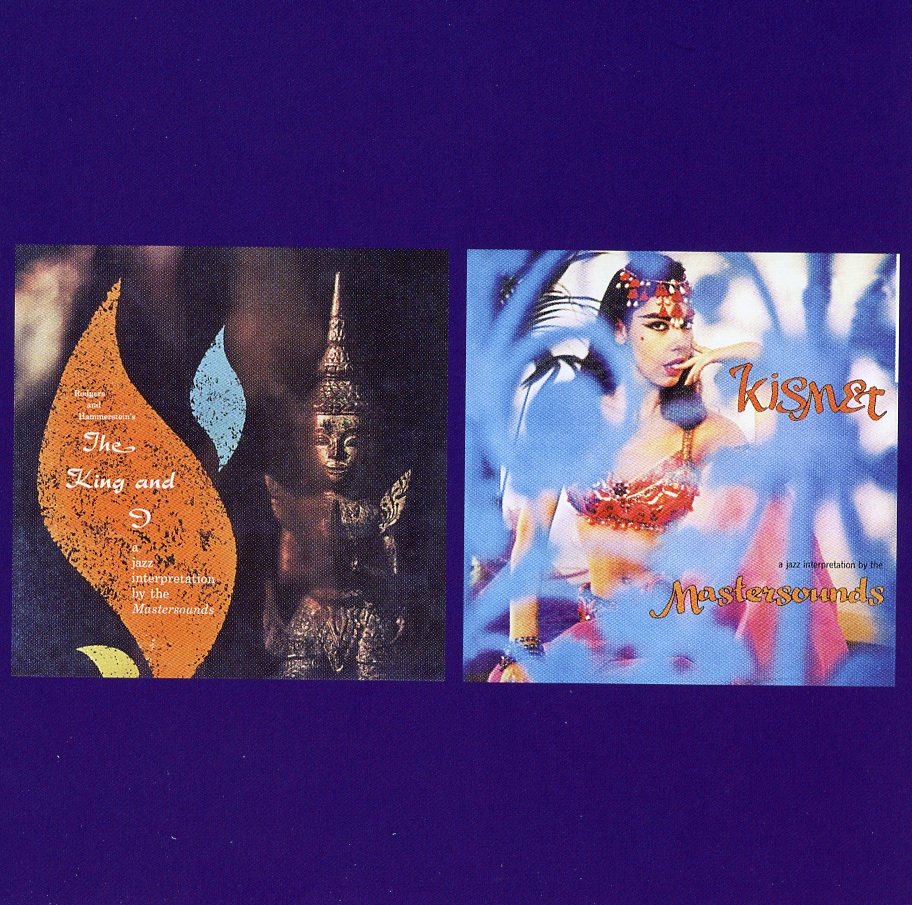
The Mastersounds replicated the vibes-piano-bass-drums format associated with the Modern Jazz Quartet to create a light swinging chamber Jazz that exuded subtlety and poise.
The wildly successful Shelly Manne and Andre Previn interpretation of My Fair Lady inspired the group to attempt their own Jazz reading of The King and I and then - augmented effectively by the guitar of Wes Montgomery - Kismet, the famous musical based on compositions by the Russian composer Alexander Borodin.
Recorded and issued on individual vinyl LPs by Richard Bock at Pacific Jazz Records in 1957 and 1958, respectively,, both of these Broadway show Jazz interpretations have long been unavailable on CD until 2009 when Cherry Hill Records combined them released them on their El Records label [ACMEM 174CD] as The Mastersounds with Wes Montgomery.
[The group’s interpretation of Flower Drum Song - also recorded in 1958 and released on Bock’s World Pacific label - has never made it to CD.]
When we did our previous omnibus piece on The Mastersounds, the following information that forms the insert notes from the CD reissuance was not available. Given our enduring interest in this magnificent group, the editorial staff at JazzProfiles that we’d bring it up as a separate posting.
Timing is a key factor in any form of popular music. It's not enough to have the right combination of qualities for success, you also have to have them at exactly the right moment. And it was this one failing that, more than anything else, cost the Mastersounds dear. Quite simply, through no fault of their own they found themselves in competition with one of the biggest groups in jazz history, and there was only ever going to be one winner.
But no one doubted the quality and distinctiveness of the Mastersounds musicianship. Charles Frederick "Buddy" Montgomery, Richie Crabtree, William Howard "Monk" Montgomery and Benny Barth first appeared early in 1957, a light, swinging chamber-jazz combo exuding subtlety and poise. Their graceful style was enthusiastically received, with a three-month residency at Dave's Blue Room in Seattle leading to a stint at the newly-opened Jazz Showcase in San Francisco.
The group was essentially the brainchild of Monk Montgomery, and it was he who secured them their first recording contract with World Pacific Records - a contract which saw the Mastersounds record six albums during the two short years of their existence. (A further two albums followed for Fantasy when the group reunited briefly in 1960).
In the year of their initial disbanding, the Mastersounds won the much-coveted Down Beat Critics' Poll For Best New Group. Yet for all their success - and this is where the matter of timing comes in - the band must have quickly realised that they would be forever labouring in the shadow of the Modern Jazz Quartet. It seemed that, in jazz circles, there was - and still is - a limitless appetite for quartets who used the standard line-up of sax, piano, bass and drums.
But somehow the MJQ, formed in 1952, had pretty much cornered the market in genteel chamber jazz in which the vibraphone supplanted the sax and, although the Mastersounds' records sold respectably, the public ultimately seemed reluctant to fully embrace another band ploughing similar territory. musicals Kismet and The King and I.
With their relatively complex harmonies and chord progressions (the score for Kismet was based on compositions by the Russian composer Alexander Borodin) and such material presented genuine challenges for improvising musicians keen to transcend the standard jazz repertoire.
Composers Rodgers and Hammerstein were so impressed by the jazz version of The King & I that they pre-released the score of Flower Drum Song to the quartet to allow simultaneous release with the soundtrack album.
This was harsh on the Mastersounds, who were no mere copyists by any means. As C.H. Garrigues, jazz critic of The San Francisco Examiner commented in his liner notes for a live recording issued in 1959: "It would be difficult to find any area of sincere jazz feeling in which they are not at home."
At a time when many jazz musicians were pioneering new areas such as 'third stream' and free jazz, the Mastersounds were, perhaps, guilty of one crime: caution. Encouraged by the commercial success of Shelley Manne's 1956 album based on interpretations of music from My Fair Lady - with stylish reworkings of the Lerner-Loewe score by Andre Previn - the
Mastersounds jumped on what by 1958 was becoming something of a bandwagon, with their versions of songs from the
For Kismet, the Mastersounds added the guitar of the Montgomerys' brother Wes. By 1958 and already in his mid-30s, Wes Montgomery was finally beginning to establish himself as one of the most important electric guitarists since Charlie Christian, though he was only known to the public as a sideman and was still holding down a day job in Indianapolis to make ends meet. His career as a leader would last less than a decade before his tragic death from a heart attack in 1968, yet during that short time Wes Montgomery made a huge impression. As guitarist Kevin Eubanks puts it: "As far as modern players are concerned, especially from the '60s when everything seemed to catch up with itself and solidify into modern-day jazz, Wes would have to be the most influential figure in the history of jazz guitar."
Montgomery’s characteristically mellow sound derived from the fact that he played using his thumb, rather than the more commonly used pick.
Legend has it that the technique evolved initially out of a purely practical concern: working all day as a machinist, Wes would practise late at night while his wife was sleeping and used his thumb so his playing would be softer and not wake her. His thumb was also double-jointed - making it much more suppler than the norm - and through constant use developed a corn, which Wes would use sparingly to give his sound an occasional edge I that contrasted with the honeyed tone produced by the thumb's I fleshier parts. All these factors combined with a fierce musical intelligence to make Wes Montgomery a truly original soloist, and the progenitor of a whole school of guitar playing whose followers included George Benson and Pat Metheny - though even rock guitarists like Jimi Hendrix and Stevie Ray Vaughan acknowledged his influence. Between 1960 and 1967, he won the Down Beat Critics' Poll for Best Jazz Guitarist no fewer than six times.
In the final years of his life, having recorded on numerous occasions with Buddy and Monk as the Montgomery Brothers, Wes divided his fans by releasing a series of albums on which he covered popular songs of the day accompanied by a full orchestra. While there was an inevitable backlash from those who were disappointed by how little improvisation the albums contained, others pointed to the way in which their enormous commercial success did much to spread the jazz gospel among a younger audience.
Just as the MJQ overshadowed the Mastersounds, however, Wes's success inevitably did something similar to the careers of his brothers Monk and Buddy. Yet as these recordings prove, both were musicians of the highest calibre. Monk, who was one of the very first Fender electric bassists in jazz, passed away in 1982, while Buddy - the youngest brother - died in 2009 and was performing as both leader and sideman to the very end. And though it would be wrong to exaggerate the importance of the Mastersounds in the history of jazz, these two records certainly deserve a better fate than the decades of neglect into which they had long since fallen.”
Christopher Evans
Saturday, July 25, 2020
STARS OF JAZZ REVIEW by Gordon Jack
© Copyright ® Steven Cerra, copyright protected; all rights reserved.

Gordon Jack is a frequent contributor to the Jazz Journal and a very generous friend in allowing JazzProfiles to re-publish his insightful and discerning writings on various topics about Jazz and its makers.
Gordon is the author of Fifties Jazz Talk An Oral Retrospective and he also developed the Gerry Mulligan discography in Raymond Horricks’ book Gerry Mulligan’s Ark.
The following obituary was published in the 12 July, 2020 edition of Jazz Journal.
For more information and subscriptions please visit www.jazzjournal.co.uk
© -Gordon Jack/JazzJournal, copyright protected; all rights reserved; used with the author’s permission.
STARS OF JAZZ
A COMPLETE HISTORY OF THE INNOVATIVE TELEVISION SERIES 1956-1958
BY JAMES A. HARROD
“The first Stars Of Jazz broadcast took place on Monday 25 June 1956 at 10.30 PM and it featured the Stan Getz Quartet and Kid Ory’s Creole Jazz Band. It followed the Lawrence Welk Show and that was its regular time-slot for the duration of the series which was seen locally in Los Angeles on Channel 7 on the KABC network. The show which was sponsored by Budweiser was eventually broadcast coast-to-coast for the final 29 programmes of the series. Stars Of Jazz with its innovative camera work and fresh production values received an Emmy from the Academy of Television Arts and Sciences, together with a Down Beat award as well as recognition from Theme magazine, TV Radio Life, TV Radio Mirror and TV Guide.
It benefitted from appointing the multi-talented Bobby Troup as its host and his laid-back but informed delivery probably helped relax musicians on what was a live TV show. He was a consummate performer and was clearly at home in a television environment having worked on the NBC Musical Chairs quiz show with Johnny Mercer, Stan Freberg, Mel Blanc and Peggy King.
Others who had auditioned for the role included Leonard Feather, Les Koenig, Dick Bock, Howard Rumsey, Sleepy Stein, Gene Norman, Stan Kenton and John Tynan. Whenever he was unavailable Johnny Green, Johnny Mercer, Mel Torme’, Andre’ Previn or Jerry Colonna stood in for him. On one occasion the Bobby Troup quintet with Bob Enevoldsen on trombone and tenor were the featured guest stars and that show was hosted by Stan Kenton.
This fascinating book is the product of more than 20 years research by the author Jim Harrod who is a member of the Association for Recorded Sound Collections, the Jazz Journalists Association and the Los Angeles Jazz Institute .He has adopted an almost forensic attention to detail in accessing AFM contracts to identify every Stars Of Jazz performer. Complete personnels and repertoire including composer and lyricist where appropriate are listed for all 130 shows. Biographical details of the major performers are also included and his research has been helped by Jimmie Baker’s scripts which were available at the Los Angeles Jazz Institute. The book includes many previously unpublished photographs by the celebrated Ray Avery who attended most of the shows.
The series featured artists who were performing in Los Angeles clubs at the time like Chet Baker, Dave Brubeck, Art Pepper, Bud Shank, Bob Cooper, Billie Holiday, Anita O’Day, Chris Connor, Dave Pell and Benny Carter. Occasionally New York-based groups like Cannonball Adderley’s quintet, the MJQ, Oscar Peterson’s trio and the Jazz Messengers appeared when they were in town as did big bands led by Charlie Barnet, Shorty Rogers, Count Basie, Harry, James and Les Brown.
Jim Harrod reveals a compelling treasure- trove of totally new material in this somewhat forgotten window on the mid-fifties west coast jazz scene.
Stars Of Jazz
A Complete History Of The Innovative Television Series 1956 -1958.
By James A Harrod, published by McFarland & Company Inc.
225 pp. ISBN 978-1-4766-7770-5 (print), ISBN 978-1-4766-3779-2 (ebook)
Subscribe to:
Posts (Atom)