Wednesday, April 28, 2021

Chico Hamilton Quintet With Strings Attached [From the Archives]

© -Steven Cerra, copyright protected; all rights reserved.


As Ted Gioia noted in his seminal work on the subject of West Coast Jazz: Modern Jazz in California, 1945-1960:

“Despite his aversion to such recognition, [baritone saxophonist] Mulligan continued to exert a strong influence on the California scene until the end of the decade. The use of counterpoint, the emphasis on relaxed tempos, the restrained drum sound, the experimentation with different combinations of instruments, the heavy reliance on compositional structures, the openness to new sounds — all of these remained trademarks of West Coast jazz in the 1950s. ….

Drummer Chico Hamilton was one of those who learned the most from Mulligan's model. Hamilton had performed on many of the early quartet and tentette sides before leaving the group to tour with [vocalist] Lena Home. Along with Shelly Manne, Hamilton contributed greatly to the establishment of a West Coast style of drumming. "It is a very melodic instrument,” Hamilton has said of the drums, "very soft, graceful in motion as well as sound: a sensuous feminine instrument.”

Hamilton reached back to prebebop drummers such as Jo Jones and Sonny Greer in developing his sound. Despite these roots in the big band era, his drum attack was far from old-fashioned; his sensitivity, taste, and dynamic range were fresh and invigorating in the wake of the modern jazz revolution. "When Chico Hamilton took a drum solo," critic Ralph Gleason once wrote, "it was probably the first time in history that a jazz drummer's solo was so soft you had to whisper or be conspicuous.”

Unlike many at the forefront of West Coast jazz, Hamilton was a native of Los Angeles, where he was born as Foreststorn Hamilton on September 21, 1921. ….

[After his stint with Mulligan and with vocalist Lena Horne] when forming his own group Hamilton  … decided to experiment with more diverse instrumentation. The subsequent addition of Buddy Collette, a Los Angeles native born on August 6, 1921, was a major coup. Collette—who was fluent on flute, clarinet, tenor, and alto—gave Hamilton access to a rich variety of tonal colors. … The unusual voice Hamilton was seeking emerged fortuitously when he learned that Fred Katz, primarily known in jazz circles as a pianist, was interested in exploring the jazz potential of the cello. Katz, guitarist Jim Hall, and bassist Carson Smith constituted the "string section" in the new Hamilton unit.” [pp. 187-188]

So given the fact that three-fifths of Chico Hamilton’s quintet had always been comprised of a “string section,” I was only a slightly bemused when Chico was recruited by George Avakian, a producer with a long association with Columbia Records, to join him at Warner Brothers for the release of Chico Hamilton With Strings Attached [Warner Brothers B 1245].

In fairness to Chico, by 1960, the date of the Warner Bros LP, although the guitar-bass-cello format complemented by flute and reeds had remained the same for almost three years, it’s sound had changed when Paul Horn replaced Buddy Collette in the woodwinds section and John Pisano took over for Jim Hall on guitar.

Paul added more clarinet, stressed the alto saxophone and played flute with a more “legit” sound than Buddy, who also favored the tenor saxophone while with Chico, and John Pisano’s guitar wasn’t tuned in fourths as was Jim Hall and his solo were not as angular nor as sparse as Hall’s. During the first three years of its existence, Fred Katz and Carson Smith had remained as constants in Chico’s quintet cello and bass, respectively.

But what I didn’t know when I acquired my copy of Chico Hamilton With Strings Attached [Warner Brothers B 1245] was that Chico had done it again!

Amazingly, he had taken what could have been the fundamentally restrictive range of the Jazz equivalent of a Chamber Group and expanded it to include new “textures” or sonorities which were created by the more harmonic orientation of the group’s new lead voices: Eric Dolphy on flute and alto sax and Dennis Budimir on guitar.

Wyatt Ruther had replaced Carson Smith on bass and Nate Gershman took over for Fred Katz on cello while Fred, who had originally been trained as a pianist stepped up as the arranger for the Warners Bros. date and surrounded Chico and the quintet with a full - you guessed it string section.

The result was the familiar sonority of Chico’s quintet but with a new depth and breadth. In his liner notes to Chico Hamilton With Strings Attached [Warner Brothers B 1245], George Avakian explained the magnitude of Chico’s accomplishment and the context for the recording this way:

“There is a familiar TV commercial in which a slightly self-satisfied voice proclaims, "They said it couldn't be done!' When Chico Hamilton, three short busy years ago, formed a quintet that consisted of drums, bass, guitar, one man doubling a lot of reed instruments, and—this is where night club owners and friends furrowed their brows—a cello, the voices echoed "Couldn't be done, couldn't be done!'

Chico Hamilton did it with success on every front, including the necessary one of paying off the mortgage. His is a musical organization of unusual quality, skill, and variety. Each member is a technician of extraordinary quality who can improvise with rare ingenuity; collectively, they blend tastefully in a seemingly endless number of combinations of sound.

The Chico Hamilton Quintet represents both a challenge and an opportunity to arrangers. An unusual number of musicians have paid Chico the ultimate compliment by asking if they may write for the group. This has served as an inspiration to the Quintet, and has helped keep alive the freshness which has always characterized its music.

In this collection, the Quintet appears both in its original form and with a string section which augments its normal sound, often as a supplement to the role of the cello in the ensemble. Appropriately enough, the arranger who wrote the scores in these particular pieces is Fred Katz, the original cellist of the group, who left the group to concentrate on composition and scoring in Hollywood. He not only wrote many of the Quintet's arrangements, but it was his instrument which gave it its unusual color. Fred's writing, which has been heard in motion picture soundtracks as well as on records, is well ahead of the crowd, though not so far out as to lose his audience. Imagination and sensitivity characterize his work in the slower .tempos; imagination and happy playfulness mark his up-tempo writing.”

Of the musicians on the recording, George wrote:

“The members of the Chico Hamilton Quintet are a mixture of highly-respected veteran musicians and talented youngsters. Leader Hamilton is one of the best-known percussionists in both the jazz and show-business fields. At 18, he played with the Duke Ellington orchestra. A stint with Count Basie followed, but Chico was not content to be only a jazz drummer; he also went into theatre work in Los Angeles, and then combined the two backgrounds in the first long-term engagement of his career—eight years with the greatest night club performer of them all, Lena Home. In 1955, he applied everything he had learned to form the Quintet — a masterful combination of jazz, showmanship, and just plain good music to play and to listen to. Bassist Wyatt Ruther is best known for his tours with the Dave Brubeck Quartet, the Erroll Garner Trio, and with Lena Home. Cellist Nat Gershman is a graduate of the Curtis Institute of Philadelphia and an alumnus of the Cleveland Symphony Orchestra. Newcomers Eric Dolphy and Dennis Budimir are native Los Angelenos; Eric is a discovery of Chico's, and Dennis broke in recently with the Harry James band.”

Sadly, this version of Chico’s quintet did not stay together very long as Eric Dolphy moved to New York to join Charlie Mingus and Dennis Budimir went with alto saxophonist Bud Shank’s new quintet featuring Carmel Jones on trumpet.

As to Chico, he moved on to his next surprise - in 1962, he formed a quintet featuring Charles Lloyd on flute and tenor saxophone, George Bohanan on trombone, Gabor Szabo on guitar and Albert “Sparky” Stinson on bass.

At least he kept the guitar!

The following video features Carson Smith’s arrangement of Bill Potts’ Pottsville, USA. from Chico Hamilton With Strings Attached [Warner Brothers B 1245].

The Chico Hamilton Quintet - Pottsville, U.S.A.

Tuesday, April 27, 2021

Patterns

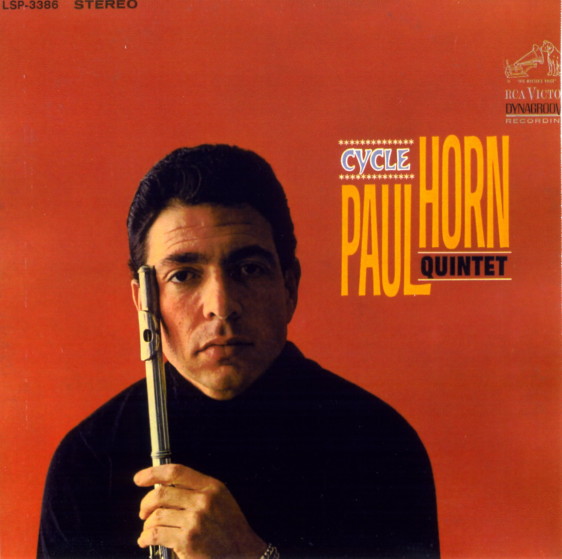
Cycle

Paul Horn - Cycles

 © Copyright ® Steven Cerra, copyright protected; all rights reserved.


According to Leroy Ostransky in The New Grove Dictionary of Jazz [Barry Kernfeld, ed/1994], Paul Horn, Paul (1930 - 2014] was a flutist, clarinetist, and saxophonist. He learned piano from the age of four and took up saxophone when he was twelve. He studied flute at Oberlin College Conservatory [BM 1952) and received the master's degree from the Manhattan School of Music (1953). He then joined the Sauter-Finegan Orchestra as tenor saxophone soloist. 


From 1956 to early 1958 he played in Chico Hamilton's quintet, and later worked in film studios in Hollywood. In 1965 he was the principal soloist in Lalo Schifrin's Jazz Suite on the Mass Texts, a role that brought him national publicity, and shortly afterwards he performed with Tony Bennett (1966). 


In 1967, after studying in India, Horn became a teacher of transcendental meditation. The following year he recorded unaccompanied flute solos in the Taj Mahal at Agra, India, using to full advantage the acoustic properties of the building, where the reverberation time is nearly half a minute; he also played in the Great Pyramid of Cheops, near Cairo. A collection of transcriptions of Horn's solos on the album Inside was published as P. Horn: Inside (New York, 1972). 


He moved in 1970 to an island near Victoria, British Columbia, where he formed his own quintet; he also had his own weekly television show and wrote film scores for the Canadian National Film Board, from whom he received an award for his music to Is and Eden. Horn toured China in 1979 and the USSR in 1983, and from 1981 he has managed his own record company, Golden Flute. His experiments have included recording the sounds made by killer whales as an accompaniment to his playing, but, although such innovations have earned him many admirers, critics have generally not been enthusiastic. Horn's style is cool and restrained, and he refers to his work as "universal" music.”


Surprisingly, not included in the discography accompanying Mr. Ostransky’s annotations about Horn are a series of recordings that Paul made from circa 1959 to 1965 with a quintet he front for the hifijazz, Columbia and RCA labels.


In addition to featuring his artistry on alto sax, flute and clarinet, Paul’s primary group at the time the hifijazz and Columbia albums were made was made up of Emil Richards on vibraphone, Paul Moer on piano, Jimmy Bond or Victor Gaskin on bass and either Billy Higgins or Milt Turner on drums.


The group’s 1960 hifijazz album - Something Blue - was one of the first recordings to combine the modal [scalar] approach introduced in Miles Davis’ Kind of Blue with the unusual or odd time signatures from the Dave Brubeck Quartet’s Time Out. Both recordings were issued in 1959.


As a result of his meetings with the sitar player Ravi Shankar a third element began to feature in Paul’s music in the early 1960s - transcendental meditation.


You can get a sense of the presence of the TM influence by reading the following introduction by Paul to his 1965 RCA recording Cycle.


Also reflected in Cycle is Paul’s growing interest in ethnomusicology which, along with his practice of transcendental meditation would help to transition him to the world or universal music which played such a large role in his later career.


Although the instrumentation for Paul’s quintet would remain the same - reeds/woodwinds, vibes, piano, bass and drums, on Cycle Paul brought onto his band some of the younger guys who were beginning to make a name for themselves in L.A. Jazz circles in the early 1960s and they are introduced in the following notes by Marv Newton.


I’m still wondering about the inclusion of bagpipes on two of the tunes on Cycle? Perhaps they can be attributed to the ethnomusicology influence?


“Everything is a cycle. The universe is a cycle. Life is a cycle. Evolution is a cycle. All is one. One is all. All is God. God is all. God is love.


Love is the motivating force behind creative expression. Music is God's love expressing through his creations to his creations. Music from any period of time and from any part of the world when played with the spirit of love is homogeneous and will be understood. Music is love's messenger. Love is God's message. 


The very gifted young musicians with me—Lynn Blessing, Bill Plummer, Mike Lang and Bill Goodwin-all have a message for you. Come listen with us. 


Om! 


Peacel”


The horizons of jazz in our time stretch into the infinite. They are bound only by the imaginations of such jazz-makers as Paul Horn. At thirty-five, Horn is one of the most vigorously creative artists in the field. Ever discontented with, and intolerant of, the static in jazz, Horn is constantly probing, search-home that point.


There is more than a scent of Highland heather in two of the selections here, Greensleeves and In the Bag. Not for the sale of mere novelty, but for a valid musical reason, Paul Horn made a marriage between his jazz quintet and the Scots bagpipes of master pipers John Turnbull and James Thomson. The result is for the listener to judge, yet we're certain of one thing: this is modern jazz with a difference — modern jazz with an excitement rarely heard on recordings. Only on one track, Cycle, is Horn's alto saxophone employed; the album in effect serves as a showcase for the leader's capacity as one of the leading flutists in jazz. In Shadows, he is heard on alto flute, exploiting that instrument's rich, velvet sound in these two tracks dedicated by Horn to Ravi Shankar, virtuoso Indian sitarist and that nation's leading composer. "I decided to do Shadows," said the leader, "on the spur of the moment. I thought of it at 7 p.m.; we recorded it at 8." His thinking, he says, was guided by consideration of the problem often posed: where does writing end in jazz, in music generally, and improvisation begin? Thus, while the opening statement of Shadows is the same on both tracks, the mid-section is wholly free-form improvisation between flute, vibraharp and bass. The dedication, Horn said: “Is because of my recent meeting and recording with Ravi Shankar and because he is one of the greatest musicians in the world.” Hence the inner spirit of the piece. One hears the vibraharp simulate the manner by which a sitarist strums periodically the basic tone row or scale of the Indian raga to establish a tonal base for improvisation. And one hears also the slurring string bass intoning, murmuring, commenting on the flute’s intentions. Oh his decision to release both takes of Shadows in the same album, Paul said: "Both were so good and so different, I couldn't make up my mind in the editing. So finally we decided to use both."


There is evident in Paul Horn's playing now a maturity that manifests itself to a great degree in his flute sound on Chim Chim Cheree, hard and penetrating, challenging the instrument's natural tone; it makes the difference between the pastoral pipe and the jazz horn. And in Cycle, the dry and driving sound of his alto sax is also illustrative of this growth.


Horn discovered the bagpipers, he says, following "some research" into the matter that disclosed a regular Tuesday night piping session at a rendezvous in Santa Monica, California. When approached by Paul with his rather unorthodox notion, the two pipers, he said, "were quite willing to try it." At the session, a pitch problem developed immediately, the pipes being a full half tone sharp, necessitating the Quintet's transposing. "At first," recalled Paul, "it looked like instant panic but we worked it out in the end." The other musicians in this album — "a group of young, talented fellows from the Coast," according to Paul-bear watching, Lynn Roberts Blessing, the vibraharpist, was born December 4, 1938, in Cicero, Indiana. At the age of eight, he had already decided on music as a career and started out on drums. At seventeen, he switched to vibes. Arriving in Los Angeles in 1959, Blessing played with the groups of Joe Loco and Ray Crawford before joining the Horn Quintet in June 1963.


Michael Anthony Lang [pianist] was born into a show business family in Los Angeles, December 10, 1941. His father, Jennings Lang, is a TV executive at Universal City (MCA, Revue Productions); his mother is Monica Lewis, the singer-actress. Mike began piano study at the age of four-and-a-half and continues his studies to this very day despite a B.A. in music and numerous awards. Mike has worked with Jack Montrose, Terry Pollard, Howard Rumsey, Leroy Vinnegar and Red Mitchell.


William "Bill" Plummer (bass) is a native of Boulder, Colorado, born March 27, 1938, but has lived in Los Angeles most of his life. A bassist for eighteen years, he studied music throughout school, making music his major subject at Los Angeles City College. Bill played with Miriam Makeba, Mavis Rivers, Herb Jeffries, Anita O'Day, Pete Jolly, Buddy De Franco, George Shearing, Shelly Manne and Nancy Wilson, among others, before joining the Horn Quintet in July 1963. He has been studying sitar for some time with Hari Har Rao, a former pupil of Ravi Shankar.


Bill Goodwin (percussion) is a native Los Angelean, born January 8,1942. He heard jazz as a child, he says, and "became interested." His late father was a jazz record collector,records led in turn to study of piano and saxophone, then to drums at the age of fifteen when he proceeded to teach himself percussion. Among those with whom Bill has worked are Frank Rosolino, Bud Shank, Art Pepper, Clare Fischer, Shorty Rogers, and the Lighthouse All-Stars.”


Monday, April 26, 2021

Jazz Lab- Donald Byrd and Gigi Gryce "In The Laboratory"

© -Steven Cerra, copyright protected; all rights reserved.


One thing often leads to another when the editorial staff at JazzProfiles goes hunting through its extensive library and recording collection to prepare these features.

Inevitably, we get so caught up listening to the music of a proposed feature such that other ideas about related postings come to mind.

This is exactly what happened while preparing a general overview of Noal Cohen and Michael Fitzgerald Second Edition of Rat Race Blues: The Musical Life of Gigi Gryce.

Out came the Gigi Gryce recordings and while listening to them I was reminded of my particular fondness for the LPs that Gigi made with The Jazz Lab, a quintet that he co-led with trumpeter Donald Byrd.

When we returned to Noal and Michael’s “Gigi Book,” here’s what we found about The Jazz Lab’s short-lived but amazingly productive existence.

“BY THE MEASURE OF RECORDING ACTIVITY, at least, Gryce's jazz career peaked in 1957. This would be his most productive period nor only as a leader, but as a sideman and writer on several recording sessions of high quality and great importance. It was at this time also that he would solidify his group conception of jazz, utilizing as a unifying element his series of recordings as co-leader of a quintet with Donald Byrd. And having entered the elite group of New York musicians capable of filling roles in a variety of settings, he was now getting sufficient work to ensure financial security. …

A very important event occurred in early 1957 when Gryce and Donald Byrd decided to join forces and co-lead the Jazz Lab ensemble. Seven years Gryce's junior, Byrd (1932-2013) relocated from his native Detroit to New York permanently in 1955, and soon thereafter was ensconced in the jazz scene, working and recording with nearly all of the hard bop stalwarts including Jackie McLean, John Coltrane, George Wallington, Art Blakey, and Horace Silver. He shared with Gryce a formal musical training, having received a Bachelor of Music degree from Wayne State University in 1954. Byrd also studied in Paris with Nadia Boulanger (1963) and later became an educator, obtaining advanced degrees from Manhattan School of Music and Columbia University. At the time of his death [2013] he was teaching at Delaware State University as a distinguished artist-in-residence.

Fluent and lyrical, Byrd's style, like that of Art Farmer before him, fit beautifully with the conception of Gryce, spinning long, graceful lines in his solos. His facility at very fast tempi was notable, and in general his approach was somewhat more aggressive than that of Farmer, but not to the extent that it conflicted with or overshadowed that of Gryce. Furthermore, Byrd had an interest in writing and would contribute both originals and arrangements of standard tunes to the group's repertoire.

The name "Jazz Lab" might suggest an esoteric or academic approach to ensemble performance, but in reality the music the band offered was most accessible. It consisted of original compositions (many taken from Gryce's publishing company) and cleverly reworked standards. Blues were an important component of the repertoire. Gryce, who appeared to be the more dominant musical force of the two co-leaders, summed up the philosophy the band espoused:

The Modern Jazz Quartet will come to a club or concert and play very soft subtle music, and then Blakey will come around like thunder. We're trying to do both, and a few other things he-sides. Insofar as I can generalize, our originals and arrangements concentrate on imaginative use of dynamics and very strong rhythmic and melodic lines. We try to both give the listener something of substance that he can feel and understand and also indicate to the oriented that we're trying to work in more challenging musical forms and to expand the language in other ways.

One advantage, we hope, of the varied nature of our library, which is now over a hundred originals and arrangements, is that in the course of a set, almost any listener can become fulfilled. If he doesn't dig one, he may well dig the next because it will often be considerably different. Several people write for us in addition to Donald Byrd, myself, and others within the group. We have scores by Benny Golson, Ray Bryant, and several more.

A point I'm eager to emphasize is that the title, Jazz Lab, isn't meant to connote that we're entirely experimental in direction. We try to explore-all aspects of modern jazz—standards, originals, blues, hard swing, anything that can be filled and transmuted with jazz feeling. Even our experimentations are quite practical; they're not exercises for their own sake. They have to communicate feeling. For example, if we use devices like counterpoint, we utilize them from inside jazz. We don't go into Bach, pick up an invention or an idea for one, and then come back into jazz. It all stays within jazz in feeling and rhythmic flow and syncopation. In any of our work in form, you don't get the feeling of a classical piece. This is one of the lessons I absorbed from Charlie Parker. I believe that one of the best — and still fresh — examples of jazz counterpoint is what Charlie did on "Chasing the Bird."

We want to show how deep the language is; in addition to working with new forms, we want to go back into the language, show the different ways the older material can be formed and re-formed. We want to have everything covered. My two favorite musicians among the younger players may give a further idea of what I believe. Sonny Rollins and Benny Golson are not playing the cliches, and they play as if they have listened with feeling and respect to the older men like Herschel Evans, Chu Berry, and Coleman Hawkins. They're not just hip, flashy moderns.

In its brief existence of barely a year, the Jazz Lab quintet utilized some of the finest rhythm section accompanists available: pianists Tommy Flanagan, Wynton Kelly, Hank Jones, and the underappreciated Wade Legge (1934-1963), a great talent who passed away at the age of only 29; bassists Wendell Marshall and Paul Chambers; and drummers Art Taylor and Osie Johnson. During this period, the Jazz Lab recorded for no fewer than five different labels, at thirteen sessions, producing a total of six LPs, all of which helped to establish a high standard for ensemble performance within the hard bop genre.'

On February 4, 1957, a landmark jazz recording took place, the debut of the Donald Byrd-Gigi Gryce Jazz Lab on Columbia Records [CL998], the most prestigious label in the business. At this time it was the label of Dave Brubeck, Miles Davis, and Duke Ellington. The Jazz Lab was signed just after Columbia dropped Art Blakey's Jazz Messengers upon completion of three albums, the first of which Byrd had participated in. Gryce returned to the nonet instrumentation (the working Jazz Lab quintet augmented by four additional horns) to reprise three compositions from earlier sessions. The fledgling Signal label on which Gryce had recorded in 1955 would soon be history, and Gryce was apparently hoping to capitalize on the distribution and publicity advantages now available through his association with a large, well-established record company.

To this end, "Speculation" was recorded for the third time in two years in very much the same format as the original version but with some modifications in the solo patterns. Now Byrd, Gryce, and pianist Tommy Flanagan each take an introductory chorus to begin the proceedings, but Gryce's solo following the theme is only two choruses as opposed to four in the earlier version. This is unfortunate since his playing is now more assertive and developed, although still very much in the Charlie Parker mold in this blues setting. In general, solo space on the nonet tracks is limited, probably because of Gryce's desire to include as much material as possible.

"Smoke Signal" is also performed using the same basic arrangement as on the Signal date but in a slightly shorter version wherein Gryce and Byrd split a chorus, the piano solo is omitted, and Art Taylor's drum feature is only a half chorus versus Kenny Clarke's earlier full-chorus outing. This track was not released with the original LP, Don Byrd-Gigi Gryce Jazz Lab, but appeared for the first time on a Columbia anthology entitled Jazz Omnibus (and not on CD until 2006) along with selections from many other artists associated with that label, including Louis Armstrong, Dave Brubeck, J.J. Johnson, Erroll Garner, Miles Davis, and Art Blakey.

Gryce's fourth recording of "Nica's Tempo" borrows elements from the Oscar Pettiford chart but features a new and attractively voiced introduction. The soloists, who again take only one chorus each, are the composer (in fine form), Byrd, Flanagan, and Taylor.

The very next day the quintet recorded two tracks, again for Columbia. Gryce's arrangement of "Over the Rainbow" is typical of the jazz Lab approach to standards, fresh yet accessible. This 1939 chestnut is transformed from a ballad into a swinging medium-tempo piece in which the melody has been reformulated rhythmically and embellished harmonically to provide a very appealing and memorable frame for the improvisations. Byrd, Gryce, and Flanagan each provide two choruses, while bassist Wendell Marshall plays one.
In the same lyrical vein, a second version of "Sans Souci" was recorded, this time at a faster tempo than in 1955 and now featuring Flanagan's celeste in the introduction and coda. Gryce utilized this instrument more and more during 1957 sessions for a different orchestral color (it was probably only available at the better recording studios). The pianist lays out or "strolls" during the first of Gryce's two solo choruses, a practice commonly employed by hard bop ensembles of this period to offer some variety and tension to performances. The routine conforms to the 1955 Prestige version with Byrd and Flanagan each taking two choruses, and the same shout variation leads to Marshall's solo which continues for another chorus. The final track of the first Columbia Jazz Lab LP was recorded a few weeks later (March 13) and was yet another return to earlier material, this time "Blue Concept," in its third incarnation. Wade Legge was back on piano in the quintet. Always conscious of form and eager to avoid a haphazard jam-session approach, Gryce updated the Prestige version with shout figures behind the horn soloists and an interlude incorporating "The Hymn," made famous by Charlie Parker.

On March 13, 1957, Gryce returned to the nonet instrumentation to record the very first version of Benny Golson's touching tribute to Clifford Brown, "I Remember Clifford," arranged by the composer, as well as the waltz by Randy Weston, "Little Niles," dedicated to Weston's son. Gryce's playing on all the Columbia sessions is especially robust and consistent, and his solo on the Weston piece displays his most soulful traits. Jimmy Cleveland has a special fondness for these Columbia sessions:

“Yeah, they're great. I thought they were just out of sight. The personnel was great, you know. That's the other thing too. He made sure he got the right kind of guys to work together great and get the concept that he’s looking for.””


Donald Byrd & Gigi Gryce. Jazz Lab Quintet.