Showing posts sorted by relevance for query black saint. Sort by date Show all posts

Saturday, August 19, 2023

Hentoff on Mingus - Nat Hentoff's Liner Notes to Charles Mingus' Recordings by Steve Siegel [From the Archives]

  © Copyright ® Steven Cerra, copyright protected; all rights reserved.


“Hentoff never attempted to tell us how to listen to Mingus or what to hear or, … , tell us how to feel. What he did do, however, was to make us aware of the complex nature of one of the giants of twentieth century American music, which, for many, served to appreciably enhance the listening experience as we made the connection between a composer, his creation and his performance.” 

- Steve Siegel

With previous features on pianist Wade Legge, the Great Day in Harlem Photograph “Mystery Man” - William J. Crump, drummer Frankie Dunlop and vocalist Jimmy Rushing, Steve Siegel has become something of a staff writer for JazzProfiles.

Here’s his latest effort on Nat Hentoff's Liner Notes written for many of the albums by legendary bassist, composer and bandleader, Charles Mingus.

For many years LP liner notes, also referred to as sleeve notes, were the primary source of information on Jazz musicians and their music. Individual books about the music and its makers comprised a relatively small offering during the first 50 years or of Jazz’s existence. Thankfully, magazines such as Down Beat, Metronome and Esquire picked up some of the slack in the USA. [England, and the Scandinavian and Continental European countries also had magazines devoted to Jazz as the primary source of information.]

Steve has done Jazz fans a real service by creating a descriptive commentary on Nat Hentoff’s learned writings for Charles’ recordings and synopsizing their unique nature and significance in this feature.

© -Steve Siegel copyright protected; all rights reserved; used with the author’s permission.


“Nat Hentoff had many interests as a writer — both within and outside the music industry. He authored over 30 books as well as a myriad of articles for various magazines, newspapers and online sources. However, his 50+ year career as a writer of liner notes for records and CDs is one area of his distinguished career that, as a body of work, has been somewhat overlooked, though his over 600 sets of liner notes, written for not only jazz but for rock, blues, folk and classical albums were, collectively, among the best written and most informative of the liner note genre. 

This isn’t surprising given that the generation of music buyers raised on 1960s-70s pop and rock albums were fed a steady stream of rather vapid liner notes written by either disc jockeys or in-house record company public relations people who were well paid to tell a rather young and gullible buyer just how great the album was as well as occasional hyperbole about how wise and “hip" purchasing that record would make them. So, the work of those writing liner notes, talented or otherwise, was often thought of as informative at best and rarely as inspirational or thought-provoking. After all, was there ever a published set of liner notes that didn't heap praise on the artist or their music? 

The history of comprehensive jazz liner note writing began with the introduction of the 12” long-playing album, first introduced by Columbia Records in 1948, which gradually, over the next eight years or so, replaced the 10” record at all the major record companies. (Interestingly, Blue Note records was one of the last labels to switch over to the 12" long playing record—in 1956.) These new 12” records provided a rather expansive back cover which demanded to be filled with something of added value to the purchaser. Record companies utilized this space for liner notes as well as promoting other releases on their label.

This need for liner notes provided many talented writers with second careers. Among those employed to do so was a young Nat Hentoff who joined with other jazz critics, whose collective writings during the bebop and post bop era of the1940’s and 1950’s, helped to legitimize jazz as a true art form. Jazz was serious art and critics writing the liner notes generally treated it as such. In the second half of the 1950s, Hentoff emerged as arguably the foremost craftsman of the art of liner note writing for jazz albums.

In reviewing a cross-section of liner notes that Hentoff wrote for jazz albums, his most prolific and absorbing output was the cogent and well-crafted work he provided for his friend, Charles Mingus.

“… There are nights when Mingus hovers over his (side)men like a brooding Zeus making up the final scorecard for eternity. His own moods are unpredictable. When he is buoyant, the bandstand becomes a picnic ground in Elysium. When he is angry, the room contracts and is filled with crackling tension of an impending electric storm. At these times, Mingus’ bass begins to mutter like a thunder bolt on the way. This huge cauldron of emotions at the center of a band can be taxing to a sideman; but if the latter has his own center of emotional and musical gravity, he can survive—and grow.”                                                           

Without knowing the source, one might assume that this evocative and thought-provoking quote would be sourced from academia—perhaps an MFA thesis or a doctoral dissertation. Actually, this wisdom came from the liner notes of a record album which could be had for $3.98 at your local record store in 1963.

This example of Hentoff’s work appeared in the liner notes to Charles Mingus' 1963 album, redundantly entitled, Charles Mingus Presents Charles Mingus. This writing is indicative of the style that Hentoff brought to liner note writing, as well as displaying his willingness to do a deep dive into the human element of music making. On many albums, Hentoff's notes are so well written as to occasionally qualitatively transcend the music within the record jacket. 

“Mingus is verbally articulate as well, and it's illuminating to follow the one immovable, uncompromising line of continuity that connects his development through the years—the line of personal and musical integrity and relentless self-searching. He may have a reputation for being an Avant- garde composer but he knows where he's come from.”

From: The Clown - 1957

Hentoff’s style of writing liner notes was rather unencumbered by the need to show off his knowledge of music. Hentoff was not a trained musician and showed little desire to unlock the technical mysteries of the music he was so passionate about. In many ways this freed him to write liner notes which dug into the artist and their aesthetic make-up.

As previously stated, his liner notes (as well as those of others), helped to legitimize jazz as an art form. He did this not by asserting in bold proclamations that the albums we were holding in our hands were terribly important because, as other writers were quick to state, they were examples of “America's only native art form,” or even by proving their importance through a musical analysis of what we were about to hear. Instead, Hentoff often accomplished this through serving as our personal escort through the mind of the artist who created the music, offering up a rich, multilayered understanding of the contextual socio-economic factors and the uniquely human traits of the artist. In the process he demonstrated how these factors melded together to create art. This dynamic approach served to humanize the artist and their art and in doing so encouraged the listener to further explore their music.

As an 18-year-old, new to the mysteries of jazz and eager to learn more about the music and its practitioners, I would devour liner notes in an effort to fully grasp why the music stirred such deep emotions in me. Many of the notes that I found to be particularly informative were signed by some guy named Nat Hentoff. As my modest record collection expanded, and even though I was struggling to understand the music and its powerful hold on my emotions, I sensed in Hentoff's writings that I was being moved not by the rather ephemeral and “guilty pleasure" emotions of the rock and pop that many of my generation were listening to, but by something that burrowed deeper into my soul. In retrospect, this was my first inkling of what the power of art to move one's emotions felt like. I now realized that the music produced by Ellington, Monk, Davis and Coltrane was indeed very special. I furthermore recognized that I had found something unique, something that was very adult, possessing magical qualities; something that I felt made me a rather special consumer of music among my teenage peers. 

Most importantly, I realized that I wasn't just a poser trying to set myself apart as a young sophisticate. There was a basis-in-fact for my musical choices.

I further realized that Hentoff's liner notes were but an aperitif—so much more remained to be learned about the music's practitioners, history and musical structure.

It was at this point that I became aware of Charles Mingus and realized the connection between his albums and Hentoff's liner notes.

“Charles Mingus' Workshop is fueled by his motions. These are not primarily exercises in form or attempts at "absolute music."  All of Mingus' writing is forcefully intended, as is his playing, to tell a story. For Mingus, music is his primary, essential means of communication with others. He tells in his work of his fears, his loves, his inflammable conflicts, his night-to-night battle to find and be himself.”  From: East Coasting- 1957

Hentoff was very close to Mingus and knew and understood this complex person as well as any jazz critic ever did. Because of this close relationship, Hentoff could do, in his liner notes, what he did best—view his subject more through a socio-psychological prism than through musical analysis or biography. This approach yielded some of his best work in the medium of liner note writing.

A clue as to why Hentoff, the non-musician, avoided the temptation to venture onto the slippery slope of opining about the technical nature of a performance as other jazz critics and liner note writers such as Leonard Feather and Ira Gitler did — both of whom were trained on an instrument — can be found in a story that Hentoff told in a Jazztimes interview:

“My daughter Miranda said to me once when she was hitting the clubs as a pianist and vocalist; she’s now mostly a teacher and composer, “You don’t know music technically. How come you can affect somebody’s living?” That bothered me a lot. I was walking down the street where I live and I saw Gil Evans coming toward me. I knew Gil when he was in Claude Thornhill’s band and I got to know him during the Miles Davis session of Sketches of Spain. So, I decided to make him my rabbi and I told him what was bothering me. And he said, “Look, I know musicians who know every note, every chord, everything. The only thing they lack is taste. I read you. I know what you like. I can tell whether you have an ear. So, stop worrying about that stuff.”

Hentoff's friendship with Mingus began in 1952 when Hentoff was working at radio station WMEX in Boston and Mingus was in town as a sideman with Billy Taylor. Hentoff's first interview with Mingus took place at WMEX. In 1953, Hentoff moved to New York City to become New York City editor for Downbeat and the daily routines of the aspiring bassist and the journalist often brought them together.

Eventually, their relationship evolved to the point that when the ever-insecure Mingus would place calls to friends at all hours and play the piano or an audio tape over the phone, explaining the work and asking those at the other end for their opinion, he included Hentoff as one of his sounding boards.

In 1958, when Mingus signed himself into the psychiatric wing of Bellevue Hospital and, after a few days, discovered that it wasn't as easy to sign oneself out, he called Hentoff who arranged for Mingus' on- and- off again psychoanalyst, Dr. Edwin Pollock, to vouch for Mingus, which ultimately led to his release.

Eventually, Hentoff managed, better than most in Mingus' orbit, to understand Mingus' contradictions, insecurities, fears — which bordered on paranoia — and wide-ranging views on a myriad of other topics. Foremost being the views he held on the pervasive racism he faced as a Black artist in the United States, as well as Mingus' thoughts on the process of losing one's identity in a rather crazy world. 

“This album is another stage in that self-discovery, and in many respects, it reaches emotional depths in Mingus that are more revelatory of the marrow of his struggle than anything he has yet recorded. What turns this raw introspection into art is that Mingus is also a singularly creative composer- leader. He has hammered out an unmistakable personal language through which he stimulates, disturbs, and re- energizes his listeners more consistency than most contemporary musicians in or out of jazz.”

From: Mingus Oh Yeah- 1962

In 1963, Mingus recorded two of his most highly regarded albums: The Black Saint and the Sinner Woman and Mingus, Mingus, Mingus, Mingus, Mingus. For the liner notes for Black Saint, Mingus shared the back cover with Dr. Edmund Pollock, his psychoanalyst. As was generally the case with Mingus, the motivation for this rather unusual arrangement was only known to him. Whatever the motivation, it is evident that Mingus left Pollock to his own means in structuring the notes. It appears that Pollock possibly had a record collection because his approach to writing the notes utilized as its model the rather typical annotated approach of listening to each selection and briefly offering analysis, the difference here being that the analysis that Pollock offers is not musical analysis but a rather bizarre selection-by-selection psychoanalysis of Mingus, the person, as viewed through his music. In essence, a music critic’s liner note format but with psychoanalytical content. It approaches a level of liner note parody which could only work on liner notes for a Charles Mingus album.

“In the first track of side 1, there is a solo voice expressed by the alto saxophone—a voice calling to others and saying ‘I am alone please, please join me!’ The deep mourning in tears of loneliness is echoed and re-echoed by the instruments in Mr. Mingus's attempt to express his feelings about separation from and among the discordant people of the world. The suffering is terrible to hear.” From Pollock ’s liner notes: The Black Saint and the Sinner Woman

Hentoff was employed to do the liner note honors for Mingus, Mingus, Mingus, Mingus, Mingus.

In contrast to Pollock's work on Black Saint. Hentoff also offers his take on Mingus' state of mind but does it in a much more straightforward manner.

Mingus's musical autobiography is a molten mixture of many elements. Among them are the daily exacerbations in the toughening of the spirit which comes from being a negro in this country. His music also addresses, however, the essential problem of every man — how does one live to the fullest of one’s capabilities?... Mingus has found a more self-liberating answer to this question than have most of his contemporaries. He is one of the most alive men I have ever known, and it is this commitment to living rather than only existing which makes his music so energizing and so insistently provocative.” 

In the early 1970s writer John F. Goodman began a series of far-reaching interviews with Mingus. In the instance where Goodman brings up the topic of jazz writers/critics it appears, from Mingus' response, that his relationship with Hentoff might have soured somewhat: 

Goodman: Nat Hentoff used to write some good stuff, used to know the music well, was very involved with it, very involved with you, I guess you were friends with him…

Mingus: Very good friends, I thought.

Goodman: I think that he writes for the Village Voice (on political and social issues) . It's not only bad writing, but…

Mingus: Well, I’ll tell you this, man, and you write this down, man. I'll tell you about Nat — he married a rich girl, a leftist. So, to keep her interest in him, and to keep his job as a writer…

Goodman: And she's a better writer than he is, incidentally.

Mingus: …here's a guy that leaves the guys and the thing he loves. And when you leave the thing you love, man, you ain’t got much left. Put that in the book.

Notwithstanding that Goodman, in this situation, hardly acts as an impartial interviewer, apparently Mingus felt betrayed that Hentoff, in a period where jazz was losing market share to rock music, had abandoned the sinking jazz ship. In actuality, Hentoff had, for some time, diversified his writings into areas well beyond music.

The reality here is that these comments were simply “Mingus being Mingus" because during the time that these interviews were being conducted, Hentoff continued to write liner notes for such late period Mingus albums as Changes One and Two and Cumba and Fusion.

Anybody who collects records will agree that liner notes, no matter how well conceived and expressed, cannot improve upon the quality of the music inscribed in the grooves of the enclosed piece of vinyl. That must stand on its own merits. But notes that complement the artistic expression contained within are, in essence, the nice big red bow that ties the experience together. (Think Bill Evans' liner notes for Kind of Blue.) Hentoff never attempted to tell us how to listen to Mingus or what to hear or, as Dr. Pollock did, tell us how to feel. What he did do, however, was to make us aware of the complex nature of one of the giants of twentieth century American music, which, for many, served to appreciably enhance the listening experience as we made the connection between a composer, his creation and his performance.

In an interview with JazzWax, Hentoff was asked how he wanted his writings to be remembered. His response: “You could hear the voices of the musicians in just about everything he wrote." Perhaps they were never heard more loudly than in his writings about Charles Mingus. 


Thursday, January 7, 2021

Hentoff on Mingus - Nat Hentoff's Liner Notes to Charles Mingus' Recordings by Steve Siegel

 © Copyright ® Steven Cerra, copyright protected; all rights reserved.


“Hentoff never attempted to tell us how to listen to Mingus or what to hear or, … , tell us how to feel. What he did do, however, was to make us aware of the complex nature of one of the giants of twentieth century American music, which, for many, served to appreciably enhance the listening experience as we made the connection between a composer, his creation and his performance.” 

- Steve Siegel

With previous features on pianist Wade Legge, the Great Day in Harlem Photograph “Mystery Man” - William J. Crump, drummer Frankie Dunlop and vocalist Jimmy Rushing, Steve Siegel has become something of a staff writer for JazzProfiles.

Here’s his latest effort on Nat Hentoff's Liner Notes written for many of the albums by legendary bassist, composer and bandleader, Charles Mingus.

For many years LP liner notes, also referred to as sleeve notes, were the primary source of information on Jazz musicians and their music. Individual books about the music and its makers comprised a relatively small offering during the first 50 years or of Jazz’s existence. Thankfully, magazines such as Down Beat, Metronome and Esquire picked up some of the slack in the USA. [England, and the Scandinavian and Continental European countries also had magazines devoted to Jazz as the primary source of information.]

Steve has done Jazz fans a real service by creating a descriptive commentary on Nat Hentoff’s learned writings for Charles’ recordings and synopsizing their unique nature and significance in this feature.

© -Steve Siegel copyright protected; all rights reserved; used with the author’s permission.


“Nat Hentoff had many interests as a writer — both within and outside the music industry. He authored over 30 books as well as a myriad of articles for various magazines, newspapers and online sources. However, his 50+ year career as a writer of liner notes for records and CDs is one area of his distinguished career that, as a body of work, has been somewhat overlooked, though his over 600 sets of liner notes, written for not only jazz but for rock, blues, folk and classical albums were, collectively, among the best written and most informative of the liner note genre. 

This isn’t surprising given that the generation of music buyers raised on 1960s-70s pop and rock albums were fed a steady stream of rather vapid liner notes written by either disc jockeys or in-house record company public relations people who were well paid to tell a rather young and gullible buyer just how great the album was as well as occasional hyperbole about how wise and “hip" purchasing that record would make them. So, the work of those writing liner notes, talented or otherwise, was often thought of as informative at best and rarely as inspirational or thought-provoking. After all, was there ever a published set of liner notes that didn't heap praise on the artist or their music? 

The history of comprehensive jazz liner note writing began with the introduction of the 12” long-playing album, first introduced by Columbia Records in 1948, which gradually, over the next eight years or so, replaced the 10” record at all the major record companies. (Interestingly, Blue Note records was one of the last labels to switch over to the 12" long playing record—in 1956.) These new 12” records provided a rather expansive back cover which demanded to be filled with something of added value to the purchaser. Record companies utilized this space for liner notes as well as promoting other releases on their label.

This need for liner notes provided many talented writers with second careers. Among those employed to do so was a young Nat Hentoff who joined with other jazz critics, whose collective writings during the bebop and post bop era of the1940’s and 1950’s, helped to legitimize jazz as a true art form. Jazz was serious art and critics writing the liner notes generally treated it as such. In the second half of the 1950s, Hentoff emerged as arguably the foremost craftsman of the art of liner note writing for jazz albums.

In reviewing a cross-section of liner notes that Hentoff wrote for jazz albums, his most prolific and absorbing output was the cogent and well-crafted work he provided for his friend, Charles Mingus.

“… There are nights when Mingus hovers over his (side)men like a brooding Zeus making up the final scorecard for eternity. His own moods are unpredictable. When he is buoyant, the bandstand becomes a picnic ground in Elysium. When he is angry, the room contracts and is filled with crackling tension of an impending electric storm. At these times, Mingus’ bass begins to mutter like a thunder bolt on the way. This huge cauldron of emotions at the center of a band can be taxing to a sideman; but if the latter has his own center of emotional and musical gravity, he can survive—and grow.”                                                           

Without knowing the source, one might assume that this evocative and thought-provoking quote would be sourced from academia—perhaps an MFA thesis or a doctoral dissertation. Actually, this wisdom came from the liner notes of a record album which could be had for $3.98 at your local record store in 1963.

This example of Hentoff’s work appeared in the liner notes to Charles Mingus' 1963 album, redundantly entitled, Charles Mingus Presents Charles Mingus. This writing is indicative of the style that Hentoff brought to liner note writing, as well as displaying his willingness to do a deep dive into the human element of music making. On many albums, Hentoff's notes are so well written as to occasionally qualitatively transcend the music within the record jacket. 

“Mingus is verbally articulate as well, and it's illuminating to follow the one immovable, uncompromising line of continuity that connects his development through the years—the line of personal and musical integrity and relentless self-searching. He may have a reputation for being an Avant- garde composer but he knows where he's come from.”

From: The Clown - 1957

Hentoff’s style of writing liner notes was rather unencumbered by the need to show off his knowledge of music. Hentoff was not a trained musician and showed little desire to unlock the technical mysteries of the music he was so passionate about. In many ways this freed him to write liner notes which dug into the artist and their aesthetic make-up.

As previously stated, his liner notes (as well as those of others), helped to legitimize jazz as an art form. He did this not by asserting in bold proclamations that the albums we were holding in our hands were terribly important because, as other writers were quick to state, they were examples of “America's only native art form,” or even by proving their importance through a musical analysis of what we were about to hear. Instead, Hentoff often accomplished this through serving as our personal escort through the mind of the artist who created the music, offering up a rich, multilayered understanding of the contextual socio-economic factors and the uniquely human traits of the artist. In the process he demonstrated how these factors melded together to create art. This dynamic approach served to humanize the artist and their art and in doing so encouraged the listener to further explore their music.

As an 18-year-old, new to the mysteries of jazz and eager to learn more about the music and its practitioners, I would devour liner notes in an effort to fully grasp why the music stirred such deep emotions in me. Many of the notes that I found to be particularly informative were signed by some guy named Nat Hentoff. As my modest record collection expanded, and even though I was struggling to understand the music and its powerful hold on my emotions, I sensed in Hentoff's writings that I was being moved not by the rather ephemeral and “guilty pleasure" emotions of the rock and pop that many of my generation were listening to, but by something that burrowed deeper into my soul. In retrospect, this was my first inkling of what the power of art to move one's emotions felt like. I now realized that the music produced by Ellington, Monk, Davis and Coltrane was indeed very special. I furthermore recognized that I had found something unique, something that was very adult, possessing magical qualities; something that I felt made me a rather special consumer of music among my teenage peers. 

Most importantly, I realized that I wasn't just a poser trying to set myself apart as a young sophisticate. There was a basis-in-fact for my musical choices.

I further realized that Hentoff's liner notes were but an aperitif—so much more remained to be learned about the music's practitioners, history and musical structure.

It was at this point that I became aware of Charles Mingus and realized the connection between his albums and Hentoff's liner notes.

“Charles Mingus' Workshop is fueled by his motions. These are not primarily exercises in form or attempts at "absolute music."  All of Mingus' writing is forcefully intended, as is his playing, to tell a story. For Mingus, music is his primary, essential means of communication with others. He tells in his work of his fears, his loves, his inflammable conflicts, his night-to-night battle to find and be himself.”  From: East Coasting- 1957

Hentoff was very close to Mingus and knew and understood this complex person as well as any jazz critic ever did. Because of this close relationship, Hentoff could do, in his liner notes, what he did best—view his subject more through a socio-psychological prism than through musical analysis or biography. This approach yielded some of his best work in the medium of liner note writing.

A clue as to why Hentoff, the non-musician, avoided the temptation to venture onto the slippery slope of opining about the technical nature of a performance as other jazz critics and liner note writers such as Leonard Feather and Ira Gitler did — both of whom were trained on an instrument — can be found in a story that Hentoff told in a Jazztimes interview:

“My daughter Miranda said to me once when she was hitting the clubs as a pianist and vocalist; she’s now mostly a teacher and composer, “You don’t know music technically. How come you can affect somebody’s living?” That bothered me a lot. I was walking down the street where I live and I saw Gil Evans coming toward me. I knew Gil when he was in Claude Thornhill’s band and I got to know him during the Miles Davis session of Sketches of Spain. So, I decided to make him my rabbi and I told him what was bothering me. And he said, “Look, I know musicians who know every note, every chord, everything. The only thing they lack is taste. I read you. I know what you like. I can tell whether you have an ear. So, stop worrying about that stuff.”

Hentoff's friendship with Mingus began in 1952 when Hentoff was working at radio station WMEX in Boston and Mingus was in town as a sideman with Billy Taylor. Hentoff's first interview with Mingus took place at WMEX. In 1953, Hentoff moved to New York City to become New York City editor for Downbeat and the daily routines of the aspiring bassist and the journalist often brought them together.

Eventually, their relationship evolved to the point that when the ever-insecure Mingus would place calls to friends at all hours and play the piano or an audio tape over the phone, explaining the work and asking those at the other end for their opinion, he included Hentoff as one of his sounding boards.

In 1958, when Mingus signed himself into the psychiatric wing of Bellevue Hospital and, after a few days, discovered that it wasn't as easy to sign oneself out, he called Hentoff who arranged for Mingus' on- and- off again psychoanalyst, Dr. Edwin Pollock, to vouch for Mingus, which ultimately led to his release.

Eventually, Hentoff managed, better than most in Mingus' orbit, to understand Mingus' contradictions, insecurities, fears — which bordered on paranoia — and wide-ranging views on a myriad of other topics. Foremost being the views he held on the pervasive racism he faced as a Black artist in the United States, as well as Mingus' thoughts on the process of losing one's identity in a rather crazy world. 

“This album is another stage in that self-discovery, and in many respects, it reaches emotional depths in Mingus that are more revelatory of the marrow of his struggle than anything he has yet recorded. What turns this raw introspection into art is that Mingus is also a singularly creative composer- leader. He has hammered out an unmistakable personal language through which he stimulates, disturbs, and re- energizes his listeners more consistency than most contemporary musicians in or out of jazz.”

From: Mingus Oh Yeah- 1962

In 1963, Mingus recorded two of his most highly regarded albums: The Black Saint and the Sinner Woman and Mingus, Mingus, Mingus, Mingus, Mingus. For the liner notes for Black Saint, Mingus shared the back cover with Dr. Edmund Pollock, his psychoanalyst. As was generally the case with Mingus, the motivation for this rather unusual arrangement was only known to him. Whatever the motivation, it is evident that Mingus left Pollock to his own means in structuring the notes. It appears that Pollock possibly had a record collection because his approach to writing the notes utilized as its model the rather typical annotated approach of listening to each selection and briefly offering analysis, the difference here being that the analysis that Pollock offers is not musical analysis but a rather bizarre selection-by-selection psychoanalysis of Mingus, the person, as viewed through his music. In essence, a music critic’s liner note format but with psychoanalytical content. It approaches a level of liner note parody which could only work on liner notes for a Charles Mingus album.

“In the first track of side 1, there is a solo voice expressed by the alto saxophone—a voice calling to others and saying ‘I am alone please, please join me!’ The deep mourning in tears of loneliness is echoed and re-echoed by the instruments in Mr. Mingus's attempt to express his feelings about separation from and among the discordant people of the world. The suffering is terrible to hear.” From Pollock ’s liner notes: The Black Saint and the Sinner Woman

Hentoff was employed to do the liner note honors for Mingus, Mingus, Mingus, Mingus, Mingus.

In contrast to Pollock's work on Black Saint. Hentoff also offers his take on Mingus' state of mind but does it in a much more straightforward manner.

Mingus's musical autobiography is a molten mixture of many elements. Among them are the daily exacerbations in the toughening of the spirit which comes from being a negro in this country. His music also addresses, however, the essential problem of every man — how does one live to the fullest of one’s capabilities?... Mingus has found a more self-liberating answer to this question than have most of his contemporaries. He is one of the most alive men I have ever known, and it is this commitment to living rather than only existing which makes his music so energizing and so insistently provocative.” 

In the early 1970s writer John F. Goodman began a series of far-reaching interviews with Mingus. In the instance where Goodman brings up the topic of jazz writers/critics it appears, from Mingus' response, that his relationship with Hentoff might have soured somewhat: 

Goodman: Nat Hentoff used to write some good stuff, used to know the music well, was very involved with it, very involved with you, I guess you were friends with him…

Mingus: Very good friends, I thought.

Goodman: I think that he writes for the Village Voice (on political and social issues) . It's not only bad writing, but…

Mingus: Well, I’ll tell you this, man, and you write this down, man. I'll tell you about Nat — he married a rich girl, a leftist. So, to keep her interest in him, and to keep his job as a writer…

Goodman: And she's a better writer than he is, incidentally.

Mingus: …here's a guy that leaves the guys and the thing he loves. And when you leave the thing you love, man, you ain’t got much left. Put that in the book.

Notwithstanding that Goodman, in this situation, hardly acts as an impartial interviewer, apparently Mingus felt betrayed that Hentoff, in a period where jazz was losing market share to rock music, had abandoned the sinking jazz ship. In actuality, Hentoff had, for some time, diversified his writings into areas well beyond music.

The reality here is that these comments were simply “Mingus being Mingus" because during the time that these interviews were being conducted, Hentoff continued to write liner notes for such late period Mingus albums as Changes One and Two and Cumba and Fusion.

Anybody who collects records will agree that liner notes, no matter how well conceived and expressed, cannot improve upon the quality of the music inscribed in the grooves of the enclosed piece of vinyl. That must stand on its own merits. But notes that complement the artistic expression contained within are, in essence, the nice big red bow that ties the experience together. (Think Bill Evans' liner notes for Kind of Blue.) Hentoff never attempted to tell us how to listen to Mingus or what to hear or, as Dr. Pollock did, tell us how to feel. What he did do, however, was to make us aware of the complex nature of one of the giants of twentieth century American music, which, for many, served to appreciably enhance the listening experience as we made the connection between a composer, his creation and his performance.

In an interview with JazzWax, Hentoff was asked how he wanted his writings to be remembered. His response: “You could hear the voices of the musicians in just about everything he wrote." Perhaps they were never heard more loudly than in his writings about Charles Mingus. 


Tuesday, May 4, 2021

See/Saw. Looking at Photographs, by Geoff Dyer

For as long as I can remember, Jazz and photography have been inextricably linked. 

I hear one and I see the other.

While not strictly speaking about Jazz photography - with one notable exception [Roy Decarava] - Christopher Irmscher’s review of Geoff Dyer’s new book See/Saw. Looking at Photographs [Graywolf 2021] reveals the many ways in which photographs are so powerful, both as an artform themselves, and in their relationship to other forms of art.

Like Jazz, “what a photograph documents is gone for good,”

Like the next Jazz improvisation, “... each photograph also inevitably points toward the future, to the next photograph or series of photographs [improvisations] about a similar subject.”

And like each photograph, each Jazz recording “ … mak[es] a distant past present again every time we look at [listen to] it.”

—Mr. Irmscher is the co-editor of the Od Review, an online journal for the photographic arts.

Copyright ©2020 Dow Jones & Company, Inc. All Rights Reserved. 

Appeared in the May 1, 2021, print edition as 'Every Picture Tells a Story.'

Geoff Dyer begins his rich new collection of essays with a consideration of “Saint-Cloud, 1924,” a magical picture by the French photographer Eugène Atget (1857-1927), quietly reflective in the way some Rilke poems are. Here, claims Mr. Dyer with his trademark playfulness, Atget’s “Atgetness” is in full display. We see a landscape devoid of human presence: a broad, tree-lined promenade, divided by rows of ornamental shrubs, receding into a hazy, mysterious distance that, thanks to the camera’s off-center position, seems even farther away than it is. Marble statues preside over the emptiness. The time is early morning; no one except the photographer is up and about. Whatever life there is in this park—originally created for the brother of Louis XIV—appears to reside in the billowing trees on either side.

A photograph is “a witness of something that is no more,” sighed the French critic Roland Barthes in “Camera Lucida” (1980), a book that has cast its melancholy shadow over most recent writing about the medium. For Barthes, what a photograph documents is gone for good, like that misty morning in Saint-Cloud, or it will be gone soon. But where Barthes always felt the painful prick of his own mortality, Mr. Dyer’s “See/Saw” finds the delicate promise of new life: A photograph, like one of the silent statues in the royal gardens of Saint-Cloud (that’s Mr. Dyer’s comparison), endures, at least for now, making a distant past present again every time we look at it. We see anew what someone else once saw, a dizzying experience to which the clever title of the book alludes. Averse to jargon, Mr. Dyer never strays too far away from an ordinary viewer’s experience. A proud interloper in the compartmentalized halls of academe—an experience he has previously celebrated in the witty essay “My Life as a 

Apart from lifting the past into our present—allowing us, in the case of Atget’s Saint-Cloud photograph, to wander, with our mind’s eye, through a vacant park as if not a day had passed since 1924—each photograph also inevitably points toward the future, to the next photograph or series of photographs about a similar subject. If Barthes, somewhat exaggeratedly, dubbed photographers “agents of death,” Mr. Dyer celebrates them as active participants in an ongoing conversation—an idea reflected in the title of his brilliant 2005 book on the subject, “The Ongoing Moment.” Thus Atget’s austere street scenes live on in the impressions of Paris recorded during the interwar period by Ilse Bing (1899-1998), the “Queen of the Leica,” the deserted Southern plantation homes visited, during the 1940s, by Walker Evans (1903-75), or the recent reworkings of Google Street View by the photographer Michael Wolf (1954-2019).

In the preface to “See/Saw,” Mr. Dyer asserts, entirely too modestly, that writing about photography has just been a sideline for him. Not counting “The Ongoing Moment,” he has published prolifically on the subject, in prominent places such as the Guardian, the New Republic and the New York Times Magazine—enough for him to envision, tongue in cheek, a “deathbed or—yikes!—posthumous edition” of his collected photography essays. Fortunately, that grand finale still seems a long way off. In the interim, the 52 scintillating essays in “See/Saw” provide reassuring Despite the range and the staggering number of artists represented, most of Mr. Dyer’s essays remain focused on just one photograph, each of them beautifully reproduced by Graywolf Press. Intriguingly, the timeless statues of Saint-Cloud lurk behind many of Mr. Dyer’s choices, which reveal a predilection—handled with a degree of self-conscious irony—for impersonal structures, such as houses, streets, and monuments. Thus, Mr. Dyer praises the work of American photographer Bevan Davies (born 1941), whose photographs, in Mr. Dyer’s understanding, exemplify how buildings, if they had cameras, would take pictures of each other. And he admires the dreamy compositions of Oliver Curtis (born 1963), which show us what we, the visitors, would look like from the perspective of a monument such as the Taj Mahal—a bunch of scraggly, indistinct shapes milling around the famous Basin of Abundance.

The author of more than a dozen works of fiction and criticism [including But Beautiful: A Book About Jazz - 2009], Mr. Dyer has cultivated an unmistakable narrative voice, by turns lofty and self-deprecating, acerbic and arch, dismissive and sympathetic. A virtuoso example of his skill is his meditation on August Sander’s 1926 portrait of the forgotten writer Otto Brües (1897-1967). His head drooping like that of a sick bird, eyes watery behind thick, wire-framed glasses, Herr Brües sits hunched, as if imprisoned in his oversized black suit, his right hand resting idly on his right leg, an unhappy young man grown old before his time. Reflecting on Sander’s photograph, Mr. Dyer lets his imagination run riot: If Brües’s black-trousered leg, looming large at the bottom of the picture, looks like it could be a sort of writing desk, it reminds him also of the plinth of a statue—which would, jokes Mr. Dyer, make that entire portrait a “photographic memorial to the unknown writer.” Or, wonders Mr. Dyer, does that leg rather represent the dark, “swampy ooze” from which all intelligent life, including that of the prematurely petrified Herr Brües, once sprang?

If these ruminations strike you as a little overwrought, that is Mr. Dyer’s intention. His readings, entertaining, nuanced and irreverent, never pretend to uncover any single truth about a photograph. Instead, they are an attentive viewer’s creative attempts—always incomplete, often fantastical, sometimes wrong—to determine what a photograph might mean. Even cursory biographical research (which Mr. Dyer concedes he hasn’t undertaken) would have disclosed the unpleasant fact that, a few years later, Otto Brües joined eighty-seven other writers in signing a pledge of loyalty to Adolf Hitler. But such additional research would only have distracted from Mr. Dyer’s point—that a good photograph is always superior to the stories we tell about it. Anything truly relevant about Otto Brües’s life is already present in Sander’s sardonic memorial.

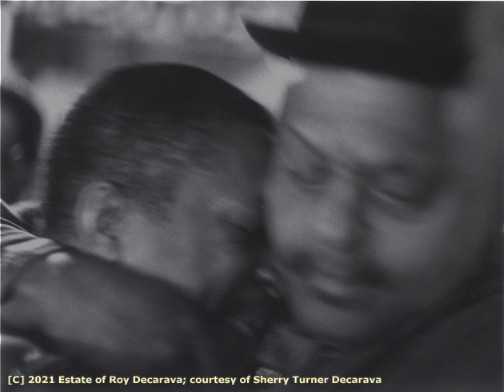
Among all the photographs gathered in “See/Saw,” the one likely closest to Mr. Dyer’s heart is a blurry black-and-white portrait of two jazz giants, Ben Webster and John Coltrane, taken in 1960 by the inimitable Roy DeCarava (1919-2009), with what must have been the slowest shutter speed possible. For Mr. Dyer, this picture is a monument of sorts, too, a commemoration of an intimate moment carved in such a way from the flux of time that, like the music of Coltrane and Webster, it remains alive today. With Webster’s giant hand wrapped around his jaw, Coltrane, his face visible only in profile, sinks into his older friend’s embrace. Topped by the inevitable hat, Webster’s head floats beside Coltrane’s, huge, like that of a benign god just come in from the mist. The two men’s closed eyes reflect the intensity of their hug, which spills beyond the frame into the viewer’s world. Webster was already past his prime then, but, thanks to DeCarava’s now iconic photograph, what could have been a melancholy leave-taking becomes also, as Mr. Dyer suggests, a new beginning for both men—one that, like a love supreme, lasts longer than a lifetime.”


Monday, March 14, 2011

Art Ensemble of Chicago


© -Steven Cerra, copyright protected; all rights reserved.

“With a mixture of parody and the obtuse, humor and intuition the Art Ensemble of Chicago combined their considerable skills to common cause and emerged as perhaps the most innovative group of the 1970s.”
- Stuart Nicholson, Jazz: The 1980s Resurgence, p. 129.

For a variety of reasons, some to do with preferences, but mostly to do with unawareness, the editorial staff at JazzProfiles, missed much of the Free Jazz movement at its inception.

Perhaps Free Jazz movements might be a better term.

But thanks to a variety of informative sources that have helped to educate us on the subject, it has been great fun to subsequently discover some aspects of this style of Jazz that suit our taste. [“one is never too old to learn something new?”].

One of these discoveries was the Art Ensemble of Chicago, whose music had to be seen as well as heard.

Although AEC did not travel very much during the latter years they were together, I was fortunate to see and to hear the group at the “old” Yoshi’s Jazz and Supper Club in Berkeley, CA in the mid-1990s.

You can get a basic “feel” for their music from viewing the following video tribute to them.


And here are some authoritative descriptions of what’s on offer in the AEC’s approach to Jazz.

“The Art Ensemble, like many other groups and musicians who emerged in this period, was an offshoot of the Chicago musicians' cooperative known as the Association for the Advancement of Crea­tive Musicians. Muhal Richard Abrams, who founded the AACM in 1965 and served as a mentor to a generation of avant-gardists, was a talented pianist and composer whose best recordings, among them Levels and Degrees of Light (Delmark) and The Hearinga Suite (Black Saint), manage a graceful balancing act between ensemble writing and unfettered improvisation.

The Art Ensemble of Chicago, consisting of saxophonists Joseph Jarman and Roscoe Mitchell, trumpeter Lester Bowie, bassist Malachi Favors Magoustous, and drummer Famoudou Don Moye, learned much from Abrams. But their approach probably owed even more to the otherworldly showmanship of the pianist-composer-bandleader Sun Ra, who had been a fixture on the Chicago scene for years and served as a kind of spiritual godfather to the AACM. Taking its cue from Sun Ra, the group enlivened its performances with costumes, makeup, poetry recitations, and even the occasional comedy routine.

If the Art Ensemble's music was sometimes in danger of getting lost in the shuffle, it was powerful enough to withstand the onslaught, and it was varied enough to hold audiences' attention. (Jarman, Mitchell, and Bowie were all prolific composers, and all three re­corded several albums as leaders in addition to their work with the Art Ensemble.) Indeed, with its mixture of free improvisation and complex composition, seasoned with an overlay of African and other influences, the Art Ensemble's music arguably merited the label "fu­sion" as much as anyone else's did—although the group itself pre­ferred "great black music." (And as if to suggest that categories are meaningless anyway, in the late seventies and early eighties the Art Ensemble made a series of outstanding albums, including Nice Guys and Urban Bushmen, for ECM Records, supposedly the most "Euro­pean" of all jazz labels.)” – Peter Keepnews in Bill Kirchner, ed., The Oxford Companion to Jazz, p. 494


“The Art Ensemble of Chicago was created in the mid sixties by Roscoe Mitchell, Lester Bowie and Malachi Favors, all members of Chicago's Association for the Advance­ment of Creative Music (AACM). They recorded for Delmark and Nessa, two small independent labels. Later, during a two year stay in Europe, they made a dozen albums for various European labels.

This, I believe, is their most versatile and exciting album yet. It is the complete and unedited non-stop per­formance that they gave at the 1972 Ann Arbor festival. All the excitement, originality, tightness, and brilliance that this group possesses can be heard on this album. Please listen to this record in its entirety without interruption to grasp the full beauty and impact of their performance.

The Art Ensemble of Chicago may be the most sig­nificant and creative group in the new music since the original Ornette Coleman and John Coltrane quartets.”

Michael Cuscuna, original liner notes to The Art Ensemble of Chicago Bap-Tizum

“The Art Ensemble initially featured Roscoe Mitchell, Joseph Jarman, Lester Bowie, Malachi Favors, and, for a brief spell, drummer Phillip Wilson. The band ig­nored the division of labor traditionally practiced by most jazz combos. True, Mitchell and Jarman could brandish their saxophones in the front line, but they were just as likely to be accompanists as lead soloists, just as inclined to play percus­sion or unusual wind instruments—conch shells or whistles—as the alto or tenor sax.

Lester Bowie could show off his mastery of a wide range of trumpet styles, covering the gamut from pseudo-early jazz growls and groans to up-to-date funk grooves. But he also might energize an Art Ensemble performance by pounding on the bass drum or engaging in offbeat on-stage antics. Malachi Favors served as bassist for the group, but almost any string instrument, from banjo to zither, might grace his hands, as well as the ever-present percussion instruments that became Art Ensemble trademarks. Indeed, the Ensemble reportedly brought some five hundred music-making implements with them when they moved to France at the close of the 1960s.


The Art Ensemble caught the attention of European audiences in this new set­ting. Within a few months of arriving, the band had recorded a half-dozen projects, including some of their finest work. Recordings were supplemented by frequent concerts, radio performances, and commissions for movie scores. During this pe­riod, percussionist Don Moye joined the band. Although this addition was lamented by some of the band's fans—who saw it giving a more conventional rhythmic foun­dation to the Art Ensemble's free-flowing sound collages—Moye's background in free jazz and his wide-ranging collection of percussion instruments fit nicely with the Ensemble's artistic impulses. By the same token, Moye added a more structured and overtly polyrhythmic, often more insistent, undercurrent to the band's sound. …

Concerts and club appearances conveyed the band's essence in a way that the group's later studio sessions often only approximated. In truth, this band needed to be seen as well as heard. Dressed in African garb, their faces painted or wearing masks, surrounded by their "little instruments"—so many that it took two hours simply to set up the bandstand—the Art Ensemble presented a striking appearance that had few precedents in the jazz world. The group's various live recordings, such as Live at Mandel Hall, Baptizum, and Urban Bushmen, may stop short of presenting the full experience of the Art Ensemble in performance, although they still manage to convey the band's vitality and unpredictability, as well as its kaleidoscopic range.”
- Ted Gioia, The History of Jazz, pp. 357-358 [paragraphing modified].

“As a mix of personalities, the Ensemble has always been in a crisis of temperament, with Bowie's arsenal of sardonic inflexions pitched against Mitchell's schematic constructions, Jarman's fierce and elegant improvis­ing and Favors's other-worldly commentaries from the bass. Sat­ire, both musical and literal, has sustained much of their music; long- and short-form pieces have broken jazz structure down into areas of sound and silence. At their best, they are as uncom­promisingly abstract as the most severe European players, yet their materials are cut from the heart of the traditions of black music in Chicago and St Louis.”
- Richard Cook and Brian Morton, The Penguin Guide to Jazz on CD, 6th ed.,
 p. 56.

“That generation of musicians, building on the achievements of post-bop apostates who questioned the rules and put their ids on the table, began with the assumption that playing free meant just that. It wasn't a matter of whether or not you used chords or swing rhythms or the tem­pered scale, or of how you measured improvisation against composition, but of having the options—of choosing to do with or without any of the tools of music in any given performance.

One measure of the Great Black Music vaunted by the Art Ensemble was embodied in the freedom to be or not to be free, and followed from a fundamental idea: Jazz is a classical music with an established yet expanding canon of masterworks, wed to a language of rules and structures. In playing off the acknowledged clas­sics, the shared postulates, the new jazz of the '60s kept the intrinsic aesthetic alive, demonstrating to the max that a worthy foundation can withstand every sort of experimentation, however adventitious or pro­vocative it may seem. The jazz avant-garde, like the classical avant-garde, is empowered by the fact that true classicism is impervious to anything but prostration. Imitation, as Emerson pointed out, is suicide.”
- Gary Giddins, Visions of Jazz, p. 503 [paragraphing modified]

If you are looking for a gateway into the world of Free Jazz, the Art Ensemble of Chicago will serve as an excellent entry point.