Showing posts with label Ann Braithwaite. Show all posts

Tuesday, July 22, 2025

Cinnamon Flower - The Expanded Edition - The Charlie Rouse Band

 © Copyright ® Steven Cerra, copyright protected; all rights reserved.
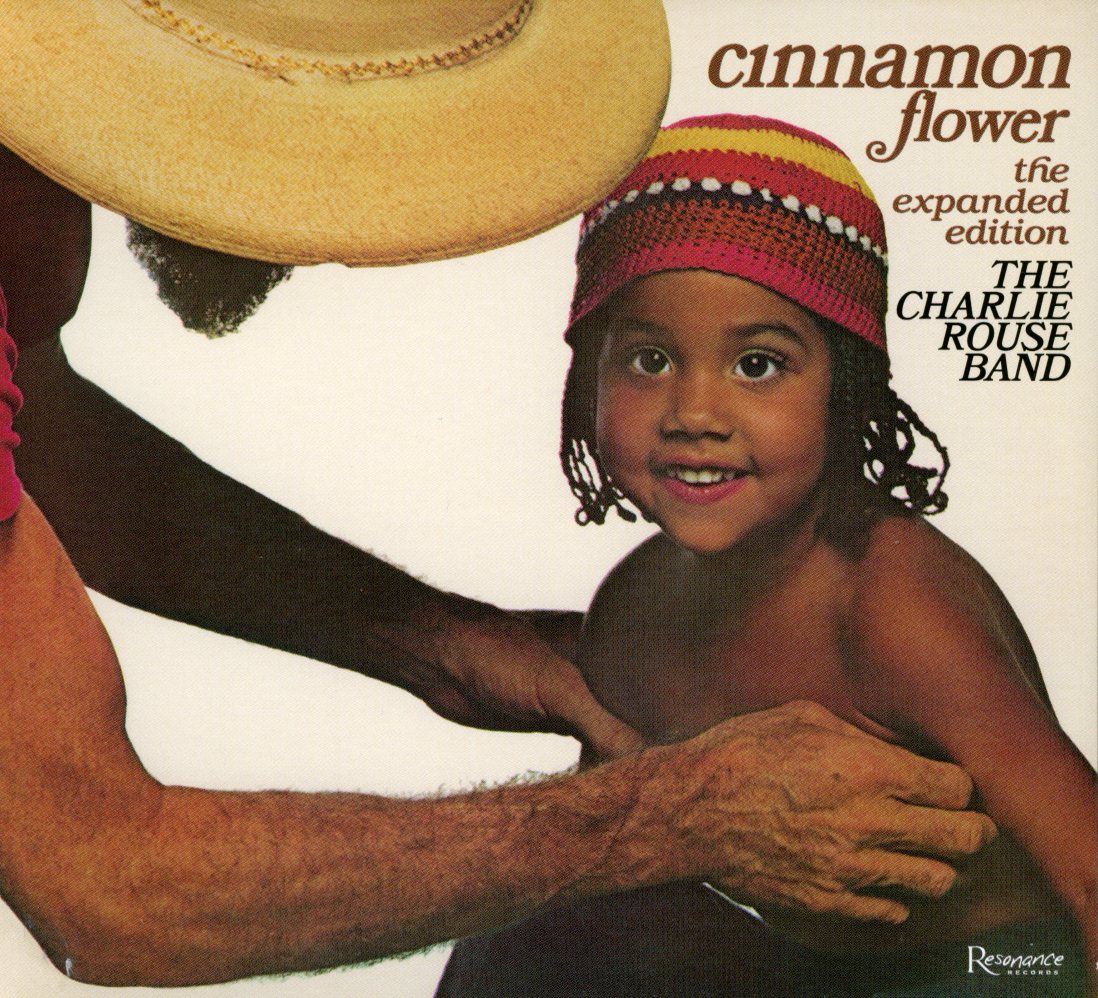

In addition to all the other sterling qualities that go into making a Master Jazz Saxophonist, Charlie Rouse [1924-1988] had something which all Jazz musicians strive for, whatever their instrument.


He had an instantly recognizable sound of his own.


Four bars of his playing and you knew it was Charlie Rouse.


As Richard Cook details in his Jazz Encyclopedia:


“Although Rouse did front eight albums of his own during a long career of playing, he is always remembered as the saxophonist in Thelonious Monk's quartet. This position came up after many years of work in the music; he joined Dizzy Gillespie's big band in 1945, worked in R&B hands, had brief spells with Duke Ellington and Count Basie, was on Clifford Brown's first record dates, and then led a hard-bop quintet called Les (Jazz) Modes [with French horn player Julius Watkins]. As that band was petering out in 1959, he sat in with Monk at a New York gig and went on to stay for the next 11 years. 


Where Johnny Griffin didn't change his style at all with Monk, and played in the same headlong fashion, Rouse, previously a typically fluent bop player, meticulously adapted himself to Monk's music: his tone became heavier, his phrasing more careful, and he seemed to act as an interlocutor between his leader and the listener. 


In the 1970s he studied acting for a time, and then found a new niche as a guardian of Monk's music in the group Sphere, which acted as a repertory band for the pianist's music [Kenny Barron, piano, Buster Williams, bass and Ben Riley, drums; “Sphere” was Thelonious’ middle name.]


He played a final tribute to his old boss a few weeks before his own death from lung cancer.”


Barry Kernfeld remarks about Charlie in his annotation about him for The New Grove Dictionary of Jazz:


“In the 1960s, Rouse adapted his style to Monk’s work, improvising with greater deliberation than most bop tenor saxophonists, and restating melodies often. His distinctive solo playing with Monk was marked by alternate reiterations of the principal thematic motif with formulaic bop runs.”


Orrin Keepnews who produced Charlie’s first album under his name - Takin’ Care of Business [Jazzland 919 JLPS, 1959], remarked that: “The trouble up to now has been that Rouse takes care of business so professionally and unflamboyantly, that it has been too easy for people to overlook him. Not fellow musicians: they’ve been aware for some time [and have accorded him the recognition of a full-fledged big leaguer].


With this by way of background you won’t want to miss -


THE CHARLIE ROUSE BAND'S BRAZILIAN SPECTACULAR

CINNAMON FLOWER GETS DELUXE REISSUE FROM RESONANCE RECORDS

AS A LIMITED-EDITION 2-LP SET, DELUXE CD & DIGITAL DOWNLOAD ON SEPTEMBER 19, 2025

Vibrant 1977 Album Featuring Tenor Man Rouse's Star-Studded Group and Engineered by Resonance Founder George Klabin Will Be Issued in Its Originally Released Version and, for the First Time, in Never-Before-Heard Undubbed Form

Deluxe Package Includes Detailed Liner Notes by Author James Gavin and an Intimate Recollection by the Tenor Player's Son Charlie "Chico" Rouse, Jr.


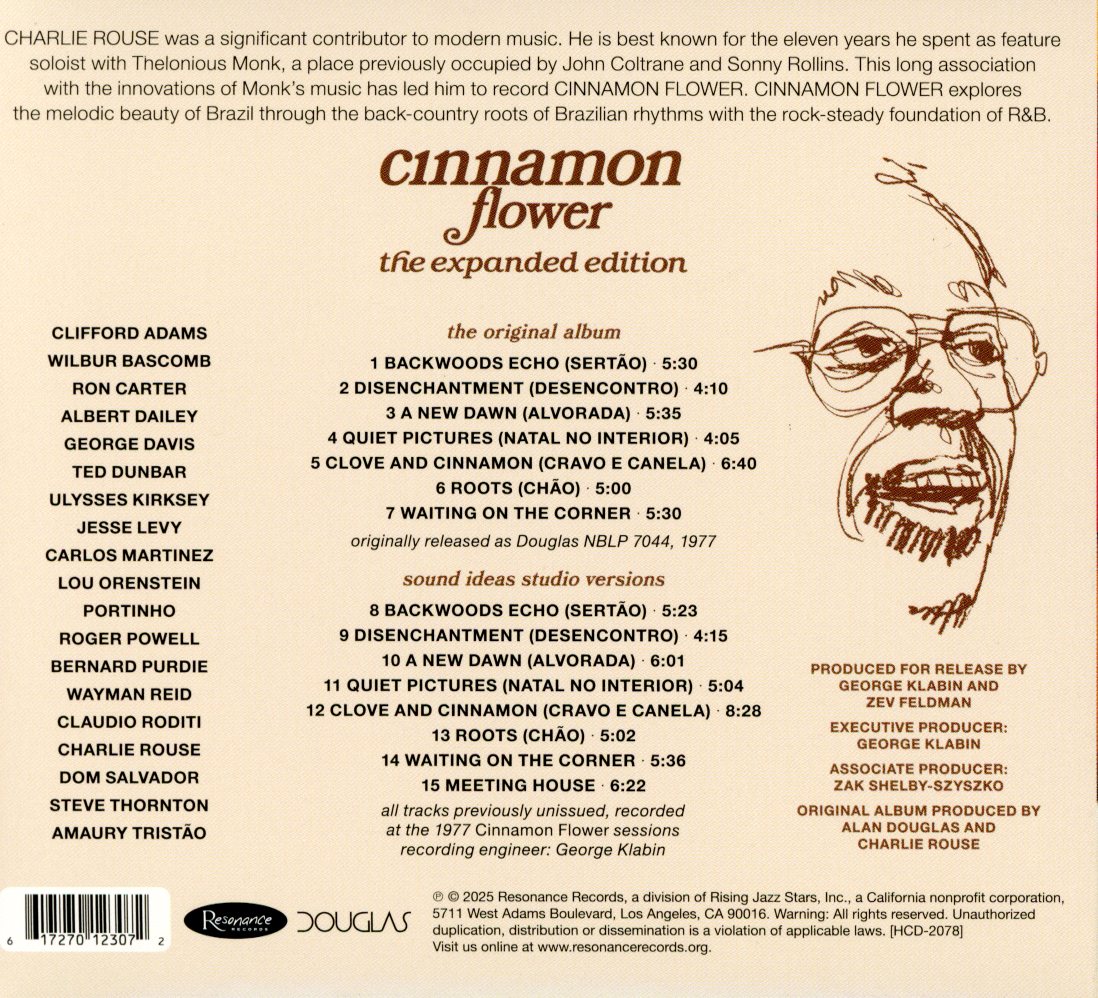
Brazilian jazz fans will receive a special treat when Resonance Records, the genre's leader in archival releases, will issue the Charlie Rouse Band's Brazilian jazz classic Cinnamon Flower as an expanded two-LP set, single-CD and digital download on September 19, 2025.


The LP package will be issued in a limited edition of 1,000 copies pressed on 180-gram vinyl; the set has been transferred from the original tape reels and mastered by Matthew Lutthans at The Mastering Lab. The first disc reprises the tenor saxophonist's album as it was released in 1977 by Douglas Records, the Casablanca-distributed imprint of producer Alan Douglas; the second LP presents the record for the first time in its original form, without Douglas' overdubbing, as it was engineered by


Resonance founder and co-president George Klabin, and includes an unreleased bonus track. The CD edition will also include both versions of the record and the extra track.


The '77 recording date featured Rouse, who had served as the tenor player in Thelonious Monk's combo for 11 years, playing potent Brazil-inflected music with elegance and soul. He had previously explored the Latin American country's sound on his 1962 Blue Note album Bossa Nova Bacchanal.


Rouse's 11-piece Cinnamon Flower band included such notables as trumpeter Claudio Roditi, pianist Dom Salvador, bassist Ron Carter, and drummer Portinho. Before the album was released, producer Douglas — known for adding instrumentation on posthumously released material by guitarist Jimi Hendrix — sweetened it with such additional players as soul drummer Bernard "Pretty" Purdie, keyboardist Roger Powell of Todd Rundgren's Utopia, and trombonist Clifford Adams of funk group Kool & the Gang.


Both packages include detailed liner notes by James Gavin, the author of widely praised biographies of Chet Baker, Peggy Lee, and Lena Horne, and an affecting remembrance of Rouse by his son, musician and educator Charlie "Chico" Rouse, Jr., who oversees the Rouse Estate. It reunites Resonance with Douglas' daughters Solo Douglas and Kirby Veevers, who worked with the label on its 2019 Eric Dolphy release Musical Prophet, which comprised Douglas' 1963 dates with the multi-instrumentalist.


Resonance co-president Zev Feldman says, "Many jazz enthusiasts know Charlie Rouse from the years he spent with Thelonious Monk, but he was much more than simply Monk's saxophonist. He had his own voice and his own style. He had an abiding interest in many musical genres and, as you can hear in this album, a particular affinity for Brazilian music."


The new edition is especially gratifying for Klabin, who racked up a long list of engineering and production credits before founding Resonance in 2008: "This music was originally recorded and engineered by yours truly at my Sound Ideas Studios in New York in the mid-70's. It remains one of my favorites because it combined great Brazilian music with great modern jazz and utilized only the very best players.


"We are pleased to release this memorable recording in two versions: the original, and as modified by Alan Douglas on his label. It is also a pleasure to present for the first time the track 'Meeting House,' written and performed by pianist Dom Salvador, which was not released on the Alan Douglas version."


Music historian Gavin notes, "Fortunately, Cinnamon Flower's original engineer, George Klabin, kept the unaltered tapes. Now, on his acclaimed jazz label Resonance Records, he is releasing the original unadulterated Cinnamon Flower for the first time. The Douglas issue is here too, allowing listeners to judge the difference for themselves. The heart of both versions is Charlie Rouse, a saxophonist whose uniqueness deserves reexamination.


"This Resonance release offers a fresh chance to revisit a musician who almost from the start was deemed 'underrated.' It's not too late for the prediction made in 1988 by Clifford Jordan, Rouse's tenor-playing peer, to come true: 'When someone dies, people stop and listen and realize that maybe he was a bit bigger than they thought. Now, people will start listening to Charlie Rouse."


Chico Rouse says, "I think now the album is going to be more appreciated than when it first came out because of the development and the exposure of Brazilian music here in this culture. I think that this record was a little ahead of its time. I hope that it shows a little bit about what my father was about in terms of being a soloist and having his own individuality, but being aware enough and strong enough to be able to take that and incorporate it into an ensemble to make the whole thing one whole."


Resonance Records is a multi-GRAMMY® Award-winning label (most recently for John Coltrane's Offering: Live at Temple University for "Best Album Notes") that prides itself in creating beautifully designed, informative packaging to accompany previously unreleased recordings by the jazz icons who grace Resonance's catalog. Headquartered in Beverly Hills, CA, Resonance Records is a division of Rising Jazz Stars, Inc. a California 501 (c) (3) non-profit corporation created to discover the next jazz stars and advance the cause of jazz. Current Resonance Artists include Tawanda, Eddie Daniels, Tamir Hendelman, Christian Howes and Donald Vega. www. Resonance Records.org



Saturday, November 2, 2024

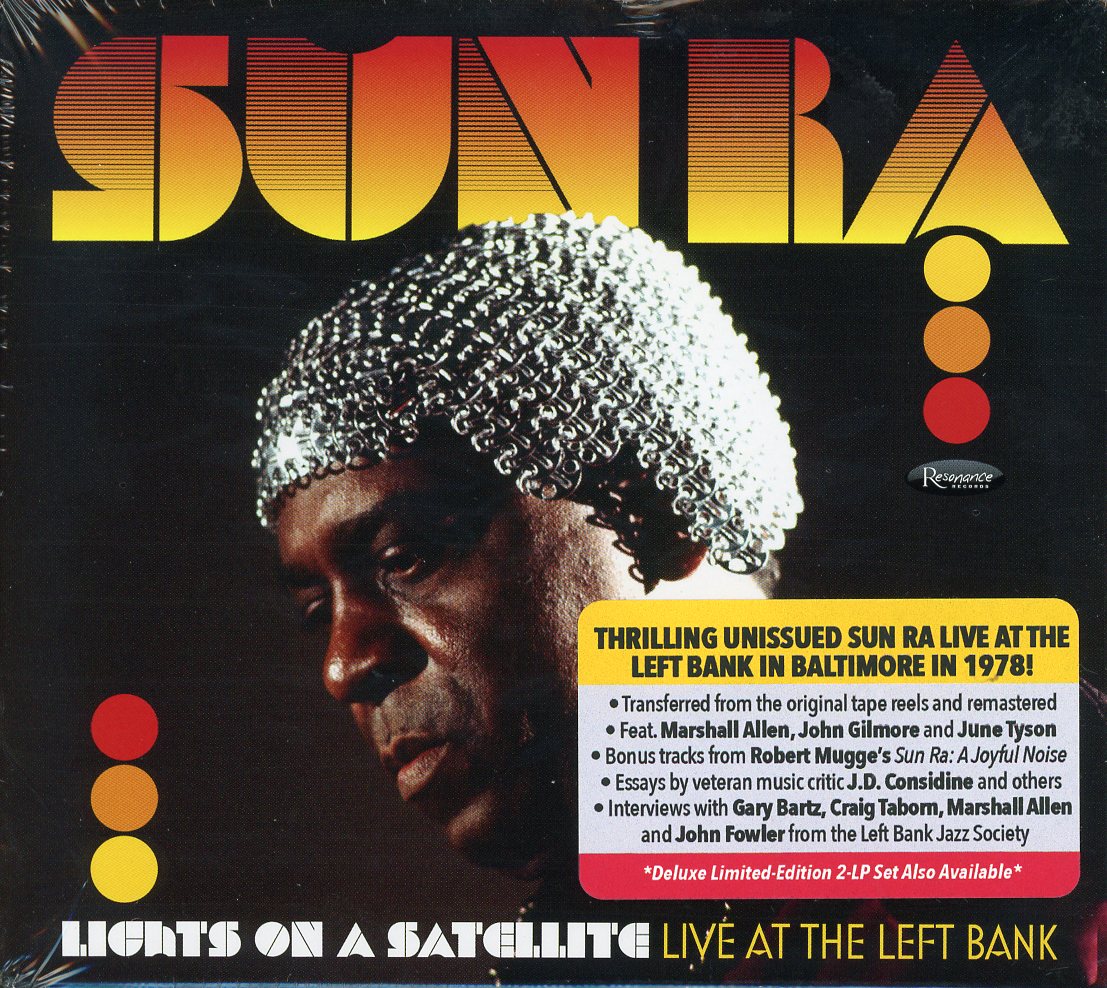
Sun Ra Lights on a Satellite: Live at the Left Bank - from Zev Feldman the Jazz Detective

 Copyright ® Steven A. Cerra, copyright protected; all rights reserved.


Some of you may recall that earlier this year in time for Record Store Day on April 20, 2024, Producer Zev Feldman in conjunction with project coordinator Irwin Chusid and Executive Producers Jordi Soley and Carlos Agustin Calembert of Elemental Records released SUN RA AT THE SHOWCASE: LIVE IN CHICAGO (1976-1977). 


You can visit my posting about this Sun Ra event by going here.


For Sun Ra fans there’s more exciting news as Zev is now partnered with - 


RESONANCE RECORDS TO PRESENT PREVIOUSLY UNHEARD SUN RA DATE LIGHTS ON A SATELLITE: LIVE AT THE LEFT BANK AS LIMITED 2-LP SET FOR Record Store Day - BLACK FRIDAY ON NOV. 29, 2024


A Collection of Thrilling 1978 Performances in Baltimore by Prophetic Bandleader's Arkestra 


It Also Arrives on Dec. 6 as Two-CD Set Deluxe Package Includes Additional Tracks Recorded by Filmmaker Robert Mugge, Notes by Critic J.D. Considine and Archivist/Band Member Michael D. Anderson, Interviews with Arkestra Icon Marshall Allen, Musicians Gary Bartz and Craig Taborn, and More


By way of context, “Sun Ra had a knack for being years ahead of the jazz world. The free jazz explorations of Cosmic Tones for Mental Therapy and electronics of Supersonic Jazz were daring moves for their time. Sun Ra's anticipation of later trends seems especially prescient when one compares his deconstructive sound collages from the 1950s and 1960s with the Art Ensemble of Chicago and other Association for the Advancement of Creative Musicians (AACM) efforts from the 1960s and 1970s. But by the 1970s, Sun Ra was already looking ahead again, anticipating the return to jazz roots of the 1980s and 1990s with sweeping excursions that spanned the whole history of the music.


Like Ellington, Sun Ra rarely featured his own piano work—although his few solo recordings, especially the magnificent Monorails and Satellites session from 1966, showed that he needed no accompanists to weave his richly textured musical tapestries. And though the Arkestra lacked the depth and cohesion of musicianship that characterized a Basie or Ellington, a Herman or Kenton, the band always boasted an inner circle of topflight players. Especially in tenor saxophonist John Gilmore, Sun Ra could draw on a rugged world-class soloist—one who anticipated and, in time, would influence John Coltrane. Gilmore's versatility was well suited for the Arkestra: he could contribute heated hard-bop solos or use the tenor to articulate piercing screams, guttural barks, and mournful cries. His affiliation with Sun Ra spanned some forty years, and he maintained his allegiance to the band even after Sun Ra's death in 1993.” Ted Gioia, The History of Jazz 2nd Ed. [2021]


Ann Braithwaite of Braithwaite and Katz offers more information in this media release about the forthcoming recording:


Resonance Records proudly presents Lights on a Satellite: Live at the Left Bank, a blazing set of previously unissued 1978 concert recordings by Sun Ra and his Myth Science Cosmo Swing Arkestra, as a limited two-LP set for RSD Black Friday, November 29.


Co-produced by Zev Feldman and Sun Ra archivist Michael D. Anderson (who also played drums on the '78 concert), the newly unearthed live session is an exciting successor to Sun Ra at the Showcase: Live in Chicago another archival find that Feldman issued on his Jazz Detective imprint for Record Store Day this April.


The new collection will also be released as a two-CD set on December 6.


Prophetic avant-gardist Sun Ra's big band is heard in blistering form — playing repertoire ranging from space age jazz to interpretations of "Somewhere Over the Rainbow" and jazz standards by Fletcher Henderson, Miles Davis, and Tadd Dameron — on a dynamic 12-track set recorded at a show mounted by the Left Bank Jazz Society at the Famous Ballroom in Baltimore, Maryland, on July 23, 1978. Those recordings are augmented by two tracks captured at the concert and featured in the classic 1980 film Sun Ra: A Joyful Noise by the acclaimed music filmmaker Robert Mugge, who also provided images for the new package.


The deluxe Resonance packages include an essay by noted jazz critic J.D. Considine (who attended the '78 show); reminiscences from Anderson, Mugge, Left Bank member John Fowler, critic Dan Morgenstern, and Arkestra veteran and latter-day bandleader Marshall Allen; and thoughts on Sun Ra's artistry from musicians Gary Bartz and Craig Taborn.


Feldman says of this newest discovery, "It was very exciting to learn from Sun Ra archivist Michael D. Anderson that these recordings from the Left Bank in 1978 even existed. Filmmaker Robert Mugge was also very kind to us by allowing us to borrow the music he had recorded for his film, which is presented here as bonus tracks. Also thanks to Mr. Mugge, we've included various high-resolution screen captures from his film that help capture the energy of what it was like to be there at the Famous Ballroom that night."


Anderson   recalls,   "When  we  played   in  the Famous Ballroom, it was incredible, being able to be in such a big place... .Especially [with] the [Arkestra] dancers. They were one part of the band that a lot of people miss because the dancers are just like instruments, but you have to see it. That's why when Mugge did this film — he was able to show the beauty of how they danced to the music."


Mugge — whose shoot at the Left Bank show was his maiden voyage as a music documentarian — remembers, "[It] went surprisingly well, our only unresolved question being, could we successfully record a large ensemble without multitrack recording equipment, or even the cables we needed to patch into the mixing board of Vernon L. Welsh's house PA system? But sound man Bruce Litecky improvised, coming up with usable audio by pointing one mike at the house PA speakers and another at whichever musician or vocalist was currently taking the lead."


Considine notes in his overview that the music at the '78 concert reached both veteran Sun Ra fans and new, younger listeners: "For the older, regular attendees, there was much of what they had gotten before. Sun Ra's arrangement of the Tadd Dameron chestnut, 'Lady Bird,' was a condensed history of mid-century jazz... .And for the younger, rock-raised newbies, there was the sonic splatter of Sun Ra's synthesizer against Dale Williams's probing electric guitar in the aptly titled 'Thunder of Drums.' There were African rhythms mixed with avant-garde improvisation, slapped electric bass driving classic swing cadences, and unabashed sentiment cheek-by-jowl against transcendental consciousness."


The Left Bank's Fowler remembers, "Sun Ra was a completely unique experience. And it was just a fun day. I mean, this was when he had all of the singers and the drummers and the dancers. There had to be 30 guys in the group. It was a real theatrical experience and a musical experience. Sun Ra was like nobody else."


Weighing Sun Ra's impact on jazz, saxophonist Bartz says, "Sunny confirmed that we need to be free as musicians. You can't get hung up into a genre or a style. If you study music, you study sounds and if you do, like any other study, are you just going to study one kind of a sound? Or are you going to study sounds, period. I don't study one kind of music. I study music. I got that from Sunny."


Pianist Taborn adds, "So many people revere him now. His approach was so comprehensive to the Black music experience as a whole. He delivered a commentary on so much of what had happened before and what was going to be happening that it applies itself across time. That's why I think his music has so much traction now 30 years after he passed."


Saxophonist and flutist Allen, who marked 66 years as a member of the Arkestra on his 100th birthday on May 25, reflects on Sun Ra's trailblazing methods as a bandleader: "When Sunny was playing, he'd play four bars, and if you didn't have the music, he'd switch it, he'd play another song, so you had to remember all this music. And then, when he played four bars, I'd come in. If I didn't, he'd switch the number, and by the time you found that number, he'd be in another one. Above all, you had to be sincere to do what he wanted you to do."”


Wednesday, December 9, 2020

Bill Evans at Ronnie Scott's on Resonance Records

 © Copyright ® Steven Cerra, copyright protected; all rights reserved.


It’s always great news when co-President Zev Feldman “unearths” another of his legacy tape discoveries and gains the approval [read, “funding”] of Resonance Records President George Klabin to release the new music on vinyl and compact disc.


Reputationally, it’s gotten to the point that Zev - aka “The Jazz Detective” - doesn’t even have to seek this stuff out anymore; people bring it to him!


Such was the case when drummer extraordinaire Jack DeJohnette sought Zev out to listen to some tapes he had recorded of his time on Bill Evans’ trio when they along with bassist Eddie Gomez performed for a month in 1968 at Ronnie Scott’s place in London.


The way this went down along with other details are all included in the media release that Ann Braithwaite of Braithwaite & Katz Communications sent out to those of us fortunate enough to receive a preview copy of the double CD set which you’ll find at the end of this introduction.


The uncovered music by Bill and the trio in performance at Ronnie’s is invaluable, let alone enjoyable, in and of itself, but that’s only the beginning when Zev’s involved because the artistic content of the music has to be matched by the production materials that accompany it.


And as far as the packaging of the product is concerned, we’ve learned over time that Zev and George “spare no expense” and put an immense amount of time and effort into the creation of the finished product. 


Under the capable and creative guidance of John Sellars, the cover art is graced with an original illustration by the renown David Stone Martin, a gift that was made to Zev’s project by Cynthia Sesso of CTSImages.com.


John has also enhanced the album's packaging with an array of photographs of Bill, Eddie, Jack and Ronnie’s club by Francois Jacquenod.


Then Zev set to work scoping out interviews for the sleeve notes booklet - again graced by photos from Francois, but also including some from Chuck Stewart and Veryl Oakland.


The interviews follow the usual Introduction by Zev that contains his explanation of “How it all Happened” and include talks with Jack DeJohnette as conducted by pianist Chick Corea and Zev’s conversations with bassist Eddie Gomez and actor-comedian Chevy Chase, a pianist in his own right who developed a friendship with Bill in the 1970s.


Zev even reached out to the London-based Jazz author and critic Brian Priestly - who was in attendance during some of these 1968 performances by Bill’s trio at Ronnie’s Club - to share his remembrances of his visits to the club to listen to the music in a well-written essay which also includes Brian’s annotations of each of the tracks on these recordings.


So what you get is not only a musical feast but an artistic one as well as other senses are brought into play to augment your enjoyment of Bill Evans Live at Ronnie Scott’s [Resonance Records HCD-2046].


When you talk with Zev about these discoveries, he modestly says that he is “the lucky one” to have the help and support of so many people - not the least of which is George Klabin at Resonance records - to make these finds into a reality that we can all share in.


While there is a great deal of truth and wisdom in the old adage - “I’d rather be lucky than good” - in Zev’s case, thank goodness he’s both - lucky and good.


Here’s Ann’s always marvelous media release:


RESONANCE’S PREVIOUSLY UNRELEASED BILL EVANS LIVE AT RONNIE SCOTT’S TO BE RELEASED AS TWO-LP RECORD STORE DAY EXCLUSIVE ON BLACK FRIDAY, NOV. 27; CD AND DIGITAL EDITIONS ARRIVE DEC. 4

Stunning 20-Track Set is Third Resonance Collection of Unissued Material Featuring Pianist Evans’ Short-Lived, Brilliant 1968 Trio With Bassist Eddie Gomez and Drummer Jack DeJohnette

Deluxe Package Includes An Overview Essay by Veteran Critic Brian Priestley, New Interviews with Gomez, DeJohnette, Pianist Chick Corea, and Evans’ Good Friend Chevy Chase, and a One-of-a-Kind Album Cover Drawing by Legendary Artist David Stone Martin


Los Angeles – Resonance Records will proudly release Bill Evans Live at Ronnie Scott’s, the label’s third collection featuring hitherto unheard recordings by the great pianist’s short-lived 1968 trio with bassist Eddie Gomez and drummer Jack DeJohnette, as a two-LP Record Store Day exclusive on Black Friday, Nov. 27. The album will subsequently see release as a two-CD set and a digital download on Dec. 4.


Resonance – a division of the Rising Jazz Stars Foundation, a non-profit corporation created to discover the next jazz stars – has previously issued two widely acclaimed, never-before-heard albums by Evans’ ’68 unit. That combo recorded the pianist’s second Grammy Award-winning Verve album, Bill Evans at the Montreux Jazz Festival; recorded on June 15, 1968, it was the only contemporaneous album released from the lineup during its brief existence.


Unearthed by Resonance co-president Zev Feldman (a/k/a “the Jazz Detective”), Some Other Time: The Lost Session From the Black Forest (2016) was a two-LP/two-CD studio date, cut five days after the Evans-Gomez-DeJohnette trio’s Montreux appearance, which had sat unheard in the German vaults for 50 years. A second historic discovery, Another Time (2018), was recorded two days later by the Netherlands Radio Union in Hilversum.


These collections garnered praise in DownBeat and JazzTimes in the U.S., Jazzwise in the U.K., and the NPR Music Jazz Critics Poll; Some Other Time topped Billboard’s Jazz Albums chart.


Drawn from Jack DeJohnette’s personal archives, Live at Ronnie Scott’s comprises 20 scintillating tracks captured during the Evans trio’s month-long ’68 residency at the eponymous saxophonist-impresario’s Soho club. (It is Resonance’s second live Evans album to emanate from that venue: 2019’s Evans in England derived from a 1969 stand at Scott’s, featuring Gomez and drummer Marty Morell.)


Recordings by the Evans-Gomez-DeJohnette lineup are as prized as they are rare. DeJohnette was an especially simpatico accompanist for Evans, for he had been a pianist before taking up the drums. Despite their chemistry, the trio played together for a mere six months. During their stay at Scott’s, Miles Davis stopped in to check out the band, and the trumpeter swiftly recruited DeJohnette for his new group. By the end of 1968, Morell was hired by Evans as his replacement, and he drummed behind the pianist through 1974.


Distinguished British critic, author, broadcaster, and pianist Brian Priestley, who witnessed Evans’ ’68 trio in action, puts the London stand and Evans’ then-current repertoire in context in newly commissioned notes for the release. He writes that the performances’ “compelling, indeed at times overwhelming, musical quality is such as to impress this listener all over again.”


Live at Ronnie Scott’s also features a joint interview, conducted by Feldman, with DeJohnette and Grammy-winning pianist (and, in his early career, drummer) Chick Corea, who played with DeJohnette in Miles Davis’ storied late-‘60s lineups.


Recalling his short but memorable stint with Evans, DeJohnette says, “The music was at a really high creative height, and I’m glad I documented that, and the tape was good enough for Resonance to run with it…You really get a chance to hear Bill stretch.”


“Bill was a big hero for me and for all of our generation,” Corea says of Evans. “Bill was just like the generation just before us, and we all looked up to him with his recordings with [bassist] Scotty [La Faro] and [drummer] Paul [Motian].”


In his own interview with Feldman, Gomez says of the recording, “It’s enlightening to go back and relive moments that are ingrained in your memory in a totally different way; time just does that. Fifty, fifty-two years; that’s a half a century. That’s a long time. So going back and listening to it and reflecting on it and seeing the changes in all three of us from this perspective gives you a different view.”


Perhaps the most unexpected element of the package is an extensive interview with the great comic actor and jazz buff Chevy Chase. He encountered Evans’ music as an underage jazz club-goer and began a friendship with the pianist as a student at Bard College, where he played in a band with classmate Donald Fagen of Steely Dan.


He tells Feldman that Evans’ music was “the most lyrical jazz you could ever hear, in terms of jazz that wasn’t sung. It was just beautiful. And yet, very complex. Everybody I know tried to be Bill, but all you have to do is put a little video of Bill on or a record and say, ‘Try that.’ He really had a touch on the piano that he couldn’t match.”


Gracing the cover of both the LP and CD iterations of Live at Ronnie Scott’s is artwork drawn from a never-before-published, one-of-a-kind lithograph by the late, legendary artist/illustrator David Stone Martin, whose distinctive interpretations of jazzmen in action were featured on dozens of classic jazz LPs, notably including many for Norman Granz’s labels of the ‘40s and ‘50s.


Feldman writes, “I had one big decision to make: do we go all the way and recreate a jacket in the same manner of DSM’s classic covers of the 1940s and 1950s, even though our album isn’t from that era?  Or do we go a different, more modern route and simply incorporate DSM’s artwork into a more contemporary style image?  I thought long and hard about this.  Ultimately, I came to see it as an opportunity to recreate that special era, a nod to those classic 1940s and ‘50s Verve/Clef/Norgran album covers.”

Bill Evans Live at Ronnie Scott’s will be the fifth Resonance title to feature unreleased music by the pianist: 2014’s Live at Art D’Lugoff’s Top of the Gate was the label’s first Evans collection. Smile With Your Heart: The Best of Bill Evans on Resonance, a mid-priced compilation, was issued in 2020.