Showing posts with label Sun Ra. Show all posts

Saturday, November 2, 2024

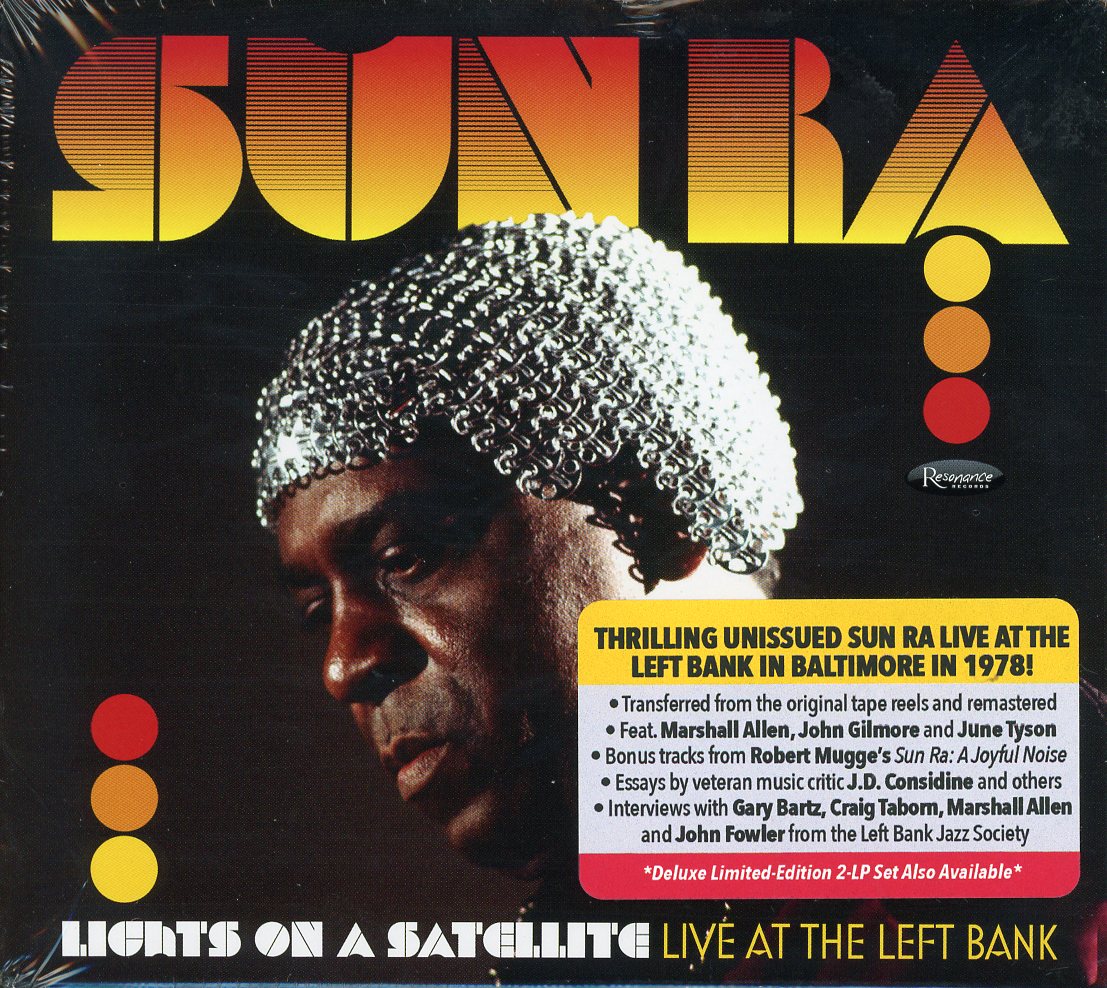
Sun Ra Lights on a Satellite: Live at the Left Bank - from Zev Feldman the Jazz Detective

 Copyright ® Steven A. Cerra, copyright protected; all rights reserved.

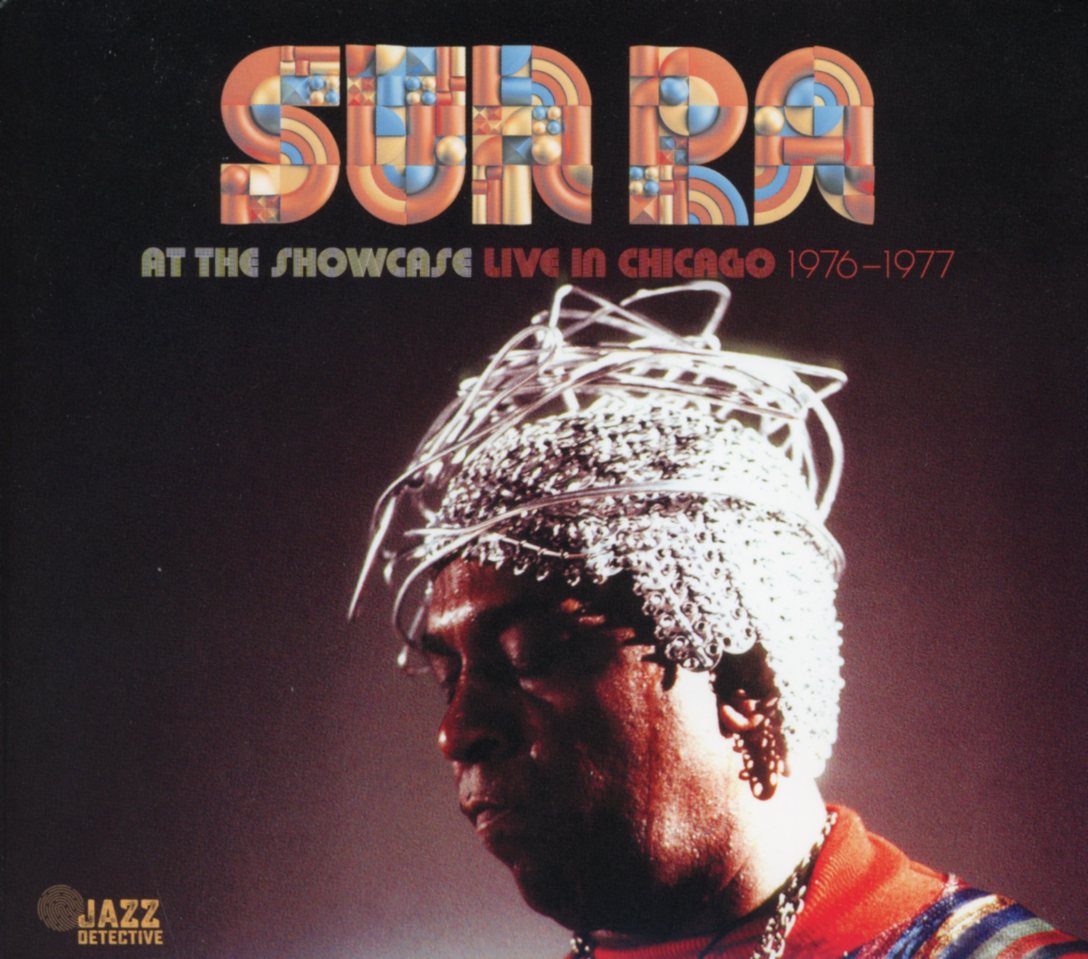
Some of you may recall that earlier this year in time for Record Store Day on April 20, 2024, Producer Zev Feldman in conjunction with project coordinator Irwin Chusid and Executive Producers Jordi Soley and Carlos Agustin Calembert of Elemental Records released SUN RA AT THE SHOWCASE: LIVE IN CHICAGO (1976-1977). 


You can visit my posting about this Sun Ra event by going here.


For Sun Ra fans there’s more exciting news as Zev is now partnered with - 


RESONANCE RECORDS TO PRESENT PREVIOUSLY UNHEARD SUN RA DATE LIGHTS ON A SATELLITE: LIVE AT THE LEFT BANK AS LIMITED 2-LP SET FOR Record Store Day - BLACK FRIDAY ON NOV. 29, 2024


A Collection of Thrilling 1978 Performances in Baltimore by Prophetic Bandleader's Arkestra 


It Also Arrives on Dec. 6 as Two-CD Set Deluxe Package Includes Additional Tracks Recorded by Filmmaker Robert Mugge, Notes by Critic J.D. Considine and Archivist/Band Member Michael D. Anderson, Interviews with Arkestra Icon Marshall Allen, Musicians Gary Bartz and Craig Taborn, and More


By way of context, “Sun Ra had a knack for being years ahead of the jazz world. The free jazz explorations of Cosmic Tones for Mental Therapy and electronics of Supersonic Jazz were daring moves for their time. Sun Ra's anticipation of later trends seems especially prescient when one compares his deconstructive sound collages from the 1950s and 1960s with the Art Ensemble of Chicago and other Association for the Advancement of Creative Musicians (AACM) efforts from the 1960s and 1970s. But by the 1970s, Sun Ra was already looking ahead again, anticipating the return to jazz roots of the 1980s and 1990s with sweeping excursions that spanned the whole history of the music.


Like Ellington, Sun Ra rarely featured his own piano work—although his few solo recordings, especially the magnificent Monorails and Satellites session from 1966, showed that he needed no accompanists to weave his richly textured musical tapestries. And though the Arkestra lacked the depth and cohesion of musicianship that characterized a Basie or Ellington, a Herman or Kenton, the band always boasted an inner circle of topflight players. Especially in tenor saxophonist John Gilmore, Sun Ra could draw on a rugged world-class soloist—one who anticipated and, in time, would influence John Coltrane. Gilmore's versatility was well suited for the Arkestra: he could contribute heated hard-bop solos or use the tenor to articulate piercing screams, guttural barks, and mournful cries. His affiliation with Sun Ra spanned some forty years, and he maintained his allegiance to the band even after Sun Ra's death in 1993.” Ted Gioia, The History of Jazz 2nd Ed. [2021]


Ann Braithwaite of Braithwaite and Katz offers more information in this media release about the forthcoming recording:


Resonance Records proudly presents Lights on a Satellite: Live at the Left Bank, a blazing set of previously unissued 1978 concert recordings by Sun Ra and his Myth Science Cosmo Swing Arkestra, as a limited two-LP set for RSD Black Friday, November 29.


Co-produced by Zev Feldman and Sun Ra archivist Michael D. Anderson (who also played drums on the '78 concert), the newly unearthed live session is an exciting successor to Sun Ra at the Showcase: Live in Chicago another archival find that Feldman issued on his Jazz Detective imprint for Record Store Day this April.


The new collection will also be released as a two-CD set on December 6.


Prophetic avant-gardist Sun Ra's big band is heard in blistering form — playing repertoire ranging from space age jazz to interpretations of "Somewhere Over the Rainbow" and jazz standards by Fletcher Henderson, Miles Davis, and Tadd Dameron — on a dynamic 12-track set recorded at a show mounted by the Left Bank Jazz Society at the Famous Ballroom in Baltimore, Maryland, on July 23, 1978. Those recordings are augmented by two tracks captured at the concert and featured in the classic 1980 film Sun Ra: A Joyful Noise by the acclaimed music filmmaker Robert Mugge, who also provided images for the new package.


The deluxe Resonance packages include an essay by noted jazz critic J.D. Considine (who attended the '78 show); reminiscences from Anderson, Mugge, Left Bank member John Fowler, critic Dan Morgenstern, and Arkestra veteran and latter-day bandleader Marshall Allen; and thoughts on Sun Ra's artistry from musicians Gary Bartz and Craig Taborn.


Feldman says of this newest discovery, "It was very exciting to learn from Sun Ra archivist Michael D. Anderson that these recordings from the Left Bank in 1978 even existed. Filmmaker Robert Mugge was also very kind to us by allowing us to borrow the music he had recorded for his film, which is presented here as bonus tracks. Also thanks to Mr. Mugge, we've included various high-resolution screen captures from his film that help capture the energy of what it was like to be there at the Famous Ballroom that night."


Anderson   recalls,   "When  we  played   in  the Famous Ballroom, it was incredible, being able to be in such a big place... .Especially [with] the [Arkestra] dancers. They were one part of the band that a lot of people miss because the dancers are just like instruments, but you have to see it. That's why when Mugge did this film — he was able to show the beauty of how they danced to the music."


Mugge — whose shoot at the Left Bank show was his maiden voyage as a music documentarian — remembers, "[It] went surprisingly well, our only unresolved question being, could we successfully record a large ensemble without multitrack recording equipment, or even the cables we needed to patch into the mixing board of Vernon L. Welsh's house PA system? But sound man Bruce Litecky improvised, coming up with usable audio by pointing one mike at the house PA speakers and another at whichever musician or vocalist was currently taking the lead."


Considine notes in his overview that the music at the '78 concert reached both veteran Sun Ra fans and new, younger listeners: "For the older, regular attendees, there was much of what they had gotten before. Sun Ra's arrangement of the Tadd Dameron chestnut, 'Lady Bird,' was a condensed history of mid-century jazz... .And for the younger, rock-raised newbies, there was the sonic splatter of Sun Ra's synthesizer against Dale Williams's probing electric guitar in the aptly titled 'Thunder of Drums.' There were African rhythms mixed with avant-garde improvisation, slapped electric bass driving classic swing cadences, and unabashed sentiment cheek-by-jowl against transcendental consciousness."


The Left Bank's Fowler remembers, "Sun Ra was a completely unique experience. And it was just a fun day. I mean, this was when he had all of the singers and the drummers and the dancers. There had to be 30 guys in the group. It was a real theatrical experience and a musical experience. Sun Ra was like nobody else."


Weighing Sun Ra's impact on jazz, saxophonist Bartz says, "Sunny confirmed that we need to be free as musicians. You can't get hung up into a genre or a style. If you study music, you study sounds and if you do, like any other study, are you just going to study one kind of a sound? Or are you going to study sounds, period. I don't study one kind of music. I study music. I got that from Sunny."


Pianist Taborn adds, "So many people revere him now. His approach was so comprehensive to the Black music experience as a whole. He delivered a commentary on so much of what had happened before and what was going to be happening that it applies itself across time. That's why I think his music has so much traction now 30 years after he passed."


Saxophonist and flutist Allen, who marked 66 years as a member of the Arkestra on his 100th birthday on May 25, reflects on Sun Ra's trailblazing methods as a bandleader: "When Sunny was playing, he'd play four bars, and if you didn't have the music, he'd switch it, he'd play another song, so you had to remember all this music. And then, when he played four bars, I'd come in. If I didn't, he'd switch the number, and by the time you found that number, he'd be in another one. Above all, you had to be sincere to do what he wanted you to do."”


Thursday, April 25, 2024

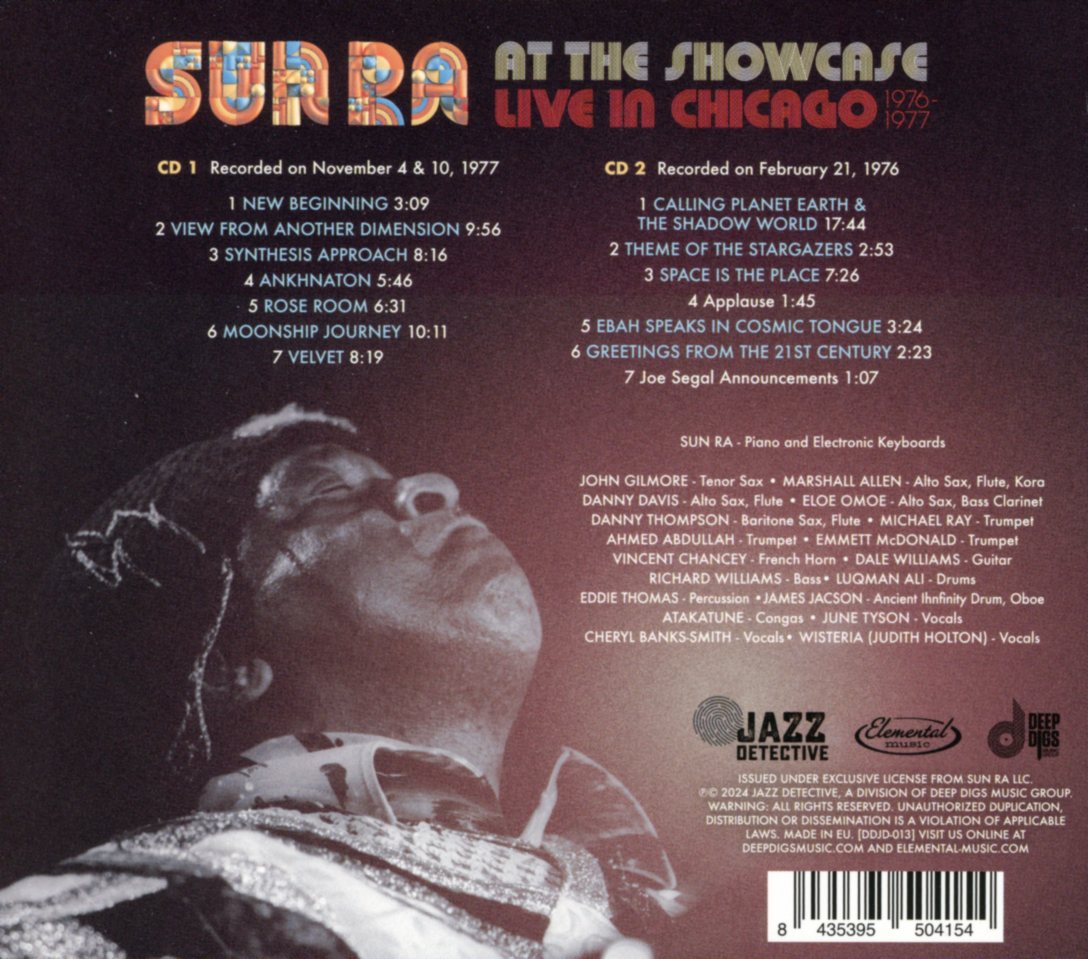
Sun Ra at the Showcase Live in Chicago 1976-1977 - from Zev Feldman the Jazz Detective

 Copyright ® Steven A. Cerra, copyright protected; all rights reserved.

“Stan Kenton was not the only 1950s big band leader who attempted to remake modern jazz in his own iconoclastic image. Sun Ra drew on an equally eclectic mixture of forward-looking jazz styles in the various recordings made with his large ensemble, the Arkestra — a band invariably described by the leader with one or more impressive descriptives attached (e.g., the Myth Science Arkestra or the Astro Infinity Arkestra). A certain extravagance permeated almost everything having to do with this artist.  Many jazz players are guilty of distorting or exaggerating the facts of their early years, but only Sun Ra went so far as to trace his origins back to the planet Saturn and claim descent from a race of angels. In truth, Sun Ra was apparently born with the more pedestrian name of Herman Blount in Alabama in 1914. He made his first forays as a pianist and composer during the Swing Era and worked for a time in the late 1940s in the Fletcher Henderson band. His visionary music, however, did not come into its own until the mid-1950s, when he

began recording extensively with his large band, first in Chicago and later in New York, Philadelphia, and other environs. The term "Afrofuturism" didn't exist back then, but with the benefit of hindsight, we can now see that this unconventional bandleader was laying down its foundations back at the dawn of the Space Age.


Sun Ra's coterie of fans came to expect the unexpected, and were seldom disappointed. The Arkestra’s lineup might include, on a given night, as few as ten musicians or as many as thirty. Dancers, costumes, slide shows, and other ‘extras' were frequently included with the price of admission. The Arkestra's music could be equally changeable. Elements of bebop, hard bop, and swing loom large on the band's mid-1950s recordings. But over the next decade, the Arkestra would embrace an even broader palette: swirling layers of percussion, spooky electronic effects, disjointed echoes of rhythm and blues, hints of Asian and African music, dissonance, atonality, at times aural anarchy. Sun Ra's jargon-laden talk of the cosmos and interplanetary music may have sounded like a half-baked script from a Cold War sci-fi movie, but his appetite for the new and anomalous truly spanned a universe, or at least several galaxies, of sounds.”

- Ted Gioia, The History of Jazz, 3rd Edition [2021]


Sun Ra

KEYBOARDS, BANDLEADER

born 22 May 1914; died 30 May 1993

“He was born Herman Blount in Birmingham, Alabama, although as every schoolboy knows, he was really from the planet Saturn. He learned to play piano by watching his sister, and subsequently toured with a Chicago band, around 1933, although he later returned to college in Alabama. For the next ten years he played in undistinguished groups in the Midwest, interrupted only by a brief and miserable spell in the armed forces. He then played in Fletcher Henderson's band in 1946. worked as a pianist in Chicago clubs, and bossed an occasional big band in the area, before forming a small group with saxophonist Pat Patrick in 1950 which eventually grew into a large ensemble. Blount had become fascinated by Egyptian studies, and he changed his name to Le Sony'r Ra, his legal name, although it would be shortened to Sun Ra for stage purposes. He called his group the Arkeslra and insisted that he was a communicator from another race, sent here to help a people in darkness. From this point, the Arkestra began enlisting musicians who would, in some cases, stay for decades: besides Patrick, these would include John Gilmore, Marshall Allen and Ronnie Boykins. Dressed in suitably elaborate robes, Sun Ra and his men began formulating stage shows which might have seemed vaudevillian but which would sustain their reputation as genuine mystics. A record label, Saturn, was established in 1956: its chaotic discography was, by the time of the leader's death, so large and convoluted that it ran to hundreds of pages and possibly thousands of recordings. The 50s music was largely in thrall to hard-bop conventions, but as time went on it took on more percussive devices, brought in Latin influences, started to take on free-form elements, and eventually involved electric keyboards. Sun Ra shifted the operation to New York in 1961, and this initiated his most radical period, with such records as The Magic City (1965) as confrontational and powerful in their way as anything made by Shepp or Ayler. The Arkestra had relatively little regular work, but they rehearsed almost all the time, and Sun Ra's men were extraordinarily loyal - 'They're in the Ra jail, the best in the world.'

In 1968 Sun Ra moved base again, this time to Philadelphia. In the 70s,the Arkestra shows became bigger and grander: there were singers, dancers and acrobats involved, and Sun Ra himself added synthesizers and such instruments as the rocksichord to his own stage paraphernalia. Later, he went further by reaching back, playing old Fletcher Henderson arrangements alongside such greatest hits of his own as 'We Travel The Spaceways'. The group travelled the world and was honoured at last, through persistence as much as anything else, although Sun Ra had always attracted an audience outside jazz by dint of his sheer strangeness. He welcomed believers and would expound at length on his other-worldly philosophies. By the late 80s, age was slowing him down and the Arkestra began to lose its zest, but it carried on all the same, and even after his death it still exists, currently under the leadership of Marshall Allen. Although, as a whole, Sun Ra's work was too sprawling and individual to really be any kind of a general influence, much of what he did was routinely ahead of its time and prescient of things which have happened in music since, whether in jazz, rock or wherever. And he is surely still out there, somewhere. 

- Richard Cook’s Jazz Encyclopedia 


“The tendency has been to treat all of the Arkestra's music after about the time of Space Is the Place [1973] in a general way, but it's not like it stopped developing. In fact, the advent of this sort of variety show framework, which also harkens to an earlier moment in jazz when elaborate floor shows included dancing and theater and comedy as well as diverse kinds of music, is in fact an important step in the evolution of Sun Ra's vision. And it was different in the mid-70s from what it had been earlier in the decade, when it was often dominated by drums, featuring long hand-drum sections and aggressive horn solos. Those components were still part of the program, but subsumed more fully into what might be best called the Ra Revue, a super entertaining sojourn through all the stages of Arkestra development, which were, in effect, a little primer on jazz, improvisation, and Afro-futurity. These recordings, drawn from two exceptionally wonderful stretches in Chicago separated by a couple of years, provide a loving view of the Ra Revue, waxed for the ages amidst the warmth of a city Sun Ra once called home.”


- John Corbett is a writer, producer, and curator based in Chicago. He is co-owner of Corbett vs. Dempsey, an art gallery and record label.


JAZZ DETECTIVE LAUNCHES PREVIOUSLY UNRELEASED

SUN RA AT THE SHOWCASE: LIVE IN CHICAGO (1976-1977)

AS LIMITED TWO-LP RECORD STORE DAY EXCLUSIVE APRIL 20, 2024

Will Also be Released as Two-CD Package on April 26, 2024


I've always thought of Sun Ra's music as the Jazz equivalent of a feast and wow did Zev Feldman ever serve up another banquet with this one. 


Preparing for the concerts with the vast amount of music performed, the large number of musicians that must be contracted and rehearsed and staging the supporting cast, the supplemental audio and lighting enhancements and the other visual accompaniments must have required staggering amounts of work on Sun Ra’s part. 


Sun Ra did not just put on a show, he put on a spectacle. 


Fittingly, Zev Feldman, the Jazz Detective, and his “partners in crime” - project coordinator Irwin Chusid and Executive Producers Jordi Soley and Carlos Agustin Calembert of Elemental Records - have matched Sun Ra’s stunning revues with a sumptuously packaged double CD extravaganza of their own.


According to Ann Braithwaite’s media release, their effort takes the form of storming performances captured live in 1976 and 1977 at the Jazz Showcase, Joe Segal's Storied Windy City Venue, including a lavish collection of Rare Photos, Notes by John Corbett, and Insightful Interviews with Sun Ra's Collaborators and Disciples, including Contemporary Arkestra Leader Marshall Allen.


Co-produced with Michael D. Anderson of the Sun Ra Music Archive, the Showcase album comprises high-energy, freewheeling performances by the 19-piece Arkestra, which features many of the band's notable soloists, including tenor legend John Gilmore, alto/flute master Danny Davis, baritone saxophonist Danny Ray Thompson, and veteran altoist/flutist Marshall Allen, who today leads the group at age 99. June Tyson, the Saturnian Queen of the Arkestra, contributes vocals to the set.


The richly annotated Sun Ra at the Showcase includes an in-depth essay by writer, musician, and label/gallery owner John Corbett; previously unseen photographs shot at the Showcase by Hal Rammel; and insightful interviews with Marshall Allen, Sun Ra collaborators Reggie Workman and Jack DeJohnette, saxophonist David Murray, pianists Matthew Shipp, Dave Burrell, Michael Weiss, Amina Claudine Myers, and guitarist and Sonic Youth co-founder Thurston Moore.


"Jazz Detective," says of this new archival release, "It is an enormous pleasure to bring to you my first collaboration with the Sun Ra estate celebrating the long-lasting legacy of the great Sun Ra. I've been listening to Ra's music for decades and find enormous inspiration and creativity in it. The road to this release began in 2022 when I reached out to my longtime friend Garrett Shelton, who in 2014 had worked with Irwin Chusid of the Sun Ra estate and archivist Michael D. Anderson on a Sun Ra centennial project. For a number of months, Michael and I worked together to find a meaningful recording that we could pair up on to release together. These recordings are an extraordinary find."


Corbett's introduction places the '70s dates in the context of the music's Windy City origins: "Sun Ra had a storied history with Chicago. It was, without hyperbole, the place where Ra was conceived. Herman Poole Blount was born in Birmingham, Alabama, in 1914, but Sun Ra came into existence in Chicago in the 1950s. In a city teeming with great musical talent and suitable venues for almost any venture, Ra had ample opportunities to hone his craft as an arranger and composer, to test his skills as a bandleader, to further his esoteric readings, to develop his unique performance persona, and to write a whole songbook's worth of original (in every sense) material. At the same time, he was free to experiment broadly and intensely. Chicago was where Ra imagined, assembled, and incubated his Arkestra."


Photographer Rammel, who witnessed the Jazz Showcase performances up close, recalls, "The mystery of how this richly orchestrated Arkestral music — its suite of songs, solos, clearly defined passages composed or improvised — unfolded was continually fascinating. Watching musicians listen to each other so intensely and react so effortlessly made traveling the space ways with the Arkestra a unique experience in all my years as a fellow traveler."


Marshall Allen, whose involvement with Ra's music has encompassed 65 uninterrupted years, says. "Sun Ra was a genius. He had the music inside his mind and his own way of playing it. of attacking every note. He was a good teacher and wrote beautiful music. Being in his band was like a dream. Once there. I found a place to stay. He wasn't just a musician. He was above all an innovator who could imagine the future."


Some of the jazz greats who played with Ra or witnessed him in live orbit speak about him with awe.


Bassist Workman says, "It's really hard to find words big enough to explain who Sun Ra was, because we are speaking about a very unique character, a learned man, and a very unusual mind. I had the chance to play with Sun Ra a couple of times. Either it was a session or it was some rehearsal or something like that. I was always very busy in those years, but tried to make time to see him. because being in his company was an important thing. It was quite an experience for me."


Drummer DeJohnette says, "Playing with Sun Ra was challenging. He never laid down any rules about how one should play. He'd just write the music and leave everybody else to use their own creative imagination to interpret the music."


Speaking of his first exposure to Ra's music at a 1973 date in Berkeley, saxophonist Murray remembers, "The band must've finished the gig at about 12:30 a.m. and we sat there talking to Sun Ra until about 3 in the morning. He spoke about many, many things. He was so mystical, and we were mesmerized. I hardly got a word in. I just couldn't believe this man could go on from one topic to another and connect all of them to mystical things, to the universe, to God. I had never heard anybody speak like that before. I love Sun Ra. his music and what he did."


Ra left his mark on later generations of pianists. Burrell says of an Arkestra live show he witnessed. 'They were playing with high energy, and I never heard such intense energy as when they walked up and down the aisle. From that time on, I knew that the Sun Ra phenomenon was intense and beautiful, and it inspired me to practice and be more serious about my own destiny." Weiss notes. "The writing is so interesting. It really comes from this big band language, but with all those exotic percussion and bells, and his interest in all these diverse keyboards was way before anybody else used that stuff." Myers says, "Sun Ra was one of the greatest creators, with his ensembles, because of his techniques on the piano, and also due to his compositions. Sun Ra was definitely an inspiration to me."


Shipp — who included Ra in his grouping of jazz keyboard originals in a 2020 essay. "Black Mystery School Pianists" — says, "I relate Sun Ra's imagination to what I call a cosmic musician, and that's what I get out of him. It's not even really jazz. He's trying to tap into the pure music of the cosmos."


Thurston Moore, whose adventurous music boasts a deep familiarity with Sun Ra's pioneering work and spirit, reflects on its meaning today: "'Greetings from the 21st Century' is Ra singing to the future a good two decades plus from where we live together now. Oh if only Ra could be here to butter our burning hearts with all the current crop of false idols running rampant in riots of war and desecration. What the world needs now...is Ra sweet Ra. Peace on Earth...and beyond the beyond -thank you for the music, Mister Ra."


If you are into Sun Ra’s music or looking for a way into it, you won’t want to miss this intriguing concert by the bandleader-composer-keyboardist-Afrofuturist.