Showing posts with label Bob Gordon. Show all posts

Wednesday, October 9, 2024

Bob Gordon – Baritone Blues - Gordon Jack

© -  Steven A. Cerra, copyright protected; all rights reserved.
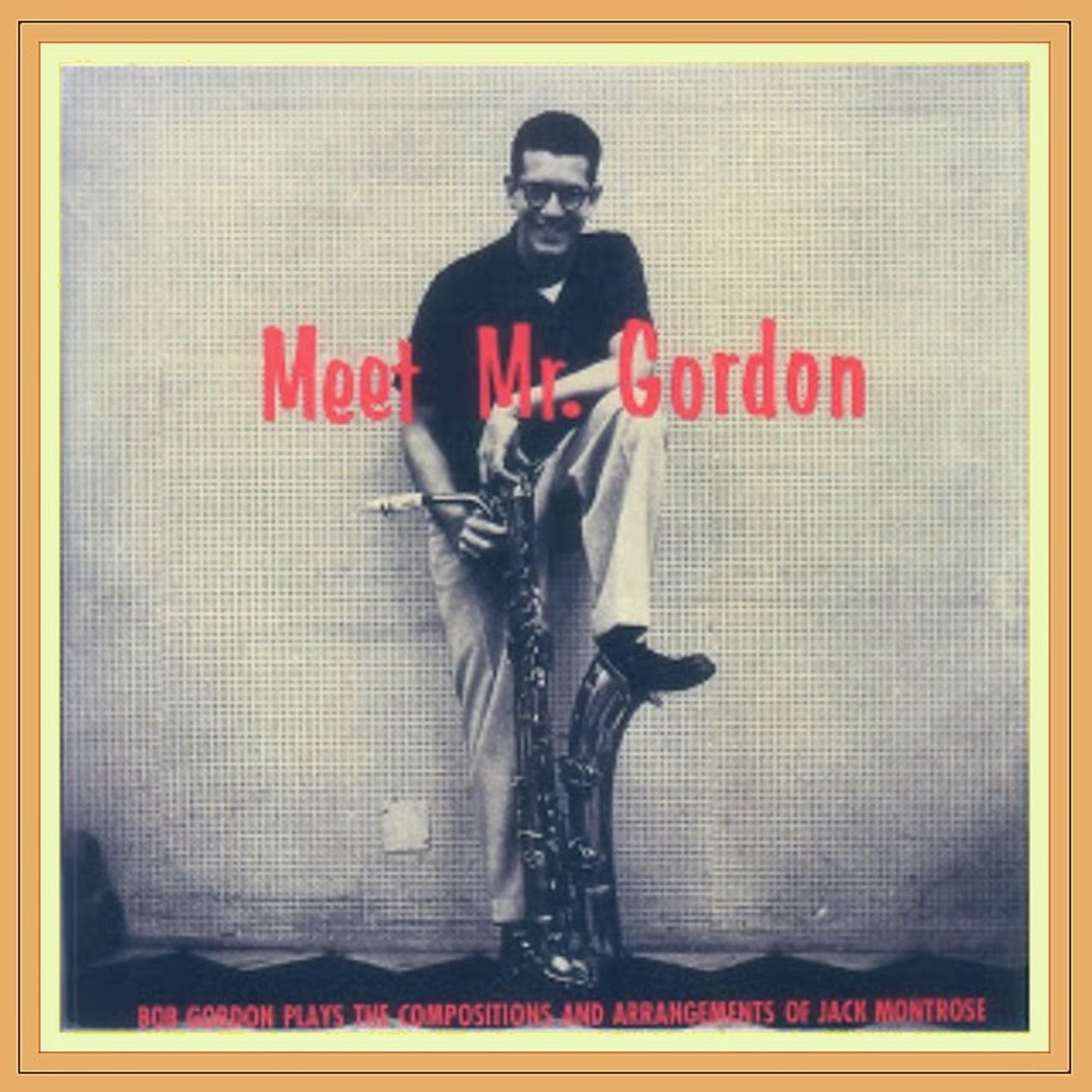

Bob Gordon, another sideman on the [Clifford] Brown sessions for Pacific Jazz, also might have made a major impact on West Coast jazz under different circumstances. A driving and creative baritone saxophonist, Gordon had created a distinctive style that stood out from the then predominant influ­ence of Gerry Mulligan. Indeed, Gordon drew mostly on influences out­side the baritone tradition. When he was asked by Leonard Feather, as part of the latter's research for his Encyclopedia of Jazz, to cite his favorite musicians on his instrument, he mentioned session mates Zoot Sims and Jack Montrose.

Born in St. Louis on June 11, 1928, Gordon came to Los Angeles in 1948 to study at the Westlake College of Music. In the early 19505 he participated in a series of successful recordings as a sideman for various West Coast jazz luminaries, including Chet Baker, Shelly Manne, Shorty Rogers, Red Norvo, Pete Rugolo, Bill Holman, and Maynard Ferguson. In May 1954, only a few weeks before the sessions with Clifford Brown, Gordon recorded as a leader for Pacific Jazz.

The resulting album, Meet Mr. Gordon, showed that the young baritonist was on the brink of emerg­ing as a major voice in the Southern California jazz scene. A short while later Downbeat awarded him its New Star Award on baritone sax. On August 28, 1955, Gordon was killed in a car accident while driving to San Diego to appear in a concert with Pete Rugolo's band.”
- Ted Gioia, West Coast Jazz: Modern Jazz in California, 1945-1960

“The accidental death of Bob Gordon, August 29, 1955, … left a huge void [on the West Coast Jazz scene]. Gordon had come from St. Louis to study at Westlake College in Hollywood. He started on alto sax because his first influence had been Charlie Parker.

But after listening to Miles Davis Capitol [aka Birth of the Cool] sessions with Gerry Mulligan these led to his discovery of the baritone, sax.

In adopting the baritone he had the wisdom not to disavow what he loved: ‘I can still find new things in the old records of Parker. Zoot Sims is also very important to me.’

Bob Gordon, whose sound was to remain very close to that of Mulligan, was certainly, by his ideas on the instrument, the best baritone of the time.”
- Alain Tercinet, West Coast Jazz [translation from the French is mine]


Bob Gordon was an inspiration to every jazz musician or aspirant who ever heard him play or was, perhaps, fortunate enough to share the bandstand with him; fortunate enough to partake of the fire that roared and the sparks that flew and the proclamations of the gods that sounded when he put his big horn to his lips and made the world abound with life and zest and unbounded love. For the world was a better place to live in when he played and perhaps this singular ability to make it so was in itself his greatest gift.

Bob Gordon was a natural musician and not the least bit revolutionary, at least intentionally. He gave not a hang for those whose prime objectives are to affect or deliberately perpetrate change. For his sole purpose in life was to express himself. To give forth with that power and perception which surged within him. These truly are the power and perception which surged within him. These truly are the seeds of progress and he knew it-I mean really knew it. It was not necessary for Bob Gordon to learn music for he was born with such equipment as one not so fortunately endowed could not hope to acquire in three lifetimes.

… The union of Bob Gordon and the baritone saxophone must have been decreed in Heaven for never have I viewed such rapport between the natural tendencies of a musical instrument and the mind of the man using it. I cannot imagine Bob Gordon using any other instrument-I mean any other instrument as a vehicle for expressing himself. He was a true baritone player not a converted alto or tenor or clarinet or what have you player: but a man who found that the low pitched, earthy, funky sound inherent in the horn suited him.

For Bob too, was earthy and funky and natural and honest.
For me Bob Gordon was more than just an inspiration—he was my other half and together we formed a musical whole. Our partnership has not ended, however, for his part is indelibly stamped upon my soul and the task is mine to carry on. For we understood one another and agreed completely. I am fortunate to have loved and been loved in return by one such as Bob Gordon. I also realize that the companionship and artistic rapport which we enjoyed were of such a nature as is not commonly experienced. I am fortunate and a better man for having known and loved Bob Gordon.”
—Jack Montrose, tenor saxophonist , composer, and arranger
(original liner notes Pacific Jazz 10” LP #12)

Lately, the editorial staff has had the pleasure of working with Gordon Jack who is the author of  – Fifties Jazz Talk: An Oral Retrospective [Lanham, MD: Scarecrow Press, 2004].

It is a book which grows in importance as a primary reference for West Coast Jazz with each passing decade along with Bob Gordon’s Jazz West Coast and the books on the subject by Ted Gioia and Alain Tercinet cited in the opening quotations.

Gordon writes regularly for Jazz Journal and he granted the editorial staff at JazzProfiles copyright permission to use the following essay on baritone saxophonist Bob Gordon which first appeared in that publication.

Gordon Jack’s writings about Bob along with the opening statements about Bob Gordon’s significance by authors Ted Gioia, Alain Tercinet and his close musical associate, Jack Montrose, will help you place Bob Gordon in the context of this style of music should you be unfamiliar with him.

These comments will also shed some light on why I subtitled this piece about Bob – “Baritone Blues.”

Order information regarding Jazz Journal is available at www.jazzjournal.co.uk/


© -  Gordon Jack/Jazz Journal, copyright protected; all rights reserved.

“THE FORGOTTEN ONES BOB GORDON By Gordon Jack.

Many baritone players gravitate to the instrument via the alto saxophone possibly because the transposition - one and half tones below concert pitch - is the same.

Bob Gordon’s instrumental journey was a similar one and his decision to concentrate on the larger horn was celebrated by his long-time colleague and friend Jack Montrose - “The union of Bob and the baritone saxophone must have been decreed in heaven. I cannot imagine him using any other instrument as a vehicle for expressing himself. I have never seen such rapport between the natural tendencies of a musical instrument and the mind of the man using it”. When they met in the late forties Gordon’s association with the baritone had become a permanent feature of the Californian jazz scene, although his high-school instrument had been the alto.

He was born in St .Louis, Missouri on June 11th. 1928 and moved to Los Angeles 20 years later where he graduated from the Westlake College of Music. After hearing Gerry Mulligan with the Miles Davis nonet he bought a Conn baritone and started sitting-in at clubs around town like the Showtime on Ventura Boulevard where trombonist Herbie Harper held court. For the next three years he worked in Los Angeles and San Francisco with Alvino Rey’s band which for a time included Harper, Jerry Dodgion, Paul Desmond, Dick Collins and Herb Barman. (Dodgion who played lead alto remembered Gordon as an “Excellent jazz baritone player who also sang.”)

For a few months early in1952 he and Jack Montrose were members of John Kirby’s final group, a sextet playing for dancers at the Five-Four Ballroom on 54th. and Broadway. Mulligan’s girl-friend Gail Madden worked as a photographer there and he used to sit-in with them every night when he came to pick her up. Montrose once told me, “Gerry had a great sound but Bob’s was even better.”


In the early part of 1953 Montrose was leading an experimental seven piece group which included Gordon, Herb Geller, Bill Perkins, Stu Williamson and a somewhat forgotten tenor player Dave Madden who had worked with Woody Herman and Harry James. (He and Gail Madden had previously been an ‘item’ although they never married. Gail also had a long-term relationship with arranger Bob Graettinger). They occasionally worked opposite Mulligan’s quartet at the Haig and in December 1953 Dick Bock recorded Chet Baker with Jack’s group for Pacific Jazz. The album has subsequently been reissued with five alternate takes including additional Gordon solos on Bockhanal and A Dandy Line (Pacific Jazz 7243 5 79972). 1953 was also the year he made a very brief appearance in the film ‘The Glass Wall’ which had music by Leith Stevens and Shorty Rogers.

George Redman was the drummer with the Harry Zimmerman orchestra on the Dinah Shore TV show. He also had a very popular small group that played six nights a week in dance halls like The Summit and The Madelon on Sunset Strip. It was usually one horn plus rhythm and Bob Gordon alternated with Bill Perkins or Bud Shank as the soloist. A fine example of Redman’s work can be found on a 1954 album where he fronts a group featuring Harper, Gordon, Maurey Dell and Don Prell (LHJ 10126).  Pianist Maurey Dell will be unfamiliar to many in a jazz context because he worked almost exclusively with singers and comedians like George Burns. Bassist Don Prell eventually joined the San Francisco symphony but Redman who was also a well known pool shark mysteriously disappeared from the Hollywood scene in the mid fifties.

In February 1954 Bob was part of an all-star group including Bud Shank, Bob Cooper and Maynard Ferguson that recorded two titles for the Emarcy label. It is an extrovert blowing session with Bob’s longest solos on record – Night Letter and Somebody Loves Me (FSR CD 383). In an interview for Jazz Journal Shank told me that Bob Gordon was his closest personal friend and whenever Bud recorded on baritone which was quite often in the fifties, his sound and approach seemed to reflect Gordon’s. I find Shank’s baritone playing more expressive and satisfying than his alto work at that time probably because of Gordon’s influence.


Three months later he recorded the only album under his own name for Pacific Jazz – Meet Mr. Gordon (Pacific Jazz 7243 4 93161 2 6). Montrose arranged all the material and the rhythm section featured Joe Mondragon, Paul Moer and Bob’s friend from St. Louis, Billy Schneider on drums. The latter is an obscure figure now but he had studied and worked with Lennie Tristano in New York. One of many highlights here is Bob’s tender statement on For Sue, a moving ballad dedicated to his wife.

In July 1954 he was selected with Zoot Sims, Stu Williamson, Russ Freeman and Mondragon to record with the brilliant young trumpeter Clifford Brown (Pacific Jazz 5 32142 2 CD). Once again all the charts were written by Montrose who by this time was almost Dick Bock’s house arranger. Max Roach had been booked but he got into a money dispute with Bock, so master percussionist Shelly Manne took his place although this would not have gone down too well with Gordon. Apparently he did not care for Manne’s playing which sometimes led to arguments on record dates. Bob was a powerful and aggressive player and he preferred powerful and aggressive drummers like Philly Joe Jones and Art Mardigan. Someone else he did not get along with was Art Pepper who was unpopular with others too. Pepper and Joe Maini nearly came to blows once at an after-hours club on Hollywood Boulevard where Bill Holman had the resident group.

By 1955 he was established as the first-call baritone player in L.A., benefiting from all the recording activity created by the popularity of the new school of West Coast Jazz. Gerard J. Hoogeveen’s excellent 1987 discography lists 23 record dates for the year in what was a busy and productive time as he performed with Pete Rugolo, Zoot Sims, Lennie Niehaus, Duane Tatro, Dave Pell, Maynard Ferguson, Jack Millman, Don Fagerquist, June Christy, Tal Farlow and Jack Montrose. It was also the year DownBeat recognised his immense talent when the magazine voted him the ‘New Star’ on baritone.

He thrived whatever the context - extrovert blowing sessions with George Redman, Herbie Harper and Maynard Ferguson, dance albums with Dave Pell’s octet and
especially in the interpretation of Jack Montrose’s complex charts with their academic but swinging explorations of fugues and canons. Given the opportunity his huge, ebullient and at all times soulful sound would have been particularly effective in the give-and-take of a Mingus ensemble.

On Sunday August 28th. 1955 Bob Gordon was killed in a traffic accident while on his way from Hollywood to San Diego for a Gene Norman concert featuring Pete Rugolo’s orchestra, Nat King Cole and June Christy. At the funeral Jack Montrose was told by Bob’s parents that his surname was actually Resnick although jazz reference books make no mention of this and it is unclear why he changed it. His widow wanted a band for the occasion so Jack Sheldon, Joe Maini, Bob Enevoldsen and Montrose performed Jack’s arrangement of Gordon Jenkins’s Good-Bye. Enevoldsen told me that under the circumstances this was almost impossible to perform. Montrose confirmed that he never missed anyone as much as he missed Bob Gordon.

The following year Leonard Feather commissioned a poll of leading musicians who were asked to nominate their favourite instrumentalists. The following voted for Bob in the ‘Baritone’ category - Georgie Auld, Al Cohn, Tal Farlow, Maynard Ferguson, Woody Herman, Bill Holman, Howard Roberts, Frank Rosolino, Pete Rugolo, Bill Russo, Bud Shank and Cal Tjader.

Another example of how highly Bob Gordon was thought of by his fellow professionals can be found on the late Danny Bank’s website. Bank was probably the most recorded baritone player in history with over 400 sessions on Lord’s discography during a 53 year career. Danny included him along with Harry Carney and Jack Washington in a long list of personal favourites on the instrument.

Bob Gordon should never be forgotten and had he lived I feel he would have become the music’s primary voice on the baritone saxophone.”

Thursday, July 28, 2022

West Coast Jazz Box

© -  Steven A. Cerra, copyright protected; all rights reserved.


“There was something special about the West Coast jazz scene of the Fifties and early Sixties. Those of us privileged enough to have lived through that era — to have heard favorite musicians holding forth at the Lighthouse, the Haig, the Black Hawk, or Zardi's (or later, at places like the Jazz Workshop, the Renaissance, or Shelly's Manne-Hole) — tend to smile broadly whenever someone's comments or a snatch of music conjures up that scene.” 
- Bob Gordon, author Jazz on the West Coast


Because I was “there” and had a professional involvement with it as a musician, I often get asked about what recordings to buy that feature the West Coast style of Jazz which existed mainly in California from 1945-1965.


My recommendation is pretty straightforward - West Coast Jazz Box: An Anthology of California Jazz - a 4 CD collection that was issued by Fantasy in 1998 [4CCD-4425-2].


The musical selections in the set are a comprehensive representation of all facets of the styles of West Coast Jazz that were played during this twenty year period and the following booklet annotations about the music by Bob Gordon, author of the definitive Jazz on the West Coast, and by the boxed set’s producers Ralph Kaffel and Eric Miller are unsurpassed in providing a brief synopsis of this “moment in time” in the history of Jazz.


Bob Gordon


“I may as well own up to this at the beginning: there is no general agreement upon the definition of the term "West Coast Jazz." The phrase has been bandied around for over four decades now, but as with many a catch phrase, it seems to mean pretty much what a given speaker wants it to mean. Like the word "jazz" itself, most everybody has a vague idea of what the term encompasses, but when it gets down to particulars, the arguments begin. So if you've already glanced at the listings for this album and decided that a particular performance doesn't fit your idea of West Coast Jazz, not to worry: you'll probably enjoy it anyway, whether or not you believe it's truly West Coast Jazz.


My personal preference for such a definition has always been: "That music produced by jazz musicians residing at the time on the West Coast."This seems to me the only definition inclusive enough to include the entire scene, from Dexter and Warden's Central Avenue duels, to musicians like Dave Brubeck, Gerry Mulligan, and Shorty Rogers, to the experiments of Ornette Coleman.


As to the origins of the term, nobody — to my knowledge, anyway — has ever taken credit (or accepted blame) for coining the phrase. When it first came into general use, the vocal wars between the boppers and moldy figs were beginning to wind down, and it's possible the trade journals felt the need for a new cause celebre to boost circulations. This cynical view, however, fails to acknowledge that in the first half of the Fifties, at least, there did seem to be certain stylistic differences between much of the jazz being produced in California and much of the jazz emanating from the East Coast. (I've emphasized "much" in both cases because many musicians from both coasts stubbornly refused to fit into their assigned pigeonhole.)


Basically, the differences were these: many of the West Coast musicians took their inspiration from such "cool" influences (there's another one of those damned terms) as Lennie Tristano and the Miles Davis Birth of the Cool band, while the mainstream of jazz in New York City could easily be recognized as a direct descent of bebop. As long as one remembers that such generalizations are generalizations — that there was cool jazz being played in New York and fire-breathing bebop being performed in Hollywood — the distinction can be useful. In any case, by the end of the decade, such differences became ever less apparent.


The musicians, of course, were loath to be so pigeonholed. Shelly Manne can be heard on a "live" recording introducing the members of his working band—one of the hottest units on either coast at the time—as a "West Coast Group." Shelly then goes on (in a native New Yorker's accent that he was never quite able to shake) to list the hometowns of his musicians: Joe Gordon (Boston, Massachusetts), Richie Kamuca (Philadelphia, Pennsylvania), and Monty Budwig (Nyack, New York), gleefully saving Victor Feldman (London, England) for last. Rarely has a musician's disdain for such labels been as forcefully, if tactfully, expressed.
And yet, and yet...


There was something special about the West Coast jazz scene of the Fifties and early Sixties. Those of us privileged enough to have lived through that era—to have heard favorite musicians holding forth at the Lighthouse, the Haig, the Black Hawk, or Zardi's (or later, at places like the Jazz Workshop, the Renaissance, or Shelly's Manne-Hole)—tend to smile broadly whenever someone's comments or a snatch of music conjures up that scene. This set should bring back fond memories for those already familiar with West Coast jazz, and perhaps it will provide some feeling for the ambiance of the period for those to whom the term is just a phrase remembered from the jazz histories.”


Ralph Kaffel 1998
I've wanted to assemble this compilation of West Coast jazz classics for many years now, but something always came up to dislodge it from its place on the year's release schedule.


The publication of Robert Gordon's Jazz West Coast (1986) and Ted Gioia's West Coast Jazz (1992) served as pointed reminders to quit procrastinating and get down to business. This year, we did.


Eric Miller and I finally decided that nothing would keep us from making this long rumored project a reality. Eric, Bob Gordon, and I — each with our own personal favorites — were responsible for selecting the contents. My own criteria were simple: to pick the tracks which not only had made a musical impact, but were solid sellers that enjoyed substantial radio play. For example, I still remember vividly the excited anticipation of initial releases by artists like the Chico Hamilton Quintet and Hampton Hawes, or the latest from the Lighthouse All-Stars, following their previews on KNOB-FM (the "Jazz KNOB" in Long Beach).


At this point I must confess to more than a little "partisanship" with respect to this music. My first job in the record business, circa 1956, was as a salesman for California Record Distributors in Los Angeles, a wholesale distributor owned, as it happened, by Contemporary Record's owner Lester Koenig. Richard Bock's Pacific Jazz Records was one of the distributor's most important labels. I always looked forward to attending the recording sessions at Contemporary's Studios (actually, the warehouse) on Melrose Place and at Pacific Jazz Studios on Third Street.


Koenig and Bock were very different personalities with unique approaches to recording and running their businesses, but I had the same great admiration for both of them and for the music they were producing.


Acquiring the Contemporary catalog in 1984, therefore — and keeping it in print, for the most part — was a major thrill for me on a personal level, as was the ability to work with Dick Bock on a few projects in the 1980’s, an association unfortunately brought to a halt by his untimely passing.


I'm sure that Lester and Dick would have enjoyed The West Coast Jazz Box, made possible to a large extent by their passion for the music.”


Eric Miller 1998


“Los Angeles had a vibrant jazz scene in the 1950s and '60s. I hung out a lot at Sam's Record Shop (the Birdland of jazz stores) at 5162 West Adams Boulevard, and Sleepy Stein did his KNOB-FM jazz show from just behind Sam's storefront windows.
Within 20 blocks of this store (and my house) were located some two dozen jazz clubs, where many of the artists in this collection played. The clubs included the It Club, the Zebra Lounge, the Parisian Room, and the Intermission Room.


Norman Granz presented his Jazz At The Philharmonic concerts twice a year in L.A. His artists included Ella, Oscar, Hawk, Pres, and Art Tatum, to name just a few. Sundays were my days for the Lighthouse, in Hermosa Beach, when I could borrow the car.


The bustling Hollywood club scene included Shelly's Manne-Hole, the Renaissance, Donte's, and Gene Norman's Crescendo and the Interlude.


Beside Contemporary and Pacific Jazz, great jazz was produced and recorded by the fledgling Hifijazz label under the direction of David Axelrod; Nocturne Records, co-owned by musicians Harry Babasin and Roy Harte; the aforementioned Normans, Granz and Gene; and the Tampa, Andex, and Mode labels.


Some 400 miles to the north, jazz was just as active in San Francisco, with its pioneering Fantasy Records — whose roster included Dave Brubeck, Gerry Mulligan, Cal Tjader, and Vince Guaraldi — as well as live jazz at the Black Hawk, the El Matador, the Jazz Workshop, and many more.


All things considered, I appreciate those years more and more with the passage of time, and see them as the "52nd Street days" of West Coast Jazz.”


The following video includes images and graphics from West Coast Jazz Box: An Anthology of California Jazz [Fantasy 4CCD-4425-2] as set to the track from the boxed set by alto saxophonist Lennie Niehaus performing Whose Blues with Jack Montrose, tenor sax, Bob Gordon, Baritone sax, Monty Budwig, bass and Shelly Manne, drums.