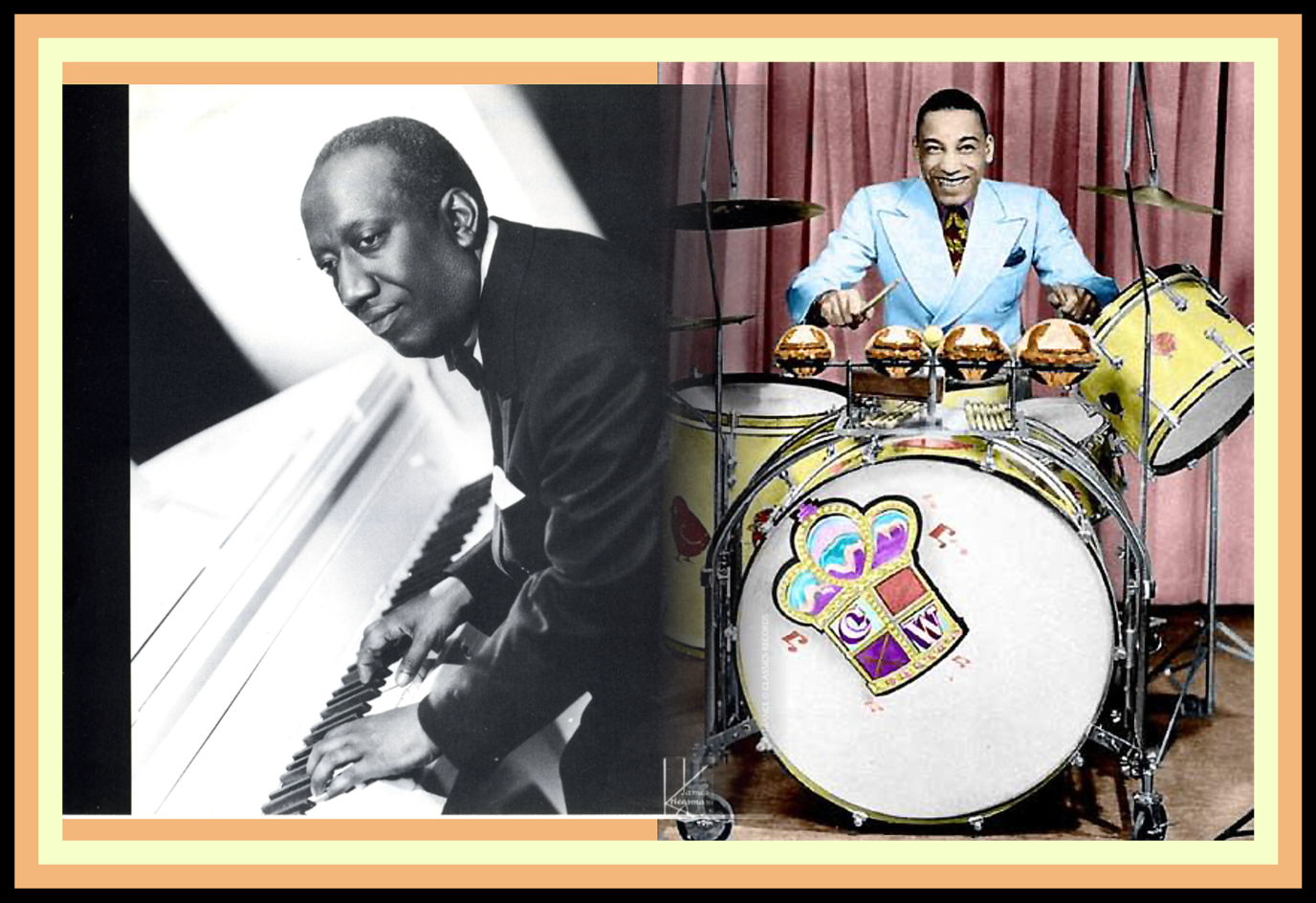
© Copyright ® Steven Cerra, copyright protected; all rights reserved.

On its own merits, as a thoroughly researched and well-written biography, Stephanie Stein Crease’s Rhythm Man Chick Webb and The Beat That Changed America [New York: Oxford University Press, 2023] deserves our appreciation, even more so when we recognize that it rescued one of the most important musicians of The Swing Era from continued obscurity.
William Henry “Chick” Webb [b. February 10, 1905] reigned supreme at Harlem’s Savoy Ballroom in the 1930s as a drummer who brought together one of the most dynamic, accomplished and influential big bands in the history of Jazz.
But following his death on June 16, 1939, what little that was known about him seemed to vanish along with his body and soul.
About two years later, World War II broke out and many musicians from the big bands joined the armed forces.
When the conflict was over, the economics that followed brought an end to the big bands and The Swing Era, all of which further diminished Chick’s memory.
A short-lived life combined with the disappearance of the context for its fame resulted in a lasting repercussion of legend shrouded in hagiography.
The usual excuses for the persistence of the Webb of Myth applied: Jazz was poorly documented; oral recollections from Chick’s musical associates were compromised by hyperbole and faulty memory; the national press offered little in the way of detailed information or documentation about the popular craze in entertainment collectively labeled the Swing Era [a passing fancy at best!].
Fortunately for the history of Jazz, there are standard bearers who recognize the importance of seminal figures like Chick Webb who helped shape the early years of the music. Some of these Enlightened Ones are even in a position to suggest to writers and researchers who are enthusiastic students of the music that topics such as the life and times of William Henry “Chick” Webb are worthy of their attention and their skill.
Enter Gary Giddins and Stephanie Stein Crease for had it not been for Gary’s suggestion to Stephanie in his capacity as the Series Editor for Oxford University Cultural Biography that she consider devoting her considerable abilities as a researcher and a writer to take up the challenge of uncovering the real Chick Webb, the man and his accomplishments, we might still be dealing with “... a mythology of apocrypha, uncorroborated tales and legends to good to be true.” [Giddins, Foreword].
Why Stephanie Stein Crease? Because:
“In 2002, Stephanie Stein Crease published her superb biography of Gil Evans, Out of the Cool. She knew music, big bands, and life-telling, and was obviously a solid writer and a no-stone-unturned researcher. When I approached her, she had another subject in mind, but I asked her to consider Webb. She was instantly taken with the idea, but instead of rushing out a standard proposal, she devoted three years to research, making certain a story was there to tell. She would return from trips to Baltimore and deep dives into African American newspapers with startling details about his early years, not least his birth date, which had been debated by jazz writers for seventy years and is carved incorrectly on his tombstone. Crease reveals the deepest feeling for Webb's humanity I have seen anywhere—with not a little of the novelistic scope and nuance I looked for long ago—but her portrait is always underscored by her staunch and corroborated legwork, accentuating his genuinely heroic stature. She adds telling details to the stories we think we know and takes us into areas that most jazz portraits ignore.” [Giddins, Foreword].
As for the paucity of documentation about Jazz, especially during its early years, which many aspirant researchers indicates hampers their efforts, Ms. Crease’s determination and tenacity were no match for this excuse for as she explains it in her Introduction:
“Researching and writing about Chick Webb was challenging. But it was far less daunting and challenging than Webbs own journey when, in late 1924, he left his hometown of Baltimore with his drums, his best friend/guitarist John Trueheart, and a handful of connections to enter the competitive world of Black musicians in Harlem and New York. Again and again, Chick Webb took chances on musicians, advances in musical directions, his own developing virtuosity, and his community.
I took a chance on writing this book, knowing that there was not the huge trove of documentation and footprints—musical and otherwise—that were resources for biographers of other jazz masters. Fortunately, my research took place during an explosion of digital resources. Newly digitized issues of prominent historical Black Newspapers, such as the Baltimore Afro-American, the Chicago Defender, the Pittsburgh Courier, and the Amsterdam News were a valuable asset. Their entertainment and cultural reporters covered Webb's entire career, including his first appearances at the Savoy Ballroom, the Lafayette Theater, the Apollo Theater, and radio broadcasts. Their columns and articles appeared a decade before DownBeat Magazine came into existence, or its writers paid much attention to Chick Webb.
What I hope has emerged from my research is a group portrait, centered around Webb, that comprises a Webb archive created from many different resources. This encompasses Webb's family life and early years in Baltimore, his lifelong health issues, and his life and career in Harlem, which traversed the high years of the Harlem Renaissance to the creative swing music-and-dance movement of the 1930s that he helped foment. Webb settled in Harlem as it was becoming a beacon for writers, journalists, political activists, artists, and entertainers and musicians of the highest order.”
So “what’s inside the box” when you open your copy of Stephanie Stein Crease’s Rhythm Man Chick Webb and The Beat That Changed America [New York: Oxford University Press, 2023]?
“Many jazz books and resources mention Chick Webb, his influence, and his intersections with Ella Fitzgerald and other musicians, but they scarcely scratch the surface of his cultural surroundings and his impact. By the end of his short life, Webb was recognized as one of America's most popular musical stars and a cultural hero. Over the past few decades, his story has tragically receded from view. The aim of this biography is to restore Chick Webb's centrality in the development of American jazz and popular music. There he is, in the middle of his band's front line, leading his musicians and thousands of dancers from his drummer's throne.” [Crease, Introduction].
Highlights and takeaways for me after reading my copy include:
[1] The Jazz drummers’ comments about Webb's technique, musical accomplishments, and place in the evolution of jazz drumming including those by Art Blakey, Kenny Clarke, Cozy Cole, Papa Jo Jones, Gene Krupa, Buddy Rich, Max Roach, and Kenny Washington. [My bias may be showing here.]
[2] While it appears at the back of the book, I brought the Selected Discography “forward” and listened to as many of the recordings listed there as possible while reading Rhythm Man to give me an audio context in which to appreciate Chick’s music. Amazingly, much of it is available via streaming apps and online videos. I was also able to supplement these with digital and analog recordings from my own collection.
[3] Garnering more information through Stephanie’s accumulated research about how Chick and his music were an extension of the Harlem Renaissance’s “philosophy of racial uplift,” although more informally by providing a vehicle for “dressing up, showing up, dancing and having a good time.” [paraphrased]
Put another way, Chick’s drumming artistry and the high standard he set for his orchestra’s performance made a major contribution to the rich cross-disciplinary artistic and cultural activity among African Americans in the period between the world wars which was given the name of - The Harlem Renaissance.
[4] Gaining and understanding through Stephanie’s narrative of how the orchestras of Duke Ellington, Fletcher Henderson, Cab Calloway and Chick Webb were able to keep working through the Depression, especially in the case of the Webb band, through its “versatility.
“Webb and his band expanded their repertoire for all possible tastes. Teddy McRae recalled that Webb had at least 150 dance arrangements even then, for every conceivable style and rhythm. It was during these early years of bandleading that Webb knew the band's key to survival was versatility. They performed anything a particular audience wanted, and aimed for an authentic sound and rhythm, whether it was a Viennese waltz, a tango, a fox trot, a slow drag, or a hot stomp.”
[5] Everything to do with the grandeur and spectacle that was The Savoy Ballroom; and what a unique place it was. Although it closed in 1958, Stephanie brings it alive again in all its vibrancy via her journey through Chick’s life.
[6] The opportunity to “relive,” in detail the legendary Battle of the Bands involving Chick’s fine aggregation and those of Benny Goodman in May 1937 and Count Basie in January 1938.
[7] Thanks to Stephanie exhaustive research and explanatory narrative, one comes away with an ability to grasp the significance of:
“The popularity of swing music and dance expanded through 1935, then swept across America the following year, crisscrossing audiences, racially and economically. Hit radio broadcasts and swing records fed into this trend, and live swing dance bands started appearing in big cities and small towns, many for the first time. In tobacco barns and elaborate ballrooms, dancers wanted to swing out. More jobs opened up for musicians and singers in new venues. It was an astonishing melting-pot moment in America: young people all over the country started dancing to the same numbers, with regional variations….. It was Swing's transformational moment in America, emerging from the harshest years of the Depression.”
[8] Where, why and how it all began with vocalist Ella Fitzgerald [1917-1996] who would become the Webb Orchestra’s “girl singer,” its leader after Chick’s death and then following the demise of the big bands in the late 1940s, rise to prominence as America’s First Lady of Song.
[9] A greater understanding and appreciation of the consequences from the opprobrium faced by the Webb [and other Black] orchestras by the predominantly White Jazz critics - among them John Hammond and Leonard Feather - who accused them of becoming too commercial.
“Hammond wasn't the only one. In the January 28 issue of Metronome, George Simon, an enthusiastic admirer of Ella Fitzgerald all along, lodged similar advice: "Here's uttering a humble prayer that this truly great Chick Webb band, which can cut just about any swing outfit in the world, won't turn into one of those stiff, stagey aggregations, which measures glory in terms of quarts of grease paint and numbers of orchestra seats sold. The band is too great, both personally and musically, to allow itself to tumble into such listless doldrums!"4”
Ah, the roots of the artistic glories of the starving Jazz musician!
[10] Finally, an accurate accounting of the facts associated with Chick’s passing on June 16, 1939, an event that has for so long been clouded over by rumor, gossip and innuendo.
The publishing of Stephanie Stein Crease’s Rhythm Man Chick Webb and The Beat That Changed America [New York: Oxford University Press, 2023] is an important contribution to the Jazz Literature.
But this is no stodgy, academic treatise. It is written in a style that is welcoming and informal, one that engages the reader in one of the best things of all - the telling of a good story.
Instructive and informative though it may be, it remains a pleasant reading experience from cover-to-cover. When you’re done, Stephanie makes you feel like you were actually a part of the story, at one point, walking into the resplendent Savoy Ballroom just in time to hear Chick count the band into its churning rendition of Liza.
Books about Jazz this good don’t come along very often. Make sure you get your copy. You’ll be glad you did. For order information go here.