Showing posts with label Don Ellis. Show all posts

Saturday, February 17, 2024

Don Ellis - Blindfold Test Parts 1 & 2

 © Copyright ® Steven Cerra, copyright protected; all rights reserved.
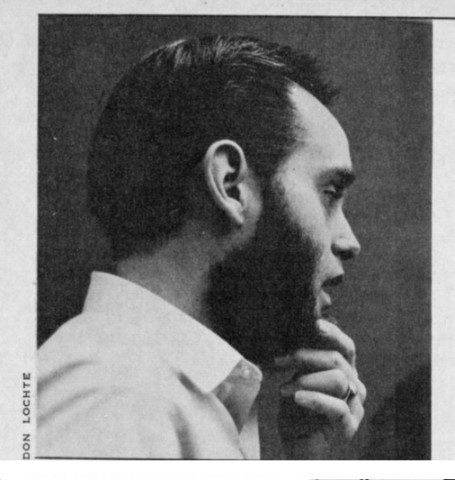

The blog archives contain an 8-part series on trumpeter and bandleader Don Ellis which was published individually and collectively on these pages and the following is intended to add to this repository of information about one of the most original musicians in Jazz History.


The esteemed author and critic Leonard Feather, who originated the Blindfold Test and made it exclusive to Downbeat, offered the following background information for these visits with Don which appeared in the January 9 and January 26, 1967 edition of the magazine.


“When Don Ellis first took the Blindfold Test (DB, Nov. 8 and 22, 1962), he was introduced as a leading figure in the New Wave.


After a few years of name-band sideman work, notably with Maynard Ferguson, he branched out on his own for a while with various groups and worked with George Russell.


Not until 1964, when he returned to his native Los Angeles, did a significant pattern emerge. It was then that he displayed the fruits of his studies with Indian percussionist Hari Har Rao, who played with him in the Hindustani Jazz Sextet. About the same time, Ellis' big band started as a workshop group, began playing one night a week publicly in a club, and established itself beyond cavil as the hit of the '66 Monterey and Pacific festivals.


In Ellis' latest Blindfold Test, as I expected, he was characteristically articulate.


[I would say that Don was “articulate” in the extreme in the following interviews. Don knew what he was talking about and could explain it cogently and coherently.]


1. STAN KENTON. Septuor from Antares (from Adventures in Time, Capitol). Marv Stamm, trumpet; Johnny Richards, composer.


Well, that was Stan Kenton and his mellophoniums, and it's from the album that he did where they were experimenting with different time pieces, this piece being 7/4. The 7/4 pattern, when you do it in 4 rather than 7/8, is much easier to feel, as far as being able to play a solo over it, but it is much harder to keep your place when you are soloing, because it's similar to two bars of 4/4.


That's why I noticed the trumpet soloist was mostly floating over the time, and would usually come out a beat late in his phrase. He would come out to end on 1 but would end on 2, because the measure was only seven beats long. I think it was probably Marv Stamm; he's a good player, but you could tell he wasn't exactly sure where 1 was.


I was talking to some of the guys that made this album, and they were saying how much they scuffled with it to learn these times [time signatures], because I don't think they had much of a chance when they made this album to go out on the road and play it; they just came in the studio and recorded it.


From experience, I know it has taken my band about a year to get comfortable in these different times. Now I can bring in any time signature, and once they learn the pattern, they've got it. They can sight-read it almost immediately.


I know at first when a guy comes into the band and tries to sit in with us, he has a terrible time. It shouldn't be that hard; we should be used to it, but the sad fact is that jazz has been boxed up in 4/4 and 3/4 time for so long that it just seems very unnatural.


In other cultures 7/4, 9/4, and 5/4, those are the basic patterns. There is nothing really intrinsically hard about this— it's just that learning it is a slightly different feeling. I think Stan is to be congratulated for being one of the first to really explore the time-signature thing in terms of big band.


I get sort of oppressed. I like — and I find it very exciting to have — heavy brass and screaming trumpets; I like that a lot, but when you hear it from beginning to end of the track, with no variation in dynamics particularly, it gets very oppressive.


That's one slight criticism I've always had for a lot of Stan's work. When you have a big band, especially with as many brass as there is on this record, it's very easy to get that oppressive heaviness going with the brass. It is much more of a challenge to get something light happening.

From playing in a section, I know when you have five trumpets and five trombones, and other horns, just to be heard, there's a tendency to play out as loud as you can and forget the dynamics.


All and all, I thought it was a step in the right direction. It rates four stars.


2. BOBBY HUTCHERSON. Juba Dance (from Component, Blue Note). Hutcherson, vibraharp, marimba; Joe Chambers, drums, composer; James Spaulding, flute.


The overall concept of this reminds me of a couple of very effective things I have heard recently, one by Yusef Lateef. I don't know what the name of it was; he had a very simple background and over a sort of a drone, and the rest of the group was playing very pointillistic things over it. It was very charming, very effective, and just recently I heard Charles Lloyd doing very much the same thing. They set up a sort of a drone and do all sorts of things above it. This seems to be the same type of conception.


In this case, I didn't have a feeling that the piece got anywhere. It didn't develop one particular mood to any great length. There was no real unity between the piece and the solos, aside from the background, which just kept on and on.


It reminds me of a sort of stream-of-consciousness writing; this is the analogue in music, and to me this is the least interesting type of jazz improvisation, because that is the easiest thing to do — just to sit up there and let your thoughts come out. The hardest thing to do is to sit there and organize your thoughts on the spur of the moment and come up with a beautifully constructed, well-organized solo or group improvisation.


It happens so rarely; only a handful of jazz masterpieces ever achieved this.


Also, the head, the form of the piece —  where everybody blows the head, then everybody solos and then you take the head out again — is ancient bebop. In this context, you would hope to hear something a little more imaginative than that.

All in all, I wasn't too impressed with it — it was fair. I kept thinking something was going to happen; it's too bad.


I won't hazard a guess who it was, because a lot of guys now are doing this type of thing. It's like when bebop got all its imitators, everybody sounded alike. Now all the guys that are doing this type of thing sound alike, with the exceptions of the ones that are really developing a personal style, like Charles Lloyd and John Handy and people like that.


3. GIL EVANS. El Toreador (from The Individualism of Gil Evans, Verve). Johnny Coles, trumpet; Evans, piano, composer.


Well, it was Gil and Johnny. I was talking with a well-known arranger about Gil a few months ago; he had been back in New York and had heard him, and he thought that Gil sounded like be was rewriting Sketches of Spain in as many different ways as possible and that what he heard was all these long, drawn-out sounds but not too much happening. I think that is what is going on in this particular track.


Gil is one of the great masters of jazz orchestration. But this particular period that he seems to be in right now is one of his least interesting from the standpoint of listening, because, well, I'm not particularly interested in hearing long, sustained sounds forever and ever.


My main interest in jazz and in any music is rhythmic interest, and, of course, there is practically none in tracks like this. The mood that it gets could be very effective as part of a larger piece. But even then I didn't feel that it had the intensity that it should have had.


It should have been much more dramatic, much more gripping than it was; it started to get into something, but it couldn't quite make it. I would like to hear Gil, instead of getting bogged down in all these drones and this particular thing that he is in now, get into more rhythmic things, using his beautiful sensitivities for orchestration but put it to a more exciting use than he has in the last few months — I guess ... I don't know how long this has been going on.


As far as rating goes, here again it was good—I would say three stars.

(Continued in next issue)


1. ANDREW HILL. Spectrum (from Point of Departure, Blue Note). Eric Dolphy, bass clarinet; Hill, piano, composer; Anthony Williams, drums.


One thing that Eric Dolphy always had was a sense of the dramatic, a sense of form. In the Blindfold Test we did three or four years back, I commented that I liked what Eric did, but I felt his choice of notes was sometimes open to question; he tends to repeat licks that you have heard him do a hundred times before. In this particular track he seemed to be very creative, and seemed to stay away from those.


One very valuable lesson that the avant-gardist can learn from Eric is that the sense of urgency — the sense of drama that he has in his playing, the violent contrast that he would sometimes use — this immediately gives it more direction.


The piece in itself was rather interesting, sort of a small suite.


I would like to comment on the drummer, who could have been Tony Williams. This particular style of drumming, breaking up the time into different fragments, can be very effective, but it also can be very deadly, particularly behind the piano solo, the first solo on the record — I felt that the time lost its intensity. The interest was there, the imagination was there, what he was doing was interesting, but he got into this sort of floating feeling, where the time is there, but it is not really played. This feeling is not one of which I am particularly fond, because I like to hear, for the most part, a very definite driving type of beat, and I don't like to hear just that — I like to hear all the variations and the imaginations.


The tendency for the younger drummers of today is to try and break things up, which is all well and good, very imaginative, but they lose the intensity of the great masters of jazz drums in the past.


That's a shame, because once you lose that you lose 90 percent of what jazz time is all about, and I think it is possible to break up the time and still keep the swinging feeling. In fact, one of the most effective devices — I've heard Tony do this at times with Miles — he'll break up the time so that you think it is gone, but all of a sudden come right in on 1, and really be cooking. This can really lift an audience right off their chairs if it is done right, but it wasn't that way in this track.


For me, the most interesting section was the 5/4 section that they got into. But just to repeat an abbreviated form of the beginning at the end was sort of a cop-out, compositionally. The piece, to be really effective, should have built someplace and should have gone to a climax or tied things together in some sort of way; it really didn't end successfully for me. There were some good moments, especially Eric's playing. I give it 3 1/2 stars.


2.  THAD JONES-MEL LEWIS. Don't Ever  Leave Me.(from The Jazz    Orchestra, Solid  State). Jones, fluegelhorn, composer, arranger; Joe Farrell, flute; Lewis, drums.


Play it once more. ... It is nice to hear a big band using all different kinds of colors. When I first heard it with the woodwinds and everything, I thought it was Gary McFarland, but then when I heard Thad Jones, I surmised that it might be the new band that he and Mel have. That being the case, I was rather surprised — I haven't heard the band yet — but from reading reviews, that wasn't what I expected to hear.


The piece was utterly charming, and Thad sounded gorgeous. Especially at the end, he played a couple of phrases that just knocked me out.


Although I haven't heard him play for several years, the flutist sounded to me like it might be ... what I would imagine Joe Farrell would be sounding like now; especially at the end, he got in some good things too. Sounded very nice—4 1/2 stars.


3.  DAVE BRUBECK. World's Fair (from Time Changes, Columbia). Paul   Desmond, alto saxophone; Brubeck, piano, composer; Eugene Wright, bass; Joe Morello, drums.


There is nothing like a nice relaxed 13!


I liked the pattern very much 3-3-2-2-3 or 6 plus 7 or 13. Dave Brubeck has been playing these time things as a group longer than anyone else, but they don't seem to be very free within the time yet. For example, on this one they just kept playing the same basic beat. In other words they haven't got to the point yet where they can really mess with the time. I am a little surprised — I mean after playing these things for so many years. It seems they should be much further into it, given the amount of time they have been doing it.


I'm delighted to hear them doing this. This is the first time I have heard them playing in 13, and they played in it all the way through. Some of their original things they did, like the Rondo a la Turk, where they did the Turkish 9, they sort of copped out and went into 4/4 for blowing, but they stayed with this all the time.


I noticed Dave was having a little trouble there keeping his left hand right on the rhythm, but he came out okay. This is the type of thing I find most exciting — I'm just sorry that Dave and his group haven't been able to develop a more flowing thing, to get a little more imaginative. But the piece is nice; let's give them four stars.


4. YUSEF LATEEF. Kyoto Blues (from A Flat, C Flat and C, Impulse). Lateef, composer, bamboo flute; Hugh Lawson, piano; Reggie Workman, bass; Roy Brooks, drums.


There are some amazing slides on the flute there at the beginning and — that leads me to believe that it was probably played on a wood flute, where all the finger holes are open, and you can control the air more than on a normal flute.


That also leads me to surmise that it might be somebody like Yusef Lateef, who has a fantastic command of unusual flutes. Last year I saw him in Buffalo, and his pockets were bulging with all kinds of flutes; he is quite an amazing musician.


One thing that didn't make too much sense in this context was to have the drums playing in a fast 7 and the piano playing in a slow 4/4 against that and the bass somewhere in between. To have all different meters going at once can be exciting in certain cases, but in this case nobody really played in any one of them; everybody just played in their own meter, and it never came together; consequently, it lost the effectiveness it could have had had the things come together occasionally or had one of the soloists, for instance, gone with the drums in 7 or something.


But the original idea I thought was excellent. The rest of the record didn't come up to the level of the original conception.


The solos weren't as imaginative as the piece, so for the original conception I'll give it four stars, but an over-all rating would be somewhat less than that.”


Wednesday, July 28, 2021

Soaring with the Don Ellis Orchestra [From the Archives]

 © -Steven Cerra, copyright protected; all rights reserved.


“Don Ellis gave the concept of big band jazz. a completely new meaning.”
- STEFAN FRANZEN


“‘I believe in making use of as wide a range of expressive techniques as possible,’ said Ellis, who never lost sight of his own artistic credo, and made some of the most challenging music of modern times.”
- Richard Cook and Brian Morton, The Penguin Guide to Jazz on CD, 6th Ed.


“Ellis helpfully pops up with a breakdown of the 19-beat figure at the start of his big band's legendary 1966 Monterey appearance: '33 222 1 222 ... of course, that's just the area code!' Everything about Ellis's band was distinctive.”
- Richard Cook and Brian Morton, The Penguin Guide to Jazz on CD, 6th Ed.


Thanks to a professional relationship and a friendship with Fred Selden, I had a front row seat from which to view the early development of the Don Ellis Orchestra.


Fred, who studied alto sax with Bud Shank and composing and arranging with Shorty Rogers, was the lead alto sax player with Don’s big band and also composed and arranged some charts for the band.


Because of his organizational and administrative skills, Fred also served as a quasi musical director for the band, especially during its formative years.


As Don explains in his annotation of Fred’s tune - The Magic Bus Ate My Doughnut - which appears on The Don Ellis Orchestra Live at The Fillmore: “Fred Selden has been an important member of the band for several years now. He first started playing in one of my student rehearsal bands and as our lead sax player he has been contributing some of our most intriguing and exciting scores.”


While the Ellis band was coming into existence, I played drums in a quintet that Fred formed which also included Bulgarian-born pianist Milcho Leviev. Milcho was featured on keyboards in the Ellis Big Band and would go on to perform in small groups headed up by Chet Baker and Art Pepper.


I often attended the rehearsals of the Ellis orchestra and they were - in the parlance of the time - “a real trip.”


Coming into existence when it did in the second half of the decade of the 1960’s, Don populated the band with young musicians who infused it with energy and a willingness to try new things.


These guys grew up with Rock ‘n Roll, unusual time signatures, electronic instruments and devices [remember ring modulators?] and technique to spare on their respectives instruments and they brought it all home in the Ellis band. Put another way, the Don Ellis Orchestra “was not your Father’s big band.”


Leading this headlong charge into the world of new and different big band Jazz was Don Ellis who played trumpet, electric trumpet, quarter-tone trumpet, four-valved flugelhorn and … wait for it … drums!


And speaking of drums, the band was blessed with the amazingly talented Ralph Humphrey who held the whole thing together from the drum chair. Ralph was the only drummer I ever heard who could play an “in-the-pocket” 17/8 drum beat!


The Ellis band’s amalgamation of styles, influences and unique combinations of instruments can be heard to full advantage on Soaring one of its later recordings [1973] done for the MPS label and recently released on CD as Soaring - The Don Ellis Orchestra [0211977 MSW].


This version of the orchestra even incorporates a string quartet!


The following excerpts from the insert notes included with the CD provide succinct explanations about the music and the musicians on this recording after which you’ll find a video montage set to Whiplash, the opening track.


In retrospect, one of the amazing things about Don’s band was that despite the complexity of its music, it enjoyed tremendous crossover popularity.


Don suffered a heart attack in 1975 and died three years later at the age of 44.


Foreword to the New Edition


“Classical, Avant-garde, East Indian and Balkan metric concepts, big hand jazz - Don Ellis brought it all together with his own orchestra; as early as the 1966 Monterey Jazz Festival, Ellis and band were putting the public's expectations to the test.


Over the years Ellis expanded and refined the band's fantastic expressive abilities by, for instance, the integration of a string quartet into the group, or inviting the Bulgarian pianist Milcho Leviev as special guest.


In 1973, trumpeter Ellis and orchestra recorded two albums for MPS. This first album is titled "Soaring"; the scintillating music created by 22 musicians, including a 12-piece horn section, three percussionists, and a string quartet provides a shimmering, translucent texture captured in a Hollywood studio at the zenith of the band's abilities.


On the first composition, "Whiplash", Ellis demonstrates how his band could accommodate funk to 7-beat time signature. "Sladka Pitka" is a showcase for insanely complex time signatures, and when it comes to "The Devil Made Me Write This Piece" with its layering of samba, legato strings, and chromatic lines, the devil is indeed in the details.


With "Go Back Home", tenor saxophonist Sam Falzone gifted the band with an instrumental bit. and "Invincible" is characterized by dramatic, lyrical paintings in sound. Ellis allows for some tender moments on "Images Of Maria" and "Nicole", whereas Czech composer Aleksej Fried's "Sidonie" celebrates an exuberant festival of uneven rhythms. No question - on "Soaring", Don Ellis gave the concept of big band jazz. a completely new meaning.”


  • STEFAN FRANZEN Translation: Martin Cook


Original Liner Notes


“At last! The Don Ellis Band soars on in its own direction - free and invincible. The tunes on this album are the most popular and most requested numbers the band has played on recent tours of the United States.
In addition to Ellis' first feature number of himself on drums (THE DEVIL) of special interest are the contributions of two Eastern Europeans. Milcho Leviev, who was know in his native Bulgaria as the leading jazz composer, pianist and film scorer, has based SLADKA PITKA on Bulgarian folk rhythms and themes.


Alexej Fried, in SIDONIE, combines jazz, rock, ragtime, and Czechoslovakian music.


INVINCIBLE marks the soloing debut of the incredible Vince Denham, who from his very first night has astounded the band and audience. This album also includes the hit single GO BACK HOME by Sam Falzone. It is by far the most requested encore number, and when the band performs it in concerts, the audience is invariably on its feet - dancing, yelling and screaming for more as the band continues to soar.”

Tuesday, July 27, 2021

The Evolution of the Don Ellis Orchestra - Part 8 - "Don Ellis Electric Heart" by John Vizzusi [From the Archives]

 © Copyright ® Steven Cerra, copyright protected; all rights reserved.


While Jazz and its makers have historically been well-served by an aural record in the form of recordings, tapes and discs, all too often, video documentation has been lacking.

I say documentation because there are any number of clips of Jazz artists performing in Hollywood films and on television excerpts filmed through a camera and later saved on tape, but well prepared career documentaries are the exception rather than the rule.

Thankfully, the decade and a half existence of the Don Ellis Orchestra has been made into an insightful and interesting documentary in John Vizzusi’s Don Ellis Electric Heart.

Here’s John’s explanation of how and why this film came into being.

DON ELLIS... FOREVER!

By John Vizzusi

"In the summer of 1972 I attended a show at The Oakland Civic Auditorium featuring The Don Ellis Band as the headliner." It was an evening filled with rock music from The Sons of Chaplin and Moby Grape. 

The Ellis Band was late and the audience became restless and many headed for the exits. We were there to see Don Ellis although I only knew of him from a Music Theory Professor at West Valley Junior College that thought Ellis was the greatest Jazz musician of the day. I anticipated this but had my doubts. When Ellis finally came out wearing his electric blue cape and carrying his silver trumpet case, he immediately told the audience he was sorry for the delay and because of his lateness, he would go "all out" for us. 

From then on, it was the most incredible show of any band I have ever seen then and today! I was astonished at his mix of Jazz-Rock-Blues-Soul-Classical and his own version of what we would call World Music today. He went far beyond anything I have ever heard and it all seemed to work, that is his odd-metered arrangements and strange electronic sounds. But this was not a gimmick I quickly realized but written arrangements and were so complex myself and the audience were completely mesmerized. He and band received a standing ovation for each piece he played and then for the last songs, we simply stood up and danced into the aisles. 

And when Don Ellis himself jumped from the stage and came down into the crowd it was just unbelievable! The memory of this concert has stayed with me my entire life.

Cut to 1997 as I was digging through my old Jazz LP's,l came across my Don Ellis albums. I listened to all of them in a day and I asked myself, whatever happened to this guy? I remember being very saddened when I heard of his death in 1978 as he was only 44 years old. But why was it that a musician this noteworthy was never talked about nor his music very seldom played. I stopped wondering quickly and created 'The Sights and Sounds of Don Ellis' a promotion to memorialize him and to get a Doc Film made on his life story. 

It was disgusting and still is that a Jazz Artist of this magnitude can just die out, name and music. So I stoned out on a path to attempt a resurgence of the name of Don Ellis, in Jazz and beyond. With the help of Don's son Tran Ellis, working together we were able to track down old footage shot on film and videotape. 

At that point I was able to offer a promotional DVD of Ellis 'Live' at Monterey, Concord and in San Francisco to whomever wrote a testimonial letter about their own experience with Ellis and donated a few bucks. What happened freaked me out! Thousands of letters, hand-written and e-mails rolled in along with some nice funding to at least get me started with the bigger Doc project. Folks from around the world started to call along with ex-members of his bands. They all asked the same question I initially asked, what happened to Don and why isn't his music being sold or played? Finally after years of research and development, I was able to secure funding to go into production on Electric Heart.”

More information about the film which was produced and released on Art Haus Musik is in the following annotation that was prepared by Hans Dieter Grünefeld for the booklet that accompanies the DVD. It is translated by Alan Seaton.

COMPLEX METERS AND SOUND EXPERIMENTS IN THE JAZZ LAB DON ELLIS - A PORTRAIT

The more radically musicians play around with conventions, the livelier the discussions. Don Ellis was a musician whose aesthetic principles were both admired and regarded with some suspicion within the jazz scene. On making his highly acclaimed debut with his big band at the Monterey Jazz Festival in 1966, he introduced the concert's opening title with the number sequence "33 222 1 222" (his subdivision of a 19-beat bar), adding ironically that it was also the area code for Los Angeles. Since then, Don Ellis has been a byword for rhythmic provocation wrapped engagingly in eccentric humour. 

No jazz musician before him had ever tested to such a degree the durability of these unusual meters. Nevertheless, using this new arithmetic Don Ellis successfully created a distinctive, idiosyncratic style, which integrated formative influences from the post-bebop era, ethnic music from India, the Far East and the Balkans, rock and pop, not to mention contemporary and avant-garde classical music in various stages and combinations.

Donald Johnson Ellis was born on 25 July 1934 in Los Angeles (USA). His father was a pastor, his mother a pianist. They encouraged his musical talent by buying him a trumpet and providing him with the opportunity to study at Boston University, where he graduated in 1956 with a Master's degree in composition. After military service, he claimed his place on the professional scene as lead trumpet in Maynard Ferguson's big band. It was not long before Don Ellis began to make a name for himself as an exceptional soloist. In 1959, Charles Mingus hired him for the recording of Mingus Dynasty. Two years later he was involved with Eric Dolphy on George Russell's Ezz-thetics album, a seminal work which heralded the shift in jazz towards modal tonalities and improvisation. 

At the same time, Don Ellis experimented with his own eccentric ideas in small ensembles. Supported by pianist and saxophonist Jaki Byard, his mentor from Boston, he attempted to rise above harmonic cliches with a "synthesis of jazz and classical elements" (Gunther Schuller), while making twelve-tone rows (e.g. in his Improvisational Suite No. 1) the reference for free solo associations. ...How Time Passes..., the title of this first album under his own name, attempts to create a variable structuring of time by constantly accelerating and slowing the tempo.

The topic would occupy Don Ellis with increasing intensity from now on. "In Los Angeles (1962) I met an Indian musician called Hari Har Rao, a student of Ravi Shankar. I'd always been interested in different rhythms (...), but it wasn't until I met him that I realised just how far one could go, and how complex these things could be. He was just a complete revelation. We formed a group called the Hindustani Sextet, which was the first time that Indian and jazz musicians worked together on an extended basis - and tried to learn each other's music." 

Based on his experience with the Hindustani Sextet, Don Ellis sought other musicians from the region to try out new rhythms in the context of a big band. Young teachers, students and session musicians attended the rehearsals; finally, out of this core of players emerged the Don Ellis Orchestra. "It has not been easy to find 20 (...) musicians with the talent and ability to play unusual time signatures like 7/8," Don Ellis wrote in his text to the Monterey album. Moreover, he met with hostility from a number of dogmatists, who felt odd meters were unnatural. Don Ellis countered with: "Not natural to whom? They are natural to a great portion of the world's peoples." Despite such opposition from within the jazz scene, Don Ellis forced through the realization of his ideas with obsessive zeal.

What was original in this was that Ellis did not see unorthodox time signatures as in any way rivalling the dominant rhythms of Afro-American swing, rather as fuel to raise jazz (as an art form) to a universal level. For him, therefore, the avant-garde was always an organic concept - and swing an unconditional option. Within this concept, however, he modified the dimensions to such extremes that certain measures, such as 3 ⅔ /4 (= 11/8) and the way of counting them (22223) seem like intriguing mathematical puzzles even today. However, Don Ellis's arithmetic contains qualitative vibrations that are very different from "conventional" swing.

Just as irritating as his rhythms is his compositional style. Instead of the conventional jazz song form, Don Ellis developed the relevant meters from a melodic framework, (not vice versa), often borrowing structures from classical music and creating an independent musical discourse in the process. His Variations For Trumpet (on Autumn), for example, take the theme through five different rhythmic phases; here, Don Ellis's solo episodes appear as if accompanied by a shadow in the arrangement and - a first in recorded jazz for 1968 - make use of stereo recording technology to enhance the overall sound aesthetic.

In any case, Don Ellis modified the big band to create a flexible grouping. To begin with, he augmented the conventional ensemble, reinforcing the rhythm section with three bass players, two drummers and at least one percussionist. From the outset the saxophone section was packed with multi-instrumentalists who also played clarinets and flutes. Later, when the trend shifted towards jazz-rock, he introduced electric instruments. Then, in 1971, Don Ellis gave his orchestra a radical makeover: suddenly there were no longer sections at all, but instead a string quartet amplified by a Barcus-Berry transducer system, a brass septet (3 trumpets, 2 trombones, tuba and horn), woodwind quartet (including oboe) and a rhythm section with three drummers and a percussionist, who would freely regroup to create different sound combinations. Strawberry Soup (on Tears Of Joy) is a good example of how well the approach works. In this variable Rondo the components attach themselves after each improvised execution of the basic 9/4 figure to each soloist in turn, resulting in a hypnotic kaleidoscope of tonal shades.

In addition to being an intellectual conceptualist, lecturer, writer, composer and arranger, Don Ellis was first and foremost a brass freak. In 1966 he commissioned a quarter-tone trumpet (featuring an additional fourth valve), because he considered the equal temperament twelve-note scale to be arbitrarily limiting. With his special trumpet he could not only fit "24 equal notes to the octave, but I could also, with a slight adjustment of my lips, get almost any interval that I would want," - a technique particularly well illustrated in The Squeeze (on Pieces Of Eight).

To one of the trumpet's tuning slides he attached a small microphone, which could be hooked up to amplifiers. Two years before Miles Davis established a trend for electric jazz with his revolutionary Bitches Brew, Don Ellis had already alienated the sound of his trumpet by connecting it to a variety of devices. Using the echoplex he could play duets with himself as extravagant cadences, such as in the soaring, impressionistic ballad Open Beauty (on Electric Bath), or his cover of the Beatles song Hey Jude (on At Fillmore). In certain solos he introduces distortion, grunting parallel octaves or amusing sound kicks with an Oberheim ring modulator and Conn Multi-Vider. His arabesque trumpet style was heavily influenced by bebop linearity. With high-speed arpeggios and striking staccato patterns, he found his way around the complex rhythms with great virtuosity.

Don Ellis also had a Superbone (a hybrid trombone with valves), a Firebird trumpet (with trombone slide) and a four-valve flugelhorn, capable of reaching very low registers, such as in the ballad Loneliness (on Live At Montreux), a poetic gem. Unsurprisingly, perhaps, Don Ellis was also an accomplished drummer. From 1970 onwards he played an active part in the band's drum rota and gave himself the lead role in his composition The Devil Made Me Write This Piece (on Soaring). Not long afterwards, however, Ellis was forced to give up playing drums - and even cut down his solo activities as a trumpeter - on account of a weak heart. He suffered a heart attack in 1975, from which he made a very slow recovery. He made a return to the stage in February 1978 with a quintet at the first Jazz Yatra in Bombay. But on 17 December 1978, Don Ellis died of sudden heart failure at his home in Hollywood. 

Throughout his relatively short career Don Ellis was immensely productive and his music met with an enthusiastic response. Appearances on television shows in the United States and Europe as well as regular tours strengthened his reputation as an innovative musician. He composed around 250 titles, by no means all of which were released under his name on his 18 LPs (now also available as CDs). Posthumous releases include Pieces Of Eight, Live in India and Don Ellis and the Wojciech Karolak Trio live at the Jazz Jamboree 1962, Warsaw (Polish Radio Jazz Archives). Several of his albums were nominated for a Grammy, although it was the score he wrote for the thriller The French Connection which finally won him the prestigious award in 1972. 

Don Ellis was always at the forefront of progressive jazz trends; he even managed to transcend them without disowning the tradition of his role models Duke Ellington, Stan Kenton and Dizzy Gillespie. Less well known is the fact that Ellis played trumpet in the Frank Zappa song Brown Shoes Don't Make It (on Absolutely Free), jammed with the prog rock group Emerson Lake and Palmer, and was also a recognised figure in the classical scene: he composed Contrasts For Two Orchestras And Trumpet for Zubin Mehta and the Los Angeles Philharmonic, and when Leonard Bernstein recorded Music Of Our Time in 1962, Don Ellis teamed up with Barre Phillips (b) and Joe Cocuzzo (dr) to form the trio for Improvisations For Orchestra and Jazz Soloists by Larry Austin. 

Twice, in 1967 and 1968, he made guest appearances at the Berlin Jazz Festival, where he fronted a hugely successful programme with a dream band in 7-time that included Reach - Cantata For Choir. Orchestra And Trumpet. However, although the impact of his ideas and his charismatic personality were spectacular during his lifetime, it is only in recent years that the music of Don Ellis has again become the focus of closer attention. 

Now for the first time we have an opportunity to enter his complex laboratory of meters and sound experiments - thanks to John Vizzusi's film biography: Don Ellis - Electric Heart (The Man his Times and his Music), which tells his life's work through specially recorded interviews with colleagues, including Maynard Ferguson and Gunther Schuller, and authentic concert recordings. In this way the jazz world is able once again to benefit from Don Ellis's rich legacy.”

It isn't often that the work of a Jazz artist of the magnitude and complexity is comprehensively rendered in a video format. Do yourself a favor - don’t miss the rare opportunity to do so as represented in John Vissuzi’s professional produced Don Ellis - Electric Heart (The Man his Times and his Music).

Here’s an excerpt: