Showing posts with label Fresh Sound. Show all posts

Monday, July 3, 2023

Dave Pell - The Complete Trend and Kapp Recordings 1953-1956

 © Copyright ® Steven Cerra, copyright protected; all rights reserved.


"What a wonderful group this would be to have in a nightclub! Polished and polite and still musicianly, it would offer a superb background for talking and drinking and eating and then, for those of us who just like to listen, there would be soloists like trumpeter Don Fagerquist, whose rich understatement is the highlight of every track here, and tenorman Pell, Ronnie Lang on alto and bari and pianist Donn Trenner and trombonist Ray Sims and guitarist Tony Rizzi. And all night, there could be tunes like these Rodgers and Hart masterpieces, the like of which one rarely hears all at once, either on records or on a stage or in a room."

- George Simon Commenting on the Dave Pell Octet, Metronome


“Mine is not the approach of a jazz musician who goes into the recording studio to play 40 minutes of completely improvised jazz. Our projects are carefully planned. I feel that our music should be well designed, interesting yet easy to follow. We find it best to state the melody first, then come the spots for the blowing. But even behind a jazz chorus I want backgrounds going at the same time to give an overall big band sound. The restatement of the melody, in one form or another, in the closing completes the pattern."

- Dave Pell


When it comes to Jazz recordings from the halcyon days of the early “modern era” [for sake of discussion, 1945-1965], with a particular emphasis on the music recorded outside of New York city, Fresh Sound Records under the guidance of Jordi Pujol continues to be one of the “go to” labels.


In any transaction, availability and affordability are key elements and, broadly speaking, both of these aspects are relevant to Jordi’s efforts at Fresh Sound as he continually makes available handsomely packaged music from the West Coast Jazz era at very reasonable prices.


A case in point is the recently released Fresh sound double CD Dave Pell - The Complete Trend and Kapp Recordings 1953-1956 [FSR 936]. Just as a point-in-passing, if you are a fan of trumpeter Don Fagerquist, who many feel made too few recordings under his own name, you’ll love this two-fers as Don is featured throughout.


Dave Pell’s [1925-2017] earliest claim to fame was as a tenor saxophonist with Les Brown’s Band of Renown from 1949-1955, but he also worked as a recording engineer, an Artist & Repertoire producer for a number of record labels and as a photographer. Many of his snaps were used as album covers and on the back jackets of Jazz LPs.


In addition to his long stint with Les Brown, Dave’s public face was best served as the leader of the Dave Pell Octet which was originally a-small-band-within-a-big-band comparable to Tommy Dorsey’s Clambake Seven, Benny Goodman’s Sextet or Artie Shaw’s Gramercy Five.


Such small groups gave the brass players in the big band a chance to rest their chops [lips and lungs], while also offering a change of pace to the audience and a chance for some of the band’s Jazz soloists to stretch out a bit.


Les Brown was so successful as a result of his close working association with comedian Bob Hope and his orchestra in residence status at the Hollywood Palladium Ballroom that he rarely worked the small group opportunities that came his way in the form of invitations to perform at college campus parties and proms.


With some of the best musicians from the Brown band in tow, Dave formed his own octet and took over these “casual” gigs for which he and a host of arrangers put together a collection of melodious arrangements that were marked by a bouncy swinging beat that students really enjoyed dancing to.


Many of the musicians ultimately left the Brown band and were joined by others exiting the Kenton, Herman and Charlie Barnet bands for the lucrative and regular work in the Hollywood recordings studios. Over time, these big band expatriates would also see their fair share of work making television commercials and radio jingles.


Many talented musicians got off the band bus, married and raised families working as on-call studios musicians.


Affordable single family housing developments sprang up north and south of Los Angeles proper. With their two bedroom, one bath, den, dining and living room floor plan [and let’s not forget the all-important two car garage [attached, of course] -  these residential developments were sold out before construction on them was completed.


Due to its easy access to the studios by car via the Hollywood Freeway - what else? - the San Fernando Valley northwest of downtown Los Angeles was a favorite of Jazz musicians and many of the guys in Dave’s Octet over the years, including Dave himself, would buy homes there and settle down to raise a family.


Because of the inversion layer that formed during the hot summer months, “The Valley,” as it came to be known, could become very hot and uncomfortable during the day. But this development became easy to deal with by taking out a second mortgage on the already-existing house mortgage and financing a swimming pool with it!!


Is it any wonder that after a time, Dave Pell began to describe his frequent Octet gigs as “pay-the-mortgage-music?”
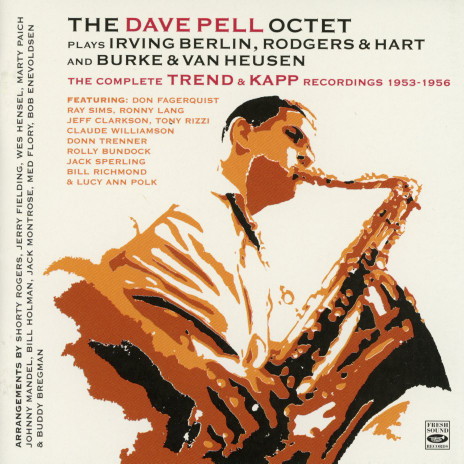


Here are Jordi Pujol’s notes to Dave Pell - The Complete Trend and Kapp Recordings 1953-1956 [FSR 936] which provide more information about Dave and the music and musicians on these wonderful recordings.


You can visit the Fresh Sound website via this link. You’ll be amazed at what is available in its large catalogue of interesting titles, all for very affordable prices.


“Dave Pell began playing clarinet early—his first musical recognition was by the Brooklyn Public School, where he won two musical awards leading the school dance band. At thirteen, his interest in jazz prompted him and his cousin, drummer Roy Harte, to organize a small jazz group called "Took Top Honors", modelled on John Kirby's sextet. As a clarinetist, Dave was influenced by the academic style of Buster Bailey (then a member of John Kirby's "Biggest Little Band in the World"). He was first clarinet with New York's "All City Star High School Band". Dave would later, however, lay this instrument aside for all but the odd occasion in favor of the tenor sax.


He made his professional debut in 1941, when he was signed by Bob Astor for a tour with Astor's orchestra. "Shelly Manne and Neal Hefti were just two of the famous guys in that band," Dave recalled. Later on he played with the band of Bobby Sherwood; then a stint with the Tony Pastor aggregation brought him to the West Coast. "I liked it so much in California that I decided to stay," said Dave. "I started my own little trio." But work wasn't too plentiful for the Pell trio so, in 1945 he joined Bob Crosby's orchestra, working for two years on the Ford radio show After that, he organized a quintet which performed in the Los Angeles area and made its first 78 rpm recordings in 1947 for the United Artists label. Later that same year, Les Brown called Dave to join his orchestra. "Les offered me such a nice situation that I couldn't turn it down. Les had the steady gig on the Bob Hope radio and TV shows. We were in town, at home, for 10 months of the year. The only time we went on the road was just for a couple of months in the summer." As a result of this, he stayed with the orchestra for the next eight years. His distinctive "cool" sound and melodic ideas, which reflect the influences of Bud Freeman and Lester Young, were always highly personal and made him one of the star soloists with the Brown band, being placed high in both the Down Beat and Metronome magazine polls.


At the beginning of 1953 he founded "The Dave Pell Octet", made up exclusively of musicians drawn from Les Brown's band. "We originally formed the Octet by taking the Les Brown rhythm section and adding each one of the top Brown soloists," Dave explained. The members of the first octet were trumpeter Don Fagerquist, trombonist and singer Ray Sims (Zoot's brother), flutist, alto and baritone sax Ronny Lang, pianist Geoffrey Clarkson, guitarist Tony Rizzi, bassist Roily Bundock, and drummer Jack Sperling.


The Octet's library had the ingeniously voiced arrangements of trumpeter and bandleader Shorty Rogers, one of the leading figures of the West Coast jazz school, and Les Brown's trumpeter Wes Hensel, whose stimulating scores gave the small group the feel of a big band. Dave said about this, "we used the guitar as a voice in unison with trumpet and so the Octet sound had a successful formula which allowed us to play a tempo that was danceable and yet still had a jazz feel." From then on, Dave's Octet began doing a few local dates during the days Les Brown's band wasn't working.


In March 1953 producer Albert Marx, formerly head of Musicraft and Discovery Records, signed The Dave Pell Octet for Trend, his new record label. Marx was associated with Paul W Trousdale, a wealthy construction and oil man. The label already had signed bandleaders Jerry Fielding and Claude Thornhill, as well as pianist Joe Burton, and in spring the Octet recorded a 10" record dedicated to the compositions of Irving Berlin. The album came out in October and became an immediate success for the company. George Simon in his Metronome review wrote: "All present songs by Irving Berlin, as played by an exceptionally musical, modern group of musicians out of Les Brown's band. Shorty Rogers arranged the first four, Wes Hensel the last four. The difference is noticeable, with Shorty's stuff more stylized and better integrated; Hensel's perhaps a bit more adventuresome in that he tries for more effects. But whatever either writes is magnificently played by this octet, which gets a better blend, a better tonal quality, and which plays more precisely than practically any group you've ever heard. This is potent proof that well trained musicians can play superior jazz, providing, of course, they have a feel for it." The Octet was listed as the best new combo of the year in polls conducted by the Daily News and the Mirror.


In the fall of 1953, Dave hired Brown's vocalist Lucy Ann Polk—formerly with Les Brown's band—as a featured singer with the Octet. She had already gained considerable reputation with some of the biggest name bands in the country, and with Les Brown's band in particular when she was twice winner in Down Beat's poll (1951-1952) of the No. 1 Girl Singer with Band award. She had decided to leave Brown (winner in the dance band division) following his summer tour of 1953 in order to settle down at her Los Angeles home. "I want to stay home and rest this summer. We've had a busy year, with all of Les' one-niters slipped in between radio, television, and recording dates, and I just didn't feel I could do my best on this long tour he has comping up"—the band would have to play more than two months of almost solid one-niters.


Dave explained that "Lucy was a pro throughout her career and when I asked her to record some sides with my octet... out of the Les Brown band... she jumped at the chance." And, he pointed out, "she had such a great easy sound that was kind of Jo Stafford but still very much her own." For her, this was a turning point that also marked the beginning of an association with Dave Pell that endured for years.


Soon after she was also signed by Albert Marx, and in December 1953, Lucy Ann, co-featured with the Octet, recorded a 10" album with eight songs composed by Johnny Burke and Jimmy Van Heusen. The scores were again supplied by Wes Hensel, and Shorty Rogers, who would be deservedly named by the Metronome magazine: "Arranger of the Year."


The ending of 1953 brought good news for the members of the Octet too, when they were all included in Downbeat magazine's poll of the top jazzmen in the country. There was good news for Lucy Ann, too, when she won her third award. Pell made the best showing, placing fourth in the list of tenormen. He was preceded by Stan Getz, Flip Phillips and Lester Young.


The Octet, by doing a combination of concert-show dates at coast colleges, became very popular among teenagers. On Tuesday March 30th, 1954, the group, with Lucy Ann Polk and Les Brown's vocalist Butch Stone, appeared in concert at the Auditorium of the Los Angeles City College. Daily News jazz columnist Bill Brown placed the concert in headlines in his column Jazz Beat of March 25th, calling the show "the most significant jazz event of the week," and he pointed "Pell and his group have flipped fans everywhere they've appeared and their Trend LP of Berlin is a heavy seller." The concert received the support of several local disc jockeys—including the popular Gene Norman. Tickets for students were sold for $1, and $1.50 for others.


The Lucy Ann Polk album came out late in spring, and Albert Marx proudly wrote in the notes: "the happiness Lucy Ann portrays throughout these first eight sides is evident that she has found the freedom of singing with a small group, the proper combination for some tasty and swinging sides." Lucy Ann was described by Les Brown's trumpeter and arranger Wes Hensel as "one of the grooviest people who ever walked this earth."


Her debut album as a single was well received both by the public and jazz critics. Down Beat's Nat Hentoff gave the record a four-star review: "Backgrounds and solos are tasty, everybody's relaxed and swinging, and the result is a happy, unpretentious collection. Lucy has good diction, a fine beat and though her vocal quality and phrasing don't always gas me, she knows what she's doing musically all the time and fits into this easeful setting very well. This is a good set to relax to."


With Lucy Ann Polk handling the vocals, the Octet appearances throughout South California were a smash success. "We're successful, I believe, because of the simple fact of showmanship," Dave admitted. "I don't mean that the guys in the octet stand on their heads, or wear funny hats while they play, or anything like that. The showmanship lies in the arrangements and in the overall presentation of the group." The whole appeal of his octet lay in the considerable time and attention given to the arrangements. Pell, on top of Shorty Rogers and Wes Hensel, continued building up his book with the works of such skilled arrangers and leading exponents in the modern sounds of jazz, such as Marty Paich, Bill Holman, Johnny Mandel, Jack Montrose and Jerry Fielding. The keynote of the group was "good taste." There's Just enough clever improvisation without completely ignoring the melody. This was the reason that Dave's music appealed even to those who were unfamiliar with jazz.


Still in 1954, Albert Marx recorded the Octet again in June, this time for a 12" album dedicated, as he wrote in the liner notes, "to present a folio of Rodgers and Hart's lesser known works by a jazz group." George Simon's Metronome review said: "What a wonderful group this would be to have in a nightclub! Polished and polite and still musicianly, it would offer a superb background for talking and drinking and eating and then, for those of us who just like to listen, there would be soloists like trumpeter Don Fagerquist, whose rich understatement is the highlight of every track here, and tenorman Pell, Ronnie Lang on alto and bari and pianist Donn Trenner and trombonist Ray Sims and guitarist Tony Rizzi. And all night, there could be tunes like these Rodgers and Hart masterpieces, the like of which one rarely hears all at once, either on records or on a stage or in a room."


In summer 1954, Dave left Les Brown after the Bob Hope radio show was dropped and Les was forced to go back on tour for good. "I decided then that I'd built up enough to break away from Les." Even though he wouldn't tour with the band that summer, he still continued to play and record with Brown until 1956.


For a couple of years The Octet, with Lucy Ann Polk as the main attraction, did many dance concerts, the majority in High Schools and colleges. "I guess I worked with Dave about once a week on all kinds of gigs—colleges, concerts, dances, every imaginable location. And, y'know, I dug it so much, both for the guys and the music," the vocalist recalled. All this boosted Lucy Ann's popularity, and helped her get another Downbeat award in 1954, as best Girl Singer with Band, despite the fact that, by 1954 she was with the orchestra much more sporadically. Dave also repeated the fourth place on the tenor division.

Despite having some good titles, Trend's catalog wasn't selling as many records as his major investor Paul W Trousdale expected, and so in spring 1955 he decided to sell the company. Former president Albert Marx entered the personal management business by signing singer Johnny Holiday as his first client, but his new career didn't last long. As for Pell, he signed a new exclusive deal with Atlantic Records in April 1955.


In February 1956 Dave Kapp, president of the Kapp Records label, purchased the Trend catalog for a figure running well into five figures. Both Capitol and Columbia Records had liens on the masters prior to the sale, Capitol for an estimated $19,000 and Columbia for approximately $6,000. Albert Marx had started working as a free-lance repertoire scout for Kapp Records. This time, his job lasted only a year, but during his time with Kapp he reissued the Dave Pell Octet and Lucy Ann Polk masters on three 12" albums, with different covers. The original 10" Irving Berlin album was filled with four new recordings by the Octet also with Jeff Clarkson, recorded at Radio Recorders in May 14,1956; four vocal tracks were removed from the original Burke & Van Heusen album, and eight new instrumentals tunes—this time with pianist Claude Williamson—were added from two sessions recorded at the same studio on May 7 and 21; whereas the Rodgers & Hart album kept the same tunes from the original Trend release.


His success was not always well received by some critics and jazz purists, who sometimes accused him of focusing too much on the commercial appeal of his music. In truth, his music was well received even to those unfamiliar with jazz. Pell was the first to admit to this, but as he envisioned it: "The direction and meaning of our brand of music is a little different. Mine is not the approach of a jazz musician who goes into the recording studio to play 40 minutes of completely improvised jazz. Our projects are carefully planned. I feel that our music should be well designed, interesting yet easy to follow. We find it best to state the melody first, then come the spots for the blowing. But even behind a jazz chorus I want backgrounds going at the same time to give an overall big band sound. The restatement of the melody, in one form or another, in the closing completes the pattern."
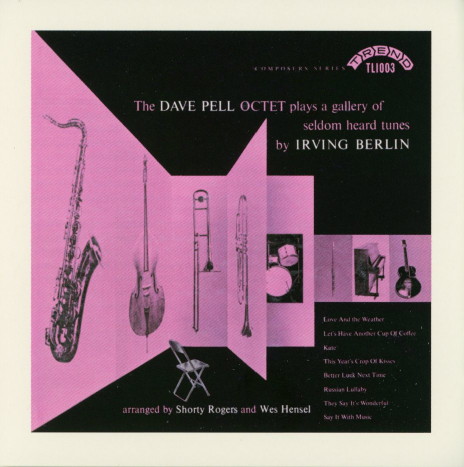


This 2 CD-set compiles all recordings made by the Dave Pell Octet for the Trend label during 1953 and 1954, and the Kapp sessions from 1956. They are the epitome of smooth sophistication; with their tightly scored ensembles, the deft styling concealed some excellent musicianship, and they all contain highly individualistic contributions from Fagerquist, Sims, Lang plus the airy, swinging tenor of Dave Pell, who proudly pointed: "We play jazz for dancing. That's our forte."


From 1955, Dave Pell's Octet played more dance dates than any other contemporary club in the country—schools, colleges and top night clubs such as Hollywood's Crescendo and the Cloister. They had numerous, and at times prolonged contracts with night clubs which forced the group to make personnel changes when some of the members had work in the studios. Up until 1961 Pell himself participated in many recordings by other jazzmen, alternating his sessions with the Octet (for Atlantic, Kapp, RCA, Capitol, and Coral) with other activities. As a photographer he won a well-deserved reputation (it has been estimated that more than 200 LP covers have been illustrated with his photographs) and as a writer he contributed a regular column to Down Beat titled "Pell Mell". This was the name that Frank Comstock had given to one of his compositions, dedicated to Dave Pell in 1949, when both of them were in Les Brown's orchestra, Dave then being featured on bass clarinet. From 1957 he had also been head of the a. & r. production department of Precision Radiation Instruments (Tops Records), and starting in the early 60s he worked as an independent producer, signing in 1963 with Liberty Records.


After retiring from the jazz stage, he continued playing as a session musician, manager, producer and music coordinator for movie scores. He gradually went back to making regular appearances in the nightclubs of Los Angeles in the 70s. In 1978 he founded the group Prez Conference, with the idea to take some of the great solos by Lester Young and harmonize them for a four-piece saxophone section. The group also comprised a rhythm section with guitar and usually included a trumpet. Prez Conference would record two albums for GNP/Crescendo, and their warm reception would take the group on a tour of Japan.


Dave started a new phase in his career when he reorganized his legendary octet the summer of 1984. After almost twenty five years since their last session, the Octet recorded an album for Fresh Sound Records titled The Dave Pell Octet Plays Again (FSR 5009). From then on Dave played regularly around Los Angeles, where the octet was one of the local staples. Their popularity never dwindled. By the year 2000 Dave was still living and playing with the same optimistic and sincere enthusiasm as always, leading his octet with great success every Friday night at the Paradise Cafe at the Beverly Garland Holiday Inn in Studio City, and other venues in Los Angeles. For several years he joined in as a featured soloist every Tuesday morning with Johnny Vana's Big Band Alumni at the Mexican restaurant Las Hadas in the San Fernando Valley. The Big Band Alumni group is aptly named, by the way. Virtually every member of the seventeen piece ensemble has credits reaching from Jimmy Dorsey and Glenn Miller to Stan Kenton, Count Basie and beyond. Despite their silver hair, however, they played such jazz staples as One O'clock Jump and String of Pearls with an irrepressible blend of easygoing familiarity and high spirited youthfulness.


The Octet's last long engagement was a series of concerts at Pete Carlson's in Palm Desert. Bruce Fessier wrote in November 9, 2015 for the Desert Sun: "The median age of this band was over 80. Pell will be 91 in February. Trumpeter Carl Saunders, a youngster at 73, became a grumpy old man after all of the missing or falling sheet music held up the show. Capp, 83, just laughed. "There's nothing like a well-prepared band," he said. "And this is nothing like a well-prepared band." When the show was still going strong after 90 minutes, Capp asked Pell, 'What are we going to do, play 'til there's a death in the band?'


"There's something about those old guys that reminds me of the Preservation Hall Jazz Band I saw in my 20s," he said. They have a feel you can't teach in college. Pell's band read their difficult charts intently, but, at some point, they were like, 'I got this,' and their personalities started seeping into the music, making it swing."

Dave passed away at 92 years old, on May 8,2017.”                                              —Jordi Pujol


Sunday, June 16, 2019

East & West - The New West Quartet [Gunther, Pinheiro, Cavalli, Pedroso] featuring Mike Del Ferro

© -Steven Cerra, copyright protected; all rights reserved.


Guitarist Ricardo Pineiro and bassist Massimo Cavalli’s work was not “new” to me as I previously reviewed the Triplicity CD they made with drummer Eric Ineke on these pages. I enjoyed the music on this recording and was very impressed with Ricardo and Massimo’s musicianship [Eric, of course, being a Jazz Master is always impressive whenever he plays].

So when Ricardo reached out with a preview copy of his latest CD - East & West - The New West Quartet - I decided to dig a little deeper into the background of the musicians on this recording, to try and understand more about each of the players and how they became Jazz musicians.

The latter was especially intriguing to me because Jazz is not the primary choice of most of today’s young musicians.

What I found as an almost universal element in each of their backgrounds was how studied they were in terms of their training and how each continues to be involved with Jazz in academic circles.

A common thread for all of these players is attendance at a university and/or conservatory and then upon graduation to continue at an academic institution in some sort of full or part time teaching capacity.

I have listed the curriculum vitae for each of the band members below and you can peruse them at your leisure to become better acquainted with their distinguished credentials.

The music on East & West - The New West Quartet has been released on the Fresh Sound New Talent label [FSNT-576] and you can find track samplings and order information via this link to Fresh Sound.

Of the eight tracks, the familiar melodies of Monk’s Bye-Ya and Coltrane’s Moment’s Notice will give you a chance to set your ears on The New West Quartet’s style.

The remaining six tracks are originals and divided evenly at two apiece between Gunther, Pinheiro and Cavalli.
Throughout the music on this recording Pinheiro uses guitar amplification as a unifying factor and as a dominant sonority.

In this regard, Pinheiro use of multiple and different amplification samples reflects the influence of Metheny, Frisell and Scofield, Abercrombie, McLaughlin, and other Jazz-Rock fusion guitar artists.

But when John Gunther’s tenor sax is added to the mix, to my ears, the sound of The New West Quartet harkens back to the recordings that guitarist John Scofield made for Blue Note in the early 1990s which featured Joe Lovano on tenor sax [or, in one instance, Eddie Harris] and bassists Dennis Irwin, Marc Johnson, and Charlie Haden and drummers Bill Stewart, Jack DeJohnette, Joey Baron and Idris Muhammad [nee Leo Morris].

The Scofield albums in question are Groove Elation, What We Do, Grace Under Pressure, Meant to Be and Time On My Hands.

In-the-pocket grooving set against New Orleans, second line street beats [think syncopated marching band cadences], the latter especially inspired by the drumming of Idris Muhammad are a major element on all these Scofield albums and they are very much apparent in Gunther’s The New West and Pinheiro’s Polka Blues courtesy of the adept drumming of Bruno Pedroso. Pedroso’s crisp snare drum cuts through with accents when necessary to push the music along, but at the same time, his beautifully “harmonic” cymbals blend nicely with the other instruments adding a nice element of overtones to the music.

As the title implies Don’t Forget Ornette, Cavalli’s tribute to the scion of Free Jazz - Ornette Coleman - provides for open and spontaneous improvisation as the keynote to this uptempo excursion into the extemporaneous.

Pó dos días, a lovely ballad by Pinheiro sounds like something sculpted from a movie theme by Ennio Morricone whose music has an almost ethereal quality to it. It is my favorite track on the CD and I have incorporated it into a video that features the artwork of the late Peter Campbell which you will find at the conclusion of this posting.

It’s nice to hear today’s generation improvising on The Blues and East & West - The New West Quartet includes two forays into this 12-bar structure: the aforementioned Polka Blues by Pinheiro and Cavalli’s Boulder Blues which is a blowing showcase for the bassist who gets a big booming bass sound reminiscent of Ray Brown’s powerful work in the lower register of the instrument.

On Monk’s Bye-Ya and Coltrane’s Moment’s Notice with their strong associations with Charlie Rouse and John Coltrane, Gunther has his work cut out for him in establishing his own identity on these two well-served vehicles for tenor saxophone. With his angular approach to soloing, John does an admirable job of making each of these pieces his own and Bye-Ya introduces the refreshingly different piano work of guest artist Mike Del Ferro. Mike’s is a two-handed piano player and he employs this skill to bring a wide range of octaves into play during his solos. His improvisations are full of surprises.

Pinheiro’s sparkling and probing guitar work is “the glue” that holds everything together on this recording and gives the music a dominant sonority. Whether comping chords, playing rhythmic phrases or soloing, the overall texture on this album is created by the manner in which Ricardo weaves his amplified guitar throughout the eight tunes that comprise it.

It is a testimony to his grace and sensitivity as an artist that Ricardo pulls it off without being overbearing as far as the other instruments are concerned.

And speaking of “other” instruments, Gunther, Cavalli, Pedroso and Del Ferro are all first-rate players about whom I’m sure we’ll hear more from in the future.

As promised, here’s a detailed look at the background of each of the musicians on East & West - The New West Quartet.


Ricardo Pinheiro

Ricardo Pinheiro completed a Degree in Music at Berklee College of Music, Boston; Degree in Psychology Sciences at the Universidade de Lisboa; and a PhD in Musicology (Ethnomusicology) at the Universidade Nova de Lisboa.

He studied with Mick Goodrick, George Garzone, Ed Tomassi, Ken Pullig, Wayne Krantz, Ken Cervenka, Chris Washburne and Salwa Castelo-Branco. He played/recorded with Peter Erskine, David Liebman, Chris Cheek, Mário Laginha, Eric Ineke, Perico Sambeat, Stephan Astbury, João Paulo Esteves da Silva, Remix Ensemble, Matt Renzi, Jon Irabagon, John Gunther, Mike Del Ferro, André Charlier, Benoît Sourisse, among many others.

He teaches at the Escola Superior de Música de Lisboa, and is the Director of its Masters in Music Program. He played and participated in conferences and meetings in Austria, Greece, Spain, France, The Netherlands, Germany, U.S.A., Denmark, Italy, South Africa, among other countries, and published articles in journals such as Acta Musicologica of the International Musicological Society, the Jazz Research Journal, or the International Review for The Aesthetics and Sociology of Music.


John Gunther

John Gunther is a composer and multi-instrumentalist playing saxophones, clarinet, and flute. With a restless musical spirit, he explores all forms of jazz from traditional to avant-garde as well as classical music, world music and experimental electronic music performing on stages throughout the U.S., South America and Europe. He has performed or recorded with many jazz luminaries such as Jimmy Heath, Ron Miles, Dave Douglas, Dewey Redman, Christian McBride, Bill Frisell, Dizzy Gillespie All-Star Big Band, Woody Herman Orchestra, & Maria Schneider Orchestra.

As soloist Gunther has performed with Sinfonietta Paris Chamber Orchestra, Carpe Diem String Quartet and Banda Nacional de Cartago in Costa Rica. As part of New York city's "downtown" music scene for many years, he produced five recordings for Creative Improvised Music Projects (CIMP) and is co-founder of the contemporary jazz ensembles, "Spooky Actions" & "Convergence."

John is an Associate Professor and Director of the Thompson Jazz Studies Program at the University of Colorado Boulder. In 2007 he founded the Boulder Laptop Orchestra [BLOrk] to explore the intersection of music, performance, art, and technology.


Massimo Cavalli

Born in Italy in 1969, Cavalli started studying electric bass with Flavio Piantoni and Enzo lo Greco and double bass and jazz improvisation with Paolino Dalla Porta. He moved to live in Portugal in 1996. Studied jazz double bass at Oporto University where he got his degree in 2006 and his master in jazz in 2011. He has a PhD degree in jazz performance by the Évora University.

He started his professional activity as a musician in 1990 playing in different clubs in Northern Italy. He played in Dubai with the Four Winds Quartet and worked with the American singer Trisha Smith. In March 1996 he participated to the young musician jazz contest in Krakow (Poland) and the same year he recorded with the group Consorzio Acqua Potabile. He worked and played with groups and artists such as: Jean Pierre Como, Antonio Faraò, Benoît Sourisse, André Charlier, Perico Sambeat, Ferdinando Faraò, Eric Séva, Laurent Filipe, Melissa Walker, Fernando Tordo, Amelia Muge, Susana Félix, Alexandre Diniz, Jacinta & Michael Bluestein, Ricardo Pinheiro, Ala dos Namorados, Fiçcões, Joel Xavier e Didier Lockwood, Politonia, among others.

He attended some jazz workshops like “Jazz em Agosto” directed by Phil Markowitz, Ed Neumeister and Arnie Lawrence, the doublebass masterclass conducted by William Parker and a masterclass oriented by Peter Erskine. He has played in several festivals: Avignon (France), Oeiras Jazz Fest (Portugal), Porto 2001 Festival (Portugal), Vigo Music Fest (Spain), 6th Matosinhos Jazz (Portugal), 2th Curitiba Jazz Fest (Brazil), 7 sois 7 luas Music Festival (Portugal), 4th Portalegre Jazz Fest (Portugal), CompoJazz 2007 (Spain), Gaia Blues Festival (Portugal), Aveiro 2003 Music Fest (Portugal), Lagoa Jazz Festival (Portugal), Festival Il Portogallo at Catania (Italy), 9th Festival Jazz aux Oudayas (Morocco), Mafra Cultural Summer 2004 (Portugal), 17th Macao Arts Festival (Macao).

His CD “Varandas do Chiado”, with original compositions with his quartet, was published in 2012. He’s currently playing with The European New Quintet (with Benoît Sourisse, André Charlier, Perico Sambeat and Ricardo Pinheiro), with the Liebman/Laginha/Ineke/Cavalli/Pinheiro Quintet, with the project “Cinema & Dintorni”, and with the acoustic world music project called “Latitude Quatro”.

In October 2018 Cavalli released on the Dutch label Daybreak Records the CD “Triplicity” in trio with master drummer Eric Ineke and Portuguese guitarist Ricardo Pinheiro.

He is currently the head of the department of Jazz and Modern Music at the Lusíada University in Lisbon where he also teaches electric bass, double bass, jazz combo, improvisation and introduction to the study of popular music.
Scholarships and Awards: Berklee College of Music (2000-2002); Fundação Luso-Americana Para o Desenvolvimento;Centro Nacional de Cultura; Rutgers University - Institute of Jazz Studies - Morroe Berger - Benny Carter Jazz Research Fund; Fundação Para a Ciência e Tecnologia.


Mike Del Ferro

Dutch pianist Mike del Ferro is a highly sought-after composer, pianist and arranger who writes and performs in an impressive array of musical genres. He has travelled the world extensively (more then 90 countries), searching for collaborations with musicians from cultures quite different to his own, and the musical results have been eye-opening, building musical bridges between cultures not normally within reach of each other. He has managed to combine elements of the revered canons of Western music interspersed with the audacity of jazz improvisation, and paying tribute to the ancient structures of Asian, South American and African traditional music. He has recently signed a contract with Challenge records for a series of  10 CD's, collaborations with musicians from all over the world, based on his travels.The first trio CD will be released worldwide in the fall of 2011, and the second production in the spring of 2012, with guest artists from Brazil. Mike's father was opera singer Leonard del Ferro (1921-1992), who sang and recorded with Maria Callas, and his childhood was thus filled with music of the highest order.A native of Amsterdam, he started his career studying classical piano at the age of nine and, after falling in love with jazz, he focused his studies on jazz and received a Masters of Music in Contemporary Music from the Amsterdam Conservatory. In 1989 he won First Prize at the Rotterdam Jazz Piano Competition, the Soloist Prize at the Europe Jazz Contest in Brussels, and First Prize at the Karlovy Vary Jazz contest and from 1993-1996 studied composition and arranging with Bob Brookmeyer at the Musikhochschule in Cologne, Germany. In 1995 Mike was appointed to the faculty of the Royal Conservatory in Gent, Belgium where he taught jazz piano until 1997. His reputation as a soloist, accompanist, composer and arranger has led to worldwide performances, recordings and tours with musicians such as Toots Thielemans, Jack DeJohnette, Oscar Castro Neves, Deborah Brown, Erik Truffaz, Jorge Rossy, Sibongile Khumalo, Carl Allen, Scott Hamilton, Richard Galliano, Thijs van Leer (Focus), Harold Land, Jan Akkerman, Norma Winstone, Benny Bailey, Candy Dulfer, Trijntje Oosterhuis, Badi Assad, Fernanda Porto, Madou Diabate and Maria Pia deVito. He has also recorded dozens of albums in many different genres from Dixieland to Salsa and has arranged music for animation for Danish animator and Oscar winner, Börge Ring. Mike del Ferro goes by Mark Twain's dictum - "Travel is fatal to prejudice, bigotry, and narrow-mindedness and many of our people need it sorely on these accounts. Broad, wholesome, charitable views of men and things cannot be acquired by vegetating in one little corner of the earth all one's lifetime" - and his music reflects the array of influences that he has picked up in some of the most exotic places in the world


Bruno Pedroso

Born in 1969, Bruno Pedroso began his music studies in 1987. In 1990, he studied with jazz drummer Allan Dawson. He also studied with live jazz legends such as Clark Terry, Sir Roland Hanna, Rufus Reid, Bill Pierce and Kenny Washington.

Since 1995 I have been almost exclusively dedicated to Jazz. Bruno Pedroso also teaches at the School of Jazz of the Hot Club of Portugal. Participates in the Portuguese Percussion Collective. In 1997 he studied with Antonio Sanchez and Billy Hart. In 1998, he went to New York, where he studied at the "Drummers Collective" school, and privately with some of the most important drummers in the world jazz scene, based in NY, such as Jordi Rossi, Jim Chapin, Carl Allen, Leon Parker, Ralph Peterson Jr., Adam Nussbaum, Steve Berrios, Kim Plainfield, Bobby Sanabria.

In the last ten years, in addition to continuing his teaching career at various schools, he continues as a free-lancer, playing with the most varied names of Portuguese Jazz. He is also invited to join groups with important names such as Julian Arguelles, Chris Cheek, Ken Filiano, Peter Bernstein, Rich Perry, Miguel Zenon, Abe Rabade, Nicholas Payton, Reginald Veal, Aaron Goldberg, Phil Markowitz, Eli Degibri, Avishai Cohen, Antonio Farao, Peter Epstein, Bob Sands, François Theberge, Rick Margitza, John Ellis, Dave O'Higgins, Richard Galliano, Gregory Tardy, Perico Sanbeat, Jesus Santandreu, Ivan Paduart, Herb Geller, Sheila Jordan, Jesse Davis, Donald Harrison, Ben Monder, among many others.

Annually Bruno Pedroso plays in the main Jazz festivals in Portugal, and abroad.
www.ipl.pt/bruno-pedroso

Tuesday, May 14, 2019

The Mastersounds on Fresh Sound

© -Steven Cerra, copyright protected; all rights reserved.


“With almost the same instrumentation as the Modern Jazz Quartet, The Mastersounds burst on the late 1950s scene when the MJQ was already established as the pre-eminent small group in jazz. But they were no imitators. Where the MJQ was all seriousness and sophisticated classical borrowings, the Mastersounds set out to get feet tapping, aided by the distinctive sound of Monk Montgomery's Fender bass. It worked. After securing a three-month booking at a club in Seattle during January 1957, the group went to play at San Francisco's Jazz Showcase, where producer Dick Bock discovered them. They were on their way, becoming the most successful quartet since the MJQ's advent. (... voted best new small combo in Down Beat's critics poll). … This CD presents their debut recordings, redolent of the time when they first caught the moment.”
- Jordi Pujol, Fresh Sound Records

One of the earliest pieces to appear on these pages was about The Mastersounds. It dates back to May 31, 2008.

The editorial staff at JazzProfiles revised it and re-posted it on October 16, 2013 to celebrate the issuance of a compact disc that contained music from a reunion of the group in the recording studios of Fantasy Records on August 10 and November 2, 1960 and the two albums that group made on these dates [Fantasy 3305 and 8862] which were combined and issued as Fantasy FCD 24770-2.  The cover art for this CD by Ray Avery was used as the graphic lead-in to that article.

But sadly, even at this later date, none of the Pacific Jazz recorded legacy of the Mastersounds had found its way onto compact disc.

The music The Mastersounds recorded for Dick Bock’s Pacific Jazz [later known as World Pacific] fell primarily into two categories: [1] the ubiquitous, for the times, Jazz interpretation of Broadway shows, in this case, The King and I, Kismet and The Flower Drum Song and [2] their arrangements of Jazz standards [e.g. an entire album devoted to Horace Silver tunes] and their interpretations of the Great American Songbook; the albums in this category consisting of both studio and in concert recordings.

Now for the good news as implied in the title of this feature - Jordi Pujol, the owner-operator of Fresh Sound Records has done the Jazz world a huge service by issuing two CDs that encompass The Mastersounds entire Pacific Jazz Jazz Standards and Great American Songbook output.

The first of these Fresh Sound CD releases in entitled Introducing The Mastersounds: Water’s Edge [FSR-CD 500] and you can locate CD or Mp3 order information about it as well as sample tracks via this link.

The second offering - The Mastersounds Play [FRS-CD 621-622] is even more impressive as it combines 3 LPs on 2 CDs including The Mastersounds Play The Music of Horace Silver, The Mastersounds Play Blues and Ballads and The Mastersounds in Concert, all of which are also available for order and track sampling via this link.


By way of background, the Mastersounds were formed in 1957 and included Charles Frederick “Buddy” Montgomery on vibes, Richie Crabtree on piano, William Howard “Monk” Montgomery on bass [originally a Fender electric bass, but later an upright string bass] and Benny Barth on drums. The Montgomery Brothers were natives of Indianapolis, IN as was their more famous guitar playing brother Wes, who was to join with them on two of their group LPs.

Monk Montgomery developed the idea for the combo while living in Seattle after he got off the road with the Lionel Hampton Big Band in 1956. According to Ralph J. Gleason, a down beat columnist at that time: “Monk, from his experience in Seattle, was convinced a good jazz group would have a chance to work in that city and he was right.”

The Mastersounds opened at Dave’s Blue Room on January 14, 1957 for a successful three month engagement. However, a dearth of work followed prompting the group to pool its meager resources and send Monk Montgomery on a trip to San Francisco and Los Angeles looking for gigs and a recording contract.

Shortly after arriving in San Francisco, Monk Montgomery stopped by The Jazz Showcase, a then newly formed club on venerable Market Street with a unique “soft drink only” policy. Dave Glickman and Ray Gorum, owner and manager of the club, respectively, upon hearing the Mastersounds tapes Monk Montgomery had brought along, booked the group into the room beginning in September, 1957 for an unlimited engagement.

The fairy-tale quality of Monk Montgomery’s California trip was to get even better when he continued his ‘quest’ down to Hollywood.  There he met fellow bassist Leroy Vinnegar whose immediate reaction to listening to the Mastersounds demo tapes was to call Dick Bock, president of World Pacific Records. Upon hearing them, Bock signed the group to a contract that would result in six albums being produced for the World Pacific/Pacific Jazz Series until The Mastersounds disbanded as a performing group in December, 1959.

The following are the liner notes from the World Pacific 12” Jazz Showcase Introducing the Mastersounds LP [WP-1271] by the noted Jazz columnist are writer, Ralph J. Gleason [1917-1975].

“There is a really terrifying tendency today, particularly in the music field, to believe that success can be bought, that talent and hard work count less than connections and "the hype."

And of course there are occasions when this seems to be true. Everyone connected with jazz has seen times when one group or one musician seems to have advanced far beyond true value merely because of the favor of someone with power and connections in the business.

The persistent talk of "payola," the fact that as a jazz musician pursues his career he will find, on occasion, a disc jockey who will take his money, a manager or an A&R [Artists and Repertoire] man who will want a piece of his original tune, merely makes the cynicism understandable.

Actually these events are the exception rather than the rule, as one eventually learns. "The hype" cannot sell something, in jazz, that is not intrinsically of value; or at least cannot sell it on any long-range, substantial basis. For every success which, rumor has it, was produced by the power of money rather than talent, there is a Dave Brubeck who, throughout his career, has operated without benefit of press agent, "payola" or personal manager.

And there's also the more and more frequent story of a good group which was able to be heard, to launch its career and to start the climb to financial success by straight life methods, aided along the way by men of good will.

The Mastersounds are such a group and the story of their success and this album is a beautiful illustration of all the truths that the cynics deny.

One day in the summer of 1957, Leroy Vinnegar called Dick Bock, president of World Pacific Records, and said "I have a tape I want you to hear. It's a terrific group." It was just as simple as that. Bock heard the group and this is the LP.

But there's a background to this which needs telling. The Mastersounds didn't spring forth full blown, full swinging, a success. They worked for it first. And hard.

In the winter of 1956, William Howard "Monk" Montgomery returned to his native Indianapolis for a visit. He had been living in Seattle for a few months following several years on the road with Lionel Hampton. With Hamp, Monk played bass—Fender bass, that electronic, oversized guitar-shaped bass.

When Monk came back from Seattle he was burning with the idea of starting a jazz group. He and his brother, Charles Frederick "Buddy" Montgomery, had always wanted to do this and on that winter 1956 visit they decided to go ahead. For drummer they chose another Indianapolis jazz player, Ben Caldwell Barth, who had played with them previously. For piano they sought out Richard Arthur Crabtree whom they remembered from jam sessions when the Johnny "Scat" Davis band had passed through town.

So the Mastersounds were born. The name, incidentally, was suggested by Buddy Montgomery's wife, Lois Ann.

Monk, from his experience in Seattle, was convinced a good jazz group would have a chance to work in that city and he was right. On January 14, 1957 they opened a three month engagement at Dave's Blue Room in Seattle. The group was set up as a co-operative one (it still is). "The whole idea was Buddy's," Monk says, "with each man in charge of one department." Monk, for instance, acts as spokesman for the others; Richie handles the book-work and the uniforms; Buddy sets the tempos and calls the tunes, and Benny is in charge of the rehearsals, among other duties.

After the initial success in Seattle, the group was prepared for anything but the drought of the next three months. "We just struggled after that, playing wherever we could," Monk says. "We were so far from home, there was nothing else to do but fight it out." They tried contacting record companies, musicians they knew — everything. But nothing worked. Then they made a demo tape, pooled their money and sent Monk on a trip to San Francisco and Los Angeles to look for a job and to try to get a record date. "It was just about the last gasp, took all our money," Monk says, "but waiting it out with the right fellows you don't mind it so much."


On the way to Hollywood, Monk stopped off in San Francisco and met Ray Gorum who was managing the Jazz Showcase", a non-alcoholic nightclub on Market Street. Gorum heard the tapes and decided immediately to book the group into the club.

Thus, from a real "scuffle" in Seattle, The Mastersounds were transported to San Francisco, a featured spot at a nightclub and a record contract with a jazz label. All without the benefit of a press agent, a manager, "payola" or any of the things some cynics consider necessary.

"It's still almost unbelievable," Monk says. "I never thought it would happen like this. All I can say is that we are so grateful."

The Mastersounds' instrumentation is the same as that of the Modern Jazz Quartet but there is no similarity in sound or approach. Their originality is so pronounced that they are able to play some of the same tunes as the MJQ does without leaving themselves open to charges of imitation.

Their approach is based on the concept of swinging ("The first thing is it must swing," Monk says) and on working out arrangements (they have almost 100 numbers in the book, each of them planned arrangements).

However, they seldom work from music, relying on heads and voicings worked out in rehearsals. Their repertoire includes original numbers by the group and by Wes Montgomery, Buddy's and Monk's guitar-playing brother. Both Buddy Montgomery and Richie Crabtree contribute extensively to the book and it all has the benefit of Monk's road time experience with Lionel Hampton. "I learned a lot from Hamp," he says, "and we've been so lucky so far."


On hearing the Mastersounds in person you are at once struck by the odd-looking bass Monk plays. He began playing on an upright bass but switched to the Fender bass when he joined Hampton. "You can make it swing," Monk says. "It won't replace the upright bass, and I'm a long way from mastering it after playing it five years, but it has advantages. For one thing, I don't get tired playing it. It's so much less work, it's more accurate and you have more speed. I can't play a tempo that's too fast for it. And I can't run a clear scale on a big bass!" Of the sides on this LP, Wes Montgomery arranged "Wes’ Tune" (which he also wrote) and "Dexter's Deck" (written by Dexter Gordon). Bud Powell's arrangement of "Un Poco Loco" is used and Richie Crab-tree arranged his own composition "Water's Edge" for the group. Otherwise all the arrangements are by Buddy Montgomery who also wrote "Drum Tune."

Here are capsule biographies of these four young men: Charles Frederick "Buddy" Montgomery: vibes, born 1/30/30, Indianapolis, Ind., hobby is checkers, favorite artists include Tatum, Milt Jackson, Garner, Wes Montgomery, Earl Grandy (a blind Indianapolis pianist). William Howard "Monk" Montgomery: bass, born 10/10/21, Indianapolis, Ind., has played with Lionel Hampton, Georgie Auld, Art Farmer, Jerry Coker; digs Percy Heath, Johnny Griffin and says he "just picked up" bass. Richard Arthur "Richie" Crabtree: piano, born 2/23/34, Sidney, Montana; has worked with Conte Candoli, Johnnie Davis; says painting and reading and writing are his hobbies; digs Bird, Diz, Miles, Bud, Philly Joe, Sonny Rollins, Ray Brown and wants "to play good someday." Ben Caldwell "Benny" Barth: drums, born 2/16/29, Indianapolis, Ind.; attended Butler University and, he says, "Indiana Ave. School of the Blues"; also plays trumpet and tap dances; has played with Lennie Niehaus, Conte Candoli, Lee Katzman, Slide Hampton, his hobbies are tennis, records, fishing and eating; digs Thelonious Monk, Art Blakey, Philly Joe Jones, Diz, Vinnegar, Basie, Max, Bird, Buddy Rich, Pres, Clifford, says his inspirations have been Krupa, Dave Tough, Jo Jones, and Big Sid and that his ambition is to be either a fish and game warden or a jazz disc jockey and critic!”

—Ralph J. Gleason Down Beat columnist Editor, JAM SESSION (Putnam's)

The sixteen-foot speaker displayed behind the Mastersounds on the cover is, according to Bill Loughborough, the world's largest—photographed in Sausalito, California by William Claxton.


As noted at the outset, the second Fresh Sound CD offering - The Mastersounds Play [FRS-CD 621-622] combines 3 LPs on 2 CDs including The Mastersounds Play The Music of Horace Silver, The Mastersounds Play Blues and Ballads and The Mastersounds in Concert,

Here are the original liner notes from the 12" World Pacific Records album The Mastersounds Play Compositions of Horace Silver at the Jazz Workshop (Stereo-1284)

Speaking as a composer, it's a great thrill to listen to another artist or group of artists interpret your composition. Every artist will give them a new and different concept. I am especially thrilled that The Mastersounds have chosen to do an album of my composition because I have long admired the group. I've listened to them at Birdland and at the Newport Jazz Festival, and they are a well-rehearsed, well arranged (but not over arranged), swingin', blowin' group.

I'm sure that everyone who hears this album will be as pleased with the interpretations given my composition as I am, and equally pleased by the solos.
- Horace Silver

“The Mastersounds at the Jazz Workshop have come to be something of a San Francisco institution. Shortly after the success of their second album for World-Pacific (Rogers & Hammerstein's The King And I), recorded late in 1957, they played their first engagement at the famed North Beach jazz club. Although the group has played across the country from the Blue Note in Chicago to Birdland in New York, and up to Newport for the Jazz Festivals, they spend much of their playing time at the Jazz Workshop in San Francisco, the city of their adoption (Monk, Buddy and Benny hail from Indianapolis, Indiana; Richie is from Sidney, Montana).

The music of Horace Silver provides a perfect vehicle for The Mastersounds to project their very earthy yet sophisticated jazz conception. The group has never been recorded in better form. This performance points up how well integrated these four sensitive musicians have become. The arrangements stem from the imagination of Richie Crabtree, with the spontaneous assistance of the rest of the players. All of the group's arrangements eventually become a group project, usually starting from a point suggested by Buddy or Richie. I have yet to see any written scores within the group. The arrangements, as they develop, become indelibly impressed on each musician's consciousness.

The Mastersounds have reached a jazz maturity that has developed from over three years of playing together. This collection of the music of Horace Silver, one of jazz' greatest new composer-arrangers, represents a high point in The Mastersounds' career.” —Richard Bock


Below are Jon Hendricks original liner notes from the 12" World Pacific Records album Ballads & Blues (Stereo-2019)

When I first got the gig to write Album Notes for this MASTEROUNDS album, I was goin' along coolin' at the prospect of having a "captive audience" — an audience before which I could say things that would get me arrested from a soap box, but which, on the back of an album, would be hailed as "entertaining and informative." Then I began to wonder how I could say anything at all about the MASTERSOUNDS without comparing them with the MODERN JAZZ QUARTET.

Both groups use the same instrumentation, except for the basic difference between Monk Montgomery's Fender electric fiddle and Percy Heath's wood. Both groups consist of a vibraphone surrounded by rhythm. They must sound somewhat alike. Comparisons are inevitable. At the same time, comparisons usually denote competition, and there really is no competition called for in jazz. Although Buddy Montgomery loves "Bags" out loud and Richie Crabtree pays musical respect to John Lewis on occasion, they are imitating no more than two preachers preaching the same sermon. The MASTERSOUNDS are as fresh as they want to be. If they sound like anyone else it's because they want to—and don't mind spreadin' the word.

Concerning the MASTERSOUNDS' work, Monk Montgomery, who acts as spokesman for the group, says, "The first thing, it must swing." This it does, as the success of their other albums for World-Pacific indicates. The group is a cooperative one in every sense, and was Buddy Montgomery's idea. This is a further indication of the more mature outlook of jazz musicians in general, for only in a cooperative group can the full potential of each individual be realized. It also serves to hold a group together longer, giving each of them the invaluable opportunity to become thoroughly aware of the artistic attributes of the others — thereby paving the way for a pure give-and-take rapport that is a joy to see and hear. As one deeply and vitally interested in jazz and its practitioners, I am happy that the MASTERSOUNDS have chosen this cooperative approach. It exemplifies the true spirit of jazz much more than the leader-sideman relationship. And most important of all — it gives each man a feeling of dignity in his work. This is something jazz musicians sorely need to offset the sometimes undignified surroundings in which they must perform. As we say in the vernacular, "It's a way it 'po'd t'be."

If there are those among you who will hear the MASTERSOUNDS for the first time, you have a refreshing musical treat in store. For those of you who already know and appreciate them, Ballads and Blues will be a welcome addition to your collection. I shall not make pointed comments on specific aspects of the music herein by calling your attention to the 4th bar in the second 8 bars of the third chorus, or any such thing as that — because by the time you go to all that trouble you'll be so confused you won't listen. And that's all you really have to do.”


And finally, these liner notes were written by C. H. Garrigues for the 12" World Pacific Records album The Mastersounds in Concert (Stereo-1026)

The release of "The Mastersounds in Concert" marks another very important step in the solution of a problem which these four very remarkable musicians set for themselves at the beginning of their careen the problem of producing jazz which is delicately dynamic, subtle in melodic content, rich in harmonic development—and which yet swings freely and unrestrainedly.

When I first heard them at the Jazz Showcase in San Francisco in the summer of 1957 there was no doubt that they were swingers. Their best number—one which always brought cheers from the crowd and kept the Showcase jammed night after night—was a romping, roaring, tempestuous version of Bud Powell's "Un Poco Loco": a version much more loco than poco and one which never failed to delight.

But even then they had a problem. It was all very well to play uptempo numbers—but a group which cannot swing at medium and ballad tempos is only half a group. Yet, how could a group consisting of vibes, bass, piano and drums play delicately, play subtly, play ballads and blues, without either becoming "soft" and ceasing to swing or, alternatively, invading the territory of the Modern Jazz Quartet? How, in other words, could they enter this area—voiced as they were—and still manage to be completely themselves?

The history of their recordings—climaxed by this one—is the story of how well they have succeeded, a step at a time, in solving that problem.

Their first LR "Introducing the Mastersounds (WP-1271) was made a few weeks after Richard Bock, President of World-Pacific discovered them at the Showcase. It showed them a thumping jumping gang who could bring a crowd to its feet cheering but which would hardly be celebrated for its subtlety and nuance.

A few months later, though, something wonderful happened. Whether by some curious insight, or through the simple fact that show tune albums were selling well, Buddy Montgomery asked Bock for permission to do a jazz version of "The King and I." Agreement was reached. The Mastersounds came up with a hit record (WP-1272): a beautifully conceived, beautifully executed LP which will go down in history as one of the loveliest sets of songs and ballads ever recorded.

In the excitement, few took the trouble to note that there was very little pure jazz in "The King And I" (though Ralph J. Gleason, writing the liner notes, pointed it out); there was melody, there were arrangements of sheer loveliness but it wasn't the jazz as jazz that the listener remembered.

Next came "Kismet" (WP 1243) and "The Flower Drum Song" (WP 1252) each was a step in the further integration of the opposite tendencies shown in (say) "Un Poco Loco" and "The Puzzlement." Each was a popular and critical success. But in neither, perhaps, was there a complete unfolding simultaneously of both the excitement of the Showcase album and the delicacy of "The King and I."
That, however, was soon to come. Late in 1958 the Mastersounds boldly tackled the problem of proving that the field of delicacy and nuance in the vibes quartet was by no means preempted by the MJQ. The album was called "Ballads and Blues" (WP 1260), and as though to emphasize a declaration of independence which was never really needed, they chose John Lewis' "Fontessa," long a hallmark of the MJQ, as one of the tunes on their blues medley.

This record, too, was an immediate and continuing success—so much so that Bock decided to record them "live" in a program of jazz standards where they could display the degree of continuing maturity since their 1957 debut. By this time the Mastersounds were on the road almost constantly; a tour of the Midwest culminating in a successful engagement at Chicago's Blue Note was succeeded by a long SRO run at San Francisco's Jazz Workshop. But when they returned to Southern California early in 1959 for an engagement at Jazzville and a college concert tour, Bock picked their concert at Pasadena Junior College on April 11 as the date to record.

The record within this envelope is the result. From the delicately romping opening of "Stompin"' through the charming, tongue-in-cheek sentimentality of "In a Sentimental Mood," into the flying carpet of "Love for Sale," through the thoughtfully lyric development of "Two Different Worlds"... it would be difficult to find any area of sincere jazz feeling in which they are not at home.
To pick out any particular moment for comment would be to slight many others. But, just for taste of the whole, take the openingfigures of "Stompin"'—notice how gently Buddy's vibes come in to overlay Richie's piano and take the solo away so gracefully that you fancy you hear the ghost of Richie's fingers still tripping behind Buddy's mallets. But notice, too, how Benny's firm, insistent rhythm {and a little later, Richie's chopping, staccato chords) break up any tendency for the lyricism to become over-sentimental. Note, too, a similar development in "Star Eyes"; then observe how deftly Benny's drums continue to develop the melody after Benny's first solo... and note how different are Benny's propulsions and patterns behind Buddy and behind Richie. Listen to Monk's fine solid anchor support... and then listen again and hear his electric bass wandering like a third hand among the lower piano chords. You will agree, I think, that the answer to their problem has been found: the swinging of "Un Poco Loco" and the delicacy of "Something Wonderful" have come together into the same number. After completing these tracks, the Mastersounds took off for a successful engagement at Birdland—punctuated by an appearance at the Newport Jazz Festival. Such is the measure of success.
—C. H. Garrigues