I found everything about the Columbia LP Miles Ahead or Miles Davis + 19 Davis fascinating as Gil Evans’ arrangements opened up a whole new world of sonorities for me.
Sometimes referred to as the Fourth Element or Atom after melody, harmony and rhythm, sonorities or textures refer to the way the music collectively sounds to the ear.
“Texture” is the word that is used to refer to the actual sound of the music. This encompasses the instruments with which it is played; its tonal colors; its dynamics; its sparseness or its complexity.
Texture involves anything to do with the sound experience and it is the word that is used to describe the overall impression that a piece of music creates in our emotional imagination.
Often our first and most lasting impression of a composition is usually based on that work’s texture, even though we are not aware of it. Generally, we receive strong musical impressions from the physical sound of any music and these then determine our emotional reaction to the work.
On Miles Ahead, Lament by J.J. Johnson really grabbed my attention because I’d never heard it before.
Trombonist J.J. Johnson’s Lament really sounded as the word implied - sad but in a beautiful sort of way.
I think that what makes the texture or sonority of J.J.’s Lament so interesting is that its melody centers around half notes and whole notes; sustained notes that bring out the lush, deep, melancholy tones of trombone. [One of the few instruments on which Jazz is played in bass clef.].
Ted Gioia offers more insights into both J.J. Johnson’s significance and Lament in these excerpts from his masterful The Jazz Standards: A Guide to the Repertoire:
“No one did more to legitimize the trombone as a modern jazz instrument than J. J. Johnson. Not every horn survived the transition from swing to bop during the middle years of the twentieth century — the clarinet, for example, has never come close to recapturing the leading role it played in many jazz bands during the late 19308 and early 19405. Over the years, other instruments — the C-melody saxophone, the banjo, the cornet — have also struggled to retain their place in the jazz world. The trombone might easily have become another casualty, relegated to Dixieland ensembles or big band horn sections, had Johnson not shown at a decisive juncture that the big 'bone could adapt to the fleet and flashy stylings of the new idiom.
Yet as early as his high school years, Johnson also focused on writing and arranging. … Johnson's best-known composition today is a 32-bar ballad named "Lament."
Johnson's debut recording from 1954 testifies to the emotional pungency of the piece, and despite this trombonist's reputation for virtuosity, his approach here is understated with no wasted gestures or showy theatrics. Even so, it took another horn player to establish "Lament" as a jazz standard. Three years later, Miles Davis featured "Lament" on his high-profile collaboration with Gil Evans, Miks Ahead, a project that even today remains one of the biggest-selling jazz albums in the Columbia archive (now owned by Sony). Davis and Evans returned to the song for their 1961 Carnegie Hall concert, also released on LP by the Columbia label.
Most later versions emulate Davis's treatment, offering up "Lament" as a slow, wistful ballad. Few have tried to update or reconfigure this song—a wise choice, since this composition needs to be underplayed for best effect. I consider it more a test of a performer's emotional commitment rather than a vehicle for ingenuity or pyrotechnics.”
Gordon Jack is a frequent contributor to the Jazz Journaland a very generous friend in allowingJazzProfilesto re-publish his insightful and discerning writings on various topics about Jazz and its makers.
Gordon is the author of Fifties Jazz Talk An Oral Retrospectiveand he also developed the Gerry Mulligan discography in Raymond Horricks’ bookGerry Mulligan’s Ark.
The following article was published in the December 15 & 20, 2020 edition of Jazz Journal.
“With the advent of bebop the trombone might have suffered the same relative decline as the clarinet but for two virtuosos - J.J. Johnson and Kai Winding. Their early recordings showed how well they overcame the difficulties of adapting the unwieldy trombone with its seven slide positions to the demands of the new music.
J.J. Johnson was born in Indianapolis on 22 January 1924 and took up the trombone at the age of 14. Fred Beckett was an important early influence with his 1940 solos on Harlan Leonard’s My Gal Sal, Skee and A LaBridges (Classics 670 CD) – “He was the first trombonist I ever heard play in a manner other than the usual sliding, slurring, lip trilling or ‘gut-bucket ’style. He made a lasting impression on me.” He toured briefly with the Clarence Love and Isaac Russell bands before joining Benny Carter’s orchestra in 1942 until 1945. Talking about Carter J.J. said, “It was a continuous education in music”. His first recorded solo took place with the band in 1943 on Love For Sale (Definitive DRCSD 1129) and the following year he was invited to appear at the first JATP concert in Los Angeles before an excited audience of more than 2000. His extrovert contributions to Lester Leaps In, Body And Soul, Tea For Two and Blues with Illinois Jacquet, Jack McVea, Nat King Cole and Les Paul would probably fool many on a blindfold test (Properbox (E) 82CD). He left Carter for Count Basie and is heard on three 1946 solos with the band – The King, Stay Cool (both on Classics (F) 934CD) and Rambo (Neatwork RP2062CD). He wrote and arranged Rambo and Jon Hendricks added lyrics to it for Manhattan Transfer’s 1985 Vocalese album.
In 1946 he received the New Star award from the critics of Esquire magazine and his swiftly articulated solo with the all-star band on Indiana Winter (based on How High The Moon) caused many to speculate wrongly that he was playing a valve-trombone (Definitive DRCD 11293). On one occasion his amazing facility prompted a Philadelphia club owner to post a sign outside advertising, “The Fastest Trombone Player Alive”. That was the year he settled in New York and started sitting-in at the clubs on 52nd. Street. For a time he had a quartet at the Spotlite with Bud Powell and later he worked there with Allen Eager. He also played at the Three Deuces in a sextet with Fats Navarro and Stan Getz. His first date as a leader took place in June 1946 with Cecil Payne, Bud Powell, Leonard Gaskin and Max Roach when Coppin’ The Bop, Jay Jay, Jay-Bird and Mad Bebop were recorded for Savoy (SVO 151CD).
In late 1947 after his hit with Robbins Nest Illinois Jacquet formed a new band with J.J., Leo Parker, Sir Charles Thompson, Fats Navarro and Joe Newman providing a high octane mix of jazz with rhythm’n’blues overtones which proved to be hugely popular. John Lewis replaced Thompson for a while and he said, “We had to play Flying Home about three times a night (but) I’ve never seen so much money”. Johnson solos on Riffin’ With Jacquet, Destination Moon, For Truly, King Jacquet, Embryo and Mutton Leg (Mosaic MR6-165). When he wasn’t on the road with Jacquet he became the trombonist-of-choice on many bop recordings in the late forties with Charlie Parker, Tadd Dameron, Dizzy Gillespie, Howard McGhee, Babs Gonzales, Leo Parker and Coleman Hawkins.
He performed on eight of the twelve titles recorded by the Miles Davis nonet in 1949/50 and solos on Deception. Kai Winding was on the other four and was featured on Godchild (Capitol 7243 5 30117 2 7). There were two other trombonists involved in the project because Eddie Bert rehearsed with the group at Nola’s studios on several occasions and Mike Zwerin played on their live performances at the Royal Roost. Peter Pullman’s book (Wail - The Life Of Bud Powell) mentions that on one occasion Powell performed with the nonet at Birdland. The last number of the set was Move and Bud received a standing ovation. He was a little bemused by the audience reaction so Gerry Mulligan very gently led him off the bandstand with the applause still ringing in his ears. An early portent of Johnson’s later highly successful collaboration with Kai Winding took place on a Chubby Jackson date in 1950 when they were featured together on Tiny Kahn’s Flying The Coop (Original Jazz Classics CD 711-2). He was briefly with Woody Herman at this time and Conte Candoli said, “He was really good on the lead book”.
In early 1951 he occasionally worked at Birdland in a small Dizzy Gillespie group with Milt Jackson and Budd Johnson or John Coltrane and in April that year he was on the 78 rpm disc that introduced Dizzy’s The Champ (Savoy SV-0170CD). Between May and August 1952 he was part of a Symphony Sid package that included Miles Davis, Jackie McLean, Zoot Sims, Milt Jackson, Max Roach, Percy Heath and John Lewis that toured New Haven, Montreal, Toronto, Chicago, Detroit, Pittsburgh and Atlantic City before concluding at Harlem’s Apollo Theatre. They did not record unfortunately but there is a fine series of photographs in Ken Vail’s book Miles’ Diary from the Apollo booking. Ira Gitler in his Jazz Masters of the 40s says, “When this group broke up, the trombonist became discouraged with the music business”. He briefly withdrew from the jazz scene because of the lack of regular work. He also had the problem of having to renew his cabaret card every six months because of an earlier misdemeanour in 1946. His permanent cabaret card was not reinstated until 1959.
He began working in the defence industry as a blueprint inspector out at Long Island but he kept practicing and making occasional recording dates. One of which took place in 1953 in Brooklyn at a Charles Mingus Jazz Workshop session with three other trombonists – Bennie Green, Willie Dennis and Kai Winding (Properbox (E) 77CD). In April 1954 he was one of the Miles Davis All Stars along with Lucky Thompson and Horace Silver who created the classic Walkin’ and Blue’n’ Boogie for Prestige (PRCD 7076-2). It’s worth pointing out again that Walkin’ started out as Gravy on a Gene Ammons 1950 date. It was written by Jimmy Mundy until it was appropriated by the infamous Richard Carpenter who got a composer credit on the Davis date.
His temporary retirement ended four months later when Ozzie Cadena wanted to team him with Eddie Bert in a two-trombone album for Savoy. Eddie was unavailable as he was contracted to Discovery. Bennie Green would have been selected but he was busy thanks to his 1953 Blow Your Horn hit which had become something of a juke-box favourite. Producer Teddy Reig suggested Kai Winding which led to a happy two year partnership that was successful both commercially and musically and was marketed under the title Jay and Kai.
Kai Winding was born in Aarhus, Denmark on 18 May 1922 and emigrated with his family to the U.S.A in 1934. He was largely self-taught and began his professional career with the Sonny Dunham and Alvino Rey bands before spending three years with the US Coast Guard from 1942. His debut as a leader took place in December 1945 with Shorty Rogers, Stan Getz and Shelly Manne when they recorded four titles for Savoy under the title Kai’s Cats (Masters Of Jazz MJCD117). One of the tracks – Loaded – was by an obscure Washington D.C. pianist called Bernie Miller (1919-1945). A year earlier Boyd Raeburn’s orchestra had recorded another of his originals – Bobby Socks - which became better known as Bernie’s Tune.
In February 1946 he joined Stan Kenton’s orchestra who had been selected as the Band of the Year by Look magazine and were breaking records everywhere they played. His first solos four months later were on Rika Jika Jack (a forgettable June Christy feature) and Artistry In Boogie (Mosaic MQ10-163). Even though he was only with Kenton for about a year his influence was immense. He created a distinctive section sound by persuading his colleagues to produce a lip instead of a slide vibrato. Milt Bernhart said, “Kai Winding was the lead trombone and without question the most important player in the band at that time”. Kenton agreed - “Kai changed the whole God-damn conception of the band and my whole way of thinking”. He brings something special to his features with the band on Capitol Punishment, Artistry In Bolero, Yesterdays, Ecuador, I’d Be Lost Without You, Collaboration and Machito (Mosaic MQ10-163). When they were appearing at the Paramount in NYC he heard J.J. Johnson for the first time at the Famous Door with Charlie Parker. He told Milt Bernhart that J.J. left him “Speechless”.
Leaving Kenton he worked with Charlie Ventura for a while in 1947 and they were recorded at the Hotel Sherman, Chicago with singer Buddy Stewart. The popular East Of Suez was introduced on the booking and Winding thrives in what was a forerunner to Ventura’s Bop For The People ensemble (Properbox 41CD). In the late forties he had a group that included Brew Moore, Gerry Mulligan and George Wallington that often worked at the Royal Roost and Bop City. They recorded 14 titles on obscure labels which are difficult to obtain now but would make a very welcome reissue from Fresh Sound perhaps. In the early fifties he combined radio and television studio work with occasional bookings at Birdland with Red Rodney, Zoot Sims, Brew Moore and Bill Harris. He was also briefly with Woody Herman in 1953 and he can be heard on the memorable Four Others by Jimmy Giuffre, a feature for the trombone section which included Urbie Green, Frank Rehak and Vern Friley (Discovery DSCD 944).
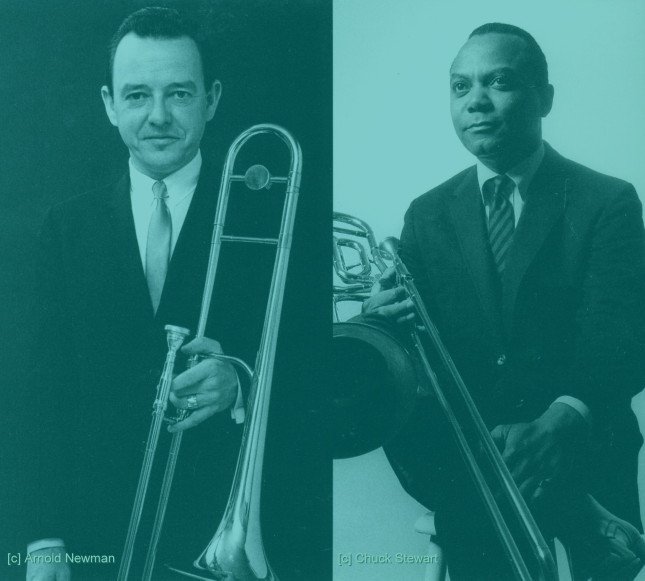
Joining J.J.Johnson in 1954 was a chance to escape the routine of studio work and return to full-time jazz. Together they created stimulating small-group performances with tightly arranged ensembles usually voiced in unison or thirds. A variety of mutes sometimes came into play for extra colour on It’s Alright With Me, I Concentrate On You, Just For A Thrill and especially The Whiffenpoof Song. Producer George Avakian was particularly impressed with their studio performance on Whiffenpoof, “It’s a wild sight to see them each keeping pace with the lightning routine of mute up, mute in, blow, mute out, mute down, new mute up, mute in, blow and so on. Never once did they fluff a phrase” (Lonehill Jazz LHJ 10179). After two years together they felt that all the possibilities of a two trombone line-up had been exhausted so they decided to call it a day in 1956 but not before one of their last albums where six other trombones were added to the mix with particularly notable performances on Night In Tunisia, The Surrey With The Fringe On Top and The Peanut Vendor. (Columbia COLCD 480990).
Years later J.J. had this to say, “I have a very fond recall of the Jay and Kai cycle. Kai was a super jazz trombonist who always performed with wit, killer chops, quasi reckless abandon yet with intelligent sophistication. He was a complete musician and total artist plus a fun, fun dude to be with or to work with”.
1956 of course was the year Leonard Feather invited 100 leading musicians from Louis Armstrong to Lester Young to nominate their favourite instrumentalists. J.J.Johnson came top in the trombone section followed by Bill Harris, Jack Teagarden, Bob Brookmeyer, Tommy Dorsey, Lawrence Brown, Jack Jenney, Vic Dickenson, Kai Winding, Trummy Young, Jimmy Harrison, Frank Rosolino and Earl Swope.”
“'You can't play all night in
a club with just two trombones and rhythm!’ a friend told Kai Winding when he
announced that he and J. J. Johnson were going to do just that.
He was wrong, but awfully
right at the same time. The answer is that you can do it, but not with ‘just
two trombones.’ You have to have the best—Kai Winding and J.J. Johnson.
Their ability as trombonists
is only part of the story. The entire "book" for the group has also
been written by them, and it is their imagination as arrangers which has
carried off this tour de force even more than their extraordinary talent as
soloists.
Jay and Kai have done it the
musicianly way, with no gimmicks—just solid musicianship. Working without a
guitar, which would have given them variety in the coloring of the solos as
well as another voice in the ensembles, makes their job that much harder. But
in order to get engagements in clubs, they had to confine the group to five
men, and the added challenge has only spurred them to greater creative height.
Each has had a wealth of big
band and small combo experience. During the hop era, Jay was in the rare position
of establishing a school of trombone playing which consisted of himself alone;
no one else was remotely in his class. Kai came up through the big band field,
achieving prominence as a soloist with Stan Kenton in 1946. In recent years,
both men have gigged extensively with small groups, and Kai still keeps his
hand in as a studio sideman between the quintet's bookings.
The arranging of the book has
been divided equally between them, and each man has contributed several fine originals.
Their choice of repertoire is discriminating; they seem to have a knack of
choosing half-forgotten but exceptional show tunes and songs which are fine
vehicles for "class" singers. (Perhaps the lyric quality of their
trombone playing is responsible for this taste.) Both play with a technical
ease which is the envy of lesser slide men. Although they play quite unlike
each other most of the time, there are many occasions on which it is impossible
for even their closest followers to tell them apart.”
- George Avakian, insert notes to CD
re-issue of Trombones for Two
The idea for this
piece came from revisiting the J.J. Johnson and Kai Winding Columbia recording
made at the 1956 Newport Jazz Festival [the LP is shared with the Dave Brubeck Quartet]. Along with bassist Bill Crow and drummer Rudy Collins, the two
trombonists’ quintet featured Dick Katz on piano. Dick was to be the pianist
with Jay and Kai’s group throughout its existence from 1954-56.
Listening to this
recording reminded me of what an excellent pianist Dick Katz was, he died in
2009 at the age of 86, but it also brought back thoughts about Dick Katz the
record producer [he founded Milestone Records with Orrin Keepnews], Dick Katz
the Jazz educator [he taught at the New School and the Manhattan School of
Music], but most especially about Dick Katz, the gifted Jazz author [Bill
Kirchner tapped him to write The History
of Jazz Piano essay in his The Oxford Companion to Jazz].
I never got to
attend any of Dick’s Jazz courses, but I always learned so much about the music
from his writings.
Sure enough, when
I went digging around my collection of Jazz recordings, there was Dick writing
his usual, clever and insightful insert notes to the 1960 reunion album by Jay
and Kai’s quintet on Impulse! Records [The Great Kai and J.J.! IMPD-225].
A sample Dick’s
expository skills, flowing style of writing and considerable knowledge on the
subject of Jazz and its makers can be found in the following excerpts from the J.J. Johnson and Kai Winding Impulse! notes:
“‘I don't know
anything about music, but I know what I like.’
This bon mot is usually attributed to the
celebrated Common Man, and while the sophisticate might wince upon hearing such
a bromide, an element of truth is present. The sentence often indicates that
knowing how music is made does not necessarily assure one's enjoyment, or even
enlightenment. The intellectual, armed with the tools of musical analysis, will
not experience music any more intensely than someone not blessed with musical
scholarship — if the conditions for being "moved," or emotionally
stimulated, do not occur in the music. Indeed, knowing too much can actually
interfere with hearing the music.
You see, music has
to do with feelings, and the knowledge of what makes it tick should be a bonus
that adds to or enhances the listener's understanding. It should never be a
substitute for emotional involvement.
Now, the
"conditions" referred to above are what concern us here. Good jazz
does not come out of the air like magic. True, a genius sometimes creates this
illusion, but in the main, it is the result of an artistic balance between the
planned and the unplanned. Even the great improviser is very selective, and
constantly edits himself.
Throughout the
relatively short history of jazz, many of the great performances have been ensemble
performances where the improvised solo was just a part of the whole. This
tradition of group playing, as exemplified by Henderson, Basie, Ellington,
Lunceford, John Kirby, Benny Goodman's small groups, the great mid western and
southwestern bands, big and small (Kansas City, et. al.)» almost came to a
rather abrupt halt with The Revolution. And that is exactly the effect Charlie
Parker, Dizzy Gillespie and their colleagues (J. J. Johnson among them) had on
jazz music. Their extreme improvising virtuosity seemed to take the focus off
the need to play as a group. But herein lies the irony — the precision with
which they played their complex tours de force was due in large measure to the
extensive ensemble experience they gleaned as members of disciplined bands
like Hines, Eckstine, etc.
It was their talented,
and not-so-talented, followers who often missed the point. Musically stranded
without the opportunity to get the type of experience their idols had (due to
many factors, economic and otherwise), they resorted to all they knew how to do
— wait their turn to play their solos. This type of waiting-in-line-to-play
kind of jazz has nearly dominated the scene for many years. Although it has
produced an abundance of first-rate jazzmen, many excellent performances, and
has advanced some aspects of jazz, the lack of organization has often strained
the poor listener to the point where he doesn't "know what he likes."
So, in 1954, when
J.J. Johnson and Kai Winding formed their now celebrated partnership, one of
their prime considerations was to help remedy this chaotic state of affairs.
Both men, in addition to being the best modern jazz trombone stylists around,
were fortunate enough to have had considerable big and small band experience.
They astutely realized that a return to time-tested principles was in order.
Variety, contrast, dynamics, structure (integrating the improvised solos with
the written parts) — these elements and others which give a musical
performance completeness — were accepted by Kai and J.J. as both a challenge
and an obligation to the listener.
This awareness,
combined with their individual composing and arranging talents, plus an uncanny
affinity for each other's playing, made their success almost a certainty. That
success is now a happy fact. From their Birdland debut in 1954 to their
climactic performance at the 1956 Jazz Festival at Newport, they built up an enviable following.
Also, they have created an impressive collection of impeccable performances on
records. That they overcame the skeptical reaction to the idea of two trombones
is now a near-legend. One only need listen to any of these performances to
demonstrate once again the old adage — ‘It ain't what you do, but the way
that...’
The respective
accomplishments of J. J. and Kai have been lauded in print many times before.
Their poll victories, festival and jazz-club successes are well known. Not so
obvious, however, is the beneficial effect they have had on jazz presentation.
Their approach to their audience, the variety of their library (a good balance
between original compositions and imaginative arrangements of jazz standards
and show tunes), together with their marvelous teamwork, helped to wake up both
musicians and public alike to the fruits of organized presentation. With the
jazz of the future, organization will be an artistic necessity; the future of
jazz will be partially dependent on it, as is every mature art form.
Hearing this
album, one could easily be led to believe that J. J. and Kai have been working
together all along. The precision with which they perform is usually found only
in groups that have worked together for a long time. Actually, they have
played together very little in the last few years, both having been occupied
with their respective groups — J.J. with his quintet, and Kai with his
four-trombone and rhythm combination. However, it is quite evident from these
performances that both have continued to grow musically and bring an even
greater finesse and seasoning to their work. This is a welcome reunion.
What can't be
verbalized are the feelings expressed in the music. That's where you, the
listener, are on your own.”
For the most part, the Columbia Masterworks Series [CMS] was Sony’s way of representing classic or iconic Jazz recordings in its catalogue in a CD format. Or as they advertised it in an early media release:
“Columbia Records is proud to present the legends who created that uniquely American art form called "jazz." Throughout the development of jazz, Columbia has recorded performances of jazz's greatest artists. Now these recordings can be experienced as never before, through the exciting Columbia Jazz Masterpieces series.
This series signifies a complete dedication to bringing the listener the finest sound quality possible. All recordings in the series have been digitally remastered from the original analog tapes using state-of-the-art equipment and original producers when possible. Every selection is available on compact disc, cassette, and Lp.
The packaging meets an equally high standard, in many cases retaining and enhancing the original artwork. Liner notes document the historical importance of these masterpieces, using original notes and new research.
There are 75 titles available right now. In coming months there will be landmark works and new compilations from many other giants — keeping the history of jazz alive for all time.”
Generally the CMS releases focused on a single recording - Louis Armstrong: The Hot Fives, Volume I, Benny Goodman: Live at Carnegie Hall, Miles Davis: Kind of Blue - but occasionally the series included compilations such as Buck Clayton: Jam Sessions from the Vaults, The Dave Brubeck Quartet: Plays Music from West Side Story and Other Shows and Films, and J.J. Johnston: Trombone Master.
Columbia describes the Johnson anthology this way:
“J. J. Johnson: "The Trombone Master" [CK,CJ,CJT: 444431]
There is little argument to J. J. Johnson's being 'the' master of the
trombone. The variety of sounds that he can evoke from the
instrument are startling. This brand new collection showcases his
virtuosity.
I’ve always enjoyed these samplers as they provide a chance to hear the artist in a variety of settings with different front line partners, rhythm sections, and song/tune selections. Since its costly to own all the recordings by a major artist, compilations provide a vehicle to hear some of their music from many of their notable recordings.
As an example “J. J. Johnson: "The Trombone Master" brings together tracks from four of J.J.’s Columbia LPs: J.J. In Person [CS 8009], Blue Trombone [CS8109], A Touch of Satin [CS 8537], and First Place [CL 1030].
And since there are no “original notes” to these collections, another great feature is that the label usually contracts with knowledgeable and experienced writers to provide an overview of the music.
Thus, we get the following insights about J. J. Johnson: "The Trombone Master from Ira Gitler who is deservedly legendary in Jazz writing circles.
“I first heard J.J. Johnson in 1946 sitting in with Dizzy Gillespie’s group at the Spotlite on 52nd Street. A couple of months later, in the late spring, at the same club, I heard him again this time with a quartet which included Bud Powell on piano. I hung out all night and listened to as many sets as possible. That is how taken I was with the startlingly fluid stylist who was translating the language of Gillespie and Parker to the trombone. “My original influences were Prez and Roy, then Bird and Diz,” J.J. once explained.
Adding Cecil Payne's alto saxophone to the quartet, Johnson cut four sides for Savoy in June, probably right around the time he was at the Spotlite. Those two 78s, particularly "Coppin' the Bop" and "Jay Jay,'' the first to be issued, quickly become part of every young trombonist's consciousness. I remember playing it for a trombonist in Raymond Scott's band one night after a dance gig at the University of Missouri where I was in attendance. "That's not a slide trombone, it's got to be a valve," he exclaimed, as he asked me to play both sides again. By this time I was a confirmed and serious J.J. fan. I remain one to this day.
One of my biggest disappointments as an A&R man for Prestige was in 1953 when J.J., who had opted out of music and gone to work as a blueprint inspector for Sperry Gyroscope, made several of the rehearsals for a Miles Davis record date but then couldn't do the actual session because of the Sperry job. It was a record date with Kai Winding that brought him out of retirement in 1954. This led to the formation of the Jay & Kai group which stayed together into mid-1956. The two eventually recorded for Columbia, and when J.J. formed his own group, it was on this label that it made its debut. The material in this collection comes from four of the outstanding albums J.J. taped with several of his groups for Columbia between 1957 and 1960. There are actually three different combinations represented, two quartets and a quintet with cornetist Nat Adderley as the other horn in the front line, with Tommy Flanagan as a constant.
At the end of August 1988, I was sitting in a dressing room with J.J. before he and Stan Getz went on at the Chicago Jazz Festival to reprise their celebrated Opera House appearance with Jazz at the Philharmonic from 1957. I told him that Columbia was planning to reissue some tracks from three decades ago. This led him to tell me about a project of Jamey Aebersold's which included a recording of Johnson and an accompanying book with the solos written out. "He asked me to rate my solos on a scale from 1 to 10," recounted J.J. "There were no 10s, one 91/2, a couple of 9s, an 8 and a 7." Since I gave up the star system when I left down beat in 1970, I won't attempt to place any numerical rating on the nine selections which comprise The Trombone Master.
Thelonious Monk's "Misterioso" is the opener, a blues in steps that J.J. recorded a year before (1957) as a sideman with Sonny Rollins. Flanagan is first; then he and J.J. state the theme. Adderley has a fiery lead-off solo combining elements of Diz and Clark Terry with his own funky self. J.J., the smoothie, eases in and proceeds to heat up with rhythmic variations that alternate between stutter stops and flying starts (and finishes).
'Laura,' from the same date, is not balladized, but swings easily with Albert 'Tootie' Heath's brushes. Johnson's velvet sound and compositional structuring are outstanding in his solo, which stretches over two choruses. Flanagan's elegant swing enters for a half-chorus before Johnson returns with the melody.
Flanagan again sets the table with a hard-digging solo, as the quintet is up once more. Johnson and Adderley do some riffing as Heath plays some fills. Then J. J. takes the bridge before both horns finally reveal the melody of Cole Porter's "What Is This Thing Called Love." In solo, Nat displays prime chops and J.J., the great technician, uses his considerable t-bone resources to spin a mesmerizing story. Wilbur (Little) walks and Tootie gets in a few licks.
The lovely old ballad, "My Old Flame," is warmed like a fine brandy in Johnson's hands. This one is all J.J. and makes for thoughtful, as
well as easy listening.
Tommy sets the tone of "Blue Trombone" with some hip blues choruses. J.J. is fully into it from bar one of his solo, the rhythm trio of Flanagan, Paul Chambers and Max Roach grooving him along os he combines intense concentration and total relaxation, wording in a quote of "Side walks of Cuba" along the way. After a typically musical solo by Max, J.J. comes back for a second solo helping, this time quoting "The Hymn," "The Jumpin' Blues" and a Lester Young via Dexter Gordon riff paraphrased into a closing board fade.
In Bob Haggart's evergreen, a muted J.J. answers the musical question "What's New?" with an oblique reference to "Everything Happens To Me." Flanagan has a half-chorus before Johnson returns.
A quasi-"For Dancers Only" intro brings "Satin Doll'' into the spotlight. J.J. is backed here by Cannonball Adderley's rhythm section of that time: Victor Feldman, piano; Sam Jones, bass,- and Louis Hayes, drums. He had toured Europe with them in 1959 and wanted to record in their company. J.J. displays a pleasant burr in his sound as he goes about his no-nonsense swinging. Feldman has a short, but romping, two-handed solo bit before Johnson trades thoughts with Hayes and Jones.
"Cry Me A River," a song popularized by vocalist Julie London, first appeared on J.J.'s album First Place but only in the monaural version. This is the first time it has been issued in stereo. Johnson is muted as the theme is backed alternately with a Latin beat and 4/4 brushed neatly along by Roach. Flanagan weaves some minor-key magic with JJ. murmuring underneath. Then J.J. and Max alternate "eights," and the Latin backing of the lament is topped with a funky ending.
Gordon Jenkins' "Goodbye '' is this collection's two-minute closer. Cannonball's rhythm section is the accompanying unit once more, but this time Feldman lends his vibraphone to J.J.'s muted, melancholy mood, a succinct, signature statement.
In 1960, Johnson disbanded his sextet of that year out of a need for personal revaluation and a desire to spend more time with his wife and two sons. He played again with Winding, and then toured for a while with Miles Davis, but as the '60s progressed, he began to devote his time to composing and arranging more extended works. In 1970, J.J. moved from New Jersey to California, and by 1975 he was concentrating almost exclusively on writing for films and television. In 1984, he traveled the European festival circuit and, from mat time, has continued to become increasingly active as a player once again. In 1988, he relocated to his home town of Indianapolis, using it as a base to take off for all global points.
The title of this collection reminds me that it was my downbeat piece on J.J. (May 11,1961) which formed the basis for the sample chapter of Jazz Masters of the Forties, the book I wrote that Macmillan published in 1966. Trombone master he was then, as he is now, a truth he reinforces every time he picks up his horn.”
- Ira Gitler, author Swing To Bop: Jazz Masters of the Forties, Oxford University Press