Showing posts with label Mark Tucker. Show all posts

Tuesday, May 3, 2022

Jazz in the Sixties - Duke Ellington in the Sixties

 © Copyright ® Steven Cerra, copyright protected; all rights reserved.


If you were a recent high school graduate looking forward to a career as a Jazz drummer when the 1960s dawned, chances are that when the decade was over you would have moved on to other things.


For in a mere 10 years, the vibrant Jazz scene with its many clubs, concerts and festivals would have been reduced to a shadow of its former self as the burgeoning Rock ‘n Roll styles began to hold sway over the listening and dancing public as the decade progressed.


Ten years earlier, the advent of the 1950s marked the demise of the big bands as the preferred form of Jazz and now, in less than a generation, Jazz had also lost its small group audience and become an “art form” preferred by a select few.


What happened and how it happened in the decade of the nineteen sixties is superbly summarized in the following excerpts from Mark Tucker’s booklet notes to the Mosaic boxed set - Duke Ellington: The Reprise Recordings [Mosaic MD5-193]. In them, Dr. Tucker also explains how the Duke and his orchestra managed to survive the carnage although their existence would also soon come to a close with Duke’s death in May, 1974.


Mark Tucker was a music historian and pianist who, at the time these notes were written, taught at the College of William & Mary in Williamsburg, Virginia. He later went on to assume a similar role at Columbia University until his untimely death in 2000 at the age of 46. His books include Ellington: The Early Years, The Duke Ellington Reader, and (with Garvin Bushell) Jazz from the Beginning.


“‘Jazz in the Sixties’ — the phrase evokes images of musical freedom, rebellion, protest and experimentation. It was a time when artists spurned conventions and set out for uncharted aesthetic territory — uncompromising innovators like John Coltrane, Ornette Coleman and Cecil Taylor; free-jazz virtuosos like Albert Ayler, Archie Shepp and Pharoah Sanders; theatrical avant-garde troupes like the Art Ensemble of Chicago and the Sun Ra Arkestra; eclectic iconoclasts like Rahsaan Roland Kirk, Misha Mengelberg and Willem Breuker. Miles Davis kept pushing restlessly ahead during the decade, exploring new sounds and textures with his quintet featuring Wayne Shorter, Herbie Hancock, Ron Carter and Tony Williams, then going electric to usher in jazz-rock with such landmark recordings as IN A SILENT WAY and BITCHES BREW (1969). Other fusions occurred as musicians drew upon rhythm-and-blues, gospel and soul, producing recordings — like Cannonball Adderley's MERCY, MERCY, MERCY (1966) and Les McCann and Eddie Harris' COMPARED TO WHAT (1969) — that captured a historical moment when jazz seemed to be reinventing itself for the younger generation. As the music reached out and crossed boundaries, fresh influences flowed in from different parts of the globe — Brazil, Africa, the Middle East, India. The important idea was to keep moving, seeking, changing, whether it was Miles pursuing "Directions in Music" (as the phrase appeared on his Columbia albums), Coltrane taking listeners to INTERSTELLAR SPACE, or Sun Ra offering PICTURES OF INFINITY.


With this musical ferment and forward motion taking place against the turbulent backdrop of American social and political events — the civil rights struggle, the rise in black nationalism, the Vietnam war, the birth of the counterculture, the riots, demonstrations, love-ins, freedom marches and assassinations — it's easily forgotten that for many in the jazz world, the main challenge posed by the 1960s was professional and economic survival. 


This was especially true for musicians who had come of age in earlier decades when jazz had enjoyed widespread popularity — when young people danced to it, listened to their favorite bands in theaters and on the radio, and bought the latest recordings of Benny Goodman, Count Basie, or even Dave Brubeck and Gerry Mulligan. But jazz recordings weren't selling as well in the '60s, and teens were dancing to the beat of different drummers. It was too late for older artists to revamp styles and develop new personae, but at least they could try to keep up with changing times. Partly they did so through repertory, covering current hits and show tunes — like Louis Armstrong's HELLO, DOLLY!, Ella Fitzgerald's THESE BOOTS ARE MADE FOR WALKING and Count Basie's theme from EXODUS. They branched out into bossa nova and added rock tunes to their set lists — especially songs by the Beatles. Some may have taken the step reluctantly — a 1965 Gerry Mulligan LP featuring hits by the Beatles, Bob Dylan, and Petula Clark was plaintively titled, IF YOU CAN'T BEAT 'EM, JOIN 'EM. Other accomplished jazz musicians, though, faced with diminishing job opportunities and disappearing incomes, headed for the studios of New York and Los Angeles where they recorded for television and movies. While their younger contemporaries were getting into "the new thing" and aligning themselves with the vanguard, many seasoned players were simply trying to cut their losses and pay the rent.


Those who led and performed with big bands found themselves in a particularly difficult position in the 1960s, aesthetically as well as economically. Swing-era survivors like Duke Ellington, Count Basie, Woody Herman and Lionel Hampton had a core group of followers getting older and grayer; these bands had to tour constantly to reach their audience, just as they'd been doing for decades, and to some extent had to keep playing old tunes and styles to keep fans happy. At the same time, if they sought exposure in the mass media and wished to remain successful recording artists, they had to respond to changing tastes and trends. Nothing could be worse for a jazz musician than to be perceived by the public as "square." Ellington addressed the need to stay current in a 1962 interview with Stanley Dance: "The Twist is bringing people back to dancing, which I think is a very good thing— With everyone in the whole world doing the Twist, you're out of step if you don't do it. I do it. I don't like to be odd." Ellington even registered the pressure to conform in the lyrics to a song from his Second Sacred Concert of 1968, SOMETHING ABOUT BELIEVING: "I want to be hip, I want to be cool/I want to be with it all the way/Because I ain't about to be no fool."


The conflicting generational tugs felt by Ellington, Basie and other swing-era veterans were less problematic for younger musicians associated with big bands in the 1960s. They could forge identities as contemporary musicians in step with the times, whether through the rhythms of rock and soul that animated charts played by Quincy Jones and the Thad Jones-Mel Lewis orchestra, or the adventurous metric experiments and non-western currents found in the music of Don Ellis. But few of these newer ensembles sought to provide full-time employment for their members; as historian Bill Kirchner has pointed out, they often fell into the category of "rehearsal" or "part-time" bands. This is not to diminish their achievements — merely to point out that the paths they followed in the '60s, and the musical options available to them, were quite different from those faced by long-time bandleaders like Basie, Herman and Ellington.


In many ways, Ellington's professional activities during the 1960s resembled those of earlier decades. Constant touring kept the band on the road for much of each year. There were regular visits to recording studios, film projects and television appearances, and for Ellington himself, the usual whirl of interviews, press conferences, award ceremonies and special events that kept him in the public eye. Throughout, there was the steady production of new music, from shorter instrumentals and songs to longer works unveiled in concert halls and at festivals.


A closer look at Ellington in his sixties, however, reveals that his career was picking up speed and becoming more intense at a time when many are planning for retirement. For one thing, the band's international travel increased during these years, not just with repeated, near-annual trips to Europe but also visits to the Middle East, Africa, the Caribbean, Latin America, India and Japan. Also, Ellington became involved with a number of large-scale musical projects that often required intricate juggling of his touring schedule. These included the show My People in 1963, the First Sacred Concert of 1965, the musical Pousse-Cafe in 1966, the Second Sacred Concert of 1968, scores for the films Paris Blues (1960) and Assault on a Queen (1966), and incidental music for the plays Turcaret (1960), Timon of Athens (1963) and Murder in the Cathedral (1966). Ellington added all this to his regular composing and arranging labors, his nightly performances and ceaseless motion.


He did have help meeting these challenges. His invaluable creative collaborator was Billy Strayhorn, the composer, arranger and pianist who had been with the organization since 1939, and who kept working for Ellington up until the time of his death in May 1967, at the age of 51. Strayhorn made major contributions to Ellington's composing and recording projects of the first half of the 1960s, from SUITE THURSDAY and the settings of Tchaikovsky's NUTCRACKER SUITE and Grieg's PEER GYNT SUITE (1960), through a string of albums that followed, among them MIDNIGHT IN PARIS and ALL AMERICAN IN JAZZ (1962), AFRO-BOSSA (1963), DUKE ELLINGTON-MARY POPPINS (1964) and THE FAR EAST SUITE

(1966).


Ellington also derived benefits, both as composer and bandleader, from a certain degree of stability in personnel. This was especially true in the reed section of Johnny Hodges, Russell Procope, Jimmy Hamilton, Paul Gonsalves and Harry Carney, which remained intact from when Hodges rejoined the band in 1955 until Hamilton departed in 1968. Returning veterans, too, such as trombonist Lawrence Brown (1960) and trumpeter Cootie Williams (1962) brought back their vivid colors to Ellington's tonal palette and helped reconnect the band to its storied past. Another key figure was trumpeter and violinist Ray Nance, who had first joined the band in 1940 and stayed, with a few interruptions, until September 1963, putting in another stint in the first half of 1965 and making only sporadic appearances thereafter. Then there was lead trumpeter and high-note specialist William "Cat" Anderson, whose tenure stretched from 1944 to 1971. Together with Strayhorn and the reed section, these four brass players provided ballast to Ellington's orchestra in the 1960s, steadying its course and giving direction during a time of flux and uncertainty.”


What was to follow from about 1962 to 1967 was a series of recordings that Ellington made for Frank Sinatra’s Reprise label, among them Afro-Bossa [1963], which according to Mark “ranks among the best albums he ever made.”


To be continued in a separate blog feature highlighting all of the Duke Reprise recordings.


Saturday, October 9, 2021

"Why Duke Ellington Avoided Music Schools" (1945)

 © Copyright ® Steven Cerra, copyright protected; all rights reserved.


"Fascinating.... Full of excellent writing."

- The New York Times Book Review


"An astounding book. An extraordinary leap in jazz studies and in the history

of race and culture in this century."                                    

-The New York Times


"One of the best teaching tools jazz has ever had.... Excellent."

- The Washington Post Book World


"A splendid view of both the man and his art."                          

 - The Economist


"The best interviews, reviews, and essays about Ellington...in an extraordinary volume for fans and scholars alike."                                                       - - Playboy


"Truly amazing....An absolute must."                                     

- David N. Baker, author of New Perspectives on Jazz


Duke Ellington is universally recognized as one of the towering figures of 20th-century music, both a brilliant composer and one of the preeminent musicians in jazz history. From early pieces such as Mood Indigo, to his more complex works such as Black, Brown and Beige, to his later suites and sacred concerts, he left an indelible mark on the musical world.


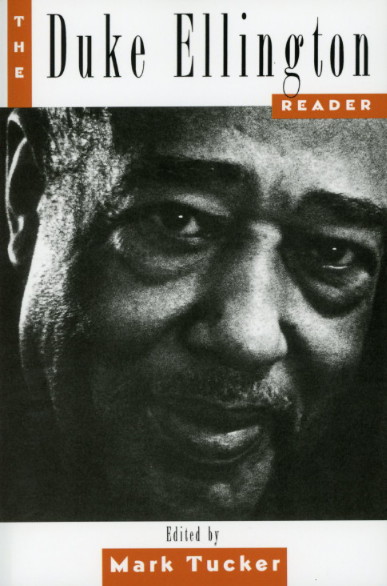
In  The Duke Ellington Reader, Mark Tucker offers the first historical anthology of writings about this major African-American musician. The volume includes over a hundred selections—interviews, critical essays, reviews, memoirs, and over a dozen writings by Ellington himself—with generous introductions and annotations for each selection provided by the editor. The result is a unique sourcebook that illuminates Ellington's work and reveals the profound impact his music has made on listeners over the years. Mark Tucker is Associate Professor of Music at Columbia University and author of Ellington: The Early Years.


This mid-forties portrait of the famous musician at home in Harlem has the standard ingredients of a personality piece: descriptions of Ellington's clothes, his taste in furnishings, even his breakfast preferences. Yet it also contains revealing statements by Ellington about the training of young musicians, the process of composing, and the relationship of jazz to "serious" music.


The piece, by an unidentified writer, appeared in the New York newspaper PM, published from 1940 to 1948. [Source: "Why Duke Ellington Avoided Music Schools," PM, 9 December 1945.]


“It was around 4 p.m. when we reached Duke Ellington's apartment on St, Nicholas Ave. the other day. The building he lives in has an old, ornate, rather dilapidated facade. The halls are narrow and dark, with tile floors.

Mr. Ellington was just getting up, the maid said. Would we wait? We said we would, and walked through an entrance hall painted a stark, gleaming white.

A small spinet piano stood against one wall of the hall. Fluffy yellow scatter rugs were on the floor. One set of French doors led into a bedroom with modern furniture in it. Another opened into the living room, also modern. One wall was lined with shelves of books.


When the Duke appeared he was wearing a red and orange flowered dressing gown with a yellow bath towel over his head. He ducked into the living room to ask if we wanted breakfast and we noticed the gold cross, which he always wears, on a chain around his neck.


"Four o'clock is a good time for breakfast," he said, "I always eat this time, I'm up all night writing."


He went away to take a shower, then returned a few minutes later immaculate in gray trousers, full and pleated around his fairly ample girth, and pegged in at the ankles. A white sport shirt was monogrammed in blue. The initials were E.K.E., for Edward Kennedy Ellington. The Duke won his nickname through the dandified dress he wore when he was a schoolboy in Washington.


We asked him about the following statement Mark Schubart had made in

the New York Times after the Duke's last concert at Carnegie Hall:

"There are those who seek in Mr. Ellington's music a growing affinity between jazz and serious music. Actually, the unmistakable style and distinction of his work is based on and derived from the jazz idiom only, and employs an instrumental technique utterly different from that of symphonic music."


The Duke listened to the quotation with a smile.


"I guess serious is a confusing word," he said. "We take our American music seriously. If serious means European music, I'm not interested in that. Some people mix up the words serious and classical. They're a lot different. Classical music is supposed to be 200 years old. There is no such thing as modern classical music. There is great, serious music. That is all.


"Critics are a funny bunch of people. They use words to their own advantage. They live in one world and we live in another. We don't understand what they are talking about. I don't think the public does, either. All music critics think jazz musicians are trying to get into the symphonic field. Ninety-nine per cent of the jazz people aren't interested in symphony techniques at all.


"Jazz is like the automobile and airplane. It is modern and it is American. I don't like the word jazz but it is the one that is usually used. Jazz is freedom. Jazz is the freedom to play anything, whether it has been done before or not. It gives you freedom. I remember in the old days when I was struggling to write something entirely new. I would try something that hadn't been done before. I felt like an intruder in a new land. No  — more like an illiterate.


"I'm not the offspring of a conservatory. I've avoided music schools and conservatories. I didn't want to be influenced away from what I felt inside. Back in 1915,1920 when I was getting started in Washington, there were two schools of jazz. There were the disciplined jazz musicians who played exactly what was written. They had all the good work. I got kicked out of a couple of those bands.


"Then there was another group of musicians that didn't know music. Some of them could only play in one key. But they played precious things. I was in between. My greatest influence came from the ragtime piano players. I was trying to play ragtime. That's what I was trying to do, but it came out a little different.


"I wouldn't have been a good musician if I'd gone to a conservatory and studied in the usual way. I haven't the discipline."


In that case, we said, why had he recently established three scholarships for graduates of New York high schools at the Juilliard School of Music?


"Things are different now," he said. "A musician coming along today has

to learn a lot. Even if he has loads of natural ability, he has to develop great

skill to be eligible for a good job. If he goes about it the way I did, it will take him much too long. Juilliard is a fine school. The people there are aware of American music. They won't hold anyone back. I developed the helter-skelter way. I don't think everyone should be allowed to do that. Most people learn faster and more at school."


The men in his band have been his strongest inspiration, the Duke said. Three of them have been with him since he started to attract public attention in 1927. [Harry Carney, Sonny Greer, and Fred Guy. Otto Hardwick was another longtime Ellingtonian still playing with the orchestra in 1945, but he had left the band between 1928 and 1932].


Almost all have been with him for more than 10 years. The unity of the Ellington band is apparent in all of the Duke's conversation. He uses the pronoun we much more than I. "We are more interested in folk music." "We play a lot of descriptive music." "We get a kick out of the jitterbugs and try to describe the different styles of dancing in our music."


"We've tried to absorb the styles of all the individuals in the band," the Duke went on. "I don't write for anyone else but the band. When I'm writing a trumpet part, for instance, I don't write within the radius of the horn, but for the man behind the horn.


"Our music grew out of the personalities in the band. We see an old man walking along the street. We play a song that goes with the man.

"Playing is demonstration," said the Duke. "But writing is the real thing. Writing is a matter of adjusting yourself, settling down to do it. You have to have a contented feeling. You get your mind set on writing, then you do it. There is no formula for it. I go for long stretches without writing. I'm a great procrastinator. I have great ideas, but nothing ever happens. Then I get an idea or I promise to do a piece and I do it. I try to write fast. Usually I work walking up and down, humming to myself and drinking Coca-Cola.


"I don't believe in working at the piano. A piano is more or less of a hindrance in composing. It limits you to what your fingers fall on. Unless you're an awfully good pianist, your suggestion is stunted. You're too apt to follow familiar harmony. I can imagine a lot of sounds I wouldn't play offhand on the piano."


Religion has helped him in his work, the Duke told us. He doesn't go to church, though; he "just believes."


"Religion helps my spirit of independence," he explained. "Helps me do things people call daring. For instance, say musicians just don't put a ninth in a particular place, and we do it. Religion helps me. I guess it gives me the proper inflation when I need it."


Negro life, rhythm and melodies have been an important source of his music, the Duke says, but he prefers to think of it as American music.

"Twenty years ago when jazz was finding an audience, it may have had more of a Negro character," he said. "The Negro element is still important. But jazz has become a part of America. There are as many white musicians playing it as Negro. Charley [Charlie] Barnet does so well on my stuff it sometimes scares me.[Bandleader Barnet (1913-1991) featured a number of Ellington (and Ellington-influenced) pieces in his repertory, among them The Sergeant Was Shy, Harlem Speaks, and Drop Me Off in Harlem.]


We are all working along more or less the same lines. We learn from each other. Jazz is American now. American is the big word."


Willie Manning, a wiry, middle-aged man in a big, double-breasted gray suit, who had been running in and out, giving the Duke telephone messages and arranging appointments, came in to insist that the Duke eat breakfast.


We went into the kitchen where the Duke ate an enormous plate of Shredded Wheat, sliced bananas and cream.


"I love a good breakfast in the morning," he observed. He also answered all telephone calls with "good morning." Just then, Willie reminded him that it was almost 6 p.m. and he had to broadcast.[The broadcast was probably from the Club Zanzibar, 49th and Broadway, where Ellington’s orchestra had been appearing often that fall.]


The Duke put on a roomy gray tweed sports jacket, a light beige camel hair overcoat and a porkpie hat. It wasn't until he had his coat on and was standing up beside us that we realized how big he is. He is tall (6 feet) and portly (200 pounds) and has the lazy ease of a large man who is not very active. His only exercise is walking down the four flights of stairs from his apartment to the street. "But I don't walk up," he added. "That would be too much exercise."”