© Copyright ® Steven Cerra, copyright protected; all rights reserved.
The Boston Globe stated: “Balliett’s genius for pictorial description (which helps make him a gifted writer of profiles) extends to the music itself. No one writes about what they listen to anywhere near as well.”
Although he played drums during his college days and was a member of a band, Whitney was not a studied musician. He had no formal training in theory and harmony so during the 40+ years he wrote Jazz profiles for The New Yorker magazine he had to fall back on his other gifts when describing the music - his gift for “pictorial description.”
In many ways, this made Whitney’s Jazz writings more accessible to the majority of Jazz fans since they, too, for the most part, lacked procedural training in melody, harmony and rhythm - the building blocks of music.
As a result, "Balliett comes as close as any writer on jazz—perhaps on any musical style — to George Bernard Shaw's intention to write so that a deaf person could understand and appreciate his comments. This volume approaches indispensability." Choice reviewing Balliett’s American Musicians.
The editorial staff at JazzProfiles thought it might be fun to share some briefer pieces from the pen of our ideal - Whitney Balliet - to give you an appreciation of his “ … genius for pictorial description.” This is the first in a series of six continuously running featuring Whitney’s sui generis pictorially descriptive approach to writing about Jazz which is marked by what Gary Giddins has labeled “writerly attributes: insight, candor, observation, discernment, delineation, style, diligence and purpose.”
These are all drawn from Goodbyes and Other Messages: A Journal of Jazz 1981-1990 [1991].
Monk [Thelonious]
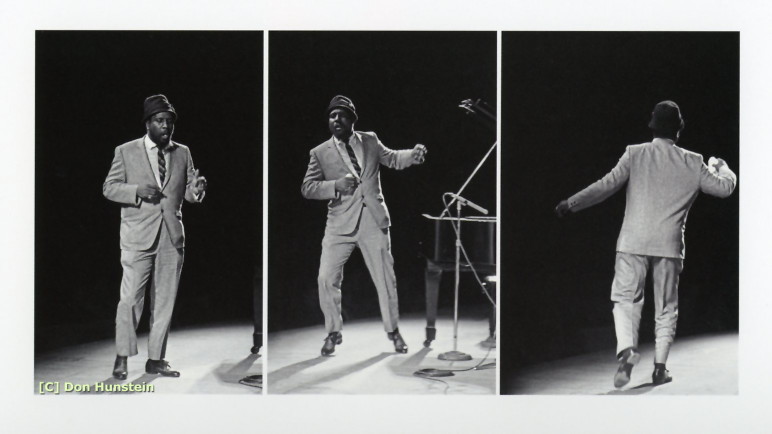
“The pianist and composer Thelonious Monk, who died last week [February 17, 1982], at the age of sixty-four, was an utterly original man who liked to pretend he was an eccentric. Indeed, he used eccentricity as a shield to fend off a world that he frequently found alien, and even hostile. A tall, dark, bearish, inward-shining man, he wore odd hats and dark glasses with bamboo frames when he played. His body moved continuously. At the keyboard, he swayed back and forth and from side to side, his feet flapping like flounders on the floor. While his sidemen soloed, he stood by the piano and danced, turning in slow, genial circles, his elbows out like wings, his knees slightly bent, his fingers snapping on the after-beat. His motions celebrated what he and his musicians played: Watch, these are the shapes of my music. His compositions and his playing were of a piece. His improvisations were molten Monk compositions, and his compositions were frozen Monk improvisations. His medium- and up-tempo tunes are stop-and-go rhythmic structures. Their melodic lines, which often hinge on flatted notes, tend to be spare and direct, but they are written with strangely placed rests and unexpected accents. They move irregularly through sudden intervals and ritards and broken rhythms. His balladlike tunes are altogether different. They are art songs, which move slowly and three-dimensionally. They are carved sound. (Monk's song titles— "Crepuscule with Nellie," "Epistrophy," "Ruby, My Dear," "Well You Needn't," "Rhythm-a-ning," "Hackensack"—are as striking as the songs themselves. But none beat his extraordinary name, Thelonious Sphere Monk, which surpasses such euphonies as Stringfellow Barr and Twyla Tharp.) His improvisations were attempts to disguise his love of melody. He clothed whatever he played with spindly runs, flatted notes, flatted chords, repeated single notes, yawning silences, and zigzag rhythms. Sometimes he pounded the keyboard with his right elbow. His style protected him not only from his love of melody but from his love of the older pianists he grew out of—Duke Ellington and the stride pianists. All peered out from inside his solos, but he let them escape only as parody.
Monk hid behind his music so well that we know little of him. He was brought from North Carolina when he was little, he eventually settled in the West Sixties, and he lived there until his building was torn down. He married the Nellie of his song title, and he had two children, one of whom became a drummer. He began appearing in New York nightclubs around 1940, but he achieved little recognition until the late fifties. (He was often lumped with Charlie Parker and Dizzy Gillespie; however, he did not have much in common with them outside of certain harmonic inventions.) Part of the reason for Monk's slow blooming was his iconoclastic music, and part was the fact that he was unable to perform in New York night clubs from 1951 to 1957 — the time when Charles Mingus and the Modern Jazz Quartet and Gerry Mulligan were becoming famous. (The police had lifted his cabaret card, because he had been found sitting in a car in which narcotics were concealed.) But when he returned to the scene, he suddenly seemed to be everywhere — on record after exceptional record, at concerts and festivals, at the old Five Spot and the Vanguard and the Jazz Gallery. He filled us with his noble, funny, generous music.
Then, in 1973, he vanished again. There were rumors that he was ill and had been taken in by his old friend and mentor the Baroness Nica de Koenigswarter, who lives in a big house in Weehawken, New Jersey. The rumors turned out to be true, and this is what the Baroness had to say about Monk before he died: "No doctor has put his finger on what is wrong with him, and he has had every medical test under the sun. He's not unhappy, and his mind works very well. He knows what is going on in the world, and I don't know how, because he doesn't read the newspapers and he only watches a little telly. He's withdrawn, that's all. It's as though he had gone into retreat. He takes walks several times a week, and Nellie comes over from New York almost every day to cook for him. He began to withdraw in 1973, and he hasn't touched the piano since 1976. He has one twenty or thirty feet from his bed, so to speak, but he never goes near it. When Barry Harris visits, he practices on it, and he'll ask Monk what the correct changes to 'Ruby, My Dear' are, and Monk will tell him. Charlie Rouse, his old tenor saxophonist, came to see him on his birthday the other day, but Monk isn't really interested in seeing anyone. The strange thing is he looks beautiful. He has never said that he won't play the piano again. He suddenly went into this, so maybe he'll suddenly come out."
But Monk must have known he wouldn't. His last public appearance, at the Newport Jazz Festival of 1976, was painful. His playing was mechanical and uncertain, and, astonishingly, his great Gothic style had fallen away.”

