“Some have suggested that Russell's eccentric style of improvisation defies description. Not true. Jazz writers have had a field day articulating and analyzing its mysterious essence. "Half B flat, half saliva," was Leonard Feather's characterization of the classic Russell tone, which was all part of a manner of phrasing that resembled "the stammering of a woman scared by ghosts." "Much of the time, his sound was astringent," Nat Hentoff has explained, "as if it had taken a long time to find its way out of that long contorted body and was rather exasperated at the rigors of the journey" A number of commentators have looked for different levels of intent in Russell's work, almost as though it were a literary text in which the surface meaning and the symbolic meaning were at odds. "He sounded cranky and querulous," Whitney Balliett has asserted, "but that was camouflage, for he was the most plaintive and lyrical of players." Gunther Schuller goes even further in expostulating this theory of "the two Russells": "At first hearing one of these Russell solos tended to give the impression of a somewhat inept musician, awkward and shy, stumbling and muttering along in a rather directionless fashion. It turns out, however, upon closer inspection that such peculiarities—the unorthodox tone, the halting continuity, the odd note choices—are manifestations of a unique, wondrously self-contained musical personality, which operated almost entirely on its own artistic laws."20
Bud Freeman offers a far different interpretation of Russell's muse, reducing it to the classic Aristotelian concepts of pity and fear— with a slightly different twist: "He became a world famous figure because people would suffer with him. They'd say 'O my God, I hope he gets through this chorus.'"”
- Ted Gioia, from the first edition of his History of Jazz [1997]
“Russell is the ensemble musician par excellence. . . . Forsaking the undulating lines of more conventional Dixieland clarinetists, Russell adds a cutting edge to the top of the ensemble sound with a powerful but flexible rasping attack. His unusual sensitivity to ensemble harmony is a joy to trumpet players, for it permits them to depart from the melody without fear of crashing head-on into clarinet notes. Russell touches the traditional third above the lead note often enough to construct a "proper" clarinet part, but more importantly he stretches the ensemble fabric with fourths, fifths (this requires an alert trombonist, for the fifth is traditionally his territory), sixths, and ninths, while spinning elastic counterlines that are closer to second trumpet parts than to the arpeggio-dominated filigrees that one is accustomed to hearing in Dixieland and military bands. It is largely his skillful handling of his very personal ensemble role that gives these old … recordings … an exhilarating vigor undiminished by time”
- Richard Hadlock, Jazz Review as quoted in Robert Hilbert,- - Pee Wee Russell, The Life of a Jazzman
"His was the pure flame," Robert Hilbert writes of Pee Wee Russell. "Hot, gritty, profane, real. No matter what physical or mental condition Russell was in, night after night he spun wondrous improvisations. No matter how disjointed his life, how scrambled his mind, how incomprehensible his speech, his music remained logical and authoritative, elegant and graceful, haughty and proud."
- InPee Wee Russell, The Life of a Jazzman
“I don't mean to sound egocentric, but if I were to practice five or six hours a day for a few weeks, I could have that degree of technical fluency too. But I don't need it for what I want to say. Some players tend to substitute technical bravado for ideas when they run out of imagination. . . . I like to gamble differently— gamble with the inner music and its possibilities. Harmonically, for example. Bix and I had the same feeling about chords. We'd hear something, and say, "That chord just has to be there, whether it's according to Hoyle or not." You have to hear for yourself, and keep trying new ideas.”
- Pee Wee speaking with critic Nat Hentoff about another clarinetist who was known as a virtuoso
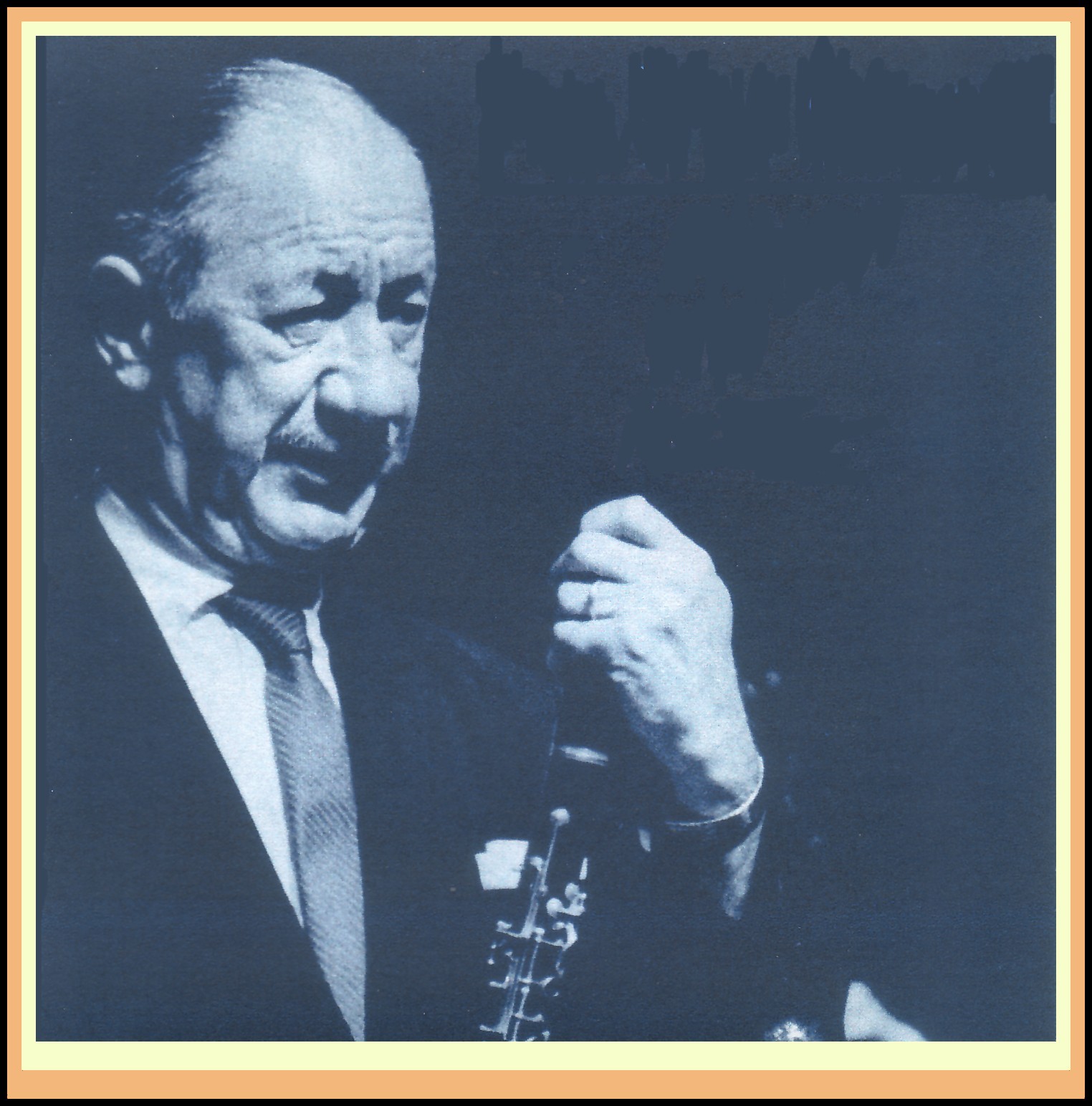
Two of my all-time favorite “Jazz people” are clarinetist Pee Wee Russell [1906-1969] and bassist Bill Crow [b. 1927].
In our efforts to commemorate 100 Years of Jazz by looking back at the music’s earliest developments in the 1920’s, Pee Wee came to mind as he was a part of the fledgling New York Jazz scene along with other Early Jazz luminaries including cornetist Bix Beiderbecke, trumpeter Red Nichols, trombonist Miff Mole and saxophonist Frank Trumbauer.
Of course, Bill, in addition to being a stalwart bassist in the modern Jazz era is also a fine writer and the author of two excellent Jazz Books - From Birdland to Broadway: Scene From a Jazz Life [1992] and Jazz Anecdotes [1990] - as well as this fine essay on his relationship with Pee Wee Russell which first appeared in the January 1990 edition of Gene Lees’ Jazzletter [Vol. 9, No. 1].
“I met Pee Wee Russell in Boston in 1956 when I was working with Gerry Mulligan’s quartet at Storyville, the jam club that George Wein operated in the Copley Square Hotel. Pee Wee was playing in the basement of the same hotel in another of George’s clubs, Mahogany Hall, where traditional jazz was featured. I think Sidney Bechet was leading the band down there at the time.
Pee Wee and I were both early risers, so I often met the tall, cadaverous clarinetist at breakfast in the hotel coffee shop. A Pee Wee was talkative at that hour, but it took me a while to catch everything he said. His voice seemed reluctant to leave his throat. It would sometimes get lost in his mustache, or take muffled detours through his long free-form nose.
Pee Wee’s playing often had an anguished sound. He screwed his rubbery face into woeful expressions as he fought the clarinet, the chord changes, and his imagination. He was respectful of the dangers inherent in the adventure of improvising, and never approached it casually.
Pee Wee’s conversational style mirrored the way he played. He would sidle up to a subject, poke at it tentatively, make several disclaimers about the worthlessness of his opinion, inquire if he’d lost my interest, suggest other possible topics of" conversation, and then would dart back to his subject and quickly illuminate it with a few pithy remarks mumbled hastily into his coffee cup."
It was always worth the wait. His comments were fascinating, and he had a delightful way with a phrase. Pee Wee’s hesitant and circuitous manner of speaking, combined with his habit of drawing his lanky frame into a concave shape that seemed to express a vain hope for invisibility, gave me a first impression of shyness and passivity. I soon discovered that there was a bright intelligence and sense of humor behind the facade. Also a determined resistance to being pushed in any direction he didn’t want to go.
I’d heard stories of the many years Pee Wee had spent drinking heavily while playing in the band at Nick’s in Greenwich Village. Like many of the musicians of his era, Pee Wee as a young man found that liquor was an integral part of the jazz life. The quantity of booze he put away eventually wore him down so badly that once or twice he had been thought to have died, when in fact he was just sleeping. His diet for years was mainly alcohol, with occasional "meals" that consisted of a can of tomatoes, unheated, washed down with a glass of milk. On the bandstand he always looked emaciated and uncomfortable.
A friend told me that in those days Pee Wee came to work sober only once, when his wife, Mary, thought she was pregnant. That night Pee Wee arrived at Nick’s in good focus, didn’t drink all night, and actually held conversations with friends that he recognized. A couple of days later, when Mary found out her pregnancy was a false alarm, Pee Wee returned to his routine, arriving at work in an alcoholic fog, speaking to no one, and alternately playing and drinking all night long.
His health failed in 1951. Pee Wee was hospitalized in San Francisco with multiple ailments, including acute malnutrition, cirrhosis of the liver, pancreatitis, and internal cysts. The doctors at first gave no hope for his recovery, and word spread quickly through the jazz world that he was at death’s door. It was reported in France that he had already passed through it. Sidney Bechet played a farewell concert for him in Paris.
When they heard of his illness, and that he was broke, musicians in California, Chicago, and New York gave benefit concerts that raised $4,500 to help with his medical expenses. Louis Armstrong and Jack Teagarden visited his hospital room in San Francisco and told him about the benefit they were planning. Pee Wee, sure that he was expressing his last wish, whispered, "Tell the newspapers not to write any sad stories about me.” -
Eddie Condon described the surgery that saved Pee Wee’s life: "They had him open like a canoe!“ Condon also was quoted as saying, "Pee Wee nearly died from too much living." Pee Wee miraculously rallied, and limped back to New York.
He changed his ways. He began eating regular meals, with which he drank milk or, sometimes, a glass of ale, though nothing stronger. He began to relax more and, at the urging of his wife, tried to diversify his interests.
"I haven't done anything except spend my life with a horn stuck in my face," he told a friend. He began to turn down jobs that didn’t appeal to him musically, staying home much of the time. For a while Mary wasn't sure she knew who he was. She said she had to get used to him all over again. "He talks a lot now," she told an interviewer. "He never used to. It’s as if he were trying to catch up.”
After our first sojourn together in Boston, I played with Pee Wee on a couple of jobs in New York with Jimmy McPartland. Then the following Christmas I was at Storyville again with the Gerry Mulligan quartet and Pee Wee was once more at Mahogany Hall downstairs. Both jobs extended through New Year’s Eve.
George Wein planned to have the Mahogany Hall band come upstairs before midnight to help us welcome the New Year with a jam session. Gerry offered to-write an arrangement of Auld Lang Syne for the combined groups, since there would be six horns in the front line. George was enthusiastic about the idea.
Gerry finished the arrangement on the afternoon of New Year’s Eve and called a rehearsal. Pee Wee made a lot of suffering noises because he was worried about having to read music. He sounded fine at the rehearsal, but he continued to worry.
That night both bands got together on the Storyville bandstand to jam a few tunes before twelve o’clock. As the hour approached, Gerry asked us to get up his» chart. Everyone got out his part, but Pee Wee couldn’t find his. We searched everywhere. With midnight only seconds away, the clarinet part was still missing, so we just -faked Auld Lang Syne. Gerry was disappointed, but the audience, unaware of the arrangement we hadn’t played, was content.
As we left the stand after the set, I passed the chair where Pee Wee had been sitting. There lay the missing part. The crafty bastard had been sitting on it all the time.
In New York I lived on Cornelia Street in the Village. Pee Wee and Mary lived nearby on King Street, so I saw him occasionally around the neighborhood, usually walking his dog Nini up Seventh Avenue South. We’d stroll along together and chat about this and that while Pee Wee let the dog sniff and mark the tree trunks. Once in a while Pee Wee would invite me over to the White Horse Tavern for a beer. He’d tell me stories about growing up in Missouri or playing with bands in Texas or Chicago, but I was never clear about the chronology. I got the impression that he remembered life in the twenties and thirties with much more clarity than the forties.
One summer afternoon I invited Pee Wee to accompany me for a swim at the city pool between Carmine and Leroy Streets that was my spa in those days. He gave me an excruciatingly pained look and said, "The world isn’t ready for me in swim trunks."
In 1960 George Wein called me to play in a sextet he was putting together for a few weeks' work. George played piano and Mickey Sheen was the drummer. The front line was wonderful: Harold "Shorty" Baker on trumpet and Lawrence Brown on trombone, two old colleagues from Duke Ellington’s band. And Pee Wee.
I was used to hearing him in a more traditional setting, where all the horns in the front line improvised together contrapuntally. On this band, Lawrence fitted beautiful parallel harmony lines to Shorty’s melodic lead, leaving Pee Wee free to play whatever counter figures he chose without having to dodge anything else. His inventions were a wonderful surprise to us all, quite different from his usual ensemble playing.
Our first gig was at the Embers in New York. Then we played Storyville in Boston, a concert in the garden of the Museum of Modern Art in New York, and a couple of college concerts. While I was sitting in a restaurant in Boston with Pee Wee, a nice looking couple came over and gave him a very warm hello. He looked a little uncomfortable as he acknowledged their greeting. "Pee Wee, don’t you remember us?“ Pee Wee looked apologetic. "You stayed at our house in St. Louis for six months!" Pee Wee shook his head mournfully. He didn’t have to clear a memory of his drinking years.
"If you say so," he said sorrowfully.
Lawrence Brown told George Wein, "For God’s sake get some work for this band! Or I’ll have to go back with Duke and play those damned plunger parts!" Lawrence had always played open horn with Ellington’s band, and evidently didn’t appreciate Duke having conned him into taking over the plunger passages that had begun with Charlie "Plug" lrvis and Joe "Tricky Sam" Nanton and had later been passed on to Tyree Glenn and Quentin Jackson. Unfortunately George didn’t get any more work for us. Lawrence went back with Duke and played those damned plunger parts.
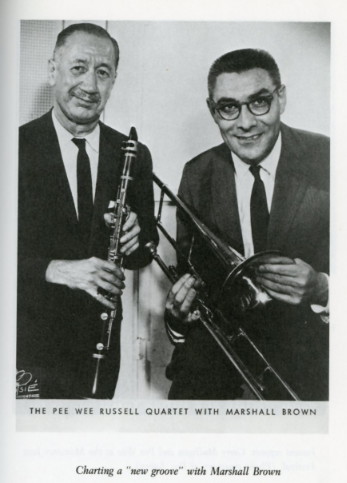
Pee Wee surprised everyone in 1962 when, in collaboration with valve trombonist Marshall Brown, bassist Russell George, and drummer Ron Lundberg, he began to use some modern jazz forms. Marshall pushed Pee Wee into learning some John Coltrane tunes and experimenting with musical forms he hadn’t tried before. He made the transition with the same fierce effort with which he’d always approached improvisation, and the group made some very good records.
Marshall was a so-so soloist who had been a music teacher at a high school in Farmingdale, Long Island. He was tremendously enthusiastic, but he was a terrible pedant, if a good-natured one. He couldn’t resist taking the role of the instructor, even with accomplished musicians. Pee Wee told interviewer Bill Coss: "Marshall certainly brought out things in me. It was strange. When he would correct me, I would say to myself, ’Now why did he have to tell me that? I knew that already.”
Mary Russell told Coss, "Pee Wee wants to kill him."
"I haven’t taken so many orders since military school," said Pee Wee.
One day Pee Wee told me that he and Mary were moving out of their old apartment. A new development had been built between Eighth and Ninth Avenues north of Twenty-third Street, where several blocks of old tenements had been torn down. The Russells had bought a co-op apartment there. I got married around that time and my wife and I moved into an apartment building on the corner of Twentieth Street and Ninth Avenue, so I was still in Pee Wee’s neighborhood. I would bump into him on the street now and then.
In 1965, Mary came home one day with an oil paint set and some canvases on stretchers. She dumped it all in Pee Wee’s lap and said, "Here, do something with yourself. Paint!"
He did. Holding the canvases in his lap or leaning them on the kitchen table as he worked, he produced nearly a hundred pieces during the ensuing two years, painting in a strikingly personal, primitive style. With bold brushstrokes and solid masses of color he created abstract shapes, some with eccentric, asymmetrical faces. They were quite amazing works. Though he enjoyed the praise of his friends and was delighted when some of the canvases sold at prices that astonished him, he painted primarily for Mary’s appreciation. When she died in 1967, he put away his paint brushes for good.
With Mary gone, Pee Wee went back to his drinking, and his health began slowly to deteriorate. In February, 1969, during a visit to Washington, D.C., where he thought he might relocate, he was feeling so bad that he called a friend, Tom Gwaltney, and had him check him into Alexandria Hospital. The doctors shut off his booze and did what they could to restore him to health, but this time he failed to respond to treatment. After a few days he just slipped away in his sleep.
The Jersey Jazz Society has kept Pee Wee’s memory alive with their annual Pee Wee Russell Memorial Stomp, and there have been occasional showings of his paintings at art galleries. And, of course, there are still the records, reminding us of how wonderfully Pee Wee’s playing teetered at the edge of musical disaster, where he struggled mightily, and prevailed.”
"I think Pee Wee, with all his nervous playing and without any facility, had more to say in the creative sense than any of the technicians and he became a world-famous figure because people would suffer with him. They'd say, 'Oh my God, I hope he gets through this chorus,' and this was his charisma, a powerful thing, really...In another hundred years, if there is another hundred years, people will talk more about Pee Wee's records than about Benny Goodman's."
- Bud Freeman, tenor saxophonist and band leader
“No jazz musician has ever played with the same daring and nakedness and intuition," Whitney Balliett wrote in a New Yorker profile of Pee Wee Russell. "He took wild improvisational chances, and when he found himself above the abyss, he simply turned in another direction, invariably hitting firm ground."
Gunther Schuller, America's preeminent jazz historian, also had high praise for Russell, saying that "he defined and exemplified what it is to be a true jazz musician....The unorthodox tone, the halting continuity, the odd note choices—are manifestations of a unique, wondrously self-contained musical personality....He was also one of the most touching and human players jazz has ever known.".
"His was the pure flame," Robert Hilbert writes of Pee Wee Russell. "Hot, gritty, profane, real. No matter what physical or mental condition Russell was in, night after night he spun wondrous improvisations. No matter how disjointed his life, how scrambled his mind, how incomprehensible his speech, his music remained logical and authoritative, elegant and graceful, haughty and proud." In Pee Wee Russell, The Life of a Jazzman, Hilbert does full justice to this remarkable figure in American Jazz.
Clarinetist Pee Wee Russell was indeed one of the great innovators in jazz history
It’s always fun to encounter attempts to explain the stylistic distinctiveness of clarinetist Pee Wee Russell in the Jazz Literature.
Describing Pee Wee’s sui generis approach to the instrument in particular and Jazz improvisation in general has been a subject written with the use of an infinite number of adjectives.
If anything underscores the difficulty of describing music with words it's trying to find a way to get one’s arms around what Pee Wee’s doing on the instrument.
Below is Ted Gioia’s fine effort from the first edition of his History of Jazz [1997]
“Pee Wee Russell, two weeks younger [March 27, 1906] than Frank Teschemacher, developed an even more stylized approach. The son of a St. Louis bartender and steward, Pee Wee — his formal name was much more elegant: Charles Ellsworth Russell — studied piano, drums and violin in his youth, but began focusing on the clarinet in his early teens. Like Beiderbecke, with whom he later performed and shared a close friendship, Russell was expelled from boarding school before embarking on a jazz career. Russell later quipped: "I learned one thing: how to get where you're going on time."14
The only problem Russell faced after this dismissal was: where exactly to go? His travels over the next few years brought him to Mexico, the West Coast, Arizona, Kansas, Iowa, North and South Dakota, Texas (where he encountered Jack Teagarden), back to St. Louis (where he met Beiderbecke), and on to New York — indeed, almost anywhere a paying gig materialized. True to form, like several of the other noted "Chicagoans," Russell performed little in the Windy City, but was part of a St. Louis contingent that later developed strong ties to the Condon crew.
Some have suggested that Russell's eccentric style of improvisation defies description. Not true. Jazz writers have had a field day articulating and analyzing its mysterious essence. "Half B flat, half saliva," was Leonard Feather's characterization of the classic Russell tone, which was all part of a manner of phrasing that resembled "the stammering of a woman scared by ghosts." "Much of the time, his sound
was astringent," Nat Hentoff has explained, "as if it had taken a long time to find its way out of that long contorted body and was rather exasperated at the rigors of the journey" A number of commentators have looked for different levels of intent in Russell's work, almost as though it were a literary text in which the surface meaning and the symbolic meaning were at odds. "He sounded cranky and querulous," Whitney Balliett has asserted, "but that was camouflage, for he was the most plaintive and lyrical of players." Gunther Schuller goes even further in expostulating this theory of "the two Russells": "At first hearing one of these Russell solos tended to give the impression of a somewhat inept musician, awkward and shy, stumbling and muttering along in a rather directionless fashion. It turns out, however, upon closer inspection that such peculiarities—the unorthodox tone, the halting continuity, the odd note choices—are manifestations of a unique, wondrously self-contained musical personality, which operated almost entirely on its own artistic laws."20
Bud Freeman offers a far different interpretation of Russell's muse, reducing it to the classic Aristotelian concepts of pity and fear— with a slightly different twist: "He became a world famous figure because people would suffer with him. They'd say 'O my God, I hope he gets through this chorus.'"
Yet, whether his music is viewed as a Delphic utterance laden with secret meanings, an expression of eccentricity, or simply a style built around various limitations, Russell ultimately succeeded where it counted most: in attracting a devoted following, one that lived vicariously through his embrace of the unorthodox. For those fans who became part of the cult of Pee Wee, there was no other clarinetist half so grand.
Russell's playing revealed his taste for the bizarre almost from the start. On his 1929 recording of "That Da Da Strain," Russell opens his solo with a halfhearted attempt to imitate the florid and fluid clarinet stylings pioneered by the New Orleans masters. Alas, with meager success. After floundering energetically in this manner for three bars, Russell abandons this attempt at virtuosity, instead tossing out isolated notes and jagged phrases, offering up all the makeshift sounds — growls that end up as whimpers, staccato jabs that shadow box with the rhythm section, notes bent until they scream — that came to characterize the Pee Wee oeuvre. His celebrated solo, recorded that same day, on "Basin Street Blues," relies on a similar knack for raising aberrations to the level of a musical style, only here within the context of the twelve-bar blues. The combination is gripping: blues, the music of pathos, and Pee Wee, the master of the pathological, meet in a surreal halfway land, one where Dixieland and Dada gropingly join hands.
Throughout his career, Russell would return to the blues and, in a manner all his own, somehow manage each time to extract the inevitable bloody victory. But though the eccentricities of Russell's style might temporarily mask the fertile muse inspiring his efforts, they could never hide it. His work was especially effective when contrasted with another player with an equally strong sense of style: whether alongside Coleman Hawkins on "Hello Lola" and "One Hour," or decades later matching his wits with Gerry Mulligan or Thelonious Monk (who he "out-Monked," his fans insisted, with some justification).”
“… Pee Wee stands as the basic minimum, as a kind of proof that jazz is demonstrably a matter of men creating a music that is what they feel and what they are.”
“His style is undoubtedly something quite inevitable — inevitable and doomed, I suppose — but it's a wonderful kind of music and it's an awe-inspiring kind of personal dedication.
“[With Pee Wee we are] dealing with someone who had something, as a musician and as a man, that few people ever have — an internal completeness and sense of personal satisfaction. Although Pee Wee himself is undoubtedly quite unaware of all these obscure metaphysical values.”
-Orrin Keepnews
Many Jazz fans are unaware of the fact that before he became a record producer and co-founder of Riverside and Jazzland records [with Bill Grauer] and other, later labels devoted to Jazz in his long and illustrious career, Orrin Keepnews [1923-2015] wrote and edited for The Record Changer, a small Jazz magazine “… which managed to survive just long [1946-52] enough to provide my on-the-job training as a Jazz writer.”
Little did Orrin realize how valuable this internship would become because, given the shoe-string operation Riverside/Jazzland records was from 1953 until it's bankruptcy in 1964, he pretty much wrote the liner notes for almost all of the records he produced.
And while Riverside, Jazzland and subsequent labels he founded - Landmark and Mainstream, among them - were essentially devoted to modern Jazz, Orrin had a very deep background in the music and its makers from the early origins of the music as is detailed in his autobiographical The View from Within: Jazz Writings, 1948-1987.
As a case in point, the following 1950 essay on clarinetist Pee Wee Russell, one of the founders of the Chicago Style of Jazz in the 1920s, is excerpted from this book. [The Riverside History of Classic Jazz RLP 12-112 is also a testimony to Orrin’s interest in early Jazz.]
In the 1990s when we both lived in San Francisco, I got to know Orrin pretty well; we were neighbors and he allowed me to interview him about a variety of artists who had recorded for him at Riverside Records.
We usually met at a restaurant/club on Geary known as The Beach House, a somewhat ludicrously decorated place with Tiki heads, lots of bamboo, waitresses in Hawaiian print dresses and a funky looking bartender who served up a pretty good Mai Tai.
During one of our get-togethers, he gave me a paperback copy of The View from Within: Jazz Writings, 1948-1987 which, dog-eared from lots of readings during business travels over the years, I still have.
I laughed when I first saw how he had inscribed it: “To Steve, a good friend of the music.” No one has ever been a better friend to the music than Orrin Keepnews.
“A tall, gaunt, stoop-shouldered fellow, something more than forty years old, with the face of a sad clown and a general air of vagueness and absent-mindedness about him, Pee Wee Russell hardly seems likely to fit anyone's conception of what a jazz musician should look like.
A total stranger to jazz would probably be a bit surprised to see him pick up a clarinet; after the stranger had heard him play for a while, the chances are that he would be more, rather than less baffled. The growl tones, the slurs and blurs of Pee Wee's music, have been known to provoke bitter arguments. The question seemed almost invariably to be: does he play the best, or the worst clarinet in the world?
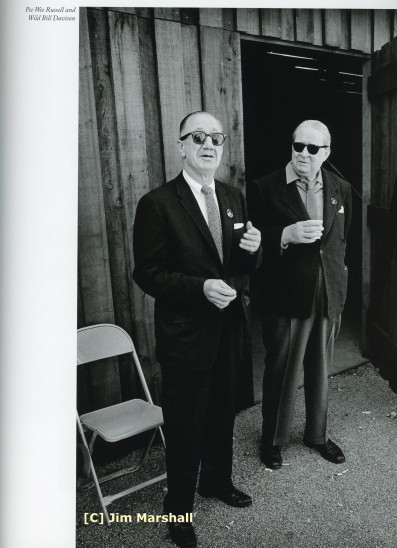
The unanswerable argument has died down now; not only is Russell an accepted and almost legendary figure in the Dixieland world, but it must also be admitted that he is no longer on the top rung. In the current New York-Chicago pattern, the top rung and the spotlight belong to a slicker, brasher, brassier type of musician: Bill Davison blasting from the center of the podium or Eddie Condon chatting with the customers are the ones more likely to be either praised or damned these days. And the reason for Pee Wee's slipping out of the spotlight is not only a change in public taste or in publicity. Even those who love Russell's work the best will grant that he is not playing as well as he once played on early Chicago record dates.
Admitting that the fellow has always been a puzzle, and that he is not now a center of attraction — although he is still a respected jazz name, it may seem a bit far-fetched to come right out and claim that Pee Wee is, in effect, an object lesson in the nature of improvised jazz, a living embodiment of the peculiar virtues and drawbacks of this music. I won't deny that that statement may sound like the sort of thing a jazz writer dreams up when he's desperately searching for "significance." But I won't apologize for the claim, either. It seems to me that not only can the enigma of Pee Wee be explained in those terms, but that all of us — or at least that total stranger to jazz whom I invented a couple of paragraphs ago — can get some valuable hints about all of jazz by looking at Pee Wee that way.
Go back to the first time you ever heard Russell on record: for me I think it may have been on the [tenor saxophonist Bud Freeman] Summa Cum Laude [orchestra’s version of] "Sunday." Then recall the first time you saw him — I remember early one evening at Nick's, when the band was sitting at a table near the stand, and I had never seen any white jazzman in person, and I knew without hesitation which one was Russell.
It has become quite a cliche in jazz writing to talk about a musician's style and solos as expressing his "ideas" or his "personality." But notes are not as easily communicative as words, and while one man's inventiveness or power may please you and stir you, it is no real indication as to whether he beats his wife, agrees with Nietzsche, or brushes his teeth regularly. And while I'm not claiming that you can learn these things by listening to his clarinet, it is nevertheless unquestionable that there is an overwhelming unity about Pee Wee. Only a man who looks and acts as he does should be able to play exactly as he does. The wry, shy, ironic humor, the hesitant, almost-humble gestures — these are identical in the appearance of the man and in the sound of the clarinet. Charles Edward Smith wrote in Jazzmen that Pee Wee "looks like the sort of person about whom anecdotes are told"—and I think you can hear that in the music, too.
This sort of thing should not be over-generalized; there are many musicians whose personalities and music are vastly more difficult to isolate and comprehend. But Pee Wee stands as the basic minimum, as a kind of proof that jazz is demonstrably a matter of men creating a music that is what they feel and what they are.
It is also true that Russell is a remarkably unchanging musician. This is undoubtedly at least part of the reason why he is not today the influential figure in jazz that he has been. Whether his playing has declined because of his physical decline, or whether it's the other way around, I wouldn't know. But I would guess that he was living at the same pace, or harder, in the golden era when men as different as Teschmaker and Goodman were clearly being influenced by his playing. It's more likely that the trouble with Pee Wee today is that his kind of music doesn't really exist any more, except for his own playing and that of a very few other deep-dyed Chicagoans. Listen to almost any old White Chicago record, and then listen to a Condon's-type band of today; the difference is immense, but Pee Wee's style is virtually unchanged. If you are as closely tied up with your music as he must be, you either must want to go along with such changes, or else be bewildered and pretty badly hurt by the fact that the world has changed, and the music has changed, and you can't and don't want to change.
I don't know why Pee Wee's music has remained constant, but it isn't hard to guess. The kind of unity of man and music in Russell that I have been talking about certainly indicates something deeply ingrained and single-minded. Anyway, Pee Wee's style must have been formed back when he was playing weekend dates in Missouri, listening to Fate Marable's riverboat band and to Charlie Creath playing rough blues on the cornet in St. Louis. His style is undoubtedly something quite inevitable — inevitable and doomed, I suppose — but it's a wonderful kind of music and it's an awe-inspiring kind of personal dedication.
A certain trombone player, at the recent height of his popularity, took to making Pee Wee something of the butt of his rough-hewn humor, calling him "Pee Wee the People," a joke I always thought was more obscure than it was worth. It may be naive, but I've always thought there was an unconscious embarrassment in the ribbing, a half-realized dealing with someone who had something, as a musician and as a man, that few people ever have — an internal completeness and sense of personal satisfaction. Although Pee Wee himself is undoubtedly quite unaware of all these obscure metaphysical values.
I don't want to get either mystical or maudlin, so I'll stop before I start mumbling about "the peace that passeth understanding" and the like. Instead I'll close with the memory of a night in Boston in 1945. Russell was playing with Max Kaminsky and a loud but uninspired local rhythm section. At the time Pee Wee could rarely be heard over the combined din of band and audience. But for one number everything slipped into place; there was silence and you could hear him playing quite beautiful blues in his accustomed style: growl and blur and more notes hinted at than he or anyone else could ever play.”
“Dry facts, as on a
tombstone. But looking deeper, one finds a tumultuous 63 years of bohemian
life, crowded with agonies, friendships and loyalties, drinking, much
wandering, life-long physical problems, and even romance. And running through
this chaotic landscape a vitalizing river of music - jazz music. In his
lifespan it evolved from ragtime into the varied styles of the 'modern"
Sixties. He lived and played through just about all of it, and in doing so had
a clear influence on the music itself. He's now a legend: ole shy, backing-away
Pee Wee, with the rumbling, many-toned speaking voice - and a clarinet sound to
match it!”
– Joe Muranyi, Jazz clarinetist
“Pee Wee Russell was an
odd-duck of a clarinetist who in his idiosyncratic way foreshadowed some of the
innovations of modern jazz. His playing at times seems "off" in the
way that some of the earliest jazz sounds almost otherworldly with its unique
tones and timbres. Russell’s expressive slides and dips pre-figure the likes of
the later Lester Young, and in our day Lee Konitz, especially when his playing
became more voice-like, and the expectations of others seemed to matter even
less. It seems the better Russell played the more idiosyncratic he got. Pee Wee
was a natural odd duck.”
“Pee Wee Russell had the most fabulous musical
mind. I've never run into anybody who had that much musical talent.”
- Gene Krupa, Jazz drummer and Bandleader
“Russell’s music was never
quite what it seemed.”
– Gary Giddins, Jazz author
“Jazz is only what you are.”
– Louis Armstrong
Trumpet players
and trombonists talk about mouthpieces, saxophone players talk about reeds,
guitarists and bassists talk about strings and drummers talk about sticks and
brushes.
These are the
devices that make the instruments they play make sounds so each in their own
way is curious about how to alter, or improve, or make easier, the production
of that sound.
Of course, this is
an oversimplification of the elements involved in playing an instrument,
but you get the idea.
For me, the
“ultimate quest” had to do with improving my brushwork. Using sticks came
naturally as I suspect it does for most drummers, but brushes were
hard work. They were the ultimate riddle.
Progress was slow
for me and I was always looking for ways to enhance the way I played brushes.
When he was on the
West Coast for a brief time, I got to know drummer Ron Lundberg, who really helped
me refine some aspects of my brushwork.
But it was to be a
short-lived learning process for after having gigged and recorded with Barney
Kessel in California, Ron left to go back to New York where he played with
pianist Marian McPartland’s trio and later with vocalist Mose Allison.
Caught up in my
own thing, I lost track of Ron until one day in late 1962 when the postman
delivered New Groove: The Pee Wee Russell Quartet [Columbia LP CL 1985;
CS 8785]. There was Ron on the cover standing behind a Ferrari “Testa Rosa”
along with Marshall Brown [valve trombone and bass trumpet] and bassist
Russell George. Pee Wee Russell was seated behind the wheel of this beautiful,
white sports car.
The album was a
gift from Ron [whose playing on it is outstanding] and it was my first – I know
that this is hard to believe – introduction to Pee Russell, whose playing can
only be described as ineffable.
Having been “corn
fed” a steady “clarinet diet” of Benny Goodman, Artie Shaw, Woody Herman, with
some Buddy de Franco thrown in for dessert, I had no idea of what to make of
the sound that came out of Pee Wee’s – was it a – clarinet?
And yet, at the
same time, I was totally captivated and mesmerized by it and I became a instant
fan.
This LP opened the
door for a journey back through time as I sought out Pee Wee’s earlier
recordings. Discovering these was like riding in a time-machine through the
history of Jazz.
Eventually I would
come to view Pee Wee’s playing as the ultimate Jazz achievement – one of
singularity or originality. But for the life of me, when it comes to Pee Wee’s
clarinet style, I’ve never been very good at describing what I heard on that
record or since. Scintillating and shuddery are the best I can do.
Thank goodness
then for the likes of Nat Hentoff, Bill Crow and Whitney Balliett who not only come to
my assistance with apt and well-informed descriptions of Pee Wee’s playing, but
who also do so from the standpoint of being among those who knew him
personally.
For those
interested in a more comprehensively detailed biography of Pee Wee and his
discography, the definitive treatment appears to be Robert Hilbert’s Pee
Wee Speaks [Metuchen, NJ: Scarecrow Press, 1992, Studies in Jazz #13].
Mr. Hilbert’s work begins with a previously undocumented first recording
session of 16-year-old Russell in 1922, and ends in 1968 with a Mississippi riverboat party shortly before his death.
The discography includes all of his known commercial recordings worldwide as
well as much new information on film soundtracks, private recordings,
broadcasts, and concerts.
Pee Wee also
shares a chapter with his long time running mate trombonist Jack Teagarden in
Richard Sudhalter’s well-written and wonderfully informative Lost
Chords: White Musicians and Their Contributions to Jazz: 1915-1945 [New
York: Oxford University Press, 1992].
In his work, the
late Mr. Sudhalter posits and interesting observation about Jack and Pee Wee:
“… Both soon became stylists as easy to
recognize as they were difficult to imitate, and their inimitability presents
students of jazz history with an intriguing conundrum.
Neither Teagarden nor Russell left a major
stylistic progeny. Neither exerted the kind of direct and diversified influence
on subsequent jazz players so notable in Coleman Hawkins, Lester Young, Benny
Goodman, Charlie Parker, Roy Eldridge – and, above all, Louis Armstrong.”
Perhaps some
answers to this puzzle can be found in the following excerpts about Pee Wee.
Nat Hentoff, Jazz
Is, [New
York: Limelight
Editions, 1991, pp. 12–13].
“Pee Wee Russell, who played
jazz with every inch of his thin, elongated body and thereby appeared to be
made of rubber as he stretched and twisted during a solo, had a sound unlike
that of any other clarinetist in jazz. He made the clarinet growl, rasp, squeak
(most of the time deliberately), and then suddenly the horn would whisper,
sensuously, delicately, promising even more swirling intimacies to come. And
never, ever, was it possible to predict the shapes of what was to come.
One night, in the late
1940's, a student from the New England Conservatory of Music came into a jazz
room in Boston where Pee Wee was playing, went up to the stand, and unrolled a
series of music manuscript pages. They were covered, densely, with what looked
like the notes of an extraordinarily complex, ambitious classical composition.
"I brought this for
you," the young man said to Pee Wee Russell. "It's one of your solos
from last night. I transcribed it."
Pee Wee, shaking his head,
looked at the manuscript. "This can't be me," he said. "I can't
play this."
The student assured Pee Wee
that the transcribed solo, with its fiendishly brilliant structure and
astonishingly sustained inventiveness, was indeed Russell's.
"Well," Pee Wee
said, "even if it is, I wouldn't play it again the same way - even if I
could, which I can't."”
Bill Crow, From Birdland to Broadway: Scenes from a
Jazz Life [New
York: OxfordUniversity Press, 1992, pp. 149-153]
Pee Wee Russell
Gerry Mulligan's quartet
often played at George Wein's Storyville in the Copley Square Hotel. In the
basement of the same hotel, Wein also had a room called Mahogany Hall, where he
featured traditional jazz with musicians like Vic Dickenson and Pee Wee Russell.
During one year's-end engagement, George wanted to combine both bands in a jam
session upstairs at Storyville to welcome the new year. Gerry offered to write
an arrangement of "Auld Lang Syne" for the occasion.
Gerry finished the
arrangement and called an afternoon rehearsal on the day of New Year's Eve. Pee
Wee Russell was worried about reading the music and made suffering noises. He
sounded fine, but continued to worry. That night, the musicians from Mahogany
Hall came up to jam a few tunes with us before twelve o'clock, and as the hour approached, Gerry called for his
chart, but Pee Wee's part was missing. Though we were disappointed, there was
nothing we could do. Midnight was upon us. We had to fake a Dixieland version of "Auld Lang
Syne." As we left the bandstand afterwards, there on Pee Wee's chair I saw
the missing part. The crafty bastard had been sitting on it all the time.
Pee Wee and I were both early
risers, so I often met the tall, cadaverous-looking clarinetist for breakfast
in the hotel coffee shop. He was talkative at that hour, but it took me a while
to catch everything he said. His voice seemed reluctant to leave his throat. It
would sometimes get lost in his moustache, or take muffled detours through his
long free-form nose.
Pee Wee's playing often had
an anguished sound. He screwed his rubbery face into woeful expressions as he
simultaneously fought the clarinet, the chord changes, and his imagination. He
was respectful of the dangers inherent in the adventure of improvising, and never
approached it casually.
Pee Wee's conversational
style mirrored the way he played. He would sidle up to a subject, poke at it
tentatively, make several disclaimers about the worthlessness of his opinion,
inquire if he'd lost my interest, suggest other possible topics of
conversation, and then would dart back to his original subject and quickly
illuminate it with a few pithy remarks mumbled hastily into his coffee cup. It
was always worth the wait. His comments were fascinating, and he had a
delightful way with a phrase.
His hesitant and circuitous
manner of speaking, combined with his habit of drawing his lanky frame into a
concave position that seemed to express a vain hope for invisibility, gave me a
first impression of shyness and passivity. I soon discovered that there was a
bright intelligence and sense of humor under that facade. Also there was a
determined resistance to being pushed in any direction Pee Wee didn't want to
go.
I'd heard stories of the many
years Pee Wee had spent drinking heavily while playing in the band at Nick's in
Greenwich Village. Like many of the musicians of his era, Pee Wee had
considered liquor to be an integral part of the jazz life. Over the years, the
quantity of booze that he put away eventually wore him down so badly that once
or twice he was thought to have died, when in fact he was just sleeping. His
diet for years was mainly alcohol, with occasional "meals" that
consisted of a can of tomatoes, unheated, washed down with a glass of milk. On
the bandstand he always looked emaciated and uncomfortable.
A friend told me that the
only time Pee Wee ever came to work sober in those days was once when his wife,
Mary, thought she was pregnant. That night Pee Wee arrived at Nick's in good
focus, didn't drink all night, and actually held conversations with friends
that he recognized. A couple of days later, when Mary found out her pregnancy
was a false alarm, Pee Wee returned to his old routine, arriving at work in an
alcoholic fog, speaking to no one, alternately playing and drinking all night
long.
His health failed him in
1951. Pee Wee was hospitalized in San Francisco with multiple ailments, including acute malnutrition,
cirrhosis of the liver, pancreatitis, and internal cysts. The doctors at first
gave him no hope for recovery, and word had spread quickly through the jazz
world that he was at death's door. It was reported in France that he had already passed through it. Sidney Bechet
played a farewell concert for him in Paris.
Eddie Condon described the
surgery that saved Pee Wee's life:
"They had him open like
a canoe!”
Condon also was quoted as
saying, "Pee Wee nearly died from too much living."
At any rate, Pee Wee
miraculously rallied, recovered, and limped back to New York. When they heard of his illness and that he was
broke, musicians in California, Chicago,
and New York gave benefit concerts that raised around $4,500 to
help with his medical expenses. Louis Armstrong and Jack Teagarden visited his
hospital room in San
Francisco and
told him about the benefit they were planning. Pee Wee, sure that he was
expressing his last wish, whispered, "Tell the newspapers not to write any
sad stories about me."
After Pee Wee recovered, he
completely changed his life style. He began eating regular meals, with which he
drank milk and sometimes a glass of ale, but nothing stronger. He began to
relax more and, at the urging of his wife, Mary, tried to diversify his
interests.
"I haven't done anything
except spend my life with a horn stuck in my face," he told a friend.
He began to turn down jobs
that didn't appeal to him musically, staying home much of the time. For a while
Mary wasn't sure she knew who he was. She said she had to get used to him all
over again.
"He talks a lot
now," she told an interviewer. "He never used to. It's as if he were
trying to catch up."
After our first sojourn
together in Boston, I played with Pee Wee on a couple of jobs with Jimmy
McPartland in New
York. And,
since my apartment in the Village was not far from the building on King Street where Pee Wee and Mary lived, I saw him occasionally
around the neighborhood, usually walking his little dog Winky up Seventh Avenue South. We'd stroll along together and chat about this and
that while Pee Wee let the dog sniff and mark the tree trunks.
Once in a while Pee Wee would
invite me over to the White Horse Tavern for a beer. He'd tell me stories about
growing up in Missouri or playing with different bands in Texas or Chicago, but I was never clear about the chronology. I got
the impression that he remembered life in the '20s and '30s with much more
clarity than he did the '40s.
One summer afternoon I
invited Pee Wee to accompany me for a swim at the city pool between Carmine and
Leroy streets. He gave me an excruciatingly pained look.
"The world isn't ready
for me in swim trunks."
Pee Wee surprised everyone in
1962 when, in collaboration with valve trombonist Marshall Brown, bassist
Russell George and drummer Ron Lundberg, he began to use some modern jazz
forms. Marshall pushed Pee Wee into learning some John Coltrane tunes
and experimenting with musical structures he hadn't tried before. He made the
transition with the same fierce effort with which he'd always approached
improvisation, and the group made some good records.
Marshall, a so-so soloist who
had been a high school music teacher, was tremendously enthusiastic, but was a
terrible pedant, though a good-natured one. He couldn't resist taking the role
of the instructor, even with accomplished musicians. Pee Wee told an
interviewer, "Marshall certainly brought out things in me. It was strange.
When he would correct me, I would say to myself, now why did he have to tell me
that? I knew that already."
Mary Russell commented,
"Pee Wee wants to kill him."
"I haven't taken so many
orders since military school," said Pee Wee.
One day Pee Wee told me that
he and Mary were moving out of their old apartment. A new development had been
built between Eighth and Ninth avenues north of Twenty-third Street where several blocks of old tenements had been torn
down. The Russell’s had bought a coop apartment there. Around the same time,
Aileen and I moved into an apartment building on the corner of Twentieth Streetand Ninth Avenue, so I was still in Pee Wee's neighborhood. I would
bump into him on the street now and then.
In 1965, Mary came home one
day with a set of oil paints and some canvases on stretchers. She dumped it all
in Pee Wee's lap and said, "Here, do something with yourself. Paint!"
He did. Holding the canvases
in his lap or leaning them on the kitchen table as he painted, he produced
nearly a hundred paintings during the ensuing two years, in a strikingly
personal, primitive style. With bold brush strokes and solid masses of color he
created abstract shapes, some with eccentric, asymmetrical faces. They were
quite amazing. Though he enjoyed the praise of his friends and was delighted
when some of his works sold at prices that astonished him, he painted primarily
for Mary's appreciation. When she died in 1967, he put away his brushes for
good.
With Mary gone, Pee Wee went
back to drinking, and his health began to slowly deteriorate. In February 1969,
during a Visit to Washington, D.C., he was feeling so bad that he called a friend and
had him check him into AlexandriaHospital. The doctors shut off his booze and did what they
could to restore him to health, but this time he failed to respond to
treatment. After a few days he just slipped away in his sleep.
The Jersey
jazz Society keeps Pee Wee's memory alive with their annual Pee Wee Russell
Memorial Stomp, and there have been occasional showings of his paintings at art
galleries. And, of course, there are still the records, reminding us of how
wonderfully Pee Wee's playing teetered at the edge of musical disaster, where
he struggled mightily, and prevailed.”
Whitney Balliett, American
Musicians: 56 Portraits in Jazz [New York: OxfordUniversity Press, 1986, pp. 127-135]
Even His Feet Look Sad
“The clarinetist Pee Wee
Russell was born in St.
Louis, Missouri, in March of 1906, and died just short of his
sixty-third birthday in Arlington, Virginia. He was unique-in his looks, in his inward-straining
shyness, in his furtive, circumambulatory speech, and in his extraordinary
style. His life was higgledy-piggledy. He once accidentally shot and killed a
man when all he was trying to do was keep an eye on a friend's girl. He spent
most of his career linked-in fact and fiction-to the wrong musicians. People
laughed at him-he looked like a clown perfectly at ease in a clown's body-when,
hearing him, they should have wept. He drank so much for so long that he almost
died, and when he miraculously recovered, he began drinking again. In the last
seven or eight years of his life, he came into focus: his originality began to
be appreciated, and he worked and recorded with the sort of musicians he should
have been working and recording with all his life. He even took up painting,
producing a series of seemingly abstract canvases that were actually accurate
chartings of his inner workings. But then, true to form, the bottom fell out.
His wife Mary died unexpectedly, and he was soon dead himself. Mary had been
his guidon, his ballast, his right hand, his helpmeet. She was a funny, sharp,
nervous woman, and she knew she deserved better than Pee Wee. She had no
illusions, but she was devoted to him. She laughed when she said this: 'Do you
know Pee Wee? I mean what do you think of him? Oh, not those funny sounds that
come out of his clarinet. Do you know him? You think he's kind and sensitive
and sweet. Well, he's intelligent and he doesn't use dope and he is sensitive,
but Pee Wee can also be mean. In fact, Pee Wee is the most egocentric son of a
bitch I know."
No jazz musician has ever
played with the same daring and nakedness and intuition. His solos didn't
always arrive at their original destination. He took wild improvisational
chances, and when he found himself above the abyss, he simply turned in another
direction, invariably hitting firm ground. His singular tone was never at rest.
He had a rich chalumeau register, a piping upper register, and a whining middle
register, and when he couldn't think of anything else to do, he growled. Above
all, he sounded cranky and querulous, but that was camouflage, for he was the
most plaintive and lyrical of players. He was particularly affecting in a
medium or slow-tempo blues. He'd start in the chalumeau range with a delicate
rush of notes that were intensely multiplied into a single, unbroken phrase
that might last the entire chorus. Thus he'd begin with a pattern of winged
double-time staccato notes that, moving steadily downward, were abruptly
pierced by falsetto jumps. When he had nearly sunk out of hearing, he reversed
this pattern, keeping his myriad notes back to back, and then swung into an
easy uphill-down dale movement, topping each rise with an oddly placed vibrato.
By this time, his first
chorus was over, and one had the impression of having passed through a crowd of
jostling, whispering people. Russell then took what appeared to be his first
breath, and, momentarily breaking the tension he had established, opened the
next chorus with a languorous, questioning phrase made up of three or four
notes, at least one of them a spiny dissonance of the sort favored by
Thelonious Monk. A closely linked variation would follow, and Russell would
fill out the chorus by reaching behind him and producing an ironed paraphrase
of the chalumeau first chorus. In his final chorus, he'd move snakily up toward
the middle register with tissue-paper notes and placid rests, taking on a
legato I've-made-it attack that allowed the listener to move back from the edge
of his seat.
Here is Russell in his
apartment on King
Street, in Greenwich Village, in the early sixties, when he was on the verge of
his greatest period. It wasn't a comeback he was about to begin, though, for
he'd never been where he was going. Russell lived then on the third floor of a
peeling brownstone. He was standing in his door, a pepper-and-salt schnauzer
barking and dancing about behind him. "Shut up, Winkie, for God's sake!"
Russell said, and made a loose, whirlpool gesture at the dog. A tall, close
packed, slightly bent man, Russell had a wry, wandering face, dominated by a
generous nose. The general arrangement of his eyes and eyebrows was mansard,
and he had a brush mustache and a full chin. A heavy trellis of wrinkles held
his features in place. His gray-black hair was combed absolutely flat. Russell
smiled, without showing any teeth, and went down a short, bright hall, through
a Pullman kitchen, and into a dark living room, brownish in
color, with two day beds and two easy chairs, a bureau, a television, and
several small tables. The corners of the room were stuffed with suitcases and
fat manila envelopes. Under one table were two clarinet cases. The shades on
the three windows were drawn, and only one lamp was lit. The room was
suffocatingly hot. Russell, who was dressed in a tan, short-sleeved sports
shirt, navy-blue trousers, black socks, black square-toed shoes, and dark
glasses, sat down in a huge red leather chair. "We've lived in this cave
six years too long. Mary's no housekeeper, but she tries. Every time a new
cleaning gadget comes out, she buys it and stuffs it in a closet with all the
other ones. I bought an apartment three years ago in a development on Eighth Avenue in the Chelsea district, and we're moving in. It has a balcony and a
living room and a bedroom and a full kitchen. We'll have to get a cleaning
woman to keep it respectable." Russell laughed - a sighing sound that
seemed to travel down his nose.
"Mary got me up at seven
this morning before she went to work, but I haven't had any breakfast, which is
my own fault. I've been on the road four weeks-two at the Theatrical Cafe, in Cleveland, with George Wein, and two in Pittsburgh with Jimmy McPartland. I shouldn't have gone to Pittsburgh. I celebrated my birthday there, and I'm still paying
for it, physically and mentally. And the music. I can't go near 'Muskrat
Ramble' any more without freezing up. Last fall, I did a television show with
McPartland and Eddie Condon and Bud Freeman and Gene Krupa and Joe Sullivan-all
the Chicago boys. We made a record past before it. They sent me a
copy the other day and I listened halfway through and turned it off and gave it
to the super. Mary was here, and she said, 'Pee Wee, you sound like you did
when I first knew you in 1942.' I'd gone
back twenty years in three hours. There's no room left in that music. It tells
you how to solo. You're as good as the company you keep. You go with fast
musicians, housebroken musicians, and you improve."
Russell spoke in a low, nasal
voice. Sometimes he stuttered, and sometimes whole sentences came out in a
sluice-like manner, and trailed off into mumbles and down-the-nose laughs. His
face was never still. When he was surprised, he opened his mouth slightly and
popped his eyes, rolling them up to the right. When he was thoughtful, he
glanced quickly about, tugged his nose, and cocked his head. When he was
amused, everything turned down instead of up-the edges of his eyes, his eyebrows,
and the corners of his mouth. Russell got up and walked with short, crab-wise
steps into the kitchen. "Talking dries me up," he said. "I'm
going to have an ale."
There were four framed
photographs on the walls. Two of them showed what was already unmistakably
Russell, in a dress and long, curly hair. In one, he was sucking his thumb. In
the other, an arm was draped about a cocker spaniel. The third showed him at
about fifteen, in military uniform, standing beneath a tree, and in the fourth
he was wearing a dinner jacket and a wing collar and holding an alto saxophone.
Russell came back, a bottle of ale in one hand and a pink plastic cup in the
other.
Isn't that something? A wing
collar. I was sixteen, and my father bought we that saxophone for three hundred
and seventy-five dollars." Russell filled his cup and put the bottle on
the floor. "My father was a steward at the Planter's Hotel, in St. Louis, when I was born, and I was named after him - Charles
Ellsworth. I was a late child and the only one. My mother was forty. She was a
very intelligent person. She'd been a newspaperwoman in Chicago, and she used to read a lot. Being a late child, I
was excess baggage. I was like a toy. My parents, who were pretty well off,
would say, You want this or that, it's yours. But I never really knew them. Not
that they were cold, but they just didn't divulge anything. Someone discovered
a few years ago that my father had a lot of brothers. I never knew he had any.
When I was little, we moved to Muskogee, where my father and a friend hit a couple of gas
wells. I took up piano and drums and violin, roughly in that order. One day,
after I'd played in a school recital, I put my violin in the back seat of our
car and my mother got in and sat on it. That was the end of my violin career.
'Thank God that's over,' I said to myself.
I tried the clarinet when I
was about twelve or thirteen. I studied with
Charlie Merrill, who was in
the pit band in the only theatre in Muskogee. Oklahoma
was a dry state and he sneaked corn liquor during the lessons. My first job was
playing at a resort lake. I played for about twelve hours and made three
dollars. Once in a while, my father'd take me into the Elks' Club, where I
heard Yellow Nunez, the New Orleans
clarinet player. He had a trombone and piano and drums with him, and he played
the lead in the ensembles. On my next job, I played the lead, using the violin
part. Of course, I'd already heard the Original Dixieland Jazz Band on records.
I was anxious in school-anxious to finish it. I'd drive my father to work in
his car and, instead of going on to school, pick up a friend and drive around
all day. I wanted to study music at the University of Oklahoma, but my aunt-she
was living with us-said I was bad and wicked and persuaded my parents to take
me out of high school and send me to Western Military Academy, in Alton,
Illinois. My aunt is still alive. Mary keeps in touch with her, but I won't
speak to her. I majored in wigwams at the military school, and I lasted just a
year. Charlie Smith, the jazz historian, wrote the school not long ago and they
told him Thomas Hart Benton and I are their two most distinguished non-graduates."
Russell laughed and poured out more ale.
"We moved back to St. Louis and I began working in Herbert Berger's hotel band.
It was Berger who gave me my nickname. Then I went with a tent show to Moulton, Iowa. Berger had gone to Juarez,
Mexico, and he sent me a telegram asking me to join him.
That was around the time my father gave me the saxophone. I was a punk kid, but
my parents-can you imagine? - said, Go ahead, good riddance. When I got to Juarez,
Berger told me, to my surprise, I wouldn't be working with him but across the
street with piano and drums in the Big Kid's Palace, which had a bar about a
block long. There weren't any microphones and you had to blow. I must have used
a board for a reed. Three days later there were union troubles and I got fired
and joined Berger. This wasn't long after Pancho Villa, and all the Mexicans
wore guns. There'd be shooting in the streets day and night, but nobody paid
any attention. You'd just duck into a saloon and wait till it was over. The day
Berger hired me, he gave me a ten-dollar advance. That was a lot of money and I
went crazy on it. It was the custom in Juarez
to hire a kind of cop at night for a dollar, and if you got in a scrape he'd
clop the other guy with his billy. So I hired one and got drunk and we went to
see a bulldog-badger fight, which is the most vicious thing you can imagine. I
kept on drinking and finally told the cop to beat it, that I knew the way back
to the hotel in El
Paso, across the
river. Or I thought I did, because I got lost and had an argument over a tab
and the next thing I was in jail. What a place, Mister! A big room with bars
all the way around and bars for a ceiling and a floor like a cesspool, and full
of the worst cutthroats you ever saw. I was there three days on bread and water
before Berger found me and paid ten dollars to get me out." Russell's
voice trailed off. He squinted at the bottle, which was empty, and stood up.
"I need some lunch."
The light outside was
blinding, and Russell headed west on King Street, turned up Varick Street and into West Houston. He
pointed at a small restaurant with a pine-paneled front, called the Lodge.
"Mary and I eat here sometimes evenings. The food's all right." He
found a table in the back room, which was decorated with more paneling and a
small pair of antlers. A waiter came up. "Where you been, Pee Wee? You
look fifteen years younger." Russell mumbled a denial and something about
his birthday and Pittsburgh and ordered a Scotch-on-the-rocks and ravioli. He
sipped his drink for a while in silence, studying the tablecloth. Then he
looked up and said, "For ten years I couldn't eat anything. All during the
forties. I'd be hungry and take a couple of bites of delicious steak, say, and
have to put the fork down-finished. My food wouldn't go from my upper stomach
to my lower stomach. I lived on brandy milkshakes and scrambled-egg sandwiches.
And on whiskey. The doctors couldn't find a thing. No tumors, no ulcers. I got
as thin as a lamppost and so weak I had to drink half a pint of whiskey in the
morning before I could get out of bed. It began to affect my mind, and sometime
in 1948 I left Mary and went to Chicago. Everything there is a blank, except what people have
told me since. They say I did things that were unheard of, they were so wild.
Early in 1950, I went on to San Francisco. By this time my stomach was bloated and I was so feeble I remember
someone pushing me up Bush Street and me stopping to put my arms around each telegraph pole to rest. I
guess I was dying. Some friends finally got me into the FranklinHospital and they discovered I had pancreatitis and multiple
cysts on my liver. The pancreatitis was why I couldn't eat for so many years.
They operated, and I was in that hospital for nine months. People gave benefits
around the country to pay the bills. I was still crazy. I told them Mary was
after me for money. Hell, she was back in New York, minding her own business. When they sent me back
here, they put me in St. Clare's Hospital under an assumed name-McGrath, I
think it was-so Mary couldn't find me. After they let me out, I stayed with
Eddie Condon. Mary heard where I was and came over and we went out and sat in Washington Square park. Then she took me home. After three years."
Russell picked up a spoon and
twiddled the ends of his long, beautifully tapered fingers on it, as if it were
a clarinet. "You take each solo like it was the last one you were going to
play in your life. What notes to hit, and when to hit them-that's the secret.
You can make a particular phrase with rust one note. Maybe at the end, maybe at
the beginning. It's like a little pattern. What will lead in quietly and not be
too emphatic. Sometimes I jump the right chord and use what seems wrong to the
next guy but I know is right for me. I usually think about four bars ahead what
I am going to play. Sometimes things go wrong, and I have to scramble. If I can
make it to the bridge of the tune, I know everything will be all right. I
suppose it's not that obnoxious the average musician would notice. When I play
the blues, mood, frame of mind, enters into it. One day your choice of notes
would be melancholy, a blue trend, a drift of blue notes. The next day your
choice of notes would be more cheerful. Standard tunes are different. Some of
them require a legato treatment, and others have sparks of rhythm you have to
bring out. In lots of cases, your solo depends on who you're following. The guy
played a great chorus, you say to yourself. How am I going to follow that? I
applaud him inwardly, and it becomes a matter of silent pride. Not jealousy,
mind you. A kind of competition. So I make myself a guinea pig-what the hell,
I’ll try something new. All this goes through your mind in a split second. You
start and if it sounds good to you, you keep it up and write a little tune of
your own. I get in bad habits and I'm trying to break myself of a couple right
now. A little triplet thing, for one. Fast tempos are good to display your
technique, but that's all. You prove you know the chords, but you don't have
the time to insert those new little chords you could at slower tempos. Or if
you do, they go unnoticed. I haven't been able to play the way I want to until
recently.
Coming out of that illness
has given me courage, a little moral courage in my playing. When I was sick, I
lived night by night. It was bang! straight ahead with the whiskey. As a
result, my playing was a series of desperations. Now I have a freedom. For the
past five or so months, Marshall Brown, the trombonist, and I have been
rehearsing a quartet in his studio - just Brown, on the bass cornet, which is
like a valve trombone; me, a bass, and drums. We get together a couple of days
a week and we work. I didn't realize what we had until I listened to the tapes
we've made. We sound like seven or eight men. Something's always going. There's
a lot of bottom in the group. And we can
do anything we want soft, crescendo, decrescendo, textures, voicings. What
musical knowledge we have, we use it. A little while ago, an a. & r. man
from one of the New
York jazz
labels approached me and suggested a record date-on his terms. Instead, I took
him to Brown's studio to hear the tapes. He was cool at first, but by the third
number he looked different. I scared him with a stiff price, so well see what
happens. A record with the quartet would feel just right. And no 'Muskrat
Ramble' and no 'RoyalGarden Blues."'
Outside the Lodge, the
sunlight seemed to accelerate Russell, and he got back to King Street quickly. He unlocked the door, and Winkie barked.
"Cut that out, Winkie!" Russell shouted. "Mary'll be here soon
and take you out." He removed his jacket, folded it carefully on one of
the day beds, and sat down in the red chair with a grunt.
"I wish Mary was here.
She knows more about me than III ever know.
Well, after Juarez I went with Berger to the Coast and back to St. Louis, where I made my first record, in 1923 or 1924.
'Fuzzy Wuzzy Bird,' by Herbert Berger and his Coronado Hotel Orchestra. The bad
notes in the reed passages are me. I also worked on the big riverboats - the J.
S., the St. Paul - during the day and then stayed at night to listen to the
good bands, the Negro bands like Fate Marable's and Charlie Creath's. Then
Sonny Lee, the trombonist, asked me did I want to go to Houston and play in Peck Kelley's group. Peck Kelley's Bad
Boys. At this time, spats and a derby were the vogue, and that's what I was
wearing when I got there.
Kelley looked at me in the
station and didn't say a word. We got in a cab and I could feel him still
looking at me, so I rolled down the window and threw the derby out. Kelley
laughed and thanked me. He took me straight to Goggan's music store and sat
down at a piano and started to play. He was marvelous, a kind of stride
pianist, and I got panicky. About ten minutes later, a guy walked in, took a
trombone off the wall, and started to play. It was Jack Teagarden. I went over
to Peck when they finished and said, 'Peck, I'm in over my head. Let me work a
week and make my fare home.' But I got over it and I was with Kelley several
months." Russell went into the kitchen to get another bottle of ale.
"Not long after I got back to St. Louis, Sonny Lee brought Bix Beiderbecke around to my
house, and bang! we hit it right off. We were never apart for a couple of
years-day, night, good, bad, sick, well, broke, drunk.
Then Bix left to join Jean
Goldkette's band and Red Nichols sent for me to come to New York. That was 1927. I went straight to the old Manger
Hotel and found a note in my box: Come to a speakeasy under the Roseland
Ballroom. I went over and there was Red Nichols and Eddie Lang and Miff Mole
and Vic Berton. I got panicky again. They told me there'd be a recording date
at Brunswick the next morning at nine, and don't be late. I got
there at eight-fifteen. The place was empty, except for a handyman. Mole
arrived first. He said, 'You look peaked, kid,' and opened his trombone case
and took out a quart. Everybody had quarts. We made 'lda,' and it wasn't any
trouble at all. In the late twenties and early thirties I worked in a lot of
bands and made God knows how many records in New York. Cass Hagen, Bert Lown, Paul Specht, Ray Levy, the Scranton Sirens, Red Nichols. We lived uptown at night. We
heard Elmer Snowden and Luis Russell and Ellington. Once I went to a ballroom
where Fletcher Henderson was. Coleman Hawkins had a bad cold and I sat in for
him one set. My God, those scores! They were written in six flats, eight flats,
I don't know how many flats. I never saw anything like it. Buster Bailey was in
the section next to me, and after a couple of numbers I told him, 'Man, I came
up here to have a good time, not to work. I've had enough. Where's Hawkins?'
"I joined Louis Prima
around 1935. We were at the Famous Door, on Fifty-second Street, and a couple
of hoodlums loaded with knives cornered Prima and me and said they wanted
protection money every week fifty bucks from Prima and twenty-five from me.
Well, I didn't want any of that. I'd played a couple of private parties for
Lucky Luciano, so I called him. He sent Pretty Amberg over in a big car with a
bodyguard as chauffeur. Prima sat in the back with Amberg and I sat in front
with the bodyguard. Nobody said much, just 'Hello' and 'Goodbye,' and for a
week they drove Prima and me from our hotels to a midday radio broadcast, back
to our hotels, picked us up for work at night, and took us home after.
We never saw the
protection-money boys again. Red McKenzie, the singer, got me into Nick's in
1938, and I worked there and at Condon's for most of the next ten years. I have
a sorrow about that time. Those guys made a joke of me, a clown, and I let
myself be treated that way because I was afraid. I didn't know where else to
go, where to take refuge. I'm not sure how all of us feel about each other now,
though we're 'Hello, Pee Wee,' 'Hello, Eddie,' and all that. Since my sickness,
Mary's given me confidence, and so has George Wein. I've worked for him with a
lot of fast musicians in Boston,
in New York, at Newport, on the road, and in Europe
last year. III head a kind of house band if he opens a club here. A
quiet little group. But Nick's did one thing. That's where I first met
Mary."
At that moment, a key turned
in the lock, and Mary Russell walked quickly down the hall and into the living
room. A trim, pretty, black-haired woman in her forties, she was wearing a
green silk dress and black harlequin glasses.
"How's Winkie
been?" she asked Russell, plumping herself down and taking off her shoes.
"She's the kind of dog that's always barking except at burglars. Pee Wee,
you forgot to say, Did you have a hard day at the office, dear? And where's my
tea?"
Russell got up and shuffled
into the kitchen.
"I work in the statistics
and advertising part of Robert Hall clothes," she said. "I've got a
quick mind for figures. I like the job and the place. It's full of respectable
ladies. Pee Wee, did I get any mail?"
"Next to you, on the
table. A letter," he said from the kitchen.
"It's from my brother
Al," she said. "I always look for a check in letters. My God, there
is a check! Now why do you suppose he did that? And there's a P.S.: Please
excuse the pencil. I like that. It makes me feel good."
"How much did he send
you?" Russell asked, handing Mrs. Russell her tea.
"You're not going to get
a cent," she said. "You know what I found the other day, Pee Wee? Old
letters from you. Love letters. Every one says the same thing: I love you, I
miss you. just the dates are different." Mary Russell, who spoke in a
quick, decisive way, laughed. "Pee Wee and I had an awful wedding. It was
at City Hall. Danny Alvin, the drummer, stood up for us. He and Pee Wee wept. I
didn't, but they did. After the ceremony, Danny tried to borrow money from me.
Pee Wee didn't buy me any flowers and a friend lent us the wedding ring. Pee
Wee has never given me a wedding ring. The one I'm wearing a nephew gave me a
year ago. Just to make it proper, he said. That's not the way a woman wants to
get married. Pee Wee, we ought to do it all over again. I have a rage in me to
be proper. I don't play bridge and go to beauty parlors and I don't have women
friends like other women. But one thing Pee Wee and I have that no one else
has: we never stop talking when we're with each other. Pee Wee, you know why I
love you? You're like Papa. Every time Mama got up to tidy something, he'd say,
Clara, sit down, and she would. That's what you do. I loved my parents. They
were Russian Jews from Odessa. Chaloff was their name. I was born on the lower East Side. I was a charity case and the doctor gave me my name, and signed the
birth certificate - Dr. E. Condon. Isn't that weird? I was one of nine kids and
six are left. I've got twenty nephews and nieces." Mary Russell paused and
sipped her tea.
"Pee Wee worships those
inch brows. Lucky Luciano was his dream man.”
"He was an
acquaintance," Russell snorted.
"I’ll never know you
completely, Pee Wee," Mrs. Russell said. She took another sip of tea,
holding the cup with both hands. "Sometimes Pee Wee can't sleep. He sits
in the kitchen and plays solitaire, and I go to bed in here and sing to him.
Awful songs like 'Belgian Rose' and 'Carolina Mammy.' I have a terrible
voice."
"Oh, God!" Russell
muttered. "The worst thing is she knows all the lyrics."
"I not only sing, I
write," she said, laughing. "I wrote a three-act play. My hero's name
is Tiny Ballard. An Italian clarinet player. It has wonderful dialogue."
"Mary's no saloon girl,
coming where I work," he said. "She outgrew that long ago. She reads
about ten books a week. You could have been a writer, Mary."
"I don't know why I
wrote about a clarinet player. I hate the clarinet. Pee Wee's playing
embarrasses me. But I like trombones: Miff Mole and Brad Gowans. And I like
Duke Ellington. Last New Year's Eve, Pee Wee and I were at a party and Duke
kissed me at midnight."
"Where was l?" he
asked.
"You had a clarinet
stuck in your mouth," she said. "The story of your life, or part of
your life. Once when Pee Wee had left me and was in Chicago, he came back to New York for a couple of days. He denies it. He doesn't
remember it. He went to the night club where I was working as a hat-check girl
and asked to see me. I said no. The boss's wife went out and took one look at
him and came back and said, 'At least go out and talk to him. He's pathetic.
Even his feet look sad."'
Russell made an apologetic
face. "That was twelve years ago, Mary. I have no claim to being an
angel."
She sat up very straight.
"Pee Wee, this room is hot. Let's go out and have dinner on my brother
Al."
“[With] Russell’s music …
there’s a danger in patronizing his home-made approach to playing and he was inconsistent, but his best music is
exceptional.” – Richard
Cook & Brian Morton, The Penguin Guide to Jazz on CD, Sixth
Edition.
“Pee Wee Russell’s ballad
playing is one of the glories of Jazz. Gary Giddins, Visions of Jazz. [paraphrase]
At first hearing, a Pee Wee
Russell solo tended to give the impression of a somewhat inept musician,
awkward and shy, stumbling and muttering along in a rather directionless
fashion. Upon close inspection, such peculiarities – the unorthodox tone, the
halting continuity, the odd choice of notes – are manifestations of a unique,
wondrously self-contained musical personality, which operated almost entirely
on its own artistic laws.” Gunter
Schuller, The Swing Era: The Development of Jazz, 1930-1945. [paraphrase]
“Some have suggested that
Russell’s eccentric style of improvisation defies description. Not true. … Yet,
whether his music is viewed as a Delphic utterance laden with secret meanings,
an expression of eccentricity, or simply a style built around various
limitations, Russell ultimately succeeded where it counted most: in attracting
a devoted following, one that lived vicariously through his embrace of the
unorthodox. For those fans who became part of the cult of Pee Wee, there was no
other clarinetist half so grand.” Ted Gioia, The History of Jazz.
Richard Sudhalter,
in his Lost Chords: White Musicians and Their Contribution to Jazz, 1915 –
1945 [New York: Oxford, 1999] offers a number of excellent observations about the
evolution of Pee Wee’s style.
One point
Sudhalter stresses about Pee Wee’s approach to Jazz was that he had a
tremendous affinity for the blues. And yet, ironically, “if there is any single figure that helped shape Russell’s musical
outlook directly in those early years it was Bix Beiderbecke, a musician
clearly without much noticeable affinity for the blues.” [p. 711]
“Russell clearly found something compelling
in Bix, a set of governing aesthetic principles that stayed with him, and in
later years he called the short-lived cornetist ‘one of the greatest musicians
who ever lived. He had more imagination and more thought than anybody else I
can think of … Everything he played I loved.’” [p. 712]
In his early
years, Pee Wee’s style was also compared to another of his short-lived compatriots,
clarinetist Frank Teschemacher. Sudhalter’s opinion of this comparison is
“To be sure, both men phrased in an angular
manner favoring a gritty, ‘non-legit’ tone and technique … and used pitch in
unconventional ways. But recorded
evidence suggests that any similarities between them is no more than a nexus,
an intersection of two individual trajectories.
By the time of Teschemacher’s death in
1932, …. records made between 1928 and 1932 …. Show more polished technique,
introduction of a liquid, almost Jimmy Noone-like tone, increased regularity of
phrasing, more ‘Conventional’ pitch sense.
Russell, by contrast, seems in the same
years to be moving in the opposite direction. Where his sound and approach on
his first records are balanced, even Bix-like, in their symmetry and sense of
order, he very soon began a process of what can almost be termed
deconstruction.
His work on records from 1928 on, in fact,
conveys the sense that he is systematically dismantling that sense of order,
then reassembling the pieces according to some new inner imperative.”
[p. 712; paragraphing modified; emphasis mine].
To paraphrase
Sudhalter, it would seem that the evolution of Pee Wee’s style of clarinet
playing went through a number of metamorphoses ranging from one of capturing
the inner spirit of Bix with his clear tone and poised phrasing to a later
vocabulary that included a wide range of squawks and growls, cries and
whispers. [p. 713]
What we also see
evolving in his style over the years is more assertiveness and individualism or
as Sudhalter describes it:
“punching, trumpet-like attacks alternating
with sotto voce mutterings; raps and
growls; lightning shifts of dynamics and tonal texture; a rubber-band
stretching of pitch and rhythmic emphasis; and, perhaps above all; a keening
quality rare in hot solo work of the time [c. 1925-1935], white
or black, as different from the majesty of Bechet and Armstrong as from the
thoughtful symmetry of Beiderbecke.” [p. 717]
Pee Wee Russell: Jazz
Original [Commodore
CMD-404] contains, according to clarinetist Joe Muranyi, recordings that
represent “ … a creative high point in of Pee Wee’s middle years. Muranyi
continues, in his excellent insert notes, to offer a number of compelling
reasons why he holds this opinion of these Commodore recordings.
In
the jazz world he was popular and well-known - in 1942, '43 and '44 he'd even
won the Down Beat poll as best clarinetist. Quite an achievement for a guy some
considered a drunken clown. He had a lifelong battle with the bottle, that's
for sure, and so did many of the guys he ran with - Eddie Condon and his
"Barefoot Mob," the barrelhouse crowd that appears on these records.
Pee Wee wasn't musically defeated by alcohol. In some strange way, he might
have used it. Sober, he was a good musician, musically schooled. Early on, he
read well enough to work in saxophone sections. But he was a quiet, shy person,
and possibly drinking dulled his inhibitions and freed him to create. In any
case, something drove him into unusual musical channels, where his ear and his
own feelings were his only guide.
Luckily, Pee Wee was a natural and it all
worked out. But the eccentric aspects of his style are often explained away by
saying that he drank too much. I know that’s wrong, that the truth is that Pee
Wee’s music speaks for itself – and yes, he did drink.
Teagarden, Bobby Hackett, Bud Freeman, and
Russell form a musical ‘murderer's row’ of soloists on several numbers here recorded
under the nominal leadership of Eddie Condon. Their collaborations are not at
all dated; the background arrangements (uncredited, but very possibly by
Hackett) are subtle and the recording balance is particularly helpful to Pee
Wee. His two spike-y choruses on “Love Is Just Around the Corner’ place him in
front of the band in a sort of loose ensemble/solo mode that's just right, and
his half chorus on ‘Embraceable You’ still lives!
Pee Wee's explorative mind is documented on
two differently detailed versions of a traditional style blues, ‘Serenade to a
Shylock’ (that was the now-forgotten slang term for the pawnbroker in whose
shop many instruments spent much of their time). The clarinet accompaniments
behind Jack's vocals are quite dissimilar, and Take 2 boldly uses the major
seventh and flat five - notes that would first be used this way in modern jazz
around 1941, and this is 1938!
Later in Pee Wee's life it become an axiom
that he had been ill-served by Dixieland and the Condon crowd. Well, I don't
think so. The music on this CD can serve as a good definition of Dixieland. A
rousing, collectively improvised ensemble is a perennial source of joy, and
Charlie was the best of clarinetists for that. As in all jazz, the style is as
good as the practitioners, and our man was among the greatest Dixieland players
- as well as being more, lots more. Without giving a single thought to it, he
had a foot in both worlds, although he never lost his Dixieland feel. He had
already been a ‘modern’ stylist in the Twenties, and had he stayed with Condon-type
groups all his life (as in a way he did), he would have ended up with the some
degree of recognition - for he brought his modernism to his Dixieland work.
The trio and quartet sessions feature
Russell's magnificent blues playing. The date with Joe Sullivan and Zutty
Singleton harkens back stylistically to the Twenties. “The Last Time I Saw Chicago”
is a delicious blues and when Pee Wee plays in the low register, with Zutty
press-rolling and Joe tremoloing a la Earl Hines, all is righteous! Among the
later quartet sides we find three versions of something basically titled ‘D. A.
Blues’ (although the last take earns a slightly different title, presumably
because of its different tempo) that bring everything to an appropriate close.
Pee Wee's chalumeau choruses after Jess Stacy's piano solos are hair-raising
journeys into a surrealistic subterranean world of the blues. By the third try,
Russell has really wormed to his task and starts with a remarkable chromatic
phrase, using the flat and major seventh, the ninth, the sixth and the
augmented fifth intervals([!). Quite melodic, it swings, too. It's in his
full-bloom sotto voce mode. He even plays games with the phrase that was to
become his "Pee Wee's Blues." On other tracks in this compilation, if
you pay close attention, you can hear him use this sequence in many ways.
… Russell was a master of mood … and was
most effective on slow ballards and blues, using a sub-tone that tapped a deep
emotional wellspring. It was his greatest achievement, quite a contribution to
the voice of jazz clarinet.
We’re in another world with him, a kind of
slow-moon minimalist universe. It’s akin to a particularly forceful speaker who
lowers his voiced to a hushed tone so he can whisper his story even more
effectively.
Pee Wee Russell was an innovator, and an
appreciation of his rugged individuality … is an acquired taste. He doesn’t
just blow the horn and express himself with conventional good notes and tone.
No, he often chooses to use the tone itself as a means of expression: he’ll
growl, squeal or drop down into a croaking, spooky, sewer-pipe lower register;
or he’ll hum one note while blowing another, resulting in a third note with an
unholy life of its own – and another kind of growl. …
His choice of notes and rhythm could be
quite unconventional. His red (and blue) notes mostly resolve nicely and, if
analyzed, can be explained as the upper notes of a chord – as in bebop. But
sometimes he misses and gets involved with a glaring red note; such a moment to
me is part of his charm. Man this barrelhouse cat takes chances.
Pee Wee was a great ear player and he was
always seeking. In essence, the search was his style.”
According to Mr.
Sudhalter, “Pee Wee’s later career was a
time of fulfillment and exploration, and for many fans and critics, rediscovery:
enough so to almost warrant a chapter of its own.… Reluctant to spend the rest of his days in the lockstep of ‘That’s a
Plenty’ and ‘RoyalGarden
Blues,’ the clarinetist reached into new areas – new repertoire and, in many
cases, new musical companions. …
Suddenly it seemed, Pee Wee Russell was the
man of the hour, who had always been ‘modern.’ For the 1957 TV show ‘The Sound
of Jazz,’ he played the blues in duo with Jimmy Giuffre, whose low-register
clarinet style owed much to Russell but lacked its unpredictability and
complexity. He recorded such numbers as Billy Strayhorn’s ‘Chelsea Bridge,”
John Coltrane’s “Red Planet,’ and the old bop standard ‘Good Bait’ … in a
quartet with arranger and valve trombonist Marshall Brown [New Groove: The Pee Wee Russell Quartet ,
Columbia LP CL 1985; CS 8785].
The new Pee Wee mania reached
its peak in 1963, when jazz impresario George Wein paired the clarinetist with
Thelonious Monk at the Newport Jazz Festival … and at one concert he played a
clarinet duet with Gerry Mulligan who afterwards commented that Russell ‘was
inclined to be further out – harmonically and melodically than I am … He was
fearless, I never thought of him [strictly] as a clarinet player – it was more like a direct line to his
subconscious.’ [emphasis
mine].
Let’s conclude
this excursion into Pee Wee Russell’s “Land of Jazz” – one that we earlier described as
singular, scintillating and shuddery –
with the following summary from Richard Sudhalter [paraphrased]:
“Admiration of Russell’s work centered on
three qualities: his highly expressive and frequently un-clarinet-like tone;
his free and defiant rhythmic sense and, perhaps, above all, his ceaseless
daring. His playing was immediate, warm, musically intelligent and naturally
swinging.
His inimitable ways represent the highest
form of creativity available to a jazz improviser. Far from being ‘eccentric,’
‘maverick’ or ‘idiosyncratic,’ Pee Wee belongs at the very center of stylistic
distinction.
Perhaps the ultimate tribute is to try and
imagine Jazz without him.”
You can checkout Pee Wee's distinctive style of clarinet playing as well as Ron Lundberg's exquisite brush work on the following video montage which is set to Moten Swing and which also features Marshall Brown on valve trombone and Russell George on bass.