Showing posts with label Pops. Show all posts

Saturday, March 28, 2026

Louis Armstrong: Views of "Pops" By 7 Jazz Trumpeters [From the Archives]

© -  Steven A. Cerra - copyright protected; all rights reserved.


“Genius is the transfiguring agent. Nothing else can explain Louis Armstrong's ascendancy. He had no formal training, yet he alchemized the cabaret music of an outcast minority into an art that has expanded in ever-widening orbits for sixty-five years, with no sign of collapse. He played trumpet against the rules, and so new rules were written to acknowledge his standards. His voice was so harsh and grating that even black bandleaders were at first loath to let him use it, yet he became one of the most beloved and influential singers of all time.


He was born with dark skin in a country where dark-skinned people were considered less than human and, with an ineffable radiance that transcends the power of art, forced millions of whites to reconsider their values. He came from “the bottom of the well, one step from hell," as one observer put it, but he died a millionaire in a modest home among working-class people. He was a jazz artist and a pop star who succeeded in theater and on records, in movies and on television.


Yet until he died, he traveled in an unheated bus, playing one-nighters around the country, zigzagging around the world, demanding his due but never asking for special favors. He was an easy touch and is thought to have handed out hundreds of thousands of dollars to countless people down on their luck. Powerful persons, including royalty and the Pope, forgave him a measure of irreverence that would have been unthinkable coming from anyone else. Admirers describe him as a philosopher, a wise man, someone who knew all the secrets of how to live. …


But few people knew him well, and many of those who were most possessive about his art were offended by his popularity. The standard line about Armstrong throughout his career, rendered in James Lincoln Collier's 1983 biography, goes like this: Louis Armstrong was a superb artist in his early years, the exemplar of jazz improvisation, until fame forced him to compromise, at which point he became an entertainer, repeating himself and indulging a taste for low humor. …


A jazz aesthetics incapable of embracing Louis Armstrong whole is unworthy of him, and of the American style of music making that he, more than any other individual, engendered.”
- Gary Giddins, Satchmo


The editorial staff at JazzProfiles can’t get enough of “Pops” on these pages. The above quotations from Gary Giddins’ superb biography of Louis Armstrong and the following feature excerpted from the January 8, 1959 issue of Down Beat magazine are intended to add more archival materials to the blog about an artist of whom it can truly be said - “No him, no Jazz.”


“In the world of jazz, Louis Armstrong is more than king.


He is a living legend and a symbol of the music.


To gauge his influence, and to obtain a new perspective on him, Down Beat gathered opinion and recollection from seven top brassmen from all areas of jazz.

Assembled around the Down Beat roundtable are veteran cornetist Rex Stewart; trumpeter-arranger Quincy Jones; lyrical cornetist Bobby Hackett; modern trumpeter Art Farmer; the melodic Ruby Braff; trumpeter-bandleader Maynard Ferguson; and trumpeter, major influence on the horn, and close friend of Armstrong's, Dizzy Gillespie.


Gillespie: "The first time I ever heard Louis was in 1935, at Fay's theater, Philadelphia. I must have been about 17. My brother-in-law was a fan of his, but I wasn't too interested in him. I liked Roy [Eldridge]. I got to admit I was impressed. I don't think I had heard him on records before that. Records were scarce at home."


Hackett: "I remember listening to Louis' records as a kid in Providence. I've never been the same since. I was just starting to fool around with the horn. The first time I heard him live was at the Metropolitan theater in Boston. We went up on the bus and stayed the whole day. He used to close the show with a spiel for the musicians in the audience. He tell us he was going to hit 400 high Cs, and he'd do it. He'd end up on a high F."


Jones: "Louis' was one of the first name bands I ever saw. That was in Bremerton, Wash., and I was about 14 or 15. I remember I was in the high school band, and I sneaked in the back door of the dance carrying my baritone horn. He wasn't so much of a legend then as he is now. And I guess I hadn't read the book on him."


Stewart: "I first heard him on records. It was in 1923 or 24 when I first heard him. What did I do? I flipped! I'm not sure what the tune was, maybe it was Mabel's Dream."


Braff: "When I was a little kid, I used to listen to the 920 Club on the radio in Boston. One guy would play 15 minutes of records by an artist. That's where I first heard him. In person, the first time was at Mahogany Hall, downstairs from Storyville."


Farmer: "I guess I first heard Louis about 1948, in person. On records, I'd heard him a lot earlier."


Ferguson: "I was about 13 when I first saw Armstrong. He came to Montreal with a big band, and played in the auditorium that's now the Bellview Casino. I had heard him on records prior to that. My mother bought me his theme song, Sleepy Time Down South, and I also had Struttin' With Some Barbecue."


At this point, everyone agreed on the scope of Louis' influence.


Braff: "He influenced everyone's playing. Lester Young . . . everyone.”


Farmer: "His playing was an influence on mine, but not directly. It's like hearing someone who plays good, and who makes you want to get the most out of your horn."


Ferguson: "I never really had one hero, but quite a few of them. Louis was one. I felt he enjoyed what he was doing more than the others."


Stewart: "He's an influence on everyone who plays a horn. He definitely influenced my playing. I think most in the conception. He taught the world how trumpet should be played."


Jones: "At first, I think he did influence me. For the first few years, anyway, in things like attack and the living part of his playing. But this was just before the era when it became hip to be cool . . . about 1948. Right after that, I went over to Diz."


Gillespie: "Louis' playing influenced mine in a roundabout way, through Roy. Roy got a lot from Louis' conception, and I got a lot from him."


Hackett: "His playing influenced everybody. His conception, his ideas . . . everything. To me, he's the perfect hot trumpet player."


There was less general agreement on Armstrong's biggest contribution to jazz.


Hackett: "I think it's his performance. He's been heard all over the world, and he has influenced anyone who is interested in music."


Gillespie: "His music is his biggest contribution, for my personal taste."


Jones: "I wish I had been around more. I'd like to have been around 45 years and be about 16 years old now. But I'd say Louis biggest contribution is that he was first. He wrote the book on trumpet. There's a lot of things in his playing that you've got to respect today."


Farmer: "Louis' contribution, I think, has been that he was really playing horn at a time when not many people were doing it. He was a good instrumentalist; one of the first and one of the greatest. And he started something . . ."


Stewart: "Well, I'd say his biggest contribution was getting me the job with Fletcher Henderson. Seriously, I really feel that without his influence, I couldn't imagine what trumpet   playing   would be like. He showed there was more range than high  C, and more  drive  than  the syncopation used before him. He did so many things.”


Ferguson: "Since Louis is associated with the word, jazz; he has made the public conscious of jazz. That shouldn't be ignored or put down. People love Louis. He's the hot jazz trumpeter off the river boat. He has a very beloved name."


Braff: "His biggest contribution was in just being. He happens to be the mother and father of music. And he's more important than Bach."


As it must in every conversation about Armstrong, the subject soon becomes a treasured performance. Sometimes it's a record. Sometimes it's an in-person appearance.


But always it's a memory to be relished for trumpet men.


Ferguson: "I guess I like Struttin' With Some Barbecue because the band is out of tune and raggedy, but Armstrong is carrying the whole thing, and he's wailing."


Stewart: "My favorite is Hotter Than That. Fireworks! And that came from the period I enjoyed him most in."


Farmer: "I can't right now think of the name of the tune, but it was made around 1927, and I always liked it because it sounded contemporary as far as his line of melody and his sound was concerned."


Jones: "I was in Hamp's band, and we were playing opposite Louis in Washington, D.C. This was in 1952. The song was Indiana, and Louis just amazed me. He played high G’s, and he was just smoking. I like his record of Chinatown, and, of course, West End Blues."


Gillespie: "I like the way Louis sings. I like his record of that French tune, C'est Si Bon. He reminds me of a conversationalist singing. He sort of talks in different ranges. It sounds like he's talking to me. Now, that's the way I'd like to sing . . . if I could sing. That phrasing, like the way I talk ... I'd like to sing that way. Louis sings the way he talks."


Hackett: "I just like everything he touches. Struttin' with Some Barbecue on Decca . . . the things with Luis Russell's band ... for vocals, I like If Could Be With You.


Braff: "For me, there's no such thing as a favorite performance by Louis. Anything with his name on it, that's all. The only things that make them weak are, maybe, the other people on them. But he always played the greatest with the weakest and corniest background. It's as if he can turn off the band he's with. He seems to be constantly playing with another band. I wish I could hear that band!"


Our round-tablers dig Armstrong for more than his music. Many are personal friends, with whom Armstrong has had good times off-stand as well as on.


Hackett: "I think he's just about the greatest guy who ever lived. When he's in town, I go over to his house and we sit around and talk about a hundred things. There's another wonderful thing about him that nobody knows. He's a very generous person. He gives to a lot of charities. And he likes to help people, and not exploit them."


Gillespie: "Louis is not two-faced. He's one of the most sincere people you'll find. You always know what he thinks. He doesn't bite his tongue, although sometimes he puts his foot in his mouth. But he's honest. That's the quality I admire in him."


Stewart: 'I'd like to say I feel Louis truly was the direct turning point . . . the reason for this wonderful music. He was the creator, the innovator, and at the same time one who gave the world much more than he received."


Jones: "He has been one of the most original figures ever on the scene. He's been a very strong voice in jazz."


Braff: "That cat is loved all over the world. And better than any of the political leaders.""

Winner of the 2025 Jazz Journalist Association Special Citation for Historic Writings, Steven Cerra is a professional Jazz drummer and the author of anthologies on Gerry Mulligan, Bill Evans, Stan Kenton, Dave Brubeck, Shelly Manne, Jazz West Coast Readers Vols. 1-3, Profiles in Jazz, Vol.1, Jazz Drummers Vols. 1-2, Jazz Saxophonists, Vol. 1, 2 & 3, and Jazz Piano, Vols. 1, 2 & 3. He also hosts the jazzprofiles.blogspot and cerra.substack blogs.



Wednesday, January 15, 2025

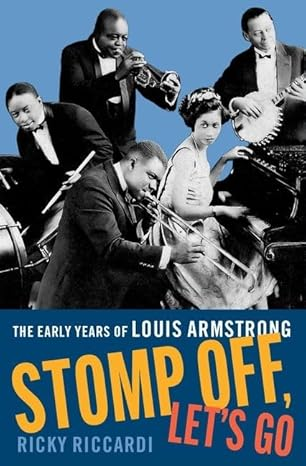
Stomp Off, Let's Go: The Early Years of Louis Armstrong by Ricky Riccardi

 © Copyright ® Steven Cerra, copyright protected; all rights reserved.


“Though Louis Prima recorded widely and well throughout the '30s, achieving great popularity and visibility, his name is often conspicuous by its absence from standard jazz histories. Dealing with him seriously means confronting one aspect of New Orleans jazz which chroniclers, almost as a point of honor, seem to find distasteful.


That, of course, is the matter of showmanship. The flamboyance of Prima's latter career, in which his identity as a trumpeter became almost totally subordinate to his role as a high-energy showman, seems to offend those who would represent Jazz as an art music of solemnity and unstinting high purpose. The Las Vegas image, the raucous sound of Sam Butera and the Witnesses, the risque badinage with singer Keely Smith—such make it all too easy to mistake this showbiz aspect of Prima for the creative substance, ignoring his past achievements and core musicianship.


Far from being exclusive to such as Prima, the idea of hot music as an arm of highly commercialized show business runs throughout the early years. It's present in the singing, dancing, and impromptu comedy skits of the dance bands, including those that prided themselves on their dedication to jazz. Its absence is a root cause of the failure of the great Jean Goldkette orchestra, an ensemble which either stubbornly resisted advice to "put on a show" or acquiesced in a manner landing somewhere between perfunctory and downright hostile.


For New Orleans musicians, especially, showmanship was—and remains—a fact of life. Was it not Louis Armstrong, above all, who understood the relationship between music and entertainment, and never wavered in his application of it, even in the face of critical hostility? "You'll always get critics of showmanship," he told British critic Max Jones. "Critics in England say I was a clown, but a clown—-that's hard. If you can make people chuckle a little; it's happiness to me to see people happy, and most of the people who criticize don't know one note from another.""

-

- Richard Sudhalter, Lost Chords: White Musicians and Their Contributions to Jazz, 1915-1945. [1999]


I had no idea that the reverse chronology that Ricky Riccardi, Director of Research Collections for the Louis Armstrong House Museum, used to write his Pops Trilogy wasn’t intentional until I read the following in the Acknowledgement that closes Stomp Off, Let's Go: The Early Years of Louis Armstrong - “It was never my intention to write the Armstrong saga in reverse chronological order, but it ended up being a blessing thanks to the sudden accessibility of several important sources that turned up in the last decade.”


Here Ricky’s statement of non-intent within the contents of the full extract:


“The more I learned about Armstrong, the more it seemed that everyone agreed about the greatness of his early years; it was after 1928 when the biographers, critics, historians, and fans disagreed regarding his later career path: did he sell out? Did he go commercial? Did he waste his talent? Was he nothing but an Uncle Tom? I knew my response — a resounding no to each of those questions — and sought to learn as much as I could about Armstrong's post-1928 career, interviewing friends of his and the surviving musicians in his band, and eventually listening to all 700+ reel-to-reel tapes compiled by Armstrong himself, now a part of the Louis Armstrong House Museum, where I have served as director of research collections since 2009.


The results were two books, What a Wonderful World: The Magic of Louis Armstrong's Later Years and Heart Full of Rhythm: The Big Band Years of Louis Armstrong, as well as a slew of CD, LP, and streaming reissues I co produced and/or wrote notes for, shining a big, broad spotlight on Armstrong's post-1928 career. I toyed with the idea of writing about his early years, but I felt that after his own Satchmo: My Life in New Orleans and the work of writers such as Gary Giddins, Laurence Bergreen, Thomas Brothers, Terry Teachout, Brian Marker, Gunther Schuller, and Robert O'Meally, there wouldn't be much more to add to the story.


If I had written about Armstrong's early years first and done the trilogy in strict chronological order, I would only have been able to rehash what had already been in print for many decades. It was never my intention to write the Armstrong saga in reverse chronological order, but it ended up being a

a blessing thanks to the sudden accessibility of several important sources that turned up in the last decade.”


These recently “turned up important sources” include:


[1] a copy of Louis Armstrong’s original typewritten manuscript for Satchmo: My Life in New Orleans as discovered by Michael Stearns the son of Monroe Stearns who served as the editor for Prentice Hall which published Louis autobiography,

[2] a 1960 draft copy of Lillian Harding Armstrong’s autobiography as told to Danish Jazz writer and historian Chris Albertson which allowed Lil’s voice to play a bigger role in the telling of Pops’ story,

[3] the acquisition of drummer Zutty Singleton's personal photo collection, some of which was used to populate the images used in Stomp Off, Let’s Go,

[4] Yoshio Toyama - “The Satchmo of Japan” - 1973 interview with Louis sister, Beatrice “Mama Lucy” Collins
[5] Bruce Raeburn at Tulane Hogan Jazz Archives “made available hundreds of interviews with Jazz pioneers,”

[6] Melissa Webster also at Tulane’s Jazz Archives “helped me access the research of the late Tad Jones who had been working on the definitive book of Louis Armstrong’s early years, 

[7] the research of James Karst about whom Ricky states: “ Since Tad Jones' passing, no one in New Orleans has made as many ground-breaking discoveries about Louis Armstrong’s early years,”

[8] access to the William Russell notes of the interviews he conducted for the 1939 book Jazzmen courtesy of the Historic New Orleans Collection.


All of which provided Ricky with a kind of primary-source-heaven to tell a more accurate and enhanced story of Pops’ formative years.


And what an inspiring story it is made even more so by Ricky’s wonderful ability as a storyteller. He never gets in the way and lets the story tell itself.


As Ricky unfolds it year-by-year we witness a heart rending example of a classic Horatio Alger rags-to-riches tale with an ascendancy replete with colorful chapter titles that include “Blessed Assurance [1912],” “Destined to be Great [1914-1915],” “The Memory of the Bullies and Trouble Makers [1916],” “Just Wasn’t My Time to Die, Man [1917],”  “Had to Eat [1917-1918], “Descending the Sky Like a God [1919-1920],” and “Big-Headed Motherf***ers, [1924 -1925].”


Ricky takes us on a journey that helps us understand the circumstances and influences that shaped the musician that Louis grew up to be. While doing so, he also stresses that his values as embodied in “Pops - The Musician as Entertainer” - never changed even if his repertoire did. 


Louis’s primacy as an entertainer is stressed over and over.


As early as the age of eleven, Louis was hamming it up with his friends as part of a Barbershop quartet the benefits of which were, as Ricky recounts it:


“Armstrong couldn't have known it at the time, but harmonizing with his friends developed his ear and provided an invaluable music education that would last a lifetime. Though he rarely liked to get into the nuts and bolts of music theory, in one interview from 1954, Armstrong shared advice he gave to a young trumpet player who struggled to improvise. "I said, 'Well, all you gotta do is think of you singing in a quartet and if somebody's playing the lead on a trumpet, you just play the second to every note he hits, the same as if you're singing a duet,'" Armstrong related. "He said he never thought of it that way. That's the only way to look at it."


Thus, for the rest of his career as both a vocalist and a trumpeter, Armstrong fell back on the lessons he learned in the quartet. When he needed to play or sing lead, he always had the melody front and center in his mind; when he needed to blend in an ensemble, it was never a problem; and even when he was improvising, the lead would be running through his head at all times, allowing him the freedom to create new melodies as if he was "singing a duet." Historians and critics have long debated whether Armstrong played like he sang or sang like he played but the truth is both were connected to the same soul. "You make the same notes, you know, like the horn," Armstrong explained about his singing. "That's why we could scat and do things like that I always would sing. I was singing before I played the horn, see." Armstrong's later bassist Arvell Shaw once said of him, "He would have been a singer regardless if he had played trumpet or not."


Although it may be hard to credit, as early as the age of thirteen, Pops was also an astute observer of trends in popular music, for example:


"It's a Long Way to Tipperary" achieved worldwide popularity after Irish tenor John McCormack recorded it in November 1914, a few months after the start of World War I. The Onwards choice of "Tipperary" is yet another example of men like Oliver and Perez playing the most popular songs of the era, a lesson not lost on Armstrong.” [Emphasis mine.]


Another feature of Ricky’s writing that I find to be particularly helpful is the way in which he summarizes certain milestones in Pops’ career. For example:


“The story of the Karnofskys buying a cornet for Armstrong would not be widely known until Gary Giddins published it in his 1988 book Satchmo. Thus, Finola's statement does seem to tie everything together: in late 1914 or early 1915, Armstrong returns to live with Mayann, works on the coal cart with Morris Karnofsky and selling newspapers for Charlie Wilson, falls under the spell of Joe Oliver at Pete Lala's, spots a cornet at Uncle Jake's pawn shop near the Karnofskys' new residence at 427 South Rampart, gets the Karnofskys to advance him the money for the instrument, and pays it off with funds earned from both the coal wagon and from selling newspapers.


However it happened and whenever it happened, Armstrong never forgot the importance of the Karnofsky family in his early life. "As I said before I must have been born with talent," he wrote in 1969. "All that I needed was a little encouragement to bring it out of me. And they did thank God. I was just a kid trying to find out which way to turn. So that Mayann and Mama Lucy could feel proud of their Louis (me). Not trying to be too much, just a good ordinary horn blower. The Jewish people sure did turn me out in many ways." Armstrong would wear a Star of David around his neck for much of his adult life, a way of remembering the impact the Karnofsky family made on him.”


Or when in 1917, King Oliver joins the Original Creole Band for the grand opening of the Royal Gardens [to become more famous as the Lincoln Gardens] in Chicago, Ricky writes:


“Louis Armstrong was also at the train station that day to see Oliver off. He called it "a sad parting" but also summed it up as "that's Show Business for you." He had no time to sulk because he had to go to work. "The minute the train pulled out, I was on my way out of the Illinois Central Station to get back up on my cart, and continue to deliver my load of coal, when Kid Ory called to me," Armstrong recalled.


Ory told Armstrong he "had heard a lot of talk about Little Louis" and that the boys in the band "told him to go get Little Louis to take Joe's place," Armstrong recalled. "I went to see him and told him that if he got himself a pair of long trousers I'd give him a job," Ory said.


Louis was ecstatic and immediately ran home to share the news with his mother. "I had been having so many bad breaks, until I just had to make a beeline to Maryann," he wrote. "She was the one who had always encouraged me to carry on with my cornet playing, since I loved it so well." "Within two hours, Louis came to my house and said, 'Here I am. I'll be glad when 8 o'clock comes. I'm ready to go,'" Ory said. Looking back, Ory reflected, "There were many good, experienced trumpet players in town, but none of them had young Louis' possibilities."


Armstrong's whole life had seemingly been building up to this moment. Shooting off the gun on New Years Eve, learning the cornet in the Waif's Home, playing for Ory at the Labor Day parade, the encouragement of the Karnofskys, the lessons and mentoring of Oliver, the protection of Black Benny and Slippers, the countless hours of playing honky-tonks such as Pons's and Matranga's with the countless bullets sizzling past him, the excitement of the Brown Skin Jazz Band, the battles with Kid Rena, all of it had led him here.

He was ready.”


The last third of the book deals with developments in Louis’ life that led to his fame with more of Ricky’s excellent summations on hand. For example:

in 1919, Louis began an association with Fate Marable’s band on the Streckfus Mississippi River Steamboats and aside from his famous gravel voice which he got from a persistent cold while on the river boats, Ricky observes:


"There was a saying in New Orleans," drummer Zutty Singleton once said. "When some musician would get a job on the riverboats with Fate Marable, they'd say, 'Well you're going to the conservatory.'" Armstrong's three seasons with Marable represented his conservatory years in every sense of the word. He entered the world of the riverboats in 1919, armed with only a trout sandwich and a jar of olives, unable to read arrangements, too bashful to take a featured solo, derided for puffing when he blew, all while doing his best to ignore racist comments from ignorant passengers. By 1921, he was reading, soloing, singing, scatting, dancing, playing slide whistle and slide trumpet, doing comedy, coining slang, inspiring youngsters, and "descending the sky like a god" in the words of Jack Teagarden.”


As to where Louis’ career stood when he got the call in 1921 to leave New Orleans to join his beloved Papa Joe Oliver in Chicago at the newly renamed Lincoln Gardens, Rickey astutely puts it this way:


“Armstrong was leaving with a musical education that would get him through the rest of his career. "He was gathering knowledge all the time," Danny Barker said of Armstrong's New Orleans years. "When Louis went to Chicago, Louis was prepared."76 His cornet style now dipped into four separate buckets: the tone of Bunk Johnson, the fire of Joe Oliver, the high notes of Henry "Kid" Rena, and the harmonic knowledge of Buddy Petit. He had mastered their styles, mastered what was called "jazz," mastered the blues, which he played for countless hours in the honky-tonks.


But there was so much more to his musical upbringing than just blues and jazz: the experience of playing ragtime from the "red back book"; playing waltzes, rhumbas, foxtrots for dancers; learning Art Hickman and Paul Whiteman arrangements directly from the records; interpreting the latest pop music hits in every band he played in; singing and harmonizing with his quartet; scatting and playing slide whistle and slide cornet on the riverboat; instilling his heart into funeral marches with the Tuxedo and Excelsior Brass Bands; humming along with the Yiddish lullabies sung by the Karnofsky family; gobbling up the operatic stylings of Enrico Caruso, Amelita Galli-Curci, and Luisa Tetrazzini on his Victrola; reciting Bert Williams's comedic monologues; singing all those songs about "Katie" and her assorted body parts. Armstrong's goal was to be a complete musician, one who could master every style, and he achieved it by the age of 21.


When a friend spotted him at the train station and asked, "Where are you going, Dipper?" Armstrong responded with pride: "Yeah man, I'm going up to Chicago to play with my idol, Papa Joe."”


Ricky is also fond of setting up “surprises” in his narrative with transitional statements like -


“Oliver also occasionally took Armstrong out on the town to hear Chicago's other jazz bands. One night they ended up at Bill Bottoms's Dreamland Café, where the orchestra was led by violinist Mae Brady. Oliver pointed at the band's pianist and told Armstrong, "That there is Miss Lil."


Oliver couldn't have known it at the time, but that simple gesture would change the sound of twentieth-century music — and eventually drive Louis Armstrong out of his band.” [Emphasis mine].


He follows this provocative statement with the chapter entitled “The Hot Miss Lil [1922-23] which of course sets the stage for their union as a couple and the resulting landmark Hot Five and Hot Sevens recordings under Pops’ leadership which “changed the sound of twentieth-century music.”


In his closing chapters of Stomp Off, Let’s Go, Ricky discusses these recordings in a way that makes them an informal track-by-track annotated discography. But this is not just any annotated discography, this one is brimming with a staggering bunch of original insights like the following one about Cornet Chop Suey:


 “But two caveats must be mentioned when discussing Armstrong's ‘ideas’ on "Cornet Chop Suey"—they weren't improvised, and they might not even have been his to begin with.” [!]


Or this fascinating assessment of what the introduction to West End Blues may represent in terms of a broader perspective of Louis’ life:


“The "introduction" turned out to be an unaccompanied trumpet cadenza that would soon take its place as one of the most iconic moments of twentieth-century music. In about 13 seconds, Armstrong drew on nearly everything that had inspired him up to this point in his career: the blues he immersed himself in in New Orleans, the tone of Bunk Johnson, the chromaticism of Buddy Petit, the classical patterns shown to him by Lil Hardin, the high notes of Kid Rena and B. A. Rolfe, the operatic stylings of Enrico Caruso, the drama of everyday life itself, the strength garnered from working on the coal cart, the hunger forged from not knowing where his next meal was coming from, all coming together to service a composition by Joe Oliver.”


The concluding chapters are also full of interesting anecdotes including Louis and Bix Beiderbecke jammin’ in Louis’ Chicago hotel room when Bix was in town with Paul Whiteman’s Orchestra, Pops’ engrossing interest in the “sweet music” of the Guy Lombardo Orchestra and Armstrong’s time on the sweet music band headed up by Carroll Dickerson.


The closing Epilogue recounts the roles of Lil Hardin and King Oliver as the “architects of Louis’ stardom,” the incredibly nostalgic 1949 reunion with Captain Joseph Jones of the Colored Waif’s home in New Orleans and contains this poignant description of Louis’ New Orleans roots in the book’s closing paragraph:


“Armstrong may have never moved back to New Orleans, but the lessons he learned in that city were present every time he stepped on stage or in a recording studio.


‘You know, I never did leave New Orleans,’ he claimed in 1950. ‘Right now I keep the essence of New Orleans every time I play.’


“‘They say, 'Where would you live?'” Armstrong asked in a tape-recorded conversation made in 1965. "I said I don't care where, I'm born in New Orleans, that's my hometown. That's it. I don't care where, I'll go to Guadalupe, wherever it is— [I'm a] New Orleans boy, and that's it."


Thus, it was fitting that the last words he sang on stage at the Waldorf in 1971 was the phrase "Boy from New Orleans." Armstrong knew what it meant to miss New Orleans, to love New Orleans, to celebrate New Orleans, to be hurt by New Orleans, and to hate New Orleans —but through it all, he knew that in many ways, he was New Orleans, with all of its complexities.


And over 50 years after his passing, he's still New Orleans.”


Aside from being a totally delightful reading experience, Ricky’s Pops trilogy deserves to be cherished by every Jazz fan because with a nod to Dizzy Gillespie when asked about Louis’ influence on his playing: “No him, no us.”


My trilogy of the Jazz equivalent of The Greatest Story Ever Told is up on my bookshelf right next to The Bible and The Complete Works of William Shakespeare.


Where are you going to put yours?


For order information, go here.