© Copyright ® Steven Cerra, copyright protected; all rights reserved.
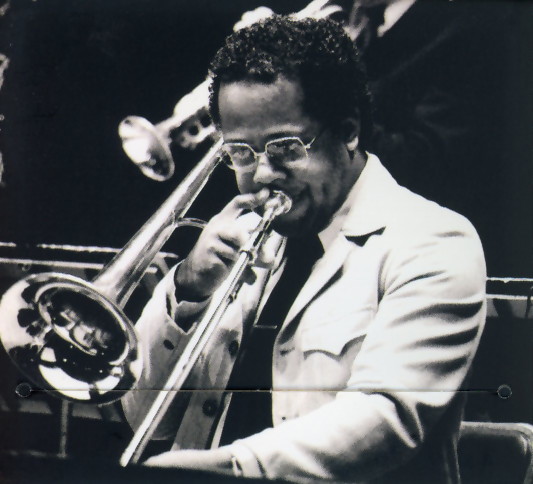
“Playing a trombone makes you realize that you’re going to have to depend on other people,” Mr. Hampton told The New York Times in 1982. “If you’re going to need help, you can’t abuse other people. That’s why there’s a real sense of fellowship among trombonists.”
“Mr. Hampton spent his entire life in music, beginning as a singer and dancer with a family band that included his parents and most of his 11 brothers and sisters. He began playing the trombone at age 12.
Even though he was right-handed, he played the trombone left-handed because the first trombone he received as a child was configured that way. His sisters gave him the nickname of Slide.
“I was hearing music every day from the time that I was born,” he said in a 2007 interview with the National Endowment for the Arts, “so I knew right away that my life would be in music.”
The Washington Post
“In 1960, he formed his own octet modeled after Miles Davis’, as he told DownBeat in a Jan. 19, 1961, interview. “Over the years, I have listened to a number of bands of different sizes that I liked,” Hampton said. “I suppose the Miles Davis Octet was a great influence on the type of should I would like to hear in my own group. For this group, I tried to get an instrumentation which would be between all the other sizes and yet get a little of each of these sounds.”
By 1962, he had solidified the band as the Slide Hampton Octet, which included Hubbard, George Coleman and Booker Little, touring the world and recording for several labels.
After touring with Woody Herman in 1968, Hampton remained in Europe, connecting with a community of expat jazz musicians including Art Farmer and Dexter Gordon. He returned to the U.S. in the late 1970s, teaching at a variety of universities and continuing his arranging and composing work and creating his World Of Trombones album, the ultimate salute to the trombone that included nine top-notch trombonists and a rhythm section.
Hampton won two Grammy Awards, the first in 1998 for Best Jazz Arrangement Accompanying Vocalist(s) for his arrangement of “Cotton Tail” performed by Dee Dee Bridgewater; the second in 2005 for Best Large Jazz Ensemble Album for The Way: Music Of Slide Hampton, The Village Vanguard Jazz Orchestra.
In 2005, Hampton was named an NEA Jazz Master.” DownBeat
This has been a year of goodbyes for many of the Jazz musicians associated with the Modern Jazz Era that followed World War II, one of whom was trombonist, composer-arranger and bandleader, “Slide Hampton” [4.21.1932 - 11.18.2021. Death is part of life, but it doesn’t mean I have to like it when one of my heroes passes away.
My first listening experience with Slide Hampton as both a trombonist and an arranger came on the 1958 and 1959 Roulette LPs by trumpeter Maynard Ferguson’s Big Band: A Message from Birdland and A Message from Newport. As usual, anytime one of Maynard’s Big Band was in action turned into an excitement-plus moment and this tradition started with these two “desert island” recordings.
My next recorded encounter with Slide’s work came about when drummer Vinnie Ruggerio hipped me to a 1962 octet LP on the European Philips label under Hampton’s leadership that has since been reissued on on CD as Jazz in Paris: Slide Hampton - Exodus [Gitanes 013 033 2].
Slide Hampton(tb,arr), Benjamin Jacobs-El(tb), Nat Pavone, Richard Williams(tp), George Coleman(ts), Jay Cameron(bs), Butch Warren(b), Vinnie Ruggiero(ds) made up he eight-piece band featured on this album, a format that Slide would return to often during his career.
Here’s more background on that album and on Slide’s career in general from a variety of sources.
“LOCKSLEY WELLINGTON HAMPTON WAS 27 YEARS OLD when, in the autumn of 1959, he left Maynard Ferguson's orchestra where he had made his name as an extraordinary trombonist and composer/arranger to launch his own octet. A wonderfully rhythmic and unique arranger, Slide came up with an unusual instrumentation for the octet: two trumpets, two trombones, tenor sax, baritone sax, bass and drums.
The group's first album, which was on the Strand label and is now a very rare item, boasted a trumpet section that consisted of Freddie Hubbard and Booker Little. In 1960, Slide's octet was signed to Atlantic Records where it recorded four albums over the next two years. In the studio, the ranks of the octet would often swell to 10 or 11 men with the addition of a third trumpet or second tenor sax or piano or congas, but the moniker usually remained.
Slide's record sales were lackluster, despite glowing critical reaction, and getting work for a group of this size proved extremely difficult. Before Atlantic recorded their fourth and final album with Slide, they released him from his contract to do one-shot projects for Charlie Parker Records (an album of mostly material from Porgy and Bess) and for Columbia's Epic label (Drum Suite feat. Max Roach).
The struggles of keeping this octet afloat proved too much; in a news item in the December 21, 1961 Down Beat, Jay Cameron bemoaned its financial woes. By 1963, it disbanded. Slide has continued to freelance as a trombonist and arranger. In 1968, he moved to Europe where he found more opportunities to write for large ensembles, but an assignment to do the charts for Dexter Gordon's Sophisticated Giant in 1977 enticed him back to the states. Since then, he has freelanced with the best of them and led his own World of Trombones (with nine trombonists!) and The Jazzmasters, a 12-piece outgrowth of the octet.”
MICHAEL CUSCUNA reissue of Drum Suite as a Mosaic singles CD MCD-1007].
JULY 2OO6
ORIGINAL LINER NOTES - Drum Suite [Epic LP - BA 17030]
ONE OF THE UNIQUE QUALITIES OF ANY SLIDE HAMPTON unit is that it always sounds as if it had several more members than it actually has. Hampton, who did his first major arrangements for the shouting, sometimes shrieking band of Maynard Ferguson, performs small wizardries of voicing that sometimes make it seem that he has even more men than Ferguson. Unlike Muzak, Hampton's arrangements have never been accused of putting live musicians out of work, but he can accomplish more with fewer men than anyone else who inhabits the no-man's land between small groups and big bands.
The impact of the Slide Hampton orchestra was never more forcibly demonstrated than the night in 1961 when a benefit for the late trumpeter Booker Little was held at New York's Jazz Gallery. Practically every jazz musician of consequence in New York was there (it was Sonny Rollins' first appearance before an audience since his retirement). Of necessity, everyone played with his own small group or a pickup band. Late in the evening, Hampton and his men came by between sets from the club they were working and played a then untitled number now called The Barbarians. The audience, which had listened in solemn attention to the modernist intricacies of the other musicians, suddenly reacted with hand-clapping and foot-stomping as if the Ellington or Basie band had arrived. Hampton was the success of the evening and made things that much easier for everyone who followed him. ….
As yet, these remarks have made no mention of Slide Hampton's considerable abilities
as a trombone player —- abilities which have been almost obscured by the attention given his band and arrangements. He did, however, win the Down Beat International Jazz Critics Poll as New Star on that instrument (tying with Dave Baker of the George Russell Sextet). Both It’s All Right With Me, which has not been played at such a breakneck tempo since Roach and Rollins first announced their partnership, and Stella by Starlight give ample indication why.
The chef d'oeuvre of the collection is Hampton's miniature five-part Drum Suite. In very short time, it skillfully manages to provide Roach with a surprising variety of moods, tempos and roles. The dexterity and sensitivity with which the drummer switches from one to the other, unveiling technical acumen that would be the envy of most men, while never forgetting that this is music, that he is part of an orchestra in which he has a definite position, is one of the delights of the set.
But for all the virtuosity and versatility of Hampton, Roach and Lateef, the first and lasting impression is of music not to be studied, but enjoyed. Which is why it is so gratifying to hear them together in this album.”
JOE GOLDBERG
Jazz in Paris: Slide Hampton - Exodus [Gitanes 013 033 2].
“It's not just because you've written and recorded a hit called Sister Salvation that you can fill a theatre like the "Théâtre de L'Etoile". That is, not when your name doesn't mean much to most people, fans or not, and you're fronting an octet, a formation that many feel to be particularly illegitimate; and especially not when the John Coltrane Quartet is due in town next week. That was a lesson that Slide Hampton learned to his cost, on November 10th 1962. One good thing did come out of it, however — apart from excellent coverage in the specialist press, that is, but print never kept the wolf from the door — and that was the chance to record in a Paris studio, fronting his own group, and playing his own arrangements. Not to mention doing so in a way that did full justice to his band. "Little by little, I've come to consider my current Octet like a big band resume’; an original resume’, where I've got all the notes on hand, from the deepest pitch to the highest: with this instrumentation I can catch everything, cover it all." said Slide Hampton to Francois Postif. For three years, with Maynard Ferguson, Slide Hampton had explored all the possibilities of writing for a big band ; his instrumental formula, even if it did neglect the piano, gave the lion's share to the brass: only two saxophones, tenor and baritone, for two trumpets and two trombones, particularly brought into the limelight on Exodus, an album throughout which the arranger pays tribute to the man he recognised as one of his mentors (apart from Duke Ellington), Gil Evans.
"My big problem with forming this Octet," he went on, "was to get eight musicians together under the same banner, with a unity that followed my own ideas. I really don't need some musician where you could say, "Hey, that's so and so," when you hear him play a solo ; what I want is for people to say one day, "Hey, that's Slide Hampton's Octet" if they hear me on the radio."
That was quite a programme, and part of it was a baritone sax player who wasn't an unknown for most of the Parisian fans, Jay Cameron. He'd been to Europe in 1947 — he wouldn't return to the States until 1955 — and belonged to the "modernist" faction of players in St. Germain-des-Pres, playing mainly with a group of pioneers preaching the faith, the group led by pianist Henri Renaud. The latter had played piano on the only record ever made under his own name by... Jay Cameron, an album that also featured Bobby Jaspar, Barney Wilen and Jean-Louis Chautemps. Here Jay Cameron takes only one solo, on Confirmation.
Definitely more voluble are George Coleman on tenor, remarkable on A moment's notice ; Richard Williams on trumpet ; bassist Butch Warren, whose solo on Star eyes is a pure joy ; and, of course, Slide Hampton on trombone, an instrument he played left-handed, even though he was a natural right-hander... fast, and with a full sound, Slide stands out brilliantly on I’ll take romance and Straight, no chaser.
Whatever his reasons — either the memory of his welcome by those who'd seen his Octet, or just his gratitude for this recording, made practically on the spot — when Slide returned to Paris, in February 1968 (with his Octet long gone), he was to stay for almost ten years.”
Alain Tercinet

