Showing posts with label Steve Davis. Show all posts

Monday, November 6, 2023

Paul Brusger -A Soul Contract - Insert Notes by Steve Cerra

 © Copyright ® Steven Cerra, copyright protected; all rights reserved.


Paul Brusger’s A Soul Contract [Steeplechase SCCD 31953] releases next week on November 15, 2023. It is available for pre-order on Amazon.com.


As a way of introducing you to the music and the musicians on Paul’s latest, here are the insert notes I prepared for the recording.


This is Paul Brusger’s second recording for Steeplechase. As was the case with the first for the label - Waiting for the Next Trane [SCCD 33115] - Paul’s talents as a bassist and composer are once again placed in the service of both maintaining and enriching the Hardbop tradition, a style of Jazz that was pervasive from 1955-1965 and which has remained a force ever since.


There are many familiar names associated with Hardbop in Jazz lore including groups such as Art Blakey and The Jazz Messengers, the Horace Silver Quintet, and the Cannonball Adderley Quintet, individual performers including Dexter Gordon, Lee Morgan and Sonny Stitt and composers who specialized in the genre such as Hank Mobley,  Sonny Clark, and Elmo Hope [each was also a fine instrumentalist].”


Paul Brusger came of age as a musician in this Hard Bop atmosphere and continues to perform as a musician and composer today with these influences as a constant source of inspiration. Scott Yanow commented in his insert notes to Paul’s CD You Oughta Know It [Brownstone BRCD 2-0002]:


“Paul Brusger will be a new name to many listeners but it is obvious, listening to his particularly strong debut, that he is not just a fine bassist in the tradition of Paul Chambers, Doug Watkins and Oscar Pettiford but an up-and-coming composer too. [His] originals have chord changes that are viable vehicles for solos in the hard bop tradition.”


In his interview with Scott, Paul shared the following by way of background:


"I played trumpet from grade school until high school but I did not quite have the chops for it. Since I always loved the woody rich and beautiful sound of the bass, I switched soon after I discovered jazz in high school. I liked fusion but acoustic music attracted me more. When I heard Charlie Parker, I fell in love with jazz. And when I heard John Coltrane, I knew that I had to be a musician!"


After graduating from high school, Paul Brusger moved to Florida where he studied sociology in college while picking up important experience playing jazz. "I am pretty much self-taught as a musician. I had the opportunity to play with the great trumpet master Idrees Sulieman, guitarist John Hart, Kenny Drew Jr. and Ira Sullivan. I worked a great deal in Florida but after a period I felt a bit stifled and knew that it was time to move ahead and relocate to New York." Since moving back to NY in 1997, Brusger has recorded with Ron Blake, played occasionally with Valery Ponomarev and guitarist Doug Raney (when he visits from Denmark), led his own groups and recorded the music for this session.


"I love all different styles but, when the music swings, for me everything comes together, which is why I love jazz. I have written a great deal during the past couple years and I hope in the future to have more of my compositions recorded by others and get better-known as a writer. In general, I want to continue getting deep within the music and communicate the joy of this music to many people."


The title of this CD - A Soul Contract - says a lot about the music contained in it and the attitude that lay behind the music.


As defined by Kenny Mathieson in his Cookin’ Hard Bop and Soul Jazz, 1954-1965 [2002]: “...deeper down this was a music which both reflected and invited a visceral, passionate response as well as a cerebral, intellectual one. The combination of earthy, driving urgency inherited from blues, gospel and rhythm and blues roots with the harmonic and polyrhythmic complexity of bebop provided the formula which ignited hard bop, and established the music as the new jazz mainstream right up to the present day. …. Jazz without creative innovation is a music in peril, but that does not mean that its history has to be discarded like so much used waste.  … 


Which brings us to the music on A Soul Contract, eight of which are originals composed in the Hard Bop tradition by Paul Brusger, along with one by trombonist Steve Davis which also fits that mold. Beautiful Love, a classic from the Great American songbook and a long-standing favorite for Jazz musicians to play on rounds things out.


In addition to trombonist Davis, Paul has engaged the services of tenor saxophonist Eric Alexander, pianist Rick Germanson and drummer Willie Jones III to join with him on these Jazz adventures through The World of Hard Bop. All of these musicians are stalwarts on the New York City Jazz scene and bring impeccable credentials as individual soloists and ensemble players.
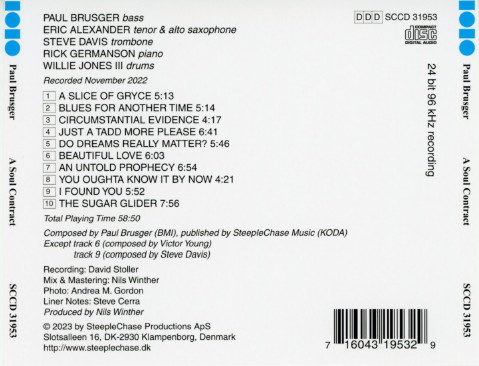


On A Soul Contract a bevy of new tunes performed by musicians of the highest quality demonstrate that Hard Bop is still in the process of creation as a form.


A Slice of Gryce - Paul’s homage to alto saxophonist Gigi Gryce [1925-1983], one of the founding fathers of Hard Bop - sets things off with the trombone and tenor sax playing the melody in unison which creates a striking sonority for this tune which is a contrafact based on “What Is This Thing Called Love.” This medium tempo burner gives everyone a chance to loosen up and culminates in a series of trades with drummer Jones based around a rhythmic four bar vamp.


Blues for Another Time rekindles memories of the great ‘bone and tenor sax Hard Bop recordings fashioned around trombonist Bennie Green and tenor saxophonist Gene Ammons, trombonist Curtis Fuller and tenor saxophonist Benny Golson, and trombonist J.J. Johnson and tenor saxophonist Bobby Jaspar. Everyone has a chance to stretch out on this medium-slow Blues which provides Paul with his first solo opportunity and more interesting four bar exchanges with drummer Jones.


Circumstantial Evidence is also a 12-bar Blues, this time in a medium uptempo with the horns harmonizing the line. After launching the head, the horns back off and allow pianist Rick Germanson to step forward and establish the groove for the track. The horns follow with some wonderful “muscle Jazz” improvising that segues into a walking bass solo by Paul. A unison shout chorus that launches two chorus of Willie’s crisp and flowing drumming to complete the soloing before the horns return to take the track out.


Jazz a Tadd More Please, Paul’s tribute to the revered composer-arranger Tadd Dameron [1917-1965], continues the tradition by Bop and Hard Bop musicians of superimposing new melodies [referred to as contrafacts] over the chord progressions of tunes from the great American Songbook, in this case, Johnny Green and Edward Heyman’s I Cover The Waterfront. 


Taken at a slow-medium tempo, Paul has the first solo which establishes a mood for the piece in which all of the soloists demonstrate that it is still possible to play softly and expressively and still burn.


Do Dreams Really Matter? Is a beautiful ballad with the opening theme stated by Eric’s rich tone on tenor with Steve joining in on the bridge and both executing the closing portion of the melody with a sensitivity that prevails throughout the piece. Rick Germanson’s solo offers some enticing chordal embellishments of the melody and confirms this as one of the prettiest tunes in the Jazz repertoire. It seems that Jazz is rarely played these days at slower tempos, but this foray brings back memories of some of the nicer ‘bone and big horn sonorities associated with the music of the late bassist, Charles Mingus [1922-1979].


Beautiful Love. This song has been around since 1931 and over the years has become a Jazz standard performed by the likes of vocalists Anita O’Day and Helen Merrill and instrumentalists Joe Pass and Bill Evans. Paul’s rubato arco rendering of the melody opens this version of the song which then transitions into a medium tempo restatement of the theme on which Steve Davis demonstrates the full tone and rich textures he can achieve on trombone. After a short solo by Rick, Paul returns this time in pizzicato to make this lovely standard a feature for Jazz bass.


An Untold Prophecy is a vehicle for the group’s excursion into 3/4 time and after an opening solo by Steve, Eric’s harmonic substitutions inject and atmospheric illusion of free Jazz over an ostinato emphasized by the piano and bass that creates an overall somber mood for this piece. One is aware that the prophecy in the title is “untold,” but given the funereal effects of the tune, perhaps it’s best left that way?


You Oughta Know It By Now is the title tune from Paul’s first recording dating back to 1997. In the accompanying notes he described it “as a tricky tune a little reminiscent of Woody Shaw and Joe Henderson. This challenging and driving piece gives each of the musicians an opportunity to stretch out.” It would seem that not much has changed in the intervening 30 years, except the musicians, as Eric, Steve and Rick really get into this bright uptempo tune.


I Found You is a Steve Davis composition from his 2014 Posi-Tone CD For Real based on a counter melody that is sensitively harmonized between trombone and tenor laid over an engaging Bossa Nova rhythm. Steve and Rick each build lilting and lyrical solos with Eric’s poignant presence strongly supporting the tune’s ending.


The Sugar Glider. I have no idea what a “Sugar Glider” is but if it produces anything like the joyous music found on this track, I want one! Set to Willie’s rockin’ shuffle beat, this blues shout’s out from the opening chorus with a brilliant solos by Eric Alexander, who is channeling his inner Hank Crawford with a rousing solo on alto sax. Steve’s turn puts forth some licks that are very reminiscent of J.J. Johnson, with Rick doing something similar with Red Garland styled block chords. And just to keep things interesting, the horns trade sixes with Wllie before returning for a rousing finish.


In his fine book, Kenny goes on to note:


“[Today] Hard bop (or its so-called neo-bop descendants) as a repertory music in the current era is a very different beast ….In the second half of the 1950s, hard bop was still in the process of creation as a form, and reflected the urgent, urban, often troubled lives of the musicians who played it. 


[... But] jazz, it should always be remembered, is in any case a multi-layered genre at almost any point in its history. Even in these years, hard bop already existed alongside, and interacted with, several shades of traditional jazz, blues, rhythm and blues, gospel, both big and small group swing, bebop, the so-called cool school, and ultimately modal jazz and free jazz, rather than in a stylistic vacuum.”


On this recording, Paul Brusger and his quintet have produced a soulful contract that connects the best aspects of the Hard Bop tradition to the best stylistic qualities that Jazz has to offer today. With his artfully constructed original compositions along with the talents of Steve Davis, Eric Alexander, Rick Germanson and Willie Jones III, Paul has assured that this transitional covenant is in good hands.


  • Steve Cerra, www.jazzprofiles.blogspot.com


Wednesday, April 20, 2022

Steve Davis: Moment to Moment [From the Archives with Revisions]

 © -Steven Cerra, copyright protected; all rights reserved.


“Davis is an adept, declarative player, always indebted to his work with Jackie McLean and Art Blakey, a hard-bop grounding which gives his playing unarguable strength and articulacy. He doesn't overplay, but he's generous with his lines and he gets a sound which often has a shouting intensity while keeping well clear of obvious expressionism. That makes his albums conventional but full and satisfying.”
- Richard Cook and Brian Morton, The Penguin Guide to Jazz on CD, 6th Ed.

“I predict that Steve Davis will be one of the true masters of the slide trombone.”
- Curtis Fuller, Jazz trombonist

“Steve Davis is one of the most talented young students that I have ever had. His love for the tradition of this music is very deep. … I like his sound, I like the way he writes. His music is very special.”
- Jackie McLean, Jazz alto saxophonist

One moment he’s talking about his frequent collaborators such as trumpeter Jim Rotondi, or tenor saxophonist Eric Alexander or guitarist Peter Bernstein or pianist David Hazeltine or drummer Joe Farnsworth.

The next moment he’s relating what he saying about them to himself, his trombone playing and his compositions.

One moment he talks with reverence about Jazz masters such as Jackie McLean, Art Blakey and J.J. Johnson.

The next moment he’s describing what he’s learned from each of them.

One moment he ‘s talking knowledgeably and appreciatively about the Great American songbook and the Jazz Standards repertoire.

The next moment he’s writing his own compositions and has become one of the most prolific composers of original music on today’s Jazz scene.

Make no mistake, however, Steve Davis’ involvement with Jazz has been anything but momentary.

Steve has a whole bunch of recordings out under his own name on Gerry Teekens’ Criss Cross label, where he also appears as a member of the Art Blakey sextet-inspired group One for All, and as a guest artist on some of the label’s CDs headed-up by the “frequent collaborators” listed in the opening paragraph.

Here’s some information by Gerry Teekens about the early years of Steve’s career.

Back in the late 60's, the alto saxophonist Jackie McLean left New York and began teaching at the University of Hartford's Hartt School of Music, instituting a Jazz program and with his wife Dollie, founding a community arts center called the Artists Collective that has been a positive force in the lives of many. McLean and his Bebop brothers in other programs around the world planted the seeds of a musical revolution and thanks to their efforts, a number of remarkably talented young creators have emerged onto the Jazz scene lately, including prized pupil Steve Davis.

Steve Davis was born in WorcesterMassachusetts on April 14, 1967, but spent his formative years in BinghamtonNew York, where his family still resides. Steve's father, a journalist who writes a column for the local newspaper, was a serious blues and Jazz fan. The family collection included a number of Art Blakey and the Jazz Messengers recordings that featured Curtis Fuller on trombone but it wasn't until Steve was fourteen "that I really started to pay attention to the music, especially Curtis. That's when I decided I wanted to play Jazz." He started on trumpet, an instrument played by his father's father, whom Steve calls his "grandsir," but later switched to trombone.


Aware of Jackie McLean from his dad's collection, Steve auditioned for McLean at the Hartt School of Music at the University of Hartford. "Just meeting Jackie, he was Professor McLean to me back then," Davis laughs, "was such a great experience. That was back in '85 and coming to Hartt and just being around Jackie completely changed my whole perception of the music. Jackie brought in a lot of people and I got a chance to meet some great musicians." At the 880 Club, a weekly all-star night gave Steve the chance to sit in with trumpeter Eddie Henderson and late baritone saxist Pepper Adams. "Hartford was a great place to cut your teeth," Steve believes. At the same time, Steve started working gigs with the pianist and bassist from McLean's group, Hotep Idris Galeta and Nat Reeves, which also proved to be a pivotal experience.

After he graduated in '89, "Jackie recommended me to Art Blakey because I was heading to New York. I got to go down and sit in with the band and then Art called me a few months later in December. I was the last guy to ever join the Messengers." Davis spent the better part of a year with the Messengers before Blakey's passing. "I remember being very blown away at the prospect of being there. I did focus on the music and I realized that Art Blakey was a human being like anyone else, but it took me some time. He had such an awesome stature and of course you couldn't help but idolize him."

As Damon Smith points out in his insert notes to Steve’s second Criss Cross CD – Dig Deep [1136]:

“Steve Davis has the rare distinction of having worked with two of the most influential bands in modern jazz history, Art Blakey's Jazz Messengers and the Jackie McLean Sextet. The impact of these experiences on his life and music has been significant. Of the many lessons that these leaders imparted on their talented trombone player, one of the most important was their emphasis on group chemistry. Both Blakey and McLean put a premium on interaction and communication. Not merely recording session anomalies, their bands actually worked together and developed as units. This was an approach for which Steve had a natural affinity and he has continually sought a similar level of rapport in his own groups. It is in this spirit and with these goals in mind that Steve approached the recording session for Dig Deep.” [underlining is mine]

Not surprisingly, the guys that Steve Davis chose to join him on this sessions are those he had been working with in the musical cooperative – One for All – which is till a working band today and also has a number of recordings outstanding available on the Criss Cross label.

Group chemistry – when it happens [not always a guarantee] – is not necessarily the product of longevity, although it helps.

Leaving one’s ego on at the front door, listening to what others in the group are playing and having character traits such as a willingness to cooperate and to be unselfish are very important for the formation of a Jazz band’s “group chemistry.”

But another principal factor that enables group chemistry is the nature of how the composing and arranging are put together and here Steve Davis has the touch of the old masters such as Tadd Dameron, Benny Golson, and Gigi Gryce.

They, along with Horace Silver, Hank Mobley and Sonny Clark, arranged Jazz originals and standards from the Great American Songbook in such a way as to blend the instrumental voicings while leaving plenty of room for the soloists to “stretch out.”


They intersperse riffs and counter melodies that nudge the music and the soloists along and create a group impression, a kind of a musical collective personality, if you will.

Group chemistry is something that seems to happen around Steve Davis’ music, no doubt, in large part due to his skills and talents in bringing it about.

Part of it, too, is because of his orientation. He’s not interested in just playing the trombone as a trombone, but wants to play like other instruments on it.

As Ted Panken relates in the insert notes to Steve’s third Criss Cross CD – Crossfire [#1152]:

Davis began to blend the harmonic acuity and rhythmic punch of J J. Johnson and Curtis Fuller with the big sound approach of the pre-J.J. big band trombonists. "I was captivated by Miles and Wallace Roney at the time," Davis comments, "and wanted to be that on the trombone. Not obvious, but more subtle, mysterious, abstract, less vibrato. I started to listen to how Curtis Fuller brought a warmth to that approach. To me Curtis phrases like a saxophone, taking it another step beyond J.J., translating Coltrane to the brass. His velocity and authority when he played next to Freddie Hubbard and Wayne Shorter in the Messengers was astounding, and he transcended whatever limitations the horn might present. …

After a while you get the confidence and intuition to create, to play off what everyone else is playing, instigate a purer, group musical approach as opposed to running some stuff you’ve been working on.”

Steve Davis listens – to everybody – and because he does, he is able to bring things together.

As he related to Ted Panken in 2004 in the insert notes to Meant To Be [Criss Cross #1248]:

"I love chord progressions and harmonic movement," Davis continues. "The melodies come from the changes …. What kind of language are you playing through these chords? It seems to be less of a priority to a lot of improvisers now to really sing a song in your solo. It doesn't mean being corny, laying on some buttery melodies. I'm talking about turning a phrase, playing something poetic. At the same time, that's not my whole concept. I love rhythm, some back-and-forth with the drums or the piano. …”

"As you hear more, you understand more, and it's got to come out of your instrument," he concludes. "I happen to be holding a trombone every day of my life—and the days I don't, shame on me. But, you can't forget that you are the musician you are without the horn in your hands. You've got to get that music out, and there comes a point when you're playing beyond your instrument in order to fully achieve that expression.

I mean no disrespect to the legacy of the trombone, but I don't necessarily think as a trombonist. I don't think first and foremost of what J.J. or Slide or Curtis Fuller would play. These are heroes of mine. Curtis and Slide are good friends. But you have to play you.

Over the years, I've been fortunate to be next to Jackie McLean and Chick [Corea, pianist] and Freddie [Hubbard, trumpeter], and peers like saxophonists Eric Alexander and Jimmy Greene—so many great musicians. You want to connect with the guys you're playing with, connect with the rhythm section, speak their language. …”

Because of his sensitive awareness to the fact that making good Jazz is a collaborative effort, Steve Davis has been a unifying force ever since his appearance on the Jazz scene.

He just has a centripetal orientation – he pulls things together. When it came time to record his 2005 Update Criss Cross CD [#1282], the musicians that he works with most regularly were on the road.

So he brought together musicians whom he had long admired – Roy Hargrove on trumpet, Peter Bernstein on guitar and Anthony Wonsey on piano – combined them when bassist Nat Reeves and Joe Farnsworth, both of whom he regularly works with, a produced a marvelously blended and balanced recording.

Coming full circle with our beginning statements about him, one of the tunes Steve recorded on this disc is the following quartet version of Henry Mancini and Johnny Mercer’s Moment to Moment which you can sample in the following video tribute to Steve. 

Below this video you'll find another one featuring Steve along with alto saxophonist Mike DiRubbo, pianist David Hazeltine, bassist Peter Washington and drummer Joe Farnsworth performing his original composition - Systems Blue. The test of every Jazz musician since time immemorial has been the ability to play the blues. I think, Steve, Mike, David, Peter and Joe all score high marks in this category for their work on this track.