Showing posts with label paul brusger. Show all posts

Monday, November 6, 2023

Paul Brusger -A Soul Contract - Insert Notes by Steve Cerra

 © Copyright ® Steven Cerra, copyright protected; all rights reserved.


Paul Brusger’s A Soul Contract [Steeplechase SCCD 31953] releases next week on November 15, 2023. It is available for pre-order on Amazon.com.


As a way of introducing you to the music and the musicians on Paul’s latest, here are the insert notes I prepared for the recording.


This is Paul Brusger’s second recording for Steeplechase. As was the case with the first for the label - Waiting for the Next Trane [SCCD 33115] - Paul’s talents as a bassist and composer are once again placed in the service of both maintaining and enriching the Hardbop tradition, a style of Jazz that was pervasive from 1955-1965 and which has remained a force ever since.


There are many familiar names associated with Hardbop in Jazz lore including groups such as Art Blakey and The Jazz Messengers, the Horace Silver Quintet, and the Cannonball Adderley Quintet, individual performers including Dexter Gordon, Lee Morgan and Sonny Stitt and composers who specialized in the genre such as Hank Mobley,  Sonny Clark, and Elmo Hope [each was also a fine instrumentalist].”


Paul Brusger came of age as a musician in this Hard Bop atmosphere and continues to perform as a musician and composer today with these influences as a constant source of inspiration. Scott Yanow commented in his insert notes to Paul’s CD You Oughta Know It [Brownstone BRCD 2-0002]:


“Paul Brusger will be a new name to many listeners but it is obvious, listening to his particularly strong debut, that he is not just a fine bassist in the tradition of Paul Chambers, Doug Watkins and Oscar Pettiford but an up-and-coming composer too. [His] originals have chord changes that are viable vehicles for solos in the hard bop tradition.”


In his interview with Scott, Paul shared the following by way of background:


"I played trumpet from grade school until high school but I did not quite have the chops for it. Since I always loved the woody rich and beautiful sound of the bass, I switched soon after I discovered jazz in high school. I liked fusion but acoustic music attracted me more. When I heard Charlie Parker, I fell in love with jazz. And when I heard John Coltrane, I knew that I had to be a musician!"


After graduating from high school, Paul Brusger moved to Florida where he studied sociology in college while picking up important experience playing jazz. "I am pretty much self-taught as a musician. I had the opportunity to play with the great trumpet master Idrees Sulieman, guitarist John Hart, Kenny Drew Jr. and Ira Sullivan. I worked a great deal in Florida but after a period I felt a bit stifled and knew that it was time to move ahead and relocate to New York." Since moving back to NY in 1997, Brusger has recorded with Ron Blake, played occasionally with Valery Ponomarev and guitarist Doug Raney (when he visits from Denmark), led his own groups and recorded the music for this session.


"I love all different styles but, when the music swings, for me everything comes together, which is why I love jazz. I have written a great deal during the past couple years and I hope in the future to have more of my compositions recorded by others and get better-known as a writer. In general, I want to continue getting deep within the music and communicate the joy of this music to many people."


The title of this CD - A Soul Contract - says a lot about the music contained in it and the attitude that lay behind the music.


As defined by Kenny Mathieson in his Cookin’ Hard Bop and Soul Jazz, 1954-1965 [2002]: “...deeper down this was a music which both reflected and invited a visceral, passionate response as well as a cerebral, intellectual one. The combination of earthy, driving urgency inherited from blues, gospel and rhythm and blues roots with the harmonic and polyrhythmic complexity of bebop provided the formula which ignited hard bop, and established the music as the new jazz mainstream right up to the present day. …. Jazz without creative innovation is a music in peril, but that does not mean that its history has to be discarded like so much used waste.  … 


Which brings us to the music on A Soul Contract, eight of which are originals composed in the Hard Bop tradition by Paul Brusger, along with one by trombonist Steve Davis which also fits that mold. Beautiful Love, a classic from the Great American songbook and a long-standing favorite for Jazz musicians to play on rounds things out.


In addition to trombonist Davis, Paul has engaged the services of tenor saxophonist Eric Alexander, pianist Rick Germanson and drummer Willie Jones III to join with him on these Jazz adventures through The World of Hard Bop. All of these musicians are stalwarts on the New York City Jazz scene and bring impeccable credentials as individual soloists and ensemble players.
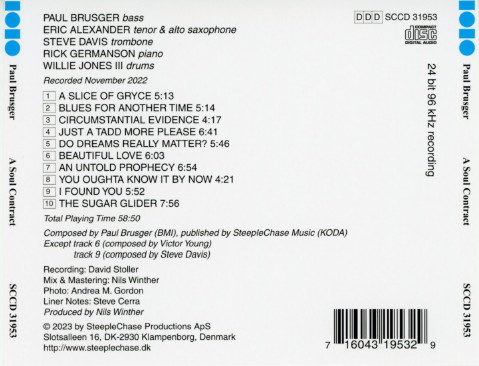


On A Soul Contract a bevy of new tunes performed by musicians of the highest quality demonstrate that Hard Bop is still in the process of creation as a form.


A Slice of Gryce - Paul’s homage to alto saxophonist Gigi Gryce [1925-1983], one of the founding fathers of Hard Bop - sets things off with the trombone and tenor sax playing the melody in unison which creates a striking sonority for this tune which is a contrafact based on “What Is This Thing Called Love.” This medium tempo burner gives everyone a chance to loosen up and culminates in a series of trades with drummer Jones based around a rhythmic four bar vamp.


Blues for Another Time rekindles memories of the great ‘bone and tenor sax Hard Bop recordings fashioned around trombonist Bennie Green and tenor saxophonist Gene Ammons, trombonist Curtis Fuller and tenor saxophonist Benny Golson, and trombonist J.J. Johnson and tenor saxophonist Bobby Jaspar. Everyone has a chance to stretch out on this medium-slow Blues which provides Paul with his first solo opportunity and more interesting four bar exchanges with drummer Jones.


Circumstantial Evidence is also a 12-bar Blues, this time in a medium uptempo with the horns harmonizing the line. After launching the head, the horns back off and allow pianist Rick Germanson to step forward and establish the groove for the track. The horns follow with some wonderful “muscle Jazz” improvising that segues into a walking bass solo by Paul. A unison shout chorus that launches two chorus of Willie’s crisp and flowing drumming to complete the soloing before the horns return to take the track out.


Jazz a Tadd More Please, Paul’s tribute to the revered composer-arranger Tadd Dameron [1917-1965], continues the tradition by Bop and Hard Bop musicians of superimposing new melodies [referred to as contrafacts] over the chord progressions of tunes from the great American Songbook, in this case, Johnny Green and Edward Heyman’s I Cover The Waterfront. 


Taken at a slow-medium tempo, Paul has the first solo which establishes a mood for the piece in which all of the soloists demonstrate that it is still possible to play softly and expressively and still burn.


Do Dreams Really Matter? Is a beautiful ballad with the opening theme stated by Eric’s rich tone on tenor with Steve joining in on the bridge and both executing the closing portion of the melody with a sensitivity that prevails throughout the piece. Rick Germanson’s solo offers some enticing chordal embellishments of the melody and confirms this as one of the prettiest tunes in the Jazz repertoire. It seems that Jazz is rarely played these days at slower tempos, but this foray brings back memories of some of the nicer ‘bone and big horn sonorities associated with the music of the late bassist, Charles Mingus [1922-1979].


Beautiful Love. This song has been around since 1931 and over the years has become a Jazz standard performed by the likes of vocalists Anita O’Day and Helen Merrill and instrumentalists Joe Pass and Bill Evans. Paul’s rubato arco rendering of the melody opens this version of the song which then transitions into a medium tempo restatement of the theme on which Steve Davis demonstrates the full tone and rich textures he can achieve on trombone. After a short solo by Rick, Paul returns this time in pizzicato to make this lovely standard a feature for Jazz bass.


An Untold Prophecy is a vehicle for the group’s excursion into 3/4 time and after an opening solo by Steve, Eric’s harmonic substitutions inject and atmospheric illusion of free Jazz over an ostinato emphasized by the piano and bass that creates an overall somber mood for this piece. One is aware that the prophecy in the title is “untold,” but given the funereal effects of the tune, perhaps it’s best left that way?


You Oughta Know It By Now is the title tune from Paul’s first recording dating back to 1997. In the accompanying notes he described it “as a tricky tune a little reminiscent of Woody Shaw and Joe Henderson. This challenging and driving piece gives each of the musicians an opportunity to stretch out.” It would seem that not much has changed in the intervening 30 years, except the musicians, as Eric, Steve and Rick really get into this bright uptempo tune.


I Found You is a Steve Davis composition from his 2014 Posi-Tone CD For Real based on a counter melody that is sensitively harmonized between trombone and tenor laid over an engaging Bossa Nova rhythm. Steve and Rick each build lilting and lyrical solos with Eric’s poignant presence strongly supporting the tune’s ending.


The Sugar Glider. I have no idea what a “Sugar Glider” is but if it produces anything like the joyous music found on this track, I want one! Set to Willie’s rockin’ shuffle beat, this blues shout’s out from the opening chorus with a brilliant solos by Eric Alexander, who is channeling his inner Hank Crawford with a rousing solo on alto sax. Steve’s turn puts forth some licks that are very reminiscent of J.J. Johnson, with Rick doing something similar with Red Garland styled block chords. And just to keep things interesting, the horns trade sixes with Wllie before returning for a rousing finish.


In his fine book, Kenny goes on to note:


“[Today] Hard bop (or its so-called neo-bop descendants) as a repertory music in the current era is a very different beast ….In the second half of the 1950s, hard bop was still in the process of creation as a form, and reflected the urgent, urban, often troubled lives of the musicians who played it. 


[... But] jazz, it should always be remembered, is in any case a multi-layered genre at almost any point in its history. Even in these years, hard bop already existed alongside, and interacted with, several shades of traditional jazz, blues, rhythm and blues, gospel, both big and small group swing, bebop, the so-called cool school, and ultimately modal jazz and free jazz, rather than in a stylistic vacuum.”


On this recording, Paul Brusger and his quintet have produced a soulful contract that connects the best aspects of the Hard Bop tradition to the best stylistic qualities that Jazz has to offer today. With his artfully constructed original compositions along with the talents of Steve Davis, Eric Alexander, Rick Germanson and Willie Jones III, Paul has assured that this transitional covenant is in good hands.


  • Steve Cerra, www.jazzprofiles.blogspot.com


Wednesday, October 8, 2014

Paul Brusger - "Waiting for the Next Trane"

© -Steven Cerra, copyright protected; all rights reserved.

Today - October 8, 2014 - is the release date of bassist, composer and arranger Paul Brusger's latest CD on Nils Winther's venerable Steeplechase label.

Entitled Waiting for the Next Trane [SCCD 33115] it features Gary Smulyan on baritone sax, Mike LeDonne on piano and Louis Hayes on drums along with more of Paul's inventive, hard-bop inflected, original compositions. If you like the music of Horace Silver, Sonny Clark and Hank Mobley, then you will feel right at home with Paul's writing.

Paul kindly asked me to put together some insert notes for the CD and I thought you might enjoy reading them, too.


"Musicians are often better known through the company they keep and bassist Paul Brusger keeps very good company.


To drop a few names - trumpet players Valery Ponomarev, John Swana, baritone saxophonist Ronnie Cuber and pianists Dado Moroni, Hod O’Brien and John Hicks - all have played on Paul’s previous recordings.


Paul’s major influence as a bassist was the late, great Paul Chambers and one can also hear echoes of “Mr. P.C.” and that of bassists Oscar Pettiford, Wilbur Ware and Doug Watkins in the way he lays down his bass lines and in the notes he chooses to frame the chords.


Paul is also a gifted composer who writes in a style that could be called “Brusger’s Bop” as his Jazz compositions are written in the straight-ahead, hard-bop style often associated with Tadd Dameron, Horace Silver, Gigi Gryce and Sonny Clark.


When combined, all of these ingredients – working with first-rate musicians, being influenced by one of the great Jazz bassist and a writing style that is closely patterned after the style of legendary Jazz composers - form a larger context for a visit with the music of Paul Brusger.


Paul is the sum of all these parts: he plays well, associates himself with exceptional musicians who all get to play the intriguing and interesting music that he has composed.


These unifying threads all come together once more on Waiting for The Next Trane.


On his first outing for the legendary Steeplechase label, Paul continues to put himself in good musical company, this time with the musical talents of baritone saxophonist Gary Smulyan, pianist Mike LeDonne and drummer Louis Hayes.


Gary plays the baritone saxophone with verve, vigor and vitality. He is a risk-taker. Gary expresses what he hears in his head and feels in his heart, not always an easy thing to do when you have to take a deep breath and blow it through the equivalent of a compressed central plumbing system to make music.


But that's the nature of Jazz: overcoming the technical problems of playing an instrument while at the same time creating interesting melodies on the spot.


You can't take anything back that you've just put out there. There's is no safety net.


The Act of Creation is rarely seen for what it really is - An Act of Courage.


And no one on today's Jazz scene has more sang-froid than Gary Smulyan.


Gary’s sound on baritone sax is very reminiscent of that of the late, Pepper Adams. But while Pepper is certainly a point of departure for him, Smulyan has moved well-beyond Adams’ influence and has established his own style on the instrument, one that also displays a considerable and very advanced technique.


If truth be told, as much as I enjoy Gary Smulyan’s playing, I have to “take it in small doses” as he puts so many ideas into his improvisations and swings so hard all the time that he [figuratively] wears me out.  The marvel is that he doesn't wear himself out!


Quite the contrary, it seems, as each in-person performance or recording is better than the previous one. Gary’s work continually grows in stature and complexity; signs of a mature artist at work.


There appears to be no limits to his artistic creativeness; he’s a veritable musical fountain from which well-constructed phrases and lines come bubbling forth to form chorus-upon-chorus of interesting solos.


All this imaginative energy no doubt stems from his passion for playing Jazz, a zeal that apparently knows no bounds.


Like Paul Brusger, pianist Mike LeDonne is an extremely skillful composer, whose services have been in such great demand that he has appeared on over 50 recordings as a leader or as a sideman during the past 25 years.


It’s nice to hear him back at the piano as many of his recent recordings have featured Mike’s exceptional abilities as a Hammond B-3 organist.


Over the years, Mike has studied with fabled Jazz pianists Jaki Byard and Barry Harris while checking out major piano stylists like Teddy Wilson, Al Haig, Tommy Flanagan, Hank Jones, Ray Bryant and Cedar Walton in some of the smaller, more intimate clubs when he first arrived on the New York Jazz scene.


In the introduction to a 2009 interview with Mike for Jazz.com, Thomas Pena wrote:


“What a career it’s been for Mike. Speaking to him is like taking a crash course in the history of Jazz. It seems that he has performed, recorded, and/or rubbed elbows with everyone in the world of jazz at one time or another.”


The list of Jazz luminaries with whom Mike has worked includes Benny Golson, Milt Jackson, and Scott Robinson and, more recently: Eric Alexander, Wycliffe Gordon, Jim Snidero and five recordings under Gary Smulyan’s leadership.


Mike also commented in the 2009 Jazz.com interview: “I feel good. I still want to improve, and I wanted to get to another level. There are always guys that you listen to, guys like McCoy Tyner and say, ‘Wow! I would like to be able to play like that…..’”


Judging by his work on this CD, it sounds like all of Mike’s wishes about improving and getting to another level have been granted, including the one about McCoy Tyner because in some of his soloing, McCoy’s influence is very apparent.


And what more can be said about Louis Hayes - Paul’s choice for the drum chair on this date? I’ve lost count of the number of memorable groups Louis has worked with and recordings that he has appeared on over the last half century including his long associations with Cannonball Adderley, Horace Silver and Oscar Peterson.


His profile on drummerworld.com contains the following description of his gifts:


“For more than fifty years, Hayes has been a catalyst for energetic unrelenting swing in self-led bands, as well as, in those whose respective leaders reads like an encyclopedia of straight-ahead, post-bop modern Jazz. ….


With so much activity in his past, Louis could easily rest comfortably on his laurels. But being a forward thinker and doer, Hayes operates in the present with his current group boasting some of the cream of the recent crop of Jazz artists. Louis Hayes possess and embarrassment of riches. His story, still being told, contains a glorious past, a vibrant present and an ever promising future.”


Bassist, Chuck Israels once described the relationship he wanted to achieve when working with a drummer this way:


"When I listen to the drummer and the bass player together, I like to hear wedding bells. You play every beat in complete rhythmic unity with the drummer, thousands upon thousands of notes together, night after night after night. If it’s working, it brings you very close. It’s a kind of emotional empathy that you develop very quickly. The relationship is very intimate.”


Paul and Louis develop such a marriage between bassist and drummer on this outing and it represents another testimony to Louis adaptability and flexibility as a masterful musician.


Whatever the setting, Louis just makes it happen.


The music on this recording is made up of eight originals by Paul and a beautiful rendition of Quincy Jones’ Quintessence. Listeners often wonder what the source of inspiration is for original compositions, but rarely get the chance to ask the composer where the music comes from. With this in mind, I asked Paul if he would make some comments about each of his tunes.


In a Minor Funk “is simply my take on the kind of groove Art Blakey and the Jazz Messengers would come up with.


It’s In There Somewhere “is a play on words on Out of Nowhere. My song uses the same changes and I wrote it in the style of Tadd Dameron and Gigi Gryce, two of my favorites composers.”


When Will You Ever Learn “is aimed at me because sometimes I tend to be too stubborn and looks for a perfection that gets in the way of the music. Like Gary Smulyan is fond of saying: “Jazz has warts.’”


Waiting For The Next Trane “is my tribute to John Coltrane. “Will there be such an influence as great as his ever again?”


Andrea’s Delight “was written for my youngest daughter. It has a pretty melody with a demanding harmonic sequence that descends in a seemingly never-ending spiral of minor thirds.”


“I choose Quincy Jones’ Quintessence for the date because it has a main ingredient that all good music must have - it’s got soul.”


Bird’s In The Yard “is my tribute to Charlie Parker, the first and foremost influence in all of modern Jazz.”


Bringing Home The Silver “is written as a samba because I wanted it to be an ideal showcase for the great Louis Hayes who held down the drum chair in Horace Silver’s quintet for many years.”


All But One “is the very first composition that I ever wrote. It is spiritual in nature and is meant to convey that we all come from different cultures, ethnicities and backgrounds, yet we are all part of this human experience called Life.”


In characterizing Paul’s music for Definitely, a compact disc that he released on his Philology label [W733.2] in 2008, Paolo Piangiarelli said:


“This beautiful CD provides tangible, even touching evidence which proves that
the new generation of US young jazzmen respects and loves the great tradition of modern jazz developed in the legendary forties by their ingenious precursors: Bird, Diz, Bud, Monk... Respect, love, but also a conscious practice of getting deep into a music that was - and stays - complex, well-constructed, tough, delicate and powerful, to be handled and checked with the fundamental creativity and technical skills that these guys have.


The band is directed by wonderful bassist Paul Brusger, who draws new melodic lines of charming, intriguing beauty, in which reminiscences of a great past - never to be denied - add new colours and strengthen the impact with the listeners. The musicians' skills can consequently stand out….”


Although the manner of writing has much in common with the modern Jazz of the decades of the 1950s and 1960s, Paul makes the tunes sound fresh through small adjustments to the harmonies, being careful to play them in the right tempos and by creating melodic platforms for Gary and Mike to express their own approach to improvising.


Some guys have a gift for composition and Paul Brusger is one of those guys.


One hears so often these days about Jazz not being what is used to be and that today’s players don’t have anything appealing to offer.


The music on Waiting for The Next Trane is Jazz composed and played at the highest levels of professionalism and artistic expression by Gary, Mike, Paul and Louis.


If this recording is any indication, Jazz is in good hands as it goes forward into the 21st century."


-Steve Cerra
www.jazzprofiles.blogspot.com/