Focused Profiles on Jazz and its Creators while also Featuring the Work of Guest Writers and Critics on the Subject of Jazz.
Sunday, November 30, 2025
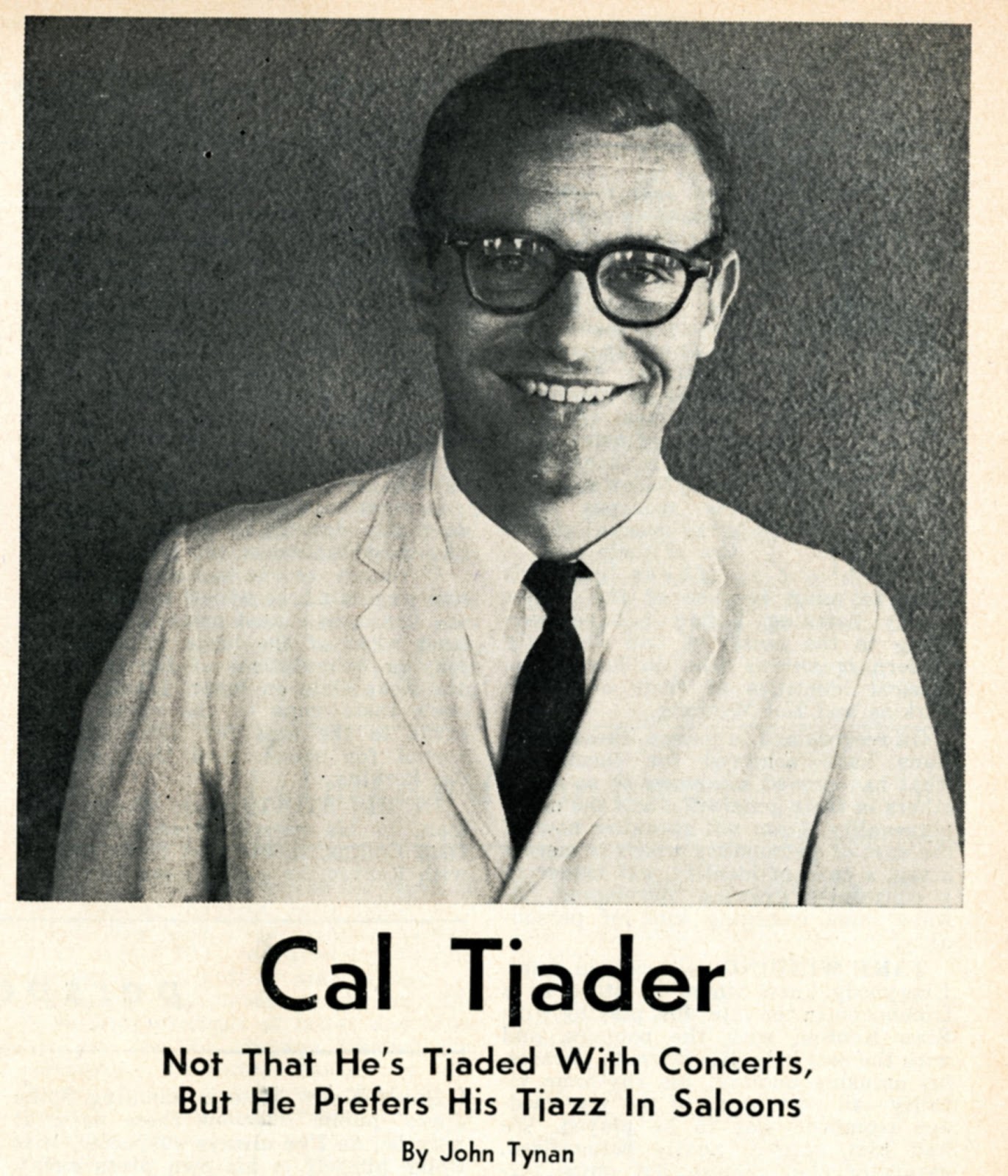
Cal Tjader - The 1957 Downbeat Interview
Tuesday, November 14, 2023
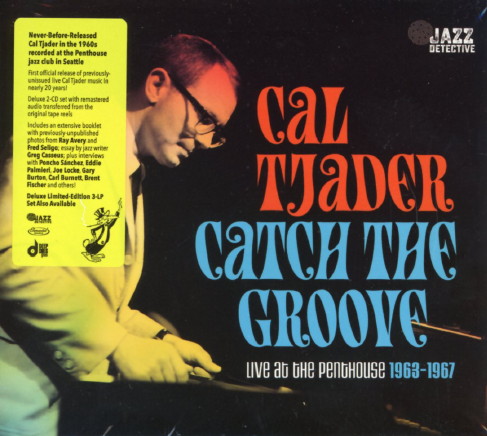
11/24/2023 Record Day - Forthcoming Releases - Cal Tjader "Catch the Groove"
© Copyright ® Steven Cerra, copyright protected; all rights reserved.
In the September 1965 issue of Jazz magazine, Herb Wong queried Tjader on many topics, …. Near the end of the profile, Tjader revealed that the performance level of his band fluctuated. This was due in large part to how they felt about a given venue. He expressed affection for the defunct Blackhawk [San Francisco] and designated the Lighthouse, the Penthouse in Seattle, the Rubiot in Tulsa, Oklahoma, and El Matador [San Francisco] as "warm clubs." All of the owners went out of their way to create a comfortable atmosphere for the musicians. "I really dig El Matador," he said. "The group likes to come to work there and the audience really comes to listen. Even the waiters seem to dig the whole thing. The feeling and tone of El Matador somehow puts the artist and the audience into instant rapport."
S. Duncan Reid, Cal Tjader: The Life and Recordings of the Man Who Revolutionized Latin Jazz
“Cal Tjader made great music. He played beautifully. I have to say, for me, Cal Tjader was the world's greatest vibes player. God only made one vibes player that great to play that pretty and that beautifully. I'm not saying he was the world's greatest vibes player because he played fast. No, Cal didn't play fast. He played very simply, very plainly. He played flowing melodic lines, but complex ones, too. He was melodic. Simple and complex and with a beautiful touch on the vibes. He played like Count Basie. Basie never overplayed. Neither did Cal.
I was 24 when I joined the Cal Tjader band in 1975. We were playing at the Coconut Grove at the Ambassador Hotel. That was a big step up for me, a local musician around Los Angeles playing with local bands, weddings, American-Legion gigs, VFW halls and like that. Then to play with Cal Tjader. That was another level.
Cal was a complete gentleman, a sweetheart, a very nice man. Before our first show, he told me which songs I should know and those I should learn. But I knew a lot of them already being such a big fan of his from childhood with my brothers' and sisters' records, plus Cal had Fantasy Records send me about a dozen albums. He told me which songs we would probably play the next week. A week later I was playing with him. He knew I didn't read music, but he told me, "Just catch the groove man. I know you can do it."”
Poncho Sanchez, conguero, bandleader
The forthcoming Record Store Day on “Black Friday” November 24, 2023 is a day to celebrate new releases, especially those involving the resurgent interest in vinyl editions with CDs of these albums generally following a few weeks later.
It seems that the Black Friday” Jazz releases often focus on what are termed today as “iconic Jazz masters,” a phrase I fear would be a source of great embarrassment for the artists in question if they were still with us.
Having had direct contact with some of the Jazz artists so designated and read or listened to interviews with many others, I think their humility and civility would have a problem with being lauded with such appellations.
I’ve been the fortunate recipient of preview copies of new Jazz recordings by some of these accomplished Jazz legends to be released on the upcoming Record Store day and I thought it might be fun to share the information on the media releases which accompanied them to make you aware of what could be the cause of a lessening balance in your bank account come November 24th!
From Ann Braithwaite/Braithwaite & Katz Communications
PRODUCER ZEV FELDMAN'S IMPRINT, JAZZ DETECTIVE, LAUNCHES NEVER BEFORE RELEASED CAL TJADER LIVE SETS RECORDED IN THE 1960s AT THE PENTHOUSE JAZZ CLUB IN SEATTLE
THIS IS THE FIRST OFFICIAL RELEASE OF PREVIOUSLY UNISSUED LIVE CAL TJADER MUSIC IN NEARLY 20 YEARS!
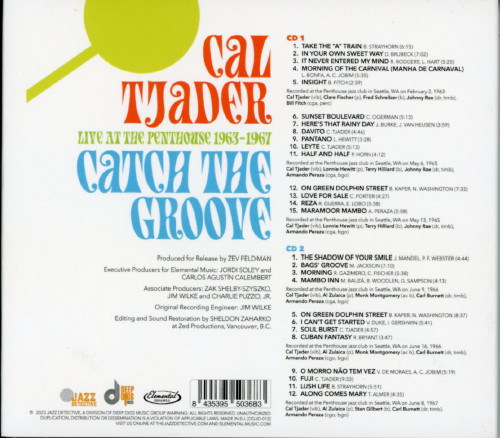
Transferred from the original tape reels and mastered for vinyl by Bernie Grundman, Cal Tjader: Catch The Groove - Live at the Penthouse 1963-1967 is presented as a 180-gram vinyl limited edition 3-LP SET and will also be available as a Deluxe 2-CD set and as a digital download.
LP Release Date: November 24th CD Release Date: December 1st
The deluxe package includes reflections by producer Zev Feldman and Brent Fischer (son of pianist Clare Fischer), liner notes by DJ and music journalist Greg Casseus, as well as interviews with Poncho Sanchez, Eddie Palmieri, Joe Locke, Gary Burton, Carl Burnett, and a statement by Tjader's son and daughter Rob and Liz Tjader.
The extensive booklet contains previously unpublished photos by Ray Avery and Fred Seligo.
All of the performances heard on this set are previously unreleased.
Vibraphone legend Cal Tjader is heard with a variety of quintets, backed by pianists Clare Fischer, Lonnie Hewitt and Al Zulaica, bassists Fred Schreiber, Terry Hilliard, Monk Montgomery and Stan Gilbert, drummers Johnny Rae and Carl Burnett, and percussionists Bill Fitch and Armando Peraza.
CATCH THE GROOVE
LIVE AT THE PENTHOUSE 1963-1967
Taking its name from Feldman's handle "the Jazz Detective" and reflecting his determined work unearthing hitherto unheard, award-winning treasures, the Jazz Detective label is an imprint of Deep Digs Music Group, a partnership with Spain's Elemental Music, with which Feldman has enjoyed a long professional relationship.
Feldman says, "It's been a great thrill to be on this journey bringing these spectacular recordings of Tjader's performances at the Penthouse to the world. It's been a project several years in the making. I've had the good fortune of working with Charlie Puzzo, Jr., son of Penthouse founder, Charlie Puzzo, Sr., and the original recording engineer and radio host Jim Wilke, to produce this joyful collection of music for release. It's just wonderful music, a little bittersweet because Cal Tjader is today, truly an underappreciated jazz giant. To me, it's sad that Cal Tjader's stature seems to have diminished since his death in 1982, even though in his day, he appealed to and reached an enormous audience. And a wide audience, comprising both young and old."
"This is a treasure trove from a great Pacific Northwest jazz club, which Cal and his sidemen regarded as one of their favorite venues in the country. And it is our hope that the superlative playing heard within this package will contribute to the large-scale reassessment that Cal Tjaderhas long richly deserved." GREG CASSEUS
"On behalf of my brother, Rob, and myself, Elizabeth Tjader, we offer our sincere gratitude to Zev Feldman for releasing this outstanding collection of previously unheard recordings from Cat Tjader live at the Penthouse Jazz Club in Seattle. The audio quality of these recordings is phenomenal. It's as if we're transported back to the Penthouse Jazz Club itself, seated a few feet from the stage where the synergy between the audience, our dad and the band members becomes virtually palpable." ROB and LIZ TJADER
"I felt that Cal made a unique and important contribution to vibes history. Although he was an unlikely guy to do it, he played a significant role in blending jazz and Latin music. I say unlikely because he didn't come from a Latin background. But he really brought together some of the most important musicians of that genre and became very popular in a field that most jazz people never knew about." GARY BURTON
"Cal was a wonderful person. That's why we hit it off. We were both conscientious of what we were doing. We were both artists with our own orchestras. He loved what he did, and I loved what I did. We bonded together and it was a wonderful bond." EDDIE PALMIERI
"Cal Tjader made great music. He played beautifully. I have to say, for me, Cal Tjader was the world's greatest vibes player." ARMANDO PERAZA
Friday, November 27, 2020
Here and There with Cal Tjader by Mark Holston
© Copyright ® Steven Cerra, copyright protected; all rights reserved.
On paper, Cal Tjader (1925-1982) seemed unlikely to achieve considerable success in Afro-Latin jazz. On disc, however, it was another story. The Swedish-American drummer-turned-vibist came a long way from St. Louis, his hometown, to bring a cool. West Coast sensibility to los ritmos calientes of Latin music. Tjader always hired the best players and discerningly mixed standards, Latin grooves, jazz tunes, and melodic contemporary pop. This was certainly the case on these 1976-77 performances, almost half of them recorded live. The dates also served as a reunion between Tjader and the superb pianist Clare Fischer who, like the leader, was (and is) an Anglo with a complete understanding of the push and pull of Latin styles.
Tracks 1-6 were originally issued as Guarabe [Fantasy 9533] and the remaining tracks, with the exception of Gary’s Tune not included due to reasons of space limitations on the disc, were released on Here [Galaxy 5121].
There are a lot of lessons to be learned and insights to be gleaned from the following sleeve notes by Mark Holston to Cal Tjader: Here and There not the least of which is how misleading cultural stereotypes can be when it comes to those musicians who perform Latin Jazz.
And Mark is “right-on-the-mark” when it comes to identifying the elements that made Cal Tjader one of the most successful, artistically and commercially, musicians to ever play Latin Jazz, not the least of which is to keep things simple and work with the best musicians available.
Another thing to listen for is how, as the author Ted Gioia has observed, Cal doesn’t overplay the vibes; he let’s them breathe. The instrument almost becomes a horn in his hands.
Happily and thanks to an early interest in the music in large part sparked by Cal Tjader, Mark Holston today writes about Latin Jazz for Jazziz, Americas, NY Latino, Hispanic, arid Latina Style magazines.
© Copyright ® Mark Holston/Concord Music Group, copyright protected; all rights reserved.
“It would have been easy to brush off the request for an interview from a neophyte Jazz journalist, but that wasn't Cal's style. Instead, he probably sacrificed much-needed rest to meet me in the lobby of his Edmonton, Alberta hotel to spend an amiable half hour indulging me in my pursuit of information about two favorite subjects, Cal Tjader and Latin jazz.
After all, in 1981 jazz journalism in the U.S. was virtually dominated by Down Beat, a magazine that had in recent years stretched the definition of jazz to the breaking point by lavishing coverage on blues, rock, and even country music personalities — just about everybody, it seemed, but Cal Tjader. JazzTimes was a struggling newcomer to the scene and Jazziz had yet to be conceived. Publications like New York Latino and Latin Beat, today's champions of the Latin jazz movement, wouldn't emerge for over a decade. Cal, just like his music, was way ahead of his time.
So, it wasn't surprising a month or so later, after having submitted a proposal to Down Beat to consider a Tjader piece, to open a letter from the editor and find the terse reply: "Cal Tjader is not in our plans at this time."
One can imagine an editorial staffer sniffing, "Not cutting-edge enough." Another may have added, "After all, Latin jazz really isn't to be taken seriously, is it?" And, Tjader's career had been tainted by that most fatal of sins: he was far too popular. Yeah, Cal always appealed more to the fans than the critics.
But back to our brief interview, conducted right after he had been paired with conga player Mongo Santamaria and his band for a performance at Edmonton's annual International Jazz Festival. Seeing Cal and Mongo reunited more than two decades after their historic late 1950s association underscored what made the vibraphonist so unique: he was easily the most successful non-Latino musician to perform the style, but he never crossed the line and tried to "go Latin." Just as Mongo struggled with English, Cal spoke his few words of Spanish with a bad tourist accent. He moved a bit stiffly on stage, probably wishing his body would just surrender to the hypnotic Afro-Cuban beat and get it over with, but remaining until the end a hostage of his thoroughly Anglo, Midwestern upbringing.
To his credit, Cal never went native. The crew cut, horn-rimmed glasses, conservative attire, and low-key demeanor all seemed to reinforce the simple fact that, when it came to the music he loved, Cal Tjader was one serious cat.
His stories about discovering the Latin scene in the Fifties, and beginning the transition from sideman for such mainstream jazz stalwarts as Dave Brubeck and George Shearing to unparalleled success as a Latin jazz bandleader, were still related with a certain sense of awe. It's entirely likely that during any given performance over the years, Cal caught himself thinking, "Wow, is this really happening to me?"
And his knowledge of Latin music, although undoubtedly encyclopedic, could be boiled down to a few simple pointers. "Keep it basic," he said, when asked about the rhythmic aspect of his style. "The first thing I learned when I started to hang around the Latin guys is just how easy it is to mess things up, to lose the groove. Everything has to be in its proper place, in harmony with what all of the other rhythm players are doing." Sounds simple, but few leaders—including some major-league Latin musicians—have managed to consistently produce the smooth blend of jazz improvisation and authentic Afro-Cuban rhythms with which Cal became synonymous.
The second and equally important part of the Tjader formula can be found in his choice of musicians. From famous names to new kids on the block, Cal had a knack for finding and employing marvelously talented musicians who would readily set egos aside for the collective good, for achieving that patented Tjader sound.
The 11 tracks on Here and There present Cal in the company of two exemplary, long-serving associates, keyboardist Clare Fischer and conguero Poncho Sanchez.
Fischer, an influential early pioneer in both Latin jazz and Brazilian bossa nova movements, was one of Tjader's longest serving and most simpstico pianists. He remains active in both genres to this day, leading a popular Latin jazz ensemble and writing arrangements for none other than bossa guru Joao Gilberto.
Sanchez, whose seven-year tenure with Cal more than prepared him for a career as a leader, has been propelled in recent years to the very front ranks of Latin jazz stardom. A devoted Tjaderite, Poncho's current album, Soul Sauce, is a tribute to his mentor, the latest in a recent spate of recordings by such artists as vibraphonist Victor Mendoza and the Estrada Brothers that have effectively evoked the Tjader touchstone.
Representing all but one cut from two mid-Seventies albums, Guarabe and Here, the collection captures the Tjader sound at the peak of its small-group-format evolution. Sans the horn section and soloists that shaped his earliest forays into the Latin jazz, these sessions, with long-form arrangements, focused more attention on the improvisational talents of Cal and Fischer and less on the typical structure common in many more routine Latin jazz dates.
The album also reminds us of Cal's legendary good taste and love of songs with strong melodic interest. "Where Is Love," given a tender bolero treatment, is a case in point. "This Masquerade," the Leon Russell hit that made George Benson a pop superstar, was recorded just months after the guitarist hit platinum with it. Bob Redfield delivers some of Benson's Wes Montgomery-derived flair and offers another insight into Tjader's genius. His ear was quick to recognize worthy material when he heard it, whether it sprang from the pop music realm or the most obscure Latin American sources. Also, his use of a guitarist provided an element all but unused in Latin jazz but highly effective in this small-group setting. Always respectful of tradition, Cal never hesitated to break the mold if it resulted in more compelling performances.
Highlights abound on Here and There. "Reza," a rousing Afro-Brazilian theme from the Sixties, is invigorated in its translation to the Afro-Cuban idiom. "Black Orchid," a lovely Tjader original that taps a lush exotic mood, features Cal on marimba and radiates the flavor of Latin jazz a new generation of fans today considers to be the essence of hipness. "Tu Crees Clue," a Mongo Santamaria tune, ignites memories of Cal's heady early days as a Latin jazz trailblazer. "Liz-Anne," a charming jazz waltz inspired by Cal's daughter, reveals the full, elegant range of his vastly underrated abilities as a soloist. "Morning," the Clare Fischer standard, and the beguiling "Here" emerge as quintessential Tjaderesque takes.
If Cal were alive today — he passed away in 1982 — he would undoubtedly be overjoyed at the growth and current popularity of Latin jazz, the recognition of the style by the Grammy Awards, and the continued success of such former colleagues as Clare Fischer, Poncho Sanchez, and a host of others.
The innumerable contributions he made over the years, symbolized by the level of enthusiasm and artistry displayed on Here and There, all but guaranteed the style's longevity and contagious popular appeal. There's no doubt that Cal Tjader's timeless music will delight fans new and old for many years to come.”
- Mark Holston, 1996
Friday, November 6, 2020
Cal Tjader: The Life & Recordings of the Man Who Revolutionized Latin Jazz - Second Edition - S. Duncan Reid
© Copyright ® Steven Cerra, copyright protected; all rights reserved.
Within one of the most complex musical categories ever, Cal Tjader quietly pioneered as a jazz vibraphonist, composer, arranger and bandleader from the 1950s through the 1980s. This life story of a humble musician also reveals his charisma. Tjader's legacy is attested to by his large audiences and his innovations that changed the course of jazz.
Expanded and revised, this second edition now includes additional interviews and anecdotes from Tjader's family, bandmates and community, print sources, and rare photographs, presenting a detailed account of Tjader as well as the progression of Latin Jazz.
With thirty five pages of additional text, plus an enhanced Glossary of Terms, Discography, Bibliography and a New Foreword by Gary Foster who played alto sax and flute in Cal’s later groups, the second Edition of Cal Tjader: The Life and Recordings of the Man Who Revolutionized Latin Jazz gives the reader a wealth of new information and insights into the man that pianist George Shearing once called - “a rhythmic genius.”
Cal, who began his professional career as a drummer in a San Francisco based octet and later trio led by Dave Brubeck in the late 1940s, joined Shearing’s quintet in the early 1950s before returning to the San Francisco Bay area to lead his own Jazz and Latin Jazz quintets in the mid-1950s.
For almost thirty years until his death in 1982 caused by a heart attack, Tjader was a universally respected Jazz artist, especially in Latin Jazz settings with his own band and jointly with pianists Charlie and Eddie Palmieri, Tito Puente and a host of others. Vocal albums with Rosemary Clooney, Anita O’Day and Carmen McRae find him adding significant “Latin tinges” to the repertoires of these fine singers and the number of excellent hornmen, pianists, bassists and drummers and Latin percussionists Tjader worked with in his thirty plus year career is simply staggering.
Cal Tjader was a consummate musician and S. Duncan Reid has done a delightful job of describing, detailing and denoting the qualities that enabled him to become a premier Jazz performer.
The following excerpts from the Preface will put the benefits derived from the 2nd edition of his biography of Cal into sharper focus:
“Thanks to an in-depth interview with Tjader's best friend, Philip Smith, this second edition will document more of the future bandleader's childhood. After a stint in the Navy during World War II, Tjader stood out as a drummer, vibraphonist and bongocero for Dave Brubeck. It was with Brubeck in San Francisco that he was first exposed to Cuban music and with George Shearing in New York that he fully perceived how the rhythms could alter the course of his career. He came back to the West Coast in 1954 and the jazz universe expanded.
As Tjader's life unfolds through the extensive research of this author, which features more than 60 interviews with colleagues, family and friends, the reader will learn about the melding of European and African music via the United States, Cuba and Brazil. Moreover, a tender, troubled and complex human being will be revealed.
The second edition gives an even larger view of his saga. Along with Philip Smith, who not only contributes anecdotes about Tjader's childhood but also his career—on stage and off—there are candid interviews with drummer Carl Burnett, bassist Stanley Gilbert, record producer Frank Dorritie, deejay Alan Schultz and further conversations with Al and Terry-Ann Torre, Eddie Coleman and the late Bob Redfield. Additional research from print sources has corrected some errors of commission and omission, brought Tjader's first known interview to light, and uncovered more on why influential critic Ralph J. Gleason went from being a proponent of Tjader to ignoring him. Plus, the vibraphonist's strained relationship with Sol and Max Weiss at Fantasy Records and his experiences with reverse racism on the jazz scene are explored to a greater degree. Finally, this second edition takes another step both in raising the profile of Cal Tjader and enlightening a new generation of musicians and music lovers about one of its founding fathers. At the same time, the way in which he was perceived by the jazz media during his lifetime is further illuminated.”
Duncan’s revised and expanded bio brings home to the reader what it was like to be a working musician during the Golden Years of Modern Jazz following World War II and how valiant and dedicated a Jazz musician Cal had to become to make it in the ever-shrinking Jazz world after the general public turned to Rock ‘n Roll in the mid-1960s and beyond.
The parade of Tjader gigs in the form of club dates, concerts and recording sessions read like a time gone by; such a schedule would be impossible to create today as the venues and recording opportunities do not exist anymore for Jazz artists.
After reading the additional annotations in the second edition what comes across even more strongly is that in the process of becoming a nationally and internationally recognized Jazz star, Cal had to work very hard to maintain a band and travel incessantly to keep it working.
Maintaining the necessary pace required to earn a decent living probably led to his early death.
Duncan’s bio provides an accurate record of personnel changes in Cal’s many groups over the years and this helps the reader gain an understanding of the efforts Cal had to make to find replacement musicians. Some musicians were consistent members of Cal’s bands for lengthy periods of time while others stayed for only a club date or a concert tour.
Cal was almost always looking for talented players and what made this especially difficult for him was that his repertoire included both straight-ahead and Latin Jazz and these are different skills not often found in the same musician. Often, Cal had to settle for one while teaching the other and with the advent of Rock ‘n Roll in the mid-to-late 1960s, the pool of young musicians interested in playing Cal’s style of music was dwindling.
When you add the fact that myriad personnel changes were done over a career lasting over thirty years his accomplishment of keeping a working band together becomes almost mind boggling.
Duncan’s book reads in such a way as to help bring home not only the professional considerations that Cal had to deal with as a top flight band leader but also the personal ones including many of the trials and tribulations in his own life.
The Jazz Life is anything but an 8-5 job. It takes a special discipline to develop the high level of skills needed to play the music, but these disciplines do not always carry over to the requirements of functioning on a regular basis in a working band.
The quirky individuality that blossoms into a distinctive Jazz “personality” sometimes fail to include the habits for becoming a responsible member of a band.
And the Jazz Life itself with the late hours, an environment filled with many unhealthy elements and the constant travel associated with it causes all sorts of friction and wreaks havoc on “normality.”
Duncan’s biography of Cal reflects on his life and those of his family and closest musical associates to reveal the stress and strains which everyone involved had to deal with and the toll they extracted on all concerned.
Thankfully, over the years Cal’s marquee value expanded such that he was able to sign with booking and management agencies that helped him find work which then allowed him to concentrate more on his music. This dynamic is fully covered in Duncan’s biography which offers the reader a look at the business dynamics of a working Jazz group.
Another facet of Cal’s career that’s brought home to the reader is the veritable constellation of Jazz luminaries that Cal performed with over the course of his career including Dave Brubeck, George Shearing, Woody Herman, Stan Getz, Dizzy Gillespie, Shelly Manne, Vince Guaraldi, Eddie “Lockjaw” Davis, Illinois Jacquet, Harold Land, Scott Hamilton, Gary Foster, Hank Jones, Cedar Walton, Eddie Gomez, John Lewis, Roy Burns, Art Pepper, Hermeto Pascoal, George Duke, Airto Moreira, Jerome Richardson, Frank Strazzeri, Paul Horn, Charlie and Eddie Palmieri, George Duvivier, Ralph MacDonald, Frank Wess, John Faddis, Clark Terry - the list seems endless.
And Duncan’s work documents Cal’s role in nurturing a whole host of excellent younger musicians including Lonnie Hewitt, Freddie Schreiber, Johnny Rae, Al Torre, Al Zulaica, Stanley Gilbert, Carl Burnet, Dick Berk, John Heard, Ratzo Harris, Harvey Newmark, Michael Smithe, Robb Fisher, Pete Riso, Vince Lateano, Poncho Sanchez, Roger Glenn, Mark Levine, and Ramon Banda, among many others.
The world that was the working life of Cal Tjader will never come again which makes Duncan’s masterful recapturing of it even more important as a lasting record of this unique era when just about every major city had a Jazz scene and musicians could earn a living playing a circuit of them.
The overriding importance of Duncan’s revised biography of Cal can best be summed up in this paragraph:
“In the midst of the quintet's run at Howard Rumsey's Concerts by the Sea (November 29 to December 4, 1977), Ted Gioia, then a student at Stanford, wrote a positive capsule review of Guarabe [Fantasy – F-9533, 1977] Gioia initially pointed to Tjader, Vince Guaraldi and Denny Zeitlin as examples of "excellent [Bay Area] musicians who never received the national attention they merited." Then he stated that Tjader, with his latest LP, "is possibly on the verge of becoming widely known." One significant thread that runs throughout this biography is that Tjader has not been, at least nationwide, accorded his proper status as a top tier jazz musician by the majority of critics and historians. However, this biography has documented that Tjader's popularity with the public both nationally and internationally was well established many years before Gioia's review was published.”
S. Duncan Reid’s second edition of Cal Tjader: The Life and Recordings of the Man Who Revolutionized Latin Jazz will go a long way toward enhancing our understanding and appreciation of Cal Tjader whom the late Jazz critic Richard Cook has called “an important and catalytic figure” in Jazz history.
Here's a link the order information at McFarland.
Friday, August 14, 2020
Tjader Jag - [Tjag ?] - The Fantasy Years, Part 1
The dictionary definition of “jag” that I am referring to is “to be completely unrestrained” in the sense of listening to all the music I can lay my hands on regarding certain artists and checking the Jazz literature to see what I can find to form a piece about him/her that I can put up on my page - these include insert notes.