Showing posts with label monterey jazz festival. Show all posts

Monday, March 11, 2024

Dizzy, Duke, The Count and Me: The Story of the Monterey Jazz Festival [Revised with Video Additions]

  © Copyright ® Steven Cerra, copyright protected; all rights reserved.


Covering the festival from its inception in 1958 to 1977 the date of its publication, Dizzy, Duke, The Count and Me: The Story of the Monterey Jazz Festival by Jimmy Lyons and Ira Kamin is a wonderful collection of articles, vignettes and remembrances about one of of the great cultural events in the USA - the annual celebration of American Contemporary Music in one of the country’s most beautiful settings.


Accompanying the writings are a collection of drawings by the renown illustrator David Stone Martin who designed many of the iconic album covers for the Clef Norgan and Verve LPs in the 1950s, as we as, many photographs by Tom Copi, Jim Marshall, Veryl Oakland and a host of others.


The Foreword is by Dizzy Gillespie, the Preface is by co-author Ira Kamin and the lead-in articles is by Ralph J. Gleason, the San Francisco based columnist and critic and one of the founders of the Festival.


Foreword


“One of the great shining examples of the kind of association I have with Jimmy Lyons is the fact that contract-wise, our contracts never seem to catch up. I just assume that I'm playing the Monterey Jazz Festival. It's assumed that I'm going to be at Monterey every year.


Now sometimes that gets a little out of hand, such as last year, when I had the chance to play a theatre with Sarah Vaughan.


Now, I love Jimmy Lyons, but oh my God, Sarah Vaughan!


Monterey has a special meaning for me, because I understand that the people expect to see me there. My face is a part of the Monterey Jazz Festival just like that chair that they have. And at the end of the concert every year I start wondering what they are going to do next year? Because you can't top yourself all the time.


But over the years, the Monterey Jazz Festival has overextended itself—musically, I mean. Each year seems to be getting a little better. Sometimes it drops. Well, it can't be the same thing all the time. But it is the one festival where the musicians really feel a part of the festival itself.

At other festivals, you have a spot, you play the spot, you go wherever your spot is. But the Monterey Jazz Festival is unique in that the musicians feel they're part of what's happening, and that lends itself to a very high degree of creativity.


And the coup de grace was the hiring of John Lewis as musical director.”


John Birks (Dizzy) Gillespie - October, 1977


Preface


“There have been twenty Monterey Jazz Festivals, held every late September, in Monterey, California, since 1958.


It's Jimmy Lyons' Festival. He founded it and every year, with the help of his musical director, John Lewis, he puts the shows together.


I spent a few dozen hours with Jimmy Lyons over a couple of warm summer months, putting together this book about Lyons and the Festival.


He lives on Telegraph Hill in San Francisco in a small apartment with his wife, Laurel. He sits at a table by a window, smokes Camel cigarettes, bites the backs of both thumbnails and talks in the most listenable voice — he used to be a deejay, the first GI voice in Berlin — about the people who've passed his way the sixty years he's been on this earth.


The first part of this book is Jimmy Lyons' account of the Festival and parts of his life that led to the Festival. The second part is a more specific, chronological overview of the Festival's first twenty years.


I would like to express my special thanks to Dizzy Gillespie for doing the Foreword. When I talked to him about the book he was in the middle of a long road trip. He had an abscessed tooth and the insides of his face were hurting from that crazy way he has of playing the trumpet. He was incredibly gracious to all of us who wanted some of his time.


I would also like to thank Hal Silverman, Laurel Lyons, Tim Ware, Elaine Ratner, Ernie Beyl, Jean (Mrs. Ralph) Gleason, The Monterey Jazz Festival staff and Board of Directors, and of course Jimmy Lyons, for their great help and patience in putting this book together.”

Ira Kamin - Mill Valley, May 1978


Why a Jazz Festival?

by Ralph Gleason


“The Monterey Jazz Festival — or any real festival, jazz or otherwise — can't be just a collection of concerts. It must be a thing unto itself, an entity beyond the individual performances, beyond the individual programs and greater than the sum of these.


The point of a festival is to be festive. To give and to receive joy and to present — in a jazz festival, at any rate — a wide diversification of styles and types of this music in as festive and benign a surrounding as possible.


To be successful as a festival, the grounds, the concerts, the musicians, the patrons and the atmosphere all have to jell together to be something more than one can find elsewhere. And this, of course, is what has happened these years at Monterey.


To be a true festival, there must be something for those who are not hard core jazz fans and who make this their sole jazz experience for the year. This, too, Monterey has provided.


The unusual combinations of music, the special events, the virtuoso performances, but above all, the opportunity to see and to hear great artists in a great setting — that is the festival.


Seeing musicians as people has always been an attraction. "People out front don't know of the battle you wage backstage," Jon Hendricks wrote in his lyrics to Count Basie's "Blues Back Stage." At Monterey and at any true festival of music, the concert hall setting is avoided and the musicians make up part of the audience, walking through the grounds, rehearsing in the mornings and early evenings, themselves digging the festival. Charles Mingus was rehearsing well into the evening concert the night before his historic appearance in 1964 and latecomers lingered by the doors to hear him.


Nor all the great music has always been on stage. There have been those delicious moments observed only by the people who came early or who stayed late and wandered around, such as the afternoon pianist Ralph Sutton rehearsed with Jimmy Rushing, the year that Ben Webster sat in on piano until Earl Hines arrived or the time Ben Webster was shooting pictures of the festival orchestra's saxophone section playing an arrangement of Ben's own solo on "Cottontail." These are the bonuses that make the festival worth more than anyone could dream of.


Of course, there's the opportunity to learn by listening to great artists from great eras in their own styles and settings. But that is only part of it. There are the once-in-a-lifetime performances.


Who could ever forget—who saw and heard ir—the "Evolution of the Blues" with Jon Hendricks preaching and Jimmy Witherspoon and Big Miller singing and Miriam Makeba and Odetta and Pony Poindexter and the children gathered onstage in a semi-circle around Jon?


Who could ever forget — who saw and heard it— Lambert-Hendricks-Bavan, dressed in monk's hoods and robes, singing in the cold night air behind Carmen McRae and Louis Armstrong in Dave and Iola Brubeck's "The Real Ambassadors." Or Lawrence Brown stepping forward to play "Poor Butterfly" or Duke Ellington's "Rockin in Rhythm" or Bunny Briggs dancing "David Danced Before the Lord with All His Might" or Dizzy and Big Mama Willie Mae Thornton or Annie Ross, Jon Hendricks, Dave Lambert and Joe Williams ending the show singing with Count Basie?


Right from the very first night, when the unknown trumpet player sat in with Dizzy, Monterey has been this way and that's what makes a festival and that's why a festival is almost a necessity in this era of restraint and inhibition. For one weekend, anything goes and the results have been some of the greatest moments in jazz history.


The festival is for the musicians and the festival is for the patrons — both. Each one digs the other and they both dig the digging. A festival is to have fun, to be festive, to give and receive love. And love, like jazz, is a four letter word and surrounded these days with Inhibitions and taboos. But at Monterey, for this one weekend, we are all free to love and jazz is free to be our music.


A festival is to have fun. You aren't supposed to like or dislike anything. You don't have to listen and you can come and go as you please. It's nor a posh concert hall where silence must be preserved and it is only a tribute to the quality of the music and the musicians that silence has been granted (not preserved or enforced) during some of the great performances.


Nowhere in this country is there such a homogeneous gathering of people as at these festivals. Pass through those gates and leave behind all the traumas and the psychodramas that inhibit the rest of the year. Glory in the music, in the people, in the place. Jazz is what you call it, everyone's his own expert (as is really true in every art form when you get down to it) and you pick your own likes and dislikes.


A jazz festival should be the best possible combination of enjoyments one can devise. Organization and improvisation, lyricism, strength, euphoria and the blues, individuals and groups, the scream, the cry and the whisper. It should all be there for you.


A festival, like music, is to be experienced. It is interesting, but not essential, to know things about the music and about the musicians. The music is enough by itself; so is the setting; so, too, are the people there. All together they make up one of the best things about living around here, even if it only happens once a year.”


Reprinted from Monterey Jazz Festival Program, 1966


Wednesday, June 23, 2021

A Ferrari for Miles by Jimmy Lyons

 © Copyright ® Steven Cerra, copyright protected; all rights reserved.


We continue our celebration of the Monterey Jazz Festival - now entering its 64th year as the longest continuous Jazz Festival -  with this anecdote from the “Jimmy Reminiscing” Dizzy, Duke, The Count and Me: The Story of the Monterey Jazz Festival by Jimmy Lyons and Ira Kamin, a wonderful collection of articles, vignettes and remembrances about one of of the great cultural events in the USA - the annual celebration of American Contemporary Music in one of the country’s most beautiful settings.


Accompanying the writings are a collection of drawings by the renown illustrator David Stone Martin who designed many of the iconic album covers for the Clef Norgan and Verve LPs in the 1950s, as we as, many photographs by Tom Copi, Jim Marshall, Veryl Oakland and a host of others.


A Ferrari in Monterey


“I have known Miles Davis since he was seventeen years old, back in '46 or '45, I guess, when he was playing third trumpet with Benny Carter's band. I bought him his first drink. There was a party for Duke Ellington out in Beverly Hills and Oscar Pettiford and I were the bartenders. Okay. So Oscar and I gave this kid a drink, the first drink he'd ever had, he says.


In the ensuing years I got to know Miles very well. I became very fond of the way he played and very fond of the guy, in spite of his irascibility. Miles was Miles. He came from a well-to-do family in St. Louis, a dentist's son or a doctor's son. He had a very good life. Miles, if you will, was a spoiled kid. But he was a good player and I loved the way he played. When Bird came through St. Louis he heard this kid play and he said, "You better leave town, kid, because you play too good to stick around here."


So the years went by. Pretty soon Miles played the old Blackhawk out here. For five years I said, "Miles, come play for me."


"Oh, who wants to play any dumb old festival? I can play any festival I want."


"Miles, come play mine.  You're my friend."


"No, I'm gonna be in France. Can't do it."


One time I said, "Come on, come down to Monterey. It's a beautiful country. You've never been there, you've never taken time off to relax a little bit. You're a New York kid. Don't sit around and fight with Columbia and have them buy you more apartment buildings in New York City to pay you off. 


You'll enjoy the sunshine."


He looked at me and said, "You need the sunshine more than me."


Next year he came back to Blackhawk. We were standing outside. He said to me in that gravelly voice, "When's that damn festival?"


"September. I've been asking you for five years. You wanna play?"


"I don't know. Maybe I wanna play it. I'll call you."


Miles called. He said, "I'll play it."


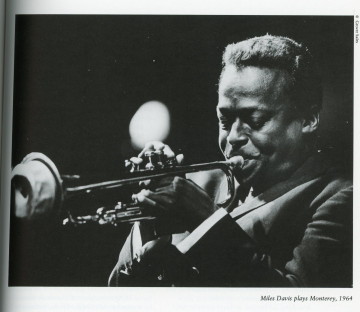
So Miles flew down to Monterey. It was in 1962. He called New York and had them fly his Ferrari out. He had the time of his life, hanging out with everybody. He came out and played a marvelous set. Later he came roaring up from the bar. He had been hanging out with Dizzy and Harry James. I said to him, "You want me to give the money to Benny (Benny Shapiro, his manager at the time)?"


"No, give it to me. I need it."


So I gave him $2,500 in cash. My wife was standing there and Miles took the money, folded it up and shoved it down her bosom. "Keep it for me; I'll pick it up later."


He came back at three in the morning, looking for his money. He thought he'd lost it.


That was Friday night. He hung around for the whole Festival. On Sunday night, Dizzy walked out on stage without a trumpet. I didn't know what had happened. Then Harry James and Miles Davis walked out with a pillow and handed Dizzy his trumpet on the pillow: Harry and Miles bringing out the master's trumpet.”


Friday, June 18, 2021

Dizzy, Duke, The Count and Me: The Story of the Monterey Jazz Festival by Jimmy Lyons and Ira Kamin

 © Copyright ® Steven Cerra, copyright protected; all rights reserved.


Covering the festival from its inception in 1958 to 1977 the date of its publication, Dizzy, Duke, The Count and Me: The Story of the Monterey Jazz Festival by Jimmy Lyons and Ira Kamin is a wonderful collection of articles, vignettes and remembrances about one of of the great cultural events in the USA - the annual celebration of American Contemporary Music in one of the country’s most beautiful settings.


Accompanying the writings are a collection of drawings by the renown illustrator David Stone Martin who designed many of the iconic album covers for the Clef Norgan and Verve LPs in the 1950s, as we as, many photographs by Tom Copi, Jim Marshall, Veryl Oakland and a host of others.


The Foreword is by Dizzy Gillespie, the Preface is by co-author Ira Kamin and the lead-in articles is by Ralph J. Gleason, the San Francisco based columnist and critic and one of the founders of the Festival.


Foreword


“One of the great shining examples of the kind of association I have with Jimmy Lyons is the fact that contract-wise, our contracts never seem to catch up. I just assume that I'm playing the Monterey Jazz Festival. It's assumed that I'm going to be at Monterey every year.


Now sometimes that gets a little out of hand, such as last year, when I had the chance to play a theatre with Sarah Vaughan.


Now, I love Jimmy Lyons, but oh my God, Sarah Vaughan!


Monterey has a special meaning for me, because I understand that the people expect to see me there. My face is a part of the Monterey Jazz Festival just like that chair that they have. And at the end of the concert every year I start wondering what they are going to do next year? Because you can't top yourself all the time.


But over the years, the Monterey Jazz Festival has overextended itself—musically, I mean. Each year seems to be getting a little better. Sometimes it drops. Well, it can't be the same thing all the time. But it is the one festival where the musicians really feel a part of the festival itself.

At other festivals, you have a spot, you play the spot, you go wherever your spot is. But the Monterey Jazz Festival is unique in that the musicians feel they're part of what's happening, and that lends itself to a very high degree of creativity.


And the coup de grace was the hiring of John Lewis as musical director.”


John Birks (Dizzy) Gillespie - October, 1977


Preface


“There have been twenty Monterey Jazz Festivals, held every late September, in Monterey, California, since 1958.


It's Jimmy Lyons' Festival. He founded it and every year, with the help of his musical director, John Lewis, he puts the shows together.


I spent a few dozen hours with Jimmy Lyons over a couple of warm summer months, putting together this book about Lyons and the Festival.


He lives on Telegraph Hill in San Francisco in a small apartment with his wife, Laurel. He sits at a table by a window, smokes Camel cigarettes, bites the backs of both thumbnails and talks in the most listenable voice — he used to be a deejay, the first GI voice in Berlin — about the people who've passed his way the sixty years he's been on this earth.


The first part of this book is Jimmy Lyons' account of the Festival and parts of his life that led to the Festival. The second part is a more specific, chronological overview of the Festival's first twenty years.


I would like to express my special thanks to Dizzy Gillespie for doing the Foreword. When I talked to him about the book he was in the middle of a long road trip. He had an abscessed tooth and the insides of his face were hurting from that crazy way he has of playing the trumpet. He was incredibly gracious to all of us who wanted some of his time.


I would also like to thank Hal Silverman, Laurel Lyons, Tim Ware, Elaine Ratner, Ernie Beyl, Jean (Mrs. Ralph) Gleason, The Monterey Jazz Festival staff and Board of Directors, and of course Jimmy Lyons, for their great help and patience in putting this book together.”

Ira Kamin - Mill Valley, May 1978


Why a Jazz Festival?

by Ralph Gleason


“The Monterey Jazz Festival — or any real festival, jazz or otherwise — can't be just a collection of concerts. It must be a thing unto itself, an entity beyond the individual performances, beyond the individual programs and greater than the sum of these.


The point of a festival is to be festive. To give and to receive joy and to present — in a jazz festival, at any rate — a wide diversification of styles and types of this music in as festive and benign a surrounding as possible.


To be successful as a festival, the grounds, the concerts, the musicians, the patrons and the atmosphere all have to jell together to be something more than one can find elsewhere. And this, of course, is what has happened these years at Monterey.


To be a true festival, there must be something for those who are not hard core jazz fans and who make this their sole jazz experience for the year. This, too, Monterey has provided.


The unusual combinations of music, the special events, the virtuoso performances, but above all, the opportunity to see and to hear great artists in a great setting — that is the festival.


Seeing musicians as people has always been an attraction. "People out front don't know of the battle you wage backstage," Jon Hendricks wrote in his lyrics to Count Basie's "Blues Back Stage." At Monterey and at any true festival of music, the concert hall setting is avoided and the musicians make up part of the audience, walking through the grounds, rehearsing in the mornings and early evenings, themselves digging the festival. Charles Mingus was rehearsing well into the evening concert the night before his historic appearance in 1964 and latecomers lingered by the doors to hear him.


Nor all the great music has always been on stage. There have been those delicious moments observed only by the people who came early or who stayed late and wandered around, such as the afternoon pianist Ralph Sutton rehearsed with Jimmy Rushing, the year that Ben Webster sat in on piano until Earl Hines arrived or the time Ben Webster was shooting pictures of the festival orchestra's saxophone section playing an arrangement of Ben's own solo on "Cottontail." These are the bonuses that make the festival worth more than anyone could dream of.


Of course, there's the opportunity to learn by listening to great artists from great eras in their own styles and settings. But that is only part of it. There are the once-in-a-lifetime performances.


Who could ever forget—who saw and heard ir—the "Evolution of the Blues" with Jon Hendricks preaching and Jimmy Witherspoon and Big Miller singing and Miriam Makeba and Odetta and Pony Poindexter and the children gathered onstage in a semi-circle around Jon?


Who could ever forget — who saw and heard it— Lambert-Hendricks-Bavan, dressed in monk's hoods and robes, singing in the cold night air behind Carmen McRae and Louis Armstrong in Dave and Iola Brubeck's "The Real Ambassadors." Or Lawrence Brown stepping forward to play "Poor Butterfly" or Duke Ellington's "Rockin in Rhythm" or Bunny Briggs dancing "David Danced Before the Lord with All His Might" or Dizzy and Big Mama Willie Mae Thornton or Annie Ross, Jon Hendricks, Dave Lambert and Joe Williams ending the show singing with Count Basie?


Right from the very first night, when the unknown trumpet player sat in with Dizzy, Monterey has been this way and that's what makes a festival and that's why a festival is almost a necessity in this era of restraint and inhibition. For one weekend, anything goes and the results have been some of the greatest moments in jazz history.


The festival is for the musicians and the festival is for the patrons — both. Each one digs the other and they both dig the digging. A festival is to have fun, to be festive, to give and receive love. And love, like jazz, is a four letter word and surrounded these days with Inhibitions and taboos. But at Monterey, for this one weekend, we are all free to love and jazz is free to be our music.


A festival is to have fun. You aren't supposed to like or dislike anything. You don't have to listen and you can come and go as you please. It's nor a posh concert hall where silence must be preserved and it is only a tribute to the quality of the music and the musicians that silence has been granted (not preserved or enforced) during some of the great performances.


Nowhere in this country is there such a homogeneous gathering of people as at these festivals. Pass through those gates and leave behind all the traumas and the psychodramas that inhibit the rest of the year. Glory in the music, in the people, in the place. Jazz is what you call it, everyone's his own expert (as is really true in every art form when you get down to it) and you pick your own likes and dislikes.


A jazz festival should be the best possible combination of enjoyments one can devise. Organization and improvisation, lyricism, strength, euphoria and the blues, individuals and groups, the scream, the cry and the whisper. It should all be there for you.


A festival, like music, is to be experienced. It is interesting, but not essential, to know things about the music and about the musicians. The music is enough by itself; so is the setting; so, too, are the people there. All together they make up one of the best things about living around here, even if it only happens once a year.”


Reprinted from Monterey Jazz Festival Program, 1966


Thursday, October 17, 2019

The Woody Herman Big New Herd at The 1959 Monterey Jazz Festival

© -  Steven A. Cerra, copyright protected; all rights reserved.


Writing in The New Grove Dictionary of Jazz, Barry Kernfeld, ed., Sarah Velez and Paul M. Laird offer this overview of The Monterey Jazz Festival.


“The Monterey Jazz Festival. Festival is held annually from 1958 near Monterey, California. It was founded by Ralph J. Gleason and the disc jockey Jimmy Lyons, partly at the suggestion of George Wein and Louis Lorillard (the founders of the Newport Jazz Festival). Gleason was an adviser to the festival's organizers during its early years and Lyons was its general manager into the 1980s; among its music directors have been John Lewis and Mundell Lowe. The festival takes place over three days in September (including the third weekend of the month) at three venues on the Monterey County Fairgrounds (seating 7000) and usually offers performances by well-known swing and bop musicians; Louis Armstrong and Thelonious Monk appeared regularly, as have Dizzy Gillespie, Gerry Mulligan, and Dave Brubeck. A blues concert has also been included in most years.


Proceeds from the festival have been used for educational purposes, including the awarding of grants and scholarships (from 1961) and the administration of the Annual California High School Jazz Competition (from 1971), the winners of which perform on the last day of the festival with its featured performers. The Monterey Jazz Festival was acclaimed during its early years for its innovative programming; in 1959, for example, it included the premieres of works by Jimmy Giuffre, John Lewis, and Gunther Schuller (all performed by an ensemble directed by Schuller) and performances by an all-star band assembled for the occasion by Woody Herman. Later, however, it drew criticism for its indifference towards free jazz and other modern styles.


The tape archive of the festival is held by the Stanford Archive of Recorded Sound at Stanford University.”


This year marks the 60th anniversary of the Woody Herman All-Star big band appearance at the MJF and the editorial staff at JazzProfiles thought it might be fun to look back on the event with these insert notes by Ralph Gleason from Woody Herman’s Big New Herd at the 1959 Monterey Jazz Festival [Atlantic LP 1328/Koch CD KOCCD-8508].


“One of the most impressive things about the 1959 Monterey Jazz Festival (which was in itself a pretty impressive affair, as witness the reviews) was the Festival orchestra put together especially to function as a workshop orchestra during the week preceding the Festival and, during the actual three days of the Festival, to double as the Woody Herman Festival Herd and the workshop band (augmented by various soloists and members of the San Francisco Symphony).


It was a long, hard week of work for the musicians. Rehearsals morning, noon and  night; literally. And when the first evening concert -Friday -began with the Chris Barber band and Ottilie Patterson singng the blues, the latecomers walking down to the Festival arena passed by the rehearsal hall and heard the Woody Herman Festival Herd wailing away through the numbers heard on this album. They had volunteered an extra rehearsal “for Woody.”


On Saturday afternoon the Herman band played under the blazing Monterey sun, interrupted occasionally by the roar of a low-flying civilian plane (the Air Force and the Navy gallantly re-routed their fliers but nobody could control the casual civilian). "I'm beginning to hate him," Woody Herman remarked as the particularly annoying small plane flew over for the umpteenth time during fits set.
                                                          
Part of the program on Saturday afternoon and again on Saturday evening consisted of a set by the Herman Herd ("I wish I could take this band on the road!"


Part of the program on Saturday afternoon and again on Saturday evening consisted of a set by the Herman Herd (“I wish I could take this band on the road,” Woody said, and everyone agreed it was one of the greatest bands Woody had ever stood before). It was recorded by Atlantic, both afternoon and evening, when the Monterey sun was replaced by the cold, foggy breeze from the Pacific and the spectators, who that afternoon were wearing Bavarian shorts and sunglasses, were wrapped in blankets, ski boots and wool caps.

Saturday night the Lambert-Hendricks-Ross Trio sang out an introduction for the Herman band. Woody turned around to the 19 men and yelled, "BOW! BOW! BOW! BOW!" and they roared into Four Brothers.  It was the classic Herman chart written by Jimmy Giuffre for the legendary Second Herd (the one with Stan and Zoot and Serge and Herbie Steward). It’s been in the books over ten years, played practically every night “The sheets are all dog-eared,” [drummer] Mel Lewis noted. But oddly enough this is only the second time Herman has recorded it.  The solos this time (first time around) are by Zoot Sims, Med Flory (baritone), Bill Perkins and Richie Kamuca, Then at the end, it's Perkins, Zoot Richie and Med . They follow the short Woody Herman bit (“After all he is our dad our dad,” Jon Hendricks wrote).


Like Some Blues Man is from the afternoon session. You'll hear Woody’s high-flying friend roaring around upstairs. "He'll be gone in a minute," Woody hopefully remarked. He wasn't Vic Feldman starts this one with a vibes solo, you hear some delightful Conte Candoli trumpet, a Bill Perkins tenor solo, Urbie Green on trombone and Charlie Byrd on guitar (he was one of the hits of the Festival) and at the end the airplane buzzes the band again! The tune was written and arranged by Ted Richards whose work shows unmistakable evidence of his close collaboration in the past with Gene Roland.


Skoobeedoobee (“from the picture 'Sal Mineo in Purgatory.’” Woody introduced it) is also from the afternoon session and has Vic Feldman on piano. Vic almost didn't get to play at all at Monterey, At the opening rehearsal he stepped forward to speak to Woody and slipped and fell off the bandstand and hurt his knee. Not too seriously, luckily. Zoot Sims and Urbie Green - and Woody too - have solo spots and I am particularly fond of the explosions by Mel Lewis at the end. Mel, incidentally, never worked with Woody before “although I always wanted to,” he says. Most of the others had, and Conte Candoli, Urbie, Richie, Zoot, Perk and Med Flory especially were veterans of other Herman bands. Don Lanphere and Bill Chase were from Woody's most recent band. This is another Ted Richards opus.


Monterey Apple Tree got a beautifully "in" introduction by Woody. "If s a very old tune of ours," he said, "and this year we're changing the title because I feel it's only fair to the fellas that are going to play it and also the listeners  - this year we're gonna call it Monterey Apple Tree." Almost everybody gets into the act on this one and towards the end there's a fine exchange of statements between tenor Don Lanphere and baritone Med Rory.


Skylark, an arrangement by Ralph Burns, is a vehicle fertile lyric trombone of Urbie Green and Urbie is also featured on Magpie which closes the LP. This was written by Joseph Mark a cousin of [tenor saxophonist] Al Cohn who contributed so many compositions to tie Herman book over the years.


These were exciting sessions and we're lucky they came out so wall on tape and could be preserved for our enjoyment. Recording outdoors is hazardous, but this LP is one of the more successful of this sort of thing, in my opinion. It's hard to separate the memories and listen objectively to the music in a situation like this,
Monterey 1959 was one of the greatest musical experiences of my life and, it would seem, that of a lot of other people.  Musicians to J.J, Johnson, Mel Lewis and Woody Herman apparently feel the same way (“I’ll be back even if I'm not working on it,” Mel says.)


The reviews were almost unanimous in praise. "This one's for jazz,”' Down Beat's Gene Lees said and added, "Monterey.. .made previous jazz festivals look like grab bags, musical potpourris that do not compare with the smoothly purposeful and thought-provoking Monterey Festival." Annie Ross commented, "It's actually inspiring to get out here and find people working like this.”' After reading off list of things to be corrected next year musical consultant John Lewis said, "It's only the best Festival ever!" Gunther Schuller wrote, “The musicians are both pleased and surprised. They are treated with respect warmth and even reverence.”  All of this colors my listening to this LP, I frankly admit.'


Monterey was a gas for musicians and fans alike. That it was, is a tribute to the planning of Jimmy Lyons, the founder and moving force behind the Festival, and John Lewis who served (without fee, incidentally) as musical consultant.


As for me, I was grateful to them then for the exhilarating program, I'm grateful now that Atlantic has preserved this portion of it for our future pleasure. If it gives you one tenth the pleasure it has already given me, it will be a success.”


The band personnel on Woody Herman’s Big New Herd at the Monterey Jazz festival are -


Woody Herman, clarinet and alto sax
Trumpets: Al Porcino, Conte Candoli, Ray Linn, Frank Huggins and Bill Chase
Trombones: Urbie Green, Sy Zentner and Bill Smiley
Alto Sax: Don Lamphere [who also plays tenor on Monterey Apple Honey]
Tenor saxes: Zoot Sims, Bill Perkins and Richie Kamuca
Guitar: Charlie Byrd
Piano and Vibraphone: Victor Feldman
Bass: Monty Budwig
Drums: Mel Lewis


I think it would be safe to say that Woody Herman had one of the earliest big bands to play Bebop.


It would also be safe to say that no one ever had a better one.


Monday, October 14, 2019

Jazz Festival - The Photography of Jim Marshall

© Copyright ® Steven Cerra, copyright protected; all rights reserved.


"This extraordinary book documents, through the brilliant photography of Jim Marshall, one of the most important periods in the cultural history of the United States."
 - NAT HENTOFF

Jazz Festivals today are ubiquitous, but there was a time in the late 1950s and early 1960s when there were only two: one in Newport, RI and the other in Monterey, CA.

In Jazz Festival, Jim Marshall the emphasis is on the latter as it includes Jim’s photographs from the 1960 through 1966 Monterey Jazz Festivals. What is particularly rewarding about these photos is that they contain images of the Jazz fans who attended these MJFs, as well as, the musicians who performed at them. In a sense, these photographs provide a social-cultural photographic document of what it was like to experience the Jazz scene at the pinnacle of its acceptance by a large portion of the American public.

Here’s an overview of Jim and the book as taken from the dust jacket.

“The incomparable JIM MARSHALL (1936-2010) is known as the defining father of music photography and his intimate photographs of the greats of rock & roll, country, folk, blues and jazz are legendary. Renowned for his extraordinary access and ability to capture the perfect moment, his influence is second to none. In 2014, Marshall became the only photographer ever to be honored by the Grammys with a Trustees Award for his life's work.

Published here for the first time ever are Jim Marshall's jazz festival photographs from the 1960s. Over 95 percent of the material in this breathtaking coffee table volume has never been seen before. Marshall's remarkable photographs of the festivals at Newport and Monterey immortalize the unique energy and soul of these celebrations of jazz. This immersive body of work feels like experiencing the atmosphere of those summer days first hand. Marshall's inimitable lens captured the crowd, the fashion, the performances and unguarded moments with jazz icons like Thelonious Monk, John Coltrane, Duke Ellington, Miles Davis, Nina Simone, Dizzy Gillespie and many more.

Complete access to Marshall's vast archive has been granted for this book. It features a foreword by President Bill Clinton, and an introduction by legendary jazz writer and historian Nat Hentoff, who places the jazz festivals in the larger context of the civil rights movement in America at the time. 


This is the first in a series of books to be published by R|A|P in collaboration with the Jim Marshall Archive.”

A fuller appreciation of the role of Jazz festivals in American cultural life during their earliest years is contained in the following essay by Graham Marsh.

COAST TO COAST 

Stay cool, look sharp and let the music lay a taste on your ears.

“For any hipster or Young Turk riding on a blue note in the 1960s, jazz festivals were the genuine article. Whether it was at Fort Adams State Park in the resort town of Newport, Rhode Island or at the 20-acre oak-studded Monterey County Fairground in California, it must have been something else! 

Both festivals were like a vinyl record collection coming to life. Gerry Mulligan, Miles Davis, John Coltrane, Thelonious Monk, Sonny Rollins, Dave Brubeck, Duke Ellington and the endless roll call of jazz luminaries live on stage at Monterey and Newport was an outstanding experience for all those lucky enough to have been there.

You can almost feel the sun's warming rays and an ocean breeze emanating from Jim Marshall's evocative photographs in this book. Jazz Festival is not a nostalgic yearning for the past but a celebration of the continuing cultural craze for all things relating to Modern Jazz and Ivy Look clothing, which for some people who care about these things, is important. Sartorially and musically both are intrinsically still linked and both are without doubt the essence of cool, the ultimate in hip.

Miles Davis, the coolest man on the planet during his ivy-suited period, was probably most responsible for both the "look and sound" of Modern Jazz. The look was predominantly East Coast Ivy League but the sound was uniquely his own. Miles used to get most of his Ivy clothes from Charlie Davidson's Andover Shop in Cambridge, Massachusetts, just off Harvard Square. Davidson was a sort of bridge figure between Modern Jazz and the Ivy Look. As well as Miles Davis, Davidson was a friend of George Wein and Charlie Bourgeois, who were both closely associated with the Newport Jazz Festival, and at the same time to a famed journalist, George Frazier, himself a well-known connoisseur of clothes and jazz. Indeed, Frazier christened Miles, "The Warlord of the Weejuns!" If Miles wore it, it was instantly hip.

In the 1960s, when it came to jazz, style was part of me equation in both clothes and attitude. At Monterey and Newport black culture was openly embraced and integrated audiences were the norm. Nobody cared — as long as you looked sharp and dug the music — anything else was just jiving, there was strictly no room for squares. At both festivals, on any given day it was a sea of Bass Weejun loafers, natural shouldered seersucker jackets, essential Lacoste tennis shirts and Clarks desert boots. Definitely on the money were also button-down shirts, chinos and 501 Levi's. Topping off these proto-cool clothes was a formidable array of men and women's hats. 

From straw pork-pie snap-brims with deep Madras bands, back-buckle Ivy sports caps and deeply hip berets to Audrey Hepburn influenced wide-brimmed straw hats and headscarves plus a confection of groovy chapeaus that would not look out of place on the catwalks of a Parisian fashion show.


Just pause for a moment and take a look at the photograph … of trombonist and Blue Note alumni J. J. Johnson, taken in 1961 at Monterey. He is wearing a classic button-down, pop-over shirt with the top button fastened, a pin sharp seersucker jacket and elegantly hip eyeglasses — it doesn't get much better than that. Monterey and Newport were a veritable catalogue of Ivy cool. It was dressing fine, making time and, moreover, a visual feast for Ray-Ban and Persol shaded eyes.

Although the Ivy clothes may have been de rigueur, at the center of it all was the music. It was Ornette Coleman on stage playing his yellow plastic Selmer alto saxophone, accompanied by Don Cherry on pocket trumpet. It was John Coltrane endlessly riffing on some standard-issue show tune. Miles Davis and Gerry Mulligan paring the music down and laying it out, looking like fashion plates to the assembled congregation. It was saxophone colossus Sonny Rollins taking care of business, always ahead of the musical curve. His insouciant trademark, top button only fastened on his three button jacket. These musicians were the cat's whiskers and in mid-twentieth-century America it was Modern Jazz that fused the connection between music and the Ivy Look.

The original Monterey and Newport jazz festivals have, over the years, spawned many music festivals worldwide but like Dobie Gray says in his song "The 'In' Crowd"-"The original's still the greatest!" You have bought the book, absorbed the images, now play the music!

But perhaps an even greater significance of Jazz festivals for the nation as a whole is reflected in this essay by Nat Hentoff.”


JAZZ FESTIVALS AND THE CHANGING OF AMERICA

I had never before seen such a large, integrated crowd coming together for a common purpose.

“This extraordinary book documents, through the brilliant photography of Jim Marshall, one of the most important periods in the cultural history of the United States.

Throughout the 1950s and 1960s, the Newport and Monterey jazz festivals and the battle for civil rights in the South offered starkly contrasting images of America.

After World War II, US soldiers who fought fascism abroad returned to an apartheid nation at home. Blacks and whites could be found in the same towns and cities throughout America but they existed in different worlds.
This was true for most of America but especially in the Southern states where segregation of the races was brutally enforced by Jim Crow laws that dictated how and where blacks could live, work, eat, travel, go to the bathroom or even take a drink of water. Imprisonment, beatings and lynchings were the penalties for blacks who disobeyed Jim Crow.

In the North, where segregation laws never took root, social norms made it difficult for blacks and whites to socialize together in public. One notable exception was the bars and music venues where they gathered to listen to jazz, the first uniquely American art form.

Yet jazz clubs that allowed too much race mixing, as it was called at the time, could still expect to be leaned on by local police. In the early 1940s, before I could vote, I often lied my way into Boston's Savoy Cafe, where I first came to know jazz musicians. It was the only place in town where blacks and whites were regularly on the stand and in the audience. This led police occasionally to go into the men's room, confiscate the soap, and hand the manager a ticket for unsanitary conditions. There was no law in Boston against mixing the races, but it was frowned on in official circles. I used to hear similar complaints from jazz club owners in New York City during the 1950s.

All of this began to change during the summer of 1954. On May 17, the US Supreme Court issued its landmark decision in Brown v. Board of Education, ruling that segregation was a violation of the US Constitution. On July 11, the first White Citizens' Council was formed in Indianola, Mississippi, dedicated to preventing the integration of the South. And on July 17 and 18, the first jazz festival was held in Newport, Rhode Island.

The Citizens' Councils soon spread throughout the South, unleashing a wave of terror directed at non-violent civil rights protesters. While Jim Marshall photographed integrated crowds peacefully digging each other's company at jazz festivals, news photographs of police dogs attacking black men, women and children captured a very different reality in the South.

The roots of jazz, as well as the roots of the civil rights movement, can be found in the field hollers of slaves reaching out to each other across plantations; gospel songs and prayers connecting slavery here with stories of deliverance of Jews from slavery in the Old Testament; and the blues, the common language of jazz, echoing in Armstrong singing "What did I do to be so black and blue?"

In The Triumph of Music (Harvard University Press) Tim Blanning of Cambridge University tells how black musicians helped prepare America for the civil rights movement. As when opera singer Marian Anderson, denied permission to sing at Constitution Hall by the Daughters of the American Revolution in 1939, was invited to instead sing at the Lincoln memorial by Eleanor Roosevelt. She returned to the Lincoln memorial in 1963, during the March on Washington, to sing the spiritual, "He's Got The Whole World In His Hands."

I was there, at the back of the stage, covering this typhoon of protest for Westinghouse radio, as Mahalia Jackson performed "I've Been Buked and I've Been Scorned," before she sang out: "Tell them about your dream, Martin!"

Outside of the Newport and Monterey jazz festivals, I had never before seen such a large, integrated crowd coming together for a common purpose. As jazz reached deeply into more white Americans, America began to change.”

If you want to see what this “change” looked like at its beginnings, Jim Marshall’s Jazz Festival is a great place to start.