Showing posts with label coleman hawkins. Show all posts

Thursday, December 1, 2022

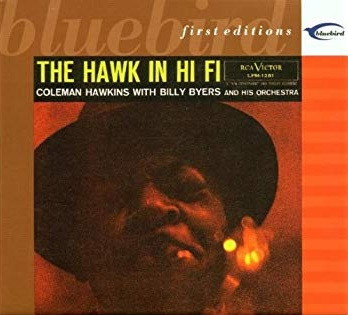
Coleman Hawkins - The Hawk Flies in Hi Fi

 © Copyright ® Steven Cerra, copyright protected; all rights reserved.

Given the phenomenal audio enhancements made possible by today’s digital electrical technologies, it seems almost impossible to remember back to the mid-1950s when analog high fidelity recordings or - Hi Fi - were all the rage.


But if you compare these to what went before them - 78 rpm shellac records - Hi Fi was a considerable reproductive enhancement in sound quality.


The “highs” were more sparkling and the “lows” were more booming and the music was given a more fuller sound due to the broader range of dynamics made possible by this “new” technology [which, ironically, was soon to be superseded by stereophonic sound!].


From a Jazz perspective, one immediate benefit of Hi Fi sound quality were recordings made featuring Jazz musicians performing with string sections. These formats were all the rage during the late 1940’s and early 1950’s as witnessed by those albums with strings cut by Charlie Parker, Don Byas, Clifford Brown, Dizzy Gillespie and Buddy DeFranco.


Some of these “with strings” efforts were more successful than others and the better outcomes were largely the result of an arranger’s knowledge of how to write for strings and the ability of string players [who were generally from a Classical music background] to phrase these arrangements with Jazz inflections.


The trick was to make the strings sound fuller and the phrasing to be more implied than stated. Of course, the other key was to use the string setting to make the soloist sound good especially when playing ballads.


I always thought that one of the more successful “with strings” collaboration was the one between arranger Billy Byers and legendary tenor saxophonist Coleman Hawkins.


The music of this Jazz alliance was released on The Hawk in Hi Fi: Coleman Hawkins with Billy Byers and His Orchestra [RCA Victor LPM 1281; RCA Spain 74321580562] which was recorded at three different sessions in New York City in 1956.


The following liner notes from the original LP will provide you with more background on Coleman, Billy and the music on this landmark recording. They were written by John S. Wilson the music critic for The New York Times for four decades and also an occasional host for a Jazz radio program which was broadcast in NYC and environs.


Luckily, in an era of YouTubes, we are fortunate to have a number of samples from the music on and I have appended a couple of these at the close of Mr. Wilson’s notes.


“COLEMAN HAWKINS is one of those rare figures on the jazz scene—a man who had to invent a means of jazz expression for his instrument. Before Hawkins took his place in Fletcher Henderson's saxophone section in the mid-Twenties, the tenor saxophone had no individuality as a jazz instrument. Hawkins single handedly made a place for it. As Benny Goodman once said. Hawkins "invented the tenor."


In as robust and vigorous an art as jazz, it is not enough simply to break new ground. As an originator. Hawkins briefly set the pace and the style for tenor saxophonists. But by his originality he had opened the floodgates, shown how it could be done, and soon the challenges from other inventive tenor men were coming thick and fast. A less flexible musician than Hawkins could have been buried under this avalanche, forgotten except as an outdated pioneer. Hawkins, however, is of that breed of men who require a challenge as much as they need air and food. 


For the past twenty years, as tenor styles have changed and the approach to jazz has been revolutionized, Hawkins has faced up to a constant challenge. The fact that he has met this challenge eagerly and gladly is reflected in the pliant quality of his playing today. When the gauntlet is down. Hawkins is at his best, as he was when he returned from a long stay in Europe in 1939 to find that both he and his charging, chopping, gut deep style of playing were considered passe. His answer, Body and Soul, is still a classic performance and a model for tenor men. In planning the program for this album. Billy Byers had Hawkins' challenge-susceptibility in mind. 


Byers himself is a somewhat unusual figure on the jazz scene. Only 28 when he wrote and conducted these selections, Byers had already had a jazz career and two studio careers and was embarking on his second career in jazz. He was a West Coast studio trombonist when he was 16 and later —after spells in both Harvard and the Army—a sideman with Georgie Auld, Benny Goodman and Charlie Ventura. He retired from jazz when he was 22 to devote himself to arranging and playing on top TV shows. By 1955 Byers felt he'd been retired long enough. He got back into jazz, mostly as a trombonist at first, then taking on more and more writing and conducting assignments.


Byers first got to know Hawkins' work well in the early Forties. He was an admirer of that work but he noticed that as Hawkins gigged his way around the jazz circuit a repetitious pattern was settling on most of his performances: Hawkins plays the melody. Hawkins plays jazz. Hawkins plays an ending. For this RCA Victor session, Byers was determined to break down this pattern and to face Hawkins with the kind of challenge to which he responds by setting him in three different kinds of groups. 


As Byers had hoped, it brought out three different aspects of Hawkins—the creative Hawkins, the stomping Hawkins and the thoughtful Hawkins. First there was a mixed ensemble— a single trumpet (Jimmy Nottingham), four trombones (Urbie Green. Fred Ohms. Jack Satterfield. Tommy Mitchell), an oboe, two flutes, strings and a rhythm section made up of Hank Jones, piano. Barry Galbraith. guitar. Milt Hmton. bass, and Osie Johnson, drums. 


Hawkins had known Byers as a trombonist but not as an arranger and at this first session he seemed curious to find out about this side of Byers. He plays on these numbers with a reserve, a delicacy that is not always associated with him. Much of this, of course, was his response to the framework in which Byers set him. On I Never Knew, for instance. Byers sets the scene with a solo flute (Julius Baker) before the rhythm section and the rest of the ensemble creeps in underneath for sixteen bars — all this before Hawkins finally bursts into view in the release. On this first chorus, Hawkins is glimpsed only briefly but on the second chorus, as the tempo increases, he takes charge and is off on one of his richly embellished solos. Notice the apt delicacy of Osie Johnson's cymbal and brush break after Hawkins' solo, just before the strings return.


On Dinner for One, Byers brings Hawkins on after a brief string and reed introduction, setting a medium tempo for him with Hawkins playing with an unusually light, fluid tone. There are charming examples of Hank Jones' light, lilting piano on both releases. On There'll Never Be Another You and Little Girl Blue, short, thoughtful trombone solos by Freddie Ohms set off Hawkins' playing.


Next, Byers faced Hawkins with a more familiar challenge—a big. shouting band with lots of loose blowing space for the Hawk to take flight in. This band is made up of five trumpets (Nick Travis. Ernie Royal. Berme Glow. Chuck Kidde. Lou Oles). four trombones ( Green. Ohms. Satterfield and Chauncey Welsch), five saxes (Sam Marowitz. Hal McKusick. Al Cohn. Zoot Sims. Sol Schlinger) and the same rhythm section as before.


His Very Own Blues, a Hawkins composition, leads out of a pretty Hank Jones opening to a riff played by Hawkins and the trumpets, which is very reminiscent of his work in the mid-Forties. As he gets off on his own, he is his familiar, jabbing, angular self, constantly pushed by the band and driven to top it as the band builds in back of him. 39"-25"-39", allegedly a descriptive title, turns Hawkins and the trumpets loose at the same pace.


The Bean Stalks Again, another riff-based piece but at a moderate tempo this time, leads off with a muted trumpet chorus by Chuck Kidde. There is a typical bit of Hawkins ingenuity as he picks up the riff under Kidde, takes it down, kneads it, swings it and builds it back up again before Kidde takes the figure quietly on out. I'm Shooting High also pairs Hawkins and Kidde and gives Hank Jones a brief moment in the spotlight on the second chorus.


Byers' final challenge to Hawkins is double-edged —a band made up of a big string section (fifteen pieces), a legitimate woodwind quartet, rhythm section, but no brass, plus, as one of the selections. Hawkins' most famous number. Body and Soul. Many of the changes in jazz in the past seventeen years, and the changes in Hawkins, are summed up in the differences between this Body and Soul and Hawkins' 1939 version. He challenges his old self from start to finish —and particularly at the finish as he deliberately sets out to outdo his old cadenza.


Throughout these pieces with the string section Hawkins plays meditatively, often with great deliberation. Notice the quiet blend he achieves with the strings and woodwinds near the end of The Day You Came Along and the smooth, melodic quality of his playing on his own tune. The Essence of You, as he comes in after the strings have set the mood. Other high points: Hank Jones' lovely piano passages on both The Day You Came Along and Have You Met Miss Jones and. on this number, the lift that is given to Hawkins' playing by the brilliance and polish of the string section led by Gene Orloff.”                                                                                                 —JOHN S. WILSON


Monday, September 13, 2021

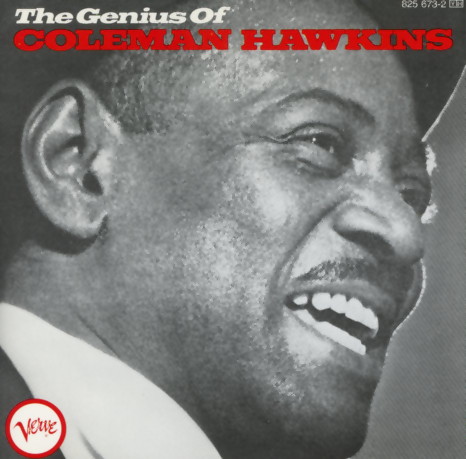
The Genius of Coleman Hawkins

 © Copyright ® Steven Cerra, copyright protected; all rights reserved.


Every so often, I like to pull a record out of the collection and share some comments and thoughts about it with you. I’m especially fond of calling to your attention recordings by musicians who helped me - in pianist Barry Harris’ phrase - “look out a bit.” [In other words, that helped to broaden my understanding of Jazz.]


Such is the case with The Genius of Coleman Hawkins [Verve 825 673-2] which features “Bean” with a rhythm section comprised of pianist Oscar Peterson, guitarist Herb Ellis and bassist Ray Brown - the Oscar Peterson Trio of that time - augmented with drummer Alvin Stoller, a wonderful player who would go on to become a first call studio drummer.


“Genius,” notwithstanding, on his recordings, “Hawk” always put forth a straightforward interpretation of songs from the Great American Songbook along with a few tunes from the Jazz Standards and the occasional original.


On The Genius of Coleman Hawkins the melody for each tune is stated in a recognizable manner, Hawkins improvises for a chorus or two and the group then takes the tune out. All but one of the 12 tracks are 3.30 to 4.00 minutes long and each manages to encapsulate one or more aspects of Coleman’s genius as described in the accompanying notes to the original LP by the distinguished Jazz writer and critic Nat Hentoff.


“One value judgement on which everybody in jazz agrees is the perennial vitality and imagination of Coleman Hawkins. Now in his mid-fifties, Hawkins can still take command of any session in which he becomes sufficiently interested. He can still record with the most "modern" players (Thelonious Monk, for one example); and he is still recognized by fellow musicians as one of their continuing resources. Sonny Rollins, for instance, always lists Bean when asked the tenor saxophonists he most admires, and these days so do many modernists even younger than Sonny.


Hawkins' stature has never been in doubt historically since he began — while with Fletcher Henderson in the twenties — to liberate the tenor saxophone and become the first major, pervasive influence on that instrument. Jazz fashions being as mercurial as they are, however, he experienced a relative eclipse in poll-like estimation for some years in the forties and even into the early fifties when the Lester Young-dominated school of tenor was predominant. Hawkins' "return" (he had never, of course, been away) to interviews in the jazz magazines and higher rungs in the polls was partially set in gear by the rise of such younger, post-cool players as Sonny Rollins who clearly owed him as well as Charlie Parker a basic debt.


Coleman himself has never worried especially about who's been in office nor, unlike some of his generation, has he become embittered by the changes in styles and popularity. He hired Monk and Dizzy in his bands and on his records during that period when "bop" was used as an epithet by most writers and even by many older musicians. "It's all a natural way that jazz grows," he said recently. "You can't stop it. That's the way it is, and you're bound to pick up things yourself if you listen."


Hawkins, while always remaining strongly himself, has always been listening. Garvin Bushell, while traveling with Mamie Smith, heard Hawkins in the pit band of the 12th Street Theatre in Kansas City as early as 1921. "He was ahead of everything I ever heard on that instrument. It might have been a C melody he was playing then. He was really advanced. He read everything without missing a note. I haven't heard him miss a note yet in 38 years. And he didn't — as was the custom then — play the saxophone like a trumpet or clarinet. He was also running changes then, because he'd studied the piano as a youngster. The only thing he lacked in the early twenties," Bushell added, "was as strong a sense of the blues and the 'soul' the southern players had. He was like a typical midwest musician of that time in that respect."


Compare, however, his first recordings with Henderson with those that followed his growing absorption of the influences brought to New York by players from the south and southwest, most notably by Louis Armstrong in his stay with the Henderson band. By the end of the twenties, Hawkins was supreme on the tenor. Wherever he traveled, he was looked up to by all the younger players. Jo Jones, explaining a rare time when Coleman Hawkins was bested at a session (in Kansas City by Ben Webster, Lester Young and Herschel Evans) points out: "You see, nobody in those days would walk in and set up with Hawkins, except maybe in New York where Chu Berry was just coming up. But most of the time at sessions guys would just be trying to show Hawkins how they had improved since he had last heard them."


Hawkins continued being the  arbiter for many young musicians  — without

publicity — for years. British writer Nevil Skrimshire noted in the Jazz Journal:


"Coleman Hawkins was apparently one of the musicians responsible for Oscar Peterson's discovery. Peterson told me that one night at a club in Toronto, Hawkins sat and listened to him all evening without saying a word. When everyone had gone, Hawkins asked him to play a tune. He said, 'I'd like to hear It's The Talk of the Town but I'd like to hear it in B natural.' As Peterson said to me, he managed that one and a couple of other teasers and was thus accepted by Hawkins."


Hawkins enjoyed this date. He'd played with the Peterson trio before on the JATP tours; and with his customary disinclination to go into long verbalizations of music, he said of this session: "It all went down pretty easy. We got several first takes that were so good we didn't do any more. They were all 'heads' and I picked most of the tunes." The original, Blues for Rene, is by Hawkins.


This is unfettered Hawkins — no strings, no paper, nothing but his horn and rhythm. He remains as described by Benny Green, the British musician, in a chapter in The Decca Book of Jazz: ". . . He was the first of the jazz saxophone virtuosi, with a technique equal to the task of playing anything his mind could conceive. And his mind could conceive patterns of great ingenuity and beauty. For all the apparent hot-headedness of Hawkins in full cry over a faster tempo or his seeming blind fervor on a ballad, the Hawkins mind behind the Hawkins heart was always perfectly poised, weaving ingenious melodic patterns almost mathematical in their precision and in the inevitability of their resolutions."


Inevitability, the feeling that a solo could not have been otherwise, is one mark of a major improviser. Coleman Hawkins, for one.”


—NAT HENTOFF, Co-Editor, The Jazz Review


Wednesday, June 10, 2020

Coleman Hawkins - "How Deep Is The Ocean" - An Analysis

© Copyright ® Steven Cerra, copyright protected; all rights reserved.


I came across the following analysis of what made the late tenor saxophonist Coleman Hawkins [1904-1969] such a brilliant improvisor when I was researching my three-part blog feature on How The Rhythm Section got its name in Jerry Coker’s How To Listen To Jazz 

Jerry Coker, himself a teacher, composer/arranger, and noted saxophonist, has annotated every aspect of The Hawk’s performance on the 3.26 version of How Deep Is The Ocean which appears in the following video.


I have interspersed the video at several points in Jerry’s explanation of what’s going on in Coleman’s performance to make it easier for you to stop and start the video as you are reading the annotation.

Of course, Coleman’s renown for his 1939 solo on Body and Soul but he employs some similar techniques on How Deep Is The Ocean which was recorded in 1943 around the time that Bebop was coming into existence at Minton’s Playhouse and Clark Monroe’s Uptown House in NYC. And although Coleman is not playing in the bebop style per se what he is playing sounds very “modern” and in that sense almost timeless - like a solo that could have been recorded today.

It’s no accident that Coleman hired some of the early beboppers in his bands and that the beboppers held him in high esteem both because he took a chance on employing them and because he took chances in his own approach to the music.

Here’s how Jerry explains the elements that make Coleman’s solo on How Deep Is The Ocean so unique.

COLEMAN HAWKINS on "How Deep Is the Ocean"

vehicle type:    Standard (ballad) formal structure:    A(8)-B(8)-A(8)-BA(8)

arrangement:    4-measure piano solo introduction loosely placed melody chorus by tenor saxophone, with rhythm accompaniment, improvised chorus by tenor saxophone, with soft horns and rhythm section accompaniment improvised cadenza by tenor, followed by chord

Analysis/Annotations

Coleman Hawkins was an extraordinary improviser of ballads. He also played the blues and fast tempos commend-ably, but great ballad players are rare, and it was his classic  solo on "Body And Soul" (1939) that established his reputation for inspired mastery of the ballad. Three of his ballad solos were under consideration: "Body And Soul," "Say It Isn't So," and "How Deep Is the Ocean." The last was chosen, somewhat arbitrarily, because it contains a slightly greater number of Hawkinesque elements.

1.   Note the progression, which has both slow and fast harmonic rhythms and contains chord sequences that descend in semitones (chromatic). It also uses an interesting device in the first four measures of the A sections; the chord is the same for all four of the measures, but the bass line descends chromatically, producing a change of scale without actually changing the chord. Listen carefully and you can hear this device taking place in Hawkins' solo at many points in both choruses. Often it will sound as though he is playing the descending bass notes, but adding many other notes in between each of the longer, emphasized bass notes. The progression to the entire selection would have been apparent, in sound, even if there had been no accompaniment other than  Hawkins's self-accompanying phrases.
2.   Listen to the vibrato of his opening phrase and at the end of the selection. He is sometimes identified by that vibrato, though it is deeper and more pronounced than on perhaps any of his recordings.
3.   Listen to the manner in which Hawkins phrases the melody in the first A section (his first entrance). Because he is loosely rendering the melody and because he is implying the progression between the melody phrases, it would be helpful to listen to a recording of the tune by a group or player playing the given melody in its purest, simplest form, so that the listener will know which of Hawkins' notes are from the given melody and which are not.
4.   Hawkins decorated the melody so heavily in the next two sections (B and A) that the given melody is mostly implied, and in the last eight measures of his first chorus (BA) he has virtually abandoned the given melody altogether. Jazz players in general were beginning to adopt such practices to allow more time for creative improvisation. This became unnecessary with the invention of the long-playing (33-1/3 RPM) record.


5.   The harmonic device mentioned in # 1, in which the first four measures of the A sections have only one chord but in which a descending bass line causes changes in scale, produces an interesting scale in the second measure of those four measure sections, called the whole-tone scale. The name derives from the fact that only whole steps (two semitones equal a whole step) are used in constructing the scale, causing the scale to have a distinctive sound. Listen to what Hawkins played the second measure of his second chorus, where he used the whole-tone scale, not in a way that sounds like a scale, but like descending chord patterns. In the eighteenth measure of the second chorus (which is also the second measure of an A section), he plays a nearly identical pattern. As mentioned in Chapter 4, improvisers often hear (in their mind's ear) the same pattern against the same chord repeatedly.
6.   Another example of the association between pattern and chord was supplied by "Hawk" in the twenty-first measure of the first chorus, the fifth measure of the second chorus, and the twenty-first measure of the second chorus. Each of the three locations are identical, harmonically, all being the fifth measure of an A section, and he treated each of these places with the same improvised melody (which has an arresting double-time feeling).
7.   Notice the density of notes in the sixth measure of the second chorus, where he played six notes per beat, deftly. The density level is noticeably greater throughout the second chorus, which, along with the entrance of the horn background, served to raise the intensity level.
8.  The third time he played the double-time idea mentioned in #6, he repeated the idea sequentially through the chords of the twenty-second measure (of the second chorus), leading into the highly intricate, embellished  sequences of the twenty-third and twenty-fourth measures. "Hawk" finally got finger-tied on the last one of those embellishments (going into the twenty-fifth measure), unfortunately, but it is doubtful that anyone else could have executed it as well, much less conceived such a phrase. Hawkins' sequential phrases and fancy embellishments can be found on nearly all of his recorded solos.


9. Like Louis, "Hawk" sometimes speared relatively high notes suddenly after subdued phrases, as a preacher might employ the device to regain the attention of his audience. This trait is evident in many other solos, including "Body and Soul." In "How Deep Is the Ocean," he used the device twice, on nearly identical phrases, in the twenty-sixth measure of both choruses.
10. The tempo stops on the thirty-first measure of the second chorus, where Hawkins played his virtuosic cadenza, again creating the sound of chord motion without relying upon accompaniment.


Friday, October 11, 2019

The 80th Anniversary of Coleman Hawkins' Out-of-Body Experience

© Copyright ® Steven Cerra, copyright protected; all rights reserved.


“This is the granddaddy of jazz ballads, the quintessential torch song, and the ultimate measuring rod for tenor sax players of all generations. Even in the new millennium, this 1930 composition continues to serve as a cornerstone of the repertoire. Yet "Body and Soul" could easily have missed the mark, fallen out of favor and never established itself as a standard, let alone achieved this pinnacle of success. Coleman Hawkins, who did more than anyone in validating the composition's jazzworthiness and will forever be associated with the song, expressed puzzlement over its popularity. "It's funny how it became such a classic," he later mused. "Even the ordinary public is crazy about it. It's the first and only record I ever heard that all the squares dig as well as the jazz people, and I don't understand why or how. ... I didn't even bother to listen to it afterwards.” ...

Although Louis Armstrong made a recording at the time of the song's release, "Body and Soul" most often showed up in the repertoire of white dance bandleaders, such as Paul Whiteman (who had a number one hit with the song in the fall of 1930), Leo Reisman, and Jack Hylton. …

Hawkins was late to the party, and didn't start playing the song until toward the end of the decade, sometimes using "Body and Soul" as an encore, or stretching out with chorus after chorus …

The song has hardly lagged in popularity in more recent years. Certainly its appeal among saxophonists is well documented, and one could easily chart a history of the tenor sax through the various recordings of" Body and Soul" over the decades.  …

For all that, something cold and almost clinical comes across in many performances of this piece. I suspect this may be the lingering after-effect of Cole-man Hawkins's transformation of "Body and Soul" from a romantic ballad to a showpiece for advanced saxophony. Soloists nowadays often tackle "Body and Soul" with something to prove—and that proof may have little to do with exploring the emotional insides of the song johnny Green bequeathed to us. For better or worse, this ballad has become more than a ballad, rather a testing ground where aspirants to the jazz life prove their mettle …”
- Ted Gioia, The Jazz Standards: A Guide to the Repertoire

One Take, and on to Immortality

Coleman Hawkins helped establish the tenor saxophone as an esteemed instrument for jazz expression—and then made ‘Body and Soul’ a must-play for musicians.


By John Edward Hasse
Oct. 4, 2019 The Wall Street Journal 

Eighty years ago next week, tenor saxophonist Coleman Hawkins made a recording of “Body and Soul” that stood musicians on their ears and became one of the most celebrated improvisations in American music.

“For me it’s one of the greatest works of music of any kind from any era,” said pianist Randy Weston. “When I first heard it, I played it note-for-note on the piano…it was something that blew my mind.”

Composed in 1929, “Body and Soul” is the best-known song by composer Johnny Green —then a 21-year-old Harvard graduate who had worked briefly on Wall Street. He was commissioned to write the song by the British actress Gertrude Lawrence. According to writer and Wall Street Journal contributor Will Friedwald, when Green was asked if he had known, while writing it, that it would become the most-recorded torch song ever, he would reply, “No, all I knew was that it had to be finished by Wednesday.” Journeying through five keys, the song’s harmonies make it challenging to play. And the tricky chord changes in the bridge—its third eight-bar phrase—make it unlike any other.

The lyrics are credited to the trio of Edward Heyman, Robert Sour and Frank Eyton. Their bold, sensuous words—“I’ll gladly surrender to you, body and soul”—were sexual enough that in the 1930s, some radio stations banned the song. Louis Armstrong’s trumpet-vocal recording of October 1930 entered it into the jazz tradition.

But it was Coleman Hawkins’s Oct. 11, 1939, saxophone rendition that made it a must-play for jazz artists and placed the piece firmly in the history books. During his 10 years (1924-34) with Fletcher Henderson’s orchestra, Hawkins had helped establish the tenor saxophone as an esteemed instrument for jazz expression. Then he spent five years performing in Europe, honing his style. By the time of this recording, he had defined a personal sound with a sensual, rich tone, full-bodied vibrato, and emotional conviction.

With no rehearsal and just one take, Hawkins captured musical lightning. “His eyes were closed,” his pianist Gene Rodgers recalled, “and he just played as if he was in heaven.”

After the first two bars, Hawkins never renders the melody as written, departing into paraphrase and then pure invention. Through two slow choruses, he takes us on a dramatic, thrilling journey through musical valleys, plains and a mountain, methodically building—with more intense tone, louder volume, and higher notes — to the peak. He compared the storyline to a love-making session. Full of ideas, his virtuosic extemporization ranks as one of the most renowned jazz solos ever, along with Armstrong’s “West End Blues” and John Coltrane’s “Giant Steps.”

This disc was an extreme outlier: Very rarely did a successful jazz recording — unless of a pianist — feature only one musician throughout, or omit a song’s melody. It’s as if, after a few words, an actor performing a Shakespeare soliloquy swerved to improvise an alternate rendering so sublime that countless others memorized it. And as if that very version became an enduring hit with the public.

Hawkins’s magnificent recording challenged musicians to more purposefully mine their own creativity and inspired them to think in unfamiliar ways. His approach on “Body and Soul”—making fresh melodies from the chords of an old piece—opened up prospects leading toward a new modernism and paradigm in jazz, which came to be called bebop.

Hawkins’s “Body and Soul” instantly established him as a star soloist. Tenor saxophonist Sonny Rollins said the record was “ubiquitous in Harlem.” 
Hawkins was as surprised as others by the success of the record, remarking “It’s the first and only record I ever heard of that all the squares dig as well as the jazz people. I don’t understand how and why.” Credit goes to the public for so warmly embracing such a maverick performance. I suspect most listeners sensed the story arc and its carnal climax.

The disc’s popularity led to reported sales of one million copies and kept it on jukeboxes into the 1950s. It’s been honored in the Grammy Hall of Fame, the National Recording Registry, and “Jazz: The Smithsonian Anthology.”
Legions of musicians and fans memorized Hawkins’s inspired solo. Singer Eddie Jefferson set new words to it—a “vocalese” version—which both he and the Manhattan Transfer recorded.

The song popularized the phrase “body and soul,” which has been used as the title of a dozen movies, several hundred CDs, and more than 60 books, including Frank Conroy’s hauntingly musical 1993 novel. But it’s Coleman Hawkins’s triumphant transformation of the song that, above all, will keep it alive for another 80 years. And another. And another.”

— Mr. Hasse is curator emeritus of American music at the Smithsonian Institution. His books include “Beyond Category: The Life and Genius of Duke Ellington” (Da Capo) and “Discover Jazz” (Pearson).


Thursday, September 13, 2018

Coleman Hawkins by Dan Morgenstern


© -Steven Cerra, copyright protected; all rights reserved.


“Coleman Hawkins was a legend in his own time: revered by younger musicians, who were amazed and delighted at his ability to remain receptive to their discoveries; loved by his contemporaries, who were equally astonished by his capacity for constant self-renewal. He was one of those who wrote the book of jazz.


The art of Coleman Hawkins transcends the boundaries of style and time. Fortunately, it is well documented. The great sound and mind that is one of the landmarks of jazz lives on, as in these grooves, awaiting your command to issue forth once more.


Even among the chosen few of jazz, Coleman Hawkins stands out. Hear him well.”
- Dan Morgenstern

It takes a special observer to identify what was special about tenor saxophone legend Coleman Hawkins, because the legendary aspects of Hawkins’ career often overshadowed the actual aspects of the style that made him so distinctive and the contributions as a bandleader that did so much to help other Jazz musicians.


So what we wind up with is largely adoration and hagiography instead of critical insight and discerning explanation.

Enter Dan Morgenstern, a long-time observer and astute commentator on Jazz and its makers.


Dan is also one of the few Jazz critics who could write about the not-so-great closing years of the great man’s career with a gentleness and compassion that is a reflection of his love for Coleman.


Morgenstern, winner of an almost embarrassing number of Grammy Awards for his liner notes, did justice to the great saxophonist in 1973 and won yet another Grammy when he wrote these notes for the album The Hawk Flies [Riverside RLP-233, Original Jazz Classic CD OJC-027].


“Even among the chosen few, the extraordinary men and women who make up the peerage of jazz, Coleman Hawkins stands out.


To begin, there is his sound, a thing of beauty in and of itself. Hawkins filled the horn brimful with his great breath. Sound was his palette, and his brush was the instrument that, for jazz purposes, he invented—the tenor saxophone.


In this post-Coltrane age, the tenor sax is so prominent a feature of the landscape that it's hard to imagine it wasn't always there. Lester Young once said, accurately, "I think Coleman Hawkins was the President first, right?," here meaning "president" in the sense of founding father. Which wasn't the sense in which Billie Holiday had laid "Pres" on Lester—at a point in time when the president of the United States was a great man, Number One in all the land.


Tenor time in jazz begins in 1924, when Coleman Hawkins joined  Fletcher Henderson's band. In a decade there, he first mastered, then established the instrument. While trumpet still was king, it was due to Hawk that tenor became president. Thus jazz became a republic in the Swing Era. King Louis was peerless by definition, but his powerful message unlocked the magic in other noble souls. If we hear young Coleman Hawkins both before and after Armstrong joined Henderson, the point is clearly made.


The saxophone family of instruments had been invented by Adolphe Sax to mirror the range and variety of the strings; he wanted his instruments to sing, to have the warmth of wood and the power of brass, and thus created a hybrid of wind mouthpiece and brass body, unlocked by a new system of keys. He did this in the 1840s, but with the exception of Bizet, Debussy, and later Ravel, no major "serious" composer knew what to do with the new arsenal of sound. Until it was discovered and mastered by jazzmen in the early 1920s, the saxophone remained a brass band and vaudeville instrument — a novelty.


Coleman Hawkins's first instruments in St. Joseph, Missouri, were piano and cello. (Of all the saxophones, the tenor most resembles the cello in range and color.) As a boy, he heard and saw The Six Brown Brothers in vaudeville. They used the whole range of saxes, from sopranino to contrabass, and with all their clowning really knew how to play. Young Coleman began to explore the saxophone.


Exactly when this occurred is not entirely clear. Hawkins, like so many other performers, prevaricated about his age. It was widely accepted that he was born on November 21, 1904; a date he unsuccessfully tried to adjust to 1907. Still, underneath incessant joking and good-natured teasing about age with his friends (Ben Webster: "I was in knee pants when my mother first took me to hear you." Hawkins: "That wasn't me; that was my father. I wasn't born then!") there ran a current of doubt, and when Charles Graham, doing biographical research, obtained a copy of Hawkins's birth certificate, it read 1901!


By the time the Father of Tenor Saxophone left for Europe in March 1934, he had already created the two prototypical tenor styles in jazz: the fast, driving, explosive riff style and the slow, flowing, rhapsodic ballad form. He made the mold, he was the model: already, Ben Webster, Herschel Evans, Chu Berry, Budd Johnson, and many more had sprung, fully armed, from his high forehead.
To Europe, where the greatness of jazz had been felt mainly through records, Hawkins brought it in the flesh. Sidney Bechet had spent time there back in the twenties, and Louis Armstrong himself had flashed like a comet through England, Scandinavia, the Low Countries, France, Italy, and Switzerland earlier in the thirties. But Hawk came and remained; the first fixed star of magnitude.


When His Erstwhile Henderson colleague, Benny Carter, that master of the alto sax, clarinet, trumpet, and arranger's pen, crossed the Atlantic a bit later and also decided to stay, the two often hooked up. Together and individually they put their stamp on European jazz for decades.


The process was reciprocal. Hawkins's love for certain of the better things in life — good food, good drink, good clothes, pretty women, fast cars — was apparent before he left his homeland, but Europe sharpened and deepened his tastes. His sense of his own dignity and worth also expanded the warmth of European appreciation and adoration. From here on in Hawk was a cosmopolitan.


Meanwhile, there were not just contenders to his crown back home, but a whole new tenor style, introduced by Lester Young. Only a few of Hawk's great European recordings had made their way into the hands of American musicians during his absence. The climate seemed right for battle and the tenor brigade was ready for Bean (as musicians then called him, "bean" being a synonym for head, i.e., brainpower) when he came home in late July of 1939, just before the outbreak of World War II. Chu Berry, Ben Webster, Don Byas, and Lester himself were gathered to greet Hawk at a Harlem after-hours spot called Puss Johnson's (there were many such music spots; the reputation of Minton's is all out of proportion). The master arrived without horn (but with a striking lady), listened, and refused to be drawn into battle. A few days later he returned with horn and reestablished his sovereignty.


Hawk's victory became official with the release, late in 1939, of the biggest record of his career: "Body and Soul." Consisting of just two choruses—framed by a brief piano introduction and short tenor cadenza—it stands as one of the most perfectly balanced jazz records ever made. After more than three decades it remains a model of flawlessly constructed and superbly executed jazz improvisation, and is still the test piece for aspiring tenorists.


Although young tenor men in increasing numbers were taken with Lester's cooler sound and unorthodox phrasing, the Hawkins approach remained firmly entrenched (as the newfound popularity of Ben Webster with Duke Ellington and Don Byas with Count Basie proved in the early forties). There also arose a school of tenors equally influenced by both: Illinois Jacquet, Buddy Tate, Gene Ammons, and Dexter Gordon are examples.


Furthermore, that leader of the new style soon to be labeled bebop, Charlie Parker, symbolized the possibility of a Hawkins—Young fusion. Though fashionable jazz criticism has emphasized only Young's influence on Parker, there can be no doubt that Hawkins, especially in terms of harmony, approach to ballads, and use of double time, also profoundly touched Bird's conception.


The influence was a two-way street. Hawkins was the first established jazz figure of major stature to not only accept but embrace the new music, which he rightly saw as a logical development. Consider this: Hawk was the only name leader to hire Thelonious Monk, the strange piano player from Minton's house band, for a downtown gig (on 52nd Street) and to use him on a record date (the earliest music heard on this remarkable collection, and Monk's studio debut). And this: for a February 1944 date with a larger band, Hawkins hired Dizzy Gillespie, Max Roach, Leo Parker, and other young modernists to back him. And this: at the end of 1944, Hawk took to California a pioneer bop group that included Howard McGhee and Denzil Best. As early as 1947, Hawk used Miles Davis on a record date; a few years later he had him in his band. The 1947 date on this album clearly reflects Hawk’s commitment to the new sounds, and his ability to fit himself into it. (Note also the inclusion of a Monk tune, perfectly interpreted.)


Hawk didn't just adapt to bop; profoundly touched by Parker, he entered a whole new phase of musical development at an age when most players have settled permanently within a given framework.


The new Hawk was most clearly visible in the blues. Prior to the mid forties, Hawkins rarely played blues, and never with much of what we now call "funk." But Bird brought a new blue stream into jazz, and Hawk was nourished by it (hear him here on "Sih-sah" and "Juicy Fruit"). And Bird’s song in Hawk's ear didn't end with the blues. You can feel it throughout tin 1957 session, and in the magnificent "Ruby, My Dear" which stems from a Monk — Hawkins reunion album that co-starred John Coltrane. (The rest of that date, by the way, can be heard on Monk/Trane.)


For many years they had affectionately called him "The Old Man." But he still looked, felt, and played young and it was the Old Man's pride that he could keep up. No resting on laurels for him; virtually everything new was a challenge. But for a while, when Lester's way of playing tenor dominated the scene, and bop had little time to look back, Hawkins fell somewhat out of favor. When producer Orrin Keepnews gave him carte blanche to pick his own men for the 1957 date reintroduced herewith, the result was the first loose, modern jazz date for Hawk in some time. It compares most interestingly with the session of ten years before, and not only for the work of Hawk himself and repeaters J. J. Johnson and Hank Jones. (It is also interesting that Hawk did not choose a bop rhythm section for himself.)

Throughout the fifties, with Norman Granz's Jazz at the Philharmonic and also on his own, he frequently teamed with old friend Roy Eldridge, ten years younger but a fraternal spirit. From 1957 on, the Metropole in New York's Times Square area became their home base. Most jazz writers except visitors from Europe) shunned the place, but musicians did drop in to hear Roy and Hawk: among them, Miles Davis, Sonny Rollins, and John Coltrane.


At the soulful establishment across the street, The Copper Rail, the players and their friends congregated to eat and drink. Even when they were three-deep at the bar, you could hear Hawk's laughter, or his voice emphasizing a point, from anywhere in the house. Though he was not a large man, his voice had a presence remarkably similar to his saxophone sound. Hawk was strong in those days. The new tenor voices, significantly that of Sonny Rollins, seemed closer in conception and sound to him than to Lester, and his star was once again in ascendance. He and Roy made periodic tours abroad. Recordings were again fairly frequent. His personal life was happy. His health seemed robust.


"You have to eat when you drink," he used to say, and he was still following his own rule. A girl I knew thought nothing of cooking him eight eggs for breakfast, and he could go to work on a Chinese dinner for two or a double order of spareribs in the wee hours of the morning with the gusto of a hungry lumberjack. In the course of a working day, he'd consume a quantity of Scotch even Eddie Condon would have deemed respectable, but he could also leave the booze alone when it got to him. When Lester Young died in 1959, not quite fifty, the Old Man told me how he used to try to make Pres eat when they were traveling together for Jazz at the Philharmonic. "When I got something for myself, I'd get for him, too. But I'd always find most of it left under his bus or plane seat when we got off."


Hawk liked Lester very much, but the only tenor player I ever heard him call "genius" was Chu Berry. Other musicians he bestowed this title on were Louis, Bird, Art Tatum, Dizzy Gillespie, and Monk—the latter a personal favorite.


At home, Hawk rarely listened to jazz. His sizable collection was dominated by complete opera sets (Verdi, Wagner, and Puccini) and also included a lot of Brahms and Debussy. Bach and Beethoven were there as well, and some moderns, but Hawk liked music with a big sound and romantic sweep best of all. With his luxurious hi-fi setup, he could fill his comfortable Central Park West apartment with sound, and the commanding view of the park went well with the music. Sometimes he'd play the piano, which he did surprisingly well—always music of his own.


In the final years, which his friends would rather forget but can't, Tommy Flanagan would sometimes drop by and make Hawk play the piano and try to copy down some of the tunes. Hawk was always a gifted composer — even with Henderson — but never had the patience to write the stuff down. By then, the expensive hi-fi equipment had fallen into disuse, the blinds were often drawn to shut out the view, and the sound most frequently heard was that of the TV — on around the clock to keep the insomniac company. As often as not, there'd be food defrosting in the kitchen—chicken, chops, ribs, or steak—but "by the time it's ready for me to fix," he once told me, "I've lost my appetite from this whiskey." He knew exactly what he was doing to himself, but some demon had hold of him.


It had nothing to do with the socio-psychological cliches of art and race so often applied to "explain" jazz artists, but it did have much to do with the fact that he was living alone now, and that his aloneness was of his own making. His last great love gone because in his jealousy he could not accept that a woman could love a man much older than herself, he now chose to accelerate the aging process he had previously hated and successfully fought off. He let his grizzled beard and hair flow freely, and let his once immaculately fitting suits hang from his shrunken frame.


Only work could shake him out of his depression, but now it seldom came. He'd never been one for managers and agents; if people wanted his services, they could call him. But only a few employers — mainly the loyal Norman Granz, sometimes George Wein, a club owner here or there —  would still come through. My friends and I got him some gigs. It was a vicious circle: because he didn't work much, he was rusty when he did play (he had always disdained practicing, and lifelong habits don't change), and because he was rusty (and shaky), he wasn't asked back. Even quite near the end, a few nights of work, leading to resumed eating, could straighten him out, and he'd find his form. But there was no steady work to make him stay on course.


Perhaps it would have been too late; he hated doctors and hospitals and refused all suggestions of medical attention. And since his voice, incongruously, remained as strong as ever and his ego just as fierce, it was difficult to counteract him. He welcomed company but never invited anyone. His daughters would come by to visit and straighten up the house when they were in town. Frequent visitors included Monk and the Baroness Nica de Konigswarter, but the closest people near the end were Barry Harris and drummer Eddie Locke.


Monk was at Hawk's bedside when it had finally become necessary to take him to a hospital. Monk even made the Old Man laugh — but it was for the last time.
Coleman Hawkins was a legend in his own time: revered by younger musicians, who were amazed and delighted at his ability to remain receptive to their discoveries; loved by his contemporaries, who were equally astonished by his capacity for constant self-renewal. He was one of those who wrote the book of jazz.


The art of Coleman Hawkins transcends the boundaries of style and time. Fortunately, it is well documented. The great sound and mind that is one of the landmarks of jazz lives on, as in these grooves, awaiting your command to issue forth once more.


Even among the chosen few of jazz, Coleman Hawkins stands out. Hear him well.”