Sometimes the music on a recording is so engrossing and engaging that I just want you to listen to it rather than have you read about it.
I mean, at some basic level, the music always speaks for itself.
In a larger artistic sense, there is something artificial about trying to describe music in words.
Gerry Mulligan died in 1996 and baritone saxophonist Ronnie Cuber put together The Three Baritone Saxophone Band Plays The Music of Gerry Mulligan as a sort of tribute to him.
Enlisting the assistance of fellow bari sax players Nick Brignola and Gary Smulyan, the band toured briefly and recorded the Dreyfus Jazz CD in 1997.
Ronnie wrote all of the arrangements and selected Andy McKee on bass and Joe Farnsworth on drums to create the rhythmic pulse in a piano-less atmosphere that Mulligan often preferred.
Gerry Mulligan left a huge footprint on the baritone saxophone and I doubt that any player of that instrument in the modern Jazz era has escaped his influence.
Of course, the magnitude of his contributions to Jazz as a composer, arranger and bandleader have few parallels in the history of the music.
I continue to be amazed by the fact that Gerry Mulligan has yet to be the subject of a major biography.
In order to rectify this omission I have published an anthology of articles, interviews and commentaries which you can find on Amazon.com as both a paperback and an eBook - A Gerry Mulligan Reader: Writings on a Jazz Original by Steven A. Cerra.
The title of this CD is a take-off on the 1960 Tough Tenors Jazzland LP recorded by Eddie “Lockjaw” Davis and Johnny Griffin.
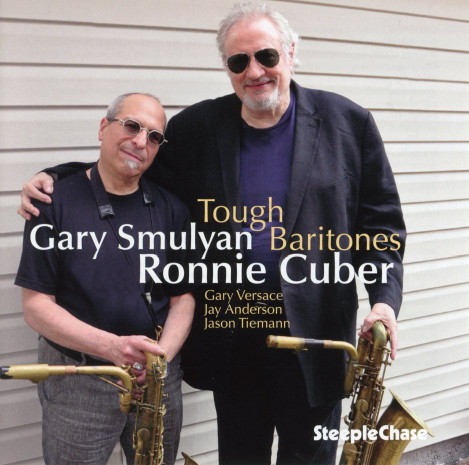
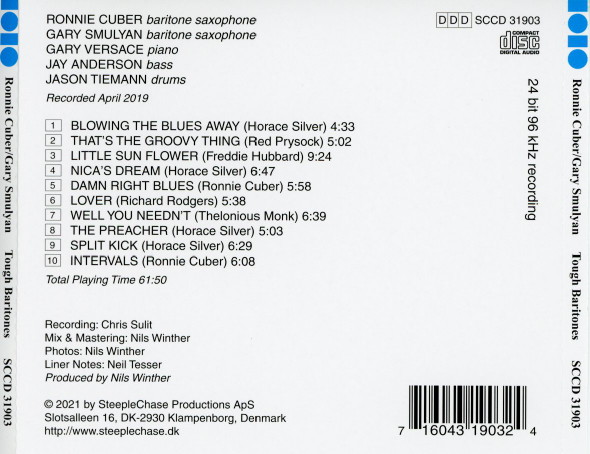
A new recording by Ronnie is always full of surprises and Tough Baritones [Steeplechase SCCD 31903] is no less so.
To begin with, he’s brought along fellow baritone saxophonist Gary Smulyan and - not to look a gift horse in the mouth - one can only ask what took so long?
Another “surprise” of sorts is that this outing finds Gary Versace at the piano instead of at his more usual place with the accordion.
When he’s not offering his unique approach to piano solos, Gary combines with bassist Jay Anderson and drummer Jason Tiemann to basically lay down the rhythm and stay out of the way. While Gary, Jay and Jason are all musicians of the highest quality on their respective instruments, they come together as a unit to propel the music forward in a manner that’s almost unobtrusive by today’s standards.
Given the facility and fluency of both Ronnie and Gary, the reserved quality of the rhythm section allows the listener to hear the full expression of ideas generated by these baritone saxophone powerhouses. Instead of a barrage of clatter in the background, we get chords, riffs and phrases fed by Gary, framed by Jay and punctuated by Jason.
Song and tune selection are always another source of surprise on Ronnie’s albums. I mean, where else can you find two baritone Jazz Masters wailing away on Red Prysock’s Rhythm and Blues classic - That’s The Groovy Thing?
In a way, the unexpected appearance of such a tune on a Jazz recording fits with Ronnie’s approach to all of his recordings, at least, from the standpoint of how I perceive them.
Ronnie in effect throws a recording party by inviting four of the best musicians on the New York Jazz scene to join him and improvise on four Jazz classics by Horace Silver, and one each by Thelonious Monk and Freddie Hubbard. And for added spice, he’s written two originals for the date one of which is a rollicking blues, included a standard from the Great American songbook and the previously mentioned Prysock R&B evergreen.
I mean we're talking about ingredients for the making of a Jazz bash of the first order.
Whenever I listen to Ronnie and Gary, there are always moments when my head whips around and my mind says: “What! Did they really lay that phrase or line down so fluidly and effortlessly on that big horn?” I’m used to finding such amazing moments in their playing, respectively, but never before have I had the chance to hear them combined.
But the combination makes something else apparent and that is although Ronnie and Gary play the same horn, their approach to phrasing is utterly distinctive and personal [Interestingly, too, each came to the big horn from another member of the saxophone family: Ronnie from tenor and Gary from alto].
Front lines made up of the same instrument are always a challenge because of the danger of too much of the same sonority creating an alikeness of sound.
But Ronnie and Gary’s strong individuality, the variety of compositions played at differing tempos with different beats and the ability of the rhythm section to make its presence felt without being overpowering gives the music by this group a pronounced and lasting appeal.
In his insert notes to the recording Neil Tesser comments on other groups with same instruments front lines that went on to make their mark in Jazz lore by working the club, concert and festival circuit and through their now, legacy recordings.
Times have changed and it may be awhile before in-performance Jazz venues are available once again, but I certainly hope that, in the meantime, there will be more recordings forthcoming from these two, tough baritones, because the first one by Ronnie and Gary is certainly magical.
And speaking of the sleeve notes for the recording by Neil Tesser, an experienced and knowledgeable observer of the Jazz scene both past and present, we asked Neil if we could share his annotations with you as part of this blog feature and he graciously consented.
“Old school - but not old-fashioned, Tough Baritones is the sort of album, and even the kind of title, you might have encountered fifty or sixty years ago. Back then, saxophone pairings were in their heyday, and frequent sparring partners carried their own cache. You had "boss tenors'' whom jazz fans instantly recognized from such abbreviated billboards as "Griff & Jaws" Johnny Griffin and Eddie. "Lockjaw Davis'', or "Al & Zoot" (Cohn & Sims), or "Jug & Stitt" (Gene Ammons and Sonny Stitt). John Coltrane and Sonny Rollins engaged in only one such bout, but the title - Rollins' Tenor Madness - became an enduring image for the whole sport. On alto saxophones, "Phil & Quill'' (Phil Woods and Gene Quill) engaged in their own friendly saxophone "conflicts." But you didn't see many Baritone Battles - largely because the hard-bop scene didn't teem with speedy bari-sax virtuosos of the sort who gravitated to tenor and alto.
By the 1970s, though, we had a deeper bench. The masterly veteran Pepper Adams - who had carved his reputation as the preeminent hard-bop baritonist, first in small groups of the 50s, and then through his work with the Thad Jones-Mel Lewis Orchestra - set the standard. Then Ronnie Cuber and Nick Brignola showed up, followed by Howard Johnson. From their example and influence emerged Gary Smulyan in the mid-80s - the latest in that line of big-horn royalty - who would soon be generally regarded as the outstanding player of his generation. Take them all together as a group - a group now augmented by guys like David Schumacher and Glenn Wilson, and such younger baritonists as Brian Landrus and Lauren Sevian - and the premise behind an album like Tough Baritones gains a lot more credence.
Of course, simply matching up Cuber with Smulyan provides all the cred you need. A studio mainstay from the 1960s through the 2000s, Cuber has appeared on literally hundreds of recordings, in virtually every context from Afro-Latin to Zappa). For most of the last half-century, he and Gerry Mulligan essentially defined the baritone sax in mainstream jazz, (although with radically different styles). Now, at the age of 78, he still plays with a combination of ferocity and dexterity that once seemed out of reach for those shouldering this behemoth, with a tone that seems to roar even at a whisper. Smulyan, nearly 15 years his junior, has built on that foundation ever since he switched from the alto sax to the baritone some 40 years ago. He has looked to Pepper Adams, and of course Cuber, for inspiration: he has sanded off the edges but retained the torque, and wrapped it all in a deceptively silky timbre marked by high-def intonation.
After hearing the opening tracks - the infectious, lickety-split Blowing the Blues Away and a marginally more relaxed, in-the-pocket blues by the r-&-b giant Red Prysock - you'll easily recognize one baritonist from the other.
Cuber lakes the first solo in each case, Bui just to keep it simple, Cuber occupies the left channel throughout the recording, with Smulyan on the right.
With those two on hand, employing a rhythm section as fine as this one seems almost greedy. But hey- sometimes the rich get richer. And so we have a dream team of Steeplechase stalwarts lo back up the baritones. Jason Tiemann divides his time between teaching at the University of Hartford's Jackie McLean Institute of Jazz and performing, mostly in New York, where his sparkling kit sound and effortless propulsion have gained much-deserved admiration. Jay Anderson, the label's bassist for comparison, has lent his keen melodic sense and dusky tone - and no little virtuosity - to too many recordings to easily tote up.
And Gary Versace . . . well, Gary Versace. Few straight-ahead pianists in recent years have managed to leap so convincingly out from the crowd. As usual, his playing here focuses on unhurried lyricism (occasionally interrupted by brilliant éclats and jaw-dropping arpeggios); on inventively voiced comp chords; and on flashes of puckish wit. He also manages to adapt to each context without burying his musical profile - in much the way that a chameleon adapts its coloration to blend in with the surroundings, but still retains its immediately recognizable shape.
For a perfect example of this, go to Nica's Dream, the durable Horace Silver hybrid that alternates between two of hard-bop's favorite grooves. (The "A" section is pure Latin Jazz, while the bridge swoops in with a hard-swinging 4/4 beat.) Versace starts his solo with sparse, single-note lyricism, wherein he does more than nod to the tune's composer; he all but genuflects at the shrine of Silver. But rounding into the second chorus, Versace's own persona gradually seeps through. By the end of the solo, we've had the chance to hear the one dissolve into the other -and, not incidentally, we've gotten an object lesson in how an artist such as Versace can absorb and transmute his influences. (The track also demonstrates the signal strengths of each saxophonist. Cuber launches his improvisation with a full-throated cry that remains throughout his chorus, woven into the repeated figures that conclude the solo; Smulyan locks his own emotionality into sequenced phrases with which he builds to an uber-melodic climax.)
The fact that Tough Baritones sounds so relaxed, brimming with ease and good cheer, comes as little surprise to those who took part in recording it. As Smulyan relates, the session was unlike most of those in which he's participated - a throwback to days when a jazz album didn't necessitate a theme, or detailed arrangements, or even, for that matter, a painstakingly curated set list. Cuber arrived at the studio armed with several Silver tunes and one by Thelonious Monk; into the mix came a valued standard (Lover, taken at hyper-speed) and a jazz classic (Freddie Hubbard's Little Sunflower, with standout solos from Smulyan and Anderson); and a couple blues that Cuber cooked upon the spot- including Damn Right Blues, its provenance enhanced by the rhythm section's channeling Les McCann's soul-jazz groove. In between takes, the musicians luxuriated in old band stories and new banter: just a bunch of guys sitting around and making a lovably hard-blowing record, almost by accident.
Observing such a studio session, you might have thought you'd discovered a time-travel machine. But it would have to be an unusually nuanced such device: a Wayback Machine that could plunk you right into the style and milieu of a previous era, without compromising the substance of the era you'd just left. From its retrofit title to the way it transpired, Tough Baritones epitomizes the Holy Grail for anyone wishing to travel back in time: they get to recapture the fondly remembered past while retaining everything they've learned since. Old school - but with a twist.”
“With his latest album, Night Talk, the brilliant arranger and bandleader Mark Masters delves deep into the Alec Wilder catalogue, crafting a vibrant, richly hued collection to spotlight one of modern jazz’s most gifted and singular voices: baritone saxophonist Gary Smulyan. Backed by the virtuosic Mark Masters Ensemble, a stellar line-up featuring four horns and an impeccably swinging rhythm section, Smulyan explores Masters’ imaginative reinterpretations with the emotional eloquence of a great singer paired with the dazzling agility of a master soloist. Night Talk embraces the shadowy grandeur of Wilder’s compositions, from the evocative noir-influenced cover photograph to the dark-tinged luxuriance of Masters’ orchestrations. The pieces are given thrilling new life by the remarkable ensemble, which includes saxophonists Don Shelton and Jerry Pinter, trumpeter Bob Summers, trombonist Dave Woodley, pianist Ed Czach, bassist Putter Smith and drummer Kendall Kay. The cream of the West Coast scene, these musicians have forged long-standing musical relationships with one another and with Masters, in some cases dating back as much as three decades.”
- Kim Giles, New World ‘n’ Jazz
“…masterful…. Leader, arranger, producer, chief cook and bottle washer Masters has crafted nine tremendous settings reminiscent of the work of such creative minds as Marty Paich, Bill Russo, Gil Evans and, say, Gerry Mulligan…. If I don’t hear a better album this year I’ll not complain…. ”
– Lance Liddle, Bebop Spoken Here
“Mark Masters is an accomplished arranger who comes up with hip, unusual ideas for jazz concerts and recordings.”
– Thomas Conrad, JazzTimes
“Masters paints complex, intricate, detailed jazz landscapes, and he has always invited some of the most adventurous and innovative players into his ensemble.”
– Dan McClenaghan, All About Jazz
In an earlier feature Mark Masters, his Jazz Ensemble and his work at the American Jazz Institute we wrote:
“What do Granchan Moncur III, Dewey Redman, Lee Konitz, Clifford Brown, Steely Dan, Jimmy Knepper, Charles Mingus, Gerry Mulligan, and the Duke Ellington saxophone section have in common?
Give up?
The music of each of these artists has been the focus of a reinterpretation by composer-arranger Mark Master who also heads up an organization called The American Jazz Institute.”
Well, it only gets better because to the above list we get to add the music of Alec Wilder in the form of Mark’s latest CD for Capri Records: The Mark Masters Ensemble - Night Talk: The Alec Wilder Songbook featuring Gary Smulyan [74162-2].
With this latest release Mark and his associates continue to treat -
“Each musician’s compositional oeuvre [in this latest effort, Alec Wilder] becomes the object of a year-long arranging “project” for Mark who often puts on concerts of the reinterpreted music featuring musicians who have evolved, over the years, into ongoing members of the Mark Masters Ensemble.
After the musicians have had a chance to rehearse the music associated with these projects and perform it in concert, Mark then takes the ensemble into the recording studio to save the music for posterity. Some of it is issued on a self-produced basis, but more recently, many have been issued on Capri Records and you can locate copies of these AJI CDs via online vendors or order them through the AJI website.”
While looking for a broader context in which to place a feature about The Mark Masters Ensemble - Night Talk: The Alec Wilder Songbook featuring Gary Smulyan I came across a number of Alec’s references to Jazz musicians and their music. I’ve included some of these below as they contain observations and insights which can be applied to Mark and the ensemble.
Perhaps the best place to start would be with this quotation which begins the insert notes to Mark’s new recording.
"Jazz musicians are a phenomenon. I don't believe the layman has any notion of the miraculous chain of events which occur when a jazz musician plays." — Alec Wilder
And these excerpts from Desmond Stone’s biography of Wilder also shed some light on Wilder’s perceptions of Jazz:
“Wilder loved jazz players because he felt they had an edge. He also believed that every great classical musician who liked jazz played the better for it, with a looseness alien to the more rigid academic musicians. "All the great musicians, … —I could mention 50 of them—they all love jazz. ...
Believing as he did that all music belongs in the same broad stream, Wilder refused to put jazz artists or any other kind of musicians into an isolation booth. He liked jazz musicians for the same basic reasons he liked Jerome Kern, Harold Arlen, Richard Rodgers, Cole Porter, and the other greats of American popular song. He spent hundreds of nights listening to jazz improvisations because he believed that good jazz players take the same imaginative risks in synthesizing materials that the most inventive and sophisticated songwriters take, and that the source of jazz other than the blues and so-called originals is the standard songs.
Wilder loved jazz players for their passion and vulnerability, but he was also aware that their standards of performance were bound to vary with the improvisations. … "Jazz improvisation is instantaneous; the musicians never do as well on a record date. Some of the most miraculous moments of jazz have gone right up the flue because no one got them on tape." Once, Mulligan, upon being told by a slightly tipsy lady that she was not very impressed by his playing in the preceding set, replied with his wry Irish smile, "Were you here last night?" That, said Wilder, succinctly defined jazz and its evanescence: sometimes it happens, sometimes it doesn't. …”
And this perspective on “Wilder Jazz” from James T. Maher’s insert notes to Marian McPartland Plays The Music of Alec Wilder [Jazz Alliance TJA-10016]:
“One summer evening several years ago, Wilder was standing against the wall in a recording studio on Broadway listening to a septet of wind players, each distinguished in his musical field — commercial, recital, or jazz — rehearsing a new chamber suite he had composed for them. Almost as though they were improvising, they forced the secrets from their parts. Suddenly, the pulse was right. The dour set of Wilder's mouth relaxed. The aeolian texture of the piece emerged: the lines began to balance, each with its proper, constantly changing, sonic weight and color. The phrases took on eloquence. Solo passages began to sing.
The wintry mask dissolved. Wilder dug his fists deep into the pockets of his tweed jacket and began to smile. He was safe, and his music was safe. He gave in to the silent laughter of joy — the open, vulnerable laughter of a boy discovering the white wonder of a windless snowfall.”
It doesn’t take long to find parallels between these comments and opinions about Alec Wilder’s views of Jazz and its makers and Mark Masters, his ensemble and the music and musicians on The Mark Masters Ensemble - Night Talk: The Alec Wilder Songbook featuring Gary Smulyan.
At the outset, like Wilder, Mark Masters takes his music very seriously; it’s not something that’s thrown together and thus recorded in some haphazard manner.
And as with the case of Wilder’s elation at observing the musicians jell during a rehearsal of his wind music, Mark has chosen to call his group an “ensemble” - which denotes a group that comes together to produce a single effect.
Put another way, the literal definition of an “ensemble” is when “all parts of a thing are taken together so that each part is considered only in relation to the entire whole.”
So what we get on the new recording is The Mark Masters Ensemble rendering selections from the Alec Wilder songbook in new interpretations performed by an octet of sterling musicians who blend together so well that the original compositions assume a new texture or sonority.
Moon and Sand, I Like It Here, Lovers and Losers and I’ll Be Around - all familiar Wilder melodies - are given new treatments thanks to Mark’s intriguing arrangements. And while you know it’s Wilder, his music never sounded like this before.
As to the “edge” that comes from taking risks in improvisations that Wilder so loved about Jazz musicians, Mark leaves lots of room for risk-taking with plenty of solo space given to each member of the group, and especially to the featured soloist - baritone saxophonist Gary Smulyan.
Joining Gary’s masterful bari in the reed and woodwind section are Don Shelton on alto, doubling on flute, and Jerry Pinter on tenor sax, doubling on soprano sax.
Bob Summers on trumpet, who has years of experience as a lead player or in the Jazz chair, and Dave Woodley on trombone form the brass section.
And all are ably accompanied by pianist Peter Czach, bassist Putter Smith and drummer Kendal Kay, each of whom is also an excellent soloist.
What you immediately notice upon first listening is how “tight” [together] the band is and how effortlessly they work through what are complicated and complex charts [arrangements].
This speaks to the high degree of musicianship on display, but also to a group that’s been well-rehearsed and well-versed in the music.
How else to explain the ability to get 53.59 minutes of music recorded in one day? Under any circumstances, that’s a lot of music to record, let alone, music that’s recorded well.
The real treat with The Mark Masters Ensemble - Night Talk: The Alec Wilder Songbook featuring Gary Smulyan is that not only does the Jazz fan get the music of Alec Wilder placed in a Jazz context, but it's been reimagined by someone with the experienced compositional and arranging skills of Mark Masters. Add to this the improvisational artistry of baritone saxophonist Gary Smulyan and the creative and disciplined skills of seven more talented musicians, and you are in for a fascinating listening experience.
In its simplest form, a contrafact is a musical composition consisting of a new melody overlaid on a familiar harmonic structure.
Put another way a contrafact is the use of borrowed chord progressions.
Songs that are frequent candidates for such alterations are Gershwin’s I’ve Got Rhythm, Jerome Kern’s All the Things You Are, and Johnny Green’s Out of Nowhere.
The list is endless.
With the coming of Bebop in the early 1940s, the use of contrafacts really kicked into high gear because alto saxophonist Charlie Parker, trumpeter Dizzy Gillespie and other pioneers of the music emphasized the harmonies in the chords to a song as the basis for their improvisations whereas Swing Era soloists generally employed variations on the melodies.
The Beboppers went so far as to use substituted harmonies to alter the original chord progressions which consequently altered the logic upon which their improvised solos was based.
Many of these early Bebop combos were quintets with trumpet and saxophone forming the front-line which was backed by a piano-bass-drums rhythm section. The chords were “fed” to the horns by the pianist in the form of “comping” [short for accompaniment], with the bass player creating lines that outline the harmony while also working with the drummer to create a groove or a feel as a metronomic pulse to help keep the music flowing.
But altering the music with different emphasis on the musical elements was just one way that Jazz changed the manner in which it was played.
Over the course of its history, jazz has also evolved by adding some instruments and dropping others. For example, Count Basie’s classic swing rhythm section consisted of piano, guitar, bass, and drums. The bop revolution dropped the guitar, retaining it only as an occasional solo instrument.
Joe Goldberg commented in his Jazz Masters of the 1950s: “In 1952, Gerry Mulligan, who has always had an affinity with several different eras of jazz, took the piano back out, and the result was the Gerry Mulligan Quartet, one of the most highly successful small groups of the fifties.
Mulligan … wrote in the notes to his first Pacific Jazz LP - ‘To have an instrument with the tremendous capabilities of the piano reduced to the role of crutch for the solo horn was unthinkable ... I consider the string bass to be the basis of the sound of the group, the foundation on which the solo builds his line , the main thread around which the two horns weave their contrapuntal interplay. It is possible with two voices to imply the sound or impart the feeling of any chord or series of chords as Bach shows us so thoroughly and enjoyably in his inventions.
‘When a piano is used in a group it necessarily plays the dominant role; the horns and bass must tune to it as it cannot tune to them, making it the dominant tonality. The piano's accepted function of constantly stating the chords of the progression makes the solo horn a slave to the whims of the piano player. The soloist is forced to adapt his line to the changes and alterations made by the pianist in the chords of the progression,
‘It is obvious that the bass does not possess as wide a range of volume and dynamic possibilities as the drums and horns. It is therefore necessary to keep the overall volume in proportion to that of the bass in order to achieve an integrated group sound."
By 1959, the pendulum of taste had swung so far that the English critic Max Harrison could say of Mulligan's once-revered quartet that "its instrumentation threw emphasis on clear melodic expression and simple rhythmic construction. The resulting lack of tension was another attraction. Whereas artists like Tatum or Parker compel our attention with the hectic complexity of their work, the somewhat detached relaxation of the Mulligan Quartet entertains and even intrigues the listener without unduly involving him. Thus, audiences who failed to respond to the uncompromising attitude of bop or the Davis 1948 band were able, in listening to the Quartet, to congratulate themselves on their advanced taste while really experiencing quite straightforward music. . . . The air of rather smart disillusionment that surrounds interpretations like Funny Valentine would also be sympathetic to superficially sophisticated audiences."
As the legendary bassist Charles Mingus succinctly said - “You have to improvise on something” - and these contrafacts with their original and/or substituted chord progressions became the format of choice for Bebop and much of the mainstream modern Jazz that followed it.
OnAlternative Contrafacts [Steeplechase SCCD31844], Gary Smulyan takes melodic substitutions and instrumentation reduction one step further by limiting the instrumentation to baritone saxophone, string bass and drums.
As a result, there is so much space that you can almost hear the music breathe.
The uncluttered atmosphere also lends itself to a very close interaction between the players: Gary on baritone sax, David Wong on bass and Rodney Green listen to one another very intently and inspire each other.
Neil Tesser and Gary define the specific meaning of “alternative contrafact and more about the music on this CD in the following insert notes. Oh, and by the way, as you will soon read, Gary’s done this sort of thing before!
“You've heard of "alternative facts." But Alternative Contrafacts?
"It's not political," Gary Smulyan says, the words tumbling out with his customary energy. "It's meant to be humorous. I've just always loved contrafacts" - which, despite what that word seems to indicate, are actually not "contra" to the truth.
In music, the word "contrafact" refers to a new melody line that follows the chords and structure of an existing composition. This methodology dominated the bebop years, when musicians regularly superimposed complex melodies on such workhorse chord progressions as Indiana (which became Miles Davis's Donna Lee), or What Is This Thing Called Love? (most famously recast as Hot House); I Got Rhythm underlies a bookful of jazz tunes. These variations allowed the boppers to inject their ideas on melody, harmony, and rhythm into familiar designs; not incidentally, it also spared them from paying royalties to the original composers, since by law, only melodies not chord progressions can be copyrighted.
So a contrafact is, literally, an "alternative" to the underlying composition, and contrafacts constitute hundreds and possibly thousands of jazz melodies from the bop years to the present. But this takes us back to the original question: what's an "alternative contrafact"?
Well, for every well-known contrafact, you can find plenty more that, for whatever reason, never gained traction among musicians. "There are so many of them that were recorded just once and then disappeared. Some of them were never played on gigs; some were composed and recorded for the sole purpose of documenting them" speculates Smulyan, who has been fascinated by this cornucopia of material for decades. He has made it a goal to corral as many as possible of the more obscure examples - the alternatives to Hot House and Donna Lee, among the scores of other tunes that lent themselves to these reworkings.
For listeners with an ear for old standards, Smulyan posits a game of sorts: Try to figure out the underlying tune without referring to the rest of this essay.The instrumentation on this disc makes that harder than you'd think. Smulyan's trio features neither piano nor guitar - the instruments that would normally outline the chords, which would make it easier to identify the original tune once the improvising begins. But for a clue, here's a list of the originals that inspired these contrafacts: Yesterdays, A Foggy Day, Love Me Or Leave Me, Strike Up The Band, Out Of Nowhere, Dinah, Lady Be Good, and Get Happy. (Mix and match.)
You've likely encountered few of the songs Smulyan has gathered for this collection. He readily admits that they're "really obscure"-even more so than on his two previous forays into arcane contrafacts, Hidden Treasures (2006) and More Treasures (2007) "But it's been an interesting project to resurrect them" he points out. I could make 20 records like this; it's fun just finding the recordings of all these things."
He's had help.
In 1970, a pianist and psychiatrist named Maurice "Reese" Markewich literally wrote the book on contrafacts when he published a now unavailable volume titled Bibliography Of Jazz And Pop Tunes Sharing The Chord Progressions Of Other Compositions. Smulyan stumbled across this book in the 1990s, and soon spent considerable time with Dr. Markewich, visiting him in an office filled with "folders and folders of sheet music and lead sheets." As Smulyan explains, "This has become my little reference book "- but one that he can't recommend to friends, since he has never unearthed another copy.
In the Bibliography, you can turn to any page with the heading of a familiar standard and find a list of the contrafacts based upon it. In addition to the well-known, it includes hundreds of tunes that, true to Smulyan's description, "were recorded just once and then disappeared." It has proved so valuable to his ongoing excavation of alternative contrafacts that Smulyan dedicates this album to Markewich (as well as to the memory of his mother Sonia).
You might wonder why it matters to have yet another contrafact to, say, Green Dolphin Street. After all, if the soloing takes place on the same chord structure as all the other Dolphin contrafacts, what's the big deal? But as Smulyan points out - and then demonstrates throughout this disc - savvy improvisers don't simply run through the melody and toss it away. "Very often, the melody is a springboard for how you improvise on that song. It can become a sort of reference point for the solo." In other words, the best players can take a cue from something in the contrafact - a phrase, a rhythmic motif, the alternate chords implied by the melody - and incorporate it as they spin their variations. And this trio comprises some of the very best players.
David Wong owns a light but authoritative touch that distinguishes his solo passages (bowed or plucked) and especially the understated solidity of his time; his stand-alone accompaniment to Smulyan on the opening passage of Deep People offers a good example. On drums, Rodney Green employs an array of consistently inventive rhythmic materials, from the hard-bop pulse of the opening track, to the lovely brush work of Moodamorphosis, to the Latin drive of On The Minute. As for Smulyan, his mastery of his instrument brooks no doubt, and he puts it to the service of a fiery, intense imagination - just as he has on the dozen albums under his own name and in the big bands he has so ably anchored, including Woody Herman's Young Thundering Herd, the Vanguard Jazz Orchestra, and the Mingus Big Band. Many of us consider him the leading baritone saxophonist of his generation - he just keeps racking up those poll victories - and in the context of this freewheeling trio, you can hear why.
As for the tunes themselves:
Vodka, by pianist Mal Waldron - first recorded by a sextet that paired tenor saxists John Coltrane and Paul Quinichette - is based on Yesterdays by Jerome Kern. Three of these contrafacts refigure songs by George and Ira Gershwin: Jimmy Giuffre's beguiling Deep People (based on A Foggy Day), Paul Chambers's Tale Of The Fingers (from Strike Up The Band), and Moodamorphosis, based on Lady Be Good, written by bop composer Gil Fuller and trumpeter Dave Burns for a James Moody recording date in 1948. The witty saxophonist-arranger Al Cohn used the Depression-Era anthem Get Happy as the foundation for Cohn Pone; of similar vintage is the romantic (You Came Along From) Out Of Nowhere, written by Johnny Green, and transformed by trumpeter Ted Curson into Ahma See Ya on a 1961 album entitled Horn Of Plenty. The American expatriate trumpeter John Eardley appended On The Minute to the framework of Love Me Or Leave Me, a Broadway hit from 1928 by the team of Donaldson and Kahn. Even older is Dinah, written by Harry Akst in 1925; in 1958, Coleman Hawkins wrote a new melody, then reversed the original title to come up with Hanid. The remaining track here, I've Changed, derives from the 1941 torcher You've Changed by Bill Carey and Carl Fischer. It’s not a true contrafact in the sense that it begins with Smulyan's solo, instead of a written melody line to replace the original; I doubt anyone will complain.
All of this would be merely academic if not for the luminous performances throughout. Nearly two decades into the 21st century, cries of "fake news" and "alternative facts" have done a pretty good job of muddying up the public discourse.”