Sometimes the music on a recording is so engrossing and engaging that I just want you to listen to it rather than have you read about it.
I mean, at some basic level, the music always speaks for itself.
In a larger artistic sense, there is something artificial about trying to describe music in words.
Gerry Mulligan died in 1996 and baritone saxophonist Ronnie Cuber put together The Three Baritone Saxophone Band Plays The Music of Gerry Mulligan as a sort of tribute to him.
Enlisting the assistance of fellow bari sax players Nick Brignola and Gary Smulyan, the band toured briefly and recorded the Dreyfus Jazz CD in 1997.
Ronnie wrote all of the arrangements and selected Andy McKee on bass and Joe Farnsworth on drums to create the rhythmic pulse in a piano-less atmosphere that Mulligan often preferred.
Gerry Mulligan left a huge footprint on the baritone saxophone and I doubt that any player of that instrument in the modern Jazz era has escaped his influence.
Of course, the magnitude of his contributions to Jazz as a composer, arranger and bandleader have few parallels in the history of the music.
I continue to be amazed by the fact that Gerry Mulligan has yet to be the subject of a major biography.
In order to rectify this omission I have published an anthology of articles, interviews and commentaries which you can find on Amazon.com as both a paperback and an eBook - A Gerry Mulligan Reader: Writings on a Jazz Original by Steven A. Cerra.
The passing of Sue Mingus [September 24, 2022] and baritone saxophonist Ronnie Cuber [October 7, 2002] in less than a month of one another brought to mind the Mingus Big Band, or at least the one featured on Mingus Big Band 93 [FDM 36559-2] as there have been several versions over the years of the homage big band and its small group counterpart, The Mingus Dynasty.
Both were established by Sue in the years following the death of her husband Charles in 1979 as a means of keeping his memory and his music alive. She also produced legacy albums of Charles’ music, and through his Jazz Workshop publishing company, she made available copies of his compositions and other educational materials for students and educators.
Although Charles spent his formative Jazz years as a bassist in small groups based in California, most notably those led by vibraphonist Red Norvo and woodwind and sax player Buddy Collette, he moved to New York city in the mid-1950s. Since then, I always identified Charles as an integral part of the vibrant New York Jazz scene.
Mingus’ music always had an aura of youthful, hard driving, high powered energy about it, and the complimentary ambience of New York’s clubs, concert halls and recording studios were perfect platforms on which to display it. If you’ve ever been to New York City, you know that the place is all about energy: it gives you a boost of vitality during your stay and then drains your vigor as you depart. One needs a vacation to recover from a vacation in New York City!
Not surprisingly, accomplished young Jazz musicians based in New York who came of age idolizing the music of Mingus appreciated the chance to participate in both The Mingus Dynasty and The Mingus Big Band to add their creative “energy” to Charles’ legacy such that Sue rarely had to look far for participants to play in either. The band also provided a vehicle for both established arrangers [e.g. Sy Johnson] and players in the band who wanted to try their hand at arranging to develop the rich melodies, divergent harmonies and challenging rhythms associated with Mingus’ Music into new interpretations.
This assessment is supported by Sam Burtis’ statement in the opening line of Gene Santoro’s insert notes to Mingus Big Band 93 [FDM 36559-2]
"This is New York music," says music director Sam Burtis as we walk across the big recording room upstairs at Manhattan's Clinton Studios. "Fletcher Henderson, Duke, Monk, Mingus - Their music is about the weird energy of this place. And the young guys in the band react to that and take it in their own directions." In fact, a number of the younger players like Craig Handy and Steve Slagle, as well as alumni like Jack Walrath and Ronnie Cuber, have contributed reworked charts which they then conducted. The easy-going camaraderie is intense and telling. It reflects the year and a half this pool of players has been tackling Mingus in the basement of the Time Cafe downtown where, workshop-style, they call tunes randomly in front of usually-packed houses.
Most of these tunes have not been recorded in twenty years or more and in the hands of these musicians they come alive in new ways. The weekly gig has honed the band's chops and given the musicians time to live through Mingus's music deeply, to internalize its demanding but modular, open-ended magic. Burtis continues: "The crowd that comes down to the club every
Thursday is young. They're the rock generation and they're drawn to this music because it's got such power. It kicks out at you the way good rock does. It's got that energy." There are those who say Mingus's music hasn't had that energy since he died, that his Gargantuan presence loomed over his musicians in his workshops, that he insisted in the primacy of the hands- on, by-ear learning that evolved during jazz's first few decades, that he deliberately, turbulently, stirred up trouble to highlight and heighten the music's already-high-octane emotions. But Mingus was, first and foremost, a composer, extending the genealogy that includes Jelly Roll Morton and Duke Ellington. His compositions have now taken on a life of their own, and members of the Big Band understand that Mingus helped lay the foundations for the post-bop musical syntax that has shaped them, that he's both their ancestor and their contemporary.
The tension between composition and improvisation (instant composition) is the dialectic heart of jazz. There are repertory bands, born of the neoclassical vogue of the last few years, that play only original charts complete with transcribed solos. But it is the openness of Mingus's music - the freedom that allows musicians to get inside the music and bring their own individuality to it - that keeps it so modern, that both replicates Mingus's own deliberate unpredictability and attracts a younger crowd (of players and listeners) via its energy. Listen to how it works in the wailing gospel choruses of "Ecclusiastics", or the gutbucket fervor of "Moanin"; or the circus-tent whimsy of "Don't be Afraid, the Clown's Afraid, too", or the shadowy, flickering interiors of "Weird Nightmare". The point is to re-open Mingus's music to contemporary experience, which it helped mold, and use the feedback loop to re-define the music from yet another perspective. And so Charles Mingus's rich and sprawling compositional legacy is like New York itself - an inspired, stormy nexus of past, present and future that's constantly being re-invented. The dynamic re-interpretations of the Mingus Big Band remind us just how contemporary and pertinent that legacy continues to be.”
- Gene Santoro
The booklet notes continue with Sue Mingus offering these observations about Mingus, the music and the musicians on this recording.
"It's like the city", said the trumpet player. "It's about chaos and contradiction, discipline and crazy unexpected beauty". "It's music", said the drummer, "that wears a tuxedo but has rolled around in the dirt." Shifting tempos, clashing harmonies, the unmistakable beat of the city.
Listen to Ronnie Cuber musically strolling down 42nd Street, recalling an encounter with Mingus at Birdland back in the Fifties as he introduces "Nostalgia in Times Square" with elegant beatnick cool. But make no mistake. Nostalgia is exactly what this 14-piece band is not about. What it's about is the chemistry which has developed - here and now - among a growing pool of New York's finest musicians as they work out on some of the most challenging music in jazz.
Almost 100 musicians have played on these charts since the Mingus Big Band first unpacked its instruments in September, 1991, in the basement nightclub of a Manhattan cafe. Some twenty of them are on this recording. The band's hard core center is the Mingus Dynasty quintet, expanded to include several musicians from the orchestra which has performed Mingus's two-hour work "Epitaph" since 1989, expanded further still to include a host of new musicians able to explore the textures and densities and wider spectrums of Mingus's big band charts.
Not many in the jazz community played Mingus music after his death in 1979, which was why these bands were formed. Mingus music was intensely personal music, solidly linked to its taskmaster. And it was hard. The music could be an obstacle course at break-neck speed for the unwary. Or a deceptively simple trio of exquisite melodies like the tune "Self-Portrait in 3 Colors" on this recording. On a rousing gospel shout straight out of Mingus's roots in the Holiness Church, called "Ecclusiastics". It could be a workshop, as Mingus originally conceived it, involving stops and sudden rehearsals in front of a live audience, with nowhere to hide. It was music that demanded everything you had, and more.
But these compositions - if not quite slated for Easy Listening - are becoming familiar. The rich legacy which Mingus left behind is reaching out to audiences and to other musicians that are suddenly ready. Something is going on in the basement. And the Mingus Big Band, with its first recording in its pocket, is about to say what.
-Sue Mingus
If you are looking for a place to begin your Mingus Big Band Journey, you need look no farther than Mingus Big Band 93 [FDM 36559-2]. Fortunately, I have been able to embed YouTube videos below for many of the tracks on this recording.
Incidentally Ronnie Cuber’s playing on these recordings is some of the best on record and that’s saying something for a brilliant player who’s recording career spanned 50 years and covered every context of popular music imaginable from straight ahead hard bop to gospel and everything in between.
“Cuber has become increasingly in demand as a clinician and guest artist at university and college music programs across North America. His concert appearances around the world continually draw rave reviews and enthusiastic audiences, whether he appears as leader, guest soloist, or with the Mingus Big Band or his latest labour of love, Three Baritone Saxophone Band (with Nick Brignola and Gary Smulyan). His playing sounds stronger than ever: an exciting amalgam of hard bop, soul, R & B and Latin that is instantly recognizable.”
- Jon Gudmundson, insert notes to Ronnie Cuber and The Metropole Orchestra: Love for Sale
Gordon Jack is a frequent contributor to the Jazz Journaland a very generous friend in allowingJazzProfilesto re-publish his perceptive and well-researched writings on various topics about Jazz and its makers.
Gordon is the author of Fifties Jazz Talk An Oral Retrospectiveand he also developed the Gerry Mulligan discography in Raymond Horricks’ bookGerry Mulligan’s Ark.
The following article was published in the October 18, 2022 edition of Jazz Journal.
“The prodigiously talented Ronnie Cuber’s association with the baritone saxophone began quite by chance. He was born into a musical family in Brooklyn on Christmas Day 1941. Beginning on clarinet he switched to the tenor at Alexander Hamilton High School and then went on to study at the Brooklyn Conservatory of Music. His influences at that time included Sonny Rollins, Hank Mobley, John Coltrane, Dexter Gordon and Gene Ammons.
His switch to the baritone took place when he tried out for Marshall Brown’s Newport Youth Band in 1959. He auditioned at Brown’s Park Avenue apartment on tenor where he played Hank Mobley’s four choruses from his 1955 “Prince Albert” solo. This really impressed Brown who already had a surplus of tenors. There was a vacancy for a baritone so Marshall generously bought him one from Ponte’s Music Store near Times Square. Equipped with his brand new Selmer he joined the band which included Michael Abene and Eddie Gomez. He recorded his first solos with them on “Brunch” in June 1959 and “Tiny’s Blues” the following month. He later acknowledged Pepper Adams and Harry Carney as his main point of reference but it was not long before he found his own unique voice.
After leaving the band in 1960 he went on the road with Slide Hampton, Maynard Ferguson, Lionel Hampton and Woody Herman. In 1964 he achieved a particularly high profile as a soloist when he joined George Benson’s trio which also featured Lonnie Smith on organ. Groups with that particular line-up often included a tenor but as Ronnie said a few years later, “It was different having a baritone. I was getting more solo space than I had playing in big bands and I sort of stood out. We got a hard-hitting rhythm and blues feel”. John Hammond recorded them for Columbia and Cuber was clearly in his element performing Benson’s down-home, blues based repertoire. In 1966 he achieved some recognition when he won the DownBeat New-Star award. In the 70s he began an association with Aretha Franklin and her musical director King Curtis. He also had a long and close musical relationship with Eddie Palmieri which inspired the love of latin music that was to become such a hallmark of his performances in later years.
In 1976 his Cuber Libre CD proved to be a stunning debut heralding the arrival of a major new voice on the instrument. It was the first of twenty critically acclaimed albums he recorded as a leader throughout a long prolific career. The producer Don Schlitten hired Barry Harris, Sam Jones and Albert Heath for the date although Cuber would have preferred Philly Joe Jones on drums but there was not enough money in the budget for him. During a recent interview with Bret Primack, Ronnie said that Albert Heath turned up without sticks which needed a quick visit to a music store on New York’s 48th Street to buy a pair. He also did not have his own drums so he used an old studio kit that was lying around which annoyed Ronnie. Two years later Cuber joined Lee Konitz’s cerebral nonet regularly working with them at Stryker’s, the Half Note and the Village Vanguard. He is heard on Yes, Yes Nonet, Live At Laren and The Lee Konitz NonetCDs. His extended feature On Tadd Dameron’s “If You Could See Me Now” on the latter is alone worth the price of the CD. After the leader he was one of the most heavily featured soloists on each album.
He had studied the flute with Danny Bank and with his bass clarinet, tenor and baritone he began working seven hours a day in the New York studios. He recorded with Eric Clapton, Steely Dan, Paul Simon, The Eagles, Chaka Khan, Carly Simon, Patti Austin, Frank Zappa, Billy Joel and Yoko Ono among others. There were also numerous jingles sessions – “I had to be flexible to earn”. He excelled whatever the environment but always as a “bebopper at heart”. Achieving a first-call status he became such an important part of the recording scene that he was voted the Most Valuable Player by the Academy of Recording Arts & Sciences (NARAS) from 1979 to 1986. From 1975 to 1985 he was a member of the Saturday Night Live Band. In 1984 he performed on Frank Sinatra’s final studio recording L.A. Is My Lady produced by Quincy Jones which actually took one week to record. According to Will Friedwald’s Sinatra! The Song Is You “Jones assembled an all-star aggregate of the hottest New-York players...the cream of the city’s studio giants”. They were all big band veterans and a small sample of the ensemble includes Randy and Michael Brecker, Joe Newman, Jon Faddis, Urbie Green, Bill Watrous, Jerome Richardson, Frank Wess, Frank Foster, Ray Brown, Steve Gadd along with Ronnie – great readers all. He also did a week with Sinatra and Dean Martin around this time at the Golden Nugget in Atlantic City.
In the 90s he began a series of recordings as a leader that allowed him to focus on bebop in various guises. Cubism in 1991 featured a wide-ranging repertoire including exotic Afro-Cuban rhythms on “Arroz Con Pollo” and “Barra-Cuber”; straight-ahead blowing on “I Ronic” (Cuber on a borrowed tenor); a James Brown-feel on “Cheetah” and the sensuous rhumba setting of “Ponta Grossa”. It is sometimes forgotten what a gifted writer he was because these are all Cuber originals. His 1993 The Scene Is Clean is a latin date with either Manolo Badrena or Milton Cardona added on percussion to a four-man rhythm section. It includes some more of his attractive compositions like “Song For Pharoah”, “Mezambo” and especially “Arroz Con Pollo”. Two years later he recorded In A New York Minutewith the admirable Kenny Drew Jnr. who has a brisk work-out on “Dig” which he concludes with a chorus in octaves. The title track is particularly noteworthy. Based on a minor, eight-bar descending sequence it develops an irresistible feeling of exquisite tension that ends all too soon. The well-named “Con Pasion” has all the dramatic intensity of an operatic aria allowing Ronnie to demonstrate his amazing facility and powerful sound in the altissimo register. Both “New York Minute” and “Con Pasion” are Cuber originals.
Cuber began a long association with Charles Mingus’s music in the early 90s when he appeared on theMingus Big Band 1993 CD. His arrangement of “Nostalgia In Times Square” aka “Strollin’ Honies” begins with his own hip, Jack Kerouac-style monologue describing how he first sat in with Mingus at Birdland as a youngster. “Moanin’” opens with his baritone in the role of a gospel preacher at a revival meeting accompanied by enthusiastic encouragement from the band before he launches forth on that unforgettable theme. Performances like these are presumably what tenor-man John Stubblefield had in mind when he said, “(Ronnie’s) a pit-bull when he and that horn connect”.
In 1996 he was heavily featured along with Claudio Roditi, Steve Turre and Michael Brecker on Horace Silver’s Hardbop Grandpop. The following year he launched the Three Baritone Saxophone Bandwith Nick Brignola and Gary Smulyan in a salute to Gerry Mulligan. One of the titles (“Waltz For Geraraldus”) is his own personal tribute. As always there is a hard edge to Ronnie’s sound that is quite different to Mulligan’s lighter, more “Lestorian” approach. Gerry rarely ventured into the bottom fifth of the horn when soloing but Cuber positively revels in the lower register which in his case extends down to a low C concert – a semitone lower than Gerry’s old Conn could reach. That same year he appeared on The Gadd Gangwith Lou Soloff and Michael Brecker. His artistry is presented in a fresh setting on the 1998Love For Salealbum with the Netherlands Metropole Orchestra. Creative use of strings and woodwinds cushion the soloist on a superior set of Songbook standards. He was memorably reunited with Steve Gadd on Live At Voce in 2009. His huge, indomitable sound on Bob Dylan’s “Watching The River Flow” with its hint of Sonny Rollins’s “Solid” (a favourite Cuber quote) recalls that earlier baritone master, Leo Parker.
Over the years he continued to release his own small group recordings on the SteepleChase label as well as finding common cause with Randy Brecker, Gerald Wilson, Eddie Palmieri, Conrad Herwig and the Mingus Dynasty. His final recording Center Stage took place earlier this year in Cologne, Germany. It featured the WDR Big Band together with Steve Gadd and two former colleagues from the Newport Youth Band – Michael Abene and Eddie Gomez.
A recent tribute from drummer Steve Johns really sums up what his fellow performers thought of him, “He was a musician’s-musician. Cuber was one of the cats that made you realize why you moved to NYC. Ronnie set the level high for us all”.
Ronald Edward Cuber died in his studio on New York’s Upper West Side on 7 October. He is survived by Roberta Arnold, his former wife and road manager and his sons Baird and Shain.
Ronnie Cuber, Master Jazz baritone saxophonist, left us on October 7, 2022 and I am re-posting this piece from the archives to his memory.
As both my Jazz buddy and Scott Yanow have noted [see below], Ronnie made a number of recordings for Xanadu in the 1970's. Unfortunately, it does not appear as though these have been reissued on CD. Each time I hear Ronnie’s baritone playing, I am impressed with his easy facility in getting around such a cumbersome instrument and how fluid he is in being able to express his ideas on such a gigantic "axe" [musician speak for instrument].
I have always found him to be a joy to listen to.
After reviewing this profile about him, I hope you’ll get to know his music so that you can feel that way, too.
“A powerful baritonist in the tradition of Pepper Adams, Ronnie Cuber has been making excellent records for over 20 years. He was in Marshall Brown's Newport Youth Band at the 1959 Newport Jazz Festival and was featured with the groups of Slide Hampton (1962), Maynard Ferguson (1963-65) and George Benson (1966-67). After stints with Lionel Hampton (1968), Woody Herman's Orchestra (1969) and as a freelancer, he recorded a series of fine albums (both as a leader and as a sideman) for Xanadu and performed with Lee Konitz's nonet (1977-79). In the mid-'80s Cuber recorded for Projazz (in both straight-ahead and R and B-ish settings), in the early '90s he headed dates for Fresh Sound and SteepleChase and Cuber performed regularly with the Mingus Big Band.”
- Scott Yanow, All-Music Guide
I have been intrigued by the sound of the baritone saxophone ever since I first discovered it while listening to Harry Carney growl out a few notes on it during a Duke Ellington arrangement of Indian Summer.
However, Harry didn’t solo much and if he did, these were not on my meager holdings of Ellington records.
The first time I heard the instrument extensively soloed was on the original Gerry Mulligan Quartet Pacific Jazz recordings of the early 1950s that featured Chet Baker on trumpet. Because of them, I became accustomed to hearing the lighter, more airy or reedy sound that Mulligan produced on the baritone saxophone.
As a result, it was quite a shock when I first encountered the deeper and more dense tone that Pepper and other baritone saxophonists whom he influenced such as Gary Smulyan, Nick Brignola and Ronnie Cuber, to name only a few.
In a way, the sound they achieve on the baritone saxophone is a throwback to Harry Carney’s gravely tone wherein the notes seem to be barked and blurted out of the instrument as compared to being airily nudged out in the Mulligan sound.
Given the vast amount of air that has to be pushed through this huge horn to make a sound, listening to the rapid flow of improvised ideas that they produce on the baritone sax, one cannot help but come to the conclusion that these guys are an amazingly talented bunch of musicians.
To give you a taste of Ronnie's playing during his formative years, I’ve used his version of Dizzy Gillespie's Tin Tin Deofrom his Xanadu Cuber Libre LP [#135] as the audio track to the following video dedicated to The Art of the Baritone Saxophone. Ronnie's playing on this track is an excellent example of his take-no-prisoners approach to Jazz improvising. He is joined by Barry Harris on piano, Sam Jones on bass and Albert "Tootie" Heath on drums.
We thought that you might also be interested in this more detailed overview of Ronnie's career as excerpted from the Concord Music Group’s website.
"Ronnie Cuber’s name has drifted in and out of prominence over the past three decades, but the distinctive sound of his baritone sax has never been out of earshot. From his early, high-profile role in guitarist George Benson’s quartet in the mid-1960s, through gigs with King Curtis, Aretha Franklin, and Eddie Palmieri at the dawn of the ‘70s, Cuber first fashioned a solo recording career with a pair of sterling straightahead albums for Xanadu in 1976 and ‘77. Since then, his own recordings—for such labels as Dire, King, Electric Bird, SteepleChase, and ProJazz—have been less readily accessible than the work he has done with other musicians, including Steve Gadd, Mike Mainieri, Frank Sinatra, Lee Konitz, the J. Geils Band, Paul Simon, Donald Fagen, Dr. John, Eric Clapton, Billy Joel, Curtis Mayfeld, and the Saturday Night Live Band.
All of that adds up to the proverbial Talent Deserving Wider Recognition, a Down Beat award that the reed virtuoso won early in his career; the release of his Milestone debut, The Scene Is Clean, should refocus that recognition on this hard-working, relentlessly creative musician.
Cuber’s musical odyssey began in Brooklyn, where he was born on Christmas Day, 1941, into a large family in which virtually everyone was a musician. His uncle played drums and violin, his mother played piano, and his father played accordion at Polish weddings. At the age of seven, Ronnie was learning clarinet, leading to training at the Brooklyn Conservatory of Music. He switched to tenor saxophone in high school and took up baritone almost by accident in 1959, when he auditioned for the Newport Youth Band. The orchestra needed a baritone player and director Marshall Brown felt Cuber could handle the job, so he bought the young musician his first bari and settled him into a band that also featured Eddie Gomez, Nat Pavone, and Larry Rosen (later the “R” in GRP).
“I didn’t begin with a strong identification with the instrument,” Cuber recalls, “but it wasn’t like I had a powerful association with the tenor at that time, either. When I did get the offer to play baritone, I had been hanging out with kids who were all into the hard-bop, Blue Note kind of sound—Hank Mobley, Sonny Rollins, early John Coltrane, Pepper Adams with Donald Byrd—so I kind of modeled myself after Pepper. It was a couple of years later on down the line that I realized that I had my own thing going, that I was developing my own voice.”
Cuber’s baritone gifts were immediately in demand. In the early ‘60s, he hit the road with the big bands of Lionel Hampton and Maynard Ferguson. He was jamming frequently with such players as Dannie Richmond, Henry Grimes, Chick Corea, and Walter Davis, Jr., when the invitation came to play with George Benson, who had just brought his organ trio from Pennsylvania to New York. “There were a lot of organ groups with tenor, guitar, and drums,” Cuber remembers, “but it was different to have a baritone in the front line. I was getting more solo space and much more freedom than I’d had playing in the big bands and I kind of stood out.”
After two years with Benson, Cuber forged a pair of affiliations with lasting impacts on his career. His association with soul tenor giant King Curtis not only put him on stage with the contemporary giants of R and B, but led to consistent studio recording work, a bread-and-butter facet of Cuber’s career ever since. And his close relationship with Latin music legend Eddie Palmieri imparted an indelible influence on Cuber’s music, an influence that can be heard throughout The Scene Is Clean—in the crackling Latin percussion of Manolo Badrena and Milton Cardona, and on the authoritative version of Palmieri’s famous composition “Adoración.”
Throughout this eclectic history, Cuber was always honing a style that has given him a unique, identifiable sound on his main horn, including an unusual facility in the upper “altissimo” register. “A lot of my blowing actually comes less out of Pepper Adams and other bari players and more out of a mixture of Sonny Rollins and John Coltrane,” be explains. “Some of it even goes back to Eddie ‘Lockjaw’ Davis.” Because of Cuber’s virtually nonstop work with other people (add Bobby Paunetto, Mickey Tucker, Sam Noto, Rein de Graaff, and innumerable commercial sessions to the credits mentioned above), his sound has only occasionally exploded onto his own recordings. “Back in the ‘70s and early ‘80s,” he says, “disco was at its height and I was in the studio six or seven hours a day, and a minimum of three times a week. Disco drying up kind of forced me into doing more of my own thing, including getting a group together to play the Newport Kool Festival in 1980, and touring Europe, Japan, and Hong Kong.”
Although he still answers the calls for his highly sought-after studio skills, Cuber relishes the idea of making his presence felt again as a recording and performing artist in his own right. He conceived of The Scene Is Clean as “a combination of everything that I like to do,” from the return to the organ combo sound (with Joey DeFrancesco appearing on “Flamingo” and the Richard Tee tribute “Tee’s Bag”) through the updated hard-bop jazz bossa of “The Scene Is Clean” (“I did a lot of research to find a tune that had not been overdone from that era and I happened to hear it on an old Max Roach–Clifford Brown album”), to the impassioned “Song for Pharoah” and the bountiful servings of Afro-Cuban rhythms and colors, as on Eddie Palmieri’s “Adoración”: “It has a very beautiful melody that I always thought would be great to play on my horn as an instrumental,” Cuber says. “It turned out to be a great tune for the album.”
And The Scene Is Clean will undoubtedly turn out to be another big boost for Cuber’s identification as a major figure in modern jazz. “If I had gone straight ahead and done my own thing and turned down all the studio work that came my way,” he acknowledges, “I probably would have been much further along the way as a leader. So I’ve kind of picked up where I left off, and it feels great.” Here's Ronnie's interpretation of Eddie Palmieri's Adoración. I dare you not to shake your booty on this one.
The baritone saxophone summit convened by Gary Smulyan on Saturday [10/8/2022] underscores the increasing presence of excellent players of the big horn in jazz today, but for a long time it was a fairly solitary occupation peopled by Harry Carney, Jack Washington, Serge Chaloff, Cecil Payne, Leo Parker, Gerry Mulligan, Pepper Adams, Nick Brignola, and Hamiet Bluiett. New York native Ronnie Cuber joined the procession in the early sixties, and for the next 60 years maintained a prominent place in hard bop and Latin jazz through his work with Maynard Ferguson, George Benson, Lonnie Smith, Lee Konitz, Eddie Palmieri, the Mingus Big Band, the Saturday Night Live house band, and a steady series of superb releases under his own name on Xanadu, Milestone, and Steeplechase. One of his most recent is with Smulyan on the aptly titled Tough Baritones; one of his greatest is this 1993 tribute to Pharoah Sanders.”
- Tom Reney, Jazz author and critic
Baritone saxophonist Ronnie Cuber was indeed fortunate to have Nils Winther of SteepleChase Productions as his producer and so are fans of Ronnie’s playing because the net result is that this Copenhagen-based label issued ten [10] CD’s under his leadership dating back to 1992 with the release of Airplay [SCCD 31309]
Collectively, they form an enjoyable retrospective of Ronnie playing over the last 30 years of his career. All are still available at reasonable prices should you wish to add them to your collection.
Each of them finds Ronnie in the company of largely different rhythm sections featuring the likes of Kenny Drew Jr., Gary Versace, Michael Weiss, Geoff Keezer, Helen Sung, Michael Wolff and George Colligan on piano; Jay Anderson, Andy McKee, Chip Jackson, Ruben Rodriquez, Boris Kozlov, and Cameron Brown on bass; Adam Cruz, Jason Tiemann, Adam Nussbaum, Tony Reedus, Ben Perowsky, Jonathan Blake and Joe Farnsworth on drums.
Most are Ronnie with piano, bass and drums rhythm sections, although he does combine with Ryan Kisor on trumpet to form a quintet album and mixes things up with a quartet recording featuring guitarist Ed Cherry and Hammond B-3 organist Brian Charette.
The tune and song selections make up a diverse repertoire of originals, selections from the Great American Songbook and mainstays of the Jazz Standards playlist.
The music is beautifully recorded [mostly in the studio but with one in performance recording done at the 2008 Berlin JazzFest] and taken collectively, these SteepleChase discs form a fitting tribute to one of the greatest straight ahead, hard driving bebop oriented soloists in the history of Jazz during the second half of the 20th century.
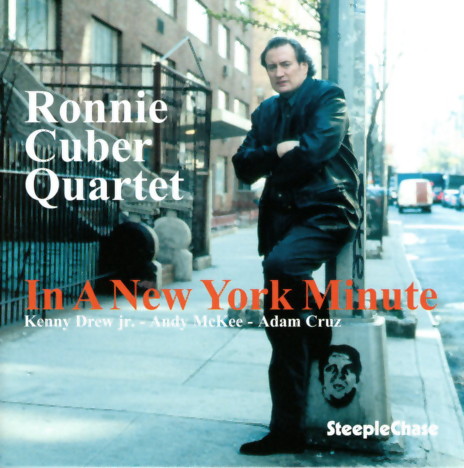
I’ve chosen to highlight Mark Gardner’s insert notes to Ronnie Cuber Quartet: In A New York Minute [SCCD 31372] because many of its tunes are available via Youtube so I can insert these in the feature enabling you to listen while you read. Mark, by the way, is British so please allow for this when you read the spellings.
“Baritone saxophonist Ronnie Cuber's first Steeplechase date, Airplay (SCCD 31309), offered a programme of mainly originals by the leader, emphasising his value as a composer as well as a potent soloist. In the enclosed set, taped exactly three years later, Ronnie is back with a completely different accompanying trio and a nice blend of further Cuber tunes plus some well known classics.
On this session Ronnie underlined his penchant for the bebop style of playing that he studied and absorbed so well many years ago. Mastering this particular form was difficult for all instrumentalists, but especially so for trombonists and baritone players because the nature of those horns makes them less flexible. Ronnie took his cue from such nimble exponents as Cecil Payne and Pepper Adams, while also listening attentively to tenor saxophonists like John Coltrane and Hank Mobley.
But he was never one to be over-influenced, sensibly realising that he needed to find his own path. This he did early in his career and became a complete individualist, a natural successor to the late and great Leo Parker whose tone was the forerunner of the Cuber sound.
His quartet for the aptly titled In A New York Minute, brought together the admirable Kenny Drew )r., whose playing grows ever more distinctive and personal with the passage of time, bass player Andy McKee and drummer Adam Cruz. Andy and Adam are no strangers having worked together in the Mingus Big Band.
McKee has been on the scene since the late 1970s when he played bass with Wall Dickerson and recorded for Steeplechase. Subsequently he worked with Philly Joe Jones, Elvin Jones, Billy Harper, Michel Petrucciani and many other prominent jazz figures.
Cruz has established himself during the 1990s via engagements with the Charlie Sepulveda Band, Hilton Ruiz, Paquito D'Rivera, Leon Parker and David Sanchez. He has performed on occasion with James Moody, McCoy Tyner and Ronnie Cuber.
The quartet jelled well, infusing the music with urgency and excitement while retaining melodic appeal and subtle touches. The inclusion of a brace of Ellington evergreens, a fine song by Johnny Mandel and a Miles Davis melody that should be aired more often provides ample evidence of Cuber's taste and understanding of the wider jazz repertoire. His own pieces are well conceived and resolved with plenty of harmonic interest.
In full cry, Cuber is rugged, direct and inventive. But in ballad vein he is capable of a delicate finesse and great tenderness. All his work is characterised by tremendous warmth and is totally free of pretension.
Dig, first recorded by Miles Davis on one of the pioneer long playing sessions back in 1951, is MD's clever variation on the Sweet Georgia Brown changes. Ronnie knows this territory intimately and his elaborations are filled with bop spirit and hipness. Kenny is right on the ball with his contribution and Adam adds some percussive points.
The engaging In A New York Minute turns out to be a most attractive Cuber line. Kenny shows touch and dexterity that were so much admired in his father's work. Note Ronnie's soft and subtle riffs during the piano solo, and then his gutsy and soulful wailing as the Minute ticks on. Don't be surprised if you find yourself shouting a "yeah" or two as the temperature rises! Andy keeps the lime moving in true New York fashion right to the close.
Con Passion was well named by composer Cuber for it has that air of hot-blooded romanticism, emphasised by the moving introduction. When the tempo starts to pop, Senor Cuber makes the big horn sing and sigh, laugh and cry, sweeping all before him. Kenny's segment sparkles and ripples with not a cliché in sight. Ronnie pours the love on again and bows out with stately grace.
His third compositional offering, Bu's Beat, is fastish modal stuff with nice modulations and a sting in the tail. The baritone's sounds so smoothly propelled and beautifully controlled that I was immediately reminded of the elegance of Cecil Payne in full sail. Kenny shifts easily too and is again prompted by bursts from the bari as the beat rolls inexorably forward. Neat solos are additionally supplied by the double A team of Andy and Adam (sweet thunder from him). Fade Down - to infinity.
Entering the familiar contours of Sophisticated Lady, perhaps Ronnie was thinking of Webster, Hodges, Carney and all the other great saxophonists who populated Duke's bands. He draws his portrait with respect and appreciation and no little lyricism. Similar sensitivity and insight are applied by Drew, whose touch is captured beautifully by engineer Josiah Gluck. A lovely coda from Ronnie is a fine finishing touch.
For Bari and Bass, a lively line, allows Cuber to show his nimble technique and imagination in impressive harness as he beeps and bops in an extended outing in which his inspiration never wanes for a split-second. It is an immensely impressive demonstration of his creative powers. Kenny trips through the changes deftly. Bass gets its chance too, in keeping with the title with Andy responding effectively. Ronnie makes it a long and delightful goodbye.
12/8 Thang, the final Cuber piece in this set, finds him at his most earthy and bluesy and wailing well to boot. Drew catches the mood and digs into a downhome groove to deliver a righteous sermon, dearly relishing the rhythmic lope. McKee reaches for his bow to deliver a resonant arco solo. The leader leads out his troops in a flourishing fashion. A good thang was had by all!
Mandel's Waltz Emily comes up fresh and sweet in the sympathetic hands of Mr. Cuber, who injects more than a few surges of adrenalin, to make Emily swing as she dances. Kenny clearly enjoys these changes and this melody to judge from his luminous improvisation.
The Juan Tizol Caravan has been padding across white hot desert sands for many a decade. Ronnie and company join the expedition en route to the next green oasis, but in their version those camels are really going! Kenny and Ronnie press on with all speed, serving up a brace of scintillating solos. Adam's percussive paces are displayed effortlessly and Ronnie's big-toned return indicates that the palm trees are on the horizon. And that ain't no mirage!
The end of another most impressive, highly musical and thoroughly absorbing album by the resourceful Ronnie Cuber. Fortunately in these technological times you only need to touch a button to relive the entire experience. Something you will find yourself doing many times, I'll wager.”