Showing posts with label shelly manne. Show all posts

Friday, April 5, 2024

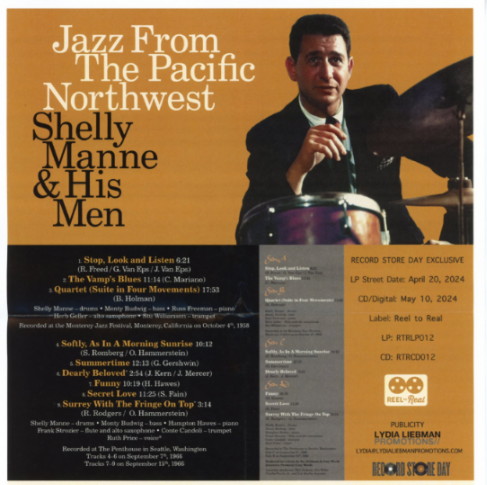
Jazz from the Pacific Northwest - Shelly Manne and His Men

 © Introduction. Copyright ® Steven Cerra, copyright protected; all rights reserved.


We Were All Influenced by Him: A Conversation with Joe LaBarbera

About Shelly Manne


A Sound Colorist: Peter Erskine Reflects on Shelly Manne


I Wanted to Sound Like Him: Jim Keltner Talks About Shelly Manne


The word “community” is very much in vogue these days. But when people use “community” today they have a particular meaning in mind: they want the term to denote something that is a force for good.


Perhaps this meaning for the term community may also be used in retrospect as when it came to the “Jazz community,” especially in Los Angeles in the 1950s and 1960s, no one contributed more “good” to it than drummer, band leader and club owner Shelly Manne [1920-1984].


Vocalist Ruth Price explains Shelly’s demeanor and role this way in the booklet from the soon-to-be-released Jazz from the Pacific Northwest - Shelly Manne and His Men:


“Thinking back now, I'm just really glad I fell into everything accidentally in the first couple of weeks I was out on the West Coast. I had a steady gig at the Manne-Hole and it kept me going. It helped me survive. There are just a few things that musicians have said to me that I really utilize. One of them was from Shelly. One night I came in and I just wasn't musical. I don't know how to explain it, except I didn't sound musical to myself. The band didn't sound musical to me either, but I know they were just like they always were. I just couldn't sing and I was having trouble. I mean, I was unhappy and he sensed it. He took me aside and said, "You know, Ruthie, it's OK to copy yourself." And I knew exactly what he meant.


When you're dealing with jazz, what you're hoping you can do is bring something fresh to it every time and that's hard to do. I wasn't finding anything fresh and I was floundering. He meant that I could sing off the stuff that I'd done before and perhaps recorded, even though that would normally be something I would never want to do. I wouldn't want to do it the same way twice, but he said, "You can copy yourself, Ruth. That's OK."


I loved him. And so did a whole lot of other people as well. He was more than just a wonderful musician. He was really a supporter of the guys, of the musicians who needed support. He was pretty wonderful.”

- Excerpted from an interview with Ruth Price conducted by Zev Feldman on May 12,2022.


Many of us in the broader Jazz community who came of age in the music during the time that Shelly was active with his various quintets and especially after he established his Jazz Club, The Manne Hole, in 1961 in Hollywood, CA, experienced his warm-heartedness first-hand, so it’s nice to see it brought forward and acknowledged in the legacy recordings from the 1958 Monterey Jazz Festival and a 1966 appearance at The Penthouse in Seattle, WA that make up this double CD set - Jazz from the Pacific Northwest - Shelly Manne and His Men - another in the Jazz Discoveries series by the “Jazz Detective”  Zev Feldman.


In the customary superb booklet materials that accompany the music on these “discoveries,” Shelly’s humanity and good-heartedness are reaffirmed many times over in the stories about him recounted by drummers Joe La Barbera, Peter Erskine and Jim Keltner, all interviewed by Zev in 2002 as these recordings were entering production. I venture to say that these anecdotes could have been compounded many times over by other stories from any musician, let alone drummer, who ever met Shelly.


Shelly was everywhere in Left Coast Jazz Circles from 1950-1970: with Stan Kenton’s Orchestra at the Rendezvous Ballroom in Balboa, CA; as a member of Howard Rumsey’s All Stars at the Lighthouse in Hermosa, Beach, CA; with Shorty Rogers Giants at Zardi’s and Jazz City in Hollywood, CA; with various iterations of his own quintet at the Blackhawk in San Francisco and later on every weekend in his own club, The Manne Hole. He even returned to work for his old boss Stan Kenton when the latter formed his Neophonic Orchestra for a series of concerts at the Dorothy Chandler Pavilion in Los Angeles from 1966-1968!


His best selling quintet albums and Broadway show LPs with Andre Previn and bassists Leroy Vinnegar and Red Mitchell helped to establish the viability of Les Koenig’s Contemporary Jazz label.


He was the drummer on Hank Mancini’s score for the ground-breaking Peter Gunn TV series [1959-63] which made Jazz a mainstay in the music scores of the then ubiquitous TV detective series, a tradition continued by the likes of Pete Rugolo, Elmer Bernstein and Skip Martin. 


His Filmography details an exhausting schedule throughout his career. He spent so much time in the studios at Universal that there is a plaque just outside the drum booth with his name on it!


He even found time to teach a class in Jazz at California State University, Northridge!! [“It’s the least I can do to spread the word about this wonderful music. Besides I live in Northridge” <big grin>.].


But after all is said and done, Shelly Manne was all about creating music and there are certainly plenty of new sounds by him and his group to enjoy on Jazz from the Pacific Northwest - Shelly Manne and His Men [Reel to Reel, LP: RTRLPO 12; CD: RTRCDO 12]. The LP street date is April 20, 2024 to coincide with an exclusive for Record Store Day while the CD releases on May 10, 2024.


Disc One features The Men with Stu Williamson on trumpet, Herb Geller on alto sax, Russ Freeman, piano, Monty Budwig, bass and Shelly on drums performing three selections at the 1958 Monterey Jazz Festival, the highlight for me being the performance of Bill Holman’s four-part suite entitled quartet which I first heard on Volume 5, More Swinging Sounds on Contemporary.


Fast forward 8 years and Disc Two finds Shelly’s Men at The Penthouse in Seattle with the group comprised this time of alto saxophonist and flutist Frank Strozier, who made his mark in the Jazz world as a member of drummer Walter Perkins MJ2 + 3, a Chicago based quintet that also included pianist Harold Mabern. Joining Frank on the front-line is Manne’s old running mate Conte Candoli on trumpet with pianist Hampton Hawes and Monty Budwig forming the rhythm section along with Shelly and vocalist Ruth Price doing the honors on two tracks.


More of Shelly's sense of community is involved with these recordings in the form of a commissioned work by Bill Holman, Herb Geller replacing alto saxophonist Charlie Mariano and joining with Stu Williamson to form the front line at the MJF [Herb was dealing with the serious illness of his wife Lorraine [ she died about a month after the MJF appearance and Shelly’s offer of a gig was timely in the extreme] and new face Frank Strozier being brought onto the group in 1965 to help expand and extend his Jazz career. By the time of the Penthouse gig, Conte had been on the band for six years [talk about loyalty; a very long time for a regular Jazz gig] and Shelly’s hiring of Hampton Hawes for the Seattle gig was a magnanimous gesture following some difficult personal times for the pianist. It was also a reunion of sorts from their time together at the Lighthouse during the early years of Jazz at that iconic club.


Beyond these background narratives, the music on these recordings are full of zest, a high level of musicianship and lots of Shelly’s trademark swing. It ranges from all original compositions on the 1958 Monterey Jazz Festival set to music drawn primarily from the Great American Songbook on The Penthouse dates in Seattle.


None of these tracks are just loose vehicles for blowing. Shelly’s music always came with intriguing arrangements, riffs or vamps between solos and shout choruses to help take things out. But there is also another feature of Shelly’s music on display on these recordings - plenty of room for the musicians to stretch out where six of the nine tracks exceed ten minutes.


Here’s more information about the music and what’s included in the package from the media release issued by Lydia Liebman Promotions.


Jazz from The Pacific Northwest combines two previously unissued concert recordings from one of the greatest jazz drummers of all-time, Shelly Marine. The first recording, recorded at the Monterey Jazz Festival on October 4, 1958, features Monty Budwig on bass, Russ Freeman on piano, Stu Williamson on trumpet, and Herb Geller on flute and alto saxophone. The second recording features Hampton Hawes on piano, Frank Strozier on flute and alto saxophone, Conte Condoli on trumpet and guest vocalist Ruth Price on two tracks recorded at the Penthouse jazz club in Seattle on September 7 and 15, 1966.


The hand-numbered, limited-edition, double LP set was transferred from the original tape reels and is pressed on 180g vinyl. The deluxe package includes an extensive 16-page booklet with essays by renowned archival producer Zev Feldman and label owner/producer/musician Cory Weeds, plus passages from Tim Jackson of the Monterey Jazz Festival, Charlie Puzzo Jr. from the Penthouse, and engineer/radio host Jim Wilke; interviews from musicians Jim Keltner, Peter Erskine, Ruth Price, Bill Holman and Joe LaBarbera; and rare photos and memorabilia. LP mastering by Kevin Gray at Cohearent Audio.


New York City-born Manne rose to fame in the 1950s after moving to Los Angeles and is known as a founding father of the "West Coast Jazz" scene. He is highly regarded as one of the most versatile and talented drummers of the day performing with countless legends including Andre Previn, Sonny Rollins, Stan Kenton, Charlie Ventura, Kai Winding and many others. Manne teamed up with Previn and Leroy Vinnegar to produce the first jazz album of a Broadway score for their version of "My Fair Lady," and he has numerous television/movie credits along with performing and composing scores. His recorded works include numerous albums for Capitol, Atlantic, Impulse!, Mainstream, Contemporary, Flying Dutchman and other international labels."


Sunday, January 29, 2023

Exploring The Scene with The Poll Winners - Barney, Ray and Shelly

 © -Steven Cerra, copyright protected; all rights reserved.


This post features another recording from our earliest Jazz experiences which the editorial staff at JazzProfiles wanted to commend to you as a reminder, if you’ve heard it before, or as an invitation to move your ears in a different direction, if you’ve not heard it previously.


Actually, this post highlights what is the fourth in a series of albums on Contemporary Records by The Poll Winners and it was issued under the title The Poll Winners Barney Kessel, Shelly Manne and Ray Brown: Exploring the Scene [s-7581; OJCCD 969-2].


Since guitarist Barney Kessel, bassist Ray Brown and drummer Shelly Manne regularly scored high in jazz fans' polls of the day, Contemporary's decision to record them as a trio was commercially impeccable. But they were also a committed musical group too as indicated by the quality of their performances on this disc and their three previous LPs: [1] The Poll Winners [1957, OJCCD 156], The Poll Winners Ride Again [1958 OJCCD-607] and Poll Winners Three [OJC 692].


[There is also a reunion recording from 1975 entitled The Poll Winners/ Straight Ahead OJCCD-409].


As the lead voice in the trio, guitarist Barney Kessel best fits this description from Richard Cook and Brian Morton’s The Penguin Guide to Jazz on CD, 6th Ed.:”The blues he heard as a boy in Oklahoma, the swing he learned on his first band job and the modern sounds of the West Coast school': Nesuhi Ertegun summary of Kessel, written in 1954, still holds as good as any description.  Kessel has often been undervalued as a soloist down the years: the smoothness and accuracy of his playing tend to disguise the underlying weight of the blues which informs his improvising and his albums from the 1950s endure with surprising consistency.”


Along with Paul Chambers and Ron Carter, Ray Brown was probably the most frequently recorded bassist in modern Jazz. His big sound, uncluttered rhythm and tasteful melodic sense developed into bass lines that were among the best in the business.


Shelly Manne’s cool melodicism, restrained dynamism, and sophisticated playing made him one of the finest musicians in modern Jazz - whatever the instrument. Jack Brand in his bio on Shelly called him “the most melodic Jazz drummer who ever lived."


Although not as common as piano-bass-drums Jazz trios, this is one of the best of the guitar-bass-drums version of the trio format even though it existed only for recording purposes.


The always dependable Leonard Feather prepared the liner notes to the original LP and they contain a wealth of background information about the musicians and the music on this album.


“DESPITE THE ELEPHANT ON THE COVER, and in an election year to boot [1960], the polls relevant to the participants in this album are those conducted annually by three leading U.S. magazines with jazz oriented readers: Down Beat, Metronome, and Playboy. Each year for the past four years Barney Kessel, Ray Brown, and Shelly Marine won first place in all three polls as the most popular jazz guitarist, bassist, and drummer. And each year Contemporary has acknowledged the poll results with a new Poll Winners album.


The "scene" explored by Messrs. Kessel, Brown, and Manne in this fourth set of improvisations is, of course, the jazz scene - particularly the scene of the past few years during which their poll winning activities took place. Jazzmen are among the most non-conforming of all non-conformists, and a run-down of the nine selections in this album illustrates the point very well. Their composers are among today's best-known jazz players. Yet what a group of strongly individual personalities they are! They range from ebulliently swinging Erroll Gamer to brilliant, moody Miles Davis, from lyrical Brubeck to the far-out cry of Ornette Coleman, from the subtle sophistication of John Lewis to the blues-rooted Horace Silver, and the gospel-rooted soul jazz of Bobby Timmons. Together, the nine pieces represent a cross-section of today's many-faceted and fascinating jazz world.


CERTAINLY NOT LEAST among the strongly individual talents in that world are Barney Kessel, Ray Brown, and Shelly Manne. Barney has been "on the scene" since the mid-1940s when he played with Artie Shaw, appeared in the movie short Jammin' the Blues, and toured with Jazz at the Philharmonic. He was born in Muskogee, Oklahoma, October 17,1923, was self-taught, and received early encouragement from Charlie Christian. When he arrived in Los Angeles in 1942, he knew no one, and had not one cent in his pockets, yet within a few years he was known internationally. He won the Esquire Silver Award in 1947, first of many accolades to come his way. He has played and recorded with most of the top jazz artists (Oscar Peterson, Charlie Parker, Lester Young, Billie Holiday, etc.) and since 1953, as an exclusive Contemporary artist, has made a number of his own albums. Barney has also been extremely active in motion picture, radio, and TV studio recording. In 1960 he formed his own quartet, and is currently appearing in the nation's leading jazz clubs.


Ray Brown was bom in Pittsburgh, October 13,1926. While not yet twenty he played with Dizzy Gillespie. Much of his playing since 1951 has been with Oscar Peterson's trio -which for a time in '52 - '53 included Barney Kessel. Ray Is generally conceded to be the bassist of the past decade. He received his first award, Esquire's New Star, in 1947 and has won the Down Beat poll every year since 1953. the Metronome poll every years since 1955, and the Playboy poll each year since it began in 1957.


In addition to his playing on Contemporary's three previous albums, Ray has recorded several of his own albums and a great many with Peterson for Verve Records.  He is on the faculty of the Advanced School of Contemporary Music in Toronto, Canada, and lives in nearby Downsview when not on tour.


During the past year, Shelly Manne has been one of the busiest of all jazzmen: leader of his own group, composer of the score for the movie, The Proper Time, impresario of his own jazz club, the Manne Hole in Hollywood, and constantly in demand for studio recording work for motion pictures, TV, and records. Born in New York City, June 11,1920, Shelly's first playing was done there on 52nd Street in the early 1940s. In the twenty years since, he's played with almost every major jazz figure - in small groups and big bands. He won the first of his eleven Down Beat plaques in 1947, the year in which Barney and Ray won their first national awards. Since 1952 he has lived in the San Fernando Valley, near Los Angeles; since 1953 has been an exclusive Contemporary recording artist.


Little Susie is a blues by pianist Ray Bryant, named for his daughter. It was written in 1957, but became popular in 1960 as a single, and is the title song of Bryant's recent trio album (Columbia CL 1449/stereo CS 8244).
The Duke, Dave Brubeck's best-known composition, was written in 1955 as a tribute to Duke Ellington. It was recorded several times by Brubeck's quartet for Columbia. The first version is on Jazz: Red Hot and Cool (CL 699).


So What was conceived by Miles Davis as a setting for an improvised recording by his sextet. It is described by pianist Bill Evans as "a simple figure based on 16 measures of one scale, 8 of another, 8 more of the first." It is on Miles' Kind of Blue (Columbia CL 1355/stereo CS 8163). For the Poll Winners' version, Shelly used two unusual percussion instruments. The lujon is a teakwood box enclosing six tubes of different lengths. On top of each tube is an aluminum plate, which is struck by a mallet producing a marimba-like sound. The lujon is the brainchild of Bill Loughborough of San Francisco, also the inventor of the boo-bam. The second instrument Shelly plays is a mbira, a small, African thumb-piano which is shaken to produce rhythmic sounds; at the same time the thumbs can produce tones by activating light metal strips. The pitch of neither instrument can be controlled; Shelly's "melodic lines" are not intended to be accurate melodically or harmonically. They serve to heighten the primitive intensity of this hypnotic work.


Misty was written by Erroll Garner in the early 1950s, and has been recorded by him several times. It’s a lovely ballad which has achieved a popularity both in and out of jazz. An interesting treatment with piano and orchestra is heard in Garner's Other Voices (Columbia CL 1014).


Doodlin' is by Horace Silver, the pianist-composer. It’s a blues, dates from 1956, and was recorded by Silver for Blue Note on Horace Silver and the Jazz Messengers (BLP 1518).


The Golden Striker is by John Lewis, pianist and musical director of the Modern Jazz Quartet. It comes from Lewis' 1957 original film score for No Sun in Venice. The Golden Striker was inspired by the life-size figures which revolve and strike the hours atop a building near St. Mark's in Venice. (Atlantic 1334/stereo 3D 1334.)


Li’l Darlin' was written in 1957 by ace arranger and trumpet-leader Neal Hefti for Count Basie, and is one of Hefti's own favorites. It is usually associated with Basie who recorded it for Roulette (52003/stereo SR 52003.)


The Blessing is by Omette Coleman, one of his first compositions, recorded by him for Contemporary (M3551/stereo S7551). It was written in 1952 in a park at Fort Worth, Teas at two in the morning, but not recorded until 1958.


This Here by pianist Bobby Timmons, was recorded in 1959 and made popular by Cannonball Adderley's Quintet, of which Timmons was a member. It’s a jazz waltz, which Cannonball describes in his delightfully informal introduction to his recording In San Francisco (Riverside 12-311/stereo 1157) as having "all sorts of properties. Ifs simultaneously a shout and a chant, depending upon whether you know anything about roots of church music and all that kind of stuff. I don't mean, un, Bach chorales and so - that's different, you know what I mean. This is soul, you know what I mean. You know what I mean? (laughter) All right.. It’s really called This Here, however for reasons of soul and description we have corrupted it to become 'dishyere."'


The style and outlook of the nine composers represented are extremely varied, yet the album has its own consistency and unity because Barney, Ray and Shelly have transformed the material at hand, playing it in their own highly personal way, and bringing to it new meanings, new emotional content.


In listening to the three hours of their recorded music now available, one realizes The Poll Winners are not just three jazz stars who get together to record because they won the popularity polls. They have a separate identity as a group. Their ensemble sound is more than the result of the unusual instrumentation, and more than the sum of their strongly individual talents.
Nat Hentoff has described what they do as a "three-way conversation."
Shelly explains: "You know the minute you do something, Barney and Ray are going to pick it up and make something of it. I think this interplay - back and forth - is the most wonderful way to play, it's the kind of playing I really enjoy the most."

- Leonard Feather

Produced by LESTER KOENIG


Cover photo of Manne, Brown, and Kessel by William Claxton. design by Guidi/Tri-Arts. Elephant from the collection of Don Badertscher Antiques. Album front and liner © 1960 Contemporary Records. Inc. Printed in U.S.A.


Thursday, March 11, 2021

"Checkmate" - John T. Williams and The Shelly Manne Quintet

© -Steven Cerra, copyright protected; all rights reserved.


“.. what Shelly has done here is to take each piece out of its original setting and put it into a setting all his own. Herein lies, I think, the most remarkable aspect of this album. Shelly has given each piece a mood and a quality quite different from al! the rest and while doing so has retained what was my original thought concerning each piece. This is an exceptional accomplishment, particularly for a jazz group of this size, and a practice which should, I think, be a more important part of contemporary jazz. The variety of colors and moods that Shelly and the group have achieved here is truly amazing.”
- John T. Williams, composer, arranger, piano player

According to Lalo Schifrin (Dirty Harry, Bullitt), jazz was a natural fit for these hard-hitting screen stories. “Filmmaking is not an individual art form,” he said. “It’s a collective, almost like a jazz jam session. It’s a gestalt. The director is the brain; the cameraman in the eyes; the film editor is the DNA; the producer is the lungs; and the composer is the ears.”

With the advent of Hank Mancini’s score for the Peter Gunn television series in 1958, Jazz went from total obscurity to almost becoming commonplace in such settings.

It was almost derigeur. Have cop or private eye show - M-Squad, Johnny Staccato, Mike Hammer, Richard Diamond - equals Jazz score.

At about the same time, Crime Jazz music was also increasingly finding its way into the movies with Anatomy of a Murder, Shadows, Odds Against Tomorrow, and Bullitt, among many others, all sporting Jazz themes and scores

Crime jazz captured the mood not only of our post-war cities, but of a character as distinctly American as the cowboy – that soulful, solitary seeker of justice, the private eye.

Checkmate was an American detective television series starring Anthony George, Sebastian Cabot, and Doug McClure. The show aired on CBS Television from 1960 to 1962 for a total of 70 episodes and was produced by Jack Benny's production company, "JaMco Productions" in co-operation with Revue Studios. Guest stars included Charles Laughton, Peter Lorre, Lee Marvin, Mickey Rooney and many other prominent performers.

The series chronicled the adventures of a private detective agency set in San Francisco. Created by Eric Ambler, the program involves the cases of the detective agency called Checkmate, Inc. Don Corey and Jed Sills run the agency, which specializes in preventing crimes before they happen, from Corey's stylish apartment, supposedly at 3330 Union St. Sebastian Cabot portrays a Ph.D. college professor whom they employ as an adviser.

But for my ears, what made the series particularly enjoyable was the Jazz score written by an up-and-coming Jazz pianist - John Williams.

Long before he composed the music for Jaws, the Star Wars series, Harry Potter and the Sorcerer's Stone, and dozens of other major motion pictures. John Towner Williams was Johnny Williams, jazz pianist. He began writing for films and television in the early 1950s and in much of his earlier work, the jazz influence was still strong. Shelly Manne worked with Williams on Hollywood sound stages and was taken with his music for the TV series Checkmate.

Manne adapted seven of Williams's themes from the show for his band. Shelly Manne & His Men. Because Williams was tuned in to trends in jazz, some of the pieces reflected modal approaches recently taken by forward thinkers like Miles Davis and John Coltrane. "The King Swings," as an example, is nearly identical in form to Coltrane's "Impressions." Accordingly, Manne and his quintet, one of the best small groups of the 1960s, plumb Williams's unusual television music for all of its considerable improvisational possibilities.

Here’s more about Shelly Manne and His Men Play Checkmate [Contemporary S-7599; OJCCD 1083-2] from Lester Koenig, who produced the recording and composer John Williams.

A NOTE FROM THE PRODUCER:

“Checkmate is one of the most successful TV shows of the current season [1961 on CBS].  The three heroes of Checkmate—Sebastian Cabot, Doug McClure, and Anthony George — aim to stop crime before it happens, accompanied by the exposed thrills, chills, and danger — and by Johnny Williams's excellent score which strikes precisely the right balance between mayhem and music.'

Shelly Manne, a friend and associate of Williams, held the percussion chair in the studio orchestra which recorded the Checkmate score. He realized that most of Williams's themes would lend themselves admirably to a jazz treatment by his own group. "What attracted me to the music," says Shelly, "was the mood the pieces create—you might call it a 'modal' mood. This is particularly true of The Isolated Pawn,' The King Swings,' 'En Passant.' By modal I mean there aren't a lot of changes and because of it you can create more exciting rhythmic interest. With only a few changes as in 'Milestones' or Coltrane's 'My Favorite Things,' the rhythm can create tension and mounting excitement through use of ostinato effects [a continually repeated musical phrase or rhythm]. Oddly enough, the 'monotony' is what helps create the intensity!"

Shelly also likes Williams's melodic lines. "They are good jazz lines. He didn't conceive of Checkmate as a jazz score, but because Johnny is also a jazz musician, he knows how to write lines which lay just right for jazz blowing."

In the months before this recording, Manne & His Men played the Checkmate music for receptive audiences at the Manne-Hole, Shelly's jazz club in Hollywood. In this way the seven themes took their places on an equal footing with the standards, jazz originals, and jazz classics which comprise the group's extended repertoire.

The characteristic element which distinguishes these performances from Williams's own first-rate big band version of the score album is the extended improvisation by the soloists. The quality of improvisation is an elusive thing. It is primarily a personal and emotional expression. To play well, a musician has to believe in what he is doing. In the case of Checkmate, Manne and his colleagues had become thoroughly enthusiastic about the Williams music, and looked forward to the recording session with much more than ordinary anticipation.”

—LESTER KOENIG December 13, 1961

A NOTE FROM THE COMPOSER:

“Probably the greatest satisfaction a composer can get is when an artist decides to play and record his work, particularly when the artist is of the caliber of Shelly Manne with his present group. The pieces contained in this album were selected by Shelly from a larger group of things that I had written for the TV show, Checkmate. Each was written for a different segment of the show and was associated with the particular personality for whom it was written. I hold the conviction, not by any means alone, that it is a composer's job not only to create the melodic and harmonic details of his music but also the timbre, that is, the final sound or color.

My gratitude to Shelly, therefore, may seem contradictory, for what Shelly has done here is to take each piece out of its original setting and put it into a setting all his own. Herein lies, I think, the most remarkable aspect of this album. Shelly has given each piece a mood and a quality quite different from al! the rest and while doing so has retained what was my original thought concerning each piece. This is an exceptional accomplishment, particularly for a jazz group of this size, and a practice which should, I think, be a more important part of contemporary jazz. The variety of colors and moods that Shelly and the group have achieved here is truly amazing.

In addition to acknowledging wonderful performances by each member of the group, I think special attention should be called to the invaluable contribution made here by Russ Freeman. Russ is truly one of the most important pianists in jazz today. He has a perception and sensitivity unequaled by all but a very few.
My sincere thanks to Shelly and Contemporary Records for this presentation of the music from Checkmate.

—JOHNNY WILLIAMS December 14, 1961

Johnny Williams, a talented pianist, as well as composer and orchestrator, was exposed lo both jazz and classical music from his childhood. His father was a well-known drummer of the Swing Era [featured with Raymond Scott’s sextet] and Johnny, who was born in Flushing. New York in 1932. started studying piano at the age of eight. He came to California with his family in 1948 and at North Hollywood High School led his first band with vocalist Barbara Ruick. a fellow student. later to become Mrs. Williams. Since 1955 Williams has been actively al work in Hollywood, composing and conducting for TV [M-Squad, Wagon Train, etc.] and writing backgrounds for many singers. He is also active as a pianist with jazz albums of his own.


Saturday, March 6, 2021

Imaginative Broadway Show Albums - Shelly Manne, Andre Previn, Red Mitchell and Leroy Vinnegar

© Copyright ® Steven Cerra, copyright protected; all rights reserved.


Beginning in the last half of the decade of the 1950s, interpretations of Broadway shows became almost commonplace in the Jazz.


There were countless versions of Jazz musicians interpreting the music of Lerner and Lowe, Rodgers and Hammerstein and Frank Loesser, to name only a few of the composers and lyricists who dominated the Broadway stages for many years - not to mention innumerable interpretations of George Gershwin’s Porgy & Bess.


I was always particularly fond of the Contemporary Records Jazz albums featuring the music from My Fair Lady, Pal Joey*, The Bells are Ringing, Li'l Abner, Gigi *and West Side Story*, especially because this music was made by pianist Andre Previn and drummer Shelly Manne in the company of bassists Leroy Vinnegar or Red Mitchell. [The three LPs with an asterisk were made as Andre Previn and His Pals and the other three were issued as Shelly Manne and His Friends.]. The musicianship is of the highest level which becomes more evident with each listening. 


The late Les Koenig who produced these “imaginative Broadway show” recordings for his Contemporary label from 1956 to 1960 always maintained that the revenue that these albums generated made possible his investment in recordings by many, lesser known Jazz artists.


I thought it might be fun to put together a blog feature that highlights each of these recordings with excerpts from their liner notes. Collectively, the Previn - Manne collaboration is one of the more impressive in the recorded Jazz repertoire.


MY FAIR LADY - Shelly Manne and His Friends [M3527/S7527]


“GEORGE BERNARD SHAW, in Pygmalion, from which My Fair Lady is adapted, proved that the difference be­tween a Cockney girl and a fine lady was mainly one of pro­nunciation. In his fable, Henry Higgins teaches the girl to speak English, thereby working a startling transformation in her. Actually the language she speaks remains the same. The difference is almost entirely a matter of accent.


And coincidentally it is also largely a matter of accent by which the wonderfully original and entertaining score written by Alan Jay Lerner and Frederick Loewe for My Fair Lady has been transformed by Shelly Manne & His Friends to a wonder­fully original and entertaining modern jazz album. In the main, the melodies and the harmonies remain unchanged. But not the accent, the rhythm, the phrasing, the way the notes are attacked. It is still My Fair Lady, of course. But it is, at the same time, modern jazz at its best.


The sources of jazz have always been many and varied. The late Jelly Roll Morton claimed Tiger Rag was derived from an old French quadrille, so it should not be too surprising to find modern musicians finding jazz in Ascot Gavotte fifty years later. And in any case jazzmen have always turned to Broad­way. The sophisticated melodic and harmonic material in the works of the Gershwins, Cole Porter or Jerome Kern have always stimulated creative jazz musicians to improvise original, entertaining, and often moving performances. It usually takes a very long time, however, before jazzmen accept show tunes, and accord them the honor of a jazz treatment. "Jazz standards" are usually some time in the making. A case in point is Rodgers & Hart's My Funny Valentine which originally appeared in 1937 and had to wait over fifteen years before the modern jazz movement gave it new life in the '50s. And so it is a tribute to the My Fair Lady score that within a few months of the show's opening, such gifted  jazzmen  as Shelly  Manne, André Previn and Leroy Vinnegar were moved to play it.


Let André Previn explain the Friends' approach: ‘What Shelly, Leroy and I have attempted in this album is unusual insofar as we have taken almost the entire score of a musical, not just 'Gems from . . , have adapted it to the needs of the modern jazz musician and are playing it with just as much care and love as the Broadway cast. There has been no willful distortion of the tunes simply to be different, or to have a gimmick, or to provoke the saying 'Where's the melody?' We are all genuinely fond of every tune and have the greatest re­spect for the wonderful score in its original form, but we are paying our own sincere compliment to the show by playing the complete score in our own métier.’”


Li’l Abner - Shelly Manne and His Friends [M3527/S7527]


“Li'l Abner has had a fabulous career since 1934 when cartoonist Al Capp created him. During the past 23 years he has appeared in hundreds of newspapers, daily and on Sundays, to the delight of millions. Today at last count 700 papers carry the Cap strip, with an estimated 40 million readers. It was inevitable Li'l Abner would eventually, as they say in jazz, "make the Broadway scene." He did, in a hit musical which opened November 15. 1956 at the St. James Theatre in New York.


What seemed most unlikely was that he would make the jazz scene. Now even this has come to pass as a result of the ingenious transformation of nine tunes from the show's score into modern jazz performances by Shelly Manne and his Friends: Andre Previn and Leroy Vinnegar.


For the musical, producer-writers Norman Panama and Melvin Frank retained the basic situation of the comic strip: Daisy Mae's struggle to catch and marry Li'l Abner; but invented a new plot. The government declares Dog-patch, U.S.A. (the natural habitat of Li'l Abner, Daisy Mae, Earthquake McGoon, Marryin' Sam, the Yokums. etc.) the "most unnecessary" town in the whole country, and orders its denizens to leave so it can be a testing ground for atomic experiments. It's up to Li'l Abner to save the day. After a wild time in Washington and Dog-patch (Li'l Abner is almost trapped into marrying Appassionata Van Climax), things reach a frantic climax with a plane carrying an atom bomb on its way to Dogpatch while the wedding of Earthquake McGoon and Daisy Mae is about to take place. Li'l Abner does, natcher'ly, save the day.


The score for this bit of madness was written by Johnny Mercer (words) and Gene de Paul (music), and manages to combine the "down home" quality of the Dogpatch milieu with the inherent sophistication of the Al Capp point of view.

................The Friends here have a fine  time  in  the

wonderful world of Li'l Abner. The deft, light-hearted Mercer-dePaul score provided a provocative opportunity for Manne. Previn and Vinnegar to follow their highly-praised, best-selling My Fair Lady album with a similar treatment of a second current Broadway hit.


The Friends have proved to be one of the most felicitous combinations in recent jazz history. Andre's extraordinary piano technique and his gift for melodic and harmonic improvisation are complemented and enriched by Shelly’s inventiveness and feeling for time, and Leroy's walking, funky, full bodied sound. …”


PAL JOEY - André Previn and His Pals  [M3543/S7543]


“THERE IS A STORY, apocryphal perhaps, about John O'Hara, author of the original Pal Joey stories, and author of the book of the Broadway musical, who, when asked to describe the show, is said to have replied, "Well it ain't Blos­som Time." Those familiar with the sentimentality of the Sigmund Romberg musical should get a pretty fair idea of what Pal Joey is not, and possibly, by indirection, what it is. Incidentally, when Blossom Time appeared on Broadway in 1924, Mr. Romberg was the subject of much discussion for adapting various Schubert themes for his score, particularly for waltzing about with a section of the Unfinished Symphony.


In any case, André Previn and His Pals, who are noted for their transformations of Broadway scores into modern jazz, haven't as yet got around to Blossom Time, but they have most certainly applied their alchemy to Pal Joey, and again, in de­scribing the results, one is tempted to repeat Mr. O'Hara.


Pal Joey made his original appearance (in The New Yorker) as the semi-literate writer of a series of letters to his Pal Ted, a successful swing musician and band leader of the late 1930s. Joey was a singer and M.C. in a Chicago South Side club, too much on the make for success and girls, "mice" he called them. Not a pleasant character, but understandable, as John O'Hara drew him. In 1940, O'Hara went to work on the musical ver­sion of Joey with the late, great lyricist Larry Hart, and com­poser Richard Rodgers, and the rest, as they say, is history.


The show opened in New York, Christmas night 1940. For many of us then, it represented the coming of age of the Broadway musical which for the first time seemed to be "look­ing at the facts of life," as composer Richard Rodgers put it. Now, 17 years later, the movie version with Frank Sinatra, Rita Hayworth and Kim Novak, introduces Joey to a new genera­tion, and it is good indeed to have Bewitched, I Could Write A Book, Zip and all the rest around again. Not the least attractive thing about the revival of Joey is the impetus it gave André, Shelly and Red for the present jazz version.


THE PALS' PERFORMANCES were completely improvised at the two recording sessions. Before doing each tune, André played it straight, and then the floor was thrown open for discussion. Various possible jazz versions were explored, and once the tempo and general approach were agreed upon, the actual recording was usually accomplished in one take. This technique relies heavily on free association and the artists' unconscious. With musicians of the Pals' caliber, it makes for an unusually fresh and original approach.”


GIGI - André Previn and His Pals [M3548/S3572]


“GIGI, BY FRENCH NOVELIST COLETTE, first appeared during the last war when the author was 70. She died in August, 1954, at the age of 81, after a small sip of champagne, having lived to see her slender story of a turn-of-the-century Paris adolescent, who had been trained to find a rich lover, but who falls in love and marries him instead, become the most successful work of her forty-four book career.


Gigi's phenom­enal public acceptance is remarkable when one considers the original is no more than an extended short story of some sixty-odd pages. It has been translated into many languages, was a French film starring Daniele Delorme in 1950, became a hit play in 1952, dramatized by Anita Loos and launching Audrey Hepburn, Colette's own discovery for the role of Gigi, as a great new star. Now, in 1958, it is a hit musical for MGM, starring Leslie Caron, Maurice Chevalier, and Louis Jourdan; and by way of the score for the film, it provides Andre Previn and His Pals: Shelly Manne and Red Mitchell, with their latest modern jazz version of a current musical entertainment.


The score for Gigi is by lyricist Alan Jay Lerner (he also wrote the screenplay) and composer Frederick Loewe, who put their special brand of magic to work on their first project since My Fair Lady. And like My Fair Lady, it gives André a chance to apply his own magic to turning eight new Lerner-Loewe songs to modern jazz. As a matter of fact, the new fashion of doing jazz versions of Broadway and Hollywood musicals owes its existence to that now famous first My Fair Lady album (Contemporary C3527) recorded by Shelly Manne and His Friends: André Previn and Leroy Vinnegar in the Fall of 1956, and still heading the best-seller lists. The Friends followed Lady with Li'I Abner (Contemporary C3533). Then André Previn and His Pals: Shelly Manne and Red Mitchell made their best-selling version of Pal Joey (Contemporary C3543).


It was not surprising that André chose to record a jazz Gigi because, as musical director of the film, he supervised all of Gigi's music, adapting much of the Lerner-Loewe material for the background score, doing a number of the arrangements, and conducting the MGM studio orchestra. In truth, this album was projected even before Lerner and Loewe had written the score. They had been delighted with the Friends' Lady, and had a copy of it in their Paris hotel room when André joined them in the Summer of 1957 to begin work on pre-scoring Gigi. Then and there they insisted André do a jazz version.”


THE BELLS ARE RINGING - Shelly Manne and His Friends [M3559/S7559]


“FOR SOME UNACCOUNTABLE REASON, Bells Are Ringing has been singularly neglected by jazz. These days original cast albums of Broadway shows are immediately echoed by a host of jazz versions, often without regard for the show's musical values, or its success or failure. Yet Bells Are Ringing contains a score which lends itself admirably to jazz improvisation, and the show is a smash hit.


The book and lyrics of Bells are by Betty Comden and Adolph Green; the music is by Jule Styne. The show stars Judy Holliday as Ella Peterson, who works for a telephone answering service, gets involved with her unseen clients, and falls in love with one of them, writer Jeff Moss, played by Sydney Chaplin. The plot is complicated by a set of bookies who devise a clever code by which they can use the answering service to handle race-track bets.


SHELLY MANNE, IN RECENT YEARS, has been hailed as the outstanding jazz drummer of the modern era. Although he has been winning or placing high in the various popularity polls conducted by the jazz magazines since the late 1940s, his current popularity is reflected in the fact he made a clean sweep of all the major polls — Down Beat, Metronome and Playboy—for three successive years: 1956, 1957& 1958.


In many ways Shelly is representative of the "new jazzman." An inheritor of the tradition (he got his musical start in New York in the late 1930s when 52nd Street was the crossroads of the jazz world and he was able to meet and jam with the top players of the time), Shelly is constantly searching for new ways in which to make his drums more expressive and musically meaningful. His schedule is a busy one, with personal appearances, recording sessions, concerts, night club engagements, and coast-to-coast TV shows.


Yet he has never lost any of the enthusiasm and joy in playing he had as a teen-ager when he haunted 52nd Street for a chance to hear his idols. This delight is clearly apparent in the light-hearted, swinging collaboration with Andre Previn.


Red Mitchell was a member of Andre's Trio on the road during the latter part of 1958. He is one of the most prominent of today's jazz bassists, and has played with leading groups (Gerry Mulligan, Red Norvo, Hampton Hawes, etc.)


Of André performance of Beethoven's Archduke Trio, the Los Angeles Examiner said (February 26, 1959): "We hear young Previn on such conspicuous occasions as the exponent of modern music in the popular vein that sometimes we forget the intuition and the dignity that he can bring to the standard literature for the piano, . . Throughout the work . . . Previn coupled technical mastery with beautifully graduated dynamics, appropriate color and an unerring sense of adjustment with the other instruments." It is not a coincidence that jazz critics have been able to say the same sort of thing about Previn's performances in the Friends/Pals series — for Andre is a consistent musician who brings the wealth of his talent to whatever he does in music, whether it be film scoring, jazz or Beethoven.”


 WEST SIDE STORY - André Previn and His Pals [M3573/S3572]


WEST SIDE STORY is based on Romeo and Juliet, against a contemporary background of warring gangs on New York's West Side.   Unlike most musicals, this one deals with a real social problem in terms of tragic theater; yet the production is brilliantly realized in song and in dance with wit and tenderness as well as tense drama] The music by Leonard Bernstein is an integral part of the total conception, its unconventional song structures and harmonic progressions are not the kind which would seem to lend themselves readily to modern jazz treatment. Yet, possibly because of the challenge provided by the Bernstein material, André Previn, Shelly Manne and Red Mitchell have improvised on it brilliantly transforming it into one of their most imaginative show-Jazz albums.


This process of transformation is explained by André: “In my experience as a Jazz musician, I have grown more and more aware of the fact that a great tune within its original context [Broadway, show, film etc.] does not automatically make a great tune for Jazz improvisation. Therefore, it becomes necessary for the purpose of a Jazz performance to alter original versions of songs; mostly harmonic alterations but sometimes even alterations in construction. Being an admirer of countless song writers, I very often have guilt feelings about making such alterations, and in the case of Leonard Bernstein’s music, these guilt feelings are magnified a hundred-fold. I happen to be a member of one of the largest official music clubs in America, namely that of ‘unqualified admirers bordering-on-idolatry of Leonard Bernstein.’ If a man like Leonard Bernstein writes songs which defy the thirty-two bar length tradition, he must have an undeniable reason for it, and changing these songs into more commonplace constructions may seem at first glance as nothing short of criminal. However, I would like to refer to Leonard’s book The Joy of Music [New York: Simon and Schuster 1960].


The Bernstein statement to which André refers is quite unequivocal on this point: “A popular song doesn’t become Jazz until it’s improvised on, and there you have the real core of Jazz: improvisation. Remember, I said that Jazz was a player’s art not a composer’s. Well, this is the key to the whole problem. It is the player who, by improvising, makes Jazz. He uses the popular song as a kind of dummy to hang his notes on. So the pop tune in acquiring a new dress changes in personality completely, like many people who behave one way in blue jeans and a wholly different way in dinner clothes. Some of you may object to the dressing up. You say, ‘Let me hear the melody, not all this embroidery.’ But until you accept this principle of improvisation, you will not understand Jazz itself.”


“Previn’s hectic career,” said Time magazine, in April, 1959, “is sometimes likened to Leonard Bernstein’s, a comparison he modestly rejects. The record, though, is of a Jack-of-all-trades, and master of many.” In any event, the meeting up of Previn’s Jazz piano and Bernstein’s music is interesting because of how much they have in common. Each is precociously gifted, each wields an awesome command of almost every kind of music. Each seemed propelled by extraordinary energy.”