Friday, August 5, 2016

Dual Brass: the formation of the Lou Blackburn-Freddy Hill Quintet

© -Steven Cerra, copyright protected; all rights reserved.


This is a wonderful story of what the world of modern Jazz world was like at the apex of its heyday in the late 1950s and early 1960s.


New groups kept coming into existence just at the point when many of the places to play were going out of existence.


Of course, this transition is observed with the luxury of 20/20 hindsight because no one could foresee the demise of the Jazz club scene at the outset of the 1960s. But the musicians looking for bookings during this era became more and more aware that this change was in the works.


Quintets led by a front line of trumpet and trombone have never been particularly common in Jazz which is one of the reasons for the interest in the quintet led by trombonist Lou Blackburn and trumpeter Freddy Hill.


In Dual Brass John Tynan details the formation of the Lou Blackburn-Freddy Hill Quintet for an article that appeared in down beat magazine, February 13, 1964


“IT TAKES MORE than conviction and courage these days to begin a new modern-jazz group; one has to have an inordinate helping of good luck too.
No one, of course, can predict how Lady Luck will turn. Many a promising new jazz group, bursting with talent and fresh ideas, has foundered on the Lady's scowl. Many another, with less to offer artistically, has prospered on her unpredictable smile.


In terms of luck alone, Lou Blackburn's burgeoning quintet is still in limbo. The former Lionel Hampton and Duke Ellington trombonist for almost two years has been deriving most of his income from Hollywood's motion-picture sound stages; jobs for the quintet are far from plentiful in an area where the jazz supply exceeds the demand, Greater Los Angeles.


But with the turn of the year, indications seemed to suggest a brighter tomorrow for this healthily swinging, unorthodox combination of jazz talent. First up in '64 came the quintet's initial out-of-town booking, at Basin Street in Denver, Colo. By February or March a German concert booker in Hamburg is expected to have completed plans for a European tour for the Blackburn group to last a minimum of 13 weeks, hopefully followed by a second 13 after a two-week vacation.

"After that," Blackburn said recently, "people will listen to us more."


Speaking in a rapid, precise manner, Blackburn recounted the group's fortunes since he organized it in November, 1962. For a while, he noted, it was heard in all the local Los Angeles clubs. Now, he added ruefully, it is difficult "to get a week in any club in town."


Still, by virtue of two albums released on the Imperial label (recently that company was acquired by Liberty records, but the Imperial brand remains on Blackburn's albums) the quintet is gaining some exposure. Of the first, New Frontier, the trombonist said candidly, "It would have been better if we had waited." This album was recorded on Jan. 25, 1963, a bare two months after the group's formation. The second LP, Two-Note Samba, speaks out eloquently for the group's distinctive personality, forged in the months following the making of the initial album.
Chief among its distinctive qualities was the playing of Freddy Hill, and Blackburn attributes to the 31-year-old trumpeter the original impetus for the group's formation.


"One night back in 1961," Blackburn recalled, "not long after I arrived in Los Angeles, I was playing with some fellows at the Rubaiyat Room in the Watkins Hotel. Freddy was one of them. Well, we seemed to get such a good blend with his trumpet and my trombone, he suggested we try to make it permanent. So we did."

Hill, a horn man little known outside Los Angeles' environs until now, began achieving some measure of professional recognition nearly five years ago. At 26 he was declared by a board of musician-judges to be the best trumpeter of the eighth annual Intercollegiate Jazz Festival held at the Lighthouse in Hermosa Beach, Calif. At that time the Floridian from Jacksonville had behind him four years on a music scholarship at Florida A&M College, two years in the 36th U.S. Army Division Band, and a further two years after discharge as music teacher in the Jacksonville public-school system. Hill participated in the week-long jazz festival as a member of the winning group from Los Angeles State College, where he then was engaged in graduate study.


(Other members of this quintet to gain recognition and a measure of jazz fame in the ensuing years were reed man Gabe Baltazar, now alto saxophone soloist with the Stan Kenton Orchestra, and Marvin Jenkins, the quintet's leader, pianist, and flutist. Both were also 26 at the time.)


Blackburn and Hill are unreservedly enthusiastic about the current quintet's trumpet-trombone front line. Following Hill's suggestion to combine their horns, Blackburn sketched the melody of an original composition, New Frontier. "We ran it down together," he recalled, "and it sounded good."


From that point the pattern for their group was set. To date, the quintet's book consists entirely of compositions and arrangements by Blackburn and Hill, although only Blackburn's works have been recorded.
While there is much concentration in the writing for the horns on harmonic relationships, Blackburn said, the tonal qualities of unison scoring are by no means ignored, and, he said, he also likes the flexibility possible in the combination.


"I dig it," said the tall, slim Hill enthusiastically. "I dig the sound. You can do a lot of things with the combination. And you have much more flexibility in some instances than, say, with trumpet and tenor. You can get more fire if you want; or you can get a woodwindy sound using mutes if you like. We use a wide variety of mutes."


Blackburn is quick to point out that the trumpet-trombone combination is not necessarily his or Hill's innovation. He cites the album Really Living, recorded some time ago by J. J. Johnson and Nat Adderley, though he noted that he doesn't feel "that the combination was exploited as well as it could be by J. J. and Nat."


Hill added, "Working as we do, we can have a brass section or a woodwind section effect. I think the combination is unlimited, really."


"At times," Blackburn continued, "it's actually difficult to distinguish just who is playing trumpet and who's on trombone, because we frequently voice the horns octaves apart, switching back and forth."


BLACKBURN SAID he feels that musicians in the Los Angeles area are "heavier" academically than those playing on the eastern seaboard.


Certainly his own background is academically impressive. Born 37 years ago in the Pittsburgh suburb of Rankin, Pa., he originally studied and gained considerable proficiency on piano. During his final two years at Roosevelt College in Chicago, however, he fell under the spell of the early work of J. J. Johnson and other modernists of the period, and he switched to trombone.


Inducted into the Army in 1945, he served until discharged in 1947. After a taste of civilian life, in which the musical going was unpredictable at best, he re-enlisted for an indefinite hitch. Promoted to master sergeant, he served his final two Army years with the Seventh Army Symphony Orchestra, along with such musicians as motion-picture composer and French hornist David Amram, concertmaster, Stanley Plummer, and string bassist Frederic Button, now with the Los Angeles Philharmonic Orchestra. Prior to that he was stationed in Japan, organized his first jazz group in Yokohama, and presented the first U.S. jazz concert ever held in Hibya Hall, Tokyo's opera house.


Service with the Army symphony orchestra in Stuttgart, Germany, did not prevent Blackburn from organizing a touring jazz variety show with the snappy billing Smart Affairs of '54 with which he played Army bases throughout the European command.

The troupe, consisting of five singers and a five-man instrumental group, included such jazzmen as vibist Walt Dickerson and pianist John Wright. One of the vocalists was Jesse Belvin, later in civilian life to attain considerable success in the commercial recording field before his death in a traffic accident.


But by 1956 M/Sgt. Blackburn had had it with the service. Some two years earlier, while on tour with the Smart Affairs troupe, he had met Lionel Hampton, who heard his playing and offered Blackburn a job as soon as his hitch was up. So, much to the envy of many a draftee, Blackburn exercised the prerogative of his rank and service and resigned from the Army.


Hampton was playing Atlantic City, N.J., when the freshly civilianized Blackburn showed up to claim his trombone chair. He was hired on the spot.


After 2 1/2 years with the Hampton juggernaut, during which he returned to Europe twice, Blackburn quit and worked with a small group for a while. Then came an offer from Duke Ellington. Blackburn didn't toy with the idea. He remained with Ellington for almost a year, before deciding to settle in Los Angeles in January, 1961.


THOUGH BLACKBURN has "worked at all the movie studios" and appears, well established in that well-paid and musically demanding milieu, he confesses he is "not really interested" in this work. "I'd rather work with five pieces," he said.
The remaining three of the five pieces now are Horace Tapscott, piano; John Duke, bass; and Vernar Barlow, drums. Barlow is a 20-year-old recent arrival from Florida of whom Blackburn predicts, "He'll be heard from."


Tapscott and Duke are doubling musicians. The former played trombone in the Hampton band before forsaking slide for keyboard; Duke is an ex-trumpet player who has, according to Blackburn, become "a very fine bassist." There has been some switching to and fro on drums with the group on occasion.


Next to be recorded in an album, Blackburn said, is a new work of his, The Afro-Eurasian Suite. This consists of three distinct sections, or movements — Newmto, an Ashanti word meaning chant; Yum Pihn, a Siamese expression meaning lovable; and Orient. The last section, Blackburn explained, is a straight jazz piece in 6/8 and 4/4 and then 6/8 played against 2/4. The suite is already in the active book, according to the leader, and the quintet regularly features it in clubs.


While Blackburn notes that "the Imperial albums helped us get our foot in the door," he emphasizes that they are but a beginning.


"I feel," he said confidently, "that we have found ourselves now. This is what we really want to do: play good jazz."”
If their luck stays bright, that is what Lou Blackburn and company will be doing from now on.


Lou Blackburn: The Complete Imperial Sessions were issued on CD by Blue Note [58294] and here are Michael Cuscuna’s insert notes to the CD reissue for which Michael served as the producer.


© -Michael Cuscuna, copyright protected; all rights reserved.
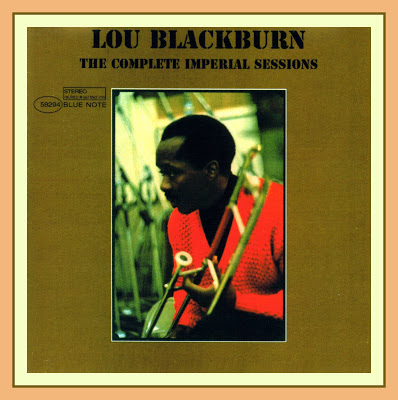


This disc contains the complete output of the Lou Blackburn-Freddie Hill Quintet. Like Curtis Amy, Teddy Edwards, Jack Wilson, and so many others in Los Angeles at the time, Hill and Blackburn were making their living in the recording studios and film soundstages. Their creative efforts were confined to low-paying club dates and the occasional album, which was usually met with nice reviews and poor sales.


Big bands were another creative salvation and the L.A. scene. Hill and Blackburn were, at various times, members of the Gerald Wilson, Onzy Matthews, and Oliver Nelson orchestras, which enjoyed some joyous live gigs and the hipper studio dates.

Together, they appeared on Wilson's Moment Of Truth, Matthews's Blues with a Touch Of Elegance, Lou Rawls's two Matthews-arranged albums Black and Blue and Tobacco Road, Oliver Nelson's Live From Los Angeles, and Nelson-arranged projects by Carmen McRae, The Three Sounds, and Thelonious Monk


Lou Blackburn was born in Rankin, Pennsylvania, a suburb of Pittsburgh, on November 22, 1922. His first instrument was piano, but during his final two years at Roosevelt University in Chicago, he switched to trombone, an instrument he felt to be mare natural for expressing himself.


He was drafted into the army in 1945 for two years. After discharge and a couple of years of civilian life as a musician, he rejoined the military and gained incredible experience while stationed in Japan and Germany, performing with David Amram, Don Ellis, Walt Dickerson, John Wright, and Jesse Belvin, and other artists who toured where he was stationed. In 1956, he left the service and gigged around Philadelphia and Atlantic City with Charlie Ventura, among others.


In 1958, he started a two-year stint with Lionel Hampton's big band, and then worked with Cat Anderson's group. An offer came from Duke Ellington in 1961 and Lou joined in time to participate in the Paris Blues and First Time/The Count Meets the Duke projects. It's easy to see why Ellington would be attracted to such an expressive and versatile trombonist, but the gig lasted only nine months.

Blackburn decided to settle in Los Angeles and, with his abilities, he had no problem breaking into the jazz, studio, and film scenes.


Freddie Hill was born in Jacksonville, Florida on April 18, 1932. He studied cello and piano as well as trumpet. After four years at Florida A & M on a music scholarship and two years in the army that brought him into contact with the Adderley brothers, among others, he moved to Los Angeles to pursue graduate studies at Los Angeles State College. Gigs with many artists, including Gerald Wilson and Earl Bostic, followed.


Hill eventually had the security Of steady studio work thanks to Wilson, Matthews, Nelson, and H. B. Barnum, but his opportunities to record as a jazz soloist were few. Besides Gerald Wilson's Pacific Jazz sessions on which he had to share space with a lot of outstanding soloists, he is heard to great advantage on Leroy Vinnegar's Leroy Walks Again!! and Buddy DeFranco's Blues Bag, which also included Curtis Fuller and Art Blakey.


Trumpeter Charles Tolliver remembers, "In 1966,I met Freddie Hill while he was working with Gerald Wilson. We discovered that we were both from Jacksonville and, it turned out, he knew my mother. He got me into Gerald's band and let me live in one of the houses he owned, which was around the corner from where Lou Blackburn lived and near where Andrew and Laverne Hill were staying at the time. Freddie and Lou were working studio dates around the clock. Earl Palmer was contracting a lot of sessions at that time."


Like Blackburn, Horace Tapscott,  born in Houston, Texas on April 6, 1934 but raised in Los Angeles from the age of nine, started on piano and switched to trombone. He worked in the bands of Wilson, Hampton, and Matthews on that instrument; he had begun to shift his emphasis back to the piano by the time of these sessions. He remained one of L.A's best kept secrets although there were glimmers of hope when he wrote and arranged the music for Sonny Criss's Sonny's Dream (Birth Of The New Cool) in 1968 and made his debut as leader the following year with The Giant Is Awakened, an album that also introduced Arthur Blythe, on the newly formed Flying Dutchman label. From the early 1970’ss until his death in 1999, Tapscott would record a series of albums, either solo or trio or with his Pan-Afrikan Peoples Arkestra on Nimbus and a variety of independent labels, that revealed a distinctive pianist/composer with a conception all his own.


Bassist John Duke, who had already worked with Horace Henderson, gigged with Bobby Bryant and Louis Jordan among others after the dissolution of this quintet. He joined the Basie band in the 70s, frequently working side jobs with Al Grey when the band was off. Drummer Leroy Henderson is best known for his 1961-62 stint with Richard "Groove" Holmes's trio, which gave him the opportunity to record with Gene Ammons and Lou Rawls. Beyond gigs with Vi Redd and Charles Kynard, little is known about him after 1963.


In a feature article on the group in the February 13, 1964 issue of Down Beat, Blackburn told John Tynan that the idea for the group came shortly after he'd arrived in L.A.: "One night back in 1961, not long after I arrived in Los Angeles, I was playing with some fellows at the Rubaiyat Room in the Watkins Hotel. Freddie was one of them. Well, we seemed to get such a good blend with his trumpet and my trombone; he suggested we try to make it permanent. So we did."


The group was formed in November 1962 and quickly secured a contract with Imperial, a label not known for much jazz recording. The front-line instrumentation is rather rare. There was a 1957 Blue Note album by Curtis Fuller with Art Farmer, J. J. Johnson's 1958 quintet with Nat Adderley, the Clark Terry-Bob Brookmeyer Quintet of 1964-65, and, much later, Woody Show's 1980 quintet with Steve Turre. Rather surprising given that the combination has a lovely sonority all its own.


In Blackburn and Hill, one can hear all the qualities that made them in demand for studio work: their clarion tones, their accurate pitch and clean articulation, their breadth Of idioms, and their blend. But unlike many studio musicians, they were both expressive, first-rate soloists. Horace Tapscott, the other soloist here, had only recently returned to the piano; these were his first recordings on the instrument. He had yet to find his own personal voice on the piano, but elements of his style, like his percussive approach, were already in place.


The aforementioned Down Beat article, by which time Varney Barlow was the drummer, mentions plans for a third album that would include Blackburn's recently composed "Afro-Eurasian Suite," but it never materialized. There was also talk of a European tour, but, in all likelihood, aside from one gig in Denver, this quintet never played anywhere but in L.A. - and even then only infrequently. Blackburn's ten years in Los Angeles was not without its many rewarding moments (including performing "Meditations on Integration" with Charles Mingus at Monterey), but in 1971, he moved to Berlin and soon formed a unique band, Mombasa, that forged its own fusion of jazz, blues, and African music, which he led into the '80s. He died in Berlin on June 7, 1990.


Freddie Hill also left the L.A. scene in 1971. He had married the sister of skater Peggy Fleming and moved out to the desert. Studio work was dying up and Hill died a forgotten man before the end of the decade.


- Michael Cuscuna, 2006”


Thursday, August 4, 2016

Dream Lucky: When FDR was in the White House, Count Basie was on the radio, and everyone wore a hat.

© -  Steven A. Cerra, copyright protected; all rights reserved.


During my undergraduate college days, I took the mandatory 20th century US History course and purchased the required textbook. On the first day of class, the instructor assigned additional books including a couple of novels which he said would help give us “the flavor of the times.”

“It’s important for you to get a feel for the periods of time as they were happening,” he said. “A great way to do that is to read the literature, listen to the music and look at the art.”

Over the years, I’ve found that another way to experience the “the flavor of the times” is to read books about social and cultural history of a particular period, especially those associated with the various Jazz ages.

Dream Lucky by Roxane Orgill is one such book. I recently came across a copy of it in a used book store and I bought it because I was intrigued by its subtitle - When FDR was in the White House, Count Basie was on the radio, and everyone wore a hat.

In digging around the internet for more information about the book, I came across the following review of it by Eddie Dean and I thought I’d share it with you.

The book is available in used hard cover formats from Amazon which also offers it as a Kindle download.

Bookshelf
When America Had a Soundtrack
By EDDIE DEAN
June 2, 2008; Page A15
Dream Lucky
By Roxane Orgill
(Smithsonian, 342 pages, $25.95)

"One day I heard Count Basie on the radio and that's when I flipped," jazz arranger Bill Potts once told me in an interview, his fervor undimmed more than 60 years later. "The secret to Bill Basie's piano playing was simplicity. He'd leave open spaces and play one note, but exactly the right note at the right place – it was just a ding."

Potts's teenage epiphany launched him on a career that saw the twilight years of the Swing Era, ranging from his landmark 1959 big-band arrangement of "Porgy & Bess" to scores for Alpo dog-food commercials. But Potts was by no means unique in falling under the spell of William "Count" Basie, who stirred an entire generation that came of age during the late 1930s and early 1940s, when the sound of Swing swept the nation.

It is hard to overestimate Basie's effect. He was the pioneer of a revolutionary crossover music that stayed true to its blues origins even as it won over white mainstream audiences. It stands today as perhaps the most enduring – certainly the least frivolous  –  American dance music ever put on record. Just a ding, but when combined with the full-throttle fury of Basie's 13 sidemen – who included saxophonist Lester "Prez" Young and trumpeter Buck Clayton – what a beautiful thunder it made.

The rise of Count Basie forms the heart of Roxane Orgill's Dream Lucky, a firecracker of a book as tight, ebullient and raucous as a classic Basie arrangement. The Swing Era has inspired a voluminous literature, not least some lovely miniatures, like Gene Lees' elegiac essay "Pavilion in the Rain" and Bobby Scott's "The House in the Heart," a haunting remembrance of Young. Dream Lucky deserves a place on the shelf next to such gems. But the book is also a cultural history, with a wider range than those tender portraits – and it will interest readers who may not be big-band aficionados and Prez cultists.

Ms. Orgill centers on a two-year period, starting in November 1936, when Basie arrives in Chicago with his rag-tag Kansas City band, and ending in July 1938, with his first coast-to-coast radio broadcast from 52nd Street in New York. Basie's struggle to reach the top is Ms. Orgill's narrative thread, but along the way she describes a Depression-era America in political and social upheaval. She makes the case for Swing not just as the soundtrack of an era but as one of the forces transforming American society on the eve of World War II.

In Ms. Orgill's episodic telling, the events of the mid-1930s unspool on the page like one of those March of Time newsreels. This nifty device allows her to cut from scene to scene, build up dramatic tension and, most important, let loose the dizzying cast of characters who dominated the headlines and crowded the airwaves, from Franklin and Eleanor Roosevelt and Amelia Earhart to Joe Louis, Jack Benny and the Shadow.

Round-the-clock radio is, for Ms. Orgill, a key to understanding the era's wild collective exuberance – the melting pot come to a boil with the lid sent flying. The fare included the eloquence of FDR's Fireside Chats, and yet it was mostly (as Ms. Orgill shows with vividly recreated dialogue) a chatterbox of madcap hijinks, racist comedy routines and screwball acts, epitomized by a lecherous wooden dummy named Charlie McCarthy. For a black musician like Basie, radio was the way to reach a new, vast audience beyond segregated clubs and ballrooms, an audience that would include white kids like Bill Potts in suburban Washington. Until then, the King of Swing was Benny Goodman, with his more polished sound. The Count was ready to attempt a coup d'état, but first he had to win in Harlem.

And he did. Ms. Orgill takes us inside the Harlem jazz clubs where Basie solders a molten-hot dance beat onto the blues. Not so far away we see Jacob Lawrence creating black-liberation paintings with dime-store supplies, Langston Hughes launching a bare-bones community theater and Adam Clayton Powell Jr. preaching a "social gospel" from the pulpit and taking to the streets to lead a strike against the electric company.

Ms. Orgill mines reports from contemporary black newspapers – mainstream outlets often didn't deem the events uptown worth covering – to give blow-by-blow accounts of Harlem's famous battles of the big bands, routinely performed before integrated crowds. As Ms. Orgill puts it, describing the Savoy Ballroom: "White could dance with Negro here: hold hands, touch cheeks, bump hips." After one memorable battle, in which Benny Goodman's band was trounced by Chick Webb at the Savoy, Gene Krupa, Goodman's drummer, said: "Chick gassed me, but good. I was never cut by a better man."

Ms. Orgill makes the sounds come alive, too. She captures everything from the historic session in which Basie made his first hit record, One O'clock Jump, to a studio orchestra rendering Rossini's William Tell Overture into the theme song for "The Lone Ranger," complete with "gunshots" made by snapping mousetraps.

Among much else, Dream Lucky shows how adversity can be the handmaiden of achievement. With millions in poverty and a war looming, FDR put meticulous care into the texts of his national broadcasts, using the microphone not to harangue and pontificate but to deliver phrases of iron resolve with the casualness of a dinner companion. Meanwhile, Lester Young, a sensitive soul adrift in a racist society, made his saxophone into an instrument of intimate conversation that could reveal deep wounds underneath the gorgeous melody. As the fascist leaders across the sea used the new communications technology to whip up crowds into hateful mobs, both of these Americans took a mass medium into the most private realms, speaking from one human being to another, of loss and hope and love and dignity.”

Mr. Dean is co-author of "Man of Constant Sorrow," a memoir by mountain-music legend Ralph Stanley, forthcoming from Gotham Books.

Wednesday, August 3, 2016

Soaring with the Count Basie Orchestra Amongst The Foo Birds

© -  Steven A. Cerra, copyright protected; all rights reserved.


Due to the simple factor of chronology, my initial exposure to Count Basie’s band was during the late 1950's.


My first LP by the band was Basie Plays Hefti [Roulette 52011] which I wore out while trying to learn all of drummer Sonny Payne, licks, kicks and fills.


This period in the band’s history would come to be known as “The Atomic Basie” period.


The explanation for this categorization are explained in the following excerpts from Chris Sheridan’s insert notes to Mosaic Records, The Complete Roulette Studio Recordings of Count Basie and His Orchestra [MD10-149].


“1957 was a pivotal year for the Count Basie Orchestra. Five years earlier, the Count had said hello to [what would become known as] the New Testament Band, embracing arrangements by Neal Hefti and Ernie Wilkins alongside those by Buck Clayton, Buster Harding and Don Redman.


Then, in July, 1957, he finally said goodbye to the Old Testament Band when, at the Newport Jazz Festival, Lester Young sat in with the Basie band for the last time.


In the transitional period between these dates, the new band had developed, using charts predominantly by its own members, notably Ernie Wilkins and Frank Foster. As the "Dance Sessions" band succeeded and grew in strength, so its grip on the past eased and most of the older repertoire was phased out, war horses like One O’clock Jump and Jumpin' at the Woodside being notable exceptions.


The scene was set for something newer when the summer of 1957 also brought to an end Basie's long-term contract with Norman Granz, who was announcing one of his several retirements. His Clef recording company had given the Count Basie Orchestra a much-needed forum in 1952; now the band needed another.


It came in the shape of Morris Levy, who had just started Roulette Records. Basie and he were no strangers. Morris Levy owned Birdland, the club at 1678 Broadway, just north of Swing Street. Named for Charlie Parker, it had, somewhat like the Woodside Hotel in the 1930s, become the New York home of the Count Basie Orchestra of the 1950s. …


For many years, the association between Basie and Roulette was thought to have had a stuttering start, the first recording session producing just a single title that was passed over in favor of material cut a month later. Like the band's first Clef session, that was apparently all Neal Hefti scores, a blast into the future that named an era. With admirable controversy, Roulette used a cover photograph of an atomic explosion, the equation of atomic fission, e=mc2, which became known as the Atomic Mr. Basie [52003].


From now on, this would be Basie's "Atomic Period.” …


One of my favorite Neal Heft arrangements for Basie Band is Flight of the Foo Birds” which is based on the chords progressions the standard, Give Me The Simple Life.


Hefti’s Flight of the Foo Birds forms the audio track to the following tribute to the Basie Band.  The solos are by Frank Wess on alto saxophone, Thad Jones on trumpet and Eddie “Lockjaw” Davis on tenor saxophone.


Was there ever a more explosive Basie band than this one [pun intended]?

Tuesday, August 2, 2016

Afro Bop Alliance Big Band - "Revelation"

© -Steven Cerra, copyright protected; all rights reserved.


Grammy Award Winner/Drummer Joe McCarthy leads the Afro Bop Alliance Big Band on upcoming release "Revelation" due out in fall (OA2)


Everytime I think I’ve heard it all in terms of Latin Jazz in Big Band configurations along comes something new and different to dazzle and surprise me.


Such was the case with the latest from Grammy-award winning drummer Joe McCarthy and saxophonist Vince Norman who co-lead the Afro Bop Alliance.


Their forthcoming CD is entitled Revelation and it was just that as it moved my ears in new directions concerning Latin Big Band Jazz.


One of the “kickers” this time is the inclusion of a Steel Pan section made up of four players which is voiced into the band’s arrangements.


I am familiar with Jamaican-born pianist Monty Alexander’s Ivory and Steel Band that included Othello Molineaux and Len “Boogsie” Sharpe on steel drums or “pans,” if you will, but they were featured as virtuoso individual soloists.


The Afro Bop Alliance also has a virtuoso steel pan soloist in Victor Provost but he also joins a steel pan section with three other steel drum players.


Besides the steel pan choir, the band’s orchestrations are also given a different sonority thanks to the inclusion of alto flutes, bass clarinet and vibraphone, not to mention some tunes with five trumpet and five trombone brass section.


Powerful is an understatement when it comes to the sound of this big band; overpowering may be more like it.


What is also remarkable about the Afro Bop Alliance Big Band is that it presents Latin Jazz in rarely heard odd time signatures [e.g. 12/8] and it does so in such a way as to make these unusual meters sound natural and effortless: like nobody’s counting and everybody’s just feeling the accents and grooving on them. It takes considerable skill to make all of this sound so easy and the high degree of musicianship on display in the Afro Bop Alliance makes these complexities sound natural and enforced..


If you like exciting, enthralling and swinging Big Band Latin Jazz, then you need look no farther than Revelation by the Afro Bop Alliance which releases on September 16, 2016 on OA2 Records.


Chris DiGirolamo of Two for the Show Media LLC is handling public relations for the recordings and he sent along the following press release at the end of which you’ll find a video featuring the band wailing on CuBop the opening track of the new CD.


“Even to someone not intimately versed in the rigors of the music business, the feat of keeping a talent-packed jazz ensemble together for 16 years shouldn't fail to impress. On Revelation, the sixth album by the DC-based Afro Bop Alliance (ABA), we hear drummer/leader Joe McCarthy and colleagues reaching still higher levels of technical excellence and compositional adventure.


Formed as a septet, the ABA has swelled to a full big band on two of five previous releases — first in 2008 with Caribbean Jazz Project: Afro Bop Alliance Featuring Dave Samuels, again in 2011 with Una Mas. That makes Revelation the third big-band outing, and its sheer sonic force is readily apparent. Victor Provost, the steel pan virtuoso who came aboard the ABA for its marvelous 2014 release Angel Eyes, returns to play on two compositions of his own, "Magharibi" and "Soufriere." The blend of steel pan — three additional steel pan players, in fact — with such powerful, resonant big band voicings is one of Revelation's delights. A revelation indeed.


Tenor saxophonist and ABA principal Luis Hernandez contributes "Dialed In," originally a small-group composition, heard here in an expanded version bursting with harmonic color, in a slow, loping 12/8 feel. And the opening "CuBop," co-composed by McCarthy and ABA alto/soprano saxophonist Vince Norman, is a nod to the band's original name and a celebration of its unique take on the legacy of Afro-Cuban jazz. Guitarist Jim Roberts emerges as a key melodic voice early on, his clean electric tone bringing to mind elements of John Abercrombie and Joe Beck.


The balance of the program is devoted to the work of Roland Vazquez, whose involved and boundlessly imaginative scores establish him as one of the major jazz composers of our time. Vazquez's accomplishments (as drummer and composer) stretch back to the mid-1970s, including a pivotal stint with his mentor Clare Fischer. A seasoned educator as well, Vazquez has amassed a varied output including works for big bands, orchestras, chamber groups, percussion ensembles and more. His 2010 release The Navigator earned wide acclaim and brought much-deserved attention to this great and underrated voice in large-ensemble jazz.

The three tracks conducted by Vazquez in the studio are "No Rest for the Bones of the Dead," "Family of Four" and "Creencias" ("beliefs"), each just over 10 minutes long. The first opens with a yearning melody from Hernandez in the foreground, with subtle accelerandos and tempo slippages moving the piece along its path toward a fine Hernandez tenor solo. The second features Alex Norris on flugelhorn, in a beautiful flight early in the song, with Matt Stuver returning for an impassioned tenor sax feature on the rideout vamp.

On the third, "Creencias," the declarative block chords of the opening yield to an inescapably tight, grooving theme and a dense and glorious thicket of angular line writing and labyrinthine sectional counterpoint. Solos follow by trumpeter and ABA principal Tim Stanley, trombonist Victor Baranco and then McCarthy, in a stirring, complex call-and-response section with the band. A brief but effective romp from pianist and ABA principal Harry Appelrnan brings the piece home, as the dynamics shift downward, the mood calms, and the piece — the album — draws to an enigmatic, hovering close.


From start to finish on Revelation is the clave in all its elasticity and permutation, animated by a rhythm section of consummate clarity and finesse. McCarthy's lithe interplay with percussionist Roberto Quintero (on the Vazquez tracks, Samuel Torres) is beautifully captured by the mics. The solid beat and versatility of the bassists — ABA principal Tom Baldwin, on the Vazquez tracks Oscar Stagnaro — is crucial to the cohesion and punch of every piece. And there's no mistaking Appelman's deft handling of the arrangements and his fleet solo turns, notably on "Dialed In."


Baritone saxophonist/bass clarinetist Darryl Brenzel, a noted composer and arranger in his own right, is something of a secret weapon on Revelation: leaping into double a muted brass section or bass line or underline a passage for flute, nailing every precise entrance and exit. His instrument jumps out in the mix, one of the many intricate details in the ABA sound palette. Another is vibraphonist Ed Fast, who appears on the Vazquez tracks and brings a metallic glint to the orchestrations (similar in some way to Provost on the non-Vazquez tracks).


In terms of depth, sophistication and sheer chops, the ABA might be situated in the lofty realm of concert jazz, but still the band remains rooted in the Afro-Cuban dance rhythm, the primacy of the groove as well as the melody. Despite its penchant for extended forms and bracingly modernist harmony, this is music that carries a very direct appeal to the listener. In a word, it's got soul — in great abundance.”


-David R. Adler New York, May 2016


You can pre-order the audio CD for $11.99 on Amazon.com.

Monday, August 1, 2016

Denny Zeitlin - "Early Wayne"

© -Steven Cerra, copyright protected; all rights reserved.


In many respects Jazz is one of the more difficult art forms to teach and to learn. The most effective method to learn about the music has been to listen to it. The rich history of Jazz thus becomes a stream of consciousness that is imparted from one generation to the next as a continuum as opposed to disconnected and analyzed fragments.


The same can be said of this process of transference from one musician to another: listening to how one musician plays Jazz can inform and inspire another musician’s efforts to play the music.


The most obvious example of this dynamic is when a strong player such as a Louis Armstrong or a Lester Young or an Oscar Peterson influences the style and approach of other trumpet players, tenor sax players or piano players, respectively.


But influences do not always follow a straight line in terms of the same instrument: brass players can influence reed players; reed players can influence keyboard players, and percussion instruments can shape the rhythmic approach of all instruments.


And an even less obvious and less common relationship is formed when a Jazz musician uses the compositions of another player as a platform of expression.


Such is the case with pianist Denny Zeitlin’s new CD Early Wayne [Sunnyside Records SSC 1456] on which the compositions of iconic tenor saxophonist Wayne Shorter form the basis for Denny’s “explorations.”


Jazz is not about expressing information; it has more to do with what pianist Keith Jarrett has described as an "internal burning. Jazz started with someone needing to express himself... .You can't want to mean it.  You have to need it. Is there something in you that absolutely needs to get out?”


Sometimes the vehicle for this inner expression [“something that needs to get out”] is facilitated by the compositions that you feel comfortable improvising on.


This context becomes one way to listen to Denny’s solo piano explorations on Early Wayne for as he explains in the insert notes:


“I was in college in 1959 when Wayne Shorter made his recording debut as a leader and I was captivated by the originality of his sound and concept, both as a performer and as a composer. He has continued to inspire me over the ensuing decades and I’ve recorded his compositions on a number of occasions.”


In another excerpt from the insert notes to his Complete Blue Note Recordings [ECM 1575-80], pianist Keith Jarrett remarks that: “A master Jazz musician goes onto the stage hoping to have a rendezvous with music. He/she knows the music is there (it always is), but this meeting depends not only on knowledge but openness …. It is like an attempt over and over again to reveal the heart of things.”


In line with this “rendezvous” we have Denny explaining that “the idea of an entire concert of Wayne’s tunes as launching pads into improvisation occurred to me as I was preparing for an annual performance at the Piedmont Piano Company in Oakland, CA. The venue is perfect - a stable of marvelous pianos; an intimate concert space that attracts an attentive and adventurous audience; flawless acoustics; a staff that really cares about music. I believe that Wayne is Jazz’s greatest living composer and improviser, and for this concert I focused on his timeless early compositions.”


The ten tracks that comprise Early Wayne were recorded in performance on December 5, 2014 and each is a magnificent example of an artist displaying the ability to create Jazz at the highest level of personal expression.


Denny’s achievements with the music are a testimony to his love of what he is doing, his honesty, and of his artistic devotion to master the discipline necessary to perform what the author Ted Gioia has referred to as “The Imperfect Art.”


As the novelist Willa Cather once wrote: “Artistic growth is more than anything a refining of a sense of truthfulness. Only the stupid believe that to be truthful is easy; only the artist knows how difficult it is.”


I’ve been listening to Denny’s music in performance and on recordings for over 50 years and I view each new opportunity to do as another episode to hear his quest for truth.


In this regard, you won’t want to miss his latest efforts as reflected in the ten stunning improvisations that make up Early Wayne: Explorations of Classic Wayne Shorter Compositions.


For order information, please visit Sunnyside Records via this link.