Sunday, December 10, 2017

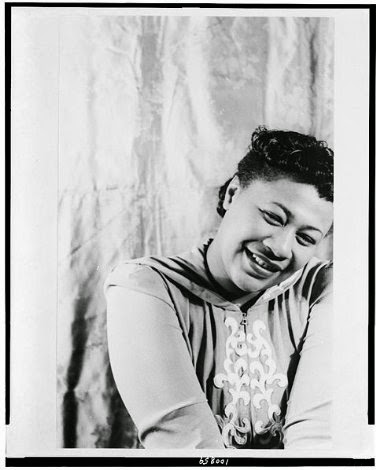
Ella and Henry - Fitzgerald and Pleasants,That Is!

© -  Steven A. Cerra, copyright protected; all rights reserved.


"I never knew how good our songs were," Ira Gershwin once said to George T. Simon, "until I heard Ella Fitzgerald sing them."


“And then there is Ella, about whom critics have surprisingly little to say, …. Her situation is not unlike that of Art Tatum — there's no way to ignore the technical and musical genius of these two, or their immense and joyous fecundity, even if you prefer your art less Olympian.”
- Henry Pleasants, The Great American Popular Singers


“She's tops! I just love her. She's Mama!”
- Jon Hendricks, Jazz vocalist


If you’ve ever wondered what made Ella Fitzgerald’s singing so singularly outstanding, you will wonder no longer after reading these excerpts about her style from Henry Pleasants, The Great American Popular Singers (1974).


“Gerald Moore, the English accompanist, tells about the time Dietrich Fischer-Dieskau, following a matinee recital Moore and the German Lieder singer had given together in Washington, D.C., rushed to the National Airport and took the first plane to New York in order to hear Duke Ellington and Ella Fitzgerald at Carnegie Hall.


"Ella and the Duke together!" Fischer-Dieskau exclaimed to Moore. "One just doesn't know when there might be a chance to hear that again!"


The story is illustrative of the unique position that both Ella Fitzgerald and Duke Ellington occupy in the musical history of our century. More than any other artists working in the Afro-American idiom, they have caught the attention and excited the admiration of that other world of European classical, or serious, music.


Ella's achievement, in purely musical terms, is the more remarkable of the two, if only because she has never ventured into the no-man's-land of semi-classical or third-stream music separating the two idioms. Duke Ellington is a familiar figure on the stage at symphony concerts, as both pianist and composer, in his jazz-flavored symphonic suites. Ella has ranged widely between the ill-defined areas known as "jazz" and "popular," but not into classical, although she has sung the songs of the great American songwriters—Arlen, Gershwin, Porter, Rodgers, for example—with symphony orchestras. Many classical singers, however, like Fischer-Dieskau, are among her most appreciative admirers.


Unchallenged preeminence in her own field has had something to do with it, along with consistent performance throughout a career that has already extended over nearly forty years. Although she has never been, in her private life, a maker of headlines, her honors have been so many that word of them has filtered through to many who never saw a copy of Billboard or Down Beat and never will.


To enumerate those honors would be tedious. Suffice it to say, citing the entry under her name in Leonard Feather's New Encyclopedia of Jazz, that, between 1953 and 1960 alone, she was placed first in Metronome, Down Beat, and Playboy polls in either the "jazz singer" or "popular singer" categories, or both, no fewer than twenty-four times. She had been a poll winner long before that — she won the Esquire Gold Award in 1946 — and she is heading the polls in both categories to this day.


With Frank Sinatra and Peggy Lee, she shares the distinction of having achieved a nearly universal popularity and esteem without sacrificing those aspects of her vocal and musical art that so endear her to fellow professionals and to the most fastidious of critics and lay listeners. Not even Frank and Peggy are admired so unanimously. The refinements of their art often fall on unappreciative or hostile ears. But with Ella, the exclamation "She's the greatest!" runs like a refrain through everything one reads or hears about her. One is as likely to hear it from an opera singer as from Bing Crosby ("Man, woman and child, Ella Fitzgerald is the greatest!").


Of what does her greatness consist? What does she have that other excellent singers do not have? The virtues are both obvious and conspicuous, and there is general agreement about them. She has a lovely voice, one of the warmest and most radiant in its natural range that I have heard in a lifetime of listening to singers in every category. She has an impeccable and ultimately sophisticated rhythmic sense, and flawless intonation. Her harmonic sensibility is extraordinary. She is endlessly inventive. Her melodic deviations and embellishments are as varied as they are invariably appropriate. And she is versatile, moving easily from up-tempo scatting on such songs as "Flying Home," "How High the Moon?" and "Lady Be Good" to the simplest ballad gently intoned over a cushion of strings.


One could attribute any one, or even several, of these talents and attainments to other singers. Ella has them all. She has them in greater degree. She knows better than any other singer how to use them. What distinguishes her most decisively from her singing contemporaries, however, is less tangible. It has to do with style and taste. Listening to her — and I have heard her in person more often than any other singer under discussion in these pages—I sometimes find myself thinking that it is not so much what she does, or even the way she does it, as what she does not do. What she does not do, putting it as simply as possible, is anything wrong. There is simply nothing in her performance to which one would want to take exception. What she sings has that suggestion of inevitability that is always a hallmark of great art. Everything seems to be just right. One would not want it any other way. Nor can one, for the moment, imagine it any other way.


For all the recognition and adulation that has come her way, however, Ella Fitzgerald remains, I think, an imperfectly understood singer, especially as concerns her vocalism. The general assumption seems to be that it is perfect. That she has sung in public for so many years—and still, when on tour, may do two sixty-minute sets six or seven nights a week—with so little evidence of vocal wear and tear would seem to support that assumption. Her vocalism is, in fact, as I hear it, less than perfect. "Ingenious" and "resourceful" would be more appropriate adjectives.


She has, as many great singers in every category have had, limitations of both endowment and technique. But, also like other great singers, she has devised ways of her own to disguise them, to get around them, or even to turn them into apparent assets. Ella's vocal problems have been concentrated in that area of the range already identified in the case of earlier singers as the "passage." She has never solved them. She has survived them and surmounted them.


She commands, in public performance and on record, an extraordinary range of two octaves and a sixth, from the low D or D-flat to the high B-flat and possibly higher. This is a greater range, especially at the bottom, than is required or expected of most opera singers. But there is a catch to it. Opera singers, as they approach the "passage," depress the larynx and open the throat — somewhat as in yawning — and, focusing the tone in the head, soar on upward. The best of them master the knack of preserving, as they enter the upper register, the natural color and timbre of the normal middle register, bringing to the upper notes a far greater weight of voice than Ella Fitzgerald does. Even the floated pianissimo head tones of, say, a Montserrat Caballe should not be confused with the tones that Ella produces at the upper extremes of her range.


Ella does not depress the larynx, or "cover," as she reaches the "passage." She either eases off, conceding in weight of breath and muscular control what a recalcitrant vocal apparatus will not accommodate, or she brazens through it, accepting the all too evident muscular strain. From this she is released as she emerged upward into a free-floating falsetto. She does not, in other words, so much pass from one register into another as from one voice into another. As Roberta Flack has noted perceptively: "Ella doesn't shift gears. She goes from lower to higher register, the same all the way through."


The strain audible when Ella is singing in the "passage" contributes to a sense of extraordinary altitude when she continues upward. In this she reminds me of some opera tenors who appear to be in trouble — and often are — in their "passage" (at about F, F-sharp, and G) and achieve the greater impression of physical conquest when they go on up to an easy, sovereign B-flat. The listener experiences anxiety, tension, suspense, relief, and amazement. It is not good singing by the canons of bel canto, which reckon any evidence of strain deplorable. But it is exciting, and in the performance of a dramatic or athletic aria, effective.


Both this sense of strain in that critical area of Ella's voice, and the striking contrast of the free sound above the "passage" may help to explain why so many accounts of her singing refer to notes "incredibly high." Sometimes they are. The high A-flat, A, and B-flat, even in falsetto, must be regarded as exceptional in a singer who also descends to the low D. But more often than not they sound higher than they are. Time and again, while checking out Ella's range on records, 1 have heard what 1 took to be a high G or A-flat, only to go to the piano and find that it was no higher than an E or an F. What is so deceptive about her voice above the "passage" is that the sound is high, with a thin, girlish quality conspicuously different from the rich, viola-like splendor of her middle range. It is not so much the contrast with the pitches that have gone before as the contrast with the sound that has gone before.


In purely vocal-technical terms, then, what distinguishes Ella from her operatic sisters is her use of falsetto; what distinguishes her from most of her popular-singer sisters is her mastery of it. One may hear examples of its undisciplined use in public performance and on records today in the singing of many women, especially in the folk-music field. With most of them the tone tends to become thin, tenuous, quavery, and erratic in intonation as they venture beyond their natural range. They have not mastered falsetto. Ella has. So has Sarah Vaughan. So has Ella and Sarah's admirable virtuoso English counterpart, Cleo Laine.


The "girlish" sound of the female falsetto may offer a clue to its cultivation by Ella Fitzgerald, and to some fundamental characteristics of her vocal art. It is, for her, a compatible sound, happily attuned to her nature and to the circumstances of her career. She entered professional life while still a girl. Her first hit record, "A-Tisket A-Tasket," was the song of a little girl who had lost her yellow basket. The girl of the song must have been a congenial object of identification for a young singer, born in Newport News, Virginia, who spent her childhood first in an orphanage, later with an aunt in Yonkers, New York, who drifted as a young dancer into Harlem clubs, and who fell into a singing career in an amateur contest at the Harlem Opera House when she was too scared to dance.


"It was a dare from some girlfriends," she recalls today. "They bet me I wouldn't go on. I got up there and got cold feet. I was going to dance. The man said since I was up there I had better do something. So I tried to sing like Connee Boswell — 'The Object of My Affection.'"


According to all the jazz lexicons, Ella was born on April 25, 1918, and entered that Harlem Opera House competition, which she won, in 1934, when she would have been sixteen. She became vocalist with the Chick Webb band the following year, was adopted by the Webb family and, following Chick's death in 1939, carried on as leader of the band until 1942. She would then have been all of twenty-four, with ten years of professional experience behind her.


According to Norman Granz, who has been her manager throughout the greater part of her career, she was younger than that. Granz says that she was born in 1920 and had to represent herself as older, when she first turned up in Harlem, to evade the child-labor laws. She was adopted by the Webbs because a parental consent was a legal prerequisite for employment.


It should hardly be surprising, then, that her voice, when she began with the Chick Webb band, and as it can be heard now on her early records, was that of a little girl. She was only fourteen. She was a precocious little girl, to be sure, and probably matured early, as other black entertainers did—Ethel Waters and Billie Holiday, for example—who grew up in the tough clubs and dance halls of Harlem while other girls were still in secondary school. What mattered with Ella, however, and affected her subsequent career, was that the little girl could also sound like a young woman — and was irresistible.


The sound worked, and so did the little girl. Ella has never entirely discarded either the girl or the sound. She was, and has remained, a shy, retiring, rather insecure person. To this day when, as a woman of matronly appearance and generous proportions, she addresses an audience, it is always in a tone of voice, and with a manner of speech, suggesting the delighted surprise, and the humility, too, of a child performer whose efforts have been applauded beyond her reasonable expectations.


Nor has Ella ever forsaken her roots in jazz. George T. Simon, in The Big Bands, remembers watching her at the Savoy Ballroom in Harlem when she was with Chick Webb:


“When she wasn't singing, she would usually stand at the side of the band, and, as the various sections blew their ensemble phrases, she'd be up there singing along with all of them, often gesturing with her hands as though she were leading the band.”


The fruits of such early enthusiasm and practice may be heard today in Ella's appearances with the bands of Count Basie and Duke Ellington, when one or more instrumental soloists step forward to join her in a round of "taking fours," with Ella's voice assuming the character and color of a variety of instruments as she plunges exuberantly into chorus after chorus of syllabic improvisation (scatting).


Ella owes at least some of her virtuosity in this type of display, or at least the opportunity to develop and exploit it, to Norman Granz and her many years' association with his Jazz at the Philharmonic tours. Benny Green, the English jazz critic, thus describes the importance of this association to the shaping of Ella Fitzgerald's art and career:


“When Ella first began appearing as a vocal guest on what were, after all, the primarily instrumental jazz recitals of Norman Granz, it might have seemed at the time like imaginative commercial programming and nothing more. In fact, as time was to prove, it turned out to be the most memorable manager-artist partnership of the post-war years, one which quite dramatically changed the shape and direction of Ella's career. Granz used Ella, not as a vocal cherry stuck on top of an iced cake of jazz, but as an artist integrated thoroughly into the jam session context of the performance. When given a jazz background, Ella was able to exhibit much more freely her gifts as an instrumental-type improvisor.”


Elsewhere, reviewing an appearance by Ella with the Basic band in London in 1971, Green has described as vividly and succinctly as possible the phenomenon of Ella working in an instrumental jazz context:


“The effect on Ella is to galvanize her into activity so violent that the more subtle nuances of the song readings are swept away in a riot of vocal improvisation which, because it casts lyrics to the winds, is the diametric opposite of her other, lullaby, self. And while it is true that for a singer to mistake herself for a trumpet is a disastrous course of action, it has to be admitted that Ella's way with a chord sequence, her ability to coin her own melodic phrases, her sense of time, the speed with which her ear perceives harmonic changes, turn her Basie concerts into tightrope exhibitions of the most dazzling kind.”


It was her activity with Jazz at the Philharmonic that exposed and exploited the singular duality of Ella Fitzgerald's musical personality. Between 1942, when her career as a bandleader came to an end, and 1946, when she joined Granz, she had marked time, so to speak, as an admired but hardly sensational singer of popular songs. With Jazz at the Philharmonic, she was back with jazz.


The timing was right. Bop had arrived, and Ella was with it, incorporating into her vocal improvisations the adventurous harmonic deviations and melodic flights of Dizzy Gillespie and Charlie Parker. Indeed, according to Barry Ulanov, in his A History of Jazz in America, the very term "bop," or "bebop," can be traced to Ella's interpolation of a syllabic invention, "rebop," at the close of her recording of " 'T'ain't What You Do, It's the Way That You Do It" in 1939.


She has cultivated and treasured this duality ever since, and wisely so. Singers who have adhered more or less exclusively to an instrumental style of singing, using the voice, as jazz terminology has it, "like a horn," have won the admiration and homage of jazz musicians and jazz critics, but they have failed to win the enduring and financially rewarding affections of a wider public. Others have stuck to ballads and won the public but failed to achieve the artistic prestige associated with recognition as a jazz singer. Ella, more than any other singer, has had it both ways.


Norman Granz, again, has had a lot to do with it. When Ella's recording contract with Decca expired in 1955, she signed with Granz's Verve label and inaugurated, in that same year, a series of Song Book albums, each devoted to a single songwriter, that took her over a span of twelve years through an enormous repertoire of fine songs, some of them unfamiliar, by Harold Arlen, Irving Berlin, Duke Ellington, George Gershwin, Johnny Mercer, Cole Porter, and Richard Rodgers.


These were the first albums to give star billing to individual songwriters, and they served the double purpose of acknowledging and demonstrating the genius of American composers while providing Ella with popular material worthy of her vocal art. "I never knew how good our songs were," Ira Gershwin once said to George T. Simon, "until I heard Ella Fitzgerald sing them."


As a jazz singer Ella has been pretty much in a class by herself, and that in a period rejoicing in many excellent ones, notably Billie Holiday, Peggy Lee, Carmen McRae, Anita O'Day, Jo Stafford, Kay Starr, and Sarah Vaughan, not to overlook, in England, Cleo Laine. I am using the term "jazz singer" here in the sense that jazz musicians use it, referring to a singer who works—or can work—in a jazz musician's instrumental style, improvising as a jazz musician improvises. Ella was, of course, building on the techniques first perfected, if not originated, by Louis Armstrong, tailoring and extending his devices according to the new conventions of bop.


There is a good deal of Armstrong in Ella's ballads, too, although none of his idiosyncrasies and eccentricities. What she shared with Louis in a popular ballad was a certain detachment—in her case a kind of classic serenity, or, as Benny Green puts it, a "lullaby" quality—that has rendered her, in the opinion of some of us, less moving than admirable and delightful. In terms of tone quality, variety, and richness of vocal color, enunciation, phrasing, rhythm, melodic invention, and embellishment, her singing has always been immaculate and impeccable, unequaled, let alone surpassed, by any other singer. But in exposing the heart of a lyric she must take second place, in my assessment, at least, to Frank Sinatra, Billie Holiday, Peggy Lee, and Ethel Waters.


This may well be because she has never been one for exposing her own heart in public. She shares with an audience her pleasures, not her troubles. She has not been an autobiographical singer, as Billie and Frank were, nor a character - projecting actress, as Ethel Waters and Peggy Lee have been, which may be why her phrasing, despite exemplary enunciation, has always tended to be more instrumental than oral, less given to the rubato devices of singers more closely attuned to the lyrical characteristics of speech.


What she has offered her listeners has been her love of melody, her joy in singing, her delight in public performance and her accomplishments, the latter born of talent and ripened by experience, hard work, and relentless self-discipline. Like Louis, she has always seemed to be having a ball. For the listener, when she has finished, the ball is over. It has been a joyous, exhilarating, memorable, but hardly an emotional, experience.


Also, like Louis, she has addressed herself primarily to a white rather than a black public, not because she has in any sense denied her own people, but rather because, in a country where blacks make up only between ten and twenty percent of the population, white musical tastes and predilections are dominant. They must be accommodated by any black artist aspiring to national and international recognition and acceptance. In more recent years, younger whites have tended to favor a blacker music. A B. B. King has been able to achieve national celebrity where a Bessie Smith, fifty years earlier, could not. When Ella was a girl, what the white majority liked was white music enriched by the more elemental and more inventive musicality of black singers and black instrumentalists.


Ella's singing, aside from the characteristic rhythmic physical participation, the finger-popping and hip-swinging, and the obviously congenial scat-ting, has never been specifically or conspicuously black. It represents rather the happy blend of black and white which had been working its way into the conventions of American popular singing since the turn of the century, and which can be traced in the careers of Al Jolson, Sophie Tucker, Ethel Waters, Mildred Bailey, and Bing Crosby.


When Ella was a girl, black singers — those in organized show business, at any rate — were modeling themselves on the white singing stars of the time, and many white singers were modeling themselves on the charmingly imperfect imitation. It is significant that Ella's first model was Connee Boswell. A comparison of the records they both made in the late 1930s shows again how perceptive an ear Ella had from the first. But it is just as significant that Connee Boswell belonged to a generation of jazz-oriented white singers— others were Mildred Bailey and Lee Wiley—who had been listening to Bessie Smith and, above all, to Ethel Waters.


Again like Louis Armstrong, Ella Fitzgerald has achieved that rarest of distinctions: the love and admiration of singers, instrumentalists, critics, and the great lay public. But while she may be for the jazzman a musicians' musician, and for the lay public the First Lady of Song, she has always been more than anything else a singers' singer. John Hendricks, of Lambert, Hendricks and Ross fame, has put it well, responding to an Ella Fitzgerald record on a Jazz Journal blindfold test:
Well, of course, she's my favorite — she's tops! I just love her. She's Mama! I try and sing my ballads like she does. I was working in a hotel in Chicago, and Johnny Mathis came in to hear me. I had just finished singing a new ballad I was doing at the time, and he came up to me and said, "Jon, you sure love your old Fitzgerald, don't you?"


"Yes," I replied, "and don't you, too?"


"We all do!" he said.


And that's it. Everyone who sings just loves little old Fitzgerald!”


Saturday, December 9, 2017

Milt Hinton and The "New York Rhythm Section"

© -Steven Cerra, copyright protected; all rights reserved.


The following anecdote is drawn from Milt’s collection of stories and photographs as contained in Playing the Changes, which also contains a CD of Milt telling stories and playing music.

David G. Berger and Holly Maxson assisted with this wonderful collection of Milt Hinton’s life in stories and in photographs.

Published by the Vanderbilt University Press, it’s a compendium that leaves a wonderful series of memories of a life well-lived.

“I'm convinced I got a lot of studio work because many producers and arrangers recognized that the rhythm section was the backbone of the music being done at the time. They also came to understand that there was a small group of rhythm section players who could easily adapt to different artists and really complement a performance. Eventually. Hank Tones, Barry Galbraith. Osie Johnson, and I got identified as part of the select group. And for a couple of years we worked together almost every day. We even got to be known as the New York rhythm section. It wasn't an official title, just an informal name people in the business gave us. And, of course, it wasn't an exclusive thing either. We all worked in plenty of other rhythm sections too.

Hank was always in demand because he's an unbelievable piano player. Back in those days he'd done a lot of records with Ella, and that seemed to make him even more popular, especially with female vocalists.


I guess they figured if Ella sounded so beautiful, how could they go wrong using her accompanist.Hank's a good-looking, dark-complected guy who's always seemed to be concerned about his appearance. In all the years I've known him. I only saw him without a coat and tie once. That was when a couple of us played a party at Shoobe's house and it was so hot. Shoobe ordered him to take off his jacket.

Barry had been with Claude Thornhill's band. He was a very knowledgeable musician who was a great reader and could also write very well. He was a warm, small town-type guy — average height and weight, short hair, rugged but good-looking. He dressed like a woodsman. No matter how cold it got. he'd never wear an overcoat, just a plaid shirt with an open collar. He had a great sense of humor, but like a lot of guys who smoke too much, his laugh always turned into a cough.

Osie was a burly, dark-complected man. He was very outgoing, affable, and had one of the most resonant voices I've ever heard. In fact, I was there when a funny incident involving his voice helped get him started in the studios.

Osie had come into New York with Earl Hines's hand and run into Jo Jones, who invited him to a record session. I guess Jo wanted him to see how things worked and meet some of the studio regulars. We were doing a small date for a singing group called the Billy Williams Quartet. In those days they had a regular spot on one of the weekly TV shows and also a couple of good-selling records.

I don't remember what tune we were running down, but I can still see Osie sitting up on a high stool next to Jo with a big grin across his face, watching and listening to everything. After a while, we started to record, but before we could finish the tune, the guys in the booth cut us off. We tried another take, but the same thing happened. Finally, after seven or eight more attempts, we made it through to the end. But while the last note was resonating, and the recorders were still rolling. Osie boomed out, "Oh, yeah."

Everyone in the room aimed toward him and for a second or two there was dead silence. Then someone said to Osie. "Man, in here you don't move 'til the red light goes out and the—"

But Billy Williams interrupted, "That's great, leave it in."


About a minute later, the playback started and when everyone heard Osie at the end. they flipped. In fact, they liked it so much they gave him a withholding slip and paid him for the date.

It didn't take long before people learned about Osie's true talents. He was a great drummer who could also arrange, sing, and play just about any kind of music. As it turned out, Jo Jones eventually lost studio work to Osie, who was a superb reader and didn't have as many personal quirks.

The four of us worked well together in all kinds of situations, and this had as much to do with our personalities as our musical talents. None of us was arrogant. In fact, we were exactly the opposite, congenial and accommodating. Whenever we walked on a date we were really concerned about the featured artist. We wanted that person to he satisfied and we'd go to great lengths to accomplish it. If the music wasn't good and needed something extra, we'd fix it. right on the spot.

It even got to the point where some arrangers would hand us chords for a tune and expect immediate results. They'd say something like. "Your part is loose, have fun with it," which meant we should do a quick head arrangement without holding up the session. Sometimes our contributions really helped make a hit. For example, the four of us did Bobby Darin's record of "Mack the Knife." Osie or Hank had the idea of going up half steps, and as far as I'm concerned, that's what made this version a smash.

Of course, we never got arrangement credits on anything we did. Back in those days, it was rare for sidemen to get credits on an album, especially in the pop music field. But we got our forty-one dollars a session. And the fact that we knew how much we'd contributed seemed to give us enough satisfaction."

Friday, December 8, 2017

Dave McKenna [1930-2008] - The Ted Panken Interview

© -Steven Cerra, copyright protected; all rights reserved.


“Dave McKenna was simply one of the legends of the jazz piano. He, of course, would probably have disagreed. "I don't know if I qualify as a bona-fide jazz guy," he said. "I play saloon piano. I like to stay close to the melody." His humility and laid-back personal style seemed a contrast to the vibrant vitality of his masterful piano style. His range is truly extraordinary. One minute he is caressing a lovely ballad, the next he is thundering and rumbling through a high-powered rendition of I Found a New Baby.”


The best I can describe it, Dave McKenna plays like he has three hands.  Where most pianists tend to devote their left hand entirely to chords or bass lines, using the right exclusively for melodies, McKenna seems to split each hand in half.  The bottom two fingers of his left hand dance through bass lines Ray Brown would be happy to conceive, the top two fingers on the right hand explore variations on the theme of the tune, both thumbs and second fingers play chords in between, and the middle fingers jump in wherever they’re most needed.”
- Robert Doerschuk, distinguished piano critic
A Jazz buddy recently sent me the following message:

“McKenna. … Before he is forgotten, a small piece on a true individualist would honor his legacy. Nobody mentions Dave McKenna anymore. Ya, I know you have a long list, but he should be on it. …”

So I dug around. I played a hunch hoping to find an interview with him in Len Lyons’ wonderful The Great Jazz Pianists, but no such luck.

And the more I dug, the more I got the feeling that it was going to be pretty difficult to locate an interview with a man who doesn’t like to talk about himself, doesn’t consider himself to be anything special in the way of a Jazz pianist and hates compliments.

But then I remembered the series of recordings that Dave made for Concord Records in the 1980/90s and trenching back through the insert notes for these I somehow managed to find the following interview that Dave gave to Ted Panken in 1999.

Miracles do happen!

© -Ted Panken, copyright protected; all rights reserved.

“Dave McKenna was one the great originals.

McKenna, a basically self-taught pianist out of Woonsocket, Rhode Island, went on the road at 17 and never looked back.

In 1999, I had an opportunity to interview McKenna for the publicity bio for a trio recording on Concord with clarinet legend Buddy DeFranco and guitarist Joe Cohn called Do Nothing Til You Hear From Us, following a duo from three years before entitled It Might As Well Be Swing. Throughout both dates, the masters played with unfettered effervescence, impeccable craft and a fiery edge that would be the envy of musicians young enough to be their grandchildren.

Their felicitous chemistry wouldn’t make sense if you looked at their careers superficially.  DeFranco is supposed to be a cold, cerebral player locked into the tropes of jazz modernism, while McKenna was the contemporary embodiment of old-style, two-handed pianism — the ultimate “saloon piano player.”  But they shared a profound common denominator.  Both came up in the top-shelf dance bands that incubated so many personal improvisers during the decade spanning World War Two and the Korean War when bebop entered common jazz parlance.
McKenna emerged from a strong regional New England jazz culture that produced such generational contemporaries as—among others—Phil Woods, Sal Salvador, and Joe Morello, Horace Silver, Gigi Gryce and Paul Motian. As he stated below, Nat Cole was his pianistic model, and he developed a rollicking-yet-subtle orchestral approach that he applied to every tune. The distinguished piano critic Robert Doerschuk described his unique style as follows in the liner notes to another of McKenna’s numerous Concord recitals, entitled Easy Street. “The best I can describe it, Dave McKenna plays like he has three hands.  Where most pianists tend to devote their left hand entirely to chords or bass lines, using the right exclusively for melodies, McKenna seems to split each hand in half.  The bottom two fingers of his left hand dance through bass lines Ray Brown would be happy to conceive, the top two fingers on the right hand explore variations on the theme of the tune, both thumbs and second fingers play chords in between, and the middle fingers jump in wherever they’re most needed.”
McKenna was tremendously consistent; almost any of his more than three dozen recordings are worth looking for.
Dave McKenna (Ted Panken) – (1-27-99):
TP: It said in the 1960 Encyclopedia of Jazz that both your parents were musicians.  Is that right?
McKENNA:  Yes.  Well, my father was just a part-time musician.  He played the snare drum in military type concert bands, like small towns used to have.  He played very well, and he was a good snare drummer.  He played a little dance music.  That’s where he met my mother.  And my mother was a good classical violinist and a good piano player.
TP: Did she give you your first musical education?
McKENNA:  No, she didn’t.  She didn’t think she was a good enough teacher.  But I used to hear her play.  She played classical; she didn’t play jazz on the violin.  But at home I heard her  play the standards of the late 1930s and 1940s, like “Smoke Gets In Your Eyes,” “Stormy Weather,” and she played them very good, all the nice changes, nothing elaborate.  Plus I heard radio jingles, the early jingles, and I went to the piano and picked out tunes.  My mother sent me to the nuns at parochial school.  They were nice old ladies, but I hated the study of music.  I really did.
TP: You liked playing and not studying.
McKENNA:  Yeah, right.  Later I took a few lessons from a guy in Boston, Sandy Sandiford.  But he more or less left me alone.  He gave me a few assignments that I played, to work out some variations on this or that.  He wanted me to play scales, too, but I didn’t.  He saw that right away and he laughed, and he said, “Well, you’re not going to do it,” which was obvious.  But he said, “You’re playing very nicely and continue to do what you do.”  The lessons were kind of casual.  I’d stop them if I felt bad or I had a cold or something.  But I’d go up there, take a train to Boston.
TP: Did your technique and piano conception develop organically?
McKENNA:  Yeah, I think so.  Just playing at home.  My early gigs were three-piece bands, piano, saxophone and drums.  I think I did my first one at 12 or 13.   It’s a French-Canadian town, and there were a lot of wedding jobs.  The first few were non-union.  They even had bands for pre-wedding showers.  French-Canadians were very big for that.
So I worked that way, and then I joined the union.  When I joined the union I had to play with a band that played Polish polkas half the night.  I didn’t stay very long with it.  So I worked around home, and then Boots Mussulli came back from Stan Kenton’s band around 1947.
TP: I assume you were listening to jazz pianists and digging them.
McKENNA:  No, not so much.  First of all, I liked songs, and I think I had a very brief time with liking the cowboy singers, Gene Autry and people like that.  Then I heard a Bing Crosby record.  I liked him okay, but he did a couple of things with a Dixieland band, either Bob Crosby or John Scott Trotter, and I liked that. Around that time, I got interested in Harry James’ band, and then Benny Goodman’s band — and I was hooked from then on.  I used to try to play like Benny rather than Teddy, although I had the utmost respect for Teddy.  (Nat Cole has been my favorite piano player for years; I loved his trio when I heard it. ) But most of that time I listened more to horn players.  Benny Goodman, Artie Shaw.  Also  Count Basie’s band, but I didn’t even know who those guys were at first, like Lester and Count himself. I love Basie.  Duke Ellington was an early favorite, too.  And later on, Bobby Hackett was one of my favorites.  By that time I was listening to Bird and Diz, too.  So I always listened to horn players more than piano players.
TP: You mentioned in another one of these liner notes that you were inspired by trumpet players, like Dizzy Gillespie  — that you played a little trumpet as well.
McKENNA:  Yeah, although not particularly with Diz.  Some of the swing trumpet players.  I loved Cootie and Rex Stewart, I loved Billy Butterfield and I loved Bobby Hackett.  Buck Clayton, oh, he knocked me out.  And then Dizzy, too.  Dizzy and Bird and Miles, early Miles — I liked all that.  But even when I was listening to Bird, I loved Johnny Hodges; he was one of my favorites.  I loved Duke’s band.  I loved even Duke’s piano playing.
TP: Why do you say “even Duke’s piano playing”?
McKENNA:  Because most people give him short shrift on that.  They  don’t pay enough attention to him.  I love Count Basie’s piano playing, too.  But as far as all the other piano players, I respect them very much and I like them a lot, but they weren’t the ones that inspired me the most.  It was horn players most of the time.
TP: It sounds like  in developing your style, you just were playing music by your mind’s ear.
McKENNA:   Right, absolutely.
TP: Were you very involved in bebop?
McKENNA:  When I was 19 or so, I went with Charlie Ventura.  I loved those guys.  I loved Bird and I loved Diz, but  I also loved the players who were on that band. Boots was a fine player, to — he went back on the road with Charlie and played baritone, whereas he was an alto player with Stan Kenton.  But Conte Candoli was on the band; I loved his playing.  Bennie Green, the trombone player.  He was wonderful.
TP: You recorded one of his pieces on an Epic date, called “Expense Account.”
McKENNA:  Yeah, that was Bennie’s tune.
TP: Let’s  get  back to your chronology, though.
McKENNA:  I worked with Boots, and he went back and got me with Charlie Ventura.  That was the small band.  It was the one originally that Roy Kral and Jackie Cain were with.  Boots asked me if I wanted to come on that, but maybe I was too scared or something — I was  18 or 19.  So another piano player went out for a while, then I went out. I named those guys already.  Charlie was the leader, Conte Candoli, Bennie Green, Boots Mussulli. Betty Bennett was the singer.  She later married Andre Previn.  Fine singer.  But no guy singer.  Red Mitchell was the bass player, and Ed Shaughnessy played drums.  Red left, Kenny O’Brien came back on.  Red left to join Woody.  Woody broke up that Second Herd and took a small band to Cuba with Milt Jackson, Bill Harris and Red Mitchell.
Then Charlie broke up that band.  I went home for a couple of months.  Then Red Mitchell called me.  He said, “Woody’s reorganizing a big band.  You want to come on?”  So I did.  Then I stayed in Woody’s band until I was drafted in the Korean War.  I spent almost two years as a cook mostly in the Army, and never got in a band.  I got out in something like September, and Boots was back home.  I worked a little with Boots Mussulli again around Worcester and Milford, where he was from. Then Charlie called again, and I went back to that quartet with Charlie, with Sonny Igoe and Bob Carter on bass and me on piano, then later we added Mary Ann McCall.  Then we did a few interesting gigs.  We were on a Stan Kenton Festival of Jazz which predated all those Newport jazz things.  It was in 1955 or so, and it had Stan’s band and the Shorty Rogers-Shelly Manne All Stars with Jimmy Giuffre and Pete Jolly and Curtis Counce, the Art Tatum was on it.  We rode the buses.  And Johnny Smith, who had a big hit, “Moonlight In Vermont,” on all the jazz stations…
TP: So you got to meet Tatum.
McKENNA:  Oh yeah.  I rode the bus with him. He was a beautiful guy.
TP: Say a few words about him.
McKENNA:  Well, he was just astounding. But his orientation, it was like hearing Franz Liszt or Rachmaninoff play.   I mean, he could swing like a son of a gun.  If you hear about eight bars of that “Elegy,” he played stride better than Fats maybe.  But he got impatient with that, and he was back to those tremendous classical runs and arpeggios.  It was beautiful.  But he made you sweat when you listened to him.  And he had a nice trio, although he was probably fettered by a trio.  He had Slam Stewart, a marvelous bass player, and Everett Barksdale on guitar.  So I think I only heard him play one solo.
TP: You’ve said that you also feel fettered by a trio.
McKENNA:  Yeah, but not because I have any technique.  I like to play rubato, change tempos, change keys, and I’d have to rehearse with a bass and drums to get that going.  So I don’t like the piano format, no.  But I love working with a band, a little band either four pieces, or five.  I love a full rhythm section, too.  I love a guitar.  Then I can just plink-plank-pluck, you know.
TP: Would you say your style was pretty fully formed by the time you went in the Army?
McKENNA:  Well, yeah, but I got more pianistic later.  When I played alone then, I played just a single line in the right hand and a single line in the left, and a few chords here and there.  Not when I played a ballad, but…
TP: You play like an orchestra now.
McKENNA:  I didn’t consciously become a solo piano player using a bass line.  I just used it to fill up what I heard on records.  That’s the way I played at home.
TP: Well, you were very distinctive among pianists who came up when you did because of the way you used the left hand.
McKENNA:  I don’t know about that.  And I’m sick of doing that, to tell you the truth — I mean, the bass line.  I’m very sloppy with stride; I came to it later in life. My favorite way to play solo is sort of rolling the chords, like four to the beat, sort of strumming them like a guitar.  Can’t do it too fast, though.  So I much prefer that to the single-note line.  You have to use a little more exertion for that.
TP: So you were influenced by rhythm guitar players also?
McKENNA:  Yeah.  I think I was.  I loved Count Basie and Freddie Green’s rhythm.  Then later on,  I got to do a couple of record dates in New York with Barry Galbraith, who was the number-one studio rhythm guitar player.  He was in that famous Claude Thornhill rhythm section which they called “the sophisticated Count Basie.”  They swung in a gentler manner, but they swung, though.  It was Billy Exiner on drums, Claude, Joe Shulman on bass and Barry on guitar.  Those guys are all long gone now, of course.
After Korea, Charlie called again with that quartet.  I was with Charlie about three or four different times.  After that, Gene Krupa called, and I worked with his quartet for a while, and I went back with Gene at different times.  I had a short time with Stan Getz, very enjoyable.  But I got a little sick, had to go home for a while, and then I worked with  Zoot Sims and Al Cohn.  Then Gene Krupa again and Charlie again.
But in 1958 I joined Bobby Hackett, and I had a long association with Bobby.   I would leave and go back.  It was on and off until Bobby died around 1978 or ’77, whatever.  Then I worked in Eddie Condon’s in New York City for a while.
TP: You lived in New York for a while.
McKENNA:  Yes, I did, from 1960 to about ’66, something like that.  I worked at Eddie Condon’s first with Peanuts Hucko’s band, then it was Yank Lawson’s band.  The first band didn’t have a bass.  It was Peanuts, Cutty Cutshall, and Buck Clayton.  Oh, I loved Buck!  Then Buck left, and Nick Travis came on for a bit, and then Yank Lawson came on.  When Peanuts left, Yank became the leader.  Cutty was there all the time.  I worked with different drummers, but we had a bass player.  It was a tough job, but those guys were good players.  And I started to retrogress.  I started to get more interested in the older traditional jazz.  I still played basically the way I did, but I changed my outlook.  Even with Hackett, I started to play… I started using the minor 7th in front all the time.  I started to become a little more old-fashioned, and I think a little too much so that way. [LAUGHS] I’m sort of a mainstream player.  A guy like Bill Evans, who I admire tremendously, was my age, but he went on to pioneer a new piano style.  Maybe in the very early ’50s we played more or less alike… Maybe.  I’m not sure of that.  Maybe I was always a little bit more old-fashioned.
TP: At least from that trio record, it sounds like your time is more in the older piano players, and Bill Evans has more of a Bud Powell type of left hand.
McKENNA:  I suppose so.
TP: There’s a quote I read where he said he didn’t get records by piano players except the records he collected of you.
McKENNA:  I think I did see that.  There’s a another quote a long time ago in DownBeat that I’m kind of proud of.  It was a thing about Andre Previn, and toward the end of the interview he said, “What young piano players do you like?”  He said, “Well, I’m not certain how young they are, but I love Bill Evans and Dave McKenna,” something like that.
Then of course, in those days, with Zoot and Al… I had to take a gig with Gene Krupa, went back with Gene for a couple of weeks because it paid more money.  DownBeat  had a “Caught In The Act” which said it was Zoot Sims and Al Cohn, with maybe Knobby Totah on bass, Ray Mosca on drums, “and Bill Evans, subbing for Dave McKenna.” [LAUGHS] I said, “Whoa, man, I wish I could clip that out.”  Bill Evans subbing for Dave McKenna.
TP: You must know 10,000 tunes.
McKENNA:  Oh, no, man!  Nobody does. In fact, there are guys that know more.  Hank Jones, Jimmy Rowles when he was living, Tommy Flanagan, they know many more tunes than I do.  They know the Bebop tunes, too, and I stopped learning them.  The Bebop tunes I knew go back to “Scrapple From the Apple” and “Yardbird Suite” and “Groovin’ High,” Dizzy’s early things, “Dizzy Atmosphere,” and then maybe up to “The Preacher,” Horace Silver and all that — then I stopped listening to it.  I didn’t stop liking it.  I just got into tunes and all that shit.
TP: Are you a vocals man?  Do you know the lyrics to all the tunes?
McKENNA:  No.  I mean, I know a few verses and I like them, but Jimmy Rowles had me beat a mile. Well, there are piano players around, more like cocktail piano players; they know more tunes and more verses than I do.  I play them if I know them.
TP: And when you’re improvising on them, are you thinking about lyrics?
McKENNA:  I never used to.  And you know, for a long while I didn’t even know who wrote what tune.  I mean, I knew the obvious, like Hoagy Carmichael wrote “Stardust” and I knew Cole Porter wrote “Night and Day,” and I knew George Gershwin wrote “I Got Rhythm” and “Embraceable You.”  But later on a friend of mine who was a brilliant musician, an arranger who gave it up for… He said, “Do you realize how many tunes Harry Warren wrote?” and he told me what he wrote — and he got to be my favorite songwriter for a while.  He’s in that class of Rodgers & Hart and Gershwin and Porter, great Pop tunes.  He wrote some rinky-tinky tunes; I even like them.  But “The More I See You,” “I Wish I Knew”…
TP: Talk about playing a duo and playing a trio and playing a solo, and the different ways you approach them.
McKENNA:  I have no analytical approach.  I just go in and do the best I can.  But  it’s tough  playing solo, and  even tougher playing with a duo.  You’re playing every minute.  At least the horn player gets to rest while you play a solo.
TP: Duos and trios have been part of your working life for 40-50 years?
McKENNA:  Well, no, not the duos and things.  I did a couple of trio records with Scott Hamilton and Jake Hanna, and I did a few duo records with my old pal Dick Johnson, including one for Concord…
TP: Well, when did you start being primarily a solo or duo pianist?
McKENNA:  I made my first solo album in 1955, when I was 25, but I didn’t do much solo work in New York at all. I took solo gigs on the Cape during the summers in the early ’60s, and then when I moved back to the Cape after Condon’s I started playing solo extensively. I had done solo gigs and  solo records, but that’s when I started to make a living at it more or less.  I got into it in the ’70s, and it became most of my living — and still is, I guess.  But I’d like to change that. I’m having a little trouble with my hands now and I’d like to play in a little band, but can I make a living?  But I don’t think I’ll be able to make much of a living playing solo either, because my technique isn’t that good, and I’m slowing up and having trouble.  But my hands are feeling a little better in the last couple of weeks, so we’ll see.  I’m starting to play a little more at home on the piano and stuff.
TP: One aspect of your technique, from what I read in one of these liner notes, the writer said you break up your hands into two parts, like you use the outer two fingers…
McKENNA:  That’s all technical.  I don’t even know what I’m doing.
TP: So it’s all intuitive for you.  It’s the way you learned.
McKENNA:  Yes.  I am a by-ear piano player — no question.  I had a little classical training. As I said, I had one other teacher, Sandy Sandiford, who was a black guy in Boston who was  a very nice jazz piano player, but he also wrote for singers up there.  I heard about him through another lady piano player in Woonsocket and I went there.  He said, “listen to this and listen that.”  He tried to make me play scales, but I wouldn’t do it.  Then I had a classical teacher very briefly in Woonsocket, a guy who just died lately, who was a classical piano player who got into church music or something.  He tried to give me Chopin.  But he said, “Dave, what’s the use?  You don’t practice.”  I said, “Yeah, you’re right.”  He said, “Just continue what you’re doing.”
I read music to a certain extent, but not well.  So when I was in New York I couldn’t have made a good living as a studio piano player, because I wasn’t a good reader.  So that answers that question.
In the ’80s I was almost exclusively a solo piano player.  I had one long gig during that time at the Copley Plaza in Boston, for most of the decade; I worked there about nine months of the year.
TP: Did you spend a lot of time in Boston when you were a kid?
McKENNA:  No.  That’s the funny part of it.  My mother is from Boston, and I grew up less than 40 miles away.  But when it came time to leave, I spend much more time in New York.  It wasn’t until later years I got to Boston.
TP: So talking to you about the Boston scene in the ’40s and ’50s is kind of pointless.
McKENNA:  Yes, it is.  I was aware of it.  I used to go when I was between gigs.  When I’d leave Charlie or Gene, I’d go up and hear the guys.  They had that Jazz Workshop at the Stables and all; I’d go up and I met Herb Pomeroy, Charlie Mariano, and all the guys. But in those days I spent much more time on the road and in New York City.
TP: But it seems you always knew you were going to be a musician.
McKENNA:  Well, the thing is, I drifted.  I thought maybe I’d go to college.  But there was no money to send me, and my marks weren’t that good in high school.  So rather than a job in a factory in Woonsocket, which was a mill town, and right after World War II most of them went south… What else was there for me?  I should have gone into the Post Office like my father; I would have had a pension now.  I’m not kidding either.  But I just drifted into it.  That’s the way it was.  And I figured you don’t have to get up early in the morning, which was the way it used to be, more or less.
TP: Well, you’d go to bed early in the morning.
McKENNA:  Yeah, right.  No more of that.  And sometimes you do have to get up ridiculously early in the morning when you’re on the road — to catch a plane.  But I never intended to be a professional musician.  I never did.
TP: It just happened.
McKENNA:  Yes, I just drifted into it.”