Friday, December 7, 2018

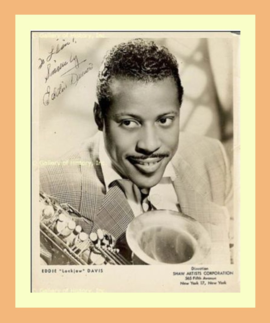
Eddie "Lockjaw" Davis - Tough Tenor Saxophonist

© -  Steven A. Cerra, copyright protected; all rights reserved.


“Davis straddles bop and swing in his phrasing; if anything, with his swallowed notes, sandpapery tone and sudden shrieks, he’s already a genre unto himself. … Davis was to become one of the most honest, no-nonsense soloist in the music. The knockout power of Davis’ blowing is thrilling.”
- Richard Cook and Brian Morton, Penguin Guide to Jazz on CD, 6th Ed.


“Eddie Davis is what you would call a natural musician for he never took a lesson in his life; not one that he didn’t administer himself, anyway. When Eddie decided that he wanted to play the tenor saxophone, he bought one second-hand and with it an instruction book which he studied diligently for eight months. At the end of this period, he played his first job [1942] at Clark Monroe’s Uptown House, one of the first bastions of modern Jazz.”
- Ira Gitler


“He talked the way he played. He was glib, and his silver-tongued, pleasantly confrontational style always elicited a great audience response.
There were players who were better known, more influential, whatever; but they weren’t any more confident or fearless than Jaws. He came to play, and if you were smart you didn’t mess with him. He brought a street-fighter’s instincts to the bandstand.”
- Joel Dorn


Okay, no shilly-shallying around: Eddie “Lockjaw” Davis’ tenor saxophone playing just knocks me out.


“Jaws” constantly delivered a brand of intensity and excitement on the instrument which aptly earned him the reputation for being one, tough, tenor saxophonist.


Whatever the setting – soloist with the Count Basie Orchestra, in Hammond B-3 Organ trios with Shirley Scott or co-leading a quintet with fellow tenor saxophonist Johnny Griffin – Eddie barreled through them all with a temerity and a boldness that would characterize his career.


“His sound was, on reflection, a surprisingly complex matter. Unlike many of the players working in the organ-combo format, where Jaws made his biggest impact, his phrasing had an elongated quality that he broke up only with his matter-of-fact brusqueness; as if he was masking emotion with a temperament that told him to get on with it.” [- Richard Cook and Brian Morton, Penguin Guide to Jazz on CD, 6th Ed.]


Jaws was a blustery soloist who came to prominence in the world of Jazz at a time when had you had to “make your bones” by engaging in “cutting” sessions with other tenor saxophonists.


Such “duels” could include another tenor sax player or even a stage full of them; some were known to go on all night, ending in the wee small hours of the morning.


The creative sparks flew when tenor saxophones engaged in such battles, and Eddie “Lockjaw” Davis was often tested, but rarely bested in these competitions.


Whether he was playing the blues or a ballad, Jaws spun solos of flat-out exuberance and exhilaration. His sound was always inimitable and accomplished.


We found a nice overview of the salient features of Eddie’s career in the insert notes that Michael Cuscuna prepared for Eddie “Lockjaw” Davis: The Heavy Hitter [32 Jazz 32057].


“Eddie Lockjaw Davis, more commonly known these days as Jaws, is a thorough master of his instrument and his art. He is a warm, articulate, no-nonsense person who dispatches his business with a flair and a near perfection.


At the beginning of the session that produced this album, I made reference to the second night of recording. Jaws looked at me with surprise and said, "Second night! I'm only supposed to do one album. We'll do that now." As we had had no rehearsals and he had never played with the pianist or drummer before, I was skeptical, to say the very least.


But watching Jaws at work was an education. He was affable and encouraging with his sidemen, yet always in charge. He kept things moving without any trace of hurry or tension. Minutes after the rhythm section arrived, everyone was in his place and ready to go. Jaws would quickly talk out an arrangement, never allow a run through, saying, "Save it for the take. Don't give it away now." And every take was a first take with everyone sounding excellent and Jaws sounding nothing short of brilliant.


It is a testament to these musicians' abilities and professionalism and a miracle to me that such performances could come out of first takes without one sheet of music or one rehearsal. For the second tune of the night, Jaws turned to the rhythm section and said, "Okay 'Old Folks' and then we'll go into 'Out Of Nowhere.' Do you know the changes to these? I'll take a chorus and a half, the piano for the bridge and the last eight bars of that chorus. Then the bass and drums lay out and the piano has four bars to modulate up to C for 'Out Of Nowhere.' We play 'Old Folks' in F. I'll play this phrase. (He plays it.) Got it? Okay, let's take it."


Jaws' tone is big and rich. He is of that generation and school that makes every note meaningful and beautiful in and of itself. He can burn earnestly without working up a sweat, and he can seduce a ballad without resorting to sentimentality. His solos seem to flow casually out of a bottomless reservoir of creativity and feeling.


Although Lockjaw is chronologically in the age of bebop, his primary influences were Ben Webster, Coleman Hawkins and Herschel Evans. Born in New York in 1921, he made his first mark in 1942 and '43 with Cootie Williams, Lucky Millinder, Andy Kirk, Louis Armstrong and other band leaders. The bebop revolution was not one that passed him by as is evidenced by the lovely Fats Navarro date on Savoy in which he was featured. But his soul and spirit was and is firmly entrenched in the style and sound of the swing masters. During the postwar era, he recorded prolifically on a variety of labels. His first session as a leader was for Haven Records. The originals on the date were arbitrarily given the names of diseases. One tune, "Lockjaw," was a hit. It established Davis and gave him a nickname that remains to this day a part of his moniker.


In 1952, Lockjaw joined the Count Basie organization for the first time and quickly became an attraction as the band's cooking blues soloist. The excitement that he generated matched Illinois Jacquet's histrionics with Lionel Hampton in the forties, but Eddie was a thoughtful soloist who never relied solely on grandstanding. Lockjaw would slide in and out of Basie's band as tenor saxophonist and road manager through the years, his longest stint lasting from 1966 to 1973.


After that first go-round with Basie, Eddie led his own groups around New York, until 1955 when he assembled a permanent working band with organist Shirley Scott. That group lasted five years and pioneered the tenor-organ format in jazz. The group's life span is well documented on a string of soulful, intimate albums on Prestige, many of which included Lockjaw's longtime associate George Duvivier.

In 1960, Eddie joined forces with Johnny Griffin, tenor master with a more modern, bop-oriented bent. For the next two years, they battled it out on many recordings and bandstands in the great tradition of Stitt and Ammons or Dexter and Wardell.


When declining public and economics took their toll on jazz, Griff moved to Europe, Jaws was soon to make the startling announcement that he was giving up the saxophone and taking a position as a booking agent with Shaw Artists, one of the heaviest jazz agencies of the period. Thankfully, although successful in that capacity, Jaws ultimately found the horn too irresistible and returned to playing. His "comeback" was in full force by 1966 when he joined the Basie band in both business and musical capacities.


In 1973, Eddie left Basie again, played with Ella Fitzgerald for a time and then stepped out as a leader and a featured soloist in a variety of settings and circumstances around the planet.


In his later years, Lockjaw often recorded with Harry "Sweets" Edison and he remained a busy soloist up until his death in 1986.”


Thursday, December 6, 2018

Joe Magnarelli - Revisiting "Mags"

© -Steven A. Cerra, copyright protected; all rights reserved.


I first met Joe Magnarelli in March, 1998 in a Seattle recording studio where we were recording Italian Jazz pianist Dado Moroni’s Out of the Night CD which I co-produced with Philip Barker for his Jazz Focus Records.

In between takes, we chatted amiably and Joe’s warm personality seemed a perfect compliment to his mellow approach to the trumpet which he plays in a style very reminiscent of Kenny Dorham.

Aside from his work on the Moroni album, I had previously heard Joe on recordings he made for Gerry Teekens’ Holland-based Criss Cross Records, a label he continues to record for under his own name and in combination with Philadelphia-based trumpeter John Swana.


Persistence [RSR CD 194] is my first encounter with “Mags’” work on Mark Feldman’s Reservoir label and it is a thoroughly enjoyable one.  On it, Joe is joined by Gary Smulyan on baritone saxophone and a rhythm section that is one of the best on today’s Jazz scene: pianist David Hazeltine, bassist Peter Washington and drummer Kenny Washington.

Peter Aaron is the music editor of Chronogram magazine and a contributor to the Village Voice, the Boston Herald, All About Jazz.com, All Music Guide.com, and Jazz Improv and Roll magazines. Here are his insert notes to Persistence [Reservoir RSR CD 194].

© -Peter Aaron, copyright protected; all rights reserved.

“There are several indispensable qualities an artist must have if he or she is to survive as a jazz musician. Tone. Technique. Ears. Resourcefulness. Adaptability. Good communication skills. Patience. Confidence. Individuality. Taste. Drive. Soul.

But perhaps the most important quality a great  jazz musician - or any great artist, really -must have is persistence. Lots of it. Because without it, none of the other qualities mentioned above can be attained; when we see them manifested these characteristics can seem like assets an artist has been born with, but the truth is they have to be nurtured, developed. Which takes persistence. And persistence itself is what keeps an artist's eves on the prize, a strength that will carry him or her through the lean times, the slings of the naysayer, the chatty, indifferent audiences, the jet lag, the bad road food, the near-empty clubs, the sleepless nights of self-doubt that all artists encounter. The ones who don't have that all-important stick-to-itiveness eventually give up the ghost and quit playing, at least professionally.

But Joe Magnarelli has persistence. Lots of it. Joe, or Mags, as the trumpeter is often called, has been playing his horn for nearly 40 years. And for more than half of those years he’s been doing it professionally, both as a leader and in the bands of Lionel Hampton, Brother Jack McDuff, Harry Connick, Jr., Toshiko Akiyoshi, Jon Hendricks, and Ray Barretto, as well as in the Glenn Miller and Carnegie Hall jazz orchestras. Joe is also a teacher, serving as an adjunct professor at the New School of Social Research in Manhattan and New Jersey City.


University in Jersey City and conducting clinics and master classes outside of these schools. And, having been a stellar student himself under James Moody, Tommy Turrentine, and others, Joe certainly has a lot of knowledge and experience to pass on. But in addition to the notes-and-bars music theory material he covers, one lesson he imparts to his students is that of maintaining their resolve despite the tests and trials of learning and playing music-in other words, persistence. "Sometimes you do have to give the kids a pep talk," Joe says. "You know, that idea of 'Whatever doesn't kill you makes you stronger."' And, indeed, all tenured musicians know the value of emotional strength, both on and off the bandstand.

Since 1994 Joe has been making acclaimed albums as a leader and co-leader, but this is his first for RESERVOIR MUSIC. (He played as a sideman on Gary Smulyan's exemplary 2003 RESERVOIR release, THE REAL DEAL.) "Being on Reservoir is a really good situation for me," says Joe. "Mark Feldman has the right sensitivity as a. producer. During the session he pretty much just let us do our thing, but when he did offer input it was right on the mark. And I’d already known [engineer] Jim Anderson from some big band and small combo dates I'd played on, so it was all very easy, very relaxed." It definitely comes across: One of the hallmarks of PERSISTENCE is its overall relaxed, free-flowing feel. It's not hard to believe him when Joe mentions that the tunes were "pretty much all done in one or two takes."

Of course, the absolutely killer band Joe put together for the session enters into the equation, too. Check this lineup, jazz fans, and just try not to salivate: Mags on trumpet, Gary Smulyan on baritone, David Hazeltine on piano, Peter Washington on bass, and Kenny "The jazz Maniac" Washington on drums. A veritable all-star team of New York’s world-class straight-ahead scene. "They're some amazing cats, alright," beams Joe. "We'd all worked with each other separately before, so we were all familiar with each other. They could all sense what I wanted play, right from the first note."

Joe wrote Persist during his tenure with the late conga king Ray Barretto. "The tune was originally called 'Persist Until You Succeed' and had lyrics written by Sue Giles, and then I just started calling it Persist," Joe explains. "But Ray didn't like that title and renamed it ‘Mags,’ after me." As  "Mags:' the piece was done in a Latin arrangement for Barretto” s Grammy-nominated 2005 release, TIME WAS - TIME IS. Reworked into a 4/4 swing-time adaptation, Persist opens this album and provides the inspiration for its title. The track kicks off with an ensemble flourish and a strong pronouncement by Kenny Washington, and features a wonderfully scrambled recurring horn vamp and colorful and blustery solos by the leader and Smulyan.

The Village, with its effortless, light bossa nova groove, recalls the music of Joe's time with Barretto as well as the lively culture of Greenwich Village, where the trumpeter was living when he composed the tune. Hazeltine takes a great, sparkling turn here, staying clear of any predictable Latin keyboard clichés, and Joe contributes a fine, bubbly solo.


The band next reprises the standard I Had the Craziest Dream, giving the Harry Warren/Mack Gordon chestnut a smooth and buoyant but relentlessly swinging treatment. While Joe delivers the tune's gorgeous melody with measurably heartfelt tenderness, it's the (non-related) Washington’s that almost steal the show here. "A trumpet player hardly ever gets to play a beautiful standard with a rhythm section like that," says Joe. "It was too much fun, playing that tune with those cats." Peter Washington's strutting bravado drives the performance, and the riveting breaks that he and Kenny Washington contribute are likewise highlights.

It's not hard to guess where the title of D Train Boogaloo came from. "I was on the D train heading downtown to a gig at Birdland when I wrote it," recalls Joe. "Before every record date I force myself to write one tune just for that particular session. The pressure helps me get focused for the date, and D Train Boogaloo is the one I wrote for this album."

PERSISTENCE also boasts a pair of ageless standards by Howard Dietz and Arthur Schwartz. Joe picked up Haunted Heart just a few years ago, while he was playing with Barretto. "I didn't realize that Dietz and Schwartz had written the tune, but I'd always loved it," Joe says. "Barretto’s band had done an arrangement of it, and Barretto liked what I was playing on it. He said, 'Man, you should always play that tune.' I love it." And no doubt listeners will love this version, with -warm deep Smulyan solo, and the lyrical musings of the leader. You and the Night and the Music, on the other hand, was an unplanned inclusion. "That was the last tune we cut. There wasn't any arrangement, we just blew." And blow, they do, especially Smulyan and Kenny Washington during an early, fiery exchange that proves one of the set’s high points.

The ballad Barretto is an homage to Joe's former mentor, who died in 2006. "I started writing it pretty soon after he passed," says Joe. "I'd work on it every morning, adding to it little by little."  It would seem the tunes namesake would've been deeply touched by the tender tribute, which is graced by the trumpeter's gorgeous lines and Smulyan's simpatico comping behind them, as well as a spare, exquisite passage by Hazeltine.

Joe had some fun with the tide of the last tune, Soul Sister. "It's basically 'Body and Soul' redone as a waltz:' he says. "I like to write on top of a standard once in a while. It's fun to do." The tracks, loping, easy, pendulum-like groove offers an excellent backdrop for the lithe intervals of Peter Washington and the leader's occasional Coltrane-esque trills. After such a satisfying ride, its the perfect performance to bring the album in for a smooth landing. And Mags and the band make it all sound so easy.

But of course it isn't easy. Oh, it gets easier as the years roll on. But only after the players have already poured years of dedication and sweat into their craft. Which is a fruitful and never-ending process for Joe Magnarelli. And one jazz lovers will never tire of listening to. If there's one lesson that this music illustrates, it's that persistence pays off.

“Life can be very demanding, but you can't let the tough times get you down," offers Joe. "Every day when you wake up it's a chance to start fresh.”

PETER AARON JANUARY 2008


I have always liked the tune – You and the Night and the Music – particularly after hearing pianist Bill Evans’ interpretation of it on the Interplay album which features a sparkling solo by trumpeter Freddie Hubbard.

The version of the tune on Persistence does not disappoint, especially if you are a fan of straight-ahead Jazz.

As you can hear on the soundtrack to the following video, after Joe plays the line [melody] using a Harmon mute, baritone saxophonist Gary Smulyan and drummer Kenny Washington launch into trading eights, fours and twos that are of such a high quality that they could serve as a model of how this form of – if you will – interplay between horn and drums is done.

Kenny’s exchanges with Gary begin at 1:09 minutes with the 8’s starting at 1:16 minutes; the 4’s at 2:01 minutes and the 2’s at 2:47 minutes.

And, if you are so inclined, listen to this audio a second time and just concentrate on the bass line that Peter Washington lays down behind Joe’s playing of the melody from 18 seconds to 1:08 minutes. All hyperbole aside, this is simply some of the most magnificent Jazz bass playing that you are ever likely to hear.


Wednesday, December 5, 2018

The Saxophone and Jazz

© -Steven Cerra, copyright protected; all rights reserved.


Written from the standpoint of the early 1980’s and published in one of the earliest editions of Gene Lees Jazzletter, Mike Zwerin’s concluding statement evolved over the next 30 years with the likes of saxophonists such as Michael Brecker, David Sanborn, and Bob Berg, continuing the liaison between Jazz and other forms of popular music.


Along with drums, electric guitar, bass and keyboards, the saxophone remains an instrument of choice for many 21st century musicians, as well.


“After Adolphe Sax patented his saxophone in 1846, Berlioz wrote: "Its principal merit is the beautiful variety of its accent; deep and calm, passionate, dreamy, melancholic, like an echo of an echo... To my knowledge, no existing musical instrument possesses that curious sonority perched on the limit of silence."


In his autobiography, Father of the Blues, W.C. Handy — who claimed to have been the first to use a saxophone in an American orchestra, in 1909 — describes the instrument as "moaning like a sinner on revival day." For Arnold Bennett, the saxophone was "the embodiment of the spirit of beer."


It combines the speed of woodwinds with the carrying power of brass and at the beginning Sax intended the seven instruments in his new family for marching bands, replacing clarinets, oboes and bassoons. It was an easy instrument to learn. Each village could now have its own band. You can produce a tone in an hour, learn a simple tune in a day. Brass players, faced with embouchure problems, may take weeks to reach the same point; violinists even longer. Fingering is much less demanding than on older reed instruments.


An exhibition on Sax and the saxophone, presented two years ago at the Centre Culturel de la Communaute Francaise de Belgique, offered a fascinating collection of documents, vintage instruments and audio-visual illustrations about the inventor and his invention. The displays included Sax's other inventions: families of brass instruments called saxhorns, saxotrombas and saxtubas; that enormous organ powered and pushed by a steam locomotive for public events; a design for an egg-shaped concert hall; an air purifier for sufferers of respiratory diseases — forty-six patents in all. But he is of course principally remembered for the saxophone family, which in range, homogeneity, speed and subtlety, became the wind instrument equivalent of the violin family, and the musical voice of the Twentieth century.


Adolphe Sax was born in Dinant, Belgium, November 6, 1814, the son of Charles-Joseph Sax, whose factory employing two hundred workers was the largest wind-instrument producer in Europe. At the age of twelve, Adolphe was an apprentice there. He studied flute at the Brussels Royal Conservatory of Music and won a prize playing the revolutionary fingering system devised by Theobald Boehm.


His first patent was for a bass clarinet, redesigned to give it more flexibility and power. He demonstrated his first saxophone in 1840, behind a curtain because it was not yet patented. It caught the attention of the government of King Louis-Philippe of France, which ordered its military officials to equip their bands with Sax's new instruments. There were articles in the newspapers, pro and con. His competitors used their influence and filed lawsuits against him. A battle of the bands — one conducted by Sax, the other using traditional instruments — on the Champ de Mars in Paris resulted in a jury prize for Sax. The press was almost unanimously favorable. He won large contracts.


Sax moved to Paris. The revolution of 1848 installed a republic and ended the monarchy, including its support of Sax, who filed for bankruptcy in 1852. But the Second Empire followed shortly and in 1854 Napoleon III granted Sax a subsidy. As political fortunes changed, he went bankrupt again, continuing his manufacturing business on a smaller scale. By the time of his death in 1894, he was in reduced circumstances and few people would have bet on the future of the saxophone.


The saxophone was never seriously integrated into classical music, aside from isolated works of Berlioz, Stravinsky, Milhaud and some others. Then came jazz. At the beginning, the dominant jazz instruments were trumpets and cornets. Buddy Bolden, King Oliver, Freddie Keppard and Louis Armstrong were kings.


After that the saxophone began to move in. In 1918, a clarinet player named Sidney Bechet was seduced by a soprano saxophone in a London shop window. In his autobiography, Treat It Gentle, Bechet comments, "This was a piece of good luck for me because i wasn't long after this before people started saying they didn't want clarinets in their bands no more."


The saxophone began to be described as "throbbing" or "wailing" as soloists such as Bechet, Adrian Rollini and Johnny Hodges rediscovered it in the '20s. Its melodic capabilities were explored by Ben Webster, Coleman Hawkins, and Lester Young in the '30s. Saxophone sections were the real stars of the dance bands. Charlie Parker played the instrument harder and faster in the '40s. Lee Konitz and Paul Desmond cooled it out in the '50s. Serge Chaloff, Gerry Mulligan and Pepper Adams picked up from Ellingtonian Harry Carney and explored the underexposed baritone sax. Steve Lacy rediscovered the soprano, which had been neglected since Bechet.


Louis Jordan, King Curtis and Junior Walker introduced the saxophone to rhythm and blues as combos gradually replaced big bands in popular music. John Coltrane and Eric Dolphy stretched the physical and emotional range of the saxophone in the '60 while Archie Shepp, Pharoah Sanders, Albert Ayler and Anthony Braxton invented sounds never before heard.


With rock and roll, the instrument went into eclipse along with jazz itself. The electric guitar took over. But to approach the subtlety and variety of saxophones, guitarists had to employ auxiliary equipment such as wah-wah pedals, phasers and flangers. The synthesizer, the first important new instrument invented since the saxophone, served cold 1970’s technopop well, but people need warmth too and the saxophone combines human breath with the speed of a guitar or a keyboard.


In the mid-1970’s Andy McKay with Roxy Music and David Payne with Ian Drury introduced the saxophone to rock. Saxophones became integral to young groups such as the Q-Tips and Dexy's Midnight Runners. Clarence demons' tenor is essential to the power of Bruce Springsteen's material. Phil Woods' alto has been featured prominently on Billy Joel's hits. Steely Dan would not be quite what it is without Wayne Shorter's tenor.


So those among us who never knew it had left will be pleased to learn that the saxophone has been making a comeback. Its continuing contemporary appeal is illustrated by a sixteen-year-old music student who switched from guitar to tenor sax, giving as his reason: "I want to play an instrument I can kiss."                                                -MZ
April 15, 1983
Jazzletter, Vol. 2, No. 9

Tuesday, December 4, 2018

Don Ferrara - The Gordon Jack Interview [From the Archives]

© -Steven Cerra. Copyright protected; all rights reserved.


"Don is a real improviser and a very complete player—sound, ideas, time. He possesses very cohesive intuition." … Don was a powerful player and one of the few trumpeters to have some of Roy Eldridge's heat."
- Lee Konitz, alto saxophone


Where I grew up, everyone’s last name ended in a vowel, or so it seemed for a very long time.


Names like “Ranucci,” “DiStefano,” and “Capaldi” - it was all so mellifluous to listen to the teachers call the attendance roll each day in the classroom.


“DeSantis” was the name above the entrance to the bakery, “DiPippo” owned the store where you went to buy musical instruments and took music lessons and “Ferrara and Ferrara” was really a law firm.


The son of one of the Ferrara attorneys was my best buddy through most of grade school and as a result of this boyhood friendship, I’ve always had a fondness for the last name of “Ferrara.”


And my fondness for that family name didn’t diminish once I heard the brilliant trumpet playing of Don Ferrara on recordings by the Gerry Mulligan Sextet and then later on LPs with alto saxophonist Lee Konitz and Gerry’s Concert Jazz Band.


Don Ferrara’s beautiful sound on trumpet always brought to mind another of my favorite trumpet players who shares the same first name - Don Fagerquist [and the same initials!]. And what I wrote about Don Fagerquist in this excerpt from a previous blog posting also applies equally as well to Don Ferrara.


“One of the musicians on the Left Coast who always knocked me out was trumpeter Don Fagerquist.


He had one of the most beautiful sounds that I ever heard on trumpet; plus, he was one heckuva swinger, which always caught me by surprise. Here’s this lyrical, pretty tone, and the next thing you know the guy is poppin’ one terrific Jazz phrase after another.


The trumpet seemed to find him. His was one of the purest tones you will ever hear on the horn. In Don Fagerquist, the instrument found one of its clearest forms of expression.


Don never seemed to get outside of himself. He found big bands and combos to work in that both complimented and complemented the way he approached playing the trumpet.


His tone was what musicians referred to as “legit” [short for legitimate = the sound of an instrument often associated with its form in Classical music].


No squeezing notes through the horn, no half-valve fingering and no tricks or shortcuts. Even his erect posture in playing the instrument was textbook.


If you had a child who wished to play trumpet, Don would have been the perfect teacher for all facets of playing the instrument.


He was clear, he was clean and he was cool.


His sound had a presence to it that just snapped your head around when you heard it; it made you pay attention to it.


No shuckin’ or jiving’, just the majesty of the trumpeter’s clarion call . When the Angel Gabriel picked trumpet as his axe [Jazz talk for instrument], he must have had Don’s tone in mind.”
- the editorial staff at JazzProfiles

Regrettably, there is not much information about Don Ferrara in the Jazz Literature, a fact that has been somewhat remedied by the following interview that Don Ferrara gave to Gordon Jack and which first appeared in the June, 2000 edition of JazzJournal.  It also forms Chapter 11 is Gordon’s invaluable Fifties Jazz Talk: An Oral Retrospective.


Gordon very graciously gave his consent to allow JazzProfiles to repost his Don Ferrara interview as a blog feature. I have retained the footnote numbering in the body of the text and you can find these sources at the end of Gordon’s interview along with a video that will give you an opportunity to sample Don’s trumpet playing.


[Gordon also advised regarding the photo that appears at the beginning of this feature: “One piece of information regarding the Ferrara, Travis, Candoli picture in my book was that they were all on stage with Mulligan's CJB in Paris at the time -1960.”]


© -Gordon Jack/JazzJournal; used with permission; copyright protected; all rights reserved.


What is really surprising about Don Ferrara, who worked with major figures like Georgie Auld, Woody Herman, Lee Konitz, Gerry Mulligan, and Lennie Tristano, is that he is not mentioned in any of the standard jazz reference books. Tristano once said that Ferrara had ‘absolutely everything,' but in a long career, despite an earlier attempt by Leonard Feather, this is the first interview he has agreed to give. It took place in 1996, when he replied on cassette tape to my list of written questions.


“I was born on March 10, 1928, in Brooklyn, New York. I started playing the trumpet when I was ten years old, and I was the only professional musician in my family. The radio was filled with music every night, broadcasting from clubs and hotels all over the city, and I would listen to Louis Armstrong, Roy Eldridge, Lionel Hampton, Glenn Miller, Harry James, Tommy Dorsey, Duke, Basie, and Woody. I was hungry to hear as much as I could, and I was knocked out by how well the trumpeters played and how different they all sounded.


Jerry Wald had a good commercial band, and it was the first big band I played with for four months in 1945, but he was more of a businessman than a musician and he didn't make much contact with the guys. I left to join Georgie Auld, and along with Diz and Woody, he had one of the best big bands in the country. Al Porcino, who was a great lead trumpeter, was there along with Al Cohn and Serge Chaloff. Al Cohn wrote most of the book, which was very loose and musical, and Georgie was a friendly guy who would hang out with the band. He was a wonderful musician, not at all competitive, and I stayed with him until May 1946, when I was inducted into the Army. That is where I met Red Mitchell, because we were both in the same Army band, and Howie Mann was there too. Howie was a friend of mine from high school, and he was a good drummer who later worked with Elliot Lawrence.


I first met Warne Marsh at this time, and we spent a lot of time playing together and listening to records, which is when I found out about Lennie Tristano. As soon as I was discharged in April 1947,1 started studying with him, and right from the beginning he got me into chords, because I didn't know how any of that worked. It was thanks to Lennie that I was able to find my own direction, although I wasn't copying anyone's playing, so there wasn't anything to change. This was really when everything started for me, and I carried on studying with him for a total of fourteen years. 1947 was also the year I started teaching.


1950 was a very busy year for me because I was rehearsing with a band that Gene Roland put together for Charlie Parker. It was Al Porcino who recommended me to Gene, who was organizing an unusual big band with the idea of working and recording with Bird. A couple of weeks before rehearsals, Lee Konitz, Warne Marsh, and I went to hear him at a club out in Queens, and we all ended up on the bandstand with Miles and J.J., who were working with him that night. I really enjoyed it. I had never played in a band as big as Gene Roland's—eight trumpets, five trombones, eight saxes, and four rhythm—and it was unbelievable to hear Bird playing in an eight-man sax section. He was so strong and beautiful, playing lead the way he played everything else, and the feeling and looseness were just wonderful. One of the tunes was "Limehouse Blues," and even though he had thirteen brass in cup mutes behind him, his line and sound cut through everything. I did about two weeks' rehearsals, but I couldn't make the recording with Bird because, once again thanks to Al Porcino, I was called for a record date with Chubby Jackson.1 Howard McGhee was in the trumpet section with Al and me, along with J. J. Johnson and Kai Winding in the trombones and a very hip sax section of Charlie Kennedy, Georgie Auld, Zoot Sims, and Gerry Mulligan, with Tony Aless on piano and Don Lamond on drums. There was talk of Chubby taking the band out to a new club in Texas, but I didn't go because Red Mitchell had recommended me to Woody Herman, so I started working with the Third Herd in April 1950.


Our first job was a month at Bop City in New York, and we had some wonderful soloists like Milt Jackson and Bill Harris that I really enjoyed listening to. The trumpet section was very strong, and Bernie Glow played most of the lead, although the way the book was written, some of the tunes had the lead split three ways. Being a "Four Brothers" type band, the saxes had most of the solos, but once in a while the trumpets got a chance. On "Route 66" for instance, Woody asked me to write a chorus for the section to play in unison in harmon mutes, which was followed by a solo for Doug Mettome. I arranged for Jeff Morton to take Sonny Igoe's place on the band for three weeks when Sonny got married, and the rhythm section sounded wonderful. Woody was nice to work for and I stayed with the band for fifty weeks, but eventually I left and went back home to Brooklyn to study with Lennie again, and I think that Don Fagerquist took my place.2


Over the next few years I was teaching and studying as well as playing at lots of jam sessions around town. Then, in 1955, Lee Konitz asked me to join his group with Sal Mosca, Peter Ind, and either Dick Scott, Ed Levisen, or Shadow Wilson on drums. Billy Bauer sometimes worked with us, and the repertoire consisted of originals by Lee and me, pieces by Lennie, together with some of Bird's lines. It was a great band. I loved the way Lee, Peter, and Sal played, and we had a wonderful time for a couple of years, playing at clubs like Birdland, Cafe Bohemia, and the Half Note.


The first time we worked opposite Mulligan and Brookmeyer, Gerry said he was so knocked out with my playing that he called me to record with his sextet. I rehearsed with the group in the afternoon of September 26,1956, and after we took a break and went out for something to eat, we recorded the album later that night.3 That was the only time I played with the sextet, but a few days later Bill Crow called and said that Gerry wanted me to join the band. I didn't because I was still working with Lee, although I really liked the sextet. The writing was very good, the blend and intonation of the four horns was perfect, and everyone could really blow. The following year I recorded again with Gerry, only this time in a big band, and just about everyone had a short solo.4 That same year Lee and I were in the studio for Norman Granz, and on "Billie's Bounce" we played Bird's four choruses from memory, because most of the people studying with Lennie were memorizing solos by Lester, Bird, and Roy Eldridge.5


One of my students was a good friend of Mulligan's, and Gerry told him to get me to call because he wanted me to join the Concert Jazz Band, which he was organizing. After three months of auditions and rehearsals we played our first gig in January 1960 at Basin Street East. The club was filled every night, and I couldn't believe how many musicians were coming to hear us, as well as film and stage people who were friends of Judy Holliday. I had already met her at the rehearsals, and she was there at the band's first night, sitting next to Dora, my wife, and they were having as much fun listening as we were playing. I remember one night later on at the Village Vanguard, someone was whistling loudly after solos and at the end of every tune, generally having one hell of a time. When we came off the stand I asked Dora who was making all the noise, and she said it was Judy!


Nick Travis played all the lead, and he had good chops and excellent time. He was a fine consistent player with a relaxed feeling, but when we were in Europe he had a loose tooth on the top, right under the mouthpiece. He really had a problem for the last part of the tour, but it wasn't apparent to anyone, and as you can hear on the records, he sounds as full and consistent as always. Gerry already had Brookmeyer, but he wanted another strong soloist in the trombone section, so a couple of months before we left for Europe, Willie Dennis joined us, and he was perfect. I had first met Willie when he was with Elliot Lawrence in 1948, and he was a very good friend of mine. When he left Elliot's band, he moved to New York and started studying with Lennie, and his playing was just beautiful. He had very good chops and great time, with a soft texture to his sound, and despite what you may think, he was not slurring all the time but tonguing very lightly. He was very spontaneous, immediately reacting to what was happening. He was also a very good cook, and if you ate at his house, you ate well. Unfortunately Willie was killed in a car accident in Central Park; Dora and I went to his funeral, which had a closed casket. His wife, Morgana King, told us that on the night of the accident, it had been raining, and the road turned but the driver didn't. He hit a tree, sending Willie through the windscreen.


Gene Quill was a great character, and one of his features in the band was "18 Carrots for Rabbit," which was nearly all alto followed by a short solo from Gerry. One night after Gene finished and Gerry took over, the audience exploded because Gene had played so well. He took an extravagant bow, turned round to the band, giving us a real dirty look, and kissed himself on the shoulder. We just broke up and couldn't play anything, missing a whole bunch of phrases to be played behind Gerry's solo. At the end of the piece, Gerry asked us what had happened. We told him what Gene had been doing and Gerry, shaking his head, said, "I don't want to play after him anymore. Who the hell can play after him!" Which is when we all started laughing again. It was great having Zoot Sims on tour with us because he was so musical. He had great time and a sound that projected a wonderful feeling every time he played. On the subject of sounds, Gerry had the best of any baritone player, and he was extremely melodic. Bob Brookmeyer, too, had a superb sound and time, and they both played piano very well.


It was very easy working with Gerry. He was definite and consistent, so you knew exactly how he wanted his things played, and he always listened intently to the soloists, letting them know how much he dug their playing. We were all friends, and it was a happy band, in fact the best big band I ever played with. Gerry also had a good sense of humor. I remember one night he became angry with some of the audience for keeping time with the band by tapping on their glasses. He walked to the mike and told them he didn't like it and it was costing everyone in the room a lot of money to hear us. Those people got up to leave, and Gerry announced that it would be a good time to play "Walkin' Shoes."


I started working with Lennie at the Half Note in November 1962, and it was the best time I ever had playing. For about a year and a half we did three weeks there every two or three months, and Lennie was just unbelievable; his surprises were endless. I had been listening to him for years at lessons and jam sessions, but to be on a gig with him was something else, because he totally followed through on everything he told his students. He had great time and he was the most melodic player I ever heard. His chords and lines were extremely rich and intense, and I couldn't believe what a great sound he got out of those terrible nightclub pianos. Lennie would ask what tune I wanted to play and at what tempo. He would tap off, and we would just start improvising.


In 1964 Dora and I were busy with the first home that we had bought in New Jersey, and for the rest of the sixties I carried on teaching and making sessions. In 1972 we moved to Pasadena, California, which is where Warne Marsh introduced me to Gary Foster. I started teaching at Gary's studio and did some playing with Gary, Alan Broadbent, and Putter Smith, who are all excellent musicians.


Lennie Tristano was very important to me, as well as being one of my best friends, and I kept in touch with him until he died in 1978. Jeff Morton was a great drummer, and we played together as often as we could until his death in 1996. We have now moved to southern California, just north of San Diego, and because I teach by cassette, we can live anywhere in the country and still keep all my students.


No interview with Don Ferrara would be complete without discussing Roy Eldridge, who had an enormous influence on his playing, and his comments in a 1956 series of articles he wrote for Metronome magazine are particularly succinct: "Every note Roy played had meaning and life . . . his feelings pushed the valves down, not his fingers." In a recent telephone conversation Don told me, "Roy was the most important trumpeter for me. His time and sound were great. His line was always melodic, and the feeling was always very intense. He had the best chops of all the trumpeters, sounding loose and strong, and it didn't matter what tempo or in what range he played; it was all meaningful."


I concluded the interview by asking Don to list some of his favorite instrumentalists, singers, arrangers, and bands. His selections are as follows:
Trumpet—Roy Eldridge. Trombone—Bob Brookmeyer, Willie Dennis, and Bill Harris. Alto—Lee Konitz and Charlie Parker. Tenor—Lester Young, Warne Marsh, and Zoot Sims. Baritone—Gerry Mulligan and Lars Gullin. Clarinet—Artie Shaw and Lester Young. Vibes—Milt Jackson. Piano— Lennie Tristano, Sal Mosca, and Bud Powell. Guitar—Charlie Christian, Jim Hall, and Billy Bauer. Bass—Peter Ind and Red Mitchell. Drums—Jeff Morton, Max Roach, and Roy Haynes. Singers—Billie Holiday and Frank Sinatra. Arrangers—Ralph Burns, Neal Hefti, Gerry Mulligan, Bob Brookmeyer, and Bill Holman. Big Band—Gerry Mulligan and Woody Herman. Small Group—Lennie Tristano, Lee Konitz, and Dizzy Gillespie/Charlie Parker.


Don Ferrara's solo abilities are well represented on the albums he made with Mulligan's sextet and the CJB. In 2000 Peter Ind released previously unissued tapes of a 1957 Lee Konitz engagement at the Midway Lounge, Pittsburgh, Pennsylvania, containing four numbers featuring the trumpeter.6 A particularly good example of Don's work in a small group situation is the LP. he mentions in the interview, where he and Konitz play Parker's famous solo on "Billie's Bounce." The album allows him to stretch out and really develop his highly individual ideas, and it has the additional advantage of including two of his distinctive compositions, "Sunflower" based on "Yesterdays," and "Movin* Around" based on Tristano's "Pennies in Minor" It is a recording that is long overdue for reissue on CD.”


NOTES
1.  Chubby Jackson Big Band. Fantasy OJCCD-711-2.
2.  In Bill Clancy's book on Woody Herman, Chronicles of the Herds (Schirmer Books), a June 1950 photograph shows Don Ferrara playing with the band at the Capitol Theater in New York.
3.  Gerry Mulligan Sextet. Emarcy Jap 826993-2.
4.  Gerry Mulligan, Mullenium Columbia/Legacy CK 65678. In addition to some examples of Gene Krupa and Elliot Lawrence playing Mulligan charts from the late forties, this CD also features six titles recorded by a Mulligan big band in April 1957. It includes a restored Ferrara solo on "Thruway" that had been removed on the original L.P. The CD booklet has some excellent and previously unpublished photographs from the session.
5.  Lee Konitz, Very Cool. MGV 8209. May 1957. Talking about Ferrara on the sleevenote to Nat Hentoff, Konitz says, "Don is a real improviser and a very complete player—sound, ideas, time. He possesses very cohesive intuition." More recently he told me: "Don was a powerful player and one of the few trumpeters to have some of Roy Eldridge's heat."
6.  Peter Ind Presents Lee Konitz in Jazz from the Fifties. Wave CD 39. February 1957.


If you wish to spend a fun evening listening to recorded Jazz sometime, try playing back-to-back records by Bobby Hackett, Don Fagerquist and Don Ferrara see where that takes you.