Wednesday, May 1, 2019

A Review of Harlem Jazz Adventures: A European Baron’s Memoir, 1934-1969 [From the Archives]

© -  Steven A. Cerra, copyright protected; all rights reserved.

It's not often that one gets to read first-hand accounts about the early makers of the music - primary source material about Jazz masters like Pops, Duke, Fats, Billie and Eddie Condon.

That's because there aren't too many people around from those halcyon days to tell their stories from a first person perspective.

Timme Rosenkrantz's memoirs is one such book.

It first posted to the blog on April 17, 2012 and I wanted to reprise it to edit out some flaws, add photographs and include the Eddie Condon video which you'll find at the conclusion of this piece.


“This book is not a sociological or jazz-historical work; it is not a refer­ence book on the evolution of jazz over the ages. There are lots of those!

This is a book about my adventures during many, and sometimes long, visits to the jazz capital of New York; about the thrill it has been to meet the great and lesser jazz musicians and their friends. It had to be a happy book about happy people and their music, and it is written by a happy man who is happy because he has been lucky enough to get close to that world, even to live the life he had, so to say, chosen as his own.”
- Baron Timme Rosenkrantz

Every time I’m the least bit inclined to forget bassist and Jazz author Bill Crow’s admonition that “Jazz should be fun,” something comes along to remind me of the import of this remark.

Most recently, it came in the form of Fradley Garner’s superb English adaptation of Timme Rosenkrantz’s Harlem Jazz Adventures: A European Baron’s Memoir, 1934-1969.

As these dates denote, Mr. Rosenkrantz, a Danish baron, spent a good portion of his life in New York City when Jazz was first coming into existence and he offers exciting and enthusiastic glimpses of this time-gone-by in the thirty-six vignettes that comprises the chapters of his memoirs.

Each chapter is a short essay and collectively they form an episodic stroll through the Jazz clubs, theaters and gin joints of Harlem [and later 52nd Street] during its heyday as the “must visit destination” for any Jazz fan.

Mr. Rosenkrantz’s lovely stories are also a brilliant example of the power of one of William Zinsser’s key points in his On Writing Well when he enjoins us to “ … let the person speak to the reader in his own words.”

The very manageable chapters and the cozy manner in which the stories contained in them are told create a much welcomed first-person narrative at a time when many of the books being published on the subject of Jazz are overly analytic and coldly academic in nature.

Credit for the engaging “tone and tenor” of Mr. Rosenkrantz’s memoirs must be given to Mr. Fradley Garner for his brilliant English translation/adaptation which is replete with a number of explanatory footnotes that help make the book even more lucid.


And while Mr. Rosenkrantz’s commercial Jazz ventures [record producer, record shop owner, concert producer, Jazz club owner] ultimately failed causing him to comment – “You can say I was born under an unlucky star if you want to.” – he’s quick to also acknowledge: “But every so often that star shone brightly and made up for all the sunshine that I slept through.” [p. 186].

Mr. Rosenkrantz was to experience first-hand the old adage: “The best way to make a million dollars in Jazz is to start with two million!”

Yet, it’s difficult to feel too sorry for him, as based on the experiences he shares in his book, Mr. Rosenkrantz met everyone who was anybody in the world of Jazz during its formative years and had the time of his life while doing so.

If this book is a testimonial to anything, it is to the fact that Mr. Rosenkrantz definitely knew how to have fun with Jazz.

Judging from a reading of Mr. Rosenkrantz’s anecdotes, tales and yarns, perhaps the book might have been alternately subtitled: A Danish Baron’s Book of Enchantments, Revelations and Amusements in The Land of Jazz.”

Take for example the title of the work’s very first chapter: Get Off at 125th Street and God Be with You” which refers to the warning given by his midtown Manhattan hotel clerk when Mr. Rosenkrantz’s asked subway directions to uptown Harlem during his very first trip to New York in 1934.

“God certainly was with” Mr. Rosenkrantz for over the next thirty-five years he was to meet and, in many cases, become personal friends with Jazz luminaries such as Don Redman, Chick Webb, John Hammond, Benny Carter, Billie Holiday, Adrian Rollini, Benny Goodman, Willie “The Lion” Smith, Art Tatum, Fats Waller, Mezz Mezzrow, Eddie Condon, James P. Johnson, Slim Gailliard and Slam Stewart, W.C. Handy, Stuff Smith, Erroll Garner, Mildred Bailey, Bud Powell, and most especially – Duke Ellington – whom he [I think] correctly refers to as “The King of Jazz.”


Among the book’s many, other enchantments are the following stories from Mr. Rosenkrantz:

- “I'll never forget that first 1934 visit to Harlem!

I walked upstairs from the subway platform at the corner of 125th Street and Lenox Avenue and blinked twice as I stepped out on the sidewalk. I felt as if I had entered another world. Huge neon signs blinked around me and over me. Beckoning shop windows caught my eye. The traffic was frightening. Music blared from every open shop door. You might think you were standing on Times SquarePiccadilly Circus, or—stretching the imagi­nation—Vesterbrogade, Copenhagen's main street, except for the people around you. They were all people of color. A solid mass of blacks, browns, yellows, grays moved along the broad avenue with a swinging, rhythmic gait that held this Nordic visitor in a trance. Their clothing was gay, their faces animated, their voices rang in the February evening air, as they fairly skipped along under the trees (now uprooted) on Lenox Avenue.

Following the crowd, I walked up the street, past several big movie houses, and suddenly, there I was standing in front of the Apollo Theater.

The Apollo was the last variety theater in New York City. Here the colossal show goes on at ten in the morning and runs nonstop until two the next morning—and to think I had wasted nearly my whole first day in con­versations, cafeterias, and clouds!

In the lineup were the greatest black artists in the world—singers, danc­ers, comedians, strong men and weak women, balancing acts, jugglers, and magicians. And the best Negro bands of the day—plus, of course, a line of the prettiest and darkest chorus girls this white man has ever seen.

And there was nearly always a full house. The program ran over two hours and changed every Friday. In between performances, they showed some Mickey Mouse films and newsreels and a feature film, something with lots of action. The black audience—and it's almost entirely black—demands action. Something has to happen!

Still and all, the films were so bad, I still believe they were chosen to empty the house. They usually succeeded.

My first night, there was a big revue with Don Redman's Orchestra as the main attraction, costarring with the Mills Brothers, those fantastic tap dancers the Step Brothers, and a funny, blues-singing comedian, Pigmeat Markham. He later gained TV fame on the Ed Sullivan Show….” [pp. 14-15] …


- “And then Billie Holiday came on. I shall never forget her, standing there in the dim spotlight. Young and beautiful as a dream, her sensitive, full lips half open; those almond eyes almost closed, as if she were having a blissful dream. Her voice wasn't big, but it crept under your skin and stayed there. She sang like an instrument—sometimes like the softest plea of a saxophone, sometimes like the shrill command of a trumpet. Never had I heard anybody sing like this. You sat there, almost clenching your fists in ecstasy. Her way of phrasing the words was so different, yet so right. You instantly knew that this was the way a jazz lyric should be treated. That voice clutched you like coiled fingers.” [pp. 43-44]


- “Anyone who knew Fats loved him. He had a heart of gold. No one came to him in vain when they were needy. No one could resist his always buoyant and contagious spirit. His laugh could be heard for miles around.

I remember one of our mutual friends, Adrian, a young Dutch composer of whom Fats was very fond. Adrian had come over to New York to try to make it as a composer and arranger, but nothing was happening. To make ends meet, he had taken a job as a wastepaper basket emptier in an office. One night, when the three of us were together, Adrian started dreaming out loud. "If only I could afford to rent a little piano, I could really start writing some tunes and working on arrangements, and get out of that office. It's killing me!"

The very next morning two moving men showed up at Adrian's doorstep bearing a new grand piano. With love from Fats. It had a great sound. I'm sure Fats had taken the time to choose it personally. In fact, he came by often to play it himself, much to the joy of everyone within hearing range on West 87th Street. At least Fats wasn't to blame for our European friend never mak­ing it. "The Flying Dutchman" managed to do a few arrangements and place them, but at last hearing, Adrian was still trying to get paid.” [p. 75]

And here are some of the book’s revelations as recounted by Mr. Rosenkrantz:

- “C-R-R-R-R-R-R-ASH! An ear-splitting drumroll unfolded into a cymbal crash at the other end of the ballroom. Then the orchestra fell in, heralding the arrival of a little hunchback drummer, the greatest in the world, Chick Webb. Something happened to me I shall never forget, impossible to put into words. Only to be felt. And I’ve learned a great drummer is to be felt before he is heard. Chick seemed to turn a light on in me.” [p. 19]


- “Young Garner's father was a singer who played several instruments, as did his older brother, Linton. Erroll was an entirely self-taught musician who hit the keys when he was three years old and never did learn how to read mu­sic. But he played like no other pianist, and his flamboyant style was a delight to the ears. He would start a ballad with a long, discordant introduction that didn't even hint at the melody to come. At last when he swung into it, his left hand lay down chords like a guitar, keeping up a steady pulse, while his right hand never seemed to catch up, improvising chords or playing octaves that lagged way behind the beat for the rest of the number. Just a pinch of Fats Waller added spice.

I was fascinated by this fellow's joyously swinging piano, and I sought him out while Louis Prima was on. Erroll was anything but happy. He didn't know many people in New York and was downhearted. No one was inter­ested in listening to him—Louis Prima was the showman attraction. And Erroll was only making forty dollars a week!

He told me he thought he'd go home soon, as it seemed nothing was going to happen for him in New York. Somehow, I had to stop him. I invited him home to 7 West 46th Street, showed him my rented Krakaur grand, and once he got started, it was impossible to pry him off the bench. Little did I know at the outset that he had a bad case of asthma and couldn't sleep lying down!” [p. 176]


- “An odd commentary on the vicissitudes of life is the fact that Ellington does not like the business of getting from one place to another. He cannot sleep on trains, ships, or in cars, and he especially dislikes flying. Constant traveling for forty years has not changed him at all. Approximately 14,650 sleepless nights account for those heavy bags under his eyes. Come to think of it, he doesn't like to go to bed at home, either. Life fascinates him so much, it seems a terrible waste of time. He just seems to thrive on not sleeping!

On the road, he prefers to play cards with the bandsmen, very often winning all their loot—but he is a gracious loser, too. Until recently, when he bought an apartment in a skyscraper on New York's Central Park West, Duke had a modest little flat on Harlem's Sugar Hill. He fell for New York the first time he glimpsed the bright lights—which, to his imaginative soul, were an Arabian Night's dream.

A born big-city man, he has a deep-seated dislike for expanses of green grass, saying they remind him of cemeteries. Can't bear any kind of outdoor sports; regarded the walk down three flights of stairs in his old Harlem apart­ment as his daily constitutional; laughingly describes himself as "a hot-house flower."

"You have to be careful, Timme," he once told me. "There's nothing more dangerous than fresh-air poisoning!"”[pp. 158-59]

The following excerpts are examples of the book’s many amusements:

- “Pod's and Jerry's, also known as the Log Cabin, at 133rd Street near the corner of Seventh Avenue, was usually the last stop for uptowners and down­towners alike. Here you could bump into celebrities like Tallulah Bankhead, Frederick March, Franchot Tone (or his mother, playing drums), and other New York theater people and Tin Pan Alley types. Many had been slumming at the Cotton Club, where they watched floorshows featuring the Duke El­lington, Cab Galloway, or Jimmie Lunceford orchestras. They'd show up in top hats and tails or dripping in ermines. As a rule, they circulated incognito, wearing oversize sunglasses to make themselves unrecognizable, which never worked nor was it intended to.

This scene inspired Don Redman to write a tune, "Take Off Those Dark Glasses, We Know Who You Are!" Confronted by one of those notables, Harlemites would chant the melody.”[p. 27]


- “A few years ago, Eddie Condon made a tour of the British Isles that is still remembered. With him he had his jug buddies Wild Bill Davison and George Wettling. The tour turned into a contest of how much liquor can be consumed while playing trad jazz. Who won I don't have to guess: Eddie had no peers. But nobody seemed to mind, for this was a very special occa­sion—the very first time the Brits had heard a stomp-down, sure-enough, live Dixieland band….

Arriving in a principal city, they were met early in the morning by the I press, who tracked them to their hotel. They found Eddie in bed with the hangover of all time. He could hardly move, but the interview was important, and the road manager let the scribes in. Eddie lay flat on his back with his hat on. "Go on, shoot!" he growled. Anything else he mumbled was lost as he faded away.

"Mr. Condon, wouldn't it be better if you sat up a wee bit in bed, so we can hear what you are saying?" ventured one of the chaps.

Condon's eyelids stayed at half-mast as he cracked open his lips and croaked, "What the hell do you think I am, man, an athlete?" [pp. 153-54]


- “The New York Herald Tribune [subsequently, The International Herald Tribune] once gave a luncheon in honor of Louis Armstrong at one of the fashionable Paris restaurants. Many prominent people from the literary world and theater were there, as well as music critics and reporters from all over the continent. Louis had asked me to come along.

It was a typical American luncheon with hamburger steaks and three different kinds of ice water. I think Louis had a side order of red beans and rice, his favorite fruits.

There were many speeches, and Armstrong was praised in as many dif­ferent accents.

Then it was Louis's turn to say a few words. Somebody had asked him what his greatest thrill had been on this latest European tour. Louis answered:
"Last week we were playing in Rome. We gave a great concert and those Italian cats went crazy. We could’ve filled the Forum, no question about that, if they had repaired it! Well, the next day my wife, Lucille, and I had a private audience with the Pope. And it knocked us out, man! I told His Holi­ness about my music and about my Swiss Kriss (a laxative), which moves me almost as much as the music, and he was real great, you know?

"'What a beautiful wife you have!' the Pope says. 'Do you have any children?'

"'No, Pops,' I told him. 'But we're still working on it.' And do you know, the Pope fell o-u-t!

And so did everybody at the luncheon party.” [pp. 127-28]

Socrates once said that “the unexamined life is not worth living,” to which, an acceptable corollary might be: the unlived life is not worth examining.

No words could form a better description of the “Jazz Life” lived by Baron Timme Rosenkrantz as depicted in Harlem Jazz Adventures: A European Baron’s Memoir, 1934-1969.


As Jazz approaches the beginning of its second century, don’t miss you chance to read about what it was like soon after it all began.

For information on ordering the book, go here.

The Great Condon, already into his 4th decade of music here, rips through the venerable standard Royal Garden Blues with the ample aid of Wild Bill Davison (ct), Peanuts Hucko (cl), Cutty Cutshall (tb), Buzzy Drootin (d), J. Varro (p) and Joe Williams (b).

Tuesday, April 30, 2019

Baby Dodds and Zutty Singleton: Paving the Path to Modern Drumming

© -  Steven A. Cerra, copyright protected; all rights reserved.


“One night late in the fall of 1933, a lanky youth with a mop of dark hair entered a night club on Chicago’s north side and asked the waiter for a table near the band. He sat down took out a stick of gum, popping it in his mouth as he watched the show. He drummed on the table with his fingers.


The dancers were running through a routine based on Liszt's First and Second Hungarian Rhapsodies. To watch the dancers and watch the conductor, too, in show work, everything depends on the drums.


Gene Krupa stayed late that night even though he had to get up for a rehearsal the next morning. Like many of today’s great drummers, Krupa was serving his extra-curricular apprenticeship with Baby Dodds.


Baby won’t actually claim that he taught any of them. “Drummers just get pointers from each other, that’s all,” he says, “and I don’t want to go claiming that I taught them. I got that in the back of my head and if they want to ask for it, I give it to them.”


Among the drummers who have asked for that stuff are Dave Tough of the Eddie Condon Band, George Wettling with Paul Whiteman; Ray Bauduc, Wally Bishop and Ben Pollack have all sat by his side.


When Zutty Singleton first heard Baby on an excursion boat out of New Orleans, he went home and asked his uncle: “I wonder if I could ever drum like that fellow on the boat?””
- Fred Ramsey, Baby Dodds, The Drums [Smithsonian Folkways FW02290 / FJ 2290]


Jazz drumming has come so far today in terms of technique and complexity that few listeners ever pause to reflect on those that started it on the path to modernity.


Horn instruments in the hands of Louis Armstrong, Coleman Hawkins, Jack Teagarden made possible examples of how to develop facility on the trumpet, tenor sax and trombone, respectively.


Earl Fatha Hines, Thomas Fats Waller and Art Tatum became beacons for those pianists who wished to bring their technical skills on piano to a higher level as did the work of string players such as Joe Venuti on violin and Eddie Lang and Django Reinhardt on guitar.


Gene Krupa and Buddy Rich gained a large measure of public attention for the stylistic advances that they brought to Jazz drumming but, sadly, too few Jazz fans are aware of the foundation upon which their drumming wizardry is based.


The editorial staff at JazzProfiles thought it might be fun to reflect back on the careers of two drummers who provided the building blocks upon which early Jazz drumming technique is based: Baby Dodds and Zutty Singleton.


We are indebted to a variety of sources for the following information including the Moderndrummer and Drummerworld websites and Len Lyons and Don Perlo’s Jazz Portraits: The Lives and Music of the Jazz Masters.


Warren “Baby” Dodds


Warren “Baby” Dodds was born in New Orleans on Christmas Eve, 1898 and died in Chicago on Valentine’s Day, 1958.


Dodds, a hard-drinking, hard-fighting musician in his youth, and is considered by many to be the Father of Jazz Drumming mainly because he defined many of the criteria by which future drummers would be judged. Although he was inspired and influenced by parade drummers like "Black Benny" and Mack Murray, and Creole bandleader Louis Cottrell, Sr., Dodds popularized the steady of the bass drum in ensemble playing, a style that persisted until 1940 and long after in traditional jazz groups.


Dodds also proved that tuning the tom-toms and snare to the other instruments in the band was essential. In addition to these innovations, he is credited with keeping an early form of the ride rhythm on the snare drum. During the 1920s, Dodds’ recordings with King Oliver's Creole Jazz Band, Louis Armstrong's Five and Hot Seven, and Jelly Roll Morton's Red Hot Peppers made him the most famous and imitated of jazz drummers.


The youngest of six children, and bearing the same first name a father, Dodds was called "Baby" from his earliest years. Everyone in the family played an instrument, and Baby's older brother Johnny was a prominent clarinetist. Baby created his first snare drum from a lard can, removing the dowels from a chair for a pair of sticks; he kicked the baseboard wall to get a bass-drum sound. On this jerry-built kit, he first accompanied Johnny.


At sixteen, Baby worked as a butler and salad boy and saved to buy first drum. He studied music with a well-known local teacher, Dave Perkins, who taught a racially mixed class, an extraordinary arrangement even for New Orleans. Baby was soon playing for dances, at picnics, and on the band (advertising) wagons with Louis "Big Eye" Nelson, Bunk Johnson, Papa Celestin, Frankie Dusen's band, and other local groups. He was developing a longstanding rivalry, born of admiration, with Johnny, who worked with King Oliver and Kid Ory in more prestigious bands.


In 1918 bassist George "Pops" Foster got Baby a job in the riverboat bands, where the drummer befriended the young cornetist Louis Armstrong. Dodds's technique improved radically with the demands of constant performing, and he was soon known for his press roll and his ability to get varied tonal coloration from the trap set, which then included a good supply of novelty instruments, like whistles, wood blocks, triangles, and tambourines. During 1921 Dodds and Armstrong were notorious crowd pleasers in Fate Marable's band, but in 1921 they were dismissed from the riverboat line for their intractable offstage behavior. Dodds was known as "a real hellion" who would "fight at the drop of a hat."


In 1922 Dodds was invited to join King Oliver's Creole Jazz Band, which had just returned to Chicago from the West Coast. When Armstrong was added as second cornet the next year, the group — which also included Baby's brother Johnny on clarinet — became the most influential small combo in jazz. Descriptions of Dodds's style emphasize its complexity, especially his use of varied tonal colors and sensitive accompaniment to whatever mood and spirit was struck by the band. Interestingly, Dodds resisted using wire brushes until later in his career, although he was able to play very lightly with sticks. He considered it imperative to fit in with the context. In short, Dodds was perhaps the first to demonstrate what has since been taken for granted: that the drummer could be, and must be, a full-fledged musician.


Shortly after Armstrong left the group to make his own name, Oliver's band broke up because of disputes over record royalties. During the remainder of the 1920s, Dodds's influence grew so that his dense sound, full of color and special effects, exemplified the state of the art for that period. Unfortunately, the famous disks that Dodds made with the Hot Five, Hot Seven, and Red Hot Peppers (1925—27) do not reveal how he played because the primitive recording techniques were unable to capture the drums' sound.


Until the 1930s, drummers were prohibited from using a bass drum and in general kept to the wood blocks, or one cymbal, sitting as far from the microphone as possible. Dodds's style, however, has been preserved by the descriptions of critics and the many drummers he influenced, a group that includes Zutty Singleton, Ray Bauduc, George Wettling, and Gene Krupa.


Dodds free-lanced for the rest of his career. His most important playing was done with his brother at the Three Deuces in Chicago and with the many white traditionalists for whom he was a major hero: Paul Mares, Mezz Mezzrow, Jack Teagarden, Eddie Condon, Jimmy McPartland, and Art Hodes.


By that time, there were younger drummers like Singleton, Big Sid Catlett, and Chick Webb, who were evolving the drummer's task as outlined by Dodds. Dodds worked with Jimmy Noone and Sidney Bechet in the early 1940s. In 1944 he was incorporated into the New Orleans revival as accompaniment to Bunk Johnson, and in 1946 he recorded drum solos and narration for historian Fred Ramsey in order to recapture the sound of jazz drumming in Chicago of the 1920s and in turn-of-the-century New Orleans (The Drums, Folkways).


Overweight and drinking heavily, Dodds suffered the first of several strokes in 1949. But he continued to play in the Chicago area until two years before his death, in 1959.


Arthur James “Zutty” Singleton


Arthur James “Zutty” Singleton was born in Bunkie, Louisiana on May 14, 1898 and died in New York City on July 14, 1975.


Zutty Singleton’s drumming served as a transition between the dense, heavy style of Baby Dodds and the lighter swing style of Jo Jones and Big Sid Catlett.
Singleton simplified not only drumming but the drum set itself, which was outfitted by most traditionalists with a colorful if cumbersome array of novelty percussives. Zutty also pioneered the drum solo, though on a modest scale, and the use of wire brushes to achieve a softer sound.


Zutty's interest in drums dates from his earliest years in Bunkie, where ke was drawn into music by an uncle, guitarist Willie Bontemps. His unusual nickname, acquired in infancy, is the Creole word for “cute.”


The family moved to New Orleans when Zutty was a boy, and he inevitably was drawn into the local music scene. He is known to have worked in the bands of Steve Lewis and John Robicheaux (1915—16) before his hitch with the navy (1917-18). Zutty had a close friend and bandmate in Louis Armstrong, with whom he was destined to make his historic contribution. The two were so close that Armstrong turned down a flattering offer to work in New York around 1920 because Zutty could not be hired along with him. Zutty later followed Armstrong into one of Fate Marable's riverboat bands (1921—23), where nightly performing and demanding arrangements radically improved | lis musicianship.


In 1925 Singleton moved to Chicago, where his most significant playing took place over a five-year period. First, he worked with clarinetist Jimmy Noone (1925—26), most notably at a club called The Nest in a trio that included pianist Jerome Carrington. To take the pressure off his colleagues, Zutty began taking chorus-long solos that were organized to reflect the song material. Although extended drum solos became commonplace a decade later thanks to the pyrotechnics of Gene Krupa, Singleton's emergence from a backup role to a soloist was boldly innovative.


The group at The Nest acquired a following that included a young Benny Goodman, the composer Maurice Ravel, and the poet Carl Sandburg. Next, Singleton replaced Baby Dodds in Armstrong's Hot Five and Hot Seven recording bands. With his lighter style and adoption of the new wire brushes (rejected at that time by Dodds), Zutty was able to contribute more fully to the recording process than drummers before him (Louis Armstrong—Earl Hines, 1928, Smithsonian Collection). On the earliest of these tracks, Zutty merely punctuates the music with a high-pitched cymbal, but by December of that year it was discovered that placing a mike under the snare, with Zutty on brushes. made the drums recordable. On some tracks he keeps time for a chorus on the large ride cymbal, a technique that few other drummers adopted until the 1930s. In two sessions with Jelly Roll Morton and Barney Bigard (1929), Singleton's neat, swinging brushwork and remarkably modern feeling is even better preserved (Giants of Jazz: Jelly Roll Morton, Time-Life).


From 1930 to 1935, Singleton was the house drummer at the Three Deuces in Chicago, perhaps the nation's first jazz club. When Art Tatum came into the club with his own drummer, Zutty moved back to New York. where his headquarters became Nick's in Greenwich Village. During the late 1930s, he accompanied and recorded with Sidney Bechet, Lionel Hampton, Roy Eldridge, Mezz Mezzrow, and numerous others. Shortly after the Goodman quartet broke the color barrier, Singleton was the drummer in another early racially mixed group, led by Mezzrow; it included Max Kaminsky, Frankie Newton, and Sidney DeParis.


Zutty's popularity drew him into the film Stormy Weather (1943), and after his trip to Hollywood, that became his home for ten years. As usual, he became the backbone of a local jazz club, this time Billy Berg's. Zutty helped arrange for Charlie Parker and Dizzy Gillespie to play there in 1945.


For the remainder of his long career, Singleton free-lanced in Los Angeles, Europe, and finally again in New York, where he lived with his wife in an apartment overlooking Birdland. In 1969 he suffered a stroke that left him unable to play. He died six years later.

Monday, April 29, 2019

Free Flight [From the Archives]

© -  Steven A. Cerra, copyright protected; all rights reserved.


Through a mutual friend, I was introduced to bassist James Lacefield during the early 1980s.

Although some of the early giants and creators of Jazz were still active, by and large, the 1980s was a time for new blood, electronic instruments and lots of fusion.

Mainly a straight-ahead guy myself, I dug the fusion, crossover thing if it was done well. After awhile, I even got on with electronic keyboards and synthesizers if they weren’t played in poor taste [overplayed; too loud; too frantic and frenetic, et al].

So when Jim Lacefield hipped me to Free Flight: A Jazz/Classical Union [Palo Alto Jazz Records 8024], an LP which came out in 1982 on which he played both acoustic and electric bass, I thought I’d keep an open mind about it and see if its music had any appeal.

Classical themes set to Jazz rhythms are always fun because they offer a fresh orientation to the composition of J.S. Bach, Mozart, Chopin, Paganini and many others. What’s more, some of these Classical Music heavyweights were the Jazz improvisers of their time.

In addition to Jim Lacefield, Free Flight was made up of Milcho Leviev on piano and keyboards with whom I had worked on a number of occasions in alto saxophonist Fred Selden’s quartet and drummer Ralph Humphrey, whose playing I was familiar with dating back to the Don Ellis Big Band of the late 1960s [Fred and Milcho were on Don’s band with Ralph].

The only member of Free Flight I was not acquainted with was James Walker, but since he was the principal flutist with the Los Angeles Philharmonic, I figured with that pedigree, he could handle himself in a musical setting that professed to be “A Jazz/Classical Union.”

Given the theme of Free Flight: A Jazz/Classical Union and the musicians performing on it, I was predisposed to like its music and I wasn’t disappointed.

I liked it so much that I went out and purchased two of their subsequent recordings: Slice of Life [CBS-FMT 4415] and Beyond the Counds [Palo Alto Jazz Records 8075].

Mike Garson replaces Milcho on these recordings and lends his particular skills and style to Free Flight’s approach which had broadened considerably beyond its Classical Music orientation.

The real revelation for me on all of these Free Flight recordings was how effortlessly flutist James Walker seemed to take to Jazz improvising, an adaptation that often causes some difficulties for musicians who primarily perform Classical Music.

But the even bigger surprise was that the whole idea of Free Flight was Jim Walker’s idea in the first place!

I found this out 30 years after I first heard the group when a recent internet search led me to the background information about Jim and Free Flight contained in the following, two essays.


© -  James Walker, copyright protected; all rights reserved.

Free Flight: Eclecticism without Compromise

“Founded in 1980 by flutist Jim Walker as a jazz outlet from his career as principal flutist with the Los Angeles Philharmonic, Free Flight has managed to turn jazz fans into classical buffs and classical audiences toward jazz.

From Bach to Beethoven to Miles Davis to the Beatles, their "eclecticism without compromise" can be heard not simply piece by piece, but within each composition, blending together flavors of classical, jazz, new age and rock music into a palatable whole.

Whatever legitimacy the label "Crossover" holds for their sound, in performance Free Flight always encourages the crossover of audiences' tastes no matter what the setting. Walker says Free Flight has always been "Performance-oriented, reaching people above and beyond the style of music played."

And the proof is, they have never had anything close to a "mediocre" reaction to any performance. A critic may have put it best: "If you can sit still while listening to Free Flight, you're either deaf or dead." Their ongoing success comes as much from their personalities as from technical brilliance, improvisational flair and compositional density.

Audiences know, Free Flight is Fun! The clairvoyant interplay between Jim & Mike Garson — who joined the group in 1982 and now composes most of their original music — flows down into the crowd, uplifting and always entertaining.
An evening of Free Flight may possess the cool side of jazz, the tranquillity of classical, as well as rock's drive, but make no mistake: Free Flight doesn't distance itself from it's listeners with these, its personalities draw people in.

Garson says the technology of the 90's has allowed the group to keep up with the contemporary production standards, while relying primarily on the sonority of the acoustic flute, piano, bass & percussion. Walker believes his concept of a flute-led jazz/classical ensemble has a strong appeal to a musician raised on jazz, but who found his profession in world-famous orchestras for 15 years.

Eight recordings plus appearances on the "Tonight Show", Lincoln Center, and the Hollywood Bowl have justified that appeal. Free Flight's recordings always hit the top of the charts and remain listening gems for years.

Their newest releases are "Free Flight 2000" and "The Best of Free Flight." These CDs capture Free Flight's "live/concert feeling" combining past favorites with exciting new compositions, a treasury of the best of their work. Other signature Free Flight albums include "Flight of the Dove" (which Jim recorded with Mike Garson) and "The Jazz-Classical Union."

Two recordings made in the late 1980's — "Illumination" and "Slice of Life" — may also be available in the near future. For more information about Free Flight — including a comprehensive selection of audio samples — please visit the website of Jim Walker, the group's founder at: www.jimwalkerflute.com.

© -  Zan Stewart/Los Angeles Times, copyright protected; all rights reserved.

Flutist Enjoys His Solo Jazz Flight - January 7, 1978


When Jim Walker walked out on the Los Angeles Philharmonic, he knew exactly what he was doing.

Walker, who had been with the Pittsburgh Symphony for eight years before joining the Philharmonic as co-principal flutist in 1977, wanted to focus his energies on studio work and the jazz/rock/classical fusion group Free Flight when he resigned his very lucrative post in August, 1984.
"After 15 years as a classical player, it was enough," Walker said. "In the beginning, I felt I was playing honest, wonderfully inspiring music. But after hundreds of repetitions, it wasn't so inspiring."

Instead of heading up a flute section, Walker, 42, discovered he wanted to be a soloist, as he is when he plays with Free Flight, which appears Sunday, on the Chamber Music in Historic Sites series, at the Mount Lowe Historical Museum in Altadena.

"I've found I have a soloist's instinct," he said, propping himself up on his couch in the music room of his Encino home.

"I do love to be heard and I've found that I want to play more than two-to-three minutes of solos during a two-hour concert. I like to be the guy who's really working out hard with two or three others. Plus, I like the challenge of improvising and playing with freshness and vitality."

Playing with a small band--Free Flight's other members are pianist Mike Garson, bassist Jim Lacefield and drummer Ralph Humphrey--and offering "contemporary crossover" sounds to predominantly youthful audiences gets a result that pleases Walker.

"I like the immediate involvement with an audience when you know that what's being put out is being actively, and enthusiastically received, which isn't always the case with a classical performance," he said. "I love those standing ovations. That's the bottom line for me. A check isn't that big a deal. I really thrive on that communication."

Though his recordings show Walker to be an exciting soloist, he thinks he still has some work to do before he'll feel completely at home as an improviser.

"I've always preached that 'the more you practiced and the better you got, the further you realized you had to go,' and I'm finding this to be true," he said. "I'm probably less satisfied in terms of how far I have to go, but I'm very happy that I'm working as a soloist."

Walker, who has a remarkable technical fluency, feels that if he has a weak point, it's that "I'm not as spontaneous as I'd like to be," he said. "A lot of times I'll play a lot of notes, when I should be playing less. So, my current campaign is to slow down.

"Technical playing can be a trap," he continued. "For someone with good facility, when you're under stress, the automatic reaction is to revert to wiggling your fingers and blowing faster and faster, as if to say, 'Well, at least something is coming out.' It's like a baseball player, when his swing goes off, to swing harder, because his timing is a little off.

"Basically, I want to put forth a buoyant, happy spirit from the stage, and I'm hoping that's what comes across to the listener, not some unbelievable coordination between four virtuosi. I want the audience to be uplifted, and the more I relax, the more that happens."

Walker--who describes Free Flight's music as alternately "high- energy new age, pop-jazz and classical adaptations"--calls himself an "American flute player." "I'm one of those guys that grew up exposed to a lot of different musics, and if I spent enough time playing them, they'd become part of my style."

Along with elements of jazz, pop, rock and the classics, Walker's style also prominently spotlights "the classical sound of the flute," he said. "A close listen will tell you I've had classical training. That's my strong suit, making a warm sound and playing warm melodies on the flute."

Though the major portion of his career has been in classical situations, Walker grew up "in an area of Kentucky where there wasn't an orchestra nearby and my parents didn't have a lot of classical music around," he said. "I was really raised hearing the great standards, like 'Stella By Starlight' and 'Stardust.' It was only later, when I was at music camps, that I found I had an attraction for classical music."
Although Walker has not appeared with a major symphony since he left the Philharmonic, he has not abandoned the classical realm. He makes occasional festival appearances, as at Chamber Music Northwest in Portland, Ore., and Music From Angel Fire, near Taos, N. M.

While he makes the bulk of his living in the studios, playing on scores such as the recent NBC miniseries, "A Year in the Life," Walker says his heart is with Free Flight, which presently tours about two-to-three months a year and whose most recent LP is "Illumination"(CBS). "This music comes closer to the type of music I like to make and listen to than anything I've done so far."

The following video features Free Flight performing Bach’s Groove - Milcho Leviev’s arrangement and adaptation of J.S. Bach’s Badineire from Orchestral Suite #12.


Sunday, April 28, 2019

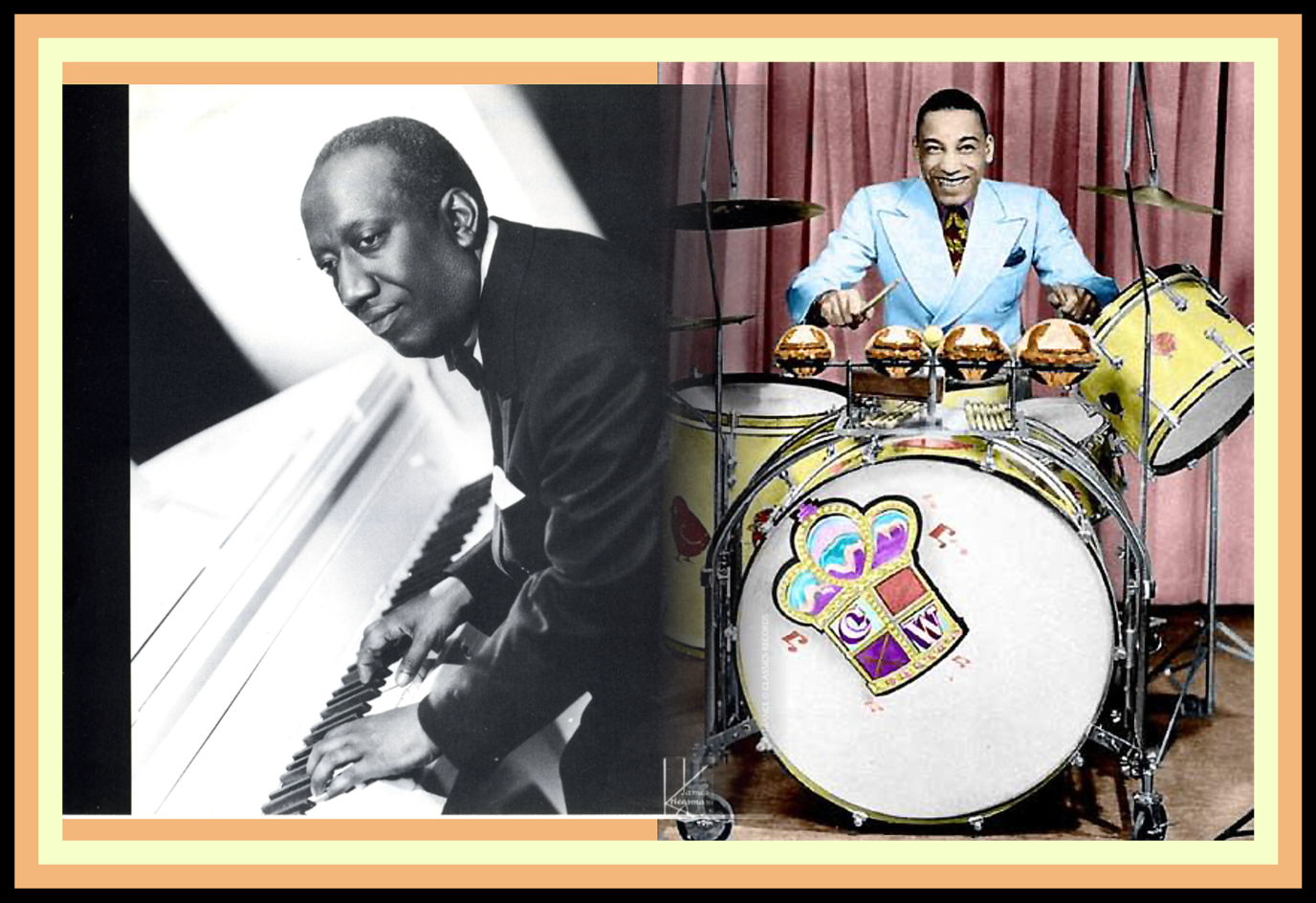
James Price Johnson and William "Chick" Webb

© -Steven A. Cerra, copyright protected; all rights reserved.


From time-to-time, the editorial staff at JazzProfiles likes to give a quick nod to some of those who made the music during its formative stages.


It’s our small way of remembering their contributions and it is a always great fun to compare what was happening in Jazz, then and now.


At times, even with the “distant” sound that characterized the audio of many of the earlier recordings, it can be quite startling to hear the improvised ideas and technical mastery of these early Jazz musicians.


Two such musicians that have always impressed us in this manner are pianist James P. Johnson, who died in 1955, and drummer Chick Webb, who died in 1939.


© -Len Lyons and Don Perlo, copyright protected; all rights reserved.


“In the hands of James Price Johnson [1894-1955], ragtime piano developed into "stride," a more boldly imaginative style characterized by a left hand that constantly strides from the lower to the middle register of the keyboard. Johnson played in a looser, more blues-based style than the classically oriented rag-timers. Though he was always drawn to composing orchestral works, he will be remembered most for his solo-piano playing and for his timeless composition "The Charleston" (1923). He was a profound force in the development of jazz piano, tutoring Fats Waller and influencing the piano styles of Duke Ellington, Art Tatum, Thelonious Monk, and countless stride players.


Johnson began learning classical piano from his mother. When the family moved to New York in 1908, he was exposed to ragtime and blues at rent parties and in Long Island resorts during the summer. He studied classical piano as well as harmony and counterpoint with Bruno Giannini and he developed a superb, almost athletic technique, which set a standard that other stride pianists were expected to emulate. He would often introduce paraphrased passages from the classics into his own blues, shouts, and rags. Johnson also learned the repertoires of the eastern ragtime players like Abba Labba (Richard MacLean) and Eubie Blake. Johnson was known for his playing at a club called The Jungle, where poor laborers from the South danced to his solo-piano shouts. One can easily imagine from listening to his recordings decades later the relentless rocking rhythms he must have generated in that environment.


In 1917, Johnson began recording rolls for the Q.R.S. company. His original “Carolina Shout” [1921 and the audio track to the above video] became a standard for the era for East Coast pianists: [Duke] Ellington and [Thomas “Fats”] Waller, for example, learned it by ear.” Jazz Portraits: The Lives and Music of the Jazz Masters [New York: William Morrow/Quill, 1989, pp.307-308].


© -Burt Korall, copyright protected; all rights reserved.


“Buddy Rich. ‘Until the mid-1930s, I had never been any place where jazz was played. I was in another world, a world called show business that really had nothing to do with music. I lived in Brooklyn with my family when I was becoming involved with jazz. One Wednesday night in '35, a bunch of my friends took me to the Apollo Theater on 125th Street in Harlem for the amateur night thing. That was the first time I dug Chick Webb.


He was the total experience on drums. He played everything well. A little later, about the time I joined Joe Marsala at the Hickory House in 1937,1 went up to the Savoy to check him out again. What I remember most distinctly was that he was different and individual—not like Cozy Cole or Jimmy Crawford or any of the other cats. Even his set was different. He had cymbals on those gooseneck holders, the trap table, a special seat and pedals made specifically for him because he was so small.


Chick was hell on the up-tempos. He kept the time firm and exciting, tapping out an even 4/4 on the bass drum. That was something in the 1930s. Most of the guys downtown could hardly make two beats to the bar; they were into the Chicago style— Dixieland.


Chick set an example. He was hip, sharp, swinging. You know, only about a half-dozen of the top drummers since then, including today's so-called "great" drummers, have anything resembling what he had. If he were alive now, I think most drummers would be running around trying to figure out why they decided to play drums. That's how good he was!


As a soloist, Chick had no equal at that time. He would play four- and eight-bar breaks that made great sense. And he could stretch out, too, and say things that remained with you. It's difficult to describe his style and exactly what he did. One thing is certain, though; he was a marvelous, big-band, swing drummer. Gene [Krupa] got to the heart of the matter when he said, after the Goodman-Webb band battle at the Savoy in '37, "I've never been cut by a better man."’ …


Webb in action made quite a picture. When swinging hard, he brought the entire drum set into play as he proceeded, moving his sticks or brushes across, around, up, and down the hills and valleys of the set. He choked cymbals, teased sound out of them, or hit them full; he played time and variations on the pulse on his snare, high-hat, cymbals, tom-toms, cowbell, temple blocks (often behind piano solos), and, of course, on the bass drum. He had facility to burn; fast strokes, with diversified accents, most often were played to forward the cause of the beat.” Drummin’ Men: The Heartbeat of Jazz – The Swinging Years [New York: Schirmer, 1990. pp. 19-21].


Glasses lifted to the early guys: no them – no Jazz.