Monday, August 17, 2020

Sunday, August 16, 2020
Saturday, August 15, 2020
Paul Desmond: Neoclassicism in Jazz [Part 1]

OUP Material, Copyright Line, and Acknowledgement
|
IP Number
|
THE IMPERFECT
© 1998 by
|
6000150
|
Introduction
© -Steven Cerra , copyright protected; all rights reserved.
There are lot’s of ways to learn about Jazz for as the noted Jazz author Doug Ramsey has advised in Jazz Matters: Reflections on the Music and Some of Its Makers [Fayetteville
"You don't need a degree in musicology to understand the language of jazz. ... Jazz is based on the common language of music understood around the world. The listener, whether musician or non-musician, can learn the idioms and vernacular of the language. It is simply a matter of absorption through exposure. My only caveat is this: in the learning process, don't spend your time listening to imitators or second-raters."
Doug’s caveat holds true as well for Jazz writers: only read the best.
Certainly, by any standard of judgment, three of the best authors about Jazz are Doug, Gene Lees and Ted Gioia .
I would think that as the youngest member of this distinguished triumvirate, Ted might be flattered to share the following, paraphrased words of praise which Gene articulated about Doug’s writing in his Foreword to Doug’s Jazz Matters:
“A decent and respectful curiosity fills Doug Ramsey’s writing. When he expresses reservations about someone’s work, he does so gently and reluctantly.
… And he praises beautifully. This is the hardest thing to do in criticism. Any writer can make himself look clever by excoriation, which calls for witty analogies and comparisons, but a rare and sensitive gift goes into the writing of sensitive praise.
And Doug has the gift of imagery, rather like that of Whitney Balliett, to give impressions of music through words.
Doug writes for the ear, he has a habit of writing only what reads well aloud….
‘The primary responsibility in writing about anything is to help people understand,’ Doug said.
That, above all, is what Doug Ramsey does.”
And that is also what Ted Gioia does, he informs the reader. Whether he is writing about one style or school of Jazz such as West Coast Jazz, or whether his discourse is about the sweeping panorama of the history of Jazz itself, Ted gives his readers knowledge and insights into how to better understand and appreciate Jazz.
Yet, Ted is no stodgy academician, but rather, an interesting storyteller who makes reading about Jazz fun and enjoyable.
His writing also enriches our listening experience by introducing fresh and different perspectives about the music for as he states in the Acknowledgements to The Imperfect Art: Reflections on Jazz and Modern Culture: [click on book title for order information]
“… mine is a decidedly ‘thoughtful’ … approach to Jazz.
Doug and Ted’s musings about Jazz also intersect at another point along its spectrum of personalities. Each has offered a treatment on the subject of alto saxophonist Paul Desmond [although in Doug’s case, it is more like a Magnus Opus!].
In The Imperfect Art: Reflections on Jazz and Modern Culture, Ted’s unique views on Paul are characterized as part of what he refers to as Neoclassicism in Jazz [pp. 81 -91].
Ted and the kind folks at Oxford University Press have graciously granted JazzProfiles copyright permission to replicate his description of what this categorization entails and why Paul’s style of playing fits so neatly into it.
As part of an ongoing series, the editorial staff plans to offer future features on other artists who approach Jazz in a “Neoclassicist” manner including John Lewis, Ahmad Jamal and Miles Davis.
So as not to confuse the reader, before describing Neoclassicism, the excerpt from Ted’s work which follows initially describes Romanticism in Jazz as a basis for contrasting these two radically different approaches to the music.
THE IMPERFECT ART , pp. 81-91, © 1998 by Ted Gioia By permission of Oxford University Press, Inc. Copyright protected; all rights reserved.
“Drawing parallels between stages in jazz’s development and periods in the evolution of other arts is, at best, a questionable endeavor. Yet the pronounced obsession with individual artists which has characterized the reactions of jazz fans, critics, and even musicians at least since the time of Louis Armstrong—reaching its peak with the figure of John Coltrane— can perhaps be best understood as the outgrowth of a temperament which is essentially "romantic" in nature.
Romanticism, with its idealization of the expressive artist, created a new aesthetic vocabulary in the late eighteenth and nineteenth century—one that fixated on the act of artistic production; one that glorified the passing moment of artistic inspiration as a secular epiphany; one in which the artist often became more important than what he created. In many instances the artist's life actually became, in his eyes and in the eyes of others, itself a work of art. With Byron, Wordsworth, Keats, Goethe, Wagner, and many of their contemporaries, biography and aesthetics begin to coalesce. The term "romanticism" has become worn with use, and, as more than one critic has advocated, much might be gained by discarding it entirely. Yet, as William Thrall has noted, "viewed in philosophical terms, romanticism does have a fairly definite meaning.”10 [William Thall, A Handbook to Literature, New York
[I]nquiry into the neo-representative character of music joined with many collateral influences to strain and shatter the frame of neo-classic theory, and to reorient all critical discussion toward the new magnetic north of the expressive and creative artist.11 [M.H. Abrams, The Mirror and The Lamp: Romantic Theory and the Critical Tradition, New York: Oxford University Press, 1953, p. 94]
The inherent romanticist elements in music are realized with particular force in jazz. In no other area of creative endeavor is there so little distance between the artist and his work of art. In the spontaneous act of improvisation, the artist has no opportunity to give his music a separate existence, to revise it, to reconsider it, to mull over it. The notion of the autonomous work of art—so fashionable in recent intellectual circles—has no place in jazz. Jazz music lives and dies in the moment of performance, and in that moment the musician is his music. His improvisation is the purest expression possible of the artist's emotions and feelings, and it is a purity which is only heightened by the absence of the spoken word. The German romanticist Novalis, arguing for the primacy of the musical arts, wrote towards the close of the eighteenth century: "The musician takes the essence of his art out of himself—and not the slightest suspicion of imitation can befall him."12 [Cited in ibid., 93]
With his a cappella introduction to the West End Blues, Louis Armstrong ushered in a period of romanticism in jazz which has become, if anything, more pronounced with the passage of time. The increasingly individualistic nature of the music, the obsessive reactions of the jazz world to figures such as Parker or Coltrane, the almost complete breakdown of barriers between the artist and his work of art—all these legacies of Armstrong are the clear signs of an aesthetic sensibility which is essentially romanticist in character.
The benefits of such a musical environment are unmistakable. Jazz, as a community of creative individuals, fosters a pluralism which is healthy for the art form as a whole. It lacks the embedded institutions of the other arts, yet a stronger emphasis on group norms, exercised perhaps through academia or other mechanisms of standardization, would probably have stifled some of jazz's greatest talents. One could not imagine a Charles Mingus or a Thelonious Monk thriving in an environment n which artistic success depended on access to fellowships, government grants, academic appointments, and the like.
The benefits of jazz's pluralism, however, have not been achieved without a price. The attendant fragmentation of the jazz community has led to a lack of cohesion among practitioners, an absence of institutions for preserving and passing on the music's traditions, and, perhaps worst of all, a steady erosion of generally accepted critical standards which define what is good and bad in the music. Without the latter, musicians—as well as listeners and critics—may find their isolation only growing. The lack of common standards and a common musical vocabulary has exacerbated the collapse of the jazz world into countless schools and tendencies, each unable to communicate with those outside of its own small world.
Jazz has become, in effect, a music of perpetual romanticism. The jazz world has always exhibited a manic quality in which the music's inherent vitality threatened to run away with itself. Today this strain is more dominant than ever before. By contrast, the powerful broadening and unifying influence of an Armstrong, an Ellington, a Parker is now apparently a thing of the past.
V
Within this pervasive aesthetic of emotional excess, however, a handful of musicians have tried to temper the music's natural impulse towards self-indulgence. They have created music of restraint, of control, of economy. These are the neoclassicists of jazz. Like neoclassical artists in other arts, they attempt to pare away the excesses of previous generations to reveal an art that is pristine and timeless. Their paradigm is the sculptor, whose work emerges from sharply cut and precisely defined lines, and whose warmth of expression is tempered by the cool, distant, and unforgiving medium with which he works. The neoclassicist recognizes that self-restraint is the essence of artistic style. A style which includes everything ceases to be a style—it has become an encyclopedia of techniques. The artist who embraces all of these techniques has, by the same token, reduced himself to a mere craftsman. Art begins only when some techniques are favored, others discarded.
Jazz, for these artists, is not just a music of possibilities, but rather a music of constrained possibilities. The temptation towards all-inclusiveness may have ruined more talent than all of the more publicized vices of the musician's life. Certainly when artistic norms collapse—as in our own day—the great artist must impose constraints upon himself. He must reject on his own what others are content to let go by.
Neoclassicism in jazz is not restricted to a specific time period or geographical area. Artists as different as Lester Young, Wes Montgomery, Bill Evans, Count Basic, Stan Getz, John Lewis, Miles Davis, and Paul Desmond can be included in its ranks, although under almost any circumstances the neoclassicist is part of a minority that distances itself from the more frenetic tradition of romanticism which permeates jazz. Thus the neoclassicist may appear to be perpetually out of fashion, a lone voice in the jazz world.
Jazz, in the hands of a neoclassicist, is a music of balance, of care, of restraint. With an unabashed lyricism and a subtle sense of formal structure, the neoclassicist displays his affinity for jazz's rich tradition of vocal music. The most successful collaborations of jazz singers and instrumentalists—the Billie Holiday/Lester Young recordings come immediately to mind-have more often than not been a part of this neoclassical heritage.
Yet the neoclassicist can often be distinguished not so much by his positive virtues as by what he excludes. Some pundit once remarked that the most telling thing about Jane Austen was that she never mentioned the French Revolution in her writings. A similar perspective, it seems, could be applied fruitfully to the study of musicians. Indeed one of the most striking characteristics of recent jazz in the romantic tradition is its all-inclusiveness. It attempts to encompass the whole musical world, from Third World folk music to the twelve-tone row. Neoclassicism, in contrast, is a music of exclusion, of omission.
VI
In the case of saxophonist Paul Desmond, one never needed to look far to find these omissions. The bebop clichés, the obsession with playing fast, the memorized licks which characterized jazz saxophone playing in the post-Charlie Parker era—all of these were noticeably absent in Desmond's music. As Dave Brubeck once mentioned, with no slight intended: "Paul's big contribution is going to be that he didn't copy Charlie Parker."13 [Downbeat, Sept. 15, 1960 , p. 17]
A comparison between Desmond and his contemporary Charlie Parker is illuminating. Parker, perhaps the most brilliant improviser in the history of jazz, was at his best when the tempo was fast and the chord structure was complex: his virtuosity delighted in musical obstacle courses such as "Ko-Ko" or "The Hymn." Desmond, in contrast, seldom played at very fast tempos, and when he did one sensed that it was done unwillingly. Not that his technique was not equal to the task; rather it was Desmond's overriding concern with creating a melodic and thematically organized improvisation that led him to eschew the facile glibness of many of the beboppers. Unlike the less talented descendants of Parker who followed a credo of "let your fingers do the walking," Desmond played a thinking man's jazz with solos that often made punning reference to other compositions and improvisations. On an early recording of "You Go to My Head” for example, Desmond inserts a quote from a Charlie Parker blues in the midst of a most un-Parker-like passage. In other contexts he would incorporate long extracts from Chet Baker or Gerry Mulligan solos into his own improvisations.
Desmond was born less euphoniously as Paul Emil Breitenfeld on November 15, 1924 , in San Francisco San Francisco Polytechnic High School San Francisco Washington Dave Brubeck in 1951, a collaboration that would continue for over a quarter of a century.
At some point during this period, Desmond discarded the name Breitenfeld for his more manageable stage name. He claimed that he came upon the name Desmond while paging through a phone book. The remark is appropriate: for an improvising artist such as Desmond, the spontaneous, spur-of-the-moment decision is the basis of all he does. And Desmond, more than most, let the philosophy of improvisation govern much of his life outside of music. His casual attitude went beyond the choice of a name. At its worst it encouraged a pronounced habit of procrastination, and Desmond was a procrastinator of almost legendary proportions. For years he spoke of writing a book about his experiences with the Dave Brubeck Quartet. Only the title (How Many of You Are There in the Quartet? — according to Desmond, a favorite question of stewardesses) and one very funny chapter ever emerged.15 [It appeared in Punch on Jan. 10, 1973 ] Among his other intended projects was an album in which he planned to play each song in the style of a different alto player.
Perhaps the latter idea was only offered as a joke. With Desmond one could never tell. He once told an interviewer that he wanted his alto to sound like a very dry martini; whether his music attained this lofty goal is open to discussion, but of the dryness of his humor there can be no dispute. The humor figured prominently in his music—a rarity in modern jazz, where the artists' self-conscious seriousness and the concert hall atmosphere of even nightclub performances casts a sombre aura over most of the music. As his close friend, jazz critic Nat Hentoff wrote:
At times Paul was the wittiest of improvisers. His ear was extraordinarily quick and true, his mind moved with eerie swiftness. He could take a phrase that someone had played earlier or a musical reference that a friend in the audience would understand and insert it into his solo. He'd build on that phrase until he had turned it inside out and seven other ways. Usually this kind of quoting is trickery, but Paul made it cohere. In his music, as in his life, the absurd cohabited with the familiar.16
[Nat Hentoff, Village Voice, Aug. 22, 1977]
For much of his twenty-six-year career, Desmond found his musical skills overshadowed by the work of his longtime friend and collaborator Dave Brubeck. Brubeck, who studied with Darius Milhaud in the late 1940s, was a pioneer in the synthesis of jazz and classical music—his piano work featured dense harmonies, a studied sense of rhythm, and the use of elements seemingly alien to jazz such as the twelve-tone row and odd time signatures. Yet Desmond was the unsung hero of the Brubeck Quartet; as much as the group's leader, Desmond was instrumental in shaping the ensemble's distinctive sound. His lyrical tone was immediately identifiable, and his ingenious compositions (most notably the group's biggest hit "Take Five") were an important part of the band's repertoire. Although not a student of Milhaud's, Desmond was involved with Brubeck's experimental work from the start. His affinity for classical music was also revealed in other ways—most markedly in his intonation, which was remarkably pure, especially when contrasted with the "dirtier" sound favored by many of his contemporaries.
In the midst of a period in which cool jazz and West Coast jazz were increasingly the scorn of jazz critics, Desmond embraced both with a vengeance. Desmond was well aware of what passed as fashionable in jazz circles; commenting on Bud Shank, a fellow Californian (although one transplanted from Ohio), Desmond said: "I sympathize with him because I have the same problem in my occupation, which is the problem of one who is sort of raised in the atmosphere of cool jazz trying to sound hostile enough to be currently acceptable.” 17 [Downbeat, Oct. 16, 1958, p. 43] In another interview he elaborated: "The things I'm after musically are clarity, emotional communication on a not-too-obvious level, form in a chorus that doesn't hit you over the head but is there if you look for it, humor, and construction that sounds logical in an unexpected way. That and a good dependable high F-sharp and I'll be happy."18 [Downbeat, Sept. 15, 1960 , p. 37]
The virtues Desmond enumerated are easy enough to list, but maddeningly difficult to attain. Desmond's dissatisfaction with his own playing frequently came to light in many of the interviews he gave over the years. As Lee Konitz, a contemporary who shares many similarities with Desmond, commented: "I feel that Paul has experienced greatness, and once this feeling of playing what you really hear has been felt by a player, it's difficult to settle for less than this."19 [Ibid., p. 16]
One senses that towards the end of his life Desmond came closer than ever to realizing this goal. His last recordings reveal an artist who is at peace with himself and who knows with a dogged assurance what it is he wants to express. The ravages of lung cancer may have lessened his stamina and shorted his phrases, but if anything this led Desmond to be even more refined and thoughtful in his playing.
The sardonic humor, however, remained. One wonders what to make of the cover of Live, the last album he saw released. Desmond is pictured seated alone in a club at closing time—the chairs are stacked on the tables, and Desmond is packed to go with a suitcase, or perhaps his saxophone case, at his side. The artist is smoking a cigarette, although even then he must have known he had only a short time before lung cancer would take its final toll. Another detail: if one looks closely, one notices little skulls and crossbones on Desmond's suspenders. These details, combined with the album's ironic title and Desmond's grim smile, are powerfully unnerving. The music inside, however, is every bit as beautiful as the album's cover is morbid. His solo on "Wave" could be a textbook example of solo construction, each chorus outdoing the previous one in inventiveness and incisiveness. Elsewhere, on his own composition "Wendy" or in his closing chorus on "Manha de Carnival" Desmond plays as well as at any point in his career. This is the music of a master.
The end was approaching fast. His last appearance in a recording studio was for friend Chet Baker's debut album with the Horizon label. He had been slated to play on the entire album, but had the stamina to record just one track before begging leave to go home and rest. Although he had rarely played in the preceding months, his tone was as pure as ever and his short haunting solo is as fitting a closing statement as any artist could wish to make.
His were the legacies of a man immersed in music. Desmond's piano, left to Bradley Cunningham, now graces Bradley's in New York Big Sur country near his birthplace in San Francisco
Friday, August 14, 2020
Tjader Jag - [Tjag ?] - The Fantasy Years, Part 1
© Copyright ® Steven Cerra, copyright protected; all rights reserved.
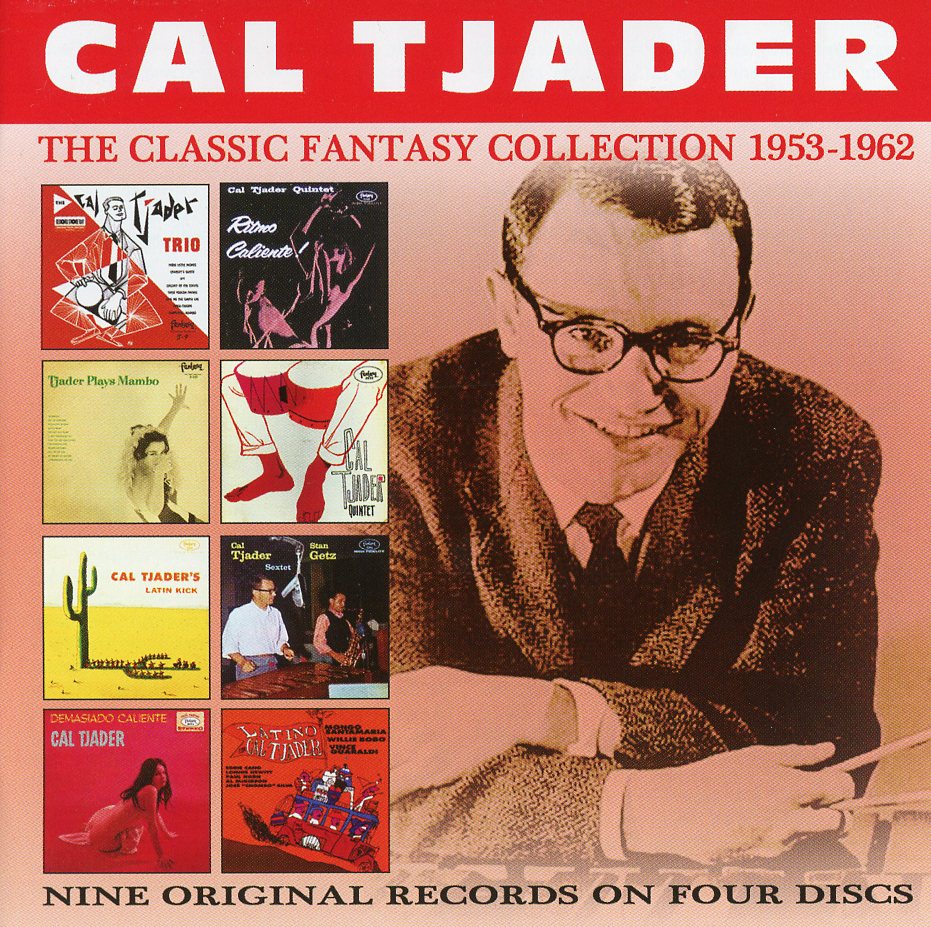
“Tjader is an important, catalytic figure, but exactly how important is difficult to quantify. ... Two [four] decades after his death, most of his records are still in print, and his unassuming presence - ‘I’m not an innovator, I’m not a pathfinder, I’m a participant’ - still abides in the spread of Latin Jazz.”
- Richard’s Cook Jazz Encyclopedia
“Cal's skill as a synthesiser of North American jazz with the music out of Cuba is by now well known. As an alumnus of the Shearing and the Brubeck groups of other years, and a long-time aficionado of afro-cuban, he comes honestly by his feel for both forms, having devoted a serious ear and an actively practicing hand to same over the past several years.”
- H. Claire Kolbe, Mambo with Tjader
People often ask me where I get the ideas for blog postings and I never know how to answer this question because the subjects for these features don’t seem to manifest themselves in any one way.
One source for them are the occasional jags I get on pertaining to a particular artist’s music. Recent examples of this wellspring approach have been the postings about composer-arranger Alec Wilder’s rather obscure instrumental octets and the music of the vocal team Jackie & Roy.
Lately, I’ve been on a Cal Tjader “jag” - [for those who may not be aware, the “T” is silent in his last name and it's pronounced “Jader”].
The dictionary definition of “jag” that I am referring to is “to be completely unrestrained” in the sense of listening to all the music I can lay my hands on regarding certain artists and checking the Jazz literature to see what I can find to form a piece about him/her that I can put up on my page - these include insert notes.
I’m sure you wouldn’t be surprised to find out that very few Jazz artists are the subject of full length biographies so invariably the liner notes for their LPs and the insert notes for their CDs are often the best source of detailed information about them.
Herein lies another problem when I’m mining for information on a Jazz musician using the information on their recordings as a primary source: I’m limited by what I have on hand in my collection.
So now I’m on a quest to fill in the gaps which brings me to an age old problem of availability and affordability.
Music streaming subscription services which may include the ability to download the music may be a solution to the affordability question, but that puts me at the mercy of what the entities that provide such services want to make available. They usually do not include annotations and discographical information.
Which now means I’m searching for available and affordable original vinyl recordings or compact discs.
The good news is that “hard copies” of many, individual Tjader recordings from his years at the Fantasy, Verve and Concord record labels are still available, but the “bad news” is that because of streaming service, fewer are being sold making the remaining stock more expensive.
Enter re-sellers such as Collectibles, Enlightenment, Avid, and Fresh Sound that combine recordings into multiple album sets and offer them at reasonable prices.
Some, like Avid, even enhance the fidelity of the original recordings into new digital formats, provide a newly written annotation about the background of the Jazz musicians and the music and also include the original liner notes and complete discographical information.
So what follows is a compendium of information about my latest “jag” on the music of vibraphonist, percussionist and bandleader Cal Tjader [1925-1982] or should that read - Tjader Tjag?
And given the sheer volume of recordings issued under Cal’s leadership beginning in 1951 with some early 78’s on Galaxy [a Fantasy subsidiary] and closely followed in 1952 with Cal Tjader - Vibist [Savoy V-38] until his death in 1982, I thought it might be easier to confine my Tjader jag to the recordings that he made for the San Francisco based Fantasy label, especially since four of these are available on a double CD from Avid and eight of these have been combined on four CDs from Enlightenment [actually nine because they have slipped the 8 tracks from the 1952 Savoy recording into the set].
And there are more individual albums from this prolific period in Cal’s career that are not included on the Avid or the Enlightenment anthologies that complement the JazzProfiles Tjader Tjag including: Mambo with Tjader, Jazz at The Blackhawk and Cal Tjader Plays Harold Arlen and West Side Story.
In addition to sleeve annotations by such eminent Jazz writers as Dick Hadlock, Ralph J. Gleason, and Philip Ellwood we’ve also managed to locate two Downbeat articles that comment on Cal’s music during this ten-year period and, unlike many other Jazz artists, Cal does have a biographer in S. Duncan Reid and we’ve drawn on his Cal Tjader: The Life and Recordings of the Man Who Revolutionized Latin Jazz [MacFarland] for additional information about these formative years in Cal’s recording career.
Other reasons for focusing our Tjader Jag on recordings from this ten year period are contained in the following excerpt from Richard Cook and Brian Morton’s The Penguin Guide to Jazz on CD, 6th Ed.:
“Cal Tjader was a great popularizer whose musical mind ran rather deeper than some have allowed. As a vibes player, he was an able and not quite an outstanding soloist, but his interest in Latin rhythms and their potential for blending with West Coast jazz was a genuine one, and his best records have a jaunty and informed atmosphere which denigrates neither side of the fusion. He made a lot of records, and many of them have been awarded reissue, which makes it difficult to choose particular winners. Tjader helped to bring Willie Bobo and Mongo Santamaria to wider audiences, and the steps towards an almost pure salsa sound are documented on most of the records listed above [from 1952-1959].”
Perhaps a good place to start since it contains eight of Cal’s Fantasy EP’s and LP’s issued digitally along with the eight Savoy tracks are the booklet notes from Cal Tjader: The Classic Fantasy Collection, 1953-1962 are with these booklet notes from the collection:
“With a vibrant, eclectic career that spanned five decades, Cai Tjader was the most successful n on-indigenous Latin musician of all! time. Although working largely within the idioms of Latin American, Cuban and Caribbean music during his lifetime, he explored too many other jazz genres, and is often credited as influencing Latin rock and acid jazz. A multi - instrumentalist, Tjader was primarily known as a vibraphonist, but also excelled at piano, drums, bongos, congas and timpani. Having spent much of his early career as sideman to musicians from a variety of cultural backgrounds, Tjader's best work was displayed on albums on which he performed as bandleader and, of these, the records he made for Fantasy Records between 1953 and 1962 contain his finest work.
“Calien Radcliffe Tjader, Jr. was born on I6lh July 1925 in St. Louis, Missouri. The son of Swedish American vaudevillians, the Tjader family settled in San Mateo, California when Callen was two years old, where his parents opened a dance studio. Eager for their child to follow in their footsteps, Callen, Snr. taught him to tap dance while his mother gave him lessons in classical piano. Once proficient enough to perform, the young Cal toured the Bay Area of neighbouring San Francisco, earning himself a small part dancing alongside Bill "Bojangles" Robinson in the film The White Of The Dark Cloud Of Joy. In his early teens, Ca! joined a Dixieland jazz band and white there began experimenting with other instruments, primarily drums. At the age of 16, he entered and won a drum contest organised by esteemed drummer Gene Krupa; he performed 'Drum Boogie', a piece written by Krupa himself with trumpeter Roy Eldridge.
Tjader served as an army medic between 1943 and 1946, going on to study at San Jose State College under the G.I. Bill, a 1944 act that offered educational benefits to veterans of World War Two. Intending to establish a career as a teacher, Tjader transferred to San Francisco State College. However when he met the young jazz pianist Dave Brubeck, who invited Tjader to join his octet - which also included among its members alto saxophonist Paul Desmond - he changed his plans. The group made a handful of recordings between 1946 and 1950 - not released in their entirety unlii the album Dave Brubeck Octet was issued in 1956 - but had difficulty finding work, and disbanded shortly after their final sessions were completed. Tjader and Brubeck went on to form a trio with bassist Ron Crotty in the hopes of turning their fortunes around and indeed found some success on the San Francisco scene. Il was while playing in this group that
Tjader took up the vibraphone, switching between vibes and drums depending on the demands of the song. After Brubeck was severely injured in a diving accident in 1951, Tjader was forced back into working side to a number of other musicians, including Alvino Rey and George Shearing. While visiting New York, Shearing's bassist Al McKibbon took Tjader to see the bands of Afro-Cuban pioneers Machito and
Chico O'Farrill, and he was introduced to Mongo Santamaria and Willie Bobo, who were playing for Tito Puente at the time.
In 1953, Tjader released his first records as bandleader for Savoy, and then signed to Fantasy Records shortly afterwards, the label with whom he would record, on and off, for the rest of his life, and exclusively between 1953 and 1962. His various groups recorded a staggering number of albums throughout the 1950s, a demand for which was bought on by the booming mambo craze across the latter half of the decade. While many West Coast players emulated the Afro-Cuban sound, Tjader enlisted seasoned veterans of Latin music to play in his bands alongside some of the most talented jazz players around, including bassist Gene Wright, pianist Vince Guaraldi, percussionists Bayardo "Benny" Velarde and Luis Miranda as well as brothers Manuei and Carlos Duran on piano and bass respectively. Highlights from his early output include Ritmo Caliente! (1955), Tjader Plays Mambo (1956) and Latin Kick (1958). In 1958 too, Tjader teamed up with esteemed tenor saxophonist Stan Getz - who would find great fame in his own right working in the Latin idiom - on Cal Tjader-Stan Getz Sextet, fronting a band that would also include bassist Scott DeFaro, drummer Billy Higgins, and a third Duran brother, Eddie, on guitar. The following year, Tjader's band played the Monterey Jazz Festival. Having suffered financially when it made its debut in 1958, Tjader was credited with boosting ticket sales, helping save the fledgling festival, which today is close to celebrating its 60th anniversary.
By 1962, after releasing Latino Con Cal Tjader with Mongo Santamaria, Tjader signed for the more established Verve Records, where the bigger budgets afforded him made the 1960s his most successful era. His 1965 album Soul Sauce spawned a major radio hit with its title track, a Dizzy Giilespie number Tjader had been developing for over a decade, which sold over 100,000 copies. During this time he worked with a host of further esteemed musicians, including Donald Byrd, Lalo Schifrin, Anita O'Day, Willie Bobo, Armando Peraza, Chick Corea, Clare Fischer, Jimmy Heath and Kenny Burrell.
He formed the short-lived Skye Records in 1968 wilh Gabor Szabo and Gary McFarland, on which he released Solar Heat (1968) and Tjader Plugs In (1969), both of which were credited as being precursors to acid jazz. He returned to Fantasy in the 1970s with the rise of the jazz fusion movement, a style that Tjader fully absorbed by adding electronic instruments and rock beats to his arrangements.
Towards the end of the decade, Concord Records president Carl Jefferson founded Concord Jazz Picante solely to promote Tjader's later work, and it was with this label that he recorded La Onda Va Bien (1980), which earned him a Grammy for Best Latin Recording. A professional to the end, Cal Tjader died after suffering a heart attack while touring the Philippines in May 1982. He was 56.
This collection, spanning over five hours of music on four discs, collates nine of the finest records made by Cal Tjader during his initial stint wilh Fantasy Records. Faithfully remastered from the original recordings, this set will not only introduce a new generation to the musical skill and dexterity of Tjader, but will act too as a welcome reminder for those already familiar with the work of this legendary musician.”
…. To be continued in Part 2 of the Fantasy years with four classic albums on two CDs on Avid Jazz and Part 3 which is based on Downbeat articles from 1955 and 1966 featuring interviews with Cal.
Thursday, August 13, 2020
Subscribe to:
Posts (Atom)