Thursday, October 29, 2020

Jackie McLean and "The Connection" at The Crossroads

 © Copyright ® Steven Cerra, copyright protected; all rights reserved.


The editorial staff at JazzProfiles has previously posted about Jack Gelber’s play The Connection and the music that pianist Freddie Redd composed for the Broadway [NYC] production from the perspective of the West Coast version of it that we saw performed at the Ivar Theater in Hollywood, CA with Redd’s score performed by tenor saxophonist Dexter Gordon. You can locate that feature in the blog archive by going here.


In that piece we used, with his permission, the following excerpts from Ira Gitler’s insert notes to the Blue Note LP The Music from the Connection: Freddie Redd Quartet with Jackie McLean [[B2-89392].


THE CONNECTION by Jack Gelber is a play about junkies but its implications do not stop in that particular circle. As Lionel Abel has stated in what is perhaps the most perceptive critique yet written about the play (Not Everyone Is In The Fix, Partisan Review, Winter 1960), "What adds to the play's power is that the characters are so like other people, though in such a different situation from most people."


The situation in which the four main protagonists find themselves is waiting for Cowboy (Carl Lee), the connection, to return with the heroin. These four, Solly (Jerome Raphel), Sam (John McCurry), Ernie (Garry Goodrow), and Leach (Warren Finnerty) are in attendance at the latter's pad with the bass player. One by one, the three other musicians drift in. They are also anxiously awaiting Cowboy's appearance. Also present, from time to time, in this play-within-a-play, are a fictitious playwright Jaybird (Ira Lewis), producer Jim Dunn (Leonard Hicks) and two photographers (Jamil Zakkai, Louis McKenzie), who are shooting an avant garde film of the play.


The musicians not only play their instruments during the course of the play but, as implied before, they also appear as actors. Some people have raised the question, "If they are actors, why are they using their real names?" Pianist-actor Freddie Redd, composer of the music heard in The Connection answers this simply by saying that he and the other musicians want recognition (and subsequent playing engagements) for what they are doing and that there would be no effective publicity if they were to appear as John Smith, Bill Brown, etc. Author Gelber concurs and says that having the musicians play themselves adds another element of stage reality.


When The Connection opened at The Living Theatre on July 15, 1959, it was immediately assaulted by the slings and arrows of outrageous reviewers, a group consisting, for the most part, of the summer-replacement critics on the local New York dailies. Although several of them had kind words to say about the jazz, none were explicit and one carper stated that the "cool jazz was cold" which showed his knowledge of jazz styles matched his perception as a drama critic.


A week later, the first favorable review appeared in The Village Voice. It was one of many that followed which helped save The Connection and cement its run. In it, Jerry Tallmer didn't merely praise the jazz but in lauding Gelber as the first playwright to use modern jazz "organically and dynamically", also pointed out that the music "puts a highly charged contrapuntal beat under and against all the misery and stasis and permanent crisis."


This, the music does. It electrically charges both actors and audience and while it is not programmatic in a graphic sense (it undoubtedly would have failed if it had tried to be) it does represent and heighten the emotional climates from which it springs at various times during the action.


The idea to incorporate sections of jazz into The Connection was not an afterthought by Jack Gelber. It was an integral part of his entire conception before he even began the actual writing of the play. If Gelber did not know which specific musicians he wanted onstage, his original script (copyright in September 1957) shows that he knew what kind of music he wanted. In a note at the bottom of the first page it is stated, “The jazz played is in the tradition of Charlie Parker." (The Connection is published by Grove Press Inc. as an Evergreen paperback book.)


Originally Gelber had felt the musicians could improvise on standards, blues, etc., just as they would in any informal session. When the play was being cast however, he met Freddie Redd through a mutual friend. Freddie, 31 years young, is a pianist who previously has been described by this writer as "one of the most promising talents of the '50s" and "one of the warmer disciples of the Bud Powell school". During the Fifties he played with a variety of groups including Oscar Pettiford, Art Blakey, Joe Roland and Art Farmer-Gigi Gryce, all of whom recognized his talent.


After he had gotten a quartet together at Gelber's request, auditioned for him and was given the acting-playing role in The Connection, Freddie told Jack of his long frustrated wish to write the music for a theater presentation. Armed with a script and the author's sanction, he went to work. In conjunction with Gelber, he decided exactly where the music was to occur. By familiarizing himself with the play's action, he was able to accurately fashion the character and tempo of each number. What he achieved shows that his talent, both the obvious and the latent of the '50s, has come to fruition. He has supplied Gelber with a parallel of the deep, dramatic impact that Kurt Weill gave to Brecht. His playing, too, has grown into a more personal, organic whole. Powell and Monk, to a lesser degree, are still present but Freddie is expressing himself in his own terms.


The hornman he chose to blow in front of the rhythm section and act in the drama, has done a remarkable job in both assignments. Jackie McLean is an altoman certainly within the Parker tradition but by 1959 one who had matured into a strongly individual player. His full, singing, confident sound and complete control of his instrument enable him to transmit his innermost musical self with an expansive ease that is joyous to hear. It is as obvious in his last Blue Note album (Swing, Swang, Swingin' — BLP 4024) as it is here or on stage in The Connection. As an actor, Jackie was so impressive that his part has grown in size and importance since the play opened.


During the early part of the run, Redd's mates in the rhythm section were in a state of flux until Michael Mattos and Larry Ritchie arrived on the scene. Mattos has worked with Thelonious Monk, Randy Weston, Max Roach and Lester Young among others. Ritchie came out of B. B. King's band to play with Phineas Newborn and later, Sonny Rollins. Together they have given the group on stage a permanence; the fusion of many performances' playing as a unit is evident here.”
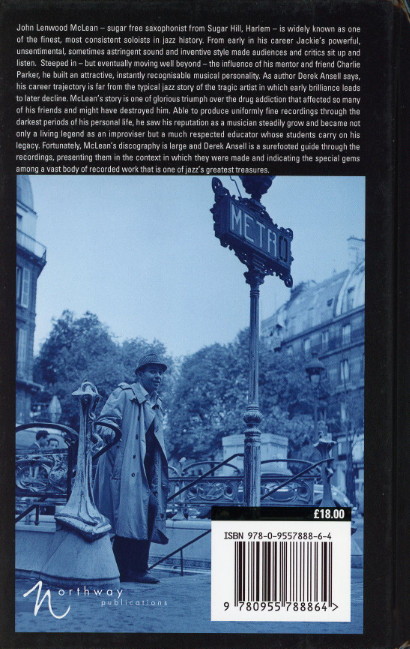


Recently I came across the following information in Derek Ansell’s Sugar Free Saxophone: The Life and Music of Jackie McLean [2012] that broadens the perspective of Jackie’s role in the production and performance of The Connection and I wanted to share it with you, as well as, post it in order to record it in the blog archives. You can purchase Derek’s excellent book from its publisher via this link.


In many ways, 1959 and The Connection could also have been labelled The Crossroads in Jackie’s career because some of his best Blue Note recordings would be created shortly before and after his appearance in the play and, of course, on the recording of Redd’s score.


But to compound matters, he was married with three children, had lost his cabaret card due to a conviction for narcotics possession [which made it impossible to work in NYC night clubs], and was about to appear in a play about Jazz musicians and drug addiction!?


“The irony would not have escaped McLean and his family on July 15th 1959 when the altoist began work as a musician and actor in Jack Gelber's highly controversial play The Connection. The Living Theatre in New York City presented the play about four jazz musician addicts waiting around in a seedy pad for their 'connection', a character called 'Cowboy*, to arrive. The four actors are joined from time to time by a playwright, a producer and two photographers and a sort of play within a play takes place as these latter characters are supposedly shooting an avant-garde film of the play


McLean, at this time addicted to heroin and not allowed to perform in jazz clubs in NYC, was allowed to appear on stage in a New York theatre, playing saxophone and acting and - yes, that's right - playing a jazz musician who is addicted to heroin. The music for the play had been designated by the writer Jack Gelber as being 'in the tradition of Charlie Parker'. By all accounts, Gelber would have been happy for the musicians on stage to play standards and various twelve bar blues concoctions but when pianist composer Freddie Redd was hired to lead the bop quartet on stage, he made it clear that he wanted to produce all new music, specially composed for the play. Gelber, who was very happy with this suggestion, promptly armed Redd with a script and that is how the music for The Connection was born.


McLean and Redd were old friends and had played together in clubs and concerts frequently. Although the rhythm section changed often in the first few months, it settled down when bassist Michael Mattos and drummer Larry Ritchie were recruited and they stayed, along with Jackie and Freddie, until the play ended its run. It is fascinating and instructive to go to YouTube on the internet and view the sample from the film of the play shown there. A slim, youthful-looking McLean can be seen and heard blowing alto in that emotive, blues inflected manner he had, with Redd pounding out the chords at the piano, and Mattos and Ritchie supporting on bass and drums. As the music plays, the action of the play, such as it is, continues. A photographer worries about running out of film for his avant-garde movie and various characters slouch around or sit looking vacantly into space, waiting hopefully for their fix to arrive. A second drummer sticks in hand but with no kit, apes every movement Ritchie makes, flourishing the air with the drumsticks. After a minute of silence and little stage activity an actor urges Freddie to 'play something' and the pianist launches into a new composition.
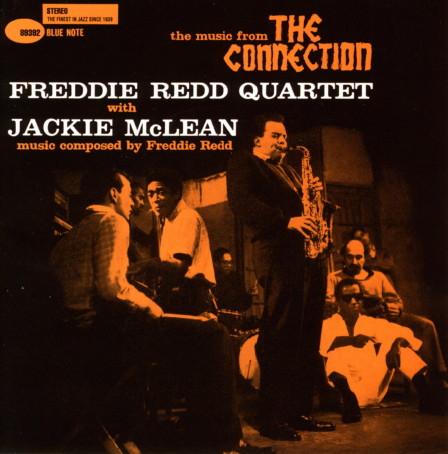


The music written for the play, which includes 'Music Forever', 'Wiggin" and 'Theme for Sister Salvation', is best heard on two discs first released in the early 1960s; The Music from the Connection by the Freddie Redd Quartet featuring Jackie McLean on Blue Note BST 84027, and an album featuring Redd, tenor saxist Tina Brooks (Jackie's understudy in NYC) and trumpeter Howard McGhee, reissued as Boplicity CDBOP 019. The play ran for more than three years and McLean was part of the company travelling to the UK in 1961. A production in California featured Dexter Gordon in the part Jackie played in NYC, Although harrowing as presented with all the realism that the actors and, particularly the musician-actors could inject into it, the play was a success. It shocked and worried a lot of people in the 1960s, people who went regularly to the theatre but didn't expect, at that time, the levels of realism that were presented to them.


'No, it was like that,' Jackie said in 1994. 'It was like that was a real hunk of life, that play It was way ahead of its time.' He went on to add, chillingly, that America later experienced widely the problems the play had predicted. And he added, perhaps tellingly, that when the company arrived in Britain, the play didn't work very well because there was no drug problem in the UK at that time. 'They had legalized drugs over there,' he told the interviewer and went on to say that there was no waiting for a connection to arrive in Britain because addicts could get drugs from their doctor. 'They had three drug convictions in the whole country' This statement prompts the obvious question, whatever happened to the enlightened attitude and laws of i960s?


This was a successful period in McLean's early years as a professional jazz musician and he acquitted himself well as an actor. Much of the credit for the play's success, however, must go first to Gelber and then to Redd for his high quality music score and, of course, to the rest of the quartet that played it night after night.


Aficionados will hear some of McLean's best solos of the period on the Blue Note Connection disc, recorded in February 1960. He is both brash and at times acerbic and, as always, there is that distinctive undercurrent of melancholy as in all his work at this time. Given that this was a result of his lifestyle, my only surprise, if that's the right word, about The Music from the Connection, would be that it is almost all bright and upbeat. A couple of dark, sombre minor compositions would surely have suited the mood and ambiance of the play? Only Freddie Redd can address that comment but it must be acknowledged that all the music from the play is memorable, distinctive and, of course, enhanced considerably by the solos of McLean and Redd and the rhythm backings.


*       *       *


The changes in McLean's mature style began in 1959 and possibly much of it was worked out as he played, night after night, in The Connection, working on the same Freddie Redd compositions but doubtless applying fresh variations over a period of nearly three years. He was always a restless, explorative soloist and, unlike most, unwilling to set a style and play it virtually unchanged for the rest of his life. The new sound of McLean was to be heard late in 1959 and much more in 1960. Perhaps by coincidence, some of his most advanced and probing solo work was caught in January 1959 when he recorded 'Blues Inn', 'Fidel' and 'Quadrangle', for Blue Note. In 1960, three tracks from a September 1st session were added to make up Jackie's Bag, which came out later that year on Blue Note BLP 4051.


The first three pieces show how much Jackie's writing had developed and matured. 'Quadrangle' is a fascinating composition which he admitted in 1962 (in the notes to Let Freedom Ring) did not fit easily with rhythm changes. When these tracks were recorded, however, he was in the process of working out new methods of writing and playing and the style here is not much removed from earlier attempts in this type of piece. Even so, the alto solo is intense, supercharged and swings like mad, courtesy of Jackie's own inbuilt sense of time and the driving, slashing rhythm section comprising Sonny Clark, Paul Chambers and Philly Joe Jones, one of the best units he worked with. 'Quadrangle' benefits from exceptional solos by McLean and Philly Joe with Clark laying out on this track. Listen to the pianist on ‘Fidel’ where he easily matches the invention and intensity of the leader. McLean stated in the liner notes to Jackie's Bag that he had written 'Quadrangle' four years earlier and it had been a style of writing he had been working towards for some time. 'I had some trouble at first putting chords on it for blowing on,' he continued, 'but I wanted to have a firm basis to play on, as well as those figures that came into my head.'


In the year and a half separating these two sessions, Jackie had begun playing modal music more frequently and had found other ways to interpret pieces like 'Quadrangle'. Playing on scales rather than the more conventional chord progressions was something that he had learned in Charles Mingus' Workshop bands in 1957 but it had not become common practice by 1960. Much of Mingus' practice at the time was forward looking and original but, as with all things, it took the general public and most other musicians a long time to catch up. The main thrust of inspiration for Jackie is most likely to have been Miles Davis’ groundbreaking Columbia LP Kind of Blue, recorded in March 1959 and beginning to gain momentum on its journey towards becoming the best-selling jazz record of all time. Davis, who pushed McLean to play standards and to study music thoroughly, also taught him to use space intelligently and effectively. So it should come as no real surprise that on the second session that made up the six tracks of Jackie's Bag, the altoist kicked off with ‘Appointment in Ghana' which uses a modal structure in the main phrase. As Bob Blumenthal noted in his insert for the updated CD release of Jackie's Bag in 2002, the practice of playing scales had not entered McLean's writing until this session.' It provided an alternative to standard harmonic sequences that McLean would apply to later performances of ‘Quadrangle', and that served him well in the more open approach he would soon document on such albums as Let Freedom Ring and One Step Beyond.


All that was in the future; in 1959 and through most of 1960-62, Jackie was developing as a major soloist and experimenting with new forms and methods of expression. By the time Jackie's Bag was released in 1960, he had already put out three good Blue Note LPs including New Soil and The Music from the Connection. Over that period of time his music had begun to move very slowly away from the solid hard bop of 'Quadrangle' towards more modal and challenging writing and playing such as we find on the six 1960 tracks that comprise the full, 2002 release of Jackie's Bag. Over the next two years it would change even more radically and dramatically but on the later tracks of this album he shared composition duties with the brilliant, ill-fated tenor saxophonist Tina Brooks. It was Brooks who played tenor on these tracks and the blend of his gospel-influenced, warm tenor and Jackie's often strident, slightly sharp, bluesy alto sound was wonderfully successful. Also featuring Blue Mitchell on trumpet, Kenny Drew on piano, Art Taylor at the drums and Paul Chambers as bassist on both dates, these selections really smoke and pulsate with vibrant modern hard bop solos.


Jackie's Bag turns out to be one of Jackie's most successful Blue Note albums of all and the others were all in the very good category. Perhaps it was the fact that the first session had only produced three good tracks that made this, eventually, the big success story that it became. When the later six tracks were added it offered stirring music from some of the best front-line and rhythm section players active at the time and, duly inspired by all of them, some of the very best McLean solos available to that date.


During the early 1960s Jackie recorded prolifically for Blue Note and other companies and his records offer a selection of standard but very adventurous hard bop, but also new music that is experimental and searching. From around this time it should have been obvious that McLean was not a musician to be put into any single category although it is true that the man who had followed, played with and shared a horn on occasions with Charlie Parker never abandoned his lifelong love affair with bebop.


On April 17th 1960, he headed to New Jersey for the Englewood Cliffs studio of engineer Rudy Van Gelder to record Capuchin Swing, (Blue Note 84038), with Blue Mitchell, Walter Bishop Jr., Paul Chambers and Art Taylor in support. It is another first rate release with tracks such as 'Francisco' and 'Condition Blue' outstanding. More Blue Note recordings followed in 1961, an important year if only for the release of two really exceptional albums: Bluesnik recorded in January of that year and A Fickle Sonance recorded on October 26th.


The end of that year saw two enthusiastic hard core followers of the musician, Dick Prendergast and Jim Harrison, staging a special concert, An Evening with Jackie McLean, at Judson Hall in NYC. These two, named by Ira Gitler in his sleevenotes to Fickle Sonance, had felt that the New York cabaret card restriction was grossly unfair and they staged this special event which included a table in the foyer displaying the covers of all the LPs featuring McLean as leader. Whether it had any effect on the NYC Police Department is unknown but surely unlikely It does show however the extent to which fans of the saxophonist were willing to go and how much they felt that his banishment from New York clubs was unreasonable. It also demonstrated just how well-known and appreciated he had become in the lives of jazz enthusiasts who, even though they could only hear him at theatres, at least had a fair number of recorded performances to enjoy.


Jackie McLean had made it in terms of recognition as a major jazz soloist and bandleader.”


Tuesday, October 27, 2020

Jimmy Rushing ‎– The Essential Jimmy Rushing ( Full Album )

SEARCHING FOR JIMMY RUSHING (His Correct Year-of-Birth)– by Steve H. Siegel

 © Copyright ® Steven Cerra, copyright protected; all rights reserved.  


Previously Steve Siegel reached out to the editorial staff at JazzProfiles and inquired if we would have any interest in featuring his writing on these pages.

Since that initial correspondence how work on pianist Wade Legge, the Great Day in Harlem Photography “Mystery Man” - William J. Crump, drummer Frankie Dunlop and Jimmy Rushing recordings following his time on the Basie Band have featured on these pages.

Here’s a brief biography which Steve sent along.

“My interest in jazz began in 1970 when, as a college student, I took a course entitled “Afro-American Music" – code for “jazz” ( In the late 1960’s a course with the title “jazz" in it may have had a difficult time getting through a college's curriculum committee, because it might not be considered a rigorous enough topic to grant college credit for). Over the subsequent 50 years I have collected approximately 2500 jazz recordings- all on vinyl, and over 250 books which deal with jazz biography, the history of jazz, jazz criticism and jazz's relationship to other art forms.

I spent 36 years in academia and upon retirement in 2013 pursued a second career as a fine arts photographer. My true objective was to finally get around to writing about jazz. Recently I embarked upon a series of human interest articles which focus upon the lives of jazz artists who were active from the bebop era through the 1960’s and are no longer with us, but have a compelling story that, perhaps due to the vicissitudes of time, was lost to history.”

© -Steve Siegel copyright protected; all rights reserved; used with the author’s permission.


“Back at the turn of the 19th into the 20th century it was common for a newborn of less-well-to-do parents to be brought into this world not by doctors but by midwives. As a result, there generally existed no birth certificate and the exact date of birth was dependent on a family’s collective memory. The lack of any official documentation also created opportunities for people to modify their date-of-birth for their own benefit. These “little white lies” could benefit celebrities lying about their age to avoid age discrimination which caused them to be disqualified from winning certain roles intended for younger actors or actresses. During times of war men sometimes lied about their age (older or younger) in order to enlist, while others might have lied to avoid being drafted. 

But what are we to make about a public figure, recognized as one of the seminal jazz and blues singers of the 20th century who, in his lifetime, provided 4 different birth years to various sources with presumably the knowledge that all 4 were inaccurate and why did he fail to ever reveal the correct year, which he presumably knew? So goes the story of Jimmy Rushing and his very elusive birth year.

Because of the large numbers of future jazz artists who were of Afro-American descent and born into poverty, biographers and historians have often struggled to pin down an accurate date of their birth and frankly when a writer is documenting his subject’s entire existence, wasting time trying to confirm any given date with no birth certificate readily available or even possibly existing, is of a secondary concern. Louis Armstrong's accurate birthdate was only confirmed long after his death.

As I was writing the article about Rushing’s post Basie period of 1950 to 1971, I discovered that in Rushing, we have an extreme case of birth year confusion. If you were to google “Jimmy Rushing Birth Year” you will come up with multiple listings of: 1900, 1901, 1902, 1903, “1902 or 1903,” “1902?,” “sometime between 1901 and 1903.” Amazingly enough ALL these years are incorrect. The only consistency across all these inaccurate dates is the month and date of his birth, August 26 - and even that date is controversial.

The actual story here is not only the elusiveness of the correct birth year but why all these incorrect dates were utilized by Rushing or by reputable sources throughout his life. Where did these dates come from and what might Rushing (or perhaps his record company) feel he had to gain through proffering them? 

One birthdate often associated with Rushing in published books and articles is August 26, 1903. The first mentions that I could find of that date appearing in print, were in the liner notes to the 1957 album, Basie at Newport, as well as in an interview with Nat Hentoff in Downbeat Magazine’s March 6, 1957 issue. It does appear though that he might have been providing that date as early as the 1940s. Even today we still find great currency given to that date. There appears to be no historical information to support this date and probably was an invention of Rushing's to shave 4 years off his true age. In fact, the 1910 census of the Rushing family, taken in February of 1910, lists Evoid Rushing, Jimmy's younger brother, as being 6 years old as of February 1910, with a December birthdate. This indicates that HE was also born in 1903. Evoid and Jimmy were not twins, so the 1903 birth year goes to Evoid and not Jimmy.

 In 1957, Rushing was turning 58. In those days, this age would be considered entry level old age. Given the opportunity to provide biographical data to Columbia as well as to Hentoff for the article, perhaps it appeared to him to be beneficial to give the “vanity age" of 54, providing Rushing a few more years of “headroom" before turning the ancient age of 60. 

The other incorrect birth year that gained wide currency later in his life was 1901. This year first appeared on his Social Security Application for Account Number, filed on June 4, 1938. This application was filled out in his handwriting and signed by him. Because of the absence of a birth certificate there existed no official document to corroborate that birth date. So essentially Rushing could enter any reasonable date he saw fit; basically, an honor system. This application now became the official governmental document which subsequently was often used as a source of Rushing's “official” age by sources writing about Rushing.  

The infrequently used year of 1900 came about when Rushing, in accordance with the Selective Service Act of 1917, registered in late summer of 1918 for World War I, using the date of August 26, 1900. He was still living home at this time and it is difficult to believe that Rushing or his parents did not know that he was born in 1899 (the correct birth year). After all, in the 1910 census which occurred before he turned 11, his parents had accurately listed him as 10 years old, which indicated a birth date in 1899. Was he trying to avoid being drafted? Probably not because even with the 1900 date he was still 18, the minimum age to be drafted at that point in the war.

1902 was the most controversial of all the listed birth years. In 1994, Rushing was one of 8 jazz artists honored with his picture on a United States Postal Service stamp. On the stamp, they listed his year of birth as 1902, based on information provided by his widow, Connie. A search of the 1910 census reveals that Rushing's sister Ethyl was listed as 8 years old in 1910, making 1902 her birth year and eliminating any possibility that Jimmy was born in 1902 and even casting doubt on 1901. 

The controversy over the 1902 date's presence on the stamp, led to some research efforts to try to definitively determine the real year of Rushing's birth. Then Historian-in-Residence Currie Ballard of Langston University uncovered the true year of 1899, presumably from the 1900 census, which upon review by this author, is confirmed. This birth year was definitive because Rushing was listed as 10 months old on the day in June 1900 when the census taker surveyed the Rushing family. Therefore, Jimmy Rushing had to be born before 1900. Evidently the revelation of this information from an academic source outside the jazz world never received wide currency, which might account for the inaccurate birth years still circulating in jazz circles to this day. 

One further mystery surrounds that census entry from 1900. The census taker lists the month of Rushing's birth as “June," not August, though the fact that he was listed on the same census line as 10 months old in June of 1900, seems to confirm the August 26, 1899 date. This might simply have been a transcription error when census forms were copied over into ledgers.

 One written source has speculated that the June date is accurate and the August date might have been created to spare his parents the shame of conceiving a child before they were legally married. This explanation is flawed because his parent’s wedding certificate indicates that they were married on July 11, 1898. Therefore, no need existed to modify the birthdate in order to conform with the social mores of the times.

In conclusion, all the available evidence clearly supports August 26, 1899 as the correct birthdate of James Andrew Rushing.

Research assistant: Nancy Sheridan Siegel


Monday, October 26, 2020

Goin' to Chicago Blues (feat. Jimmy Rushing)

Jimmy Rushing: His Recording Career After Count Basie by Steve H. Siegel

 © Copyright ® Steven Cerra, copyright protected; all rights reserved.


The reposting of the writings of Steve Siegel previously included his work on pianist Wade Legge, the Great Day in Harlem Photography “Mystery Man” - William J. Crump and drummer Frankie Dunlop have featured on these pages.

Here's his delightful piece on Mr. Five by Five - Jimmy Rushing.

By way of background, Steve sent along this brief biography.

“My interest in jazz began in 1970 when, as a college student, I took a course entitled “Afro-American Music" – code for “jazz” ( In the late 1960’s a course with the title “jazz" in it may have had a difficult time getting through a college's curriculum committee, because it might not be considered a rigorous enough topic to grant college credit for). Over the subsequent 50 years I have collected approximately 2500 jazz recordings- all on vinyl, and over 250 books which deal with jazz biography, the history of jazz, jazz criticism and jazz's relationship to other art forms.

I spent 36 years in academia and upon retirement in 2013 pursued a second career as a fine arts photographer. My true objective was to finally get around to writing about jazz. Recently I embarked upon a series of human interest articles which focus upon the lives of jazz artists who were active from the bebop era through the 1960’s and are no longer with us, but have a compelling story that, perhaps due to the vicissitudes of time, was lost to history.”

© -Steve Siegel copyright protected; all rights reserved; used with the author’s permission.


The multifaceted Jimmy Rushing (1899-1972) was perhaps one of the more underrated singers of the 20th century. He performed equally well with blues, jazz or popular material. Whitney Balliett, the then jazz critic for The New Yorker, wrote of Rushing that "His supple, rich voice and his elegant accent have the curious effect of making the typical roughhouse blues lyric seem like a song by Noël Coward." Critic Nat Hentoff felt that Rushing was a seminal influence in the development of post–World War II popular black music. Ralph Ellison opined that it was "when Jimmy's voice began to soar with the spirit of the blues that the dancers – and the musicians – achieve that feeling of communion which was the true meaning of the public jazz dance" and to ballads he brought … “a sincerity and a feeling for dramatizing the lyrics in the musical phrase which charged the banal lines with the mysterious potentiality of meaning which haunts the blues. In contrast with Rushing's reputation, he seldom comes across as a blues 'shouter’.” According to Gary Giddins, “Rushing brought operatic fervor to the blues."

Yet despite all the accolades, to many people who know of Rushing, he is thought of as the short, squat singer with the large, rather gravelly voice who sang the blues with the Count Basie Orchestra, way back in the 1930s and 40s. Ironically, Rushing once stated that “blues (singing) were really my personal hobby.” Only when Count Basie would hear Rushing play and sing the blues for his own pleasure did he ask him to sing them with the Basie Orchestra.

Rushing's almost 50-year career can be neatly divided into two periods. The first was his “boy singer" career in both large and small bands led by others, which started in 1925 with a group led by Basie bassist to be, Walter Page, which in 1927 morphed into Page’s Blue Devils, with Bill Basie joining up in 1928. 

In 1929, both Rushing and Basie joined Benny Moten's group. In 1935, following Moten's death, Basie took over leadership and the Count Basie Orchestra was born. For the next 15 years Rushing honed his reputation as the preeminent big band blues singer, backed up by the best riffin' and shoutin' big band a singer of Rushing’s style could have hoped for. When Rushing left Basie around 1950, he and Basie had spent 22 years together. Basie once said of his relationship with Rushing: “In all the time he was with the band, Jimmy Rushing has been what I might call my right arm, there were times in the early days of the band that I'd have given it all up but for Jimmy's urging me to stick with it.” 

Following his brief retirement, he began his solo career where he spent the next 20 years touring the world guesting with big bands, working jazz festivals and night clubs and recording prolifically for labels, both large and small. For a singer whose supposed métier and reputation was formed as a blues shouter, his musical stylistic inclinations were broad in scope and his ability to give sophisticated and emotionally satisfying performances across jazz, blues and popular styles was unquestioned.

Between 1955 and 1971 Rushing made 13 solo studio albums; three for Vanguard, five for Columbia, two for ABC Bluesway, one for Modern Jazz Records, one for Colpix and one for RCA. He also contributed to five other albums, three on Columbia; one was entitled Cat Meets Chick, where he shared the vocals with Ada Moore; one other was the Sound of Jazz soundtrack album which was produced at Columbia's 30th St. studio the day after the classic live television presentation of the jazz episode of the Seven Lively Arts series. He finally got a chance to sing with the Ellington band on the 1959 Columbia album, Jazz Party.

Rushing also guested with his former employer on the 1957 Basie Live at Newport album where he sang three songs, backed by the Basie band.

His other guest appearance was on Modern Jazz Records, on an excellent album entitled Blues and Things which was nominally an Earl Hines Trio date with Rushing guesting on four cuts. 

Rushing’s recording career spanned a period of rapid change in music.  When Rushing began his solo career, big bands were dying, bebop was upon us and hard bop was stirring. At the time of his first recordings for Vanguard in 1955, it was the birth of rock ‘n roll with Elvis, Little Richard and Jerry Lee Lewis beginning their recording careers. The 60s brought the British invasion and the morphing of rhythm and blues into soul music. The late 60s ushered in the psychedelic era. In the midst of all these changes few recording artists from earlier eras managed to steer the course and continue on without compromising their own core identities, especially any artists who started their careers in the 1920s like Rushing had. His ability to maintain his integrity through this maelstrom of changing tastes and yet retain recording contracts and produce first rate records, was rather amazing. In the Rushing discography we don't find Jimmy Does the Beatles or Rushing Meets Janis Joplin (though that pairing would have been VERY interesting). Even another member of the illustrious 1899 birthday club, Duke Ellington (the “club" also included Fred Astaire, Humphrey Bogart, Alfred Hitchcock and Earnest Hemingway) did an album of popular tunes of the day, entitled Ellington ‘66, which included the Beatles song, I Wanna Hold Your Hand.

We often use the word “timeless” to describe works of art and literature that retain great value over a period of time and have appeal to the aesthetics of multiple generations. Rushing's work, though not offering great mass market appeal (but then again, jazz never did), has endured.

Few artists have ever received a Grammy nomination at the age of 72 in their 46th year as an artist, as Rushing did in 1971. Yet many critics seem to be, if not exactly unfair to Rushing's work, rather tepid in their reviews. It is somewhat reminiscent of the views that critics had of Monk in the mid to late 60s – when many felt that he was just repeating himself and going through the motions. As if somehow it was necessary to now and again scale a new mountain to prove relevance. So, let’s just throw away that bottle of 1961 Bordeaux because it just sits there in the bottle…never seems to change.

But imagine the critical response aimed at Monk if he had made a dramatic change in his music; one as dramatic as the one Miles Davis laid on the critics with Bitches Brew. The point being that Monk and Rushing were caught in an aesthetic “straight jacket.” Sacrificing your core identity chasing trends is bad but to use Lester Young’s term, being a “repeater pencil" is no better.

In his book, How to Listen to Jazz, Ted Gioia takes the jazz critiquing profession to task and asks the question: “Who are these expert listeners, empowered to translate strange and wonderful sounds into a verbal description, assign a score or grade… and then move on to the next song?” This question could very clearly be directed at the critics’ appraisal of Rushing’s extremely eclectic body of work from when he left Basie in 1950 until his death in 1972. If a critic's cup of tea is Rushing the blues shouter, then a review of Rushing's final album, the Grammy nominated vocal performance on, The You and Me that Used to Be, with only one blues offering, may have one star deducted simply for Rushing's audacity. If you were assigned to review Rushing's Columbia album with Dave Brubeck you might deduct one star simply because you suspect that the “yin and yang” of Brubeck and Rushing could never produce good jazz.

The message here is that Rushing's work from 1950 to 1971 when he crisscrossed the world as a jazz nomad has rarely been given its due, in part because Rushing dared to break out of the mold of the blues-shouting, big band boy singer and instead, simply sang the older songs that moved him.

Gene Ammons’ 1956 album, the oxymoronic entitled, The Happy Blues, could easily be the title of any anthology of Rushing’s post 1950 blues efforts. In Rushing's hands the term blues was certainly more of a statement of a musical genre than an actual description of his performances within that genre. 

Rushing rarely seemed to occupy the blues he sang about; that the subject matter was not really happening to him. Instead, he was really describing some other poor soul who he was reassuring: “don't worry pal, everything will work out just fine." Make no mistake, Rushing was never detached from his blues material, he just never let it drag HIM down. After all, this attitude of optimism against all odds, is really the essence of the blues.

As outstanding a blues singer as Rushing was, the structure and inherent harmonic limitations of the blues format itself probably served to confine him musically. The freedom of expression that Rushing found in the 32 bar AABA popular song format can easily be discerned through listening to any of his albums where both blues and a popular song structure are programmed back-to-back. A good example of that can be found on Basie at Newport. On side two of the original album issue, we hear the blues pastiche, Original Blues, followed by the exuberant Evening.

First and foremost, Rushing was a story teller. Sometimes the story would be told in a 12-bar blues and other times in 32 bar AABA popular song structure. Oftentimes his voice would impart a blues feeling to the popular format and conversely his demeanor and phrasing might obscure the feel of a 12-bar blues and make you not realize you were listening to one. In a musical world where many of the best vocal as well as instrumental jazz artists were much more comfortable in one format or the other, Rushing’s stumpy legs straddled both worlds.

Rushing's recorded output during his solo career began with three albums in 1955-1956 for Vanguard. The backing band was essentially a gathering of Basie alumni, spanning the entire tenure of Rushing's time with Basie. The musicians included Walter Page, Jo Jones, Buddy Tate, Emmitt Berry, Vic Dickenson and Freddie Green, with John Hammond producing. This configuration provided Rushing with a comfortable and familiar environment as he began his solo recording career. The songs included old chestnuts such as Evenin', Sent for You Yesterday, Every Day and Goin' to Chicago. The programming was slanted towards the blues. This not only provided a safe start for Rushing but also protected Vanguard's financial interests by tapping into Rushing's established fan base of potential record buyers. 

Overall, these were very good performances by all involved, even classic, with a freshness to the performances. Much of this can be attributed to the fact that in all the years Rushing recorded with Basie, the technology was rather primitive. Up until 1949 when the technology to record onto magnetic tape was perfected, all recordings were direct to acetates. The recording quality of this early technology was highly variable, at its worst with limited dynamic range and noisy media. Therefore, the nuances of Rushing's complex voice such as timbre, tonality and gradients of volume changes, which were so essential to Rushing's art, were oftentimes not clearly presented in recordings from the 1930s and 40s. By 1955 Vanguard had a reputation for high quality audio recordings, so Rushing’s powerful voice sounded like a real voice projected into a 3-dimensional space. 

By 1956 Rushing had established himself as a solo artist and the powerhouse record company Columbia signed him to a contract. He stayed with Columbia until 1961, producing six albums.

1956- Cat Meets Chick – A story in Jazz (with Ada Moore)

1957- The Jazz Odyssey of James Rushing Esq.

1958- Jimmy Rushing and the Big Brass

1959- Rushing Lullabies

1960- The Dave Brubeck Quartet Featuring Jimmy Rushing

1961- Jimmy Rushing and the Smith Girls - Bessie, Clara, Mamie, Trixie

During his post Basie recording career, Columbia was the only label that provided Rushing the opportunity to show his musicals chops across a wide variety of musical styles. There was still Jimmy the blues shouter but we also hear the playful Jimmy (Trixie Ain't Walkin' No More from the Smith Girls Album), Jimmy the big band singer, Jimmy the popular song interpreter and Jimmy the jazz singer. 

Many of the Columbia albums also provided a thematic basis, as opposed to a collection of unrelated songs. With the exception of the Smith Girls album which is evenly split between blues and non-blues offerings, the other albums are programmed with rarely more than one blues per side, with some sides devoid of blues. 

Many of the Columbia albums feature Rushing singing material he might have sung with Basie but had never previously recorded. The Jazz Odyssey album contains only one previously recorded song. The Big Brass and The Jazz Odyssey albums also feature a Basie alumni band under the direction of Buck Clayton. 

The Brubeck-Rushing album may be more noteworthy for the unlikely pairing of Paul Desmond with Rushing, than for the pairing of Rushing with Brubeck. But regardless, the pairing of Brubeck's group and Rushing's vocals seem to have defied the musical odds and come together to produce an enjoyable album, with Brubeck providing sympathetic backing for Rushing.

Of the six Columbia albums, The Big Brass album seems to combine the individual strengths of the other albums in the series: diverse repertoire – two blues and ten popular songs; a well programed mix of ballads, mid and upbeat tempos, arranged by Jimmy Mundy, Buck Clayton and Nat Pierce; sympathetic backing (again, mostly Basie alumni) and strong performances from Rushing. 

These Columbia albums are very significant to Rushing’s post Basie discography in that they collectively serve to redefine him in a manner that was impossible during his time with Basie due to the commercial expectations that both the live audiences and record buying public had toward seeing and hearing Rushing, the blues shouter. 

As mentioned, the three Vanguard albums which preceded the Columbia albums, were very good but were more an extension of the Basie years and therefore broke little new ground. The two albums which Rushing made for ABC/Bluesway in 1965-66, following the Columbia albums, were likewise of high quality, but stylistically were updates of the Vanguard albums. Only the Columbia albums showcased Rushing as he had always seen himself, as a ballad singer and a singer of standards.

As the 1960s turned into the 1970s and Rushing entered his eight decade, it turns out that he had one more album left in him. The album was made for RCA and was entitled The You and Me that Used to Be and won for the 72-year-old Rushing, the Downbeat Record of the Year Award as well as a Grammy nomination for best jazz performance by a soloist. It is considered by many to be his best album and was completed less than a year before his passing on June 8, 1972.

The record came about while Rushing was working weekend gigs at the Half Note in Greenwich Village with a backing band of the Al Cohn-Zoot Sims group featuring Dave Frishberg on piano. RCA producer Don Schlitten proposed the album and Schlitten, Frishberg and Rushing worked out the play list. Mel Lewis, Milt Hinton and Ray Nance and Budd Johnson came on board. The concept was to emulate the format that Billie Holiday and Teddy Wilson put together for the classic 1930's/40’s Columbia recordings. The album was comprised of ballads and standards and one blues – Fine and Mellow, probably Rushing's salute to Holiday, his former bandmate in 1937 with Basie.

If you listen very closely to the album you will hear Rushing, at times, emulating the perfect diction of many of the period singers of the 20s and early 30s, who originally sang these songs. On 1923’s Linger Awhile you will hear him over-enunciate and “roll" his R's on the word “Linger.” He does the same thing on the final three words of 1931’s I Surrender Dear – “I surrender dear,” lending a note of authenticity (and humor) to the session. Truly a master vocalist at work.

The album and Rushing's recording career ends on a poignant note with Sammy Kahn's Thanks a Million, which is about one lover thanking the other for their enduring love and support and could easily be construed as Rushing thanking his fellow musicians and fan base for making his dreams as a musician come true, during his amazing almost 50-year career.

You made a million dreams come true and so I'm saying -

 Thanks a million to you.”