Thursday, January 7, 2021

Hentoff on Mingus - Nat Hentoff's Liner Notes to Charles Mingus' Recordings by Steve Siegel

 © Copyright ® Steven Cerra, copyright protected; all rights reserved.


“Hentoff never attempted to tell us how to listen to Mingus or what to hear or, … , tell us how to feel. What he did do, however, was to make us aware of the complex nature of one of the giants of twentieth century American music, which, for many, served to appreciably enhance the listening experience as we made the connection between a composer, his creation and his performance.” 

- Steve Siegel

With previous features on pianist Wade Legge, the Great Day in Harlem Photograph “Mystery Man” - William J. Crump, drummer Frankie Dunlop and vocalist Jimmy Rushing, Steve Siegel has become something of a staff writer for JazzProfiles.

Here’s his latest effort on Nat Hentoff's Liner Notes written for many of the albums by legendary bassist, composer and bandleader, Charles Mingus.

For many years LP liner notes, also referred to as sleeve notes, were the primary source of information on Jazz musicians and their music. Individual books about the music and its makers comprised a relatively small offering during the first 50 years or of Jazz’s existence. Thankfully, magazines such as Down Beat, Metronome and Esquire picked up some of the slack in the USA. [England, and the Scandinavian and Continental European countries also had magazines devoted to Jazz as the primary source of information.]

Steve has done Jazz fans a real service by creating a descriptive commentary on Nat Hentoff’s learned writings for Charles’ recordings and synopsizing their unique nature and significance in this feature.

© -Steve Siegel copyright protected; all rights reserved; used with the author’s permission.


“Nat Hentoff had many interests as a writer — both within and outside the music industry. He authored over 30 books as well as a myriad of articles for various magazines, newspapers and online sources. However, his 50+ year career as a writer of liner notes for records and CDs is one area of his distinguished career that, as a body of work, has been somewhat overlooked, though his over 600 sets of liner notes, written for not only jazz but for rock, blues, folk and classical albums were, collectively, among the best written and most informative of the liner note genre. 

This isn’t surprising given that the generation of music buyers raised on 1960s-70s pop and rock albums were fed a steady stream of rather vapid liner notes written by either disc jockeys or in-house record company public relations people who were well paid to tell a rather young and gullible buyer just how great the album was as well as occasional hyperbole about how wise and “hip" purchasing that record would make them. So, the work of those writing liner notes, talented or otherwise, was often thought of as informative at best and rarely as inspirational or thought-provoking. After all, was there ever a published set of liner notes that didn't heap praise on the artist or their music? 

The history of comprehensive jazz liner note writing began with the introduction of the 12” long-playing album, first introduced by Columbia Records in 1948, which gradually, over the next eight years or so, replaced the 10” record at all the major record companies. (Interestingly, Blue Note records was one of the last labels to switch over to the 12" long playing record—in 1956.) These new 12” records provided a rather expansive back cover which demanded to be filled with something of added value to the purchaser. Record companies utilized this space for liner notes as well as promoting other releases on their label.

This need for liner notes provided many talented writers with second careers. Among those employed to do so was a young Nat Hentoff who joined with other jazz critics, whose collective writings during the bebop and post bop era of the1940’s and 1950’s, helped to legitimize jazz as a true art form. Jazz was serious art and critics writing the liner notes generally treated it as such. In the second half of the 1950s, Hentoff emerged as arguably the foremost craftsman of the art of liner note writing for jazz albums.

In reviewing a cross-section of liner notes that Hentoff wrote for jazz albums, his most prolific and absorbing output was the cogent and well-crafted work he provided for his friend, Charles Mingus.

“… There are nights when Mingus hovers over his (side)men like a brooding Zeus making up the final scorecard for eternity. His own moods are unpredictable. When he is buoyant, the bandstand becomes a picnic ground in Elysium. When he is angry, the room contracts and is filled with crackling tension of an impending electric storm. At these times, Mingus’ bass begins to mutter like a thunder bolt on the way. This huge cauldron of emotions at the center of a band can be taxing to a sideman; but if the latter has his own center of emotional and musical gravity, he can survive—and grow.”                                                           

Without knowing the source, one might assume that this evocative and thought-provoking quote would be sourced from academia—perhaps an MFA thesis or a doctoral dissertation. Actually, this wisdom came from the liner notes of a record album which could be had for $3.98 at your local record store in 1963.

This example of Hentoff’s work appeared in the liner notes to Charles Mingus' 1963 album, redundantly entitled, Charles Mingus Presents Charles Mingus. This writing is indicative of the style that Hentoff brought to liner note writing, as well as displaying his willingness to do a deep dive into the human element of music making. On many albums, Hentoff's notes are so well written as to occasionally qualitatively transcend the music within the record jacket. 

“Mingus is verbally articulate as well, and it's illuminating to follow the one immovable, uncompromising line of continuity that connects his development through the years—the line of personal and musical integrity and relentless self-searching. He may have a reputation for being an Avant- garde composer but he knows where he's come from.”

From: The Clown - 1957

Hentoff’s style of writing liner notes was rather unencumbered by the need to show off his knowledge of music. Hentoff was not a trained musician and showed little desire to unlock the technical mysteries of the music he was so passionate about. In many ways this freed him to write liner notes which dug into the artist and their aesthetic make-up.

As previously stated, his liner notes (as well as those of others), helped to legitimize jazz as an art form. He did this not by asserting in bold proclamations that the albums we were holding in our hands were terribly important because, as other writers were quick to state, they were examples of “America's only native art form,” or even by proving their importance through a musical analysis of what we were about to hear. Instead, Hentoff often accomplished this through serving as our personal escort through the mind of the artist who created the music, offering up a rich, multilayered understanding of the contextual socio-economic factors and the uniquely human traits of the artist. In the process he demonstrated how these factors melded together to create art. This dynamic approach served to humanize the artist and their art and in doing so encouraged the listener to further explore their music.

As an 18-year-old, new to the mysteries of jazz and eager to learn more about the music and its practitioners, I would devour liner notes in an effort to fully grasp why the music stirred such deep emotions in me. Many of the notes that I found to be particularly informative were signed by some guy named Nat Hentoff. As my modest record collection expanded, and even though I was struggling to understand the music and its powerful hold on my emotions, I sensed in Hentoff's writings that I was being moved not by the rather ephemeral and “guilty pleasure" emotions of the rock and pop that many of my generation were listening to, but by something that burrowed deeper into my soul. In retrospect, this was my first inkling of what the power of art to move one's emotions felt like. I now realized that the music produced by Ellington, Monk, Davis and Coltrane was indeed very special. I furthermore recognized that I had found something unique, something that was very adult, possessing magical qualities; something that I felt made me a rather special consumer of music among my teenage peers. 

Most importantly, I realized that I wasn't just a poser trying to set myself apart as a young sophisticate. There was a basis-in-fact for my musical choices.

I further realized that Hentoff's liner notes were but an aperitif—so much more remained to be learned about the music's practitioners, history and musical structure.

It was at this point that I became aware of Charles Mingus and realized the connection between his albums and Hentoff's liner notes.

“Charles Mingus' Workshop is fueled by his motions. These are not primarily exercises in form or attempts at "absolute music."  All of Mingus' writing is forcefully intended, as is his playing, to tell a story. For Mingus, music is his primary, essential means of communication with others. He tells in his work of his fears, his loves, his inflammable conflicts, his night-to-night battle to find and be himself.”  From: East Coasting- 1957

Hentoff was very close to Mingus and knew and understood this complex person as well as any jazz critic ever did. Because of this close relationship, Hentoff could do, in his liner notes, what he did best—view his subject more through a socio-psychological prism than through musical analysis or biography. This approach yielded some of his best work in the medium of liner note writing.

A clue as to why Hentoff, the non-musician, avoided the temptation to venture onto the slippery slope of opining about the technical nature of a performance as other jazz critics and liner note writers such as Leonard Feather and Ira Gitler did — both of whom were trained on an instrument — can be found in a story that Hentoff told in a Jazztimes interview:

“My daughter Miranda said to me once when she was hitting the clubs as a pianist and vocalist; she’s now mostly a teacher and composer, “You don’t know music technically. How come you can affect somebody’s living?” That bothered me a lot. I was walking down the street where I live and I saw Gil Evans coming toward me. I knew Gil when he was in Claude Thornhill’s band and I got to know him during the Miles Davis session of Sketches of Spain. So, I decided to make him my rabbi and I told him what was bothering me. And he said, “Look, I know musicians who know every note, every chord, everything. The only thing they lack is taste. I read you. I know what you like. I can tell whether you have an ear. So, stop worrying about that stuff.”

Hentoff's friendship with Mingus began in 1952 when Hentoff was working at radio station WMEX in Boston and Mingus was in town as a sideman with Billy Taylor. Hentoff's first interview with Mingus took place at WMEX. In 1953, Hentoff moved to New York City to become New York City editor for Downbeat and the daily routines of the aspiring bassist and the journalist often brought them together.

Eventually, their relationship evolved to the point that when the ever-insecure Mingus would place calls to friends at all hours and play the piano or an audio tape over the phone, explaining the work and asking those at the other end for their opinion, he included Hentoff as one of his sounding boards.

In 1958, when Mingus signed himself into the psychiatric wing of Bellevue Hospital and, after a few days, discovered that it wasn't as easy to sign oneself out, he called Hentoff who arranged for Mingus' on- and- off again psychoanalyst, Dr. Edwin Pollock, to vouch for Mingus, which ultimately led to his release.

Eventually, Hentoff managed, better than most in Mingus' orbit, to understand Mingus' contradictions, insecurities, fears — which bordered on paranoia — and wide-ranging views on a myriad of other topics. Foremost being the views he held on the pervasive racism he faced as a Black artist in the United States, as well as Mingus' thoughts on the process of losing one's identity in a rather crazy world. 

“This album is another stage in that self-discovery, and in many respects, it reaches emotional depths in Mingus that are more revelatory of the marrow of his struggle than anything he has yet recorded. What turns this raw introspection into art is that Mingus is also a singularly creative composer- leader. He has hammered out an unmistakable personal language through which he stimulates, disturbs, and re- energizes his listeners more consistency than most contemporary musicians in or out of jazz.”

From: Mingus Oh Yeah- 1962

In 1963, Mingus recorded two of his most highly regarded albums: The Black Saint and the Sinner Woman and Mingus, Mingus, Mingus, Mingus, Mingus. For the liner notes for Black Saint, Mingus shared the back cover with Dr. Edmund Pollock, his psychoanalyst. As was generally the case with Mingus, the motivation for this rather unusual arrangement was only known to him. Whatever the motivation, it is evident that Mingus left Pollock to his own means in structuring the notes. It appears that Pollock possibly had a record collection because his approach to writing the notes utilized as its model the rather typical annotated approach of listening to each selection and briefly offering analysis, the difference here being that the analysis that Pollock offers is not musical analysis but a rather bizarre selection-by-selection psychoanalysis of Mingus, the person, as viewed through his music. In essence, a music critic’s liner note format but with psychoanalytical content. It approaches a level of liner note parody which could only work on liner notes for a Charles Mingus album.

“In the first track of side 1, there is a solo voice expressed by the alto saxophone—a voice calling to others and saying ‘I am alone please, please join me!’ The deep mourning in tears of loneliness is echoed and re-echoed by the instruments in Mr. Mingus's attempt to express his feelings about separation from and among the discordant people of the world. The suffering is terrible to hear.” From Pollock ’s liner notes: The Black Saint and the Sinner Woman

Hentoff was employed to do the liner note honors for Mingus, Mingus, Mingus, Mingus, Mingus.

In contrast to Pollock's work on Black Saint. Hentoff also offers his take on Mingus' state of mind but does it in a much more straightforward manner.

Mingus's musical autobiography is a molten mixture of many elements. Among them are the daily exacerbations in the toughening of the spirit which comes from being a negro in this country. His music also addresses, however, the essential problem of every man — how does one live to the fullest of one’s capabilities?... Mingus has found a more self-liberating answer to this question than have most of his contemporaries. He is one of the most alive men I have ever known, and it is this commitment to living rather than only existing which makes his music so energizing and so insistently provocative.” 

In the early 1970s writer John F. Goodman began a series of far-reaching interviews with Mingus. In the instance where Goodman brings up the topic of jazz writers/critics it appears, from Mingus' response, that his relationship with Hentoff might have soured somewhat: 

Goodman: Nat Hentoff used to write some good stuff, used to know the music well, was very involved with it, very involved with you, I guess you were friends with him…

Mingus: Very good friends, I thought.

Goodman: I think that he writes for the Village Voice (on political and social issues) . It's not only bad writing, but…

Mingus: Well, I’ll tell you this, man, and you write this down, man. I'll tell you about Nat — he married a rich girl, a leftist. So, to keep her interest in him, and to keep his job as a writer…

Goodman: And she's a better writer than he is, incidentally.

Mingus: …here's a guy that leaves the guys and the thing he loves. And when you leave the thing you love, man, you ain’t got much left. Put that in the book.

Notwithstanding that Goodman, in this situation, hardly acts as an impartial interviewer, apparently Mingus felt betrayed that Hentoff, in a period where jazz was losing market share to rock music, had abandoned the sinking jazz ship. In actuality, Hentoff had, for some time, diversified his writings into areas well beyond music.

The reality here is that these comments were simply “Mingus being Mingus" because during the time that these interviews were being conducted, Hentoff continued to write liner notes for such late period Mingus albums as Changes One and Two and Cumba and Fusion.

Anybody who collects records will agree that liner notes, no matter how well conceived and expressed, cannot improve upon the quality of the music inscribed in the grooves of the enclosed piece of vinyl. That must stand on its own merits. But notes that complement the artistic expression contained within are, in essence, the nice big red bow that ties the experience together. (Think Bill Evans' liner notes for Kind of Blue.) Hentoff never attempted to tell us how to listen to Mingus or what to hear or, as Dr. Pollock did, tell us how to feel. What he did do, however, was to make us aware of the complex nature of one of the giants of twentieth century American music, which, for many, served to appreciably enhance the listening experience as we made the connection between a composer, his creation and his performance.

In an interview with JazzWax, Hentoff was asked how he wanted his writings to be remembered. His response: “You could hear the voices of the musicians in just about everything he wrote." Perhaps they were never heard more loudly than in his writings about Charles Mingus. 


Wednesday, January 6, 2021

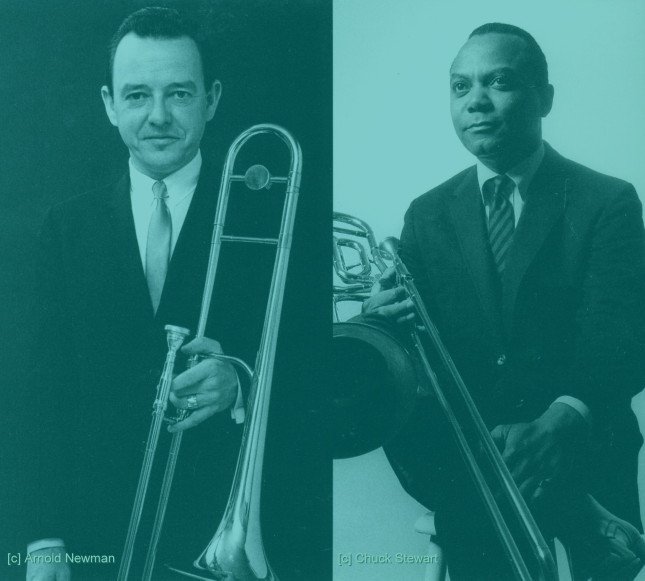
JJ Johnson and Kai Winding-"The Continental"

JJ Johnson & Kai Winding- "Blue Monk"

J.J. JOHNSON AND KAI WINDING QUINTET: The Early Years by Gordon Jack

 © Copyright ® Steven Cerra, copyright protected; all rights reserved.


Gordon Jack is a frequent contributor to the Jazz Journal and a very generous friend in allowing JazzProfiles to re-publish his insightful and discerning writings on various topics about Jazz and its makers.


Gordon is the author of Fifties Jazz Talk An Oral Retrospective and he also developed the Gerry Mulligan discography in Raymond Horricks’ book Gerry Mulligan’s Ark.


The following article was published in the December 15 & 20, 2020 edition of Jazz Journal. 


For more information and subscriptions please visit www.jazzjournal.co.uk


© -Gordon Jack/JazzJournal, copyright protected; all rights reserved; used with the author’s permission.


“With the advent of bebop the trombone might have suffered the same relative decline as the clarinet but for two virtuosos - J.J. Johnson and Kai Winding. Their early recordings showed how well they overcame the difficulties of adapting the unwieldy trombone with its seven slide positions to the demands of the new music. 


J.J. Johnson was born in Indianapolis on 22 January 1924 and took up the trombone at the age of 14. Fred Beckett was an important early influence with his 1940 solos on Harlan Leonard’s My Gal Sal, Skee and A La Bridges (Classics 670 CD)  – “He was the first trombonist I ever heard play in a manner other than the usual sliding, slurring, lip trilling or ‘gut-bucket ’style. He made a lasting impression on me.”  He toured briefly with the Clarence Love and Isaac Russell bands before joining Benny Carter’s orchestra in 1942 until 1945. Talking about Carter J.J. said, “It was a continuous education in music”. His first recorded solo took place with the band in 1943 on Love For Sale (Definitive DRCSD 1129) and the following year he was invited to appear at the first JATP concert in Los Angeles before an excited audience of more than 2000. His extrovert contributions to Lester Leaps In, Body And Soul, Tea For Two and Blues with Illinois Jacquet, Jack McVea, Nat King Cole and Les Paul would probably fool many on a blindfold test (Properbox (E) 82CD). He left Carter for Count Basie and is heard on three 1946 solos with the band – The King, Stay Cool (both on Classics (F) 934CD) and Rambo (Neatwork RP2062CD). He wrote and arranged Rambo and Jon Hendricks added lyrics to it for Manhattan Transfer’s 1985 Vocalese album. 


In 1946  he received the New Star award from the critics of Esquire magazine and his swiftly articulated solo with the all-star band on Indiana Winter (based on How High The Moon) caused many to speculate wrongly that he was playing a valve-trombone (Definitive DRCD 11293). On one occasion his amazing facility prompted a Philadelphia club owner to post a sign outside advertising, “The Fastest Trombone Player Alive”. That was the year he settled in New York and started sitting-in at the clubs on 52nd. Street. For a time he had a quartet at the Spotlite with Bud Powell and later he worked there with Allen Eager. He also played at the Three Deuces in a sextet with Fats Navarro and Stan Getz. His first date as a leader took place in June 1946 with Cecil Payne, Bud Powell, Leonard Gaskin and Max Roach when Coppin’ The Bop, Jay Jay, Jay-Bird and Mad Bebop were recorded for Savoy (SVO 151CD).


In late 1947 after his hit with Robbins Nest Illinois Jacquet formed a new band with J.J., Leo Parker, Sir Charles Thompson, Fats Navarro and Joe Newman providing a high octane mix of jazz with rhythm’n’blues overtones which proved to be hugely popular.  John Lewis replaced Thompson for a while and he said, “We had to play Flying Home about three times a night (but) I’ve never seen so much money”. Johnson solos on Riffin’ With Jacquet, Destination Moon, For Truly, King Jacquet, Embryo and Mutton Leg (Mosaic MR6-165). When he wasn’t on the road with Jacquet he became the trombonist-of-choice on many bop recordings in the late forties with Charlie Parker, Tadd Dameron, Dizzy Gillespie, Howard McGhee, Babs Gonzales, Leo Parker and Coleman Hawkins.


He performed on eight of the twelve titles recorded by the Miles Davis nonet in 1949/50 and solos on Deception. Kai Winding was on the other four and was featured on Godchild (Capitol 7243 5 30117 2 7). There were two other trombonists involved in the project because Eddie Bert rehearsed with the group at Nola’s studios on several occasions and Mike Zwerin played on their live performances at the Royal Roost. Peter Pullman’s book (Wail - The Life Of Bud Powell) mentions that on one occasion Powell performed with the nonet at Birdland. The last number of the set was Move and Bud received a standing ovation. He was a little bemused by the audience reaction so Gerry Mulligan very gently led him off the bandstand with the applause still ringing in his ears. An early portent of  Johnson’s later highly successful collaboration with Kai Winding took place on a Chubby Jackson date in 1950 when they were featured together on Tiny Kahn’s Flying The Coop (Original Jazz Classics CD 711-2). He was briefly with Woody Herman at this time and Conte Candoli said, “He was really good on the lead book”.


In early 1951 he occasionally worked at Birdland in a small Dizzy Gillespie group with Milt Jackson and Budd Johnson or John Coltrane and in April that year he was on the 78 rpm disc that introduced Dizzy’s The Champ (Savoy SV-0170CD). Between May and August 1952 he was part of a Symphony Sid package that included Miles Davis, Jackie McLean, Zoot Sims, Milt Jackson, Max Roach, Percy Heath and John Lewis that toured New Haven, Montreal, Toronto, Chicago, Detroit, Pittsburgh and Atlantic City before concluding at Harlem’s Apollo Theatre. They did not record unfortunately but there is a fine series of photographs in Ken Vail’s book Miles’ Diary from the Apollo booking. Ira Gitler in his Jazz Masters of the 40s says, “When this group broke up, the trombonist became discouraged with the music business”. He briefly withdrew from the jazz scene because of the lack of regular work. He also had the problem of having to renew his cabaret card every six months because of an earlier misdemeanour in 1946. His permanent cabaret card was not reinstated until 1959.


He began working in the defence industry as a blueprint inspector out at Long Island but he kept practicing and making occasional recording dates. One of which took place in 1953 in Brooklyn at a Charles Mingus Jazz Workshop session with three other trombonists – Bennie Green, Willie Dennis and Kai Winding (Properbox  (E) 77CD). In April 1954 he was one of the Miles Davis All Stars along with Lucky Thompson and Horace Silver who created the classic Walkin’ and Blue’n’ Boogie for Prestige (PRCD 7076-2). It’s worth pointing out again that Walkin’ started out as Gravy on a Gene Ammons 1950 date. It was written by Jimmy Mundy until it was appropriated by the infamous Richard Carpenter who got a composer credit on the Davis date.


His temporary retirement ended four months later when Ozzie Cadena wanted to team him with Eddie Bert in a two-trombone album for Savoy. Eddie was unavailable as he was contracted to Discovery. Bennie Green would have been selected but he was busy thanks to his 1953 Blow Your Horn hit which had become something of a juke-box favourite. Producer Teddy Reig suggested Kai Winding which led to a happy two year partnership that was successful both commercially and musically and was marketed under the title Jay and Kai.   


Kai Winding was born in Aarhus, Denmark on 18 May 1922 and emigrated with his family to the U.S.A in 1934. He was largely self-taught and began his professional career with the Sonny Dunham and Alvino Rey bands before spending three years with the US Coast Guard from 1942. His debut as a leader took place in December 1945 with Shorty Rogers, Stan Getz and Shelly Manne when they recorded four titles for Savoy under the title Kai’s Cats (Masters Of Jazz MJCD117). One of the tracks – Loaded – was by an obscure Washington D.C. pianist called Bernie Miller (1919-1945). A year earlier Boyd Raeburn’s orchestra had recorded another of his originals – Bobby Socks - which became better known as Bernie’s Tune


In February 1946 he joined Stan Kenton’s orchestra who had been selected as the Band of the Year by Look magazine and were breaking records everywhere they played. His first solos four months later were on Rika Jika Jack (a forgettable June Christy feature) and Artistry In Boogie (Mosaic MQ10-163). Even though he was only with Kenton for about a year his influence was immense. He created a distinctive section sound by persuading his colleagues to produce a lip instead of a slide vibrato. Milt Bernhart said, “Kai Winding was the lead trombone and without question the most important player in the band at that time”. Kenton agreed - “Kai changed the whole God-damn conception of the band and my whole way of thinking”.  He brings something special to his features with the band on Capitol Punishment, Artistry In Bolero, Yesterdays, Ecuador, I’d Be Lost Without You, Collaboration and Machito (Mosaic MQ10-163). When they were appearing at the Paramount in NYC he heard J.J. Johnson for the first time at the Famous Door with Charlie Parker. He told Milt Bernhart that J.J. left him “Speechless”.


Leaving Kenton he worked with Charlie Ventura for a while in 1947 and they were recorded at the Hotel Sherman, Chicago with singer Buddy Stewart. The popular East Of Suez was introduced on the booking and Winding thrives in what was a forerunner to Ventura’s Bop For The People ensemble (Properbox 41CD). In the late forties he had a group that included Brew Moore, Gerry Mulligan and George Wallington that often worked at the Royal Roost and Bop City. They recorded 14 titles on obscure labels which are difficult to obtain now but would make a very welcome reissue from Fresh Sound perhaps. In the early fifties he combined radio and television studio work with occasional bookings at Birdland with Red Rodney, Zoot Sims, Brew Moore and Bill Harris. He was also briefly with Woody Herman in 1953 and he can be heard on the memorable Four Others by Jimmy Giuffre, a feature for the trombone section which included Urbie Green, Frank Rehak and Vern Friley (Discovery DSCD 944).


Joining J.J.Johnson in 1954 was a chance to escape the routine of studio work and return to full-time jazz. Together they created stimulating small-group performances with tightly arranged ensembles usually voiced in unison or thirds. A variety of mutes sometimes came into play for extra colour on It’s Alright With Me, I Concentrate On You, Just For A Thrill and especially The Whiffenpoof Song. Producer George Avakian was particularly impressed with their studio performance on Whiffenpoof, “It’s a wild sight to see them each keeping pace with the lightning routine of mute up, mute in, blow, mute out, mute down, new mute up, mute in, blow and so on. Never once did they fluff a phrase” (Lonehill Jazz LHJ 10179). After two years together they felt that all the possibilities of a two trombone line-up had been exhausted so they decided to call it a day in 1956 but not before one of their last albums where six other trombones were added to the mix with particularly notable performances on Night In Tunisia, The Surrey With The Fringe On Top and The Peanut Vendor. (Columbia COLCD 480990).


Years later J.J. had this to say, “I have a very fond recall of the Jay and Kai cycle. Kai was a super jazz trombonist who always performed with wit, killer chops, quasi reckless abandon yet with intelligent sophistication. He was a complete musician and total artist plus a fun, fun dude to be with or to work with”.


1956 of course was the year Leonard Feather invited 100 leading musicians from Louis Armstrong to Lester Young to nominate their favourite instrumentalists. J.J.Johnson came top in the trombone section followed by Bill Harris, Jack Teagarden, Bob Brookmeyer, Tommy Dorsey, Lawrence Brown, Jack Jenney, Vic Dickenson, Kai Winding, Trummy Young, Jimmy Harrison, Frank Rosolino and Earl Swope.”


Tuesday, January 5, 2021

Capitol Records – A Towering Success


© -  Steven A. Cerra, copyright protected; all rights reserved.


Sometimes it’s fun to look back and see how much things can change in a person’s lifetime.

Until the advent of digital sound files in the later part of the 20th century, recorded music was still analog-based.

The music was preserved on tape and then transferred to vinyl by record companies who owned the rights to the music.

Cover art or photography was commissioned, someone wrote the notes and compiled the track information for the back cover and off went the newly minted 33 1/3 rpm long-playing records to a wholesale distributor who then made them available to retail outlets.

There are still recording companies today, some very large and others of the boutique variety which are usually devoted to a specific style of music. Much of today’s music is self-produced.

Almost all of today’s music is recorded digitally and distributed primarily through compact disc or some form of downloadable file-sharing system or streaming app.

I doubt that the following story that John Tynan, the then West Coast Editor of Downbeat magazine, recounts of the first 15-years or so of Capitol Records’ existence could be written today.

And that’s what makes it so much fun to read.

What a difference a half-century + makes!

© -  John Tynan/Downbeat magazine, copyright protected; all rights reserved.

"WHEN A RECORD COMPANY erects a $2,000,000 temple to its own greatness, it's time to probe the where­fore.

About the time of the outbreak of World War II in Europe, a quiet young Iowan named Glenn Wallichs was oper­ating a small recording studio at 5205 Hollywood Boulevard. With the country just pulling out of the depression, things were beginning to improve a bit business-wise, but it was still a scuffle for many small enterprises such as Wallichs'.

Sharing the premises with the record­ing studio, even to using the same tele­phone, was a radio announcer who owned a record store he called "The Stomp Shop." His name was Al Jarvis. Also operating from the same location — and using that same serviceable phone — were Charles Emge and Ward Humphrey the publishers of a lively weekly magazine, Tempo, which chron­icled the music activities of the west coast throughout the '30s. From this rather unseemly beginning grew Cap­itol Records.


WITH THE TURN of the decade Wallichs decided to open a record store. To this end he entered into partnership with his father, Oscar, who at the time owned an appliance shop in Hollywood. Together they launched Music City.

Music City quickly became hangout for assorted songwriters, pluggers, working musicians. Anyone connected in any way with the music business in Hollywood inevitably headquartered there on a cracker barrel basis.

One such songwriter, Johnny Mercer, who made Music City his base of social and professional operations, had by 1941 formed a fast friendship with Wallichs. The epoch-making negotia­tions between Mercer and Wallichs that led to Capitol's founding reportedly went something like this:

Wallichs: "Johnny, how would you like to start a record company?"

Mercer: "I wouldn't. But I know someone who would."

Wallichs: "Who is he? Can you get hold of him?"

Mercer: "Name's Buddy DeSylva. He's head of production at Para­mount."

Wallichs: "Let's get together with him and talk this thing over."

B. G. (Buddy) DeSylva did indeed want to start a record company. The three pooled resources, with DeSylva putting up $25,000 to kick the venture off. Wallichs contributed his technical and organizational know-how, and Mercer's offering was equally priceless  — his genius for writing good songs.


SO IT WAS DONE. In July of 1942 Capitol Records elected as its first offi­cers, B. G. DeSylva, president; Johnny Mercer, vice president; Glenn Wallichs, general manager.

What followed belongs a little in the realm of fantasy. Capitol first releases consisted of six sides, among them Cow Cow Boogie with music by Benny Carter and lyrics by Don Raye and Gene DePaul. Ella Mae Morse did the rocking vocal with the Freddy Slack orchestra. For anyone who has been conscious of popular American music over the last 15 years, nothing more need be said about Cow Cow Boogie. Along with Mercer's Strip Polka, it virtually put Capitol Records in busi­ness.

With that extraordinary acumen that enabled him to see the potential in a west coast record company interested in producing well recorded, good pop material, Wallichs immediately inno­vated another policy that was to revolu­tionize the marketing strategy of phon­ograph records. He announced the plan of providing disc jockeys throughout the country with complimentary copies of all Capitol records. The idea proved so successful that soon the other big companies followed suit.

THE YOUNG FIRM grew phenome­nally. Soon the demand for Capitol's product was so great that an agree­ment was reached for the Scranton Record Co. to supply limited amount of vital shellac in addition to that which already was contracted for in Holly­wood.


In the first six months of Capitol's existence, hits like Ella Mae Morse's Mr. Five By Five, Elk's Parade by Bobby Sherwood, and Johnny Mercer's I Lost My Sugar in Salt Lake City further consolidated the company's economic position. Branch offices were opened in Chicago and New York, and the following year two more were started in Atlanta and Dallas.

The second year of Capitol's life was marked, among other things, by the in­troduction of another new factor in the record business, the News Maga­zine. In addition, the careers of Jo Stafford, Nat Cole, Peggy Lee, Stan Kenton, and songwriter Dick Whiting's young daughter, Margaret, were spawned on the label in 1943.

No big-time record company is with­out its quota of album releases, and Capitol had big-time aspirations by 1944. A package titled Songs by John­ny Mercer was released to meet with immediate success, shortly followed by a second album aimed at the growing kiddy market, Stories for Children By the Great Gildersleeve.

WAR'S END saw an increasing ex­pansion by the label. In 1945, 14 albums were released and marketed to be joined by 19 more in 1946, one of which proved to be the biggest selling item in the children's field, Bozo at the Circus. The same year also witnessed the inau­guration of the Capitol Transcriptions firm and the outright purchase of Scranton Record Co. for $2,000,000. Capitol went on the market as a result, issuing its first stock April 30, 1946, offering 95,000 shares of common stock.

When the American Federation of Musicians imposed a ban on all re­cording by its members in 1947, Capi­tol plunged into a furious whirl of re­cording activity before the pre-announced deadline, thereby obtaining a huge backlog of sides. Among these discs, which turned into smash sellers, were Manana by Peggy Lee, Nature Boy by Nat Cole, and Pee Wee Hunt's Twelfth Street Rag.

One of the more remarkable facts about this remarkable business enter­prise is that the most profitable year in Capitol's history was 1948, a gloomy year indeed for the entire rest of the industry. Capitol's sales spiraled to $16,862,450, with a profit of $1,315,847, and this bumper year saw them extend their market to foreign countries.

THE FIRST FIVE years of the 1950s were a continuation of the success story, climax of which was reached last year with the purchase of 96.4% of Capitol Records, Inc., by the British firm of Electric and Musical Industries, Ltd., for $8,500,000, with Glenn E. Wallichs retained as president of the company.


In 13 years Capitol has risen from a less than audacious dream given ut­terance in a record store to Big BIG Business in the commercial music world. With its new international head­quarters completed and occupied this month, the Capitol Tower stands above Hollywood and Vine as a monument to the three men who begot the enterprise out of their creative talents, drive, initiative, and imagination — the late Buddy DeSylva, Glenn Wallichs, and tunesmith Johnny Mercer.”

Capitol Bandwagon Is Booming

“Should big bands ever rise to the peak of popularity they once knew, no one could be happier about it than Capitol Records. For they have assembled the most imposing list of top name orchestral talent to be found on any label.

And even if the music world never again experiences the phenomenon of bands leading the record-selling parade, Capitol is evidently quite satisfied with the results its stable is achieving even now.


Look at some of the crews now doing their waxing for Cap:

Les Brown, Harry James, Ray Anthony, Billy May-Sam Donahue, Stan Kenton, Woody Herman, and Ken Hanna.

In addition, they have the big-selling Benny Goodman BG in Hi-Fi album still going for them, and though Duke Ellington recently left the company, there are discs of his still in the catalog as well as some yet-unreleased sides in the bank.

Plus which Guy Lombardo is now in the Capitol ranks — a man who sells steadily and well.” [!]

Monday, January 4, 2021

The Twig

Although Paul Desmond is shown on the cover slide, this video features Bill Smith on clarinet along with Dave Brubeck on piano, Eugene Wright on bass and Joe Morello on drums performing this selection from "The Riddle."

Smith, Brubeck, Wright and Morello - Not A Law Firm - Part 1

 © Copyright ® Steven Cerra, copyright protected; all rights reserved.


I’m often asked what the source is for my blog postings or, how do I decide what to post about?


I never know how to answer that question mainly because the inspirations are so varied. They seem to come from so many sources.


As a case in point, the recent passing of bassist Eugene Wright [5.29.23 - 12.30.2020] brought to mind three recordings that he made between 1959 - 1961 featuring clarinetist Bill Smith with pianist Dave Brubeck and drummer Joe Morello.


Given the myriad recordings Gene was on with the “classic Dave Brubeck Quartet” with Joe and alto saxophonist Paul Desmond, you might ask why these three relatively obscure albums [one of which has never been issued on CD] came to mind?


And my answer would be, “I don’t know, they just did.”


So much for “the method” of  how I prepare features for the blog.


What I DO KNOW is that the music on all three of them is delightful, especially given the contrast of Bill’s magnificent clarinet playing to Paul Desmond’s equally magnificent alto sax playing and I commend all three of them if they are new to you.


As usual, Gene is his rock-solid, stay-at-home bassist “self” which makes it easy for Dave and Bill to wander all over the place seeking new and different ways to form Jazz expressions.


In tandem with Morello [talk about MAGNIFICENT], Gene and Joe made-up one of the most swinging Jazz rhythm sections that no one ever talks about.


The first of these, three recordings was issued on Columbia in 1959 as The Riddle [CL 1454] and it has sadly never been issued as a single CD by Sony.


Notes by DAVE BRUBECK 


"To me, "Hey, Ho, Nobody at Home" is more than the folk song this album uses as its basic theme, but the tune itself is evocative of friend Bill, poking his head into my living room, singing out, "Hey, anybody home!" And you know exactly who it is (who else greets you in such a way?) even though you haven’t seen him for two years since he left for Paris or Rome. He is a friend who stays close even after years of separation. 


In the summer of 1959 our paths crossed again in Lenox, Mass. This time it was I who did the "Hey Ho-ing," because I had heard that Bill was living in the woods somewhere near Tanglewood [Stockbridge and Lenox in the Berkshire hills in western Massachusetts]. One evening we were engulfed in a sudden summer deluge and I thought of the still unlocated Bill, camping somewhere out in the woods and how he might be in need of warm food, fire and friends.  I drove down to the lake campground someone had pointed out to me as a lakeshore site reserved for Tanglewood personnel. I drove the car down to the end of the dirt road and honked my horn, hollering, "Bill Smith" as loudly as I could; and suddenly, floundering out of the wet shrubbery emerged a laughing Bill, yelling, "It's me! It's me! I'm here. Don't go 'way!" 


One glance and I could see that this boy needed dry clothes and a hot meal, so we took him back with us to Music Inn, where my family and I had made our summer headquarters. That same night we began rehearsing this album.


I was intrigued with the idea Bill presented to me—a jazz LP which was basically variations on a single theme, but so skillfully devised that the listener is scarcely aware of the direct relationship. The idea of unity in an LP should intrigue jazzmen, and Bill has given us one solution to the problem by relating all the themes. This is the first riddle of the album: to discover the thematic relationship of each of the tunes. The second riddle is to detect which parts of the music are written, and which are improvised. Almost everyone who has heard this album (including Joe and Gene, our own rhythm section) has had difficulty separating the composed from the improvised sections. I take this as a real compliment, because good jazz composition sounds as though it were really improvised, and good improvisation should sound as though it was as well thought out as a composition. I think the integration of the composed and improvised

parts have been very successful. Although Bill and I do not work together regularly, and, in fact, had not played together for years, a musical rapport from previous years still existed.


I think we were able to understand and feel each other's style because we have known each other for 14 years now, and have worked together from widely divergent circumstances from "joint jobs" to studying with Milhaud, playing in the old Octet, and even teaching at U.C. extension. It was fun to be back together


Over the years I have watched Bill grow in all fields of achievement as a composer. He has developed into one of the finest "legit" clarinetists and was selected as a member of the Fromm Chamber Music Players for his ability to play modern classical works It was in this capacity that he was at Tanglewood. This same high quality of musicianship carries over into his jazz, which I find exciting, original and very personal. As a teacher, composer, arranger, classical instrumentalist and jazz performer he ranks with the best in each field and that is a broad area for any one man to cover adequately, let alone well.


Recording a session with Bill  Smith is not like going to a studio and playing the blues, or standards, or “originals” based on standards. Bill uses 9 bar phrases and odd chord progressions that keep you on your toes. They at first seem unnatural, because they are out of the usual pattern, but soon you begin to see how they fit into the overall design, and they open up new areas for improvisatory explorations. When I first saw chord sequences Bill expected us to improvise on my first reaction was to want to change everything to a sequence more natural to me. Then I recalled how some of my own tunes had been received by other Jazz musicians with the comment

 "Nobody can improvise on those changes.” And a few years later those same tunes like The Duke and In Your Own Sweet Way turned up in the Jazz repertoire of many groups who can now play them as naturally as any other tune. It just takes time to adjust to change. When Bill confronted me with the same problem, I had the same reaction. And that's exactly what it is — REACTION. If jazz is to progress some of us must venture away from the soft cushion.”


Part 2 on Brubeck a la Mode [Fantasy F-3301; OJCCD 200-2] issued in 1960 and Part 3 on Near-Myth/Brubeck-Smith [Fantasy F-8063; OJCCD 236-2] issued in 1961 to follow.