© Copyright ® Steven Cerra, copyright protected; all rights reserved.
Musician Magazine was in circulation from about 1976 to 1999 and, given the time frame, it published fewer features on Jazz relative to the musical interests of the general public. It’s a shame, because the quality of the articles and interviews they did issue about Jazz were first rate.
We’ve previously published interviews from the magazine by Jerome Reece on Chet Baker, Pete Watrous on John Coltrane and Tony Scherman on Tony Williams.
And now we turn to Chip Stern’s piece on Sonny Rollins which focuses on Newk’s [Sonny’s nickname] music in the 1980s.
As Mark Rowland, who edited 15 years of Jazz interviews for the magazine along with Tony stated:
"Writing about music is like dancing about architecture." I forget who said that first, but it was probably a musician, serving all would-be Boswells a generous slice of humble pie. Anyway, it hardly matters, because anyone who writes about music regularly has moments' — or years — when he or she feels the same way. Music may be the universal language, as another saying goes, but it gets pretty darn cantankerous when we try to translate its appeal into the one we use for everyday communication. More than a few stylists, straining for descriptions to take flight with the same grace and profundity as a John Coltrane solo or a Miles Davis blues, have instead found themselves sinking into a familiar quicksand of useless adjectives and spent metaphor.
What's a writer to do?
Well, write about the musicians, for one thing. For while the wonders of music, or the wondrous things music does for us, are often too mercurial to be properly bottled in prose, the vessels of such glory are real people—a breed of characters who are a lot like you and me and at the same lime mysteriously apart, special. (Heck, we named our magazine after them.) Figuring out what makes them lick is a task that has challenged the besl and the brightest writers working in the field of popular music today. Over the years we've been proud to publish some of the results.”
“YOU DON'T KNOW WHAT LOVE IS
The Manhattan workshop of Sonny Rollins — a tiny studio on the top floor of a Tribeca high-rise — seems to domicile an extremely studious NYU junior. To the left of his bed, a neat pyramid of books on Shintoism, Buddhism, Hinduism, Islam, Judaism, and Christianity is crowned by a portrait of an African drummer dancing against a brooding russet sky (the painter: The Prophet), Across the room to the right, shelves spill over with manuscripts, cassettes and one of those silly back-window-of-a-car bobbins-head dolls that hypnotize you in traffic snarls—only this one is of a beaming Satchmo. An Indian tamboura and a disheveled African gut-string instrument peer shyly from their respective corners; a punch-drunk piano creaks under the weight of manuscript paper; through an adjacent picture window, Manhattan's northern boulevards veer off frostily in eerie diagonal lines of night and light. Stretched out on the bed in jogging sweats and a floppy wool cap, Sonny Rollins's gentle eyes dominate the powerful axis point of his patrician nose.
"A lot of guys say, 'I don't care about the people; I just play.' But I never met a musician who didn't want to reach people."
"I think my whole life has been a work in progress," Rollins is reflecting. "I've had a beautiful life, and I've played with some of the most fantastic musicians. And I was accepted by all the older guys as well as the beboppers. I remember playing at the Village Vanguard, and Roy Eldridge and Papa Jo Jones came to see me; and Jo was hollering, 'Yeah, Sonny! Sonny Rollins, all right...' and that made me feel so proud, you know, like they were giving me the nod. I always had the rhythm thing, the placement of notes, I was always gifted with the ability to swing.
"The part of "Sonny Rollins that is unfinished," he goes on, "is that... Well, I consider myself lucky that I've survived this far. A lot of cats withered away from all the pressures and pitfalls, but I changed my life around. It wasn't just about music when I got away from that scene for the first time [in 1959|. I quit to do a total reconstruction on every level of my life. I married Lucille; I began getting seriously inlo physical culture and weight lifting, which led me directly into the practice of yoga; I began reading a lot on metaphysics and philosophy. I turned around.
"Now when I look at myself there's more that I want to do, but I can see where somebody could isolate a period in the Fifties and say, 'Well, he had it together and it was a whole story.’ I mean, I liked all of the good stuff. Like that trio album [Live at the Village Vanguard, Blue Note] with Wilbur Ware and Elvin (Jones); I thought we had a nice free-swinging thing going. I liked Way Out West [Contemporary] — it was a nice idea and had some nice feeling on it. I dug Freedom Suite [Riverside], of course, because I had Max [Roach] and Oscar [Pettiford] on it, especially the concept of doing a whole piece of music as a suite — and the message of the music. I can appreciate all of that, but it's not relevant to the fact that I still think my stuff is unfinished—as a whole."
Therein lies the dilemma of being Sonny Rollins: No artist is more beloved by his audience, but then none inspires greater expectations than the saxophone colossus. At times Rollins must feel nearly cannibalized by this devotion. What's next? What's new? What have you done for me lately? Here is a musician, just shy of his nineteenth birthday, bouncing along with Fats Navarro and Bud Powell on that pianist's seminal 1949 Blue Note session. Accepted and encouraged by the tribal elders of improvisation, Rollins (Newk to his friends, owing to his striking resemblance to then-Brooklyn Dodgers pitching ace Don Newcombe) went on to become the icon of Fifties hard-bop tenor, much as his soulmate John Coltrane dominated the frenetic Sixties.
Rolling's collaborations with Powell, Navarro, Benny Green, Thelonious Monk, Miles Davis, the Modern Jazz Quartet, J. J. Johnson, Clifford Brown, and Max Roach, as well as his own trendsetting work as a leader, froze the embryonic image of the young improviser for three generations.
For so prodigious a talent, the recordings from that era are at once a blessing and a curse. For younger fans, great Rollins performances like "Oleo," "Pent-up House," "Pannonica," "Strode Road," "Old Devil Moon," "The Freedom Suite," and "Blessing in Disguise" have a life all their own. But for creative artists, recordings are also frozen time. Such moments shadow them wherever they try to grow, reminding listeners who were on that scene at that time, how much better things were. And nostalgia sets in.
Even if Sonny Rolling's Fifties recordings were only a ghost of what he was doing down live, I can sympathize with my elders. For beyond his extraordinary musicality — his mythic thematic intuition — there remains something surreal about that tone and groove; the bottomless brawn of the Rollins tenor, as notes blossom transparently in cubist shards and bulbous balloons of sound, the impudent grace of his swing, lines lazily coiling and uncoiling; improbable quotes and asides from his stream-of-consciousness; the deft way he builds anticipation with rhythmic and melodic motifs, then suddenly exceeds all expectations in a harmonic spillover of emotions and ideas that render his drummer, the song — even his tenor— totally irrelevant. Yeah—play it again, Sonny.
Still, unless you went off to Gettysburg with Eisenhower in 1961, it's worth noting that there have been some changes in music over the last thirty years, and in the way listeners perceive that music. Nowadays, kids of my daughter's generation don't really hear Tin Pan Alley melodies floating languidly above a set of moving changes in the treble clef — they hear melody coming out of the bass. The way songs are portrayed today is from the bottom up, out of the backbeat and the rhythms — all those rhythms. "Jazz" goes in one ear and out the other.
"Doesn't that bother you?" Sonny inquires earnestly. "Wouldn't that lack of communication be troubling? It concerns me — how do you connect with people when jazz as we understand it is not really in their environment? I mean, bebop never went away. It's still a foundation of musical knowledge.
"But," Sonny continued, "variety is an essential part of my presentation as well. I usually try and play a lot of styles. I hadn't wanted to play fifties bebop in a long, long time - maybe since the Fifties. You know, when more rhythms came to the forefront and drummers began to play with more cross-rhythms; when different percussion instruments began to augment the rhythm section, and different sorts of grooves began to develop, that was very interesting to me. I've always loved rhythms as opposed to a band with piano, upright bass and a drummer going ching-chinka-chink/chinka chink — I just hear too many rhythms to be satisfied with that. I haven't maybe gotten my thing completely together yet, but I don't ever want the music to come across as one-dimensional."
This is a sore point with Sonny's older fans, for whom the past sixteen years have been a long, unsatisfying flirtation with the static rhythms of rock ‘n’ roll, redeemed only by the intermittent transmogrifications of the "real" Sonny Rollins in concert situations or live recordings like Don't Stop the Carnival (on Milestone). Without attempting to justify the moments of triviality that sometimes belabor his studio efforts, or explain his genial deference to sidemen who don't deserve to lick his ligature, I think it's superficial as hell to simply dismiss all of his studio work outright (dig Horn Culture, Nucleus, Easy Living, and Don't Ask)— because that misses the point. Which is that Sonny Rollins has always had an abiding affection for pop music in all forms.
During the sacred Fifties, Newk developed a reputation for transforming the most out-of-left-field pop songs and show tunes into joyous parodies or compelling personal statements, from "Toot, Toot, Tootsie" and "Rock-a-Bye Your Baby With a Dixie Melody" from the lexicon of Al Jolson, to the hard swing and boyish affection with which he showers "Wagon Wheels" and "I'm an Old Cowhand" from Way Out West. Or listen how, on 1960's East Broadway Rundown, his Latin airs and operatic bluesiness turn "We Kiss in the Shadows" (from The King and I) into the most sublime of jazz performances.
There you have the pop music of days long gone. So why should it be so surprising that Sonny Rollins is interested in the pop, dance, and R&B forms of today? His first great influence was Louis Jordan, a connecting link between the urban and rural blues traditions that evolved into swing, R&B, and rock 'n' roll; in conversation Rollins speaks admiringly about artists as diverse as Hank Williams, Robert Johnson, Frank Sinatra, (Nat "King" Cole, Stevie Wonder, and James Brown. ("I always dug James Brown a lot.... I know that James Brown told a cat that he wanted to play with me one time.") Beneath him, you say? Hell, this is an artist who treats "Pop Goes the Weasel" to thematic variations worthy of Mozart at the opening of The Solo Concert.
True, what's been a work in progress for Sonny has been a prolonged slump to others. But this time, instead of going to the bridge or the ashram, Rollins went home to an upstate farm — sort of an elongated working sabbatical — where he alternately emerges and recedes with new ideas and refinements, pausing to reflect and recharge. Those forays and experiments in Sonny Rollins's music — good, bad and indifferent — are symbolic of a life's search, a process that must be viewed holislically.
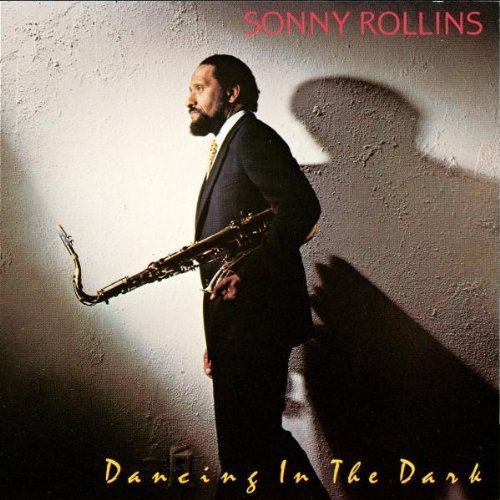
Understand, that where some life cycles simply cease, others grind and grow powerful slowly. The fact is, Rollins has been on a roll since his Rolling Stones guest shot on Tattoo You and his own production of Sunny Days, Starry-Nights in 1984. Nor is the gusher of live, straight-no-chaser Sonny that fanatics found so exhilarating on The Solo Album and G-Man at all mitigated on his latest studio album, Dancing in the Dark, where Sonny and his band (trombonist Clifton Anderson, bass guitarist Jerome Harris, keyboardist Mark Soskin and drummer Marvin "Smitty" Smith) achieved the sort of collective chemistry, pacing and power we've come to expect from Newk in his best live shows. He's captured the loose spirit of a jazz band in the studio more effectively than at any point in the last sixteen years. Including that most beloved of his aspects— Sonny Rollins; The Spontaneous Orchestra.
Dancing's title tune is the tour de force of a balanced, engaging session. Newk's unaccompanied opening cadenza sets up a spider's web of complexity. He basks in the glow of Anderson's trombone, before ripping off an astonishing series of variations, trampling bar lines and chord changes in his wake without negating his gruff, operatic lyricism. More to the point, Sonny Rollins sounds as if he's having a good time — he's not holding anything back, and that is unprecedented in his studio efforts since Next Album. Like so much of his work from the past sixteen years, he doesn't achieve his effect simply through harmonic means, but through colorful manipulations of timbre and pitch. It's as if Sonny has been chipping away at the edge of his dark round sound over the years, revealing layers of color and a percussive edge. It is a very, well, grandfatherly kind of sound, that puts this writer in mind of the grandfather of the tenor, Mr. Coleman Hawkins. Additionally, "O.T.Y.O.G" chases the train at a brisk gallop, and "Allison" frames the lyrical side of Rollins's writing and improvising in a charming medium-up stroll that suggests Tadd Dameron to some well-traveled ears. So maybe entrenched jazzbos and critic types will finally find something to like in Dancing in the Dark.
"Well," Sonny says, "I try not to worry about the critics anymore. They can dislike you or like you depending on what the consensus is. I guess they get together and form an opinion. Is that what you guys do?" he asks mischievously.
"It's a no-win situation," I reply. "Because you command the greatest love, you create the greatest expectations. We're always wondering how come the Sonny Rollins we love and the Sonny Rollins you love are invariably so disparate. Like, I dig a lot of what you've done on records recently, but number one on my wish list... do you know what that is?"
"What."
"Trio," I say prayerfully.
"Oh, really," he replies quizzically. "Well, that's nice, but you know that I think that is very avant-garde. Maybe people would accept that — I don't know."
"Well," I press on insistently, "is it a question of people accepting it or you accepting it?"
"As far as my accepting it, it takes very good players — very strong bassists and drummers. Anytime I had a combination where I could have done that, I already had a band — there were other guys involved, but I'm certainly not averse to the idea of playing with a trio again; in other words, that's a hint, right?" He smiles, then goes on to consider maybe doing it as part of a set, when the phone rings and he's saved by the bell.
"Anyway," I go on as he hangs up the phone, "no writers could possibly be harder critics on Sonny Rollins than Sonny Rollins."
"That's true," he agrees, "I'm a very tough critic of myself."
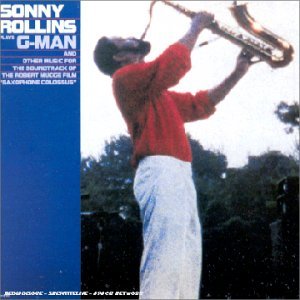
"When G-Man came out I was beside myself. Wow, they finally captured Sonny going berserk in a live situation. The way yon twisted the harmony inside out, those incredible long-held tones, the multiphonics, that one high note at the beginning that sounds like an enraged Electro-lux, just the unbelievable intensity of it. I thought, 'Gee, this is historic, this is a breakthrough, I want to go out in the street and yell hooray and walk through ground glass and hot coals in my bare feet.' Then when I came down I figured, 'Well, Sonny probably hates it,' right?"
Newk explodes in loud laughter. "Well, okay, that is true," he admits. "I'm glad people liked it, but I didn't do what I wanted to do; plus I got a horn that I'd just gotten fixed, which meant that it was different than usual — it takes a while to break a horn in. So I was very frustrated that it was not what I wanted to do at all."
"My horn-player friends are always fidgeting to get the reeds and ligature and action together — horns are funny."
Newk chuckles. "Ha ha ha. Yeah, horns are funny— that's a good title for a tune," he says, then becomes distant. "No, you never get that stuff right. Making art is something that you never..." and his voice fades into an ellipse of thought, still trying to get it right — better, even better.
"You know," he continues, "I do care what people think about me; and I care what the so-called critics think, of course. It's a no-win situation because... how can you ever live up to everything a person might want you to be? There are things on some albums that I like, but I think there's a facet of me playing that hasn't been recorded yet. I definitely feel that way. So I'm not about to look back and say this was good and that was good. I'm still in the race actually, and there's still things I want to work on. So I just try and keep my own sights straight. But it certainly is a great feeling to know that you are loved and/or hated for your work."
"Oh, God, nobody hates you, Newk," I insist. "Why do you suppose that all of us were hollering for you to do a solo album all these years? Because we wanted to kill your bands; gel rid of these chumps so that we can listen to Sonny."
"Right," he laughs, "instead of shoot the piano player, shoot the whole band. I am wont to play a lot of solos and take long cadenzas and so forth. Actually, I'm trying to express myself completely; present the Sonny Rollins everybody is expecting to hear, you know. The bands are there because it's a convention — you want to hear a band playing, have a good-sounding group. I might be able to play solo for the rest of my life, but that would be pretty energy-consuming — I don't know if I could handle that.
"I'm trying to reach a collective type of improvisational thing with the group—the basic spirit of jazz. I'm a jazz player and I want the band to sound like a real good jazz band. There was a period in my life when I used to fire piano players, so I have had periods when I couldn't get people to follow me, and I guess I was a little more volatile at that point. But everybody isn't the same. The very fact that I have a group of people accompanying me would tend to suggest that they are accompanists rather than leaders. But that's also an art, to follow people — and to follow me you have to have certain skills."
"Do you favor accompanists over collectivists?" I wonder.
"I've tried both," he replies. "I've tried a lot of different combinations during my life as a bandleader.... I don't know.... I'm not sure. I think as a bandleader you want to have people you can mold in a way that they gel out the music that I want to portray. So I'm not looking for guys who have to express themselves all the time. I think that playing with me, the guys who are quote-unquote "accompanists'' have a lot of room to express their emotions and feelings and get out their own music. Playing with me I think is very easy, because they have a lot of space to express themselves within the context of the compositions. I don't tell them how to solo or what to play. I don't like to tell anybody anything; they should sort of know. So when I say mold, I mean I want to mold a group to present my picture: the picture I have in my mind of the sound I'm trying to project.
"Let me tell you something. There's a lot of guys who say, 'I don't care about the people—I just play.' But I have never met a musician who didn't want to reach the people. You don't dance on stage unless you feel like dancing; you don't do things that are completely repugnant to yourself. Now you're playing for yourself first, of course, but then you want to reach somebody. Because, well, you may be great but how do you know if nobody likes you? Maybe I'm a little sensitive about people thinking I'm playing music to reach people — I'm playing to reach myself.
"We're just instrumental musicians, and if l could sing like Louis Armstrong I would probably try to — the human voice is the first instrument, and that's really the greatest instrument if you can use it. You see, when you get up on that stand, it is a show, whether you're consciously entertaining or not. The curtain rises, the lights are out. But instrumental musicians don't have many tools — all we can do is use music. To me there is no real connection with entertainment as it's known in singing groups and dancing groups. So yes, I do want to communicate with people, but no, I'm not an entertainer. I still want them to have a positive experience, but not at the expense of music. 1 want them to think, also, and I want them to feel more optimistic when they a leave a Sonny Rollins performance than when they came in — feel a little happier if that's possible in this fucked-up world,"
And they do, but then they're only listening to Sonny Rollins, and when Saint Newk has packed up his horn and headed north again, the challenge remains — to be Sonny Rollins. To try and clear the vessel, to fine-tune it, to test it so that he can be a channel for his own emotions and longings and fantasies; more importantly, so that he can truly be the new man, be a channel for things older and stronger and more eternal than Sonny Rollins; so that all of this can come through him — in a pure gush of love and freedom sweet, oh so sweet.”
To be continued in Part 2.


